Unknown's avatar

Who Has Seen the Lord?

“Who Has Seen the Lord?”

John 20:1-18 (20:18) – April 20, 2025

            Who doesn’t like to hear a good story? Storytellers are wonderful to listen to. Small children love to hear stories. Even grown-ups enjoy stories. Certain stories are told over and over again, in different ways. Cinderella. King Arthur. The Arabian Nights. Aesop’s fables. Even the Wizard of Oz.  What about The Greatest Story Ever Told? That’s another name for the narrative of the Passion Week, following Jesus step by step from Palm Sunday through Good Friday, finishing up with the happily ever after ending on Easter morning! 

            We left Jesus on the cross, on Friday afternoon, when last we saw Jesus on Good Friday. Jesus had walked through the days of Holy Week, debating with the Pharisees and other Jewish leaders in the Temple. He had eaten a Passover dinner with His disciples on Thursday evening. The special thing Jesus did on Thursday was instituting the Lord’s Supper with the bread and cup of the Passover meal. Do this in remembrance of Me, He said.

            After dinner, Jesus went to the Garden of Gethsemane to pray. He wanted His disciples to keep watch with Him, but they were too exhausted. After the events of a very busy week, just think. The disciples couldn’t keep their eyes open!

            Then the events follow in rapid succession. The arrest, torture, trials, and sentencing. The walk down the Via Dolorosa, the Way of Sorrow. Jesus dragging the cross outside the old city of Jerusalem. The disciples fled. (I won’t blame them—since their Rabbi was sentenced as a criminal and enemy of the state, I suspect the disciples were afraid they might be connected with their leader Jesus, too!) We see the women at the foot of the cross. The faithful women. And Jesus’ mother, Mary. Then—Jesus dies on the cross. The earth quakes, the sky darkened. All creation mourns as the Word made flesh, the creator of all the universe, dies on the cross.

            As we continued to follow the Greatest Story Ever Told, Jesus is taken down from the cross shortly before sunset. His body is turned over to one of the Pharisees, Joseph of Arimethea. Joseph hurriedly lays the dead body of Jesus in a tomb nearby. And, the faithful women are also there. What faith they must have had! What tenacity, and what love. The women disciples follow their leader, their rabbi, their Lord and master, even though He’s dead. To care for His body, in the absence of the disciples – the men disciples who are in hiding.

            The women are there. Not shunted aside, not put in second place. These faithful women disciples play an important role in caring for their Rabbi and their friend, hurriedly washing and preparing His dead body for the grave, before the Sabbath begins at sunset.

            As Friday night swiftly approaches, with it comes the Jewish holy observance. Especially this special Sabbath—which falls during Passover. No work is to be done at all on this holy day of rest, not even the compassionate work of caring for a dead body.

            After Sabbath day and Saturday night end, it is now Sunday morning. Faithful Mary Magdalene heads out for the tomb even before the sun has fully risen. Can you see her, eager in her haste to get to the tomb? With some oils to anoint the body? As she comes near the tomb, she discovers the stone has been rolled away. The tomb is now empty. What happened? Mary runs to get some assistance, someone to come with her and check things out more fully.

            Sure enough, Mary tells what she discovered. Two of the—men—disciples come back with her. Mary returns with the other two, back to the tomb. They see the tomb, and sure enough. It is empty. And then, these two men disciples turn right around. Go back to the rest. In hiding.

            But—what about Mary? What does she do? Again, I come back to the indisputable fact that the women disciples are faithful and true. What a roller coaster ride Mary has been on. Starting on Palm Sunday, their leader Jesus marches right into the lion’s den, right into Jerusalem itself. All through the Passion Week, Jesus appears in and around Jerusalem, in the Temple, doing anything but keeping a low profile. I am certain the men and the women accompanying them knew very well that the Jewish leaders were planning on doing bad things to Jesus.

The women disciples show compassion, love, and care for their Rabbi, their master and friend. Mary stays put near the tomb. Jesus had been her best friend and her teacher. After she met Jesus, her life was different – and lots better! But now, Jesus had been killed and buried. Not only that, it appeared that someone had stolen his body. [1]

            At this desperate point, early on Sunday morning, Mary weeps. She does not know where her Lord and Master’s body has gone! After many days and nights of worry, anxiety, strong emotion, and intense grief, I can well understand how Mary broke down in tears.

            What about us, today? Have you ever been through days of intense emotion, gut-wrenching anxiety, even intense grief? All of those feelings tumbling and roiling through you? Then you know a little of what Mary was going through.

            What Mary did not suspect at first was that she was in the Greatest Story Ever Told. She sees Someone through her tears. She suspects this Person is the gardener, of all things! She says, “Sir, if you have carried him away, tell me where you have put him, and I will get him.” 

            Then, Jesus—for it is He!—Jesus speaks to her. Jesus calls her by name. “Mary!”          Do you hear that? Jesus calls her by name. “Mary!” How sweet to have someone who loves you very much call you by name! Remember, I just said that Mary had been on an emotional roller coaster the whole week previous? Just think what this would do! Wow! Mary’s eyes are opened. Mary finally sees clearly, and responds, “Rabbi!” “Teacher!”

            There’s a word in the next verse that is sometimes misunderstood. In verse 17, Jesus tells Mary, “Do not hold on to me.” In the original language, Greek, the word ‘hold on’ or ‘touch’ is a present imperative verb. The verb in the sentence can be translated “Do not keep touching me!” Mary realizes that it was really and truly Jesus, in the flesh. I suspect she fell on her knees and grabbed onto His legs with every ounce of strength in her body. Clutching, crying, laughing. Can you just see her? Jesus, gently trying to get her to let go. “Mary, can you stop clutching at Me?”

            Can you see Mary now, as she understands in full. Jesus is alive! He is risen! She listens to Jesus, returns to the disciples, and declares the joyful truth to everyone!

            Mary is not only a faithful friend and follower of her Rabbi, she is also someone who carries the Good News! The news that Jesus is no longer dead, but He is risen! He is alive again. I want all of you to understand this all-important point. Jesus has entrusted Mary with the Gospel message. She is a preacher of the Good News!

Mary Magdalene is no longer just a supporting player, just a side note in the Gospel. Instead, she transitions to a lead actor in the Greatest Story Ever Told, here in John 20. And, one of the first and best preachers, sharing her experience, hope and joy.

            What a story! Except—this is not make-believe. This is for real. This is very much the truth. Yes, our risen Lord Jesus is alive. Yes, He is Lord. And, yes, He has conquered death once and for all. Do you hear? Listen again to the words of the disciple Mary. She told the disciples, “I have seen the Lord!”  

I pray we all can affirm together today: He is risen! Christ is risen, indeed!  

Alleluia! Amen!

@chaplaineliza

(Suggestion: visit me at my other blogs: matterofprayer: A Year of Everyday Prayers. #PursuePEACE – and  A Year of Being Kind . Thanks!


[1] https://worshipingwithchildren.blogspot.com/2016/02/year-c-easter-sunday-march-27-2016.html

Unknown's avatar

Let’s Go Deep!

“Let’s Go Deep!”

Luke 5:1-11 (5:4) – February 9, 2025

When did God become real to you? Were you sitting in Sunday school, when you felt deep within that God was real, and you felt wonder? Or, were you at a camp or retreat, around a campfire, when something let you know God was the real thing, and you felt nothing but awe? Or, perhaps, were you praying next to a loved one’s bed in the hospital, and you powerfully understood that God is real, and you felt deep comfort? Have you had a God-encounter?

            The situation here today is where God becomes real for these people. Edward just read the Gospel lesson from Luke 5 to us, and we heard about Jesus calling the first disciples. But, we need to back up in this reading, before the Rabbi Jesus calls anyone to be a disciple.  

            We break into the action quite early in the public ministry of Jesus. So early, in fact, that He has not even called anyone to follow Him, to be His disciples. We see Rabbi Jesus, alone, teaching, preaching, healing, and beginning His ministry. Luke starts off with the phrase “One day as Jesus was standing on the shore of the Lake of Gennesaret.” I think Doctor Luke meant this to say that this was a typical day in the life of Jesus. Teaching, preaching, doing miracles. All in a day’s activities, for the Rabbi Jesus.

            But, Jesus is not the only one mentioned in this Gospel reading today. We are introduced to Simon. (or Simon Peter, but that name comes later on.) Simon did not have a good night fishing. In those days, people fished at night.

“The fishermen would spend the night in the shallows, tossing their nets and pulling in the catch. Then as dawn broke, they would bring the fish to shore and sell them at the market. Because of a lack of facilities for preserving fish, this was a daily event. Except this day.” [1]

            Have you ever had a bad day (or night) at work, too? Or how about at school? Has everything gone off the rails? Did you get off on the wrong foot? Or, was your supervisor, or teacher, or co-worker just downright grumpy, and their negative attitude threw a monkey wrench into the whole day?

            I suspect our friend – and future disciple – Simon could relate. He caught nothing the whole night long, so he had nothing to sell at the local market, and nothing to take to his folks at home to eat. No one knows for certain how Simon was feeling, but I know that many people in a similar situation would feel demoralized, defeated, or just plain empty inside. All because the nets had been empty all night long! But this Gospel reading does not only feature Jesus and Simon, No, there is a crowd, too!

The crowds who have gathered to hear the Rabbi Jesus teach and preach—and watch the miracles!—I suspect are filled with wonder, curiosity, and questions. Who is this rabbi with such clarity in teaching the word of God? Who is this rabbi with such power and authority? Yes, we see the people crowding around Jesus so much that He got in a boat by the seashore, put out a little way, and then preached to the crowd.

(Did you know—little known fact—that Jesus was using the natural amplification of the water to make His voice heard better? When someone is out in the water a little distance from shore, their voice can be heard as naturally amplified because of the sound waves bouncing off or echoing off of the surface of the water and traveling on towards the shore.)

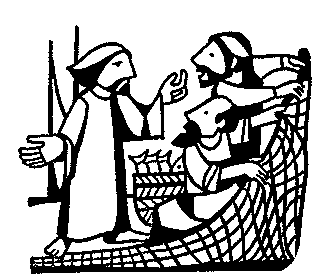
            Doctor Luke tells us what happened next. When Jesus was done preaching, He asked Simon to cast off, take the boat out again, and lower his nets. Now, fishermen would customarily dock the boats, then wash their nets away from the boats. They had already cleaned up after a night and early morning’s work and were ready to go home. [2]

And yes, this non-fisherman Rabbi Jesus asked Simon to start all over again. To go out into the deep water and go fishing – again! In the daytime! Against his better judgment, Simon agrees to traipse out to the deep water to go fishing, even though they have worked hard all night, because Jesus requested that he and his co-workers go out and try fishing again.

We know what happened. Hardly had the nets gone into the water, but the fish came swimming into the nets. The nets were filled to bursting! It was a miracle. Simon Peter and his co-workers experienced it—they were eye witnesses.  

“Just think. A little invitation from Jesus, a small inconvenience, and before you know it, Simon was in over his head. Did Jesus show up that day looking for followers? Or was that a bonus? The catch of the day?” [3] Was this all because Jesus asked them to go deep, and to set sail for deep waters?

What was the surprising response? Continuing from Luke 5: “When Simon Peter saw this, he fell at Jesus’ knees and said, “Go away from me, Lord; I am a sinful man!”For he and all his companions were astonished at the catch of fish they had taken, 10 and so were James and John, the sons of Zebedee, Simon’s partners.”

What happened? Simon Peter had a God-encounter, there in the boat. God became real to him. Simon Peter deeply experienced God as very real to his life, but couldn’t handle it. What is Jesus’s unexpected response? Jesus tells Simon Peter and his co-workers, “Don’t be afraid; from now on you will fish for people.” Jesus calls them into a God-encounter.

For Simon Peter and his co-workers, his friends, this was decision-time. They decided to drop their nets on the shore, leave their boats where they were, and follow Jesus. There were many, many people in the crowd who also had the opportunity to follow Jesus, but they did not. The crowd only stayed for the good preaching and the miracles, not the following-Jesus-part.

Has Jesus struck you to the heart and soul, like Peter? Has God become real to you, through this Scripture reading? I encourage you to follow Him today. Thank Him for forgiving your shortcomings and sins. Thank Jesus for inviting you to come with Him for the journey.

What can we do with this newfound, exciting relationship with God? Become a disciple. Go out and talk about how God became real in your life. Talk about God’s Good News, today. God will be wonderfully praised by all who tell how God has become very real to them, and changed their hearts and lives.

How has God become real to you? Go deep. Become a disciple. Go and tell.

@chaplaineliza

(Suggestion: visit me at my other blogs: matterofprayer: A Year of Everyday Prayers. #PursuePEACE – and  A Year of Being Kind . Thanks!


[1] https://www.umcdiscipleship.org/worship-planning/where-you-are-far-horizons/fifth-sunday-after-the-epiphany-year-c-lectionary-planning-notes/fifth-sunday-after-the-epiphany-year-c-preaching-notes

[2] http://www.word-sunday.com/Files/c/5-c/A-5-c.html

[3] https://www.umcdiscipleship.org/worship-planning/where-you-are-far-horizons/fifth-sunday-after-the-epiphany-year-c-lectionary-planning-notes/fifth-sunday-after-the-epiphany-year-c-preaching-notes

Unknown's avatar

God-Given Gifts!

“God-Given Gifts!”

1 Corinthians 12:12-27 (12:12) – January 26, 2025

At this time of the year, many people get all excited about sports. Hockey, basketball, and especially football. The end of the football season is upon us! There are many different types of positions on a football team. I was wondering: how good would a team be if all of the players were big and bulky, like offensive linemen? Or, how about if all the players wiry and nimble, like wide receivers? How successful would a team like that be? 

The Apostle Paul told the church in Corinth about another group, or team. Except, he called it a body—God’s Body. God put together all the different believers into a team, or body called the church. God’s team. When we consider our Bible reading for today, we can also see that God made different kinds of gifts. God’s plan is for human beings to live together in one body. That is, with one another, in a great big community, in all its colorful diversity.

What on earth is Paul talking about? A body? Why is he mentioning a metaphor like that? He was responding to a letter from the church in the city of Corinth. He had spent a number of months in the city, teaching and preaching. Then, he went on his way to spread the Good News of Jesus Christ to other cities. He was an itinerant preacher and missionary, after all.  I suspect Paul had a great number of people sending him letters, asking him questions, wanting his advice about continuing problems in the various churches he had founded. A number of big things were the matter with the church in Corinth. In his letter, Paul tried to correct several issues, including this important issue about spiritual gifts, and unity in the church.

What is the background of today’s reading? One chapter before, in chapter 11, Paul offers instruction on public worship. He deals with the believers in church acting inappropriately, and lets them know they ought to straighten up, and be unified – together! Then, in chapter 12, Paul continues the theme of unity – except he brings in the wonderful concept of spiritual gifts in the Church. Diversity of spiritual gifts, given to each member of the Church, of the Body of Christ.

That is not just a few members, or only some members of the Church. It is not even most members of the Church. God gives gifts to ALL members of the Church, of the Body of Christ. Each person in the Church, no matter who, no matter where they are from, is a beloved member of the Body of Christ. That is the Church Universal, and God gives gifts to all.

Not just the church on this side of Morton Grove, not just the church that holds their worship services in English, not just the church that has people who “look like us.” No, each individual person is beloved, and is given a share in the diverse gifts of the worldwide Body of Christ. Can you, can I possibly imagine the diversity in that worldwide body? And, can you, can I possibly begin to understand that God is so pleased when we all, worldwide, agree together and act and worship and live together in unity as a loving Body of Christ?

We all are probably familiar with a popular children’s toy. Put out by Hasbro, small children have played with it for decades. Made even more famous by an appearance in Toy Story movies from Pixar. Mr. Potato Head, accompanied by his partner, Mrs. Potato Head, of course. You remember how Mr. Potato Head works. A large potato. And, the separate parts of the body: eyes, ears, nose, mouth. Hands, feet.

Reminds me of the Apostle Paul’s metaphor of the Church, the body of Christ, doesn’t it? But what if our Potato Head had all eyes, and no hands? Or, all ears and no feet? What then? Lopsided? Wouldn’t work properly? Just imagine if our local church, St. Luke’s Church, was all lopsided like this? Wouldn’t work properly? Not only is the Church meant to have unity, and work well together, it is also made up of diverse or different parts, on purpose!

            Looking back at Genesis, we can see that diversity is definitely in God’s plan for humanity from the very beginning. The sheer creativity of God in creation is so big and so varied. A countless variety of individuals made in every size, shape, color, ethnicity. Having endless variations of gifts and abilities that God gave to each of us.

This is a recurring problem in Corinth – the people were convinced that some people and some gifts were better than others. They completely missed Paul’s repeated statements that God gives a multitude of diverse gifts and abilities to all of God’s beloved, diverse church members! Not that some church members were better, or more popular, or had a greater gift than everyone else. No! Paul states plainly that every person counts! Every gift counts, and every single person in each of their lovely, multi-colored, multicultural diversity is beloved of God. What is more, has received God’s spiritual gifts for free use in the multi-colored, multicultural Body of Christ!

Yes, tension and division and racism and enmity exist – all within the Body of Christ. I cannot even imagine how that breaks God’s heart, knowing that churches on one side of town are arguing with churches on the other side of town. Or, that some churches are ignoring the plain words of the prophet Micah to do justice, to love mercy, and to walk humbly with our God. Or, ignoring the plain words of Jesus to be merciful to the powerless and the least of these.

Yes, in today’s uncertain times, the Church has “tensions from within and without which are bringing doubt and confusion to the Body as we face the challenges of the near and distant future.” [1] Thank God we have a firm foundation on which we all stand. Thank God we have the words of Paul here in 1 Corinthians calling us to unity under God, rejoicing in our diversity with all the multi-colored, multicultural people of God, worldwide.

Yes, each of us is different from each other. And, yes, we are all one in Christ Jesus. We can celebrate that blessed both/and reality today! Just imagine what a marvelous job each Church could do, if each member used what God has freely given to each one, to the best of their ability! What an opportunity for ministry and outreach!

What possibilities lie before us as a church, as the Body of Christ in this place? May each of us prayerfully ask today what God would have us to do with the gifts and abilities God has given each of us.  Amen, alleluia!

@chaplaineliza

(Suggestion: visit me at my other blogs: matterofprayer: A Year of Everyday Prayers. #PursuePEACE – and  A Year of Being Kind . Thanks!

[1] https://www.churchofscotland.org.uk/worship/weekly-worship/monthly/2025-january/sunday-26-january-2025-third-sunday-after-epiphany-year-c

Unknown's avatar

Open Hearts to Joy!

“Open Hearts to Joy!”

Luke 2:8-20 (2:15) – December 15, 2024

So many houses and apartments are decorated for the season at this time of year. Colorful lights and holiday decorations indoors and out, shining Christmas trees, special dishes and fancy tablecloths. Plus, some families have a Nativity scene in a special place, whether under the Christmas tree or placed in an extra special location, even outside, all lit up at night.

As we consider our Scripture reading for this morning, we think about the familiar words from Luke chapter 2. We think of the very pregnant Mary and her husband Joseph, coming into the town of Bethlehem late one day, but they could not find any place to stay. So familiar it is today, but I suspect you all can think of the Nativity scene figures: a kneeling Mary, Joseph hovering over his wife, and the baby Jesus lying in a manger.

Where did this tradition of decorating with a Nativity scene come from? Yes, the Nativity scene is a familiar way of retelling this story of the birth of Jesus. But—how did Nativity scenes begin? It was in 1223. “According to St. Bonaventure’s biography, St. Francis of Assisi got permission from Pope Honorious III to set up a manger with hay and two live animals—an ox and an ass—in a cave in the Italian village of Greccio. He then invited the villagers to come gaze upon the scene while he preached about ‘the babe of Bethlehem.’ (Francis was supposedly so overcome by emotion that he couldn’t say ‘Jesus.’)” [1]

            That first Nativity was located in Italy, during the 1200’s. The practice of Nativity scenes, pictures and photos has certainly spread from there, all over the world. Do you remember acting in Christmas Nativity scenes, or perhaps Christmas pageants with a Nativity scene in them? You, or your children? Or grandchildren?

            The Nativity scenes I remember always had at least one shepherd visiting the baby Jesus, along with a sheep or two. Perhaps you remember when you or your children or grandchildren were in a Christmas pageant. Were there shepherds abiding in the fields, keeping watch over their flocks by night? And, sheep! I remember several Nativity scenes in Christmas pageants years ago, where the small children were dressed up as sheep.

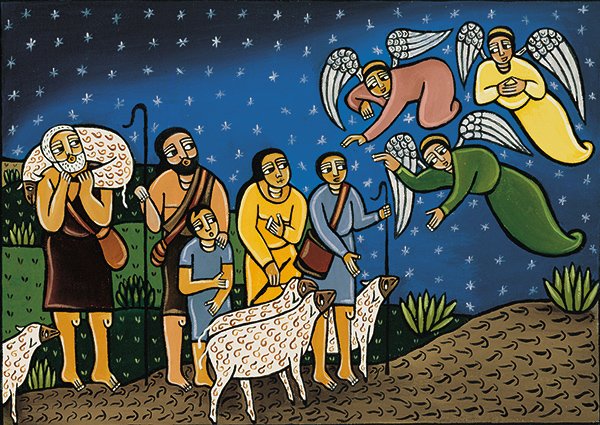
            Let’s hear again from Dr. Luke the words the angel said to the shepherds, that Christmas night: “the angel said to them, ‘Do not be afraid; for see—I am bringing you good news of great joy for all the people.” Not just the people in Italy, where St. Francis was. Not just the people in Europe, or North America. Good news of great joy for all the people, all over the world.

This week in Advent, here at this church we are concentrating on the shepherds. As we read this familiar Christmas story, was there much in the shepherds’ daily life and experience to fill them with joy? I do not think they were particularly joy-filled, with their ordinary, workaday life and their low, social status. I wonder whether the shepherds felt like that, right before the angel chorus broke into this hum-drum, workaday world and appeared to them?

Remember the difficult situation the shepherds were in. The shepherds’ position on the social ladder in Palestine was pretty much the bottom rung. The Jewish religious leaders even considered shepherds ritually unclean, since their duties and their work of looking after sheep made it impossible for them to observe the Sabbath. Working as a shepherd was something that vagrants might pick up, or a job for ne’er-do-wells, or others who were very much down on their luck. Their society stereotyped shepherds as liars, degenerates, and thieves.

 Just imagine the reaction of these lowly shepherds as they heard this news from the angels! Good news of great joy, especially, particularly for them! And centuries later, imagine the reaction of these same shepherds to think that they are now an integral part of a Nativity scene, a central part of the Christmas story played out time and time again, year after year.  

When my children were small, one of the first Christmas decorations I’d take out of the box would be our little Nativity scene. The little figures were all children, and it was intended specifically for the young. I would tell and re-tell the Christmas story again and again. When they were small, all four of my children would love to play with the figures, spending a good long time with those inexpensive yet meaningful little figures.  

Different churches do different things to communicate this narrative of the birth of Jesus. I read that the Rev. Janet Hunt has a yearly practice she does in her Lutheran church in De Kalb. But, I will let her tell you herself. “It has been my practice for many years to ‘build the creche’ with the children during the children’s sermon during Advent.  One week we add the animals. The next week the angels join them. Pretty soon Mary and Joseph arrive and not long after the baby Jesus and shepherds and the three sages from the East arrive last of all. The order is not perfect, of course, but it is one way of bringing the story home.” [2]

My personal Nativity scene, the one my children played with, has white children, every one. I had not thought about this when I bought the set of figures, more than thirty years ago. Even though my children were part of a multi-ethnic, multi-cultural school system, we still had an all-white Nativity set. Were the people in that first Nativity people of color? Yes, they were.

            Let us return to these shepherds of the first century, on the hills surrounding Bethlehem. They were downhearted outsiders, all right! People of color, non-white, on the bottom rung of their society, for sure. “But God does not give up on us. God sends angels to people who have given up on God. How would you respond to God sending angels to you when you’d given up on God? Like the shepherds, I’d be terrified.” [3]     

Remember the words of the angel of the Lord: “Do not be afraid; for see—I am bringing you good news of great joy for all the people.” We can praise God! God did not send good news of great joy to just a few people in the world, or even some of the world’s people. Or, only people of a certain position in society. No, our God sent good news of great joy to all the people of the world.

The angel has come to all cultures, all ethnicities, all people, wherever their position on the social ladder. All people, everywhere. Even us. You and I can truly come to the manger in Bethlehem side by side with the lowly shepherds.

            That is not only GOOD news, that is GREAT news. Good news of great joy, for all the people of the world! Alleluia, amen.

@chaplaineliza

(Suggestion: visit me at my other blogs: matterofprayer: A Year of Everyday Prayers. #PursuePEACE – and  A Year of Being Kind . Thanks!


[1] http://www.smithsonianmag.com/smart-news/the-first-nativity-scene-was-created-in-1223-161485505/ 

[2] https://dancingwiththeword.com/re-telling-the-story/

[3] http://www.workingpreacher.org/preaching.aspx?commentary_id=1522

Unknown's avatar

Be Prepared!

“Be Prepared!”

Ephesians 6:10-20 (6:10) – August 25, 2024

            I love to go to a baseball game! I do not go that often now, but in years past, I used to regularly go to Wrigley Field and watch the Cubs play. I don’t know if everyone is familiar with the equipment that baseball players need, but one player on a baseball team needs special equipment. The catcher is in a key spot on the team, and a very dangerous one! The pitcher regularly throws the ball at very high speeds. A catcher needs protection from those balls! A catcher’s mask, a chest protector, and shin guards, just to mention a few!

            This is similar to our Bible reading today. The Apostle Paul is finishing up his letter to his Ephesian friends. He warns them to be prepared, with a few practical, direct words for his long-time congregation. (I say long-time, because he spent about three years with this church, longer than with any other church he planted.)

Paul goes through a list of spiritual equipment that will protect his friends from attacks – the attacks of the Devil! Paul does not pull any punches. He is straight and up front with his former church members. He wants to warn them, prepare them for some really difficult times. These difficult times can often come into our lives today, too.

Let’s look more closely at what Paul says. “Finally, be strong in the Lord and in his mighty power. 11Put on the full armor of God, so that you can take your stand against the devil’s schemes. Therefore put on the full armor of God, so that when the day of evil comes, you may be able to stand your ground, and after you have done everything, to stand.”

            When I think of armor, my mind immediately goes to the military. Military service people definitely wear armor to protect themselves every day, in some duty stations, where some serve. Just as in baseball a catcher needs certain equipment to be prepared and safe while in a dangerous position, so do Christian people. Paul was in prison, in Rome, while writing this letter to the Ephesians. Paul was shackled to a Roman soldier inside of his cell, to make double sure he was going to stay put. Paul had the opportunity to become sadly familiar with the Roman soldier’s armor. Everyone, all believers in Christ need certain equipment (or pieces of armor) simply to be prepared!   

Let’s talk about baseball again, for a minute. What about the pieces of equipment the catcher wears? “The mask protects the catcher’s face from foul tips or pitches that might get past the glove. The glove protects the hand from balls. The chest protector protects the middle part of the body. Finally, the catcher wears shin guards to protect the knees and legs. No catcher would ever think of going into the game without this protective equipment.[1]

            Here in the letter to the Ephesians, at the very end of the practical portion of Paul’s letter, Paul details the protection you and I need in our lives, too. (And, this protection is so similar to what a baseball catcher wears!) We can see very well the kind of protection Paul is talking about if we think of a Roman soldier. Roman soldiers were commonplace, all over the Roman empire. Paul calls this protection the armor of God. He is thinking specifically of the armor the typical Roman soldier wears.

            We buckle the belt of truth around our waists. This is like putting on truthfulness. We are to tell the truth – at all times. Sometimes, it is not easy to be honest! In some situations, we are so tempted to bend the truth a little, or even a lot! But, the indwelling power of the Holy Spirit will help each of us with this important foundation of our faith.

            Next, each of us puts on the breastplate of righteousness. That’s a word we mention a lot in religious circles. Another way of thinking of it is putting on right behavior, putting on justice. Just like a catcher puts on a chest protector. Paul exhorts us to act rightly! This is certainly not easy! This thoughtful and prudent kind of action and behavior is often laughed at, by many people. Just think of rude or uncaring people, who may tease you or be mean to you for acting in a way that Jesus tells us to! (And, Jesus is our model for righteousness.)

            Which leads us to our shoes. Paul tells us to put on shoes that show we are speakers of peace. Not to argue and bicker, we are to go out of our way to bring peace to people!  

            These next two pieces of armor are clearly protective pieces. The shield of faith is our protection against those fiery darts that Satan can fire at us. And, not just physical darts! What about mean and nasty words that come our way, words that plant seeds of doubt in our hearts and minds? And, the helmet of salvation keeps the Evil One away. Thank God we have Jesus gifting each of us with salvation, because that is exactly what Paul talks about here.

            The last piece of armor is actually a weapon. The sword of the Spirit is the word of God. The letter to the Hebrews tells us that the Word of God is living, and active, and sharper than any two-edged sword. The Roman sword is a short sword, or weapon, used for combat at close quarters. This means that we are to actually engage the enemy, become active participants in battle! No sitting on the sidelines, as far as Paul’s fellow believers are concerned. As we continue to follow Jesus, we will continue to win the battle against Satan.

Whether inside or outside the church, however and wherever we serve our Lord, God intends for us to be prepared. That means being prepared by these words of caution and exhortation. Paul used these words in Ephesians to advise all of us to be ready to deal with challenging, even dangerous situations. We all need this prudent protection of God’s armor, in our everyday walk as believers.

Final words for today, quoting Paul? Be strong in the Lord! Stand ready, inside and out. And, do all this in prayer, always asking for God’s help. Are you prepared? Am I? With God’s help, yes – we are! Alleluia, amen! 

@chaplaineliza

(Suggestion: visit me at my other blogs: matterofprayer: A Year of Everyday Prayers. #PursuePEACE – and  A Year of Being Kind . Thanks!
(Thanks so much to link http://www.lectionarystudies.com/sunday21bae.html from the Rev. Bryan Findlayson of Pumpkin Cottage Ministry Resources, a lectionary resource I often quote from. Rev. Bryan gave me a lot of insight this week, and I used much of his material for describing the pieces of Godly armor!)


[1] https://sermons4kids.com/sermons/the-armor-of-god

Unknown's avatar

Today!

(I attended a denominational national assembly this weekend, and was not leading worship. Here is a sermon from my archives! I hope it touches your heart and spirit.)

“Today” – 2 Corinthians 5:20-6:2

June 28, 2006

            Once upon a time, there was a loving Father with abundant wealth, property and resources. He loved His many children dearly and did everything in His power to provide abundantly for them.

            Does this story line sound familiar? It should. That loving Father is God, our Heavenly Father. He created the world in the beginning, including humanity. Our loving God gave humans abundant resources, and provided many good and gracious gifts for them, doing everything possible to provide a rich and rewarding life for them.

I’d especially like to focus on the love. God’s love for humanity, for the world, for us. I dare say that many of us here today could quote John 3:16—“For God so loved the world that He gave His only begotten Son, that whoever believes in Him should not perish, but have everlasting life.”

From this verse, can we tell how much God loves the world? How much does God love us? This much?     (spread arms and pause)  

There was a problem, way back when, when God lavished such good and loving care on humans, on His children. That problem was and is SIN.

Face it, humanity—and that includes you and me—is fallen. I usually hesitate when I make sweeping statements, but not in this area. We are sinful. As Romans 3:23 says, “For all have sinned and fall short of the glory of God.” That is ALL. Not a few, not even most, but ALL. Everyone. All humanity. We don’t sin all the time, or in every situation. There are plenty of times when members of the human race act in kind ways, and think loving thoughts, but that troublesome sin nature is alive and kicking in each one of us.

Can you see a toddler or preschooler, stamping her feet, crossing her arms across her chest, and shouting, “No!!” Can you see a teenager, disrespectful and angry, slouching away from the dinner table without a word? Can you see the prodigal mentioned in the Gospel of Luke, wishing that his father would kick the bucket already, so he could get his inheritance? Do these selfish, proud, disrespectful, ungrateful actions (and thoughts, I might add) have anything in common? I would say, yes, they do. The sin nature that is part and parcel of all humanity is readily evident, in all of these situations. We are human, therefore we sin—by thought, word, or deed—by omission or by commission.

It would be really bad news if the story ended there, wouldn’t it? Humanity would be both hopeless and helpless, stuck in the miry clay of our own sinfulness. BUT, that is not the end of the story. God still loves us. Remember John 3:16? “For God so loved the world?” That love still comes to us, regardless of our sinfulness, regardless of our selfishness, regardless of how much we have disregarded the abundant love and the lavish care that God showers upon us each and every day.

As our passage from 2 Corinthians says, we humans trespass. We sin. We mess up. We make mistakes. But God loves us anyhow! God doesn’t keep a tally sheet, a ledger of all our good deeds and bad deeds. God does not count these mistakes against us. In fact, God goes above and beyond our mistakes, reconciling the world to Himself.

It’s not that God is estranged from the world, from humanity. It’s the other way round. It is humanity—it is you and me—that is estranged from God. God created humans, and He loves humans. He created each of us with our foibles and quirks and personality flaws as well as our individual strengths. He created each one of us as individuals to give glory to His name in our own individual ways. God knows us so much better than we know ourselves, and He still loves us just the same! God reconciled the world—that’s you and me—to Himself, out of love.

Like I said, that is wonderful news! Amen! Praise God! Thank You, Jesus!

Jesus was sinless, but He was made to be sin for us. Jesus took all of our collective sin upon Himself on the cross so that in Him we might become righteous before God. Can we tell how much God loves the world? How much does God love us? Is it this much?     (spread arms and pause)  

So, now that we know about God’s abundant love that He lavishes upon each of us, what are we going to do about it? Listen to the words of our passage again. “’At an acceptable time I have listened to you, and on a day of salvation I have helped you.’ See, now is the acceptable time; see, now is the day of salvation!”

D.L. Moody, noted evangelist during the 1800’s and founder of Moody Bible Institute, did much of his evangelistic work around Chicago. One Sunday evening in September 1871, Mr. Moody closed his sermon with the injunction for the congregation to evaluate their relationship with God over the next week and to return the following Sunday. When Mr. Moody was on his way home after the evening service, he heard the fire alarms all over and saw the flames against the sky, turning the night sky red and orange. That meeting hall where the service was held burnt to the ground, along with most of the city of Chicago. The Great Chicago Fire happened that night.

Mr. Moody was horrified, knowing that he had not told his listeners the full message of the love of God, for each one of them. He vowed from that day on to tell the whole story, to always let people know the good news of salvation in every sermon he preached.

What about you? Are you still thinking about God’s offer of salvation? You may have been a church member all your life, faithful and hard at work for many years. But you may have never realized that God’s joyful message of reconciliation was especially for you. You may have been born into a loving Christian family, maybe even a pastor’s kid or missionary’s kid, and been surrounded by God’s abundant love all your life. But just because I may be born in the room behind a bakery doesn’t make me a biscuit . . . and just because I may be born into a Christian family doesn’t make me a Christian by birthright or by osmosis. God has no grandchildren. There are only children of God.

God has been loving us—you and me—all of our lives, even when we turned our backs on Him. If this is that day for you, that acceptable time, that day of salvation, praise God! Enter into the joy of a loving relationship with God, a close friendship with God.

If God had a refrigerator, your picture would be on it. If God had a wallet, your photo would be in it. God can live anywhere in the universe, and He wants to live in your heart. If you have never, truly experienced God’s love for you, individually, there is no time like the present. We can indeed enter into the joy of our Father’s loving embrace and experience His abundant love for each one of us. Today is the day of salvation! God is ready. Are you?
@chaplaineliza

(Suggestion: visit me at my other blogs: matterofprayer: A Year of Everyday Prayers. and  A Year of Being Kind . Thanks!

Unknown's avatar

We All Are Witnesses!

“We All Are Witnesses!”

Luke 24:48 – April 14, 2024 

Have you ever been confused by the number of hurried, jumbled nature of things happening at once? And the speed at which these things happen? This experience is more common than we might think. Just think of the passing of time, where it’s New Year’s, you and I turn around, and it’s already Easter! Or, before we know it, the school year is over!

However hurried and jumbled these past months have been, it pales in comparison with our Gospel reading today. The end of the Passion Week must have been momentous and confusing for the followers of the Rabbi Jesus. Some confusing and jumbled things were happening very quickly. From the big festival entrance on Palm Sunday to the Passover Dinner of Maundy Thursday evening, to the arrest, trial and Crucifixion on Good Friday.

Events happening in short succession from morning until night. Everything happening one thing after another. This was compounded by the followers of Jesus scattering, running away, frightened by the very real, very legal, very official things happening to Jesus on Thursday night and Friday during the day.

   Let’s fast-forward to that Sunday morning, the first day of the week. The disciples still must have been frightened to death of the Jewish and Roman authorities. I suspect they needed to talk about the happenings of the past few days, too. We can see that from our scripture passage.

We pick up the narrative right after the events of the Road to Emmaus. To fill everyone in, two followers of Jesus got on the road to Emmaus that Sunday. As they walked, they talked. Debriefed. Tried to figure things out, as best as they could. And what circumstances they needed to figure out! A Stranger began to walk with them on the way, and unbeknownst to them, it was the risen Jesus, incognito. He shared with them a summary of all that He had come to earth to do. Of His ministry, His message, and His purpose. And still, they did not know it was Jesus.

Not until dinner that evening in Emmaus, the risen Jesus was revealed when He blessed and broke the bread. And then—Jesus disappeared! The other two at the dinner table did not waste any time! They ran back to Jerusalem, to the Upper Room, to tell what they had seen. Yes, they were witnesses. Eye witnesses, verifying everything that had happened that day.

Our Gospel reading for today picks up the story at this point. All of the followers of Jesus are gathered together in the Upper Room, and are talking about the story of the road to Emmaus. Do they believe? Or, don’t they? Are a few skeptical? Or doubtful? Are some still frightened?

Let’s transition to today. Here and now. I can hear some people today, scoffing at the idea of some guy rising from the dead. And then, miraculously traveling alongside of two other guys? Good as new—in fact, even better? No way! Not a chance. The other two must have been hallucinating. Or dreaming. Or maybe, seeing a ghost. They can’t believe. Or, won’t believe.

As we start the Gospel reading, the risen Jesus suddenly appears to the group in the locked Upper Room. What does He say? “Peace be with you.” A common greeting of the time. He’s also calming their hearts, their spirits, their anxieties, their emotions. “Peace be with you.”

How does the risen Jesus immediately respond to the disciples?  “Don’t be frightened! It is I, myself.” He emphasizes His identification. “I, myself!” It’s not anyone else, but Jesus! He lets them know that He is solid and corporeal, not a ghost. Not a spirit. And, Jesus doesn’t criticize His followers for being afraid! For feeling uncertain, doubful and anxious!

I wonder whether you have ever had a kind and patient teacher, or instructor, or coach. When you were afraid, uncertain, or anxious, did this kind and patient person get angry with you? Or, upset? Or, did this person continue to be open and willing to help you? Generous with time and welcoming to your attempts? Well, that is Jesus, all over. To a T.

Jesus tells the disciples, first. They are to proclaim what they have seen and heard. They are to be witnesses to the power of the resurrection. They are to tell how the risen Jesus has made a difference in their lives! And boy, that was a big difference!

When we read the book of Acts, that is exactly what we see. The disciples being witnesses of what they have seen and heard, witnesses of the power of the resurrection. Time after time, no matter what, the disciples tell others about how Jesus lived, preached, did miracles, and rose from the dead. Then, how all that has made an earth-shaking difference in their lives.

This is the message that Jesus told the disciples to start to carry, when John was a very young man. Some decades later, we see the aged John still carrying the message Jesus told him to, the message of sacrifice, hope, and resurrection. John is still being a witness, all those decades later, at the close of the first century! Dear friends, our Lord Jesus gave specific instructions to His friends, to go and be witnesses. He gives those same instructions to us. We are to be witnesses of the power of the resurrection.

Can you think of someone who was a witness to the power of God, in your life? Someone who immediately comes to mind for me is Miss Rose. I met her more than thirty years ago, when my older two children were very small. She was a witness to the power of God, and to God’s love. She communicated God’s love to everyone she ever met, just about! A little lady, a dynamo for God, she would tell everyone about God and how much God loved them.

I met her again, some years ago when I was a chaplain intern at the Presbyterian Homes. She was a resident there. I was so happy to see her. Miss Rose and her joy in the Lord bubbled over and communicated to everyone she met there, too. Even though she was in severe, chronic pain, Miss Rose witnessed to the power of the resurrection, asking people she met, “Do you know Jesus? Can I tell you about Him, and what He’s done in my life? Can I tell you my story?”

Each of us has an opportunity to be a witness, to communicate the Good News about the risen Jesus and the power of the resurrection. We can communicate by words, by a smile, by being kind, through our actions, through our generosity.

Think about someone who impacted your life, who communicated the Good News to you. There’s a great example for you! Just like Miss Rose is a marvelous example for me, to be a witness despite pain and suffering, even through difficulty in my life. I can still communicate God’s love, just like the aged Apostle John did, too, decades after the Resurrection. He was even in prison when he wrote his letters, on a little island in the Mediterranean Sea. That didn’t make any difference. John still told his story, how the risen Jesus made a difference in his life.

What is important is that we get out there and start being a witness, telling people about the power of God, and about how much the risen Jesus has changed our lives. Can you be a witness? It’s as simple as telling your story. Can you tell the story of Jesus and His love? Jesus loves you. Jesus loves me. Jesus loves all of us.  Be witnesses. Alleluia, Amen.

@chaplaineliza

(Suggestion: visit me at my other blogs: matterofprayer: A Year of Everyday Prayers. and  A Year of Being Kind . Thanks!

Unknown's avatar

Only the Beginning!

“Only the Beginning!”

Mark 16:1-8 (16:7) – March 31, 2024

            Who here is on social media? Surfing the web, looking through my several accounts is a pleasant way to pass the time, but it is also a way to see some really humorous things. For example, just yesterday I saw a meme that said “In order to be truly Biblical, the only people invited to the sunrise Easter service will be women.” Because, at sunrise on that first Easter, that is all who were there – the women were the first witnesses to the Resurrection!

            We know more about what happened on that Easter Sunday from the other Gospel accounts. But, Mark? Not so much. Mark writes in his usual concise, blunt manner. Short on details and description, heavy on action. Let’s take a closer look at our Gospel reading.

            “After the Sabbath was over, Mary Magdalene, Mary the mother of James, and Salome bought spices to go and anoint the body of Jesus. Very early on Sunday morning, at sunrise, they went to the tomb.” 

I want to remind everyone that Jesus did not have only men disciples. There were many more than just the twelve men named in the Gospels. “In their accounts of Jesus’ last days, all four gospel writers mention “the women who had followed Jesus from Galilee”.  Taken together we find that eight women are named, with the most familiar being Mary Magdalene.” [1]

Some of these faithful women go to their Rabbi’s tomb early on Sunday. What did they encounter? What was it that really happened early that Sunday?

The big stone rolled over the entrance to the tomb must have been worrying the women. Mark even mentions it. I suspect they already were discussing how their combined strength was probably not enough to even budge the stone. But—what is this? The stone is already rolled away! It’s the first inkling that things at the tomb are not as these women first thought.          

“So they entered the tomb, where they saw a young man sitting at the right, wearing a white robe—and they were alarmed.“Don’t be alarmed,” he said. “I know you are looking for Jesus of Nazareth, who was crucified. He is not here—he has been raised!”

            Their Rabbi, whom they had just seen die three days ago in the most horrific way, is suddenly said to be miraculously alive – awake, aware, and raised from the dead!  

            Let’s continue with the angel’s words from Mark 16: “Look, there is the place they laid him. But go, tell his disciples and Peter that he is going ahead of you to Galilee; there you will see him, just as he told you.” So they went out and fled from the tomb, for terror and amazement had seized them; and they said nothing to anyone, for they were afraid.”

Frankly, the reaction of the women makes a great deal of sense. “Terror would be a natural response to the unexpected, especially where a dead loved one is concerned. Amazement would certainly be realistic when the terror of the moment gives way to a hint of hope. Could it really be true? Could the prophecies have been fulfilled?” [2]

            Of course, looking back with our historical perspective and the perspective of faith in our risen Lord Jesus Christ, it is next to impossible for us to imagine what it was like for the women disciples, encountering an empty tomb!

These words are the first ending of the gospel of Mark, right here. Yes, our Bibles have some additional verses that come after verse 8, that were added later on. But, right here is where we are left for now. The women frightened half to death, and no trace of the men disciples up to this point. What happens now? This is surely infinitely more agonizing a cliff-hanger than any radio serial or any two-part television episode!

The immediate response of the disciples isn’t really that far-fetched when you stop to think about it. We have already seen the betrayal of Judas, the denial of Peter, the desertion of his disciples, and “finally even the failure of these women, who up to this point had proved the most faithful of his disciples. They are afraid, too afraid to speak of the wonders they have heard. And so Mark ends here, right here, inviting us the reader to pick up where these women left off and share the good news announced by the messenger at the empty tomb.[3]

We know the men disciples scoffed at the women’s testimony, at first. I don’t know if I could have believed this right away, either. What would your response have been?

But wait, the blessed reality is that our God conquered death. We don’t just hope so, we don’t think it would just be a nice idea, Jesus Christ rose from the dead, and the angel told the women the blessed truth. It took some time for all the disciples to believe it and fully comprehend it, but that is a reality we can trust today, too.

We know now, from the other Gospel accounts, that this was just the beginning of the story, the beginning of that Good News, that Jesus has risen, indeed! Despite worry, anxiety, despair, loss, and cynicism today, we know the tomb is empty.

As commentator David Lose says, “The story of what God is doing in and through Jesus isn’t over at the empty tomb, you see. It’s only just getting started. Resurrection isn’t a conclusion, it’s an invitation. And Jesus’ triumph over death, sin, and hate isn’t what Mark’s Gospel is all about. Rather, Mark’s Gospel is all about setting us up to live resurrection lives and continue the story of God’s redemption of the world.”

            Our opening hymn “He Lives!” has the words “I serve a living Savior, He’s in the world today.” Our Lord Jesus wants each of us to go out and tell others that He lives! Easter Sunday is not a nice nursery story or a pretty fairy tale. It is saving truth. I know – we all know that our Redeemer lives!  Jesus came to redeem His people from their sins. The Resurrection is not the end of the story. It’s only the beginning!

And yes, we are invited to witness to Him, to go and tell everyone that Jesus Christ is risen today! Share this Good News, today! Alleluia, amen.

@chaplaineliza

(Suggestion: visit me at my other blogs: matterofprayer: A Year of Everyday Prayers. and  A Year of Being Kind . Thanks!


[1] https://juniaproject.com/did-jesus-spend-most-time-12-men/  (Matthew 27:55, Mark 15:40, Luke 23:49, John 19:25)

[2] https://www.stewardshipoflife.org/2012/04/a-story-for-uncertain-times/

[3] https://www.davidlose.net/2015/03/easter-b-only-the-beginning/

Unknown's avatar

Live in God’s Light!

“Live in God’s Light!”

John 3:14-21 (3:19-21) – March 10, 2024

            Remember getting report cards in school? What about yearly reviews from your boss, or your supervisor? Those can be very stressful, even upsetting. People in authority can have real power over us, and sometimes negative influence, too. Can you remember if you had any mean teachers? Unfair bosses? What about rotten coaches? Getting checks or bad marks on a report card, or a reprimand from a manager at your work?  

This Scripture reading is early in the rabbi Jesus’ ministry. Jesus had already made a name for Himself, with the tremendous teaching He had done and the wonderful miracles He had performed. So, a lot of people were talking about Jesus, this itinerant rabbi from Galilee. Even the most important leaders among the Jews, the Pharisees, were talking about this Rabbi Jesus. One of the Jewish leaders summoned up enough courage one night to sneak over to where Jesus was staying. Nicodemus wanted to know more about Jesus.  

Here in John chapter 3, our Lord Jesus and Nicodemus have a long conversation. There is so much fascinating material here! I could preach so many different sermons from this one reading alone. But, I wanted to focus today on the last part of the reading.

Listen again: “the light has come into the world, but people love the darkness rather than the light, because their deeds are evil. 20 Those who do evil things hate the light and will not come to the light, because they do not want their evil deeds to be shown up. 21 But those who do what is true come to the light in order that the light may show that what they did was in obedience to God.”

I suspect you and I and many people around the world know John 3:16. This much beloved verse is one of the dearest and most memorized Bible verses of all time. “For God so loved the world that God gave His one and only Son, that whoever believes in Him shall not perish, but have eternal life.” But, what about several verses further on? Does God really give us all a heavenly report card? Does everyone get bad marks from God, because “people love the darkness rather than the light, because their deeds are evil?”

So often people “do not want their evil deeds to be shown up.” We humans run from the light of God! A vivid image that comes to the mind of commentator Rev. Sharon Blezzard was that of “cockroaches scurrying when the lights are turned on. Being exposed, being vulnerable, even in the loving and grace-filed light of Christ, runs counter to our [fallible] human nature.” [1]

            The upright, law-following Jews of Jesus’ time tried their hardest to follow all God’s rules, to obey even the smallest rule in the Law of Moses set out in the first five books of the Bible, the Pentateuch. Even the strictest law-follower among the Jews knows they fall down sometimes, and fail to keep strict adherence to the Mosaic Law code.

            It doesn’t matter whether we are talking about the strict law-followers two thousand years ago, or upright believers in God today. Telling ourselves that we are good and right and following God all the time is so human, so natural! Sadly, many people “want to keep our evil desires, our sinful expressions, and our selfish ways hidden in the shadows. In fact, we’re pretty adept at adapting to the darkness and fooling ourselves into all sorts of pretty little lies and heady rationalizations.” [2]

The Bible calls this the natural state of people. We often see people in their natural state feeling frustrated because they are fooling themselves, and want to wallpaper over that hidden darkness in their lives, where they trip up or even turn away from following God.

            I recognize that so many of our fellow humans judge every little thing. Don’t you know a few people – even more than a few – who have frowns on their faces, their hands on their hips, or shake their fingers at certain people? And, if these disapproving, judgy folks judge you and me, it can really hurt! How much more does it hurt for us to get judged by God? Could we be fooling ourselves? Is each of us going to get a bad report card from God, with failing grades in following Jesus? This is such a helpless, hopeless place to be!

            But, thanks be to God! This helpless, hopeless place is not the end of all things. No, we have the blessed truth of John 3:16 to turn to! For God so loved the world.            

               Some people cannot get past the words “God so loved the world.” If they trust that God loves them, they think God can’t possibly love their awful neighbor. Or the guy who cussed them out. Or the lady who is always really mean. God can’t possibly love them? God loves the world – except for those people from a certain country overseas. Or, except for those homeless people or undocumented people. Or, except for those people who believe something really weird about God. Or, well, you get the idea.

            Let’s try an experiment. I am going to say John 3:16 several times, except with little changes each time. Here goes. For God so loved the world that he gave his only Son, so that everyone who believes in him may not perish but may have eternal life.

            Second time: imagine someone saying this to you. For God so loved (person’s name) that he gave his only Son, so that if (person’s name) believes in him, (person’s name) may not perish but may have eternal life. And, the third time, say this to yourself. For God so loved me that he gave his only Son, so that if I believe in him, I may not perish but may have eternal life. [3]

            Has anyone ever said that to you before? Jesus means it. He truly does.

What this reading is doing is giving all of us permission to get out of the condemnation business! Jesus did not come to condemn us. [4]

Jesus shines His loving, grace-filled light into the darkness and shadows of our hearts and loves us anyway. As I say each week in the Assurance of Pardon: believe the Good News! The Lord will never waver in persistent, caring love for each of us. And, that is a promise that is faithful and true – we have the words of Jesus on it.

For God so loved the world. Even you and me.

Amen.

@chaplaineliza

(Suggestion: visit me at my other blogs: matterofprayer: A Year of Everyday Prayers. and  A Year of Being Kind . Thanks!


[1] https://www.stewardshipoflife.org/2015/03/living-in-the-light/

[2] Ibid.

[3] https://www.umcdiscipleship.org/worship-planning/depths-of-love/fourth-sunday-in-lent-year-b-lectionary-planning-notes/fourth-sunday-in-lent-year-b-youth-lessons

[4] https://www.umcdiscipleship.org/worship-planning/depths-of-love/fourth-sunday-in-lent-year-b-lectionary-planning-notes/fourth-sunday-in-lent-year-b-preaching-notes

Unknown's avatar

Powerful Name of Jesus!

“Powerful Name of Jesus!”

Mark 1:21-28 (1:27) – January 28, 2024

            . Illness is a sad reality in this world, and all of us are witness. We all know people who either are sick right now, or have been sick in the past. Some are friends, others acquaintances, still others family members Many, many illnesses come from micro-organisms like viruses or bacteria. Today, the medical world can diagnose many of these diseases by looking at a person’s blood under a microscope or running a specific test.

            We know sickness is a part of this broken, fallen world we live in. That is a fact. Yes, this present world is full of God’s beauty and majesty, but it is also full of evil and danger, trauma, and illness. Both physical illness as well as mental illness.

            As we think about our Scripture reading this morning, what kinds of thoughts are in your mind? The Gospel of Mark shows us the Rabbi Jesus very early in His ministry. He is preaching and teaching in the area around the sea of Galilee. Listen again: “The people who heard Jesus were amazed at the way he taught, for he wasn’t like the teachers of the Law.” So, we can see “We open with Jesus and his newly formed group of disciples coming to Capernaum and the people in the synagogue being impressed with Jesus’s authority.” [1]

            Right off the bat, the Rabbi Jesus shows who and what He is. We can see, through Mark’s account of Jesus’ words and actions, that Jesus exerts power and authority. Mark wanted to make crystal clear what Jesus’s mission here on earth truly was – not only to bring Good News but also to bring freedom to the captives. We can also see that Jesus has marvelous understanding of what God means to the people He is preaching to, as well as what God intends for those same people to be – and become. Just so with this reading today

What does Jesus encounter in this synagogue? Let us listen again: “Just then a man with an evil spirit came into the synagogue and screamed, 24 “What do you want with us, Jesus of Nazareth? Are you here to destroy us? I know who you are—you are God’s holy messenger!”

I’m going to stop right here and say that I believe this event did happen. Yes, we here in the 21st century have a more nuanced view of the psyche, and what mental health and mental illness look like. Yes, chemical imbalances affect brain health and chemistry, too. This could be severe mental illness, or a complicated medical diagnosis that affects mood and stability. At the same time, I believe there are also powerful unseen forces in the wider world today, and these forces can affect individuals and their mental and emotional stability.

So, we have the Rabbi Jesus, here in the Capernaum synagogue. Next thing we know, a man with a demon inside comes up and confronts Jesus – face to face! Yes, the man in this instance could have severe mental or behavioral problems. And, yes, Jesus could well be involved in a situation with something in the spiritual realm. Any way you look at it, our Lord Jesus is exerting mighty power and authority. 

This confrontation brings things to a head, and with just a word, Jesus shuts down the evil spirit. He commands, “Be quiet!” This can also be translated “Be muzzled!” Have you ever seen an animal wearing a muzzle? This is often done with dangerous or wild animals, and the muzzle takes away their power to bite and roar. [2]

            Through this strong command, “Jesus makes the unclean spirit feeble, weak, unable to continue to use its words to exert its power. By doing so, Jesus proves that the unclean spirit does not have real authority—it is just masquerading like all other evil spirits and forces in the world.”[3] We see here, just as we are shown over and over through the Gospels, our Lord Jesus displays His mighty, Divine power and authority, and people respond! With amazement, awe and even fear.

            I don’t know if you have ever been in the presence of someone who is larger than life? Someone who you can tell has real power, real authority, and knows for sure how to use them. From all the Gospel accounts, that was Jesus. He not only was an effective teacher, but also a compelling preacher. Plus, Jesus had a remarkable gift for showing His power and authority in a winsome, persuasive and – most importantly, an authentic manner.

            The Gospel of John tells us that Jesus is the living Word of God who became a human being. We can see how effective His spoken words are with this evil spirit. “It is notable following the man’s outburst, and immediately after the unclean spirit has left him, that again the congregation talk about Jesus’ teaching. This is the first recorded miracle by Mark. The drama is not primarily presented as a healing miracle, rather a deliverance of an individual from the grip of chaotic forces that convulse and threaten their life.[4]

            Life here in the Chicago area today is certainly different than life in the first century. The modern day is vastly different from the ancient world, or medieval times. But, our Lord Jesus is still the same. He is still mighty and powerful, and has remarkable authority over all things.

Yes, Jesus has authority over things today, too. In our own lives, we might have emotional barriers or spiritual problems. With such sadness, upset and distraction going on, who wouldn’t have some difficulties and problems in their lives right now? Whether you have deep feelings, some heartache or pain, grief or despair that you are dealing with today, Jesus can work wonders in your life and spirit, too.

            I tell you today that our Lord Jesus is not afraid to face down the evil things, the traumatic events that come into each of our lives on a regular basis. Just as our Lord Jesus showed in the Gospels again and again, the authority of God and God’s Word is for God’s people’s wholeness and healing. All God’s people. That is a promise, and that is a blessed reality. Alleluia, amen!

@chaplaineliza

(Suggestion: visit me at my other blogs: matterofprayer: A Year of Everyday Prayers. and  A Year of Being Kind . Thanks!


[1] https://cepreaching.org/commentary/2024-01-22/mark-121-28-4/

[2] Ibid.

[3] Ibid.

[4] https://www.churchofscotland.org.uk/worship/weekly-worship/monthly/2024-january/28-january-2024-fourth-sunday-after-epiphany-year-b#topic5