1 Out of the depths I cry to you, O Lord. 2 Lord, hear my voice! Let your ears be attentive to the voice of my supplications!
3 If you, O Lord, should mark iniquities, Lord, who could stand? 4 But there is forgiveness with you, so that you may be revered.
5 I wait for the Lord, my soul waits, and in his word I hope; 6 my soul waits for the Lord more than those who watch for the morning, more than those who watch for the morning.
7 O Israel, hope in the Lord! For with the Lord there is steadfast love, and with him is great power to redeem. 8 It is he who will redeem Israel from all its iniquities.
REFLECT
There’s nothing like an emergency room or a critical care unit in a hospital to give a person a kind of perspective, a window into suffering and pain—on all different levels.
In the depths. Overwhelmed by the chaotic waters. It’s real. It hits home. This is where some people are regularly at, more often than any of us would like to admit.
When we read Psalm 130, we aren’t sure whether it’s the depths of sorrow or grief, or the depths of emotional frustration or psychological pain, or a combination of all of the above. This psalm is a window onto the psalmist’s soul, which is about to split in two.
Have you ever felt like that? Have you ever cried to God from the depths of suffering and pain? I know I have, and it is painful. Horrible. I don’t care to remember it, most of the time, so I pack it away and submerge what unpleasant memories I have in some inner part of my mind.
Sometimes, life stinks. Some might ask, how can it get worse?
The psalmist tells us how, in verse three. Just when we thought life was really rotten, sin can take center stage and make matters even worse. Sometimes, I can let the sins I commit every day really get under my skin. It isn’t always the huge sins; it can be the little ones, too. The white lies, losing my temper, ignoring people. These little slips of thought, word and deed. Oh, and the bigger sins, too.
What would happen if God were to keep a balance sheet, with all of the good, pleasing deeds I’ve done in one column, and all the bad, evil, nasty things I’m guilty of in the other? I’d imagine I would keep some angelic bookkeeper pretty busy, keeping track of all the petty little bad things I do each and every day, as well as the occasional good things.
Thank God that God does not keep balance sheets, and weigh the good versus the bad in my life. Thank God I am forgiven! Did you hear that declaration? “But there is forgiveness with You, so that You may be revered.” God loves this psalm writer so much that God is willing to forgive.
Then, there is a shift. The psalm writer changes from up close and personal to the corporate body. It’s like the psalmist says, “Hey, Israel!! If God can forgive me of my iniquities, surely God can forgive all y’all, too!” See, the LORD does have steadfast love. It isn’t just wishful thinking. God is ready to redeem all God’s people from all their iniquities, to embrace them in God’s everlasting arms.
This is good news for us, today. Not only will God forgive our sins and iniquities, but God will be there to help us through the rough places, the difficult things, the frustrating circumstances, the painful heartaches. God has promised to be there for us, indeed.
What a promise. What assurance. What a God. Amen!
RESPOND
Just as God does not keep heavenly balance sheets on me or on you, so we do not need to keep track of good deeds versus bad deeds done to us. How freeing, and how wonderful! Who can you help through difficult times? Who needs a hand to travel through rough places today? Please, be that helping hand. And, if you can be kind and merciful to others, do that, too!
REST
Dear Lord, sometimes life is hard. Sometmes, life downright stinks. But Lord, You are right there in the middle of things! You come through, and can walk beside us, sit right next to us, even, going through the darkest valleys, You are right by our side.Thank You, God, for never leaving us nor forsaking us. What a God You are, indeed! I know it hardly seems adequate in the least, but – thanks. Thanks so much. Amen.
About the Author
The Rev. Elizabeth Jones is a full-time hospice chaplain in Chicago, is a Certified Alcohol and Drug Counselor (IAODAPCA), and is working on a DMin in spiritual direction. Elizabeth has a loving husband who is a senior editor, four curious and strong-minded adult children and two adorable grandchildren.
(I preached at a memorial service last weekend for a dear woman. Here is the slightly edited meditation on her chosen Scripture reading.)
“Home: Where Jesus Is”
Home. There’s no place like home. I know this feeling is not true for all people, but it’s very true for many people, around the world. Many of us have a deep craving to go home, to be comfortable, with familiar people we know and love. Have you ever been away from home for a long time, and returned at last? Perhaps felt the satisfaction, the deep-down joy at being your own neighborhood, on those familiar streets once more? And especially, in your own bed?
I know that our dear sister had that feeling, growing up for a number of years in an orphanage in Iowa. Yes, there were loving people at the orphanage, but it just wasn’t home.
That is one of the deep emotions our Lord Jesus taps into in today’s reading from the Gospel of John, chapter 14. It is the evening of the Passover Dinner, the Last Supper on Thursday night. He knows His time on this earth is almost over. Jesus gives His disciples as much reassurance as possible. “Do not let your hearts be troubled. You believe in God; believe also in me. 2 My Father’s house has many rooms; if that were not so, would I have told you that I am going there to prepare a place for you?”
A place, especially for you. That heartfelt feeling of “home” is something that goes deep, indeed. Sure, many people grow up at home. Families are at home. Beloved pets are at home. Even all of our stuff is oftentimes at home.
Remember the movie “The Wizard of Oz”? That MGM mega-blockbuster made in 1939 had Dorothy, played by Judy Garland, singing a song early in the movie about what she imagined about a special place for her. “Somewhere Over the Rainbow” was almost cut from the finished movie by MGM, because they thought that it slowed down the pace of the movie.
This longing, this yearning for a home somewhere far away, somewhere over the rainbow, is deep within the human psyche. As commentator Chris Lohrstorfer says, ““Somewhere over the Rainbow” encapsulates our own wandering heart’s desire for a promised land of rest and restoration. It speaks to our hope – our need for somewhere else.” [1]
The disciples, Jesus’s friends, often did not understand what He was about. Again and again we see how much they did not understand what He said. How often do we misunderstand the words of Jesus, too?
Also remember, the Rabbi Jesus had been an itinerant Rabbi for three years. That meant that Jesus had no permanent residence. He had no home! In Matthew 8 and the parallel passage in Luke 9, “Jesus replied, ‘Foxes have dens and birds have nests, but the Son of Man has no place to lay his head.’”
Several people I know are resident aliens. Citizens of another country, they live here in the United States for an extended time. With school visas or work visas, they often cannot live here permanently. True, they can learn, go to school, go to work and provide for their families and loved ones, and go about all the other activities involved with living a full life, but they cannot have a full, deep sense of “home.” There’s no place like home, as Dorothy said.
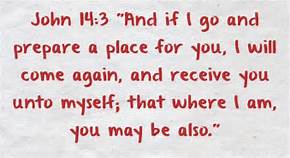
Here in John 14, we hear Jesus letting the disciples know He understood them, deeply, intimately, completely. We know Jesus can understand us and our problems, too. He knows every tear that falls, even those silent and sorrowful tears that redden our eyes late at night. He knows all the pains and suffering that can come into our lives day by day. Jesus shows us that finding that place called “home” is often not a place, but a relationship. The next verse, from John 14: “3 And if I go and prepare a place for you, I will come back and take you to be with me that you also may be where I am.”
See? Jesus is not leaving His disciples all alone. Jesus understood about “home.” He understands our deep need for rest and restoration. He promised to get a place ready for us!
Jesus shares with us – His home, His inheritance, His position. We now are “children of God.” Can you imagine the great love that speaks to us?[2]
This is not only good news, this is great news! The absolutely best news that anyone could ever have delivered to them. This is good news for each of us, and it is good news that our dear sister is rejoicing in, right now, in heaven! We do know for sure, because Jesus tells us in these verses, that God will be with us and take care of us after we die. So, we and every person we love who dies are okay. [3]
Today, we all can look forward to finally going home, where Jesus is. Where Jesus has gotten everything ready for us. Where there will be no more crying, no more tears, no more fighting or wars or conflict of any kind. Jesus has promised! Such Good News. Alleluia! Amen.
Words, words, words, words!! Words of every kind, of every description. Words that tell, words that show, words that praise, words that criticize. Words separate and draw together. Words fill people with joy and peace as well as with suspicion and animosity. Words have power. Whether insightful words or divisive words, encouraging words or capitulating words, words have the ability to shake emotions and to inflame passions for good or for evil.
How do people use words and language, anyway? People speaking a common language need to agree upon the sense of what they say. It helps to be bound together by social convention as well as language rules of practice and use. In fact, language provides the structure of our common experience, understanding and perspectives. But I don’t want to get all high-falutin’ and theoretical. I want to bring this home to where we live.
We all use language. Every day. In conversation at home, or on the telephone, or at work. Reading a newspaper or writing e-mail. All of these uses of language use words. Words communicate meaning, ideas, stories. Each one of us has a personal story, of what it was like, what happened, and what it’s like now. Our stories are communicated using words and language, and each individual has a creative, unique way to tell his or her story.
The story of an individual’s own personal life makes sense because it is part of a larger story, the Story that has the story of Jesus Christ at its center. It is a story of God’s initiative which calls for my gratitude and response, a Story some theologians have called ‘the history of salvation.’ It is the Story of Jesus, the Story set forth in the Word of God that attracts, crossing boundaries and transcending lines of race, class, culture and age.
Our gospel text for today, the first 14 verses of the Gospel of John, is a restatement of an old theme. Remember Genesis 1:1? “In the beginning, God created the heavens and the earth.” Most scholars today believe the apostle John was thinking of that introduction to the Greatest Story ever told when he wrote his own portion of it. John 1:1: “In the beginning was the Word.” John reframed that Story, and gave it a new look from a different perspective.
In John, Chapter 1, we have God, the creative God who made heaven and earth. The almighty God wanted to communicate with us puny, limited human beings. But how was God supposed to communicate His Story?
I can remember when my children were younger, in first and second grades. Sometimes they would need help with their homework at night. Years before, I had taken several courses of math in college . . . college algebra, trigonometry, analytical geometry. But, after considering more advanced mathematical ideas, how was I supposed to explain simple addition and subtraction to my young children in language they would understand?
That’s the way I look at God’s problem sometimes. It’s sort of like God, able to do the most advanced mathematics possible–in God’s head!!–and God needed to be able to explain the simplest addition and subtraction problems to us ordinary, simple-minded human beings.
There was another problem, as if the simple-mindedness of humanity wasn’t enough. That problem was (and is!!) sin. Funny thing, how sin keeps cropping up in our lives and getting in the way. Sin divides people from one another as well as from God. Sin isolates and forces apart. Sin happens on a horizontal plane with other people as well as on a vertical plane with God. And sin causes humanity to walk in darkness and to run from God’s presence.
So here we have a loving God, a God of light, a God who wants so much to communicate with us fallen, sinful human beings. But how was God supposed to communicate God’s Story?
The Gospel of John tells us how. In the beginning was the Word. The Word was God. The Word is God. Jesus is the Word. John 1:14 says that the Word, Jesus, became flesh, and . . . the Word dwelt among us.
Think about it: the whole idea of God becoming a helpless baby, a human being, able to feel cold and heat, able to be hungry and thirsty, with blood and bones and a nervous system and a digestive system. So staggering was this idea that some of the people in John’s day could not believe it. God? the creative God who made heaven and earth? Coming to earth as a helpless, human baby? No way!!
And, that’s not all!! Not only did this Creator God appear in creation so that our eyes could see Him, this almighty God, after making Himself flesh and blood, has the crazy idea of dwelling among people. Becoming one of us limited human beings, sharing our food and living in our midst. Jesus became fully man. He didn’t just seem to be a man, and pretend to be human. He really and truly became human, living with us as one of us.
What a way for the almighty, eternal, creative God to communicate to us in a way that we limited human beings might possibly understand. God wanted humanity to understand His Story of good news, the Bible, but God also wanted humanity to understand God’s Word made flesh, the one called Jesus of Nazareth.
Jesus (the Word incarnate) is the central principle of Scripture as well as the central character of the Greatest Story ever told. Reformed believers have throughout the centuries been finding new ways to confess their faith, using the fallible, limited resources of language that have been handed down to humanity throughout the generations. God helps us understand His Story, and there is nothing God wants more than for us to want to understand God’s Story better and better.
A good many years ago, a bible translator went to a remote, mountainous region in the interior of Africa. He worked hard at turning an obscure oral language into a written language, which involved decoding the language, writing a grammar, learning extensive vocabulary, and finally translating a portion of the Bible into the heart language of that particular people-group.
After several years of intense work and language preparation, when he felt he was ready, the missionary made his first presentation of the Story of Jesus to a group of headmen from the tribe. He was surprised at their response, which was unlike any he had ever had before in all his years of being a missionary and telling people the Story of Jesus. The group of men just sat there in silence, and then the chief came forward.
The chief grasped the missionary’s hands and, with tears in his eyes, thanked him for coming to tell them the Story of Jesus. “This Story of good news is the one my people have waited for, all their lives long!!” And then came the clincher: the chief asked, “Your tribe has had this Story for many, many years. What took you so long to tell us?”
Communicating the Story of Jesus has power! Awesome power! This is a Story that can change people’s lives for eternity. Telling the Story in someone’s heart language is one of the best ways to communicate how much God loves us.
When Jesus came to this earth, He spoke the language of the people of His region, and He communicated ideas in ways people could understand. Yes, He was the Word become flesh, and yes, He showed us how to live this life that we have to live. Jesus, ‘the one Word of God which we have to hear and which we have to trust and obey in life and in death.’
Praise God that God sent the Son Jesus into this world, the Word incarnate, the Word that became a helpless baby in Bethlehem. Praise God that God has given us the right to repair that broken relationship with us, and to be called the children of God. And praise God that God loved us so much that He gave His only begotten Son on our behalf, to reconcile us to God for eternity.
I have a secret confession to make. I am greatly thankful that I have never had to take a job in retail. As I said to my husband this past weekend, I would have quit after the first day, simply because of the constant, cheesy, sometimes saccharin-sweet Christmas music that is piped in over the PA system at every retail store I go into. This is done for about two months before Christmas. And, that’s a long, long time to hear Christmas carols and songs, non-stop.
And yet – and yet, as we consider this alternative Advent Bible reading from Luke chapter 1 today, I invite you to come with me back in time, to a time before there even was a Christmas. We are not only going to time-travel, but we are going to ocean-hop, too. Let us go to the modest home of a teenager named Mary, living with her parents in Palestine, around the beginning of the first century of the Common (or, Christian) Era.
This teenaged girl – really, young woman, as she was in that time and place – had an angel visitation. We even find out the Angel’s name, Gabriel. The few times that the angel Gabriel appears in the Bible (that we know of), are times of great importance. Especially this appearance, when Gabriel heralds the birth of the coming Messiah! But, we haven’t gotten there yet. Mary is in her parents’ home when the angel suddenly arrives, about to upend everything concerning Mary and her life as she knows it.
Another very important fact: the country where Mary is living, and her people, the Jews, are under Roman rule. Palestine is an occupied country, like so many other regions and nations under the boot of Rome and the powerful Roman army. Palestine doesn’t sound much like a “Silent Night, Holy Night,” where “all is calm, all is bright.” Does it?
Our mighty God does not wait until everything is perfect, or everything is calm and placid, to work wonders and miracles. God sent the angel Gabriel to a teenager in a modest house, in a country under military occupation. Not to the ruling classes, not to the king’s family in his luxurious palace, but to an unlikely young woman in a backwater town.
Let us shift gears and move our focus to the modern day. Here in the United States, we have a great deal of internal struggle! Things today are certainly not perfect, or calm or placid. As we mark the first Sunday in Advent, the first candle on the Advent wreath is called the candle of Hope. Can you and I possibly find hope in an atmosphere of anxiety? Of uncertainty? Overwhelmed by pervasive negativity, with the American people’s attitudes filled with division, derision and defensiveness?
Let’s return to Mary and the angel. How does Gabriel lead off in this conversation from Luke chapter 1? 28 The angel went to her and said, “Greetings, you who are highly favored! The Lord is with you.” Admittedly, Mary wonders what on earth is going on! Dr. Luke tells us, Mary “was greatly troubled at his words and wondered what kind of greeting this might be.” I dare say you and I would be greatly troubled, too, if we were to encounter an angel!
Sure enough, Gabriel announces to Mary that she is highly favored, and that “you will conceive and give birth to a son, and you are to call him Jesus. 32 He will be great and will be called the Son of the Most High. The Lord God will give him the throne of his father David, 33 and he will reign over Jacob’s descendants forever; his kingdom will never end.”
Mary probably knew her place in society of her time, as a female, as a second-class citizen. Mary “is common, ordinary, of little account in her world and definitely not the stuff of legends…and she knows it. Only after expressing her wonder and dismay, and then hearing again Gabriel’s affirmation and promise, does she manage to summon the courage to believe that God has indeed favoring her by working in her and through her for the health of the world.”[1] What was Mary’s response to the angel? 38 “I am the Lord’s servant,” Mary answered. “May your word to me be fulfilled.”
We all know very well that our teenaged Mary became pregnant by the Holy Spirit, and gave birth to the baby Jesus in Bethlehem. We are well used to seeing Mary as a sweet, calm, quiet, almost docile follower of God’s will for her life. However, I would like to suggest that Mary was also a prophet! As a prophet, she would also be a bringer of hope to the world!
This prophetic role, this insight is a new way of looking at Mary for me. New for me, and I hope enlightening to you, too. As we consider the call of the prophets in the Hebrew Scriptures, and consider the call of Mary by the angel Gabriel, we see all the familiar, classic steps: we see God’s initial call, God’s task, the prophet’s objection, God’s reassurance, and the prophet’s acceptance of call. [2]
I will say more about this next week, when we take a look at the Canticle that Mary sings, but I want to bring before us the earth-shattering idea that “Luke portrays her in a startling role: one that shakes up the way we’ve been brought up to think of her and invites us to stop observing her and start imitating her.” [3]
I know that the Christmas carol “Once in Royal David’s City” calls mother Mary “mild,” and the typical portrayal of her on Christmas cards is calm, placid and docile. But, how can this mild depiction of Mary cause our hearts to be hopeful, today? Especially when it seems that the whole world is uncertain, the current political situation is contentious, and our society in the United States is fractured and broken?
While Mary’s specific task is specific to her, the prophetic call remains open to everyone. God can call each one of us to a prophetic role, especially at this time of Advent, at this grateful and expectant time of year when people are looking up, looking outward, looking for hope. We can all be like Mary, the prophet, bearing good news to everyone.
Have you seen the comics lately? I’m sure everyone here is familiar with the comics section of the newspapers–the daily comics in black and white, and the Sunday comics in full color–even if you don’t read them regularly. Can you picture this scene from the comics? A single panel, showing two business men by an office water cooler. One looks like a boss, and he says to the other, “If there’s one thing I hate, it’s a yes-man. Isn’t that right, Baxter?”
We chuckle, because we all are familiar with that kind of attitude. I’m sure we can recognize that tendency in other guises, other forms. In some other places, not only a place of employment but also clubs, associations, even places of worship. Getting some yes-man to tell us what we want to hear . . . not what’s good for us to hear, not what we need to hear, but instead what we want to hear. This kind of black-and-white attitude is going way overboard!
As we consider this Bible reading from 2 Timothy chapter 3 today, let us reflect again on these words from the older man Paul to his young friend Timothy: “But as for you, continue in what you have learned and have become convinced of, because you know those from whom you learned it,15 and how from infancy you have known the Holy Scriptures, which are able to make you wise for salvation through faith in Christ Jesus.”
I suspect that Paul – and his friends, the other disciples, and other, older believers – could easily relate dozens of times that they had experiences in the faith communities they called home. Experiences where “yes-men” (or, “yes-people”) put in their definite opinions, where one group of people held up “tradition” as the gold medal standard, and everything had to bow before “tradition.” This “traditional” group of believers sound as intolerant as the “black-and-white” people I mentioned just before. A pendulum swinging way to one side or the other.
Our commentator Dr. Dirk Lange says, “We have always done it this way” can mean anything from the worship of the early church to what a congregation has done for just the past twenty years. The writer to this particular church community, and especially to this follower named Timothy calls upon tradition. It is not to be ignored! “Continue in what you have learned” and not just recently but since your childhood.” [1] You and I need to sit up straight and find out exactly what the older man Paul had to say about tradition! Or, is it about the Word of God, instead?
The Hebrew Scripture reading for this Sunday comes from Jeremiah 31, and tells us that “The day will come when God’s word will not be on stone tablets or in books, but written into our very hearts.” This reading from 2 Timothy and the reading from Jeremiah are all about the Word of God! Except, how does that square with a concentration on tradition?
When a pendulum swings, especially if it swings widely, we can watch the wide swing get more and more extreme. This is so similar to observing people with firm, set-in-their-ways opinions and manner of thinking and behavior.
Our writer Paul tells Timothy he could be sure of one thing: his firm foundation of the Word of God, taught to him by reliable elders in the faith. Not twisting this way and that, not susceptible to following “tradition” blindly, like so many sheep.
But, Paul does not stop there. This is a letter to Timothy, after all. Timothy is a church leader, a pastor of a congregation, and Paul uses this letter to not only give advice to his younger friend, but to advise and instruct. “Timothy is instructed to be a faithful student and teacher of the Word. Under that is the belief that to be a strong, true church a congregation must be made up of people who know their Bible well.” [2] Not in the sense of bashing others over the head with their superior biblical knowledge, no! No, we are to use the Bible as a standard, as a measuring tape or yard stick to guide others along the road of journeying with Jesus.
We have the assurance, from our scripture passage today, that Timothy had the opportunity to know God. He had the opportunity to read some of the same texts we have to read today! Timothy was instructed, from the time he was very young, in the way of salvation through Jesus Christ. His mother and grandmother were both women of faith, and Timothy grew up in a believing household, a household that put God first.
The descriptive words to Timothy that Paul uses here are important: teaching, correcting, training. “The Scripture invites us into a pattern of gospel living. It does not provide “yes” and “no” answers to every situation, every question, every dilemma. Those who have “confessed” the faith in life-threatening situations understand that there are many gray areas, hard to resolve through Scripture alone (take the example of Dietrich Bonhoeffer or Martin Luther King, Jr.).” [3]
I consider the commands in this passage to be good advice to anyone wanting to follow Christ more nearly, even in gray areas, even through difficult times. We are to proclaim the message. Communicate the Good News! In whatever way we can. How do we put it into practice? How do we live the Christian life? Now what, in other words?
This command may give some people pause. How can I preach the Good News? Another way of thinking about it is . . . telling what God has done in your life. What has God done for you? How has God made a difference in your life? How has God made a difference in mine? What new things have you and I learned from the Lord lately? What an opportunity it is to share these things with others, with our friends, with those who might not know God.
Thank God we have been given this Good News! I can tell about God’s faithfulness in my busy, hectic life. I can praise God for helping me to walk the Christian walk, one day at a time, and so can you. That’s truly something to celebrate. That’s truly Good News to share. Alleluia, amen.
(I am on vacation this week, or rather, a stay-cation. Enjoying stepping away from pastoral and preaching responsibilities. Here is a sermon from the beginning of July 2007, when I was co-interim pastor of a (sadly) now-closed little church, St. John’s United Church of Christ in Evanston, Illinois.)
Acts 2:42 July 1, 2007
“Approaching God in Community”
Life here in America, even here in the Chicago area, in the 21st century can be lonely. People often live alone, drive alone, shop alone, even work alone. Many people do not talk about their lives, are never asked how their day is going, rarely experience a caring touch. Loneliness and a sense of isolation are part and parcel of many people’s daily lives. Unless people intentionally make an effort to interact with others today, whole days—even weeks can go by without meaningful encounters.
There are lots of reasons for this. The rapid communication trend with ever increasing speed has distancing, impersonal effects on many. The nuclear family is fragmented, now more than ever. Technology will continue to develop, and businesses downsize, fragmenting society and driving people further apart. And then, of course, we need to consider the speed with which everything is going now, so much faster than fifteen or twenty years ago.
A retired pastor friend of mine told me a while ago about some elderly people at a church he pastored, a number of years ago. Some of them lived alone, either in houses or apartments. My friend told me about the loneliness that drove several of them out to the grocery store every day, because if they did not have that interaction with the checker checking out their food, they would not have a personal encounter in the entire day. A few were so hungry for personal contact, they desperately wanted the physical touch that comes from an exchange of money at the cash register; so simple, so fleeting.
Similarly, some people today are searching for an interaction with God. George Barna, the guru of surveys, statistics and demographics, found that 49 percent of people who do not attend church, in the 1990’s—less than ten years ago—wanted a close relationship with God. These are people who do not even darken a church door. The percentage is even larger when we consider the people who do attend church. There is a common desire among many to have an encounter with God. Saint Augustine referred to it as a God-shaped hole in our hearts.
This longing for God, this desire for an encounter with God, I see as similar to longing for human contact. Both longings stem from a deep loneliness, a need for something internally, a kind of relationship. Many people are yearning for some kind of deep relationship in their lives, both horizontally—with other human beings, as well as vertically—with God.
However, there is a problem. This longing cannot be filled. The encounter—both vertically as well as horizontally—that many people want to have cannot happen. Something gets in humanity’s way. Something is in our lives and hearts, and acts as a block, a separation. You know it as well as I do, and this something is sin. Sin is a separation; it comes between us and other people. Sin comes between us and God.
I won’t dwell on sin much, other than to say that it is a prideful, selfish, sometimes downright rebellious attitude. The “me, first!” attitude that comes between us and other people, and especially comes between us and God. And that deep-down attitude separates us, builds walls, and keeps humanity from developing relationships, from having meaningful, honest encounters.
But there is good news. God wants to break down that separation, and allow us to encounter Him. The Bible tells us that Jesus had willingly taken our sins on Himself to pay the “wages of sin” in our place! And God the Father made it clear to everyone that He was completely satisfied with this payment by the fact that He raised Jesus His Son up from the dead! And so, the way is now clear for us to have the relationship with God that we were meant to have! At last, the “hole in our souls” can be filled to our satisfaction, this deep-down longing for God can be filled.
So this is good news! This is very good news! But I haven’t even started to examine our scripture passage for this morning. I wanted to take a brief look at the second chapter of Acts.
Peter—you all remember Peter, don’t you? Peter was just finishing his sermon in Jerusalem, on the day of Pentecost. The book of Acts records one of the biggest altar calls ever. About three thousand people welcomed the gospel message of Peter into their hearts, and joined the brand new group of believers that day. Talk about a soul-winning campaign! God touched the hearts of thousands of people that day, and drew all these people to Himself. God had a close encounter with each one of these people that day.
One of the most amazing things we can learn from this passage is that God not only repaired the way for Him to have a relationship with each person, vertically-speaking, but this lifting of the sin-separation repairs the way for us as individuals to have a relationship, to have an encounter with each other. God causes the separation to disappear, both horizontally, as well as vertically.
Listen again to the passage, starting at Acts 2:41-42. “So those who welcomed his message were baptized, and that day about three thousand persons were added. They devoted themselves to the apostles’ teaching and fellowship, to the breaking of bread and the prayers.”
Welcoming the message of the good news is the first part I want to consider. God repaired the separation. About three thousand people came to faith in the message Peter preached. God drew these people to Himself, reached their hearts, and caused the separation of sin to disappear.
Do you hear? Do you understand? God wants to approach us just as much as we want to approach Him—more, even, since God’s love is higher than the highest heaven and deeper than the deepest sea. And God has made this possible by the death of His Son on the cross, reconciling us to Himself, breaking the separation that divides us from God.
But wait—that’s not all. Not by a long shot.
God not only wants to bring us into a close relationship with Him, God wants each of us to come into a relationship with each other. And what an awesome opportunity to do both at the same time. In worship, we have the opportunity to experience a close encounter with God and with other people worshiping with us.
We here at St. John’s Church call this congregation a church family. Well, that’s exactly what Dr. Luke had in mind as he wrote the book of Acts. He wanted to emphasize that separate, lonely, desperate individuals not only developed a relationship with God, but through their heartfelt belief, they developed a relationship with each other. And that relationship, that fellowship has the opportunity to be realized in worship, together.
In centuries past, congregations took the opportunity to worship actively together. Congregational singing, reciting creeds, celebrating communion, reading liturgy, passing the peace—all of these are expressions, activities that congregations used to do together. But, there’s more. Much, much more. God is pleased when we are creative, and what better way to be creative than in worship and praise of our God.
Now, especially in some churches, worship is becoming increasingly a passive activity. Just sit back, and watch the show up front. But this isn’t a way to have a relationship with God, or with our fellow church family! People cannot interact with God and with others if they don’t have anything to do on a Sunday morning in a worship service.
God wants a relationship with us. God wants to get in touch with us. And part of that interaction comes from our getting in touch with each other. As someone here in the congregation mentioned a couple of weeks ago, it is especially at times of deep emotion that a congregation can pull together and show love and concern for each other.
It would be silly to think that a relationship could be built simply on loving thoughts and nothing else. No, a relationship is built on regular interactions, close encounters on a regular basis. The book written to the Hebrews advises these believers not to neglect the assembling of themselves together. They were to assemble regularly for worship. I’d like to go even further, and suggest that we not neglect worship that is interactive—not only between the congregation and God, but between the members of the congregation.
God is offering you, offering me, the opportunity for a relationship with Him, as well as a relationship with our church family. The options are there in front of us—loneliness and separation, both vertically as well as horizontally, or relationship and fellowship, with God and with our church family.
What does this look like? I don’t know, exactly. It’s different for different congregations. God is a God of infinite variation, and I suspect He accepts worship of all different kinds, just as God accepts people of all different cultures and people-groups.
I invite you to start praying about worship, and talking about it with each other, too. Some here may feel rather skittish, or downright silly, entertaining different and new ideas about worship. Some may even feel like they’re “breaking the rules,” but that’s okay. This interactive worship, both in a horizontal way as well as a vertical way, is truly biblical worship. It is truly a way for us to approach God, as well as each other. And in this day and age, that’s what humanity needs—a close encounter with God, as well as with each other.
Have you ever been far from the city lights, at night? Have you ever looked up into the sky, and seen countless stars spread out, twinkling high above? When I went to the Upper Peninsula of Michigan, and again in rural central Indiana, the starry skies were absolutely breathtaking. Amazing. Majestic, as the psalmist King David said in our Psalm reading today.
Listen again: “Lord, our Lord, how majestic is your name in all the earth! You have set your glory in the heavens.” I can just imagine King David sitting far away from the lights of the city of Jerusalem, perhaps contemplating the stars as he saw them in his youth, when he looked after his father’s sheep, or as a younger adult, a leader of men in the wilderness of Judah, David certainly had many opportunities to gaze up into the night skies and see the breathtaking stars.
As we gaze up into the night and see the amazing sight of all the stars laid out above us, we marvel. Marvel just as countless people have done throughout the millenia. As we think about the vastness and sheer beauty of the heavens, other vast, even unanswerable questions may come to mind. Just as countless people have done, and have reflected upon. Questions like: What was God doing before God created the world? And, how can there never be a time before or after God? And, how can God pay attention to each person in the world all the time? [1]
These kinds of big questions have puzzled people for millenia, too.You and I could get hung up on these kinds of questions, and totally lose sight of the sheer, magnificent, bottomless awesomeness of God. Or, are we simply to return to the first verse of today’s reading, and be totally in awe at God’s glorious majesty? “Lord, our Lord, how majestic is your name in all the earth! You have set your glory in the heavens.”
My husband tells me when I am thinking about big ideas, I am sometimes too focused on individual trees, rather than looking at a whole forest. That is what comes to mind when I get sidetracked by wondering what God was doing before God created the world. Or, maybe, why did God create rattlesnakes and mosquitoes? Perhaps – it is okay just to contemplate the vastness of the heavens and the sheer beauty of all the stars, comets, moons and other creations in the universe! Just as Psalm 8 invites us to do.
“How majestic is your name.” That’s the line that stands out, maybe because the psalm begins and ends with those same words. “How majestic is your name.” That sounds wonderful, indeed! Our opening hymn was written by Michael W. Smith, and we sang these exact words at the beginning of our service. And, the words sung by the angels, the seraphs flying around the heavenly temple in Isaiah 6 – they kept singing, kept repeating “Holy, holy, holy is the Lord of hosts, the whole earth is full of God’s glory.”
Over and over, the seraphs sang those words. And, it is sometimes in the singing and in the repetition that the majesty and awesomeness of God begins to make sense. I mean, as much as it can, to our puny, limited, human comprehension.
The concept of the Trinity, one God, Three in One, is a difficult concept to start to believe, much less fully comprehend. For a small comparison, we can look at water. Water is liquid, at room temperature. Yet, when we freeze water, it turns hard. It becomes ice. Is it still water? Yes. And, when we heat up water, it turns into steam – becomes gaseous. Is it still water? Yes.
This example of the three states of water is an imperfect way to talk about the Trinity. Yet, we can marvel at the awesome complexity of the doctrine of the Trinity just as we marvel at the glory and magnificence of our God and God’s creation, just as Psalm 8 leads us to do. Whether we sing about our awesome God, talk about the glory of God, or contemplate God and God’s magnificent creation, it’s all good. And, all these activities are exactly what we are led to do throughout the Bible, and especially here in Psalm 8.
Looking to the skies and contemplating the glory of God may be a sincere way for people to begin to try to understand how huge God is. And, if we are coming at the theological concept of the Trinity – which is also a huge thought – perhaps it’s best for you and me to think about this huge thought from God’s end of things, from God’s point of view. Whether you and I “can fully grasp the nuanced theological understanding of what Trinity means, we can acknowledge that, in part, it means that God wants to be known and experienced by those who claim the majestic name of God as sovereign. We give thanks for an accessible God.” [2]
I return to one of my tried and true ways of looking at biblical things, from a theological perspective. You all know that sometimes I view the topics or ideas from my sermons in a way that children see them, or in a way that young people more readily understand. Psalm 8 tells us about the wonders of God. Even little children can (and do) accept this as the truth of God! However, little children are definitely not interested in explaining how or why, or about lengthy sermons droning on about different theologians and their competing view on God and the Trinity.
Very often, deep down, children understand that God made them and God loves them. This is a foundational truth! You and I can have – along with the children – a “simple” and “trusting” faith. We don’t need to use the “right” words in our prayers and creeds. Remember – God wants to be known by us, above all! And, our Lord wants to be experienced by all who claim the name of the majestic God. By those who praise God’s name.
Yes, the theological understanding of the Trinity is also a deep theological truth. Yet – I can tell you right now that we as fallible, frail humans fall short of understanding God’s ways. I can also tell you that in the midst of everything, we can know we are loved. God wants each of us to know our Lord intimately! As my commentator the Rev. Dr. Derek Weber says, “We are being made more like the Christ we follow. Our love is being shaped by God’s love that is poured into us. We are God’s act of creation. That’s a part of the message of Trinity Sunday. The Creator works within us, choosing us to be a sign of God’s presence in the world.” [3]
Yes, God’s message is quite simple. We can know we are loved by God. God wants each of us to know our Lord intimately! And, our awesome God works within each of us, choosing each of us to be a sign of God’s presence in the world. This is the best Good News we can bring to the world. Alleluia, amen!
Have you ever been in a building during a power outage? A brown-out? Where something disrupted the electricity? Some years ago, I was at an evening meeting in a large building in Evanston, and that is exactly what happened. The electrical power was somehow shut off or interrupted, and everyone had to evacuate the building.
In situations like that, there can be a real feeling of helplessness. What happened? Where did the power go? When can we get it back? What do we do now? The disciples must have felt very much like this when the Rabbi Jesus made His statements about departure, at the dinner table on that Maundy Thursday night. Jesus told His disciples in no uncertain terms that He would leave them very soon. A distressing, disorienting situation, indeed! What is going on? Is our Rabbi really going to leave? What will we do? Where will we go now?
At dinner that night, our Lord Jesus reassures His disciples with the news that even if He does go away, the Heavenly Father will send another Helper or Advocate, the Holy Spirit. The Holy Spirit will help these new believers! As Jesus said, God our Father “will give you another Advocate, to be with you forever. 17 This is the Spirit of truth, whom the world cannot receive, because it neither sees him nor knows him. You know him, because he abides with you, and he will be in you.”
We can see how the disciples react to this news, given just before Jesus has His arrest, followed by the trials and then the crucifixion. Confusing events happening in short succession. This was compounded by the followers of Jesus scattering, running away, frightened by the very real, very legal, very official things happening to Jesus before and after His crucifixion. Their leader and rabbi has gone. Several dozen disciples, huddled in an upper room, all together. Wondering where their power is. Talk about a power disruption! Seems more like a power loss of epic proportions.
And now what? As the disciples huddle in that Upper Room where Jesus and His disciples last met, The disciples still must have been frightened to death of the authorities, after the crucifixion. I suspect they needed to talk about the happenings of the past few weeks, too. Debriefed. Tried to figure things out, as best as they could.
We go forward several weeks to the day of Pentecost, another major feast day for the people of Israel. And where are the disciples? Back in Jerusalem, in the upper room, still hidden away from the authorities. Isn’t that a lot like today? No matter where people live in this world today, no matter what their situations are, no matter what they do for a living, a common desire among many people is that desire for reassurance, a wish for something to hope in, to believe in. A desire to know exactly where their power is coming from.
But that is where today’s story continues. You remember the scene? A little over one hundred followers of the risen Lord Jesus had gathered together in Jerusalem, in that very same second story of a building. The place that was the same Upper Room where the disciples had their Last Supper with their Rabbi. When, on that Harvest Festival morning, a noise like the rush of a mighty wind blew through that upper room. Apparently, it was loud enough—surprising enough—so that people on the street heard it, too!
The Holy Spirit came with full power, with heavenly flames over each head and with some kind of noise, music or something that caught everyone’s attention for some distance. After the energizing of the Holy Spirit, the followers of Jesus couldn’t help themselves. They spilled out into the street, and started speaking other languages, as the Holy Spirit gave them knowledge and utterance. Surprising? Amazing? Miraculous? Yes to all three!
But, let’s back up. Just before the Holy Spirit came upon the disciples. Regardless of people’s Power-Source, something was definitely missing in the lives of these followers of Jesus, and something is definitely missing in the lives of many people today. Some people—for various reasons—give up on a belief in a God, in a Higher Power. They fall back on the vacuum of nothingness, or hopelessness, the feeling of nihilism, the concept that life ends at the point of death, and there is nothing whatsoever afterwards—life on this earth is all there is. Others raise up the substitution of some man-made idol (like the golden calf at the foot of Mount Sinai).
All kinds of things can function in our lives like a golden calf—something else like money, prosperity, position, huge house, great success, or comfort and lifestyle. Other people cling to the Higher Power of self-sufficiency, the substitution of self for God, the crazy idea that I run the show, I’m all that matters, I can be that Power-Source in my personal life.
We all know what a false hope that can be. The Higher Power of self-sufficiency, the substitution of “me, me, me!” for the power of the Holy Spirit. What was so different and so life-changing was that the powerful Holy Spirit moved mightily upon the disciples, and the very breath of the risen Jesus was felt by many—on that day of Pentecost, through the centuries, and to the present day.
The newly-energized disciples spread the Good News of Jesus and His Resurrection, and of God’s reconciliation. Boy, did the Good News travel! The authorities in and around Jerusalem got seriously worried, so upset that they eventually started to crack down on anyone who called themselves a follower of the risen Jesus. The disciples needed to move out from Jerusalem, and started taking the message of the Good News out to the ends of the earth.
God did a new thing at Pentecost, when the Holy Spirit came with power! I wonder if God is doing a new thing now, today? It’s possible that “God will use such a time as this to blow new life through and among and into and upon us. For our own sakes, yes. But even more so for the sake of those to whom we are sent.” [1]
Have you not known? Have you not heard? The everlasting Lord, the God of all creation is sending the Holy Spirit into each of our lives. Yes, the Holy Spirit is active and powerful, and living around the world. Yes, Pentecost happened, almost 2000 years ago, and Pentecost can happen again, right here and right now. Is the Holy Spirit speaking to you? Have you had the Holy Spirit turn on the power in your life?
We, the Church, are on assignment—out among the people God wants us to minister to. Feeding the hungry, comforting the afflicted, welcoming the stranger, taking care of the least of these. We can all tell people about the Good News—the wonderful news of God’s reconciliation and healing. Alleluia, amen!
I love butterflies! I love their different colors, their delicate wings, and how they are such a beautiful part of nature. I respect them so much for their help in pollinating flowers and flowering vegetables. All in all, butterflies are a marvelous part of God’s creation!
Butterflies can help us think about our Scripture reading for today, too. We just heard the narrative from Acts chapter 1, where the resurrected Lord Jesus meets with His disciples for the very last time, and is taken up into heaven. Jesus rises, or ascends into heaven. Just as we proclaim in our Apostles Creed – “He (meaning Jesus) ascended into heaven.”
But, wait. Before we get to this reading from Acts, let’s backtrack. We are still celebrating Eastertide. We are still thinking about the Resurrection, and how amazing that was! Like a butterfly bursting out of a cocoon, Jesus was resurrected from the dead. This whole situation after Easter was totally unprecedented. The Rabbi Jesus, God’s Anointed, the Messiah, come back from the dead? Being resurrected, and brought back to life? How can such a thing be? It was a blessed miracle of God, that’s how!
Many school children see when they watch caterpillars in their classrooms, the caterpillars eat all the time! This can be compared to the typical human concerns for food, shelter and taking care of our basic needs. Yet, what happens with a caterpillar and the metamorphosis? “The butterfly has long been a Christian symbol of the resurrection; it disappears into a cocoon and appears dead, but emerges later far more beautiful and powerful than before.” [1]
We can compare this metamorphosis to what happened with our Lord Jesus. After the crucifixion, our Apostles Creed tells us “He died and was buried.” After His resurrection, the Risen Lord Jesus had now burst on the scene in a marvelous Resurrected body. As the disciple Thomas said to Jesus in the Upper Room, “My Lord, and my God!”
Jesus walked and talked for forty days with His disciples. We do not know for sure, but I suspect He gave them further information about why He had come down from heaven, setting aside His divinity, being born of the Virgin Mary as a human baby. From the Gospel reading from Luke chapter 24: “44 Jesus said to them, “This is what I told you while I was still with you: Everything must be fulfilled that is written about me in the Law of Moses, the Prophets and the Psalms.” 45 Then he opened their minds so they could understand the Scriptures.”
Just imagine. What a marvelous gift that was for the disciples! They were given the gift of understanding all the Scriptures from the Hebrew Bible,that predict the coming of the Messiah Jesus. Whereas the Rabbi Jesus before His crucifixion and resurrection was walking and talking among them, as they thought, a very special man. But now?
Wouldn’t that be absolutely fantastic, to have the resurrected Jesus, the Word made flesh, interpreting Scripture so that we could more fully understand it? Talk about an in-depth bible study! Those would be some awesome conversations. I know I would be sitting at our Lord Jesus’s feet, like Mary of Bethany, hanging on His every word.
I also suspect our Lord Jesus significantly affected and touched His followers while He realized His time was becoming shorter and shorter. Don’t you think Jesus must have told them He would be going away—soon? We know how upset the disciples became when Jesus told them such things before His crucifixion. In John 16, at that Last Supper the night Jesus was betrayed, He spoke plainly about His departure. But, that was the last thing His followers wanted to hear about, or think about, either!
If we reflect more deeply on that thought—the thought of Jesus going away—it’s similar to the idea of our loved ones dying and going away. Many people become deeply distressed at even the thought of it, much less the actuality. Even if we know our loved ones have died and gone to heaven, and we will eventually be reunited with them, it still can be distressing, even traumatizing for us to contemplate their departure from earth.
Often, we are in a quandary on how to help children understand the death of a dear loved one. A grandparent, or a parent, or another dear loved relative or close friend. One high school-aged Girl Scout wanted younger Sunday school and preschoolers at her church to see and understand the connection of a caterpillar transforming into a butterfly, and how it reminds Christians of Jesus Christ’s death and resurrection. So, she constructed a teaching tool for all ages to visit at her church, First Presbyterian Church of Virginia Beach.
Emma Reed “completed the butterfly garden and accompanying instructional materials as part of her Girl Scout Gold Project Award. She said, ‘Allow me to pose this question: How often do you see kids wanting to run around the backyard or go on an outdoor adventure?’
“In addition to constructing the butterfly garden, Reed’s project includes educational posters, felt board and drawing activities on the butterfly life cycle for Sunday school students as well as preschoolers at the church’s Beach Day School. ‘I sincerely hope that my project will spark interest in these kids to want to learn more about butterflies, gardens and anything about nature,’ Reed said. ‘As important as it is to get young kids involved in the outdoors, it is just as important to bring the whole community together in these endeavors.’” [2]
Yes, it is important for the whole community, the whole church to come together and to see the glorious truth of the Resurrection. And, if butterflies can help us in the telling of the Gospel truth, so much the better! Plus, the beauty and wonder of a butterfly garden is a marvelous way to spread God’s message!
We all are familiar with the words of the Apostles Creed. I quote again: Jesus Christ, “born of the Virgin Mary, suffered under Pontius Pilate, was crucified, dead, and buried; He descended into hell; the third day He rose again from the dead; He ascended into heaven, and sits on the right hand of God the Father Almighty.” These words are the very words I am preaching about here, today. They are not just stuffy old words found in some theological tome or some stilted book of creeds of the church. No! These words are faithful, true, and powerful.
Jesus had the cosmic, heavenly view in mind. In other words, here in the first chapter of Acts, it is like the glorious, resurrected Jesus is telling His followers, “Forget that other stuff. Look, I am going now. I will send you all a Helper, an Advocate, to help you in the important work of being My witnesses. So, BE my witnesses!”
The followers of Jesus did not know what to expect. But, we know. This ascension may be the end of Jesus’s time on earth, but no fear! We are going to celebrate the coming of the Holy Spirit next week, on Pentecost Sunday. Talk about coming attractions! Praise God, today we have the power and help of the Holy Spirit assisting us as we share the Good News of Jesus, reconciling us to God. That is something we can all celebrate! Alleluia, amen!
I invite you to turn on the network news, read the news on your cellphone, listen to the news on a podcast, read a computer news website. Take the opportunity to sample any of these news sources. I’m sorry to say, but repeated over and over again are stories, articles, and photos of disquieting and upsetting events in this world.
These familiar words of our Lord Jesus we have just read sound far away and distant. It seems that on the contrary, every day, we are surrounded by evidence of anger, upset, uproar, catastrophe, and outright fighting.
Peace. I’ll say it again—peace. When I think about the word “peace,” many disparate connections come to mind. Peace on earth. Interior peace. Peace be with you. Peace in the Middle East and in Ukraine. Peace in our time. Visualize world peace.
Many today are searching for peace in an unpeaceful world. It doesn’t matter where you are located, what you do for a living, who your ancestors are. The drive for a peaceable life is a drive that is deep-seated and heartfelt in many people, a drive for living in a peaceful community, with a stable government, in a peace-filled environment.
There is a realistic, cynical part of me that wants to say, hold it! Come on. This isn’t paradise, you know. Wake up and smell the coffee. Come back to reality. Peace just won’t happen now, not on a worldwide scale. At least, not that kind of peace.
Let’s go back to the situation of Jesus and His disciples. Jesus was living in what is now the country of Israel. During the first century of our common era, Israel was by no means an independent country. It was a Roman province, under the heel of Roman domination and oppression. In plain terms, Israel was under occupation! Remember the political situation Jesus was operating under! Everything was not hunky-dory in Jesus’ time. Certainly not.
So, politically, the situation was not good. Personally, in the life of the Rabbi Jesus, this was not a peaceful time, either. Remember where Jesus and His disciples were, here in John 14. This was the Passion Week of our Lord. This chapter from John is part of the Upper Room Discourse, given earlier at the Passover dinner on the night Jesus was betrayed.
I ask again: was Jesus talking about external things? I think not. One big clue I have comes from our Lord Jesus’s phrase “I do not give to you as the world gives.”
What does the world give? What is big, in the world’s eyes? What is worthwhile, as far as the world is concerned? Money, power, prestige. A big house, a big car, a big job. An attractive spouse, 2.5 well-behaved, cute children, Graduating from “appropriate” schools, living in “appropriate” places, knowing “appropriate” people. Fill in the blanks. These are all external, human attempts to try to get to peace. Many people try to achieve peace with themselves and with others through the world’s methods and by being steered into ways the world proposes.
So, some people turn around and concentrate on the inside! To be more specific, on their insides. The internal person. But, there’s a danger here, too. If we’re not careful, worry and anxiety can sneak into the picture. Worry and anxiety can gnaw away at us on the insides, as well as our relationships with God and with others around us.
Has anyone here had any experience with termites? I never have, thank God, but I understand that termites can go through large amounts wood over an extended period of time. If we allow worry and anxiety to eat away at our peace and relationship with God and with others,it’s like termites eating away at a wooden front porch. After a period of time, even though the porch looks stable, and seems like it can hold weight, it collapses.
It’s the same way with us, when we allow worry and anxiety to get the better of us and take control of our insides. This refers to the second part of verse 14:27, “Do not let your hearts be troubled, and do not let them be afraid.” This is Jesus giving advice to us! He is telling us, just as He told the disciples so long ago. This is an exhortation, not a suggestion.
What does all that have to do with you and me, today, anyway? Whether we’re talking about 2000 years ago, or whether we’re talking about today, life continues to happen. We can see that things, events, situations just don’t stop. Exterior upset, stress, catastrophic illness, fighting, calamity. All of these can happen, and probably will, at some point or other in our lives.
Let’s think more about scary things, unpeaceful situations. When you and I are really scared, what happens? Do we have a safe space where we can run? Who do you run to? “We run to someone who loves us and will help us! Does that make us feel better? It does me! I don’t like to be scared and alone…I think that’s what Jesus means by giving us peace, Jesus reminds us that we have each other to help us remember that we are never truly alone.” [1]
It isn’t easy. Jesus didn’t say it was. This was the most event-filled night of our Lord Jesus’ life. He knew what was coming. Yet—He makes the statement, “Peace I leave with you, My peace I give to you.” He gave His disciples the gift of His peace.
Jesus gives us the same gift, today, too. His peace. It isn’t peace like the world would expect. It isn’t always external peace (although it can very well be that, too!), but it is peace on the inside. Peace where it counts, as far as Jesus is concerned. We have His word on it. He promises to give us peace in our interior selves. Even though life happens, and trials and tribulations come into each one of our lives, we can claim our Lord’s promise and carry His peace with us, wherever we go. We can praise God for these gracious words of peace.
How can you impart God’s peace to those around you? How can you communicate the good news of the gift of Jesus’ peace to others? My challenge to each one of you is to pray that God will not only encourage your hearts with Godly peace, but also provide opportunities for you to extend the peace of Christ to others.
What a gift! What a promise! What an opportunity! Thank Jesus for His peace.








 Pastor, Preacher, Pray-er