Unknown's avatar

Marked by God’s Love!

“Marked by God’s Love!”
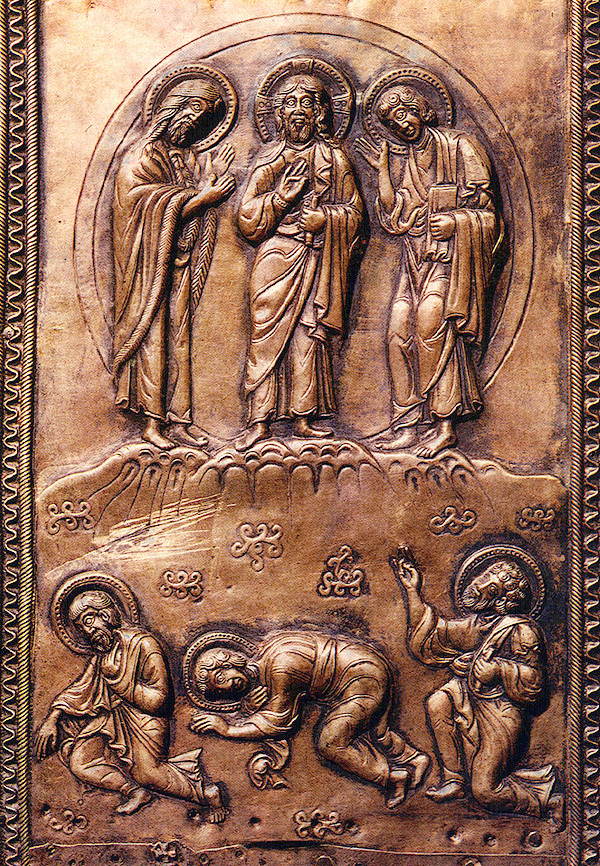
Mark 9:2-9 (9:) – February 11, 2024

            It’s almost Valentine’s Day. If you go into stores or look at ads now, we see Valentine’s Day celebrated, Valentine celebrations encouraged, and of course, we all need to buy something for our own personal Valentine, or else! Flowers, chocolate, stuffed animals, hearts – all to show our love for people, and especially for our particular loved ones and family members.

            If we go back 2000 years to that mountaintop where the Transfiguration happened, we can see when God spoke. And moreover, when God expressed Divine love. Not an expression of earthly or human or fallible love, but God’s love.

            Jesus had been preaching God’s word, healing people and doing other miracles for some time. If we think about it, by this time the Rabbi Jesus was really popular. Just think of any popular person, or famous celebrity. Often mobbed by people when He stopped to preach in a synagogue, or if He stayed overnight at someone’s home.

Shortly before today’s reading Jesus heals another blind man. Jesus was even more in demand than ever, after that display of power and might! Remember, that’s one of the main emphases for Mark. Showing the power and might of the Son of God!

Let’s set the scene. We have Jesus with His disciples. He had twelve disciples who are named, and some other followers. Women, too! Usually unnamed, but also there. But in several important instances, Jesus had an inner circle. Three special, or key disciples, who would be the ones he wanted to tell special things. Important things, as in the Gospel reading for today.

            This inner circle – Peter, James and John – were asked by Jesus to accompany Him early one morning. When they arrive at the top of the mountain, what do they find? Jesus, “His appearance changed from the inside out, right before their eyes. His clothes shimmered, glistening white, whiter than any bleach could make them. Elijah, along with Moses, came into view, in deep conversation with Jesus.” That sudden happening must have shocked the three disciples down to their sandals! Can you comprehend the utter shock and even dismay that these men felt? Awe and amazement, too.

            The most important thing about this point in Jesus’ journey through Palestine is that He had been speaking quite frankly to His disciples for some time. Mark tells this story in the midst of Jesus’ frustrated, repeated attempts to help his disciples understand that he must suffer the trial and death that leads to the cross, but they just cannot accept it.” [1]

            I don’t know whether I would have accepted these statements from Jesus, either, if I had been a follower of Jesus at this point in His ministry. The Rabbi – the Messiah – Jesus all along had been displaying all the signs of the Coming One, the Messiah sent by the Lord. Healing, miracles, preaching and teaching God’s message with authority and power. What a message of hope and encouragement for the downtrodden people of Israel!

            On top of this mountain, after months of this miracle-making, teaching and preaching, Peter, James and John see their Rabbi Jesus have a Divine encounter with Moses and Elijah

            Can you just see these three grown men, clutching at each other, huddling together like small children? Scared to death at these miraculous, out-of-this-world happenings? “Um—oh, Lord! Um—let’s build three altars here! One for You, and—um—one for the other two guys, too!” Or, something like that. Do you think Peter and the other two disciples were very receptive to what God was saying at this point? I suspect not.

            Here on the mountain of Transfiguration, Jesus elevates His message even further. Yes, His disciples hear the message in the form of speech directly from the Lord. The spoken words from the Lord were not many, but they were significant. “This is my Son, marked by my love. Listen to him.” If the three disciples were not paying strict enough attention to Jesus before, you can bet that this breathtaking experience caused them to really sit up and take notice!

            The Divine voice from within the cloud certainly confirms what the earthly Jesus had been communicating to His disciples all along. And, these words show a turning point in the ministry of Jesus – traveling down the road to Jerusalem, towards suffering, the Passion and death, despite His disciples’ refusal to hear what Jesus was saying, repeatedly.  

            I am wondering if the words from the Lord helped to transform Peter James and John? Yes, these words are confirmation for our Lord Jesus, and an expression of God’s Divine love: “This is my Son, marked by my love. Listen to him.” And I wonder, were the disciples changed and transformed by these words, too?

Just as our Lord Jesus was affirmed and transfigured by this Divine statement of love, can we be changed and transformed as we think about these words? Can you and I meditate on these words of the Lord, and see whether this message has a deeper meaning for us, and can change and transform us, too?  

This supernatural event of Transfiguration prepares us as we begin the period of Lent, that 40-day time of preparation when we journey with Jesus toward Jerusalem and the Passion and Crucifixion. How can you – how can I prepare our hearts and minds as we journey with Jesus? I think considering God’s words of Divine love are a wonderful starting point.

Just as much as God spoke out of the cloud on top of that mountain and expressed love for the earthly Jesus, just so much God loves each of us. This Divine love is not faulty or fallible, not human or limited, but instead unconditional and everlasting. We don’t need to be on the top of a mountain to experience God’s love. God will be there. We can celebrate the fullness of the Lord’s presence, and the reality of God’s love and grace! God does indeed love all of us.

Alleluia, amen.

Take a few moments to reread the gospel. Imagine you’re before the Lord Jesus as He speaks to you in His glory. What is His word to you? We start the journey of Lent this week with Ash Wednesday. How will that word of Jesus help you this week on your Lenten journey?

@chaplaineliza

(Suggestion: visit me at my other blogs: matterofprayer: A Year of Everyday Prayers. and  A Year of Being Kind . Thanks!


[1] https://www.umcdiscipleship.org/worship-planning/crossing-over/transfiguration-sunday-year-b-lectionary-planning-notes/transfiguration-sunday-year-b-preaching-notes

Unknown's avatar

Remember Jesus

“Remember Jesus”

communion line drawing

1 Corinthians 11:23-27 – March 30, 2018

One Sunday in another church, one of the bible reading was from the second chapter of Ruth. In the middle of the reading were the words, “The Lord be with you” (Ruth 2:4). The congregation, trained as they were in liturgical language, immediately interrupted the reading with the unison, “And also with you.” The congregation had only ever heard the words, “The Lord be with you,” as a liturgical call that demanded a response, which they provided. [1]

This leads me to ask, how often can “church” get in the way of worship? Here we are at Good Friday, one of the most holy and most devastating days of the church year. And, we can hide in our “churchiness.” Have you pulled the bedcovers of church tradition and church practice over your head, and hidden away from the sadness, shock and devastation of Good Friday?

The words of our New Testament reading for this evening include the words of institution for the Communion service. These are the words I will say later in this service as we remember our Lord at dinner with His friends. The apostle Paul “had learned these words from Christians before him (who had received them ultimately from the Lord) and was in turn passing them on to the Corinthian believers.” [2] These words which our Lord Jesus spoke at that Passover seder were already well known in the Christian community, just a few years afterwards.

Amazing, how significant and meaningful certain meals can be. I suspect you all can remember a particular meal you shared with someone. Was it grandparents? Children? Good friends? We remember meals, and deep conversations, and meaningful interactions. We remember the weather, the situation, where we were. All of this we remember.

All bound up in our Communion service is the recollection of where Communion came from. Whether we call it Holy Communion, or the Eucharist, or the Lord’s Supper, we remember this night when it all started. We remember what our Lord Jesus said and did; we remember what happened after that dinner, on that night two thousand years ago.  

A problem showed up by the time Jesus’s followers were familiar with this remembrance meal,. Paul highlighted this problem in his letter to the believers in Corinth. People of higher or lower social status commonly received different amounts and better or worse qualities of food and drink at their church potlucks in Corinth. That was just the way it was: widespread, almost universal social custom and it could not be changed.

Paul wanted the Corinthian believers—and us, too—to know that “the Lord’s Supper was intended to demonstrate the unity of the church in the mutual dependence on the grace of God shown in the death and resurrection of Jesus.” [3]

Do we hear? Do we understand? Jesus wanted us to know that God’s grace is poured out on all of us, whether we live on the right side or the wrong side of the tracks, whether we are born into wealth or into poverty. No matter our country of origin, or place of citizenship, we all have citizenship in heaven if we believe in the death and resurrection of Jesus.

Remember, Jesus set aside all pretensions and false importance. He did not puff Himself up, or claim undue privilege. As the Gospel of John tells us, our Lord Jesus took the place of a servant and washed His disciples’ feet when they were arguing among themselves, when each considered himself too important to wash the others’ feet. Can our “churchiness” get in the way of our worship? Our reverence? Our remembering?

Rev. Janet Hunt reflects on special times in her family, from her cousin, She remembers, ““I don’t really want a Shamrock Shake. I just want the feeling I had: 7 years old and my mom bought me one after the parade.”

“My cousin Greg posted this on Facebook a few weeks back.  His status update touched me so that first I found myself laughing and then tearing up remembering his mother, my Aunt Jane.  We exchanged a few private messages after that where he recalled with me that this was common practice for his mom, one passed on, evidently, by our grandmother — that of special treats communicating something about love.  That shamrock shake, in fact, was his mother’s way of saying, “I love you and you’re special to me.”

“Meals and memory do get all tied up together, don’t they?” [4]

Whether it’s a memory of our own meals, or a remembering of a meal shared in the Bible—like the meal of Abraham and his three heavenly Guests by the oaks of Mamre, or our Lord Jesus sharing loaves and fishes with a huge crowd, or the great welcome party when the Prodigal came home—we remember certain meals. We share together this special meal, this sharing of bread and passing the cup. We remember deep emotion and feelings, and sometimes we are struck to the heart.

We remember that Our Lord Jesus wanted us to know His message: “I love you, and you’re special to me.” As often as we eat this bread and share this cup, we remember. On this very special night, we remember. Amen.

[1] http://www.workingpreacher.org/preaching.aspx?commentary_id=279  Commentary, 1 Corinthians 11:23-26, Dwight Peterson, Preaching This Week, WorkingPreacher.org, 2009.

[2] Ibid.

[3] Ibid.

[4] http://words.dancingwiththeword.com/2012/03/on-meals-and-memories-some-thoughts-for.html

“On Meals and Memories,” Janet H. Hunt, Dancing with the Word, 2012.

Unknown's avatar

Believe the Message!

“Believe the Message!”

Mark 1-17 fishers of people

Mark 1:14-20 (1:15) – January 21, 2018

What is news? There are lots of different kinds of news. National news, local news. Partisan news, news that is slanted one way or another. What’s more, we hear so much about “fake news” today. News fit to scare the pants off of some people, and news meant to get some people really upset. News brings about all kinds of reactions. What kind of news can we possibly trust? How do we know which kind of news to believe?   

If we take a closer look at our Gospel reading for today, the Gospel writer Mark talks about news, too. Good News. God’s news—God’s wonderful message of Good News, brought by the greatest newsman, the greatest news announcer of all time, our Lord Jesus Himself.

Mark doesn’t waste any time with genealogies (like Matthew) or with long backstories of how Jesus came into the world (like Luke and John). No, Mark starts right off with a bang, with the baptism of Jesus. Then, shortly after He is baptized, Jesus starts to travel about saying, “Time’s up! God’s kingdom is here. Change your life and believe the Message.”

I love the relevance, the immediacy of Eugene Peterson’s modern translation. How appropriate that this translation of the Bible is called “The Message.” The whole Bible is God’s Good News to humanity, and most especially right here, in the Gospel of Mark.

Here we are, right at the beginning of Jesus’s ministry. John the Baptist (the cousin of Jesus) was already on the scene. A sort of a warm-up act for the main event, for some time John had already been proclaiming “Repent! And, believe God’s Good News!” First Jesus came to John to be baptized, and now was the time for Him to begin His own ministry, His own preaching of God’s Good News.

What do we hear first thing in our Gospel reading today? John the Baptist has been arrested. Next thing, Jesus begins to gather a group of disciples around Himself. Mark tells us that the way Jesus does this is by proclaiming God’s Good News. The Kingdom of God has come to us. Or, as Eugene Peterson translates it, “Believe God’s Message!”

One sure way to know when the writers of the Bible really want readers to pay attention is when a word or phrase is repeated. “The emphasis of Mark’s gospel is that Jesus’ coming is the gospel, the “good news,” a term that in the first fifteen verses of the gospel occurs three times.” [1]  Today’s text continues the story from last Sunday, that is, the beginning of Jesus’ ministry as He tells God’s Good News to His first disciples. In today’s reading Jesus calls four fishermen at the Sea of Galilee — Simon Peter, Andrew, James and John.

Our Gospel reading last week was from John chapter 1, and there are some differences between John’s account and Mark’s account from today’s scripture reading. In that sermon, I also mentioned how Jesus called several of His first disciples—this time it was John and James first, and then Simon Peter and Andrew. Some people have said, “I don’t understand. Which story is true, the Gospel of John or the Gospel of Mark?” Great question.

When a car accident happens in the middle of a busy intersection, that is a real tragedy. I understand when the accident is serious enough, the police sometimes get involved to find out exactly what happened. Imagine the surprise and even consternation when eyewitnesses on different street corners have different perspectives and impressions of the same event!

In the case of the car accident, the different people all saw the same vehicles collide, but from opposite angles and varying positions. Different things may have made a strong impression on one witness, more than another.

It’s no wonder that their eyewitness accounts are somewhat different from each other. And, in the case of the four different Gospel accounts, that adds to the richness and depth of the separate narratives. Each Gospel writer had a separate emphasis and perspective, and different things he wanted to highlight and point out.

However, we need to drill down to what is common between these readings. Jesus calls His first disciples, and Jesus tells them all, “God’s kingdom is here. Change your life and believe the Message.” What is the definition of God’s Good News, anyway? In Greek, the word is euaggelion, or Gospel. God’s Message of Good News to all humanity.

As we trace this Good News through the four Gospels and the rest of the New Testament, we get some more information. God’s Good News is truth. With the coming of the man Jesus here on the earth, humanity has the opportunity to see and touch and experience what God is like. A key feature of this Good News is hope. The fallen world is pretty hopeless and dark, but Jesus brings hope to the hopeless heart. And, last, God’s Good News means salvation. Salvation is not just being saved from the negative aspects of escape from sin and death. No! Salvation is eternal life, and the power to live life victoriously. [2]

God’s Good News is something new to many; something different, even radical. Why on earth should anyone want to adopt this strange, new life from Jesus? Maybe, this way of being and living is even a bit frightening? Many people may well be afraid of taking such a big step.

As Dallas Willard writes, “when he was a boy, rural electrification was just happening and power lines were being strung throughout the countryside.  But suppose even after the lines were up and running you ran across a house where the weary family still used only candles and kerosene lanterns for light, used scrub boards, ice chests, and rug beaters.  A better life was waiting for them right outside their door if only they would let themselves be hooked into the power lines.  “My friends,” you could proclaim, “electricity is at hand!”  But suppose they just didn’t trust it, thought it was too much of a hassle, and anyway didn’t believe the promises that things might be easier with this newfangled juice running into their house.  “If it’s all the same to you, we’ll stick with the old ways.” [3]

You see the difficulty? How some people are afraid of change? Or, prefer not to change their lives? How some don’t want to accept this Good News from God because it’s different, or new, or out of their experience? Can you hear Jesus saying, “My friends, God’s Kingdom is at hand! God’s Good News of eternal life is right here, waiting for you!”

Jesus still offers this gift of God in our world today, proclaiming His Message of God’s Good News, His Message of God’s truth, hope and salvation.

God’s Good News actually makes our job simple. We need to widely and clearly communicate the Message of God. “What mustn’t be lost on us is the urgency of its communication, for the day of judgement is at hand. We point to the hope of eternal life in Christ and call on everyone everywhere to turn and put their trust in Jesus.” [4]

Have you responded as the disciples did, by dropping everything and embracing the Good News? Jesus is calling, waiting for you and for me. Jesus says, “Believe the Message! Come, follow Me.”

[1] http://www.workingpreacher.org/preaching.aspx?commentary_id=2315

Commentary, Mark 1:14-20, Michael Rogness, Preaching This Week, WorkingPreacher.org, 2015.

[2] Barkley, William, The Gospel of Mark (Westminster Press: Philadelphia, 1975), 25-26.

[3] http://cep.calvinseminary.edu/sermon-starters/epiphany-3b-2/?type=the_lectionary_gospel

Commentary and illustration idea, Mark 1:14-20, Scott Hoezee, Center for Excellence in Preaching, 2015.

[4] http://www.lectionarystudies.com/studyg/sunday3bg.html   “Repent and Believe in the Good News,” Rev. Bryan Findlayson, Lectionary Bible Studies and Sermons, Pumpkin Cottage Ministry Resources.  

@chaplaineliza

(Suggestion: visit me at my regular blog for 2018: matterofprayer: A Year of Everyday Prayers. #PursuePEACE – and my other blog,  A Year of Being Kind . Thanks!)