Unknown's avatar

How Majestic!

“How Majestic!”

Psalm 8:1-9 (8:1) – June 15, 2025

            Have you ever been far from the city lights, at night? Have you ever looked up into the sky, and seen countless stars spread out, twinkling high above? When I went to the Upper Peninsula of Michigan, and again in rural central Indiana, the starry skies were absolutely breathtaking. Amazing. Majestic, as the psalmist King David said in our Psalm reading today.

            Listen again: “Lord, our Lord, how majestic is your name in all the earth! You have set your glory in the heavens.” I can just imagine King David sitting far away from the lights of the city of Jerusalem, perhaps contemplating the stars as he saw them in his youth, when he looked after his father’s sheep, or as a younger adult, a leader of men in the wilderness of Judah, David certainly had many opportunities to gaze up into the night skies and see the breathtaking stars.

            As we gaze up into the night and see the amazing sight of all the stars laid out above us, we marvel. Marvel just as countless people have done throughout the millenia. As we think about the vastness and sheer beauty of the heavens, other vast, even unanswerable questions may come to mind. Just as countless people have done, and have reflected upon. Questions like: What was God doing before God created the world? And, how can there never be a time before or after God? And, how can God pay attention to each person in the world all the time? [1]

            These kinds of big questions have puzzled people for millenia, too. You and I could get hung up on these kinds of questions, and totally lose sight of the sheer, magnificent, bottomless awesomeness of God. Or, are we simply to return to the first verse of today’s reading, and be totally in awe at God’s glorious majesty? “Lord, our Lord, how majestic is your name in all the earth! You have set your glory in the heavens.”

            My husband tells me when I am thinking about big ideas, I am sometimes too focused on individual trees, rather than looking at a whole forest. That is what comes to mind when I get sidetracked by wondering what God was doing before God created the world. Or, maybe, why did God create rattlesnakes and mosquitoes? Perhaps – it is okay just to contemplate the vastness of the heavens and the sheer beauty of all the stars, comets, moons and other creations in the universe! Just as Psalm 8 invites us to do.

“How majestic is your name.” That’s the line that stands out, maybe because the psalm begins and ends with those same words. “How majestic is your name.” That sounds wonderful, indeed! Our opening hymn was written by Michael W. Smith, and we sang these exact words at the beginning of our service. And, the words sung by the angels, the seraphs flying around the heavenly temple in Isaiah 6 – they kept singing, kept repeating “Holy, holy, holy is the Lord of hosts, the whole earth is full of God’s glory.”

            Over and over, the seraphs sang those words. And, it is sometimes in the singing and in the repetition that the majesty and awesomeness of God begins to make sense. I mean, as much as it can, to our puny, limited, human comprehension.

            The concept of the Trinity, one God, Three in One, is a difficult concept to start to believe, much less fully comprehend. For a small comparison, we can look at water. Water is liquid, at room temperature. Yet, when we freeze water, it turns hard. It becomes ice. Is it still water? Yes. And, when we heat up water, it turns into steam – becomes gaseous. Is it still water? Yes.

            This example of the three states of water is an imperfect way to talk about the Trinity. Yet, we can marvel at the awesome complexity of the doctrine of the Trinity just as we marvel at the glory and magnificence of our God and God’s creation, just as Psalm 8 leads us to do. Whether we sing about our awesome God, talk about the glory of God, or contemplate God and God’s magnificent creation, it’s all good. And, all these activities are exactly what we are led to do throughout the Bible, and especially here in Psalm 8.

            Looking to the skies and contemplating the glory of God may be a sincere way for people to begin to try to understand how huge God is. And, if we are coming at the theological concept of the Trinity – which is also a huge thought – perhaps it’s best for you and me to think about this huge thought from God’s end of things, from God’s point of view. Whether you and I “can fully grasp the nuanced theological understanding of what Trinity means, we can acknowledge that, in part, it means that God wants to be known and experienced by those who claim the majestic name of God as sovereign. We give thanks for an accessible God.” [2]

            I return to one of my tried and true ways of looking at biblical things, from a theological perspective. You all know that sometimes I view the topics or ideas from my sermons in a way that children see them, or in a way that young people more readily understand. Psalm 8 tells us about the wonders of God. Even little children can (and do) accept this as the truth of God! However, little children are definitely not interested in explaining how or why, or about lengthy sermons droning on about different theologians and their competing view on God and the Trinity.

            Very often, deep down, children understand that God made them and God loves them. This is a foundational truth! You and I can have – along with the children – a “simple” and “trusting” faith. We don’t need to use the “right” words in our prayers and creeds. Remember – God wants to be known by us, above all! And, our Lord wants to be experienced by all who claim the name of the majestic God. By those who praise God’s name.

            Yes, the theological understanding of the Trinity is also a deep theological truth. Yet – I can tell you right now that we as fallible, frail humans fall short of understanding God’s ways. I can also tell you that in the midst of everything, we can know we are loved. God wants each of us to know our Lord intimately! As my commentator the Rev. Dr. Derek Weber says, “We are being made more like the Christ we follow. Our love is being shaped by God’s love that is poured into us. We are God’s act of creation. That’s a part of the message of Trinity Sunday. The Creator works within us, choosing us to be a sign of God’s presence in the world.” [3]

            Yes, God’s message is quite simple. We can know we are loved by God. God wants each of us to know our Lord intimately! And, our awesome God works within each of us, choosing each of us to be a sign of God’s presence in the world. This is the best Good News we can bring to the world. Alleluia, amen!

@chaplaineliza

(Suggestion: visit me at my other blogs: matterofprayer: A Year of Everyday Prayers. #PursuePEACE – and  A Year of Being Kind . Thanks!


[1] https://worshipingwithchildren.blogspot.com/2016/04/year-c-trinity-sunday-may-22-2016.html

[2] https://www.umcdiscipleship.org/worship-planning/trinity-sunday-year-c-lectionary-planning-notes

[3] https://www.umcdiscipleship.org/worship-planning/trinity-sunday-year-c-lectionary-planning-notes/trinity-sunday-year-c-preaching-notes

Unknown's avatar

Full of God’s Glory!

“Full of God’s Glory!”

Isaiah 6:1-8 (6:3) – May 26, 2024 

Have you ever visited a really beautiful church? Magnificent, with lovely stained glass windows, carved pews, high, vaulted ceilings? What comes to my mind is the National Cathedral in Washington D.C., or St. Paul’s Church in London, or perhaps one of the great Gothic cathedrals in the Rhine valley in France or Germany. Think of a church like that, only magnify the beauty and wonder of the building ten times. I cannot even imagine a place that spectacular.

Yet that is just what Isaiah is trying to describe for us in our scripture passage today. A church—or, more specifically, a heavenly temple—so magnificent that he can hardly even begin to describe it.

That is only the beginning! What is even more magnificent, more awe-inspiring is what Isaiah sees inside that heavenly temple. The prophet says he “saw the Lord, high and exalted, seated on a throne; and the train of his robe filled the temple. Above him were seraphim, each with six wings: With two wings they covered their faces, with two they covered their feet, and with two they were flying. And they were calling to one another: “Holy, holy, holy is the Lord Almighty; the whole earth is full of his glory.”

Isaiah finds himself in the throne room of heaven in the presence of the Lord of creation. Awe-inspiring, terrifying, humbling, overwhelming. I don’t know about you, but God’s magnificence and glory can knock me off my feet when I least expect it. God can bump me and shake me up. God can turn my self-sufficiency inside out. Has that happened to you, too?

Perhaps you recognize the words from our opening hymn this morning: “Holy, Holy, Holy, Lord God Almighty!” Today is Trinity Sunday, that day in the church year, the week after Pentecost, when we lift up one of the ineffable mysteries of the Church: the holy Trinity itself. I love this passage from Isaiah for several reasons. First, this is Isaiah’s call story, how the Lord God reached out to Isaiah and touched this man with the power of God, and placed him on the road of being a prophet for God.

Such a moving story, and one that resonates with anyone who has been similarly called by the Lord into a God-ordained calling or vocation. (And not necessarily just a “churchy” vocation.) Some people feel very strongly that they have been called to be doctors or nurses, teachers or social workers, farmers or mechanics. God can call people to a variety of positions, all to serve to God’s glory and for the good of humanity.

Yet, this reading today is much more than that. Not only is Isaiah’s experience one of marvel and awe. This reading is one of the sources for our worship service today.

As Dr. Lisa Hancock advises, “The whole encounter begins with Isaiah showing up at the temple. So, consider taking some time to welcome and orient the congregation toward showing up to God’s presence in their midst. Acknowledge all that we bring with us into worship, the burdens and joys and everything in between.” [1] We as a congregation strive to tune into God’s presence with us even as we have come to be present to God and one another. The most amazing part is, we come into God’s presence each time we gather to worship!

            Orthodox Christianity confesses the Holy Trinity each time a congregation repeats the Apostles Creed. Confessing belief in the Father, Son and the Holy Spirit – or in more modern language, Creator, Redeemer and Sustainer – is an intellectual, static form of statement of faith. Yet, as we consider the Trinity more deeply, even more theologically, we often are thrust into the midst of relationship! This awe-inspiring, terrifying Presence that Isaiah saw in the heavenly temple is also a vibrant Three-Persons-in-One. Difficult for us to even comprehend, but the idea of a Divine Relationship, companionship, a heavenly Community-in-One is the beginning of our understanding. As complex and mind-blowing as it can be.             

            Just as those seraphim sang, “Holy, holy, holy is the Lord of Hosts!” and just as we are welcomed into God’s presence each time our congregation enters into worship, so the Holy Trinity is here in this place. The Three Persons of God are in beautiful relationship with one another, and we are invited into that heavenly relationship, too!      

            We are cautioned, however. God does not only want the people from this particular neighborhood as a part of that heavenly relationship. God does not only belong to this particular church. God also is God of our Catholic friends, and of Holy Name Cathedral in downtown Chicago, and of Trinity UCC and San Lucas United Church of Christ. God is also God of the Quaker meeting in Evanston as well as Chinese Christian Union Church in Chinatown, and our Korean friends Love Sharing Disciple Church in Morton Grove. A whole multitude of different faith traditions, too, from every tribe, every nation under heaven.

            As my online friend Rev. Bosco Peters says, “We live in a world that so often fears difference. We bully them, persecute them, will not employ them, do not want to live in their neighbourhood, kill them, go to war with them. Yet the universe…holds wonderful diversity in unity. This beautiful multiplicity held in harmony in our universe is no accident because the source and heart of all reality is the one we call “God” – three in one. To live the Trinity life is to rejoice in diversity and to work towards holding it in unity.” [2]

It does not matter to God – the awe-inspiring, humbling and overwhelming God is above all and over all. Just as the Holy Trinity is in relationship and in heavenly community, Triune Three-in-One, our God wants a relationship with each of us! The Lord desires to develop an intimate relationship with every person, in beautiful diversity, promoting harmony and unity regardless of color, creed, cultural difference, language or nation of origin.

We are encouraged to enter into relationship just as we are encouraged to enter into worship each week! With God, yes! And with every other person in diversity, regardless of color, creed, cultural difference, language or nation of origin. God created each one of us to live the Trinity life! Rejoice in diversity and work towards holding it in unity. That means each and every person, each and every child of God. Including you, including me. Alleluia, amen.

@chaplaineliza

(Suggestion: visit me at my other blogs: matterofprayer: A Year of Everyday Prayers. and  A Year of Being Kind . Thanks!


[1] https://www.umcdiscipleship.org/worship-planning/ascribe-to-god/trinity-sunday-year-b-lectionary-planning-notes

[2] https://liturgy.co.nz/trinity-sunday-2024?fbclid=IwZXh0bgNhZW0CMTAAAR30CzSonnCEtgz7V1bvjxP9SYmzEmRrJj2NYa4L3R2dl-dmA1nf3cPFzL4_aem_ATWps3Va7lMKpyFuppPtoxnznrMJ8apyP_Fq3to2Rlo1zOv7fsosZJtrIT-639n4JB33Yo04O1K_sCdt-hhKevdp

Unknown's avatar

God Baking Bread!

“God Baking Bread!”

Matthew 13:33 – August 6, 2023

            Has anyone here baked bread, from scratch? I have, although it’s been a number of years since I baked white bread and wheat bread. Now, I more often bake sweet breads – banana, zucchini, apple, and other types. Homemade bread is such good bread!

            In our short Scripture passage today, we have our Lord Jesus, telling another one of His parables. This one is in chapter 13, which has a number of parables or short stories, all about the kingdom of God. These metaphors and word-pictures are meant to help Jesus’s listeners get a little bit better understanding of this huge concept Jesus taught about!

            The topics Jesus used for His parables are down to earth, from real life. For example, Jesus talks about a farmer and his field, and the weeds that grow. Typical of so many in that time, and relatable to so many of His listeners! Remember, we are looking at Bible readings that help us Re-Image God, in a nurturing, feminine way. The parable we highlight today features a woman. Yes, and something typically known as women’s work, in the home.

An unusual topic for a Rabbi to talk about! I am sure there were (and are) men who traditionally and habitually bake bread, but in Palestine as in many other rural-based cultures, but women often did many of the tasks involved with housework and home-making. Including the regular baking of bread. And, in a typical Palestinian house, a lot of bread needed to be baked each week. In the first century of the Common Era, you couldn’t run out to the local grocery store and get a loaf of bread, a dozen eggs and a gallon of milk, after all.

This parable of the yeast is one where our Lord Jesus focuses on work done by a woman. Sometimes, when the Bible mentions yeast in connection with spiritual things, yeast has a negative connotation. Not here! Jesus did something unexpected! He turned the tables on a typical understanding of yeast, or leaven. This parable is unusual and unexpected! In a matter-of-fact way, Jesus lifts up this work of baking, and the work of women, too. And without specifically naming it, Jesus compares God’s work to women’s work.

One of my favorite commentators is the Rev. Janet Hunt, a Lutheran pastor in De Kalb, a couple of dozen miles to the west of us, near Northern Illinois University. She loves to bake bread, and talks about her baking at length in her article about this particular parable. Pastor Janet’s mother used to bake bread, too. According to Pastor Janet, she was told “that our mother’s mother also baked as her mother did before her in a time and place where doing so was not an occasional practice or a hobby as it is with me, but was a necessary part of one’s weekly tasks, for bread was an everyday staple and it was not yet sold in stores.” [1]

Even today, in some rural areas and small towns, baking bread at home is much more common than it is in urban areas. The woman in this parable took a lot of flour – over a bushel of flour! She probably ground that flour with a hand-cranked little mill, too. And then, baked some bread. Jesus said that she mixed the yeast into the flour until it had leavened the whole big batch of flour! In case you are not familiar with the process of leavening, the introduction of the yeast causes a transformation of the dough.  

Before the adding of the yeast, before its mixing and incorporating into the whole batch of dough, what do we have? A big pile of flour, and some water to moisten it. Perhaps a bit of sweetener like honey, perhaps not. But, imagine the working and mixing of the flour, water and yeast! As this unnamed woman mixes and kneads the dough, the yeast gets incorporated throughout the whole. As the dough rises, the yeast does its work unseen, quietly.

The woman of Jesus’ parable “would not have had a finely tuned gas or electric oven in which to bake her bread. It would likely have been done in a clay oven over hot coals. And while she certainly could have turned her attention to other things while the bread rose or the coals came to the right temperature, baking the bread would have required her to stay nearby all day long so as to be ready for the next step. For in fact, it is possible to let bread rise too long, making the final product less appealing. And coals need to be at a certain temperature to make the baking optimal.” [2]

I hope I am making the baking of bread sound like a challenging activity, because it was, and is! Let us take a step back, and consider again this short parable of Jesus. He compares the kingdom of heaven to yeast. Could it be that our Lord is saying that “Kingdom work” takes time, energy and attention, just as the work of yeast and baking takes time, energy and attention? That it sometimes requires patience as we wait for ‘yeast’ to rise?    

Time after time, I have heard stories and read accounts of the slow or hidden or pain-staking work of the kingdom of heaven finally showing fruitfulness. Finally, good dough baking and bringing forth good, homemade bread, as we recognize the kingdom of heaven at work in our lives or in the lives of those near and dear to us! We can take common things, everyday materials, and have them transformed by God.

God loves to take things as simple as bottles of water given out for free at a farmer’s market, or boxes of cereal or feminine hygiene products brought to a local food pantry to be a part of God’s kingdom. Because, they are! Something as simple and as straight-forward as common, everyday activities or items can be used and transformed into God’s purposes – God’s work – God’s kingdom.

Remembering this parable of the yeast, we can see how God works quietly, confidently, sometimes over a long time. Today, we come before God to celebrate the Lord’s Supper, that meal of common things that our Lord Jesus transformed into a sacrament. We come to meet God in a special way at God’s table, doing what Jesus commanded us to do. As often as we eat this bread and drink this cup, we celebrate our Lord until He comes again in glory.

Doing Kingdom work as Jesus told us to do from this parable, we can bring glory to our God in common ways, using everyday things. We don’t have to be extraordinary ministers or missionaries, or God’s adventurers. As Jesus told us? We can use ordinary things, everyday items, common ways. And, this will indeed bring glory to God. Let us take these words to heart, and go and do them. Amen, alleluia!

@chaplaineliza

(Suggestion: visit me at my other blogs: matterofprayer: A Year of Everyday Prayers. #PursuePEACE – and  A Year of Being Kind . Thanks!


[1] https://dancingwiththeword.com/a-one-sentence-parable-which-opens-up-the-world/

[2] Ibid.

Unknown's avatar

Sweeter than Honey

“Sweeter than Honey”

Psalm 19 (19:10) – October 4, 2020

            Happy New Year! L’Shana Tovah! We are starting the Jewish year 5781.

            The new year’s greeting that one person says to another, “A sweet new year to you!”  “L’Shana Tovah!” reminds me of this verse from Psalm 19: The Laws of the Lord “are more precious than gold; they are sweeter than honey.”

Psalm 19 has been a beloved reading of mine for years. Not only does King David get all excited about the heavens communicating the glories of God, but he also expressed his awe and praise about Scripture doing the same thing.

            Certainly, the law of the Lord, the statutes, the ordinances, the decrees of the Lord are not exactly warm bedtime stories. However, these words of the Lord are guideposts for us. How else are we to know and to understand how we are supposed to treat each other?

            David made it his life’s work to try to follow God, as best as he could. Psalm 19 definitely shows us how highly he thought of Scripture. What do you treasure most? Would you think of something valuable as “sweet?” King David obviously did.

            Like David, we stand in awe of God’s glory, whether we marvel at the vast heavens or the countless stars, or are amazed at the order and trustworthiness of God’s Word. 

As we consider the Bible, God’s Word, more closely, these words and ideas give us more specifics for what it means to love God and to love others. On several occasions during His ministry, our Lord Jesus talks about God’s Law. He gives a response to a devout Jew who wanted to know the most important command of any of those given in the Hebrew Scriptures. Jesus’ response? Love God, and love others. The rest of the Bible is commentary.

As David praises God’s Word in this psalm, I am also reminded of the Ten Commandments, another Lectionary Scripture reading for this morning. Talk about the law of God, the commands of God, the statutes of God, and the decrees of God! The Ten Commandments encapsulate the high points. These special commands list how people are supposed to love God and to treat each other.

Thinking about the whole Bible – the Hebrew Scriptures and the New Testament – as guideposts or directions for living God’s way, the way set out for us gets very clear. It is not just a mental exercise, or an intellectual game we play in our heads. No! I like Eugene Peterson’s translation of our Psalm reading for today in The Message: “The revelation of God is whole and pulls our lives together. The signposts of God are clear and point out the right road. The life-maps of God are right, showing the way to joy.”

“The directions for living we find in the commandments and in Jesus’ teaching are intended to be put into practice in real life. And they are intended to make that life more whole, more peaceful, more joyful.” [1]

Best of all, when we live in this way, we are allowing the life and love of God to flow through us. Each of us does our part to heal the broken and wounded world around us.

If so, then you allow the life and love of God to flow through you. If so, our living in God’s way and walking God’s road surely is sweet. Sweeter than honey from the honeycomb!

Alleluia, amen.


[1] http://thewakingdreamer.blogspot.com/2012/03/non-virtual-faith-exod.html

“Non-Virtual Faith,” Alan Brehm, The Waking Dreamer, 2015.

@chaplaineliza

(Suggestion: visit me at my regular blog for 2020: matterofprayer: A Year of Everyday Prayers. #PursuePEACE – and my other blog,  A Year of Being Kind . Thanks!

Unknown's avatar

Our Good Confession

“Our Good Confession”

1 Tim 6-12 good confession

1 Timothy 6:11-13 – September 29, 2019

Some people express their devotion to certain things so clearly, don’t they? Take sports teams. I am sure you know friends or acquaintances who devoutly follow a sports team in season and out. I have one particular friend who regularly wears the team jerseys (yes, he has several), plus team hats, team jackets, and team flags. All the official merchandise! Everyone knows who he supports!

I wonder, do many of us know people who express their belief or devotion to Jesus Christ with the same excited amount of fervor? Or, are people shy of expressing their belief in the Lord very loudly, lest they be considered weird or narrow-minded, or even extra judgmental?

We are looking at the letter to Timothy for the second week in a row. Here we sneak a look over Paul’s shoulder as he dictates this letter, and discover he is concerned about Timothy remembering what is really important. He tells Timothy what that is: remember when he made the good confession, when he openly told everyone he was on Team Jesus. Can you see him excitedly shouting, waving his arms and wearing his Team Jesus merchandise?

Perhaps that “Team Jesus” uniform and jersey analogy is going a bit overboard, even somewhat fanciful. However, Paul was quite sincere in reminding Timothy about the time he publicly confessed his faith in Jesus Christ. This time of baptism was an important time in any adult believer’s life, both early in the founding of the church as well as in later centuries.

I suspect we here in the United States have only an unclear idea of how much danger the first believers were in. They were outlaws, outcasts in the Roman Empire. The Roman Empire was not particularly fond of Jews, but at least Judaism was allowed. However, Christians were getting rounded up by the authorities because Christianity was a new, outlaw religion.

Did Paul realize his friends would get in trouble if they told people they were on Team Jesus? Yes, of course he did. Sadly, he knew this very well. He himself was in prison for regularly testifying to the Lord Jesus Christ.

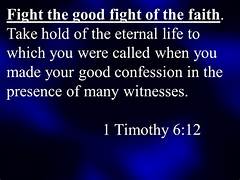
Let’s take a closer look at the words Paul wrote to Timothy: “12 Fight the good fight of the faith. Take hold of the eternal life to which you were called when you made your good confession in the presence of many witnesses. 13 In the sight of God, who gives life to everything, and of Christ Jesus, who while testifying before Pontius Pilate made the good confession, I charge you 14 to keep this command.”

Almost everyone who became a believer in Jesus Christ at that time was converting as an adult from another kind of religion to Christianity. In other words, taking the step of a public baptism was part of confessing Jesus Christ as Lord, publicly.

In many cases, the newly-baptized person put on a fresh, white robe, signifying new life in Christ. I want to emphasize—after baptism—putting on fresh, new clothes: a brand-new Team Jesus jersey, letting everyone know that the newly-baptized person was now an openly-professing Christian.

Just so we do not mistake exactly what this confession details, let me give an illustration from the book of Acts, chapter 16. Paul, Dr. Luke and their friends were on a missionary journey to a large city in Macedonia, Philippi. Paul—as usual—was getting in trouble for preaching, teaching and casting out evil spirits. Paul and his friend Silas get thrown into prison, and God sovereignly causes an earthquake to happen. The jailer (who has been hearing all about their good confession all day and into the night) gets convicted by God, Reading from Acts 16: 29 The jailer called for lights, rushed in and fell trembling before Paul and Silas. 30 He then brought them out and asked, “Sirs, what must I do to be saved?”

31 They replied, “Believe in the Lord Jesus, and you will be saved—you and your household.” 32 Then they spoke the word of the Lord to him and to all the others in his house. 33 At that hour of the night the jailer took them and washed their wounds; then immediately he and all his household were baptized.

That was the good confession. Right there. The confession made by the Philippian jailer, even though he knew what a commitment that confession might be.

But, wait—Paul does not stop there in his letter to Timothy. He then mentions the Rabbi Jesus, who after His arrest and during His trial makes the good confession before Pontius Pilate oly a few hours before His crucifixion. Moreover, Christ Jesus made this good confession before many hostile witnesses.

A professor of the New Testament Dr. A.K.M. Adam states “In this, Timothy followed the example of Jesus before Pilate, who did not deny God in order to secure his own safety (the letter identifies Jesus’ response to Pilate also as a “good confession”).” [1] Again, the apostle Paul is not shying away from openly stating that these people believe in the Christian God.

We here in the United States might think, Paul, are you crazy? Coming right out and telling hostile people you are a Christian? Wearing your Team Jesus jersey all the time, day and night?

Yes, Paul does mean that. He is faithful, and he confesses his faith in Christ on a regular basis. He wants to encourage Timothy to do the same, to live each day for Jesus.

I think most people who knew how hard the baseball player Joe DiMaggio played would say he gave his heart and soul to the game of baseball. Late in his career, when the New York Yankees were comfortably ahead in the pennant race, Joe DiMaggio was asked why he continued to play so hard. He said, “Because there might be somebody out there who’s never seen me play.” Just so, the Christian should live every day as if someone will see him who has never seen a Christian before. [2]

So, Paul and Timothy are both wearing their Team Jesus jerseys, and maybe Team Jesus hats and jackets, too. The transformed Paul and Timothy let everyone who sees them know that they are Christians, showing love, compassion, and caring to all.

Paul even gives Timothy a run-down of all the attributes we ought to expect to show in our lives if—if we have this good confession, and before hostile witness, too! If we show this kind of sincere, persistent faithfulness, then our lives will start to show these Godly characteristics Paul mentions in verse 11. We will pursue righteousness, godliness, faith, love, endurance, and gentleness. That was the transformation that Paul told Timothy would happen. And, God does transform lives, even today!

Just like Timothy, we are encouraged to live like we mean it. Live as if someone who sees us has never seen a Christian before. Live the best life we can, for God’s glory. It’s not just with a spoken-confession, but it is also with a doing-confession. Not only show Christ by the words we say, but we show our belief by the actions we do. Yes, confess with our mouths the Lord Jesus, and also do the deeds that please God and glorify His name.

That is confessing the good confession, indeed. Alleluia, amen.

[1] http://www.workingpreacher.org/preaching.aspx?commentary_id=731

Commentary, 1 Timothy 6:6-19, A.K.M. Adam, Preaching This Week, WorkingPreacher.org, 2010.

[2] https://ministry127.com/resources/illustration/faithful-all-the-time Source: Summer of 49, David Halberstam

@chaplaineliza

(Suggestion: visit me at my regular blog for 2019: matterofprayer: A Year of Everyday Prayers. #PursuePEACE – and my other blog,  A Year of Being Kind . Thanks!

Unknown's avatar

Transfigured? Frightened!

“Transfigured? Frightened!”

Mark 9:6 (9:6-7) – February 11, 2018

Jesus Transfiguration Georgian relief Luke 9

Transformations can be quite a surprise. For example, when a run-down house gets a top-to-bottom rehab job over weeks or months, the house can be really transformed. Or, when someone is diligent over time with diet and exercise, and loses a lot of weight, they can be really transformed, as well. People can be surprised and impressed when they see the stunning changes that happen, gradually. These kinds of transformative changes can take a while.

The type of stunning change that happened in our Gospel reading today did not take weeks or months. Instead, our Gospel writer Mark talks about the transformation happening suddenly. Or, to use one of Mark’s favorite words: immediately.

We need to set the scene. Just previous to this reading, in Mark chapter 8 Jesus asks His disciples who others say that He is, followed by who the disciples think He is. Peter makes the great statement “You are the Messiah.” It is then that Jesus predicts His death. He starts to tell His disciples that He will have to suffer, be rejected and die, and then rise after three days. All of which must have been difficult to understand for the disciples.

I can relate to the followers of Jesus. Jesus was a charismatic leader, and many people listened to Him, and even followed Him. However, some of the things Jesus said were clear out of their experience. Even with all of the biblical revelation, evidence and commentary that we have nowadays, some of the statements of Jesus are still a challenge for us to understand, today. I can relate to the disciples’ confusion and puzzlement!  

A few days after the confession of Peter and all this big stuff happening, Jesus decides to go for a day trip, up on the top of a mountain. He asks only three of His disciples to come with him: Peter, James and John. After they reach the mountaintop, Jesus suddenly is changed. Transformed. Or, as the Gospels tell us, Jesus is transfigured. This is a state of God’s heavenly glory, suddenly appearing all around Jesus, making His clothing whiter than anyone has ever seen. If that is not enough, the glorified Jesus is seen talking with Moses and Elijah.

Can you see the picture? Imagine a huge, bright spotlight shining on Jesus, Moses and Elijah. Plus, there are more small spotlights all around, and the background surrounding them is all backlit. Except—the people of Jesus’s time have never even heard of electricity. All of this super-white light and super-white clothing is supernatural. Of heavenly origin.

I am reminded of the heavenly glory that surrounded Moses on top of Mount Sinai. Moses was no stranger to heavenly whiteness and brightness. He was in the presence of the Lord God Almighty for many days. And, Elijah—going up to heaven in a fiery chariot pulled by fiery horses? That must have been a heavenly experience of light and glory, too. Much less being in heaven, in God’s presence for centuries at that point.

Moses and Elijah were the premier representatives of the Jewish people, of the Jewish law code and the voice of the prophets. Revered by millions of Jews since their time. And, on top of that, they were in the presence of the suddenly-glorified Lord Jesus Christ. Is it any wonder that mere humans Peter, James and John were all shaking in their shoes?

I discovered a fictionalized conversation between Jesus, Moses and Elijah, from that mountaintop that Mark tells us about. This conversation comes from Pastor Joyce, written in 2003, from a commentary website I visit on occasion. Listen to this conversation:

Elijah: Look at these stubborn and fearful people. How do you get these children to honor God?

“Moses: And how do you teach them to love each other? God knows I tried. I brought God’s law down from the mountain top. It is very clear. The simple commandments tell them how to love and honor God and how to live together in mutual love and respect.

But right after I told them how to live, they began complaining about God and began to worship false idols. The law told them not to betray or disrespect others. Yet, the powerful continued to grasp for more wealth and power. Foolish people they thought that would give them security. But for these things they have to oppress the weak. Then the fighting starts. It can lead to killing.

“Elijah: Well, I warned them. I told King Ahab and the people not to worship false idols. I challenged 450 prophets of Baal and they died on the mountain top. But today, people still worship the idols they create: power, material possessions, and the comfort they bring. But they do not receive satisfaction from them. NO! How do we teach people to find the real thing — joy in relationships with God and with each other?

“Jesus: God sent you, Moses, to give the law.  God sent you, Elijah, and other prophets to warn the people of how they are harming themselves. Now God has sent ME… I will live among these rebellious people for a while. I will love them and I will die for them. These men you see before you, and those who follow them, will carry on my work of reconciliation to God and humankind.

“Moses: These men? Look, they are dumbstruck. They are frail. They are confused.

“Elijah: Good joke, Jesus. Now… tell us your real plan.

“Jesus: I have no other plan.

“Elijah: But how will they find the wisdom and the strength?

“Jesus: Ahhh… I will be with them.” [1]

Did everyone hear? Jesus promised to be with the disciples, a number of times. Not only with the disciples, but with all of His friends and followers.

It’s true that Peter—good, old foot-in-mouth Peter—made some sort of confused and excited offer to build three little booths or mini-altars there, on top of the mountain. Yes, with our 20/20 retrospect, we can laugh at Peter’s fumbling and falling all over himself. But, wouldn’t we be in the same boat? What if there were a heavenly visitation right here, right now? Boom! Cue the bright lights! The glorified Jesus, here in our midst, here at St. Luke’s Church!

The thing is, Jesus could have stayed there, on that mountaintop, with Peter, James and John. Relatively safe, and the mountaintop could have become a pilgrimage site, renowned throughout the world. But, no. Jesus knew He had to walk the way of the Cross. He knew we, His followers and friends, had to come down from that mountaintop, too.

The disciples did not just slink away and hide. No, they went out after the Resurrection and Ascension and after Pentecost, and they turned the world upside down with the Good News of the risen Lord Jesus. It was not all sweetness and light for the disciples, or for the other followers of Jesus. No, many of them had a very difficult time. Yet, Jesus was with them.

Today, we don’t permanently live on the mountaintop, either. Yes, we often walk through the dark valleys. Yes, there is sorrow and pain in our lives. As David Lose says, the nitty-gritty details of misunderstanding, squabbling, disbelieving disciples. Religious and political quarrels of the day. Jealousies and rivalries both petty and gigantic. Into the poverty and pain that are part and parcel of all of our lives. [2] Yet—Jesus is right by our sides, too. Yes, in the good times, and yes, in the not-so-good, even sorrowful times, too.

Do you hear? Jesus will be with us, in good times and bad. We can take comfort in that. We can celebrate. Praise God. We are not left alone and friendless. What a friend we have in Jesus, indeed. Amen, alleluia.

[1] http://desperatepreacher.com//bodyii.htm

[2] http://www.workingpreacher.org/craft.aspx?post=1563

“He Came Down,” David Lose, Dear Working Preacher, 2012.

@chaplaineliza

(Suggestion: visit me at my regular blog for 2018: matterofprayer: A Year of Everyday Prayers. #PursuePEACE – and my other blog,  A Year of Being Kind . Thanks!)

Unknown's avatar

Generous with Our Faith

“Generous with Our Faith” – March 29, 2015

Jesus raising Lazarus John 11

John 11:25-27

Some people strive to be punctual. Even, early. My grandfather was like that. If he wasn’t fifteen minutes early for an appointment, he would consider himself late! Then, some people have a more fluid idea of time. They see a more relaxed framework of the spectrum of late- versus-early. These come down at different points on this spectrum. And then, we have Jesus.

Our Gospel reading is quite long today, from the 11th chapter of the Gospel of John. I wanted to read this whole passage in the context of this sermon. At the beginning of the reading, we have Jesus and His disciples, some distance from the town of Bethany, where His friends Mary, Martha and Lazarus lived. Let me set the scene. I will be using the awesome, modern version of the Gospel, translated by Eugene Peterson, called The Message.

1-3 A man was sick, Lazarus of Bethany, the town of Mary and her sister Martha. This was the same Mary who massaged the Lord’s feet with aromatic oils and then wiped them with her hair. It was her brother Lazarus who was sick. So the sisters sent word to Jesus, “Master, the one you love so very much is sick.”

When Jesus got the message, he said, “This sickness is not fatal. It will become an occasion to show God’s glory by glorifying God’s Son.”

5-7 Jesus loved Martha and her sister and Lazarus, but oddly, when he heard that Lazarus was sick, he stayed on where he was for two more days.


Here’s the situation in Bethany. We receive quite a lot of information here! Jesus was very close to all three siblings, to Lazarus, Mary and Martha. Lazarus became very sick! So sick, that his sisters sent an emergency message, a call for help, to Jesus. The request to Jesus has been made. A sincere request, made by the loved ones of Lazarus. I suspect we all can relate to this earnest request. We’ve made similar prayers from time to time. Any number of us have sent SOS messages to Jesus, too!

Jesus made mention of showing God’s glory through Lazarus’ sickness. Obviously, He made this comment to His disciples, and I suspect to whomever else was there, listening to Him, at the time. And, as was often the case with Jesus and some of the cryptic things He said, people just did not understand what He meant, at the time. Back to Jesus:

After the two days, Jesus said to his disciples, “Let’s go back to Judea.” They said, “Rabbi, you can’t do that. The Jews are out to kill you, and you’re going back?” 11 Jesus replied, “Our friend Lazarus has fallen asleep. I’m going to wake him up.”

12-13 The disciples said, “Master, if he’s gone to sleep, he’ll get a good rest and wake up feeling fine.” Jesus was talking about death, while his disciples thought he was talking about taking a nap.

14-15 Then Jesus became explicit: “Lazarus died. And I am glad for your sakes that I wasn’t there. You’re about to be given new grounds for believing. Now let’s go to him.”

Jesus knows. I mean, Jesus really knows the situation some miles away. His disciples are confused, and at first think Lazarus is just asleep. But, no! Is this a major complication, or what? Sure, there are miracles all over the Old and New Testaments, but miracles of healing, or of feeding large groups of people. Not of reversing death itself! And, especially, after several days!

On top of the disciples’ confusion at the words and behavior of Jesus, Jesus wants to go back to Bethany, which is a town just down the road from Jerusalem. “Jesus, You can’t go there! The Jewish leaders are going to arrest You. Probably try to kill You, too!” Jesus goes anyway.

17-20 When Jesus finally got there, he found Lazarus already four days dead. Bethany was near Jerusalem, only a couple of miles away, and many of the Jews were visiting Martha and Mary, sympathizing with them over their brother. Martha heard Jesus was coming and went out to meet him. Mary remained in the house.

We see Mary and Martha, in the house of mourning. Two very different women, mourning in two very different ways. Many of their friends and acquaintances are with them, too. Sympathizing and mourning with them, as was the custom of the time. Martha goes to meet Jesus while her sister stays put.

21-22 Martha said, “Master, if you’d been here, my brother wouldn’t have died. Even now, I know that whatever you ask God he will give you.”

23 Jesus said, “Your brother will be raised up.”

24 Martha replied, “I know that he will be raised up in the resurrection at the end of time.”

25-26 “You don’t have to wait for the End. I am, right now, Resurrection and Life. The one who believes in me, even though he or she dies, will live. And everyone who lives believing in me does not ultimately die at all. Do you believe this?”

27 “Yes, Master. All along I have believed that you are the Messiah, the Son of God who comes into the world.”

What a statement! What a testimony! Even though Martha is distraught at the death of her dear brother, she still has deep faith. As we’ve just heard, she states that her brother will be raised in the resurrection at the end of time. What does Jesus say? He does her one better.

I am the Resurrection and the Life.” Did you hear? Did everyone hear these words of faith? Words of hope? Words of new life? “The one who believes in me, even though he or she dies, will live.” And then Martha responds again, with great faith. “All along I have believed that you are the Messiah, the Son of God.”

I could preach a solid sermon on this statement of Martha’s, alone. This ringing declaration, these great words of a rock-solid faith were made at such a devastating time for Martha. On top of everything, in the middle of mourning her brother, we can see that this is not just an intellectual admission or assent for Martha, but heartfelt belief. But wait, there’s more! Much more!

28 After saying this, Martha went to her sister Mary and whispered in her ear, “The Teacher is here and is asking for you.”

29-32 The moment Mary heard that, she jumped up and ran out to him. Jesus had not yet entered the town but was still at the place where Martha had met him. When her sympathizing Jewish friends saw Mary run off, they followed her, thinking she was on her way to the tomb to weep there. Mary came to where Jesus was waiting and fell at his feet, saying, “Master, if only you had been here, my brother would not have died.”

33-34 When Jesus saw her sobbing and the Jews with her sobbing, a deep anger welled up within him. He said, “Where did you put him?”

34-35 “Master, come and see,” they said. Now Jesus wept. 36 The Jews said, “Look how deeply he loved him.”

37 Others among them said, “Well, if he loved him so much, why didn’t he do something to keep him from dying? After all, he opened the eyes of a blind man.”

We can tell, from these few scenes in the Gospel, that Martha, Mary and Lazarus had a close, intimate relationship. Mary even fell at Jesus’ feet, sobbing. Saying, “if only! If only You had been here!” The words of deep, gut-wrenching emotion are here, too. “Jesus wept.” We know that Jesus felt with Mary and Martha! We can see from this account that Jesus felt so badly and grieved with them, even though He knew what He was intending to do!

How often do we get into a situation where we have the opportunity to come alongside of someone who is devastated, a friend, a relative. Grieve alongside of them, and walk with them down that sorrowful road of mourning, loss, anger, anxiety. Grieve over the deep pain and loss in the reality of death. That’s why I think Jesus cried with Mary. And with Martha, and with the rest of the mourning people. Back to Jesus.

38-39 Then Jesus, the anger again welling up within him, arrived at the tomb. It was a simple cave in the hillside with a slab of stone laid against it. Jesus said, “Remove the stone.”

The sister of the dead man, Martha, said, “Master, by this time there’s a stench. He’s been dead four days!”

40 Jesus looked her in the eye. “Didn’t I tell you that if you believed, you would see the glory of God?” 41-42 Then, to the others, “Go ahead, take away the stone.”

Practical Martha. “Master, by this time there’s a stench. He’s been dead four days.” Wouldn’t that be something you might think of, too? I probably would have thought of it, too.

They removed the stone. Jesus raised his eyes to heaven and prayed, “Father, I’m grateful that you have listened to me. I know you always do listen, but on account of this crowd standing here I’ve spoken aloud so that they might believe that you sent me.”

43-44 Then he shouted, “Lazarus, come out!” And he came out, a cadaver, wrapped from head to toe, and with a kerchief over his face. Jesus told them, “Unwrap him and let him loose.”

45-48 That was a turnaround for many of the Jews who were with Mary. They saw what Jesus did, and believed in him.


Because of this display of resurrection power, because Lazarus was brought back to life, we see that many believed that Jesus was, indeed, the Messiah! The Son of God!

Let me ask: what do you believe? Do you think Jesus was just a great man? Did He preach great sermons, and live an exemplary life? Or, do you think Jesus was a prophet of God? A miracle-worker, like the prophets of the Old Testament, or like the Apostles? Or, the third option. Or—do you think Jesus was, indeed, the Messiah? The Son of God? As Jesus Himself said, the Resurrection and the Life?

Hear the words of Jesus! “The one who believes in Me, even though he or she dies, will live. And everyone who lives believing in Me does not ultimately die at all. Do you believe this?” Just as Jesus asked Martha so long ago, He is asking us, today, too. Can we respond with Martha, “Yes, Master. Yes, Lord. I believe.” With great faith. “All along I have believed that you are the Messiah, the Son of God.” Jesus is asking. Do we, really, believe?

Jesus was generous, giving life abundantly to Lazarus. Can we do any less in our lives? We are encouraged to be generous with our faith! To believe Jesus. To take Him at His word, and to trust in Him. Like Martha. Like Mary. We find out that we can believe Him, we can trust Jesus when times are hard, difficult, through storms and suffering. We are also happy to trust Jesus when times are happy, when everything is going our way. Whatever is happening in your life today, can you believe Jesus? Can you be generous? Believe the good news of the Gospel. Have faith! Believe Jesus!


Thanks to Eugene Peterson for his wonderful translation The Message. I read most of John chapter 11, around which I have interwoven this message. “Scripture taken from The Message. Copyright © 1993, 1994, 1995, 1996, 2000, 2001, 2002. Used by permission of NavPress Publishing Group.”

@chaplaineliza

Thanks to the kind friends at http://www.40acts.org.uk – I am using their sermon suggestions for Lent 2015. #40acts Do Lent generously!

(Suggestion: visit me at my daily blog for 2015: matterofprayer: A Year of Everyday Prayers. Thanks!)