Unknown's avatar

Diverse Gifts and Abilities!

“Diverse Gifts and Abilities!”

1 Corinthians 12:1-11 (12:10) – January 19, 2025

“In the beginning, God created the heavens and the earth.” God created everything on the face of the earth. Just think of the myriads of different kinds of plants, animals, climates, languages, cultures. God made it all, and God rejoices in the countless variations and differences. What a diversity in creation! We can be amazed over and over, at the ever-renewable wonders of God’s creation, whether we look at a flower in a vase, through a microscope at a microbe, or at the photographs sent from the landing craft now exploring on the planet Mars.

When we consider our reading for today, we can also see that God made different kinds of spiritual gifts, as well. God’s plan is for human beings to live together, with one another, in community. The main purpose for these diverse gifts is for the common good. God wants us to use our gifts for one another. What an awesome opportunity! Here, God freely and openly gives us gifts—spiritual gifts—to serve one another.

Now, let’s back up. The Apostle Paul cites Jesus Christ as a starting point at the beginning of Chapter 12. He states the authority of Jesus, and even makes the statement “Jesus is Lord” a sort of litmus test for being a follower of Jesus Christ. After all, no one who is a pagan can say “Jesus is Lord” and really mean it (at least in Paul’s day, that was true). But there is a problem. The problem is us human beings.

We are fallen people. We sin. In and of ourselves, we have no standing, and are not righteous before God. As Romans 3:23 reminds us, “There is none righteous, no, not one.” But the Holy Spirit gives us a big assist here! The Holy Spirit helps us to say the words “Jesus is Lord!” It is through the power of the Holy Spirit that we exercise these gifts that God so graciously gives to us!

Let’s look at what Paul says about these spiritual gifts. There are many kinds of gifts! Yet, there is one Lord. There are diverse abilities! Yet, one Spirit. I see a definite connection here. It’s all about God, and God’s immense creativity. Just as God created the world in all of its glory, beauty and diversity, so too the Lord created people in all their wonderful diversity, with diverse gifts and abilities for us to share with one another.

I started out quoting Genesis 1:1–”in the beginning, God created the heavens and the earth.” Looking back at Genesis, we can see that diversity is definitely in God’s plan for humanity from the very beginning. The sheer creativity of God in creation is so big and so varied. Musically speaking, there are countless variations on a countless number of themes. The only way I can figure this out is that God is pleased when we use our God-given creativity in any one of a myriad of ways—inventing, designing, doing, helping, making, thinking, crafting, composing, giving. And when we use our God-given gifts and abilities, it plain feels good inside.

When we look at this chapter in 1 Corinthians, Paul stresses that the church—the group of believers in Christ he was writing to–in all of its diversity, is a community. A great, big extended family, if that helps you think about it. I know that can remind us of the whole topic of the families each of us were born into–and some people don’t want to go there–with in-laws, out-laws, black sheep, and all the rest. But biblically speaking, this is God’s family.

This reminds me of my birth family, my family of origin. I am one of six sisters and brothers. The six of us are about as diverse as anyone would want to see. Across the political spectrum, in terms of talents, abilities, interests and activities, the six of us are so different from each other. Yet, we came from the same parents, and grew up in the same household. Even within my own family, there is such a rich diversity.

With God as our Heavenly Parent, we as believers in Jesus Christ are all sisters and brothers of one another. Why? Because God’s Word says so. Paul says, several verses down in this same chapter, “For in the one Spirit we were all baptized into one body—Jews or Greek, slaves or free—and we were all made to drink of one Spirit.”

There are different services, and different activities, yet there is one Holy Spirit over all, energizing all. And this is a corollary benefit: whatever happens, whenever people use their God-given gifts and abilities, God receives praise and honor!

Tomorrow, we observe a federal holiday, where we remember and give thanks for Martin Luther King Jr. His stirring words helped to move this nation toward justice, empathy and equity. His witness called forth the best of all of us.

Sadly, in recent years, we have seen the increasing rise of hatred, separation one from another, and white supremacy. We need to go forward towards those loving, caring and equitable ideas that Martin spoke of. We have been given these gifts to show the whole world that God means for all of us to serve one another, no matter who they are, no matter where they may be.

God can break through insular, tribal loyalties! God can and does knit all of us together as one humanity, one great big extended family. Plus, tomorrow as a Day of Service is not simply a day on the calendar, but it is a day on which all of us can serve and work, pray and hope, struggle and strive to – as Martin said – bend the arc of history closer to justice, and be shaped into the people of God that God’s prophets call all of us to be. Each day. Every day.

So, we can praise God that we have been graciously given these gifts and abilities to use, for each person we meet.  What an awesome opportunity! Here, God freely and openly gives us gifts—spiritual gifts—to serve one another, for the common good. How can you take that opportunity, and use these gifts for one another’s benefit, and continue to build the Beloved Community we are told of repeatedly in the Bible? Not just tomorrow, on the MLK Day of Service, but every day? How can you best serve God’s worldwide family? How can I?

God willing, we can and we will. Alleluia, amen.

@chaplaineliza

(Suggestion: visit me at my other blogs: matterofprayer: A Year of Everyday Prayers. #PursuePEACE – and  A Year of Being Kind . Thanks!

Unknown's avatar

Remember Your Baptism!

“Remember Your Baptism!”

Luke 3:15-17, 21-22 (3:21) – January 12, 2025

Photos are marvelous at capturing memories. Now, of course, almost everyone snaps photos with their cell phones. But, can you remember looking at old photos? Especially when we are together with good friends or relatives, and several of us look at the photos together, pointing out special features, memories can come to life!

Memories are special things. Perhaps you have a memory of an exciting event, or of a special friend or relative, and the photo perfectly captures your memory. And, when you are with others now who were there for that special event in the past – something wonderful can happen.

I wonder how many of us can remember our baptisms? In this particular church’s tradition, I know the pastors almost always baptize babies and small children. That is a particular theological view of baptism, and one where we affirm that God extends heavenly blessing and grace to all, regardless of when they come before God in baptism.

How often have you have seen someone get baptized? What do you think of when you remember? The darling little child, getting baptized? The proud parents and sponsors, bringing their child forward to be welcomed into God’s forever family? The congregation, promising to teach this little one the ways of God, and to help the parents bring up this child in a manner pleasing to God?

            Well, that’s today. That’s one common understanding we now have of baptism.

            What about our scripture passage today? This section of Luke’s gospel tells about John the Baptist, baptizing people in the wilderness. John was a prophet of God. He was set apart for a special purpose, to give out a special message from God. The companion Gospel of Mark even tells us a little about John—about the rough clothes he wore, and the food he was able to scrounge from subsistence living where he was in the wilderness, some distance from Jerusalem.

            Two thousand years ago, John the Baptist wanted adults to confess their own sinfulness, to realize that each one had sinned and fallen short before God. As a result of that confession, John would then baptize each one. This is a slightly different view of baptism, and one that was (and is) just as valid. And, we come back to Jesus, waiting patiently. Jesus wanted John to baptize Him, too – even though Jesus never sinned.

The Rev. Jeff Campbell relates, “A loving God is constantly reaching out, wanting to be at the center of our lives. And although we might still have questions, we are directed to Jesus, just as John directed those gathered who were seeking a Messiah.” [1]

As we consider this baptism of Jesus focus of our service today, some may wonder about who John was. As we see in these Gospel accounts of Jesus’ baptism, some wondered there, too. In Mark’s Gospel, he tells us they were questioning in their hearts whether John the Baptist might possibly be the Messiah. John redirected their questioning and their gaze by pointing to one who would come after him. John pointed to Jesus. 

Jesus was an extra-special case, since He already had an intimate relationship with His Heavenly Father. Looking at today’s reading, we can see what happened, from Luke’s account: “And as [Jesus] was praying, heaven was opened 22 and the Holy Spirit descended on him in bodily form like a dove. And a voice came from heaven: “You are my Son, whom I love; with you I am well pleased.”

As we consider these loving words of the Lord, there are several things that are abundantly clear.  God says this about Jesus before he has taught anybody, healed anyone, or died on the cross.  As we remember this remarkable event at the beginning of a new year, God’s statement especially reminds us that God loved Jesus and loves us not because of anything we do but just because God loves us.  Period. [2]

Some people have the idea that baptism is needed and necessary for salvation. Other people see the baptism of infants and young children as a sort of rite of passage, something that needs to be done, and so they want their minister to “do the baptism.” Some faith traditions encourage this way of thinking and this kind of theology. [3]

John baptizes Jesus. In centuries to come, many differing views arise about John’s simple, straight-forward act of baptism. We don’t know if Jesus was immersed or sprinkled. We don’t know which liturgy John prefers, or if the vows that Jesus made were the same as the ones we make or not.

However, baptism is a sign of this marvelous, free gift of God’s love. God’s rich and abundant love and grace are poured out. As we can see from our reading today in Luke, all the people present received this marvelous gift, this love and grace from God. And, each of us is encouraged to follow the example of our Lord Jesus, and be baptized, too.

Just a short time ago we celebrated the birth of the Baby born in Bethlehem. We remember in the fullness of time, Jesus was nurtured in the water of Mary’s uterus. We remember Jesus was baptized by John in the water of the Jordan. We remember that Jesus became living water to a woman at a Samaritan well. We remember Jesus washed the feet of the disciples. And, we remember Jesus sent His friends forth to baptize all peoples, all nations, by water and the Holy Spirit.

Yes, Jesus was baptized, and received this affirmation of God’s love at the beginning of His ministry! As we remember our baptism, we also remember that each of us received this same love and grace from God through water and the Word.

Praise God. What wondrous love towards our Lord Jesus. What wondrous love toward each of us. God calls each of us beloved. With each one of us God is pleased.

            Alleluia, amen!

@chaplaineliza

(Suggestion: visit me at my other blogs: matterofprayer: A Year of Everyday Prayers. #PursuePEACE – and  A Year of Being Kind . Thanks!


[1] https://www.umcdiscipleship.org/worship/season-after-epiphany-2019-part-1-worship-planning-series/january-13-baptism-of-the-lord-sunday-year-c/baptism-of-the-lord-2019-year-c-preaching-notes

[2] http://worshipingwithchildren.blogspot.com/2012/11/year-c-baptism-of-lord-january-13-2013.html

[3] https://www.stewardshipoflife.org/2013/01/remember-your-baptism-live-it/

Unknown's avatar

Amazed by Love!

“Amazed by Love!”

Luke 2:15-20 (2:18) – December 22, 2024

Merry Christmas! What a wonderful expression. People greeting each other on the street, in the stores, here at church. I know not everyone celebrates Christmas, but still. What a joyous time of the year. Today, we are here at the 4th Sunday of Advent! Many, many people can hardly wait for the arrival of Christmas Day! Especially for children, I bet some people are so excited that they hardly sleep a wink for the next few nights. (But that’s mostly for reasons of Santa and presents under the tree, not for the religious reasons I’m talking about this morning.)

Merry Christmas, many people say! But I want you to go back, two thousand years. Go back to a time when “Merry Christmas” was not even a phrase, a wish, not even an idea in people’s heads. Go back to the time Dr. Luke describes in his Gospel. Back to the time when Israel was an occupied country, and the Roman Empire was the occupying force. Back to the time when all people in Israel needed to be enrolled. The Roman government decided to have a census, so that they would be able to tax the people of Israel more accurately.

            We remember this census. The Holy Family, Joseph and his fiancée Mary, went to Bethlehem to enroll, because Joseph was a direct descendent of King David. I suspect there were many people on the roads. Today, traveling can be stressful and nerve-wracking. I am certain travel in the first century was much more difficult. Poor roads, with many people walking to get from one place to another. We might imagine that Joseph and Mary had a donkey, but nowhere in the Gospel is that mentioned. Travel conditions were challenging, at best.

Wait a minute. Do we really concentrate on the difficulties and trials of travel to Bethlehem, of the labor and birth of a baby without medication, or of any of the rest of this real-life narrative from Luke chapter 2? Or, do we imagine a nice, tidy, picture-perfect Christmas card? With Mary in a rich, bright blue robe, gazing lovingly at her radiant newborn baby, Joseph looking adoringly at both mother and child. Not to mention the cleaned-up shepherds gazing in wonder, their tidy, well-groomed sheep lying quietly in adoration, too.

That picture-perfect Christmas card was not what actually happened, not by a long shot. Mary felt the pains of labor begin. What a scary thing! To be far, far from home, in an unfamiliar place, and to have such a significant event happen. Significant, and potentially life-threatening, too. Plus, anyone who has worked with large animals (even many smaller animals) knows what a group of them smell like. That’s where Jesus was laid, in a manger among the animals. And, is anyone familiar with the hustle, bustle and smells associated with the labor and delivery room of a hospital? This refocused picture of the birth is not all gentle, meek and mild, to be sure.

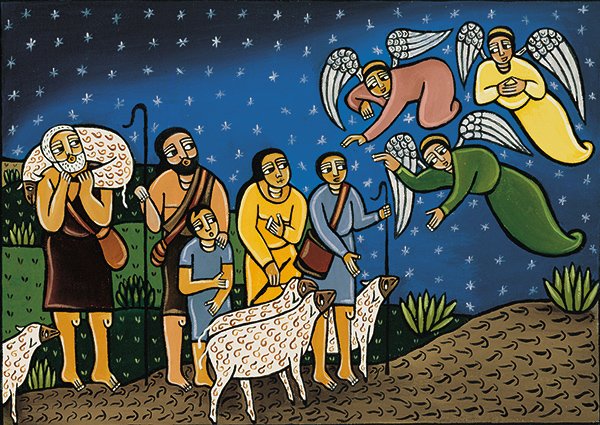
As Luke tells us, there were shepherds abiding in the fields, keeping watch over their flocks by night. When messengers personally come to deliver a special announcement, it is a big deal. These angels coming to the shepherds, well, that was a super big deal, to be sure!

            And the announcement? This isn’t the birth of a normal, ordinary baby. No! This baby is an extra special baby. The Messiah, who will save His people from their sins. Did you hear? This special baby, this Savior, Christ the Lord, is born to you—to me—to all of us, in the city of David, which is called Bethlehem.

            Did you hear? The Savior, the Christ, the promised Messiah, came into this world as a Baby. The Eternal Second Person of the Trinity, Creator of the whole universe, God the Son, emptied Himself of all God-ness. Took on humanity, and was born as a helpless Baby. That is not only good news, that is earth-shaking news. Good news of great joy for all the people. For you, for me, for all of us. How better to communicate to earth than to become one of the frail human beings God intended to reach?

            The Almighty God who made all of heaven and earth, the powerful God who can hold the incomprehensibly vast universe in the span of God’s fingers? Yes, that same God wanted to reach to earth—reach to each of us, to all of us, in love. With love. Through love. 

            That loving outreach is from God’s point of view. Yes, the Almighty God sent the Baby in Bethlehem to earth, in love. But, what if frightened, nervous humans did not in the least expect that? What if short-sighted humans closed their eyes and their hearts to the possibilities of God’s love breaking into the world in such a tender way?

            Mary could have been frightened half to death of the angel and closed her heart to the Divine possibilities that blessedly came about. But, Mary chose love. She chose openness and possibilities that transformed her heart and her life.

            When Mary’s baby was born, Jesus spoke quietly through the blood, sweat and tears of the labor pains of that young woman. Jesus cried softly as an infant, and allowed us all to see the unimaginable caring, the oh-so-tender love that Almighty God expressed, to each one of us. And, each of us is embraced in God’s everlasting arms of lovely love.

            One of my favorite Christmas carols talks about this very thing. This Christmas poem—before it was set to music—was written by Christina Rosetti in 1885. Here is the first verse:

Love came down at Christmas, Love all lovely, Love Divine,
Love was born at Christmas, Star and Angels gave the sign.

Love Divine was born at Christmas. Born for you, born for me. Praise God, our Lord and Savior Jesus was born as a Baby in Bethlehem. Yes, He would preach and heal and suffer and die. And, yes, He would rise again on that Easter morning years later.

Yet—right now, we rejoice in the blessed fact that Jesus was born.

Praise God, we, too, can stop by that manger in Bethlehem, and be caught up in the wonder of what happened that night, so long ago. We, too can welcome this lovely, Godly Love that has come into this broken, weary world, today.

Alleluia, amen.

@chaplaineliza

(Suggestion: visit me at my other blogs: matterofprayer: A Year of Everyday Prayers. #PursuePEACE – and  A Year of Being Kind . Thanks!

Unknown's avatar

Open Hearts to Joy!

“Open Hearts to Joy!”

Luke 2:8-20 (2:15) – December 15, 2024

So many houses and apartments are decorated for the season at this time of year. Colorful lights and holiday decorations indoors and out, shining Christmas trees, special dishes and fancy tablecloths. Plus, some families have a Nativity scene in a special place, whether under the Christmas tree or placed in an extra special location, even outside, all lit up at night.

As we consider our Scripture reading for this morning, we think about the familiar words from Luke chapter 2. We think of the very pregnant Mary and her husband Joseph, coming into the town of Bethlehem late one day, but they could not find any place to stay. So familiar it is today, but I suspect you all can think of the Nativity scene figures: a kneeling Mary, Joseph hovering over his wife, and the baby Jesus lying in a manger.

Where did this tradition of decorating with a Nativity scene come from? Yes, the Nativity scene is a familiar way of retelling this story of the birth of Jesus. But—how did Nativity scenes begin? It was in 1223. “According to St. Bonaventure’s biography, St. Francis of Assisi got permission from Pope Honorious III to set up a manger with hay and two live animals—an ox and an ass—in a cave in the Italian village of Greccio. He then invited the villagers to come gaze upon the scene while he preached about ‘the babe of Bethlehem.’ (Francis was supposedly so overcome by emotion that he couldn’t say ‘Jesus.’)” [1]

            That first Nativity was located in Italy, during the 1200’s. The practice of Nativity scenes, pictures and photos has certainly spread from there, all over the world. Do you remember acting in Christmas Nativity scenes, or perhaps Christmas pageants with a Nativity scene in them? You, or your children? Or grandchildren?

            The Nativity scenes I remember always had at least one shepherd visiting the baby Jesus, along with a sheep or two. Perhaps you remember when you or your children or grandchildren were in a Christmas pageant. Were there shepherds abiding in the fields, keeping watch over their flocks by night? And, sheep! I remember several Nativity scenes in Christmas pageants years ago, where the small children were dressed up as sheep.

            Let’s hear again from Dr. Luke the words the angel said to the shepherds, that Christmas night: “the angel said to them, ‘Do not be afraid; for see—I am bringing you good news of great joy for all the people.” Not just the people in Italy, where St. Francis was. Not just the people in Europe, or North America. Good news of great joy for all the people, all over the world.

This week in Advent, here at this church we are concentrating on the shepherds. As we read this familiar Christmas story, was there much in the shepherds’ daily life and experience to fill them with joy? I do not think they were particularly joy-filled, with their ordinary, workaday life and their low, social status. I wonder whether the shepherds felt like that, right before the angel chorus broke into this hum-drum, workaday world and appeared to them?

Remember the difficult situation the shepherds were in. The shepherds’ position on the social ladder in Palestine was pretty much the bottom rung. The Jewish religious leaders even considered shepherds ritually unclean, since their duties and their work of looking after sheep made it impossible for them to observe the Sabbath. Working as a shepherd was something that vagrants might pick up, or a job for ne’er-do-wells, or others who were very much down on their luck. Their society stereotyped shepherds as liars, degenerates, and thieves.

 Just imagine the reaction of these lowly shepherds as they heard this news from the angels! Good news of great joy, especially, particularly for them! And centuries later, imagine the reaction of these same shepherds to think that they are now an integral part of a Nativity scene, a central part of the Christmas story played out time and time again, year after year.  

When my children were small, one of the first Christmas decorations I’d take out of the box would be our little Nativity scene. The little figures were all children, and it was intended specifically for the young. I would tell and re-tell the Christmas story again and again. When they were small, all four of my children would love to play with the figures, spending a good long time with those inexpensive yet meaningful little figures.  

Different churches do different things to communicate this narrative of the birth of Jesus. I read that the Rev. Janet Hunt has a yearly practice she does in her Lutheran church in De Kalb. But, I will let her tell you herself. “It has been my practice for many years to ‘build the creche’ with the children during the children’s sermon during Advent.  One week we add the animals. The next week the angels join them. Pretty soon Mary and Joseph arrive and not long after the baby Jesus and shepherds and the three sages from the East arrive last of all. The order is not perfect, of course, but it is one way of bringing the story home.” [2]

My personal Nativity scene, the one my children played with, has white children, every one. I had not thought about this when I bought the set of figures, more than thirty years ago. Even though my children were part of a multi-ethnic, multi-cultural school system, we still had an all-white Nativity set. Were the people in that first Nativity people of color? Yes, they were.

            Let us return to these shepherds of the first century, on the hills surrounding Bethlehem. They were downhearted outsiders, all right! People of color, non-white, on the bottom rung of their society, for sure. “But God does not give up on us. God sends angels to people who have given up on God. How would you respond to God sending angels to you when you’d given up on God? Like the shepherds, I’d be terrified.” [3]     

Remember the words of the angel of the Lord: “Do not be afraid; for see—I am bringing you good news of great joy for all the people.” We can praise God! God did not send good news of great joy to just a few people in the world, or even some of the world’s people. Or, only people of a certain position in society. No, our God sent good news of great joy to all the people of the world.

The angel has come to all cultures, all ethnicities, all people, wherever their position on the social ladder. All people, everywhere. Even us. You and I can truly come to the manger in Bethlehem side by side with the lowly shepherds.

            That is not only GOOD news, that is GREAT news. Good news of great joy, for all the people of the world! Alleluia, amen.

@chaplaineliza

(Suggestion: visit me at my other blogs: matterofprayer: A Year of Everyday Prayers. #PursuePEACE – and  A Year of Being Kind . Thanks!


[1] http://www.smithsonianmag.com/smart-news/the-first-nativity-scene-was-created-in-1223-161485505/ 

[2] https://dancingwiththeword.com/re-telling-the-story/

[3] http://www.workingpreacher.org/preaching.aspx?commentary_id=1522

Unknown's avatar

Jesus Says: Don’t Worry!

Jesus Says: Don’t Worry!

Matthew 6:25-34 – November 24, 2024

            Some people are real worriers. They worry about their house or apartment, they worry about their children or their parents, they worry about their job, their school, their friends, their car, their health – and that’s just to begin with! All of us know someone like this. And sometimes, worry about one or two, or even more of these things creeps into our hearts, too!

            All of these things are troubles, concerns. Worries. The news on the radio, on the television, different media websites—all depend on worry, anxiety and fear to pull in their viewers.  Here in our bible reading this morning, our Lord Jesus is telling us not to be filled with worry. Worry—anxiety—fear. When we come right down to it, this yucky predicament called worry sounds so familiar! We might not like it, we might be uncomfortable with it, but various yucky, fearful situations still happen to many of us, on a regular basis.

            All the worry and anxiety I just mentioned? That was mostly external. Looking outward. Fear of people, places and things. Yes, common to all of us. Let’s up that worry and anxiety one notch higher. Let’s sprinkle some self-centered fear on it. Does that sound familiar, too?

            Fear of the interior, that’s the inside job. Your insides, my insides. Our feelings and emotions, everything all mixed together like with a blender or a kitchen mixer. I imagine some people are so anxious and worried about what’s going on inside of them that they don’t even want to examine themselves, and do an inventory. They would far rather hide under a blanket. Or check out in ways that involve various addictions.  Emotional insecurity is very real. Lots of people feel alone. All by themselves, and cut off from others. Bitterness and frustration can make things worse. Worry and anxiety can magnify those feelings, way out of control.

            What can anyone do about this huge mountain of worry, fear, insecurity and anxiety?

            Since this Sunday is Thanksgiving Sunday, our Gospel reading has a few things to say about all this worry and negativity. This reading is from the Sermon on the Mount. The second half of Matthew chapter 6 is all about treasure and where we can find it. As is often the case in Scripture, Jesus lets us know that He is summing up this section by beginning with the word “therefore.” “Therefore” is used “to indicate that the writer or speaker is drawing a conclusion. Jesus’ words here are very simple and to the point: worrying is pointless.” [1]

Wait a long minute, there! Worry is part and parcel of the human condition. Anxiety and fear of the unknown (and especially of what IS known, what we recognize coming up!) are so often sad realities. Worry is invasive, like a nasty, invasive plant. Those of you who garden are very much aware of these weeds, these choking, creeping plants that wind around the healthy flowers and vegetables we plant in our gardens.

            I have heard a good deal about worry and anxiety in past years. In my previous job, I worked as a hospital chaplain, and now I am a hospice chaplain. Yes, I would pray with anyone who asked. But, I would also listen. As I listened, I heard about a whole lot of worry, anxiety and concern. And, rightfully so! Anxiety about upcoming treatment, worry about finances, awkward anticipation about losses of various kinds. But I would also hear about depression, anger, and self-pity. I’d hear about these painful emotions mixing and crashing around inside of people. Oftentimes, I would be helpless to do anything about it, except listen.

            In my personal life today, I have concerns. Sure, I have thoughts that sometimes preoccupy my mind. I can live in yesterday for far too long of a time. I sometimes look forward to tomorrow—or next week with some fear and anxiety. I especially have concerns about an upcoming procedure in the hospital, very soon.

But what does Jesus tell us in this paragraph from the Gospel of Matthew? He talks about the beauty and the vastness of God’s creation. He tells us to pick up our heads and look around. Doesn’t God take care of the birds of the air and the beasts of the field? If God takes care of them, think about us. Think about you and me. Do you think for one minute that God would forget about you? Or, that God would forget about me?

            One of my favorite commentators is the Rev. Janet Hunt. She is a Lutheran pastor, serving a church not too far away, in De Kalb – near the Northern Illinois campus. She talks frankly about being a worrier. She carried her fear and anxiety so deeply that her folks had her going to a therapist as a little girl (when that was still pretty unusual!). She said she still worries. She worried about where she put her cell phone the night before, She worried about an upcoming funeral sermon she needed to preach. She even worried about raking the leaves in her large yard!

            Yet, Pastor Janet gets right to the point. She says, “Without a doubt, my worries are small and even when they aren’t they don’t seem to paralyze me as they do some [people].  Still, even my small worries get in the way of my living in the moment God has prepared for me.  They take away from my fully experiencing and appreciating what is right in front of me.” [2]

            This Gospel reading is certainly a challenge for me, today, with the unknown looming ahead of me. Yet, whether our worries are big or small, we can all be reminded of this precious gift Jesus offers us all, in pointing to God’s tender care for all that is in this world.

            Anything can seem overwhelming, if we look at the whole huge thing all at once. Jesus’ words are really wise: “34 So do not worry about tomorrow; it will have enough worries of its own.” In other words, one day at a time. “Don’t worry about tomorrow!” Those aren’t my words—they’re the words of Jesus!

            As we consider this Thanksgiving week, and any week of the year, “these words [of Jesus] are ours this Thanksgiving —  urging us to let go of the worry — and to entrust whatever it is that would rob our lives of peace and joy — urging us to finally give it all back to God who gives us all of that for which we give thanks in the first place.” [3]  Praise God!

Suddenly, in this world not worrying actually becomes an option.

Our God can help each of us deal with worry, fear and anxiety, whenever and wherever they might rise up, in each of our lives. We can all say amen to the Lord’s goodness. We can truly give thanks to God.

@chaplaineliza

(Suggestion: visit me at my other blogs: matterofprayer: A Year of Everyday Prayers. #PursuePEACE – and  A Year of Being Kind . Thanks!


[1] https://lifeprojectblog.com/2024/09/09/worry-5/

[2] http://words.dancingwiththeword.com/2012/11/no-more-worries.html

[3] Ibid.

Unknown's avatar

Out of Their Abundance?

“Out of Their Abundance?”

Mark 12:38-44 (12:44) – November 10, 2024

Just think, for a moment, about the sound two coins make as they clink into each other. I have two coins here. I’m going to take them both in my hand and shake them. Can you hear that? What does that sound bring to mind? Do you feel satisfied, or scary? Is that the sound of abundance, or scarcity? What do you think of that sound? [1]

We turn to the Gospel reading for today, from Mark 12. The Rabbi Jesus and His disciples are in Jerusalem, and Jesus is having another in those continuing discussions with the chief leaders and teachers of the Jewish Law. They happen to be in the rear of the Temple. Large sanctuary, many people walked and talked, and went to and fro. Business being transacted, multiple conversations and commotion going on. Except – the sound of two coins shaken together would be easily drowned out.

Listen again to a portion of today’s Gospel reading: “a poor widow came and put two very small copper coins into the temple treasury, worth only a few cents. 43 Calling his disciples to him, Jesus said, “Truly I tell you, this poor widow has put more into the treasury than all the others. 44 They all gave out of their abundance; but she, out of her poverty, put in everything—all she had to live on.”

Yes, I realize that our Lord Jesus was talking primarily about giving money. But, I have always thought of giving and being generous to count just as much for giving our time, and our talents, and our generosity in many other kinds of ways. Not simply in terms of money. I have a friend who has been retired for almost ten years now. He goes around town, quietly, and does good. He was raised in the church, but that was many years ago. Yes, he does have a belief in God, and he expresses that faith by doing good for others and being faithful.

Sometimes that means driving a friend to a doctor’s appointment. Or volunteering at a local not-for-profit organization. Sometimes that means picking up the left-over baked goods from a business at the end of the day, at closing time. And then, delivering those baked goods to a homeless shelter. He does all of this without thanks, with little or no fanfare. He is faithful. He is dependable. He contributes, in any way he can. And, I am so glad he is my friend.

Except, this is not the way that many religious people operate. Many religious folks – good, church-going folks – have been taught is that God works through deals. You do this, and I’ll do that. We do our bit, and then God will follow through with God’s part. “Pay a little extra and get a better seat at God’s table. Put in some overtime, split hairs on the detail of the law and you’ll get a nice long robe and watch everyone in the marketplace bow to you as you pass. Sure, maybe they had to foreclose on a widow or two, but business is business after all. And to make up for it look how much they gave, how much went into the offering box. Isn’t that what we want, more in the [offering] plate?” [2]

I know there are multiple ways to give, to be generous, including online giving – which is a wonderful thing. Here in the United States and in many other places around the world, we can give at the touch of a computer key or by pressing a cell phone button.

A number of years ago, at another church, I remember walking by the room next to the sanctuary where two trustees would be counting the offering after the worship service. But today, we don’t hear the offering. “The clink of coins is lost. Perhaps the value we place in pennies, nickels, and dimes has been lost, too. We no longer hear, see, or feel the weight of what happens when our small offerings come together in praise and honor of the God of abundant life.” [3]

But, back to our widow, the woman our Lord Jesus specifically points out. She had next to nothing to live on. God sees this woman, and many, many just like her. God cares about her, and about the countless others around the world. Along with commentator David Lose, I doubt anyone else, including the religious elite parading around the Temple that day and dropping in their token offerings and spare change, noticed this woman.

            Don’t you think that God also sees our struggles today, recognizes our challenges, cares about where we are hard pressed to make ends meet? And, isn’t God inviting each of us? This congregation knows I do not bring divisive politics into this pulpit. I preach what the Gospel teaches, what our Lord Jesus tells each of us to do.

I’m exhorting each of us to have open ears to what God is saying. God invites us to look around and see each other, those in our community we know and those we don’t.  I mean really see each other – the pain of those who are discriminated against because of their ethnicity, the desolation of those who cannot find work and have been abandoned to fend for themselves, the despair of those who have given up on finding work and have lost hope, the anguish of those who have been exploited by unfair employers, abusive landlords, or even detestable sex traffickers. God is inviting us to see them, to care for them, and to advocate for a system that does not leave anyone behind.[4]

This vignette from the Gospel of Mark is just a slice of the widow’s life. But, I’d like to follow the widow home. See how she treats her neighbors. Does she bring over a pot of soup to a sick friend? Does she clean the apartment of someone who has fallen and broken their leg? And what about her listening skills? Is she someone people come to, to talk about their troubles? Giving to God is so much more than just dollars and cents. So much more than just the coins the show-offy rich people put into the collection box in the Temple.

What about us, today? How can we take this scripture lesson today, and apply it to our lives? Is it just a nice story about what happened to people in Jesus’s day? Or, is it much more?

Today, we all can be like the widow in Jerusalem. This widow gave extravagantly. She gave over and above. She gave, trusting in God’s abundance. And, this widow decides that everything she is and has belongs to God. Like my friend I told you about, who does lots of things without thanks, with little or no fanfare. We all can be faithful. We all can be dependable. We all can contribute, in any way we can, to God and to God’s kingdom.

God willing, I’ll contribute to God’s kingdom. Will you contribute, too? Alleluia, amen.

@chaplaineliza

(Suggestion: visit me at my other blogs: matterofprayer: A Year of Everyday Prayers. #PursuePEACE – and  A Year of Being Kind . Thanks!


[1] https://www.umcdiscipleship.org/worship-planning/truth-telling/twenty-fifth-sunday-after-pentecost-year-b-lectionary-planning-notes

[2] https://www.umcdiscipleship.org/worship-planning/truth-telling/twenty-fifth-sunday-after-pentecost-year-b-lectionary-planning-notes/twenty-fifth-sunday-after-pentecost-year-b-preaching-notes

[3] https://www.umcdiscipleship.org/worship-planning/truth-telling/twenty-fifth-sunday-after-pentecost-year-b-lectionary-planning-notes

[4] https://www.davidlose.net/2015/11/pentecost-24-b-surprisingly-good-news/

Unknown's avatar

Who Does Jesus Love?

“Who Does Jesus Love?”

John 11:32-44 – Sunday, November 3, 2024

            Today is All Saints Sunday. A lot of people think of “saints” as super-holy people. Like St. Francis of Assisi, or Mother Teresa, or St. Ignatius of Loyola. These people and many other titled saints are super-stars (or, super-saints) of the faith! What kinds of things do you think about when you consider these super-holy people? Do they pray all the time? Do they do good works for God all the time? Or, what exactly do they do all day long? And when they get to heaven, do they play harps all the time?

            When we consider the people of the Bible, many of them are considered saints. Yet, if we read more closely, almost every person recorded in the Bible – either in the Hebrew Scriptures or the New Testament – displays very human characteristics! They show very human emotions, grieve, cry, get mad, say or do stupid things, and sometimes even worse.  

            Listen to Mary of Bethany as she pours out her agonized heart to her friend the Rabbi Jesus, and the following, very human exchange: “Mary came to where Jesus was waiting and fell at his feet, saying, “Master, if only you had been here, my brother would not have died.”

 When Jesus saw her sobbing and the Jews with her sobbing, a deep anger welled up within him. He said, “Where did you put him?”“Master, come and see,” they said. Now Jesus wept.”

            Merriam-Webster’s Dictionary has several definitions for “saint,” including “one of the spirits of the departed in heaven” and “one of God’s chosen and usually Christian people.” [1] This definition is more broad than what people often think of, when they think about saints. If we take this broader definition to heart, we can think of all Christians as being saints, and all of the people in the Hebrew Scripture as being saints, too.  

            Our Scripture reading today from the Gospel of John is often read during Lent, during the period right before Easter. However, this reading is also read on All Saints Sunday, as a witness to the power of our Lord Jesus over death. This reading is also lifted up in the African American tradition in a service of healing, for those suffering emotional distress, grief, divorce, and physical ailments. This healing also “speaks to a range of human issues and concerns. Suffering often drives individuals to petition for God’s healing.” [2]

            Whether we come to the Gospel of John expecting healing, or in preparation for Easter, or to commemorate all the saints, this reading remains one of the most hopeful, one of the most triumphant proclamations in the Bible. Our Lord Jesus has power over the living and the dead.

            Yet, here we are, on All Saints Sunday. Consider our Lord Jesus – or, the Rabbi Jesus, as He was considered then. His reaction to the death of Lazarus brings the reality of death close to us all. Jesus wept! He wept over his friend Lazarus. As our commentator Karoline Lewis says, “death is inevitable, and its pain, its loss, its cause for anger is all true and real.” She is speaking to preachers, like me. We are working professionals, who bear the hard part of death, being in the business of tending its consequences to those we professionally care for, yet so often do not take the time for our own personal sadness and grief. [3]

            How often do we tell ourselves that we will grieve “later on,” after we finish this necessary paperwork, or after we make these phone calls, or after we do these needed errands, putting off the grieving, the pain, the loss of our loved ones.

            The message we receive from the Gospel of John today tells us in detail about the raising of Lazarus. But before that happens, his sisters are devastated! Who wouldn’t be? A loved one’s death is devastating, even if death is a blessed release or a welcome and final end of pain.

I know, in my life, it is difficult for me to get up and get going when I feel devastated. It’s so hard to continue doing the normal, everyday things that need to get done in my life.  Have you ever experienced this kind of an invisible wall? Or, has someone close to you ever come up against something like this? These kinds of deep feelings happen with sad regularity among people who have just lost a loved one, a dear relative.

So many people let us down, here in this world. Either on purpose, or accidentally. Even unconsciously, sometimes. I know, it still happens. We get let down, time and again. It feels like a punch in the gut, sometimes! It hurts!

Here is where this Scripture reading comes in. It works on our hearts, draws each of us closer. We see the grief Jesus clearly felt, being disturbed at death and at the brokenness of this world, as we see Him approach the tomb. The wonder of Lazarus stepping out and the command to unbind him is a certain and sure symbol and promise of the freedom we will all know one day! And surely, this points to God’s Power, God’s Grace and God’s Gifts, for all of us. [4]

            We gather together here, in this place, to remember our friends and relatives each of us has lost, whether in this past year or in years past. Yes, we grieve and mourn. It is fitting and right that we do so. We are reminded that Jesus wept at the grave of Lazarus.

There is a tension we hold – holding many complicated emotions, holding grief and mourning, and at the same time joy and gratitude as we sit with the stark fact of missing our friends, our relatives who have died. And yes, we can rejoice as we consider “the promise and hope of the Resurrection and that even as Lazarus and his beloved family are privileged to live into that promise in this life even now, so are we [for the resurrection life to come]. So are we. Thank God, so are we.” [5]

Our Scripture reading today asks us to reflect that Jesus is, indeed, the Resurrection and the Life, not just for the crisis moment of death, but for all moments in life. Jesus announces that the world is definitively under God’s care and power. And, John chapter 11 offers all of us the promise about how each of us can live our lives today, not just about how our days will end. [6]

Is there someone you particularly remember, or especially miss? Someone who has crossed that river Jordan to join our Lord Jesus in the heavenly places? We have candles here. I invite anyone who wishes to come, to light candles for those loved ones. Light them in your hearts as well, as we come together in gentle comfort and encouragement of each other.

As we lean on relationship with each other in this life, even when faced with death itself, we see with eyes of hope that new life can spring up, through faith in Jesus Christ.  Yes, there is a balm in Gilead to heal the sin-sick soul, to make the wounded whole, and His name is Jesus. Alleluia, amen!  

@chaplaineliza

(Suggestion: visit me at my other blogs: matterofprayer: A Year of Everyday Prayers. #PursuePEACE – and  A Year of Being Kind . Thanks!


[1] https://www.merriam-webster.com/dictionary/saint

[2] http://www.theafricanamericanlectionary.org/PopupLectionaryReading.asp?LRID=64

[3] https://www.workingpreacher.org/dear-working-preacher/for-all-the-saints-2

[4] http://dancingwiththeword.com/these-precious-gifts-of-all-saints-day/

[5] Ibid.

[6] O’Day, Gail R., Gospel of John, New Interpreter’s Bible Commentary, Vol. 9 (Abington Press, 1996) 695.

Unknown's avatar

On Eagle’s Wings

“On Eagle’s Wings” – Memorial Meditation

Isaiah 40:28-31 – Sunday, October 20, 2024

            My husband Kevin is a homebody – most of the time. However, he does enjoy occasionally hitting the road. I suggested to him about two months ago that we take a road trip, so we planned to go to the Smokies National Park next week. That is, until Hurricane Helene blasted right through that region, causing devastation all the way from landfall in Florida to many points north. The official Smokies park service website now pleads with prospective visitors not to visit, at least for a while, because of the massive clean-up that needs to be done.

            So, since I have PTO time reserved away from work already, my husband and I made a quick switch to someplace closer to home. On Wednesday, we are heading to Cahokia Mounds near St. Louis, to Pere Marquette State Park, on the Mississippi River, and to Starved Rock State Park. I know this is not prime time to see eagles, but I hope that perhaps we will catch a glimpse of these magnificent birds on their migration south to open waters for the winter! 

One of Carol Metler’s favorite church hymns was “On Eagle’s Wings.” This lovely, newer gospel song was originally written as a verse and refrain for Psalm 91, which affirms that we find refuge under God’s wings. The refrain of this gospel song is most sung in Protestant congregations – “And God will raise you up on eagles’ wings, bear you on the breath of dawn, make you to shine like the sun and hold you in the palm of God’s hand.” 

            Whether we consider Psalm 91 or Isaiah chapter 40, both sections of the Bible talk about God’s protecting hand – and more! Listen to the words of the prophet again: those who hope in the Lord will renew their strength. They will soar on wings like eagles; they will run and not grow weary, they will walk and not be faint.”

This chapter in Isaiah especially mentions the followers of God soaring on wings like eagles. You know and I know the followers of God often do not have an easy time of it. Life is not a walk in the park. Life is a challenge, sometimes. Even, more often than that, sometimes.

            I suspect our dear Carol knew that life was a challenge, many times in her life. She was stubborn, and persistent, and she made it through – with God’s help!

            However, I would like to step back and consider the historical context of this biblical passage. Isaiah chapter 40 was written while the Jewish people were in exile in Babylon, and it is  in the section of the book that deals with comfort. This reading comes from the very middle of Exile.  The Jewish people had been stuck in the foreign country long enough to feel like everything was going wrong and God wasn’t doing anything to help them. [1]

Commentator Dr. Steed Davidson stresses God’s power at work. The prophet does a compare/contrast thing here. Human people are inadequate to change the long distances of history and the circumstances of life. But – but – God is the Creator of heaven and earth! God has strength and power that transcends faulty human striving. Plus, verse 31 calls on “listeners to participate in God’s processes in order to experience transformation.” [2]

            God gives strength to the weary to continue. God comes alongside those who are bone tired, so weak and dispirited that, of themselves, they could not take even one more step. But, God! But – God! Have you ever been so tired, or worn out, or anxious, fearful, discouraged – or one of a dozen other downhearted emotions? And then – but, God!

            Imagine trying your hardest on a challenging project, and feeling like you got to the end of yourself. You can’t give any more. And then, but, God! Or, imagine you are sitting by the bed of a loved one recovering from serious surgery or in the middle of chemotherapy, and you feel so helpless to help your dear loved one. And then, but, God! God transforms everything.

            “But” is usually a negative, a placeholder, a frowny face kind of a word, in so many situations. “But” so often has negative connotations – except for this one, here – but, God!

            God transcends the negative language that we use. God transforms any downhearted stammering of “but, but, but…” into a positive, blooming, blessing of “but – God!” Showing the renewing, revitalizing possibilities of our Lord. Like the Refuge we run to, like a sturdy, safe Rock in the wilderness, God is so much more than we can possibly ask or think.

            The pastoral musician Father Michael Joncas wrote this song in the 1970’s, and it has been sung countless times, and in some very harrowing situations. Imagine the ultimate shock, horror and heart-rending grief of the September 11th attacks; this song was performed at many of the funerals of the victims of that attack. This song is often performed during or at the end of a Catholic funeral mass. And, we will have this song played later on in this worship service, too.

Countless people have been touched by the words and music of this hymn, and many of those same grieving, hurting people would testify that God did indeed come close to them through their difficult times, just as this song tells us.

            This is just what the authors of our two sections of Scripture wanted us to remember. Time and again, stories and narratives from the Bible remind us that the saints of old had challenges – difficulties – they had to deal with – walk through – even, soar above, on eagle’s wings. Can you relate? Hoping in the Lord is expecting that God’s promise of strength is a reality. God can come alongside. God can comfort and strengthen. Just as it was when our prophet wrote these words, just as it is now, today. God can assist us when we are alone as well as when we are together in one group, one congregation, one family.

“Do you not know? Have you not heard?” Praise the Lord, we know God’s protection and care is always with us, always holding us in the palm of God’s hand.

And to that, we all may say, alleluia, amen.

@chaplaineliza

(Suggestion: visit me at my other blogs: matterofprayer: A Year of Everyday Prayers. #PursuePEACE – and  A Year of Being Kind . Thanks!


[1] http://worshipingwithchildren.blogspot.com/2015/01/year-b-5th-sunday-after-epiphany-5th.html

[2] https://www.workingpreacher.org/commentaries/revised-common-lectionary/fifth-sunday-after-epiphany-2/commentary-on-isaiah-4021-31

Unknown's avatar

Who Then Can Be Saved?

“Who Then Can Be Saved?”

Mark 10:17-27 (10:26) – October 13, 2024

If we turn on the television, read a book, or listen to a podcast or talk radio, sometimes we might hear experts giving advice. These knowledgeable experts are often from well-known places. This week I am thinking about advice on how to live the “right” way. That’s sometimes thought to be a fruitful life, or a healthy life, or a spiritual life. Wouldn’t you be interested if you heard a radio program with a noted author or well-known expert in just this subject?

            That’s the case with Rabbi Jesus, today. In today’s scripture lesson, we get just a hint of what our Lord Jesus had to deal with much of the time. Can you see this situation? I love St. Ignatius and his prayer suggestion to put ourselves into the narrative. Let us imagine ourselves being there, right with our Lord Jesus the itinerant Rabbi, and His disciples.

The Rabbi Jesus was about to travel somewhere, and a number of His disciples are getting ready to accompany Him. It is significant to read what our commentator David Lose has to say about this journey. “In Mark, this is not merely “a journey” in general (per the NRSV), but rather represents the road to Jerusalem and the cross.” [1] And, repeatedly, our Gospel writer Mark tells us that Jesus has His face set to go to Jerusalem.

When, what happens? “17 As Jesus went out into the street, a man came running up, greeted him with great reverence, and asked, “Good Teacher, what must I do to get eternal life?” That is a pretty big question, isn’t it? Many people throughout the ages have wondered exactly that! The Rabbi Jesus was a widely acknowledged wise person, an expert in the interpretation of the Hebrew Scriptures, the Law of Moses and in lots of things associated with religious and spiritual life.

After all, you don’t get an expert in religion and spiritual life coming to your town just any old day.

The Rabbi Jesus is matter-of-fact, and responds (as many Rabbis would), “You know the commandments: Don’t murder, don’t commit adultery, don’t steal, don’t lie, don’t cheat, honor your father and mother.”

This is a shortened list of some of the Ten Commandments from the book of Exodus. These commands from God are revered as being the shorthand version of God’s rules for living. Now, while we have our imagining caps on, imagine we are watching this whole scene play out. Our teacher, the Rabbi Jesus, is involved in conversation with this earnest young man.

Except, something is different about this young man. He’s well-dressed, and looks to be really rich. Plus, he answers the Rabbi Jesus in all seriousness! “He said, “Teacher, I have—from my youth—kept them all!” 21 Jesus looked him hard in the eye—and loved him!”

 What do we see here? “Jesus looks at him with love (verse 21). He does not treat him as insincere or mock him as self-righteous, but rather loves him. Every interpretation we may offer must therefore take seriously Jesus’ absolute regard and unconditional love for this man.” [2]

I am still looking at this whole scene through my imagination, too. I am right there, watching everything go on. Watching the gathered crowd in the dusty afternoon in one of the towns of Palestine. And, we can see the love shining out of our Rabbi’s eyes!

But, let us get back to our rich young man who asked Rabbi Jesus this serious question. “’Jesus said, “There’s one thing left: Go sell whatever you own and give it to the poor. All your wealth will then be heavenly wealth. And come follow me.’ 22 The man’s face clouded over. This was the last thing he expected to hear, and he walked off with a heavy heart. He was holding on tight to a lot of things, and not about to let go.”

Dr. David Lose said about this point in the reading, “what Jesus really meant was that we needed to unburden ourselves of whatever might be keeping us from relying on God.” [3] Yes, the rich man had a great deal of difficulty hearing these words of Jesus.

            Let’s face it: these are difficult words for many people to hear. We love our stuff, don’t we? Or, if not most of our stuff, at least some of our stuff. I would really have difficulty giving up my computer and my car. I think I am not the only one in this room today for whom that is true. Others might have difficulty unburdening themselves of whatever might be keeping each one from God.

“Jesus knew that the only thing that could overcome the gravity of the riches of this life is a force stronger, a greater pull. Love redeems; love rescues; love wins. He knew that. He knows that. Jesus loved him even though it didn’t seem to work. The young man walked away, grieving. The burden on his heart increased, instead of lightened. He had the antidote; he had the prescription. But the medicine was too bitter for him to swallow.” [4]

Let me ask, as we still consider us being there, right next to Jesus. What would it be like to have Jesus look upon each of us with that same love? What is more, Jesus asks each of us the same question about our stuff, about following Jesus. And, what is our response to Jesus?

All of our stuff gets in the way between us and God’s kingdom. All of this clutter and distraction in our lives keeps us at a distance from God. We know what Jesus has asked us to do, just like this young man did. When you don’t do what God has asked you to do, how do you picture God responding to you? Do you imagine God looks at you—at us—with loving compassion like Jesus did in this story? What’s more, we all will see how all of our “small steps” in loving and giving combine to create a beautiful impact of compassion in God’s world.

            And, maybe, just maybe “God’s gift of salvation can actually free us to do something: to love each other, to care for God’s people and world, to share the good news…right here, right now, wherever it may be that God has placed us.” [5]  

            God willing, we can all show love, giving, and compassion, every day. Alleluia, amen.

@chaplaineliza

(Suggestion: visit me at my other blogs: matterofprayer: A Year of Everyday Prayers. #PursuePEACE – and  A Year of Being Kind . Thanks!


[1] https://www.workingpreacher.org/commentaries/revised-common-lectionary/ordinary-28-2/commentary-on-mark-1017-31-3

[2] Ibid.

[3] http://www.davidlose.net/2015/10/pentecost-20-b-curing-our-heartsickness/

[4] https://www.umcdiscipleship.org/worship-planning/walking-with-jesus/twenty-first-sunday-after-pentecost-year-b-lectionary-planning-notes/twenty-first-sunday-after-pentecost-year-b-preaching-notes

[5] http://www.davidlose.net/2015/10/pentecost-20-b-curing-our-heartsickness/

Unknown's avatar

How Majestic is God’s Name!

“How Majestic is God’s Name!”

Psalm 8 (8:4) – October 6, 2024

            How many here can think of a truly unforgettable experience you have had? Maybe going on vacation, and seeing an unforgettable sunset or rainbow? Or perhaps taking a trip to a National Park, and experiencing some unforgettable scenery, like a spectacular waterfall? Or maybe traveling by boat or ship and seeing unforgettable sea creatures, whales, or sea lions? The world is full of marvelous, unforgettable things, and God created them all!

            But, we can’t go on vacation every day. Very few of us are able to see marvelous scenery or go to exotic places on a regular basis In the every-day, ordinary kind of way, I wonder if you and I really think the world is majestic? Awesome? God has made the world, and I think the Lord has done a pretty good job. But, how many of us think the Lord is majestic? Awesome? I mean, on an every-day basis. Are we stunned, at a loss for words by the majesty of the Lord?

            Let’s hear how our psalm today starts, again. “Lord, our Lord,  how majestic is your name in all the earth! You have set your glory in the heavens.” Wow! And, that is just the first verse! The Lord is OUR Lord, and the Lord’s name is majestic. Not just so-so, not pretty good, but majestic! Not to mention, the Lord has set glory and majesty in the heavens!

            I can see the stars on a clear night, but not quite as many here in Chicago as I can up in Wisconsin or in Michigan, far from the city. My husband Kevin spent two years in the mountains of Colorado, a number of years ago. He said the stars regularly put on an amazing display in the mountains, on a clear night. And, the moon, too! Truly majestic to see.

            Our psalmist marvels at the heavens, too – and more! “When I consider your heavens, the work of your fingers, the moon and the stars, which you have set in place, what is humankind that you are mindful of them, human beings that you care for them?

Our psalmist King David started out contemplating the heavens, and the awesome majesty of God. Now, he shifts to considering humanity. “In comparison to the grandeur of the universe, the psalmist questions why God would be mindful of humanity and care for them.” [1] Really, this is a valid question! After God created the heavens, and the stars and moons and all the other heavenly bodies, we humans are like grains of sand. Maybe even smaller, maybe microscopic. Who are we that God is even mindful, even aware of us? 

From time to time, maybe even more often than that, it is so easy to get caught up in the pressures and expectations of the world! You and I can know that very well. Such feelings of loneliness, insecurity and doubt can threaten to overwhelm us. Imagine, not being sure that we are worth anything, and feeling that we are like tiny grasshoppers or worms.

I don’t know about you, but just reading this description of humanity makes me feel so insignificant, especially in the face of such glory, such grandeur of all creation. However, isn’t this an opportunity to affirm, to witness to the blessed fact that this God who is described here by King David is also my God? In fact, our God?

            We have reassurance from King David! “Psalm 8 reminds us of our unique identity as children of God and the incredible value and purpose we have in Him. This psalm teaches us to look beyond ourselves and recognize the greatness of our Creator, who has entrusted us with the responsibility to care for [God’s] creation.” [2]

            Listen to the next verses of this psalm, and see how much trust the Lord gives to us, how much happiness and at the same time, responsibility: “You have made thema little lower than the angelsand crowned them with glory and honor You made them rulers over the works of your hands; you put everything under their feet:”

            How amazing that we – we puny humans – are crowned by God with glory and honor! And, that is all humanity we are talking about. Not just a few humans, not just the humans in our particular group or from our particular country. No! This psalm says ALL. Everyone. What a Godly proclamation to give each of us a worthy opinion of ourselves!

But wait, there’s more! God not only has made a royal proclamation that crowns all of us with glory and honor, the Lord has also made each of us heaven-appointed stewards of this marvelous world we all inhabit.

We all have a task to do, simply by nature of being born on this earth. Just as in the beginning of Genesis, Adam and Eve were assigned tasks by God to tend and keep the Garden of Eden, so with each person today. Whether we garden, or recycle and pick up trash, or choose responsibly-sourced food items and clothing, we all can be good stewards of this beautiful earth God has created for each of us and given us to live in.   
            One of my favorite people I follow on social media comes from the Peak District in northern England. She is a brilliant photographer of her native Peak district, and her handle is “Peaklass.” I love the description and the advice she gives: “In our rush through life, moving faster, working smarter, we miss so much. We miss the drift of seasons and the gentle ebb and flow of nature. We miss patterns, colours, changing light. We miss beauty and quiet. Sometimes we all need to stop and just watch the clouds roll.” [3]

            This psalm ends as it begins, “Lord, our Lord, how majestic is your name in all the earth!” Can you think of a more wonderful praise and prayer to our God than to enjoy the beauty and majesty of God’s creation, today? Yes, God’s name is majestic in all the earth! Each of us can stop where we are today, and praise God for all creation, all creatures great and small.  

            Two days ago was the feast day of St. Francis of Assisi; many faith traditions celebrate with a Blessing of the Animals this weekend. St. Francis is not only a patron saint of animals, he is also the patron of all creation, or the natural world. I want to end today with a benediction, a verse from the hymn that is attributed to Francis, “All Creatures of Our God and King.”

Let all things their Creator bless,
And worship Him in humbleness,
O praise Him! Alleluia!

Praise, praise the Father, praise the Son,
And praise the Spirit, Three in One!

            O, let us praise God, indeed! Alleluia, amen.

@chaplaineliza

(Suggestion: visit me at my other blogs: matterofprayer: A Year of Everyday Prayers. #PursuePEACE – and  A Year of Being Kind . Thanks!


[1] https://youthgroupministry.com/lessons/youth-ministry-lesson-on-psalm-8-embracing-our-identity-in-christ/

[2] Ibid.

[3] https://x.com/peaklass1/status/1842835391595905259/photo/1