Unknown's avatar

Amazed by Love!

“Amazed by Love!”

Luke 2:15-20 (2:18) – December 22, 2024

Merry Christmas! What a wonderful expression. People greeting each other on the street, in the stores, here at church. I know not everyone celebrates Christmas, but still. What a joyous time of the year. Today, we are here at the 4th Sunday of Advent! Many, many people can hardly wait for the arrival of Christmas Day! Especially for children, I bet some people are so excited that they hardly sleep a wink for the next few nights. (But that’s mostly for reasons of Santa and presents under the tree, not for the religious reasons I’m talking about this morning.)

Merry Christmas, many people say! But I want you to go back, two thousand years. Go back to a time when “Merry Christmas” was not even a phrase, a wish, not even an idea in people’s heads. Go back to the time Dr. Luke describes in his Gospel. Back to the time when Israel was an occupied country, and the Roman Empire was the occupying force. Back to the time when all people in Israel needed to be enrolled. The Roman government decided to have a census, so that they would be able to tax the people of Israel more accurately.

            We remember this census. The Holy Family, Joseph and his fiancée Mary, went to Bethlehem to enroll, because Joseph was a direct descendent of King David. I suspect there were many people on the roads. Today, traveling can be stressful and nerve-wracking. I am certain travel in the first century was much more difficult. Poor roads, with many people walking to get from one place to another. We might imagine that Joseph and Mary had a donkey, but nowhere in the Gospel is that mentioned. Travel conditions were challenging, at best.

Wait a minute. Do we really concentrate on the difficulties and trials of travel to Bethlehem, of the labor and birth of a baby without medication, or of any of the rest of this real-life narrative from Luke chapter 2? Or, do we imagine a nice, tidy, picture-perfect Christmas card? With Mary in a rich, bright blue robe, gazing lovingly at her radiant newborn baby, Joseph looking adoringly at both mother and child. Not to mention the cleaned-up shepherds gazing in wonder, their tidy, well-groomed sheep lying quietly in adoration, too.

That picture-perfect Christmas card was not what actually happened, not by a long shot. Mary felt the pains of labor begin. What a scary thing! To be far, far from home, in an unfamiliar place, and to have such a significant event happen. Significant, and potentially life-threatening, too. Plus, anyone who has worked with large animals (even many smaller animals) knows what a group of them smell like. That’s where Jesus was laid, in a manger among the animals. And, is anyone familiar with the hustle, bustle and smells associated with the labor and delivery room of a hospital? This refocused picture of the birth is not all gentle, meek and mild, to be sure.

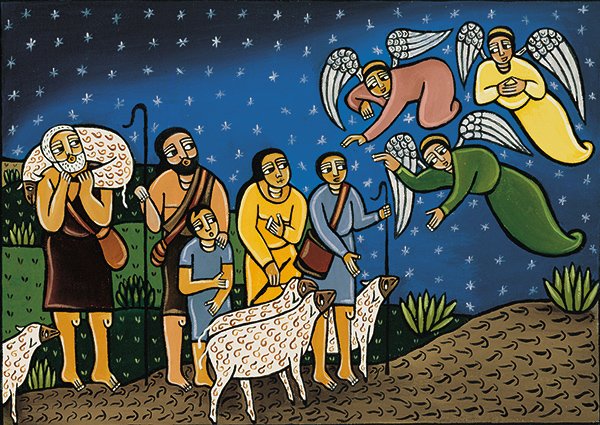
As Luke tells us, there were shepherds abiding in the fields, keeping watch over their flocks by night. When messengers personally come to deliver a special announcement, it is a big deal. These angels coming to the shepherds, well, that was a super big deal, to be sure!

            And the announcement? This isn’t the birth of a normal, ordinary baby. No! This baby is an extra special baby. The Messiah, who will save His people from their sins. Did you hear? This special baby, this Savior, Christ the Lord, is born to you—to me—to all of us, in the city of David, which is called Bethlehem.

            Did you hear? The Savior, the Christ, the promised Messiah, came into this world as a Baby. The Eternal Second Person of the Trinity, Creator of the whole universe, God the Son, emptied Himself of all God-ness. Took on humanity, and was born as a helpless Baby. That is not only good news, that is earth-shaking news. Good news of great joy for all the people. For you, for me, for all of us. How better to communicate to earth than to become one of the frail human beings God intended to reach?

            The Almighty God who made all of heaven and earth, the powerful God who can hold the incomprehensibly vast universe in the span of God’s fingers? Yes, that same God wanted to reach to earth—reach to each of us, to all of us, in love. With love. Through love. 

            That loving outreach is from God’s point of view. Yes, the Almighty God sent the Baby in Bethlehem to earth, in love. But, what if frightened, nervous humans did not in the least expect that? What if short-sighted humans closed their eyes and their hearts to the possibilities of God’s love breaking into the world in such a tender way?

            Mary could have been frightened half to death of the angel and closed her heart to the Divine possibilities that blessedly came about. But, Mary chose love. She chose openness and possibilities that transformed her heart and her life.

            When Mary’s baby was born, Jesus spoke quietly through the blood, sweat and tears of the labor pains of that young woman. Jesus cried softly as an infant, and allowed us all to see the unimaginable caring, the oh-so-tender love that Almighty God expressed, to each one of us. And, each of us is embraced in God’s everlasting arms of lovely love.

            One of my favorite Christmas carols talks about this very thing. This Christmas poem—before it was set to music—was written by Christina Rosetti in 1885. Here is the first verse:

Love came down at Christmas, Love all lovely, Love Divine,
Love was born at Christmas, Star and Angels gave the sign.

Love Divine was born at Christmas. Born for you, born for me. Praise God, our Lord and Savior Jesus was born as a Baby in Bethlehem. Yes, He would preach and heal and suffer and die. And, yes, He would rise again on that Easter morning years later.

Yet—right now, we rejoice in the blessed fact that Jesus was born.

Praise God, we, too, can stop by that manger in Bethlehem, and be caught up in the wonder of what happened that night, so long ago. We, too can welcome this lovely, Godly Love that has come into this broken, weary world, today.

Alleluia, amen.

@chaplaineliza

(Suggestion: visit me at my other blogs: matterofprayer: A Year of Everyday Prayers. #PursuePEACE – and  A Year of Being Kind . Thanks!
Unknown's avatar

Open Hearts to Joy!

“Open Hearts to Joy!”

Luke 2:8-20 (2:15) – December 15, 2024

So many houses and apartments are decorated for the season at this time of year. Colorful lights and holiday decorations indoors and out, shining Christmas trees, special dishes and fancy tablecloths. Plus, some families have a Nativity scene in a special place, whether under the Christmas tree or placed in an extra special location, even outside, all lit up at night.

As we consider our Scripture reading for this morning, we think about the familiar words from Luke chapter 2. We think of the very pregnant Mary and her husband Joseph, coming into the town of Bethlehem late one day, but they could not find any place to stay. So familiar it is today, but I suspect you all can think of the Nativity scene figures: a kneeling Mary, Joseph hovering over his wife, and the baby Jesus lying in a manger.

Where did this tradition of decorating with a Nativity scene come from? Yes, the Nativity scene is a familiar way of retelling this story of the birth of Jesus. But—how did Nativity scenes begin? It was in 1223. “According to St. Bonaventure’s biography, St. Francis of Assisi got permission from Pope Honorious III to set up a manger with hay and two live animals—an ox and an ass—in a cave in the Italian village of Greccio. He then invited the villagers to come gaze upon the scene while he preached about ‘the babe of Bethlehem.’ (Francis was supposedly so overcome by emotion that he couldn’t say ‘Jesus.’)” [1]

            That first Nativity was located in Italy, during the 1200’s. The practice of Nativity scenes, pictures and photos has certainly spread from there, all over the world. Do you remember acting in Christmas Nativity scenes, or perhaps Christmas pageants with a Nativity scene in them? You, or your children? Or grandchildren?

            The Nativity scenes I remember always had at least one shepherd visiting the baby Jesus, along with a sheep or two. Perhaps you remember when you or your children or grandchildren were in a Christmas pageant. Were there shepherds abiding in the fields, keeping watch over their flocks by night? And, sheep! I remember several Nativity scenes in Christmas pageants years ago, where the small children were dressed up as sheep.

            Let’s hear again from Dr. Luke the words the angel said to the shepherds, that Christmas night: “the angel said to them, ‘Do not be afraid; for see—I am bringing you good news of great joy for all the people.” Not just the people in Italy, where St. Francis was. Not just the people in Europe, or North America. Good news of great joy for all the people, all over the world.

This week in Advent, here at this church we are concentrating on the shepherds. As we read this familiar Christmas story, was there much in the shepherds’ daily life and experience to fill them with joy? I do not think they were particularly joy-filled, with their ordinary, workaday life and their low, social status. I wonder whether the shepherds felt like that, right before the angel chorus broke into this hum-drum, workaday world and appeared to them?

Remember the difficult situation the shepherds were in. The shepherds’ position on the social ladder in Palestine was pretty much the bottom rung. The Jewish religious leaders even considered shepherds ritually unclean, since their duties and their work of looking after sheep made it impossible for them to observe the Sabbath. Working as a shepherd was something that vagrants might pick up, or a job for ne’er-do-wells, or others who were very much down on their luck. Their society stereotyped shepherds as liars, degenerates, and thieves.

 Just imagine the reaction of these lowly shepherds as they heard this news from the angels! Good news of great joy, especially, particularly for them! And centuries later, imagine the reaction of these same shepherds to think that they are now an integral part of a Nativity scene, a central part of the Christmas story played out time and time again, year after year.  

When my children were small, one of the first Christmas decorations I’d take out of the box would be our little Nativity scene. The little figures were all children, and it was intended specifically for the young. I would tell and re-tell the Christmas story again and again. When they were small, all four of my children would love to play with the figures, spending a good long time with those inexpensive yet meaningful little figures.  

Different churches do different things to communicate this narrative of the birth of Jesus. I read that the Rev. Janet Hunt has a yearly practice she does in her Lutheran church in De Kalb. But, I will let her tell you herself. “It has been my practice for many years to ‘build the creche’ with the children during the children’s sermon during Advent.  One week we add the animals. The next week the angels join them. Pretty soon Mary and Joseph arrive and not long after the baby Jesus and shepherds and the three sages from the East arrive last of all. The order is not perfect, of course, but it is one way of bringing the story home.” [2]

My personal Nativity scene, the one my children played with, has white children, every one. I had not thought about this when I bought the set of figures, more than thirty years ago. Even though my children were part of a multi-ethnic, multi-cultural school system, we still had an all-white Nativity set. Were the people in that first Nativity people of color? Yes, they were.

            Let us return to these shepherds of the first century, on the hills surrounding Bethlehem. They were downhearted outsiders, all right! People of color, non-white, on the bottom rung of their society, for sure. “But God does not give up on us. God sends angels to people who have given up on God. How would you respond to God sending angels to you when you’d given up on God? Like the shepherds, I’d be terrified.” [3]     

Remember the words of the angel of the Lord: “Do not be afraid; for see—I am bringing you good news of great joy for all the people.” We can praise God! God did not send good news of great joy to just a few people in the world, or even some of the world’s people. Or, only people of a certain position in society. No, our God sent good news of great joy to all the people of the world.

The angel has come to all cultures, all ethnicities, all people, wherever their position on the social ladder. All people, everywhere. Even us. You and I can truly come to the manger in Bethlehem side by side with the lowly shepherds.

            That is not only GOOD news, that is GREAT news. Good news of great joy, for all the people of the world! Alleluia, amen.

@chaplaineliza

(Suggestion: visit me at my other blogs: matterofprayer: A Year of Everyday Prayers. #PursuePEACE – and  A Year of Being Kind . Thanks!


[1] http://www.smithsonianmag.com/smart-news/the-first-nativity-scene-was-created-in-1223-161485505/ 

[2] https://dancingwiththeword.com/re-telling-the-story/

[3] http://www.workingpreacher.org/preaching.aspx?commentary_id=1522

Unknown's avatar

To Practice Joy!

“To Practice Joy!”

Luke 2:1-14 (2:10) – December 17, 2023

            Have you ever been so busy, so worried, or so focused, that you couldn’t be joyful? Sometimes it feels that way for me. Sometimes, with so much work for the hospice I work for, so many things to do for the small church I pastor – St. Luke’s Church – I feel stretched thin and working hard. Many people I know are head down, sitting in the computer chair, laptop on till late at night. It seems like I cannot find the time to be joyful – to practice joy!

            I wonder whether the shepherds on the hills surrounding Bethlehem felt anything like that? I wonder if their livelihood as shepherds – precarious at best – was also problematic, even hectic? I mean, you and I might connect shepherds with idyllic, pastoral scenes, with green pastures and quiet waters flowing gently under a sparkling blue sky. Let me tell you: life as a shepherd in Palestine was not idyllic, not by any means!

            Working as a shepherd was truly lurking on the outskirts of Palestinian society, in the first century. We just heard in our reading that the angels brought Good News. The shepherds needed some Good News, too. On those hilltops around Bethlehem, they were not exactly welcome in the general society of the town, either. Focusing on today’s Scripture reading, Dr. Luke tells us about the shepherds, abiding in the fields, keeping watch over their flocks by night. But, he does not mention anything about the low position they held in society.

            Let’s come at this miraculous birth announcement from another direction. Yes, the shepherds were keeping watch over their flocks by night, and yes, the divine messenger from heaven bursts upon them, lighting up the sky. The first words out of the angel’s mouth: “Do not be afraid!” I am certain the shepherds were terrified! And then, the angel shares the Good News: ““I bring you good news that will cause great joy for all the people. 11 Today in the town of David a Savior has been born to you; he is the Messiah, the Lord.” The angel’s marvelous news surely would cause great joy for everyone! Wouldn’t it?

            Then—before the shepherds have had a chance to digest this incredible announcement—the sky changes again. What had moments ago been silent and dark now roars with sound and flashes with light, a multitude of angels offering praise to God. [1] We can almost hear the angelic chorus in Handel’s Messiah: “Glory to God in the highest!”

            I wonder: are you and I ready to rejoice with the shepherds right now? Can we sing with the multitude of angels, praising God and lifting our voices to the skies? Or, would we be terrified, along with the shepherds, at the Good News of great joy that the angel brought?

            Let’s think some more about those shepherds. “By the time of Jesus, shepherding had become a profession most likely to be filled from the bottom rung of the social ladder, by persons who could not find what was regarded as decent work. Society stereotyped shepherds as liars, degenerates, and thieves. The testimony of shepherds was not admissible in court, and many towns had ordinances barring shepherds from their city limits.” [2]

Imagine the difference in class between the shepherds and the bulk of the townspeople of Bethlehem. Certain people live “on the wrong side of the tracks,” or “on the other side of town.” Perhaps they come from the “low-class hill country,” or “that sketchy place down by the river.”

Yet, God revealed the great Good News of the Messiah’s birth to these lowly, no-count shepherds! Imagine, angels – God’s heavenly messengers – came to these people on the bottom rung of the social ladder, not to the president of the biggest synagogue in Bethlehem, and not to the most respected Rabbi in town.    

The Gospel of Luke is a gospel centered on “a connection to the marginalized, the lowly, and the common and often unacceptable people of first century Judea that will be present throughout Jesus’ life and ministry. It reminds us that these are the very people who Jesus will invite to be part of the Kingdom of God.” [3] This stunning heavenly birth announcement came to the outsiders, people on the margins. In modern-day terms, God’s heavenly birth announcement comes to the homeless, people selling Streetwise or begging at street corners, migrants, people in tent camps, to lonely seniors, and children of teenaged mothers.  

            It truly does not matter – you and I can spread the Good News to everyone we meet, too.  

            The angels did not observe the class consciousness of society, or the language barriers or color barriers of so much of our world. No! The angels sent from God brought glad tidings of great joy to ALL the people. Not just some select few, not even to most of the earth’s population. No! This Good News came to ALL the people. It comes to all with an emotional, mental, or spiritual disconnect, too!       

            The angels came to the “fields of the isolated, the disenfranchised and the forgotten, or in our own painful places of spiritual wilderness, because God speaks the good news of Christ’s coming there. God brings great joy to those who need it most there.” [4]

            I realize that it can take a tremendous amount of emotional energy to navigate each day’s difficulties. Each day’s challenges can sap each one of us of strength to continue. So, “joy” can seem like a luxury, something that is almost unattainable. Yet, such joy is a gift. God brings joy to each of us, to lighten our hearts and brighten our souls. “We practice what we might have a knack for but want to get better at: drawing, soup-making, karate. We practice what we’re good at and know we’ll lose if we don’t keep at it: yoga, math, courage. Could joy fall into that category? Could we practice delighting in some piece of each new day, meeting each new person with wonder, treasuring each connection?” [5]

God wishes to draw ALL of us in to the Good News of the birth of God’s Son. Regardless of where we come from, or where we are right now, we receive great joy. Each one of us has the angel of the Lord bringing Good News to us—personally. Glad tidings of great joy, no matter what! Wonderful news, any time we need it! Alleluia, amen! m

@chaplaineliza

(Suggestion: visit me at my other blogs: matterofprayer: A Year of Everyday Prayers. #PursuePEACE – and  A Year of Being Kind . Thanks!
(I would like to express my great appreciation for the observations and commentary from the Do Not Be Afraid Advent Devotional – © 2022 Illustrated Ministry, LLC.. I used several quotes and ideas from their useful resources. Thanks so much!)


[1] The Do Not Be Afraid Advent Devotional – © 2022 Illustrated Ministry, LLC

[2] http://www.workingpreacher.org/preaching.aspx?commentary_id=1522

[3] https://www.workingpreacher.org/commentaries/revised-common-lectionary/christmas-eve-nativity-of-our-lord/commentary-on-luke-21-14-15-20-12

[4] http://www.workingpreacher.org/preaching.aspx?commentary_id=1522

[5] The Do Not Be Afraid Advent Devotional – © 2022 Illustrated Ministry, LLC

Unknown's avatar

God’s Birth Announcement

(St. Luke’s Church had an electrical outage over the weekend. The radiator pipes burst, and there was no worship service on Sunday, December 25, 2022. This sermon comes from my archives, from December 24, 2003.)

“God’s Birth Announcement”

Luke 2:1-14 – December 24, 2003

            I have several friends who have recently had babies. Welcoming babies into the world is such a joyous occasion. One of the first things most people I know do is spread the news about the new baby, letting other friends and acquaintances know about this new little one who has joined the human race. When and where the baby was born, how big it was, whether it was a girl or a boy, and what the parents decided to name the baby are all details that are joyously spread, as soon as possible.

             I wonder . . . what would God’s birth announcement look like?

            In the fullness of time, God sent His Son. Prophesied in many passages from the Hebrew Scriptures, foretold for centuries before His coming. Looking at the Old Testament passage for today, Isaiah 9, the prophet tells his readers about the Wonderful Counselor, Mighty God, Everlasting Father, and Prince of Peace, who is the coming Messiah.

            Throughout the Advent season, we’ve been preparing for the coming of this Messiah. Well, I have news for you. He’s here. Today is Christmas Eve, and tomorrow we celebrate once again the earthly birthday of the Babe of Bethlehem, the Savior of the World, the only begotten Son of the Heavenly Father. Our Lord Jesus Christ, our savior and redeemer, from age to age the same, came into this fallen world as a baby. Imagine that. Emptying Himself of all His vast, eternal God-ness, and being born as a human baby.

            I wonder: what would God’s birth announcement look like?

            I think we have a pretty good idea, if we take a look at the second chapter of Luke. Doctor Luke gives a full accounting of what went on in those days. This account here is God’s version of a birth announcement, but what an unexpected sort of announcement!

            Let’s look at the parents of the Baby, first of all. The mother, Mary of Nazareth, is not even married yet. Sure, she’s engaged to this carpenter, Joseph, but they haven’t yet been fully joined in marriage. Marriage in those days, in the Jewish culture, was a several-step process. Mary and Joseph hadn’t quite finished the whole marriage thing.

            We read in chapter 1 of Luke that the Holy Spirit came upon Mary, and she conceived. Is Joseph the father of this Baby? No. Joseph could not believe this part of the account at first, until assisted by some heavenly help. An angel came and reassured Joseph that Mary was on the up and up, and that the baby inside of Mary was really the Messiah, the Savior of the world. In other words, the Son of God.

            So, the birth parents are not the usual kind of parents. The circumstances of the birth are not quite the typical birth scenario, either. Imagine the birth of a baby today, here in Evanston. Chances are that the baby would be born either in St. Francis or Evanston Hospitals, with the latest medical technology available, just in case. Not so for Mary, the mother of Jesus. Not only did she have the baby Jesus in less than optimum circumstances, in terms of hygiene and medical needs, but she was also far from her home as well.

            Mary and Joseph were both far away from familiar people, places and things. They were travelers, like many people in the town of Bethlehem at that time. Luke 2 tells us that there wasn’t any place for them to stay–anywhere. Because of the census ordered by Caesar Augustus, the town of Bethlehem was mobbed.

            Since Bethlehem was the ancestral home of King David (who had a lot of children!), that meant that there were quite a lot of people who had to be counted who were descended from David. And not all of them had money. We can see, from the offering that Mary and Joseph offered to the Lord shortly after the birth of the baby Jesus, that they did not have very much money.       

            Bethlehem must have been very crowded indeed, if a woman about to give birth couldn’t find even a room to have her baby in. She and Joseph had to room in a stable. It would be similar to today, where a young woman might have a baby in any common garage. We could even take it a step further, and draw some definite similarities between Mary and Joseph and some other young, homeless couple going to have a new baby, searching for a place to spend the night.

            I don’t know whether any of you have currently had the opportunity to see a sign in front of the First Presbyterian Church in Evanston, but one of the smaller trees near the front door to the sanctuary is practically covered with blue ribbons. There is a sign posted next to the tree, saying “While celebrating One homeless Family, these ribbons ask us to remember the homeless with us today.” I had never thought about the Holy Family in that way before. Again, it’s God’s unexpected way of announcing the birth of His Son.

            While we’re thinking about the stable where Mary had her baby, what about that stable, anyway? Jesus, after all, was a descendant of King David, through both His mother Mary and His adopted father, Joseph. A stable is an unexpected place to find a king. I don’t know about you, but I’d expect royalty to be born in a palace, or at least in a nice house. Not in a stable, anyway.

            And who are the people who first receive this birth announcement? Are they influential members of the community? Rich, movers and shakers? Leaders of the local synagogues and teachers of the Law of Moses? Those would be the kinds of people who I might expect to have a birth announcement sent to them. But God doesn’t work that way. Again, God does the unexpected, and chooses the most unlikely people to receive a hand-delivered message from the Lord of Hosts, the King of Kings.

            Some people in the 21st century probably are so accustomed to the Christmas story that their idea of shepherds keeping watch over their flocks by night is somehow associated with Christmas cards. But it was life as usual for these working people. An everyday way of life in Palestine. What’s more, being a shepherd was not a particularly high class job. The lowly vocation of shepherd was on the outskirts of society. A possible comparison today is to think of a person selling “Streetwise,” the paper sold for $1.00 outside of grocery stores and coffee shops here around the Chicago area.

            And suddenly, the angel of the Lord came to these shepherds–came to people in homeless shelters, people selling “Streetwise,” people down on their luck, people on the edge, on the outs of society. The angel of the Lord came to them with good news. Good news. With news of God’s birth announcement. We can see God again breaking through, in an unexpected way, to an unexpected group of people.

            God sends a birth announcement in unexpected ways to unexpected people, in many situations, all over the world. The angel was the first to tell of the newborn Baby, born in Bethlehem, but then the shepherds spread the news about the new Baby, letting other friends and acquaintances know about this new little One who has joined the human race. When and where the Baby was born, the news that it was a boy, and that the parents decided to name this Baby Jesus–for He would save people from their sins–are all details that the shepherds joyously spread, as soon as possible.

            Again, it’s God’s unexpected way of announcing the birth of His Son. Can you think of someone who hasn’t heard about this birth announcement? We today have the opportunity to spread the news about this Baby born in Bethlehem. And we can joyously praise God, for Jesus is the savior and redeemer of the world, as the angel of the Lord proclaimed so long ago.

Unknown's avatar

Joy at Arm’s Length

“Joy at Arm’s Length”

 Luke 2:1-14 (2:9-10) – December 12, 2021

            Have you felt recently like there are lots of feelings coming your way? It seems like 2021 is a year of deep feelings. Yes, the feelings of fear, anxiety, worry, and grief (over many different kinds of losses!). At the same time, there are occasions of happiness, comfort, and once in a while, excitement! Can you recognize joy in that bundle of feelings?

Let’s look at what Dr. Luke has to say about the shepherds. “And there were shepherds living out in the fields nearby, keeping watch over their flocks at night. An angel of the Lord appeared to them, and the glory of the Lord shone around them, and they were terrified.”

            As we read this familiar Christmas story, was there much in the shepherds’ daily life and experience to fill them with joy? I do not think they were particularly joy-filled, with their ordinary, workaday life and their low, social status.

Remember the difficult situation the shepherds were in. The shepherds’ position on the social ladder in Palestine was pretty near the bottom. Working as a shepherd was something that vagrants might pick up, or a job for ne’er-do-wells, or others who were very much down on their luck. Similar to the current day, where the angels might come and give a heavenly announcement to homeless people.

            Today, you and I do not need to be down and out like the shepherds to have difficulty finding joy. Goodness knows, there is a lot going on in the world today, much less in each individual life. Look at the extreme weather! Look at the political situation, both local and national! Look at finances all over! Look at health situations! Need I say more? Actually, I do.

            My friend Rev. April Fiet reflects about our focus on joy, too. She says, “I was already struggling with joy because I feel guilty delighting in things when others are suffering. It feels inappropriate. How can I rejoice when someone else is experiencing the pain of a loved one in the hospital and being unable to be with them? How can I feel delight when business owners are forced to close their doors? How can I justify smiling at the sound of the birds in the trees or the scent of fresh baked bread when neighbors are sick, families are separated, and such brokenness exists in the world?” [1]

Oh, my. I can relate to Pastor April’s reflections. Are you and I uncertain about joy? Is it difficult for us to feel joy, even a challenge to think about experiencing joy?

I know what it is like to work a hum-drum, workaday job. Yes, I have had some jobs like that, years ago. I wonder whether the shepherds felt like that, right before the angel chorus broke into this hum-drum, workaday world and appeared to them?

Dr. Luke says that the shepherds were doing their job in the fields by taking care of the sheep. It is what they did every day. “Maybe their job had become a routine. Perhaps they were used to living in the fields, and they had forgotten to notice the green grass or look up at the glittering stars. Suddenly, the angels came to the shepherds to share, “the good news of great joy for all the people.” They said, “Jesus has been born. It is a blessing for you. It is a blessing for everyone!”[2] Imagine, a bunch of extraterrestrial beings lighting up the whole night sky! Imagine, what would that have been like if you had been there?

Years back, many people remember cute Christmas pageants, with children dressed in bathrobes as shepherds, and angels with aluminum papered wings and tinsel halos singing “Gloria!” Yet, the real angels’ joyous announcement was contagious! They surrounded the shepherds with that great joy, for all people! The ultimate birth announcement for all time!

I am sure you remember getting filled with joy just because your friend or relative was so joy-filled. We just celebrated the birth of a grandbaby in this congregation a few days ago, and the grandparents were so joy-filled it surely was contagious for the rest of us! And how much more to have a glorious angel chorus filled with joy, singing their Glorias to God in the highest!

But, sometimes – it can be difficult to be filled with joy, even if angels are telling us to be. Sometimes, uncertain hearts can still lean away from joy, for all kinds of reasons. Some remember birth stories of sadness, either in their own lives, or in the life of someone close to them. And some people are just not feeling particularly holly-jolly, merry and bright at this time of the year. Again, for a whole host of reasons. And, that is okay. God understands and God is right here with us, through it all.

Even if we have the angel chorus turned down low, like on a car radio, we can still hear the good news of great joy. “Today in the town of David a Savior has been born to you; he is the Messiah, the Lord.” We can listen to the joyous chorus – softly: “Glory to God in the highest heaven, and on earth peace to those on whom God’s favor rests.”

Yes, the angels brought something extraordinary to the shepherds, and to all of us. Even when we are uncertain to receive it, the angels bring us good tidings of great joy, for all the people! And even when some of us do not have the strength or wherewithal to reach out for joy, a loving, gentle God continues to beckon to us. God’s gift of joy still remains.

I encourage us all – look for God’s joy in our lives today. And, God-with-us, Emmanuel, will stay at our sides in an uncertain Advent, through the Christmas season, and for the rest of our lives. Alleluia, amen!

@chaplaineliza

(Suggestion: visit me at my other blogs: matterofprayer: A Year of Everyday Prayers. #PursuePEACE – and  A Year of Being Kind . Thanks!


[1] https://aprilfiet.com/my-thoughts/advent-for-uncertain-hearts-week-3-joy-at-arms-length?fbclid=IwAR27woV9I-D9ZOu6-QnqwTF_Md7hE8MDmhpkjxdJ9JivtCJY-Nqmscm5aG8

[2] Illustrated Ministry – Week 3, Do Not Be Afraid, Advent 2021

Unknown's avatar

Moved into the Neighborhood!

“Moved into the Neighborhood!”

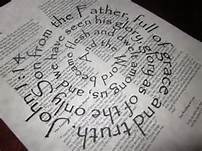
John 1-14 word made flesh, circle

John 1:1-14 – December 24, 2019

A long time ago, in a galaxy close by—even, in this galaxy right here, the Word was first. The Word was present before anything else. What came into existence was Life, and the Life was Light to live by. The Life-Light blazed out of the darkness; the darkness couldn’t put it out.

All right, I have a confession to make. I saw the new Star Wars movie on Saturday. I love the original Star Wars trilogy. I did not love the prequel trilogy, however I really liked the last trilogy of movies. And, the last of the current trilogy, “The Rise of Skywalker,” was a satisfying end to the story—thus far.

What does Star Wars have to do with Christmas? Especially during the past week, I was intrigued by the juxtaposition of Light and Dark in the Star Wars universe; the two flip sides of the Force, that ultimate dyad of positive and negative energy, where Light is Good and Dark is Evil.  I saw a few differences to what we have highlighted this Advent season here at St. Luke’s Church—the Light and the Dark.

Except, different from the Star Wars universe, this galaxy’s kind of Light and Dark are both positive, both are needed. Both are made by the same ultimate Source, or Force, or heavenly Creator at the beginning of all things.

The beginning of the Gospel of John is modeled after the beginning of Genesis 1—except John goes much deeper, and gets theological right away. John chapter 1 tells us a lot about the Word—the Light—the Life—and then, brings those descriptions down to earth. The cosmic Light—the Word spoken before anything was created—that Word—or Light—or Life comes down to earth and gets up close and personal. How much more personal can you get than becoming flesh, becoming a tiny Baby?

I think everyone here is more familiar with the narrative of Luke 2, where we hear about Joseph, and Mary, and the census, and the awkward situation the young couple was in—being still fiancés, still pledged to each other, and not yet married. But wait, there’s more! We hear about the shepherds, angels and their heavenly birth announcement. The shepherds run to visit the newborn Baby, and afterwards go and tell everyone in that town of Bethlehem: “Alleluia! The Messiah is born!”

Somehow, the narrative told by Luke seems a lot more relatable than the first chapter of John. I mean, who can relate to the eternal Word spoken before anything was created? And, the cosmic Light that is also Life? Isn’t that a mixed metaphor, John? Couldn’t you get your metaphoric descriptions straightened out before you set it down as Gospel truth?

This Scripture reading from John 1 is the reading for Christmas Eve, where John tells us of the Eternal Word, part of the everlasting Trinity, becoming flesh. As Luke would say, Emmanuel, God with us, becoming a Baby born in Bethlehem.

Jesus was the name that Mary and Joseph gave to their Son, and John tells us He is “the Light of all people” coming into the world. After a month of Advent, of waiting and longing and talking about the miraculous birth, Jesus is now here! We have also been talking about how Light and Dark are both positive things, both created by God.

As we reflect on the two narratives, the familiar one in Luke 2 and our reading for tonight, John 1, both readings talk about the Light of the world come to earth. Yet, Jesus is both human and divine. “Those two things coexist in him, just like light and dark. John tells us darkness does not overcome the light. The darkness is there alongside the light as it shines. Darkness helps light stand out, just like the stars shining in the night sky.” [1]

We have already talked about how darkness can be warm and friendly. Just think of baby animals and their mothers. Puppies, kittens, calves, lambs, all kinds of animals resting with their mothers. And, think of human babies. They rest with their mothers in the warm, welcoming darkness of night. Not like the good versus evil, light/dark split of the Star Wars universe, but instead all creation created by God, and all is named good.

We can see how there is a natural bridge connecting John 1 (talking about the Eternal Word/Light/Life), and the narrative of Luke 2, telling about the common, every-day birth of a Baby—yet miraculous, too. Both are integral parts of the Greatest Story Ever Told.

“But note: when God decided to get personally involved, God came to tell us that we are loved, deeply, truly, and forever. God loves all of us, but especially wants those who don’t feel loved or lovable, those who regularly feel like they’re on the outside looking in, those who feel forgotten, and those who wonder what the point of life is, to hear the “good news of great joy” that God loves all of us.” [2]

Is it any wonder that our Scripture reading for this evening tells us, in the wonderful translation by Eugene Peterson, that this Wonderful Counselor, Almighty God, Prince of Peace, Word become flesh, “moved into the neighborhood.” Jesus became one of us, a human being.

That is the meaning of Christmas: Jesus has moved into our neighborhood, and become one of us. As the angel said, Jesus is born for you. For me. For each of us. That is the miracle, come to earth. Glory to God in the highest! Amen.


(I would like to thank illustratedministry.com for their Advent devotional “An Illustrated Advent for Families: In Light & Darkness.” For this sermon, I have borrowed several ideas and quotes from the Christmas Day devotional. Thanks so much!)

For further information, see info@illustratedministries.com

@chaplaineliza

(Suggestion: visit me at my regular blog for 2019: matterofprayer: A Year of Everyday Prayers. #PursuePEACE – and my other blog,  A Year of Being Kind . Thanks!

[1] Advent devotional “An Illustrated Advent for Families: In Light & Darkness.”

[2] http://www.davidlose.net/2015/12/christmas-eveday-c-keep-it-simple/

“Keep It Simple,” David Lose, …in the Meantime, 2015.


Unknown's avatar

Some Children See Him

“Some Children See Him”

peru-nativity

Luke 2:8-15 – December 24, 2016

So many houses and apartments are decorated for the season at this time of year. Colorful lights and decorations indoors and out, shining Christmas trees, special dishes and fancy tablecloths. Plus, some families have a Nativity scene in a special place, whether under the Christmas tree or placed in an extra special location. Here at St. Luke’s Church, we have the Nativity scene with some other lovely Christmas decorations, in the narthex of our church.

The Christmas narrative from the Gospel of Luke is so familiar. Mary and Joseph enrolling for a census in Joseph’s ancestral town. Since it was the time of the census, the town was crowded to bursting. Mary was greatly pregnant, and while she was in Bethlehem, labor pains started. She and Joseph found shelter in a stable, and put her newborn baby in a feeding trough, a manger.

This evening, we are going to focus on the shepherds abiding in their fields, and the angel alerting them about the birth of this super-special Baby. Starting at verse 10 of Luke 2: “10 But the angel said to them, ‘Do not be afraid; for see—I am bringing you good news of great joy for all the people: 11 to you is born this day in the city of David a Savior, who is the Messiah,[a] the Lord.’” The shepherds quickly go into town and find the Baby, and worship and adore Him.

Yes, the Nativity scene is a familiar way of retelling this story. But—how did Nativity scenes begin? It was in 1223. “According to St. Bonaventure’s biography, St. Francis of Assisi got permission from Pope Honorious III to set up a manger with hay and two live animals—an ox and an ass—in a cave in the Italian village of Grecio. He then invited the villagers to come gaze upon the scene while he preached about ‘the babe of Bethlehem.’ (Francis was supposedly so overcome by emotion that he couldn’t say ‘Jesus.’)” [1]

However, that first Nativity was located in Italy, during the 1200’s. The practice of Nativity scenes, pictures and photos has certainly spread from there, all over the world. Do you remember acting in Christmas Nativity scenes? You, or your children? Or grandchildren?

When my children were small, one of the first Christmas decorations I’d take out of the box would be our little Nativity scene. The little statues were all children, and it was intended specifically for the young. I would tell and re-tell the Christmas story again and again. My younger two children would love to play with the figures, spending a good long time with those inexpensive yet meaningful little figures.

My personal Nativity scene, the one my children played with, has white children, every one. I had not thought about this when I bought the set of figures, more than twenty years ago. Even though my children were part of a multi-ethnic, multi-cultural school system, we still had an all-white Nativity set.

Let’s hear again the words of the angel to the shepherds, that Christmas night: “the angel said to them, ‘Do not be afraid; for see—I am bringing you good news of great joy for all the people.” Not just the people in Italy, where St. Francis was. Not just the people in Europe, or North America. Good news of great joy for all the people.

Think about Edith, our church’s pen pal from Kampala, Uganda. Almost everyone she sees on a regular day happens to be African, and dark-skinned. She has seen lighter-skinned people before, but most everyone she sees and interacts with is darker-skinned. What would a Nativity scene at Edith’s church in Kampala look like? (I don’t know. I can ask her!)

I love to go to a fair trade store in Evanston, a not-for-profit shop that sells goods from all over the world, called 10,000 Villages. This store has lots of different kinds of Christmas decorations, especially different kinds of Nativity scenes. Nativities from Mexico, South America, all over Africa, India, southeast Asia, and the Middle East.

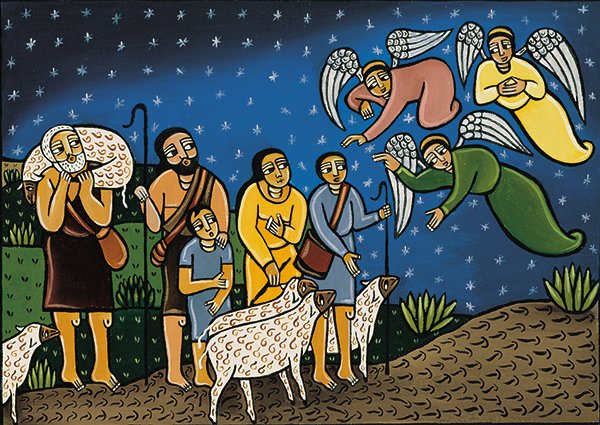
I bought this Ethiopian Nativity puzzle several years ago from a fair trade shop. I love the way the figures almost come alive, with their bright colors. Is this vibrant Nativity a welcome sight for you, or is it a bit distracting? Perhaps we might be encouraged to meditate on something a little different? Perhaps we can use an alternative, ethnic kind of manger scene, or different- culture picture of the Mother and Child, this year? Certainly something to think about.

Remember the words of the angel of the Lord: “Do not be afraid; for see—I am bringing you good news of great joy for all the people.” We can praise God! God did not send good news of great joy to just a few people in the world, or even some of the world’s people. God sent good news of great joy to all the people of the world.

The angel has come to all cultures, all ethnicities, all people, everywhere.

That is not only GOOD news, that is GREAT news. Good news of great joy! We can truly praise God with the angel hosts, saying, “Glory to God in the highest heaven,
and on earth peace among those whom God favors!” Alleluia, amen!

[1] http://www.smithsonianmag.com/smart-news/the-first-nativity-scene-was-created-in-1223-161485505/

@chaplaineliza

(Suggestion: visit me at my regular blog for 2016: matterofprayer: A Year of Everyday Prayers. #PursuePEACE – and my other blog,  A Year of Being Kind . Thanks!)