Unknown's avatar

Love: God’s Better Way

“Love: God’s Better Way”

1 Corinthians 13:1-7 (13:4) – February 2, 2025

One of the most popular themes for songs is that of love. Songs that describe love of one person for another, or songs that tell about how awful it is to have unrequited love. Also, songs that tell about the emotions and feelings that come with being “in love.”

            One classic popular song written by Burt Bacharach and Hal David talks about love in a basic and simple way. Saying, “What the world needs now is love, sweet love.”

What is the state of the world, anyway? Judging from a quick view of the local news, the city of Chicago, the state of Illinois, the federal government, the uproar in Washington D.C., unemployment, not to mention abuse of different kinds—against women, children, and seniors. That is not even mentioning the various armed conflicts throughout the world—fights over territory, disputes over resources, differences between people of different religious beliefs.

            What can possibly bring harmony, hope and wholeness into the world today?

            This brings us to our scripture reading for the day, from 1 Corinthians 13. This chapter is called the Love Chapter. It is so often used as a scripture text for weddings! Perhaps you or a friend or relative had this chapter read at a wedding. But, did you know that the apostle Paul did not write this chapter to glorify romantic love?

One of my favorite commentators, Karoline Lewis, states “that this “Wedding Text” is not a passive, observable event that seeks our affirmation and support, but something that calls for our participation. This is not a text where we are asked to look on as guests, dressed for a party and seated dutifully in the church pews, but rather necessitates our involvement.” [1] Did you hear? Our participation! Our involvement!  

We are not supposed to sit quietly in a pew and let love happen to us. We are not supposed to sit in the bleachers while the professionals handle this love business. No! Let us take a closer look at exactly what Paul tells us to do, and how we are to get involved.

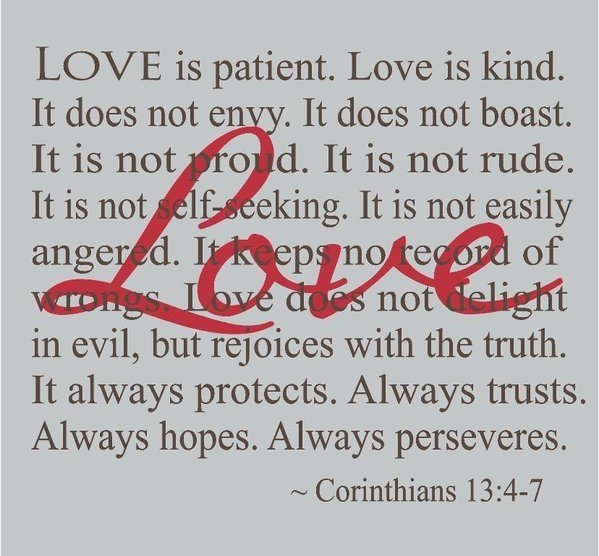
            Let us listen again to a portion of the words of 1 Corinthians 13, as brought up to date by Eugene Peterson in his modern translation “The Message.” “Love never gives up. Love cares more for others than for self. Love doesn’t want what it doesn’t have. Love doesn’t strut, Doesn’t have a swelled head, Doesn’t force itself on others, Isn’t always “me first,” Doesn’t fly off the handle, Doesn’t keep score of the sins of others, Doesn’t revel when others grovel.”

This is a penetrating way to teach people. Show them by example—examples of how not to love. Examples of jealousy or boasting, arrogance or rudeness. And especially, an example of a horrible injustice, where people are openly bigoted against females. (This can also be true of people who are bigoted about other differences, too, like about handicaps, or people of color, or of a different class of people, or of other nationalities or countries of origin.)

Those bad examples? Paul shows us clearly in this passage—don’t do those things! Don’t be that way! Sometimes, a bad example is the quickest way to our hearts and minds.

Paul was involved in a longer argument here in chapters 12 and 13 of his first letter to the Corinthian believers. Chapter 12 was all about the spiritual gifts that came from God, and meant for the strengthening of the body of Christ – the Church. Then in chapter 13, Paul zeros in on the most excellent of all of these God-given gifts. The gift of love. (or, charity, if we are speaking in a more flowery, King-James-version kind of a way).

            In this section I just read, Paul tells his friends and former church members what love is definitely not! Doesn’t strut, doesn’t have a swelled head, isn’t always “Me First!” Paul was making comparisons here! He had lived in the city of Corinth for many months, while he was pastor of this young church. He knew the rough and tumble, political attitude of the general population of the city of Corinth. Plus, he knew that this uncaring, callous attitude was rubbing off on the people inside of the church, too! That is why he wrote these words.

If we want to find out more about 1st century Corinth, “Charity [or, love] was not the activity of his opponents that spread their agenda. They promoted themselves, acted with arrogance, even engaged in shameful activities (backdoor politics?). As they sought personal gain, they provoked others, instilled animosities, and celebrated when others “lost face.” These were not the hallmarks of Christian community.” [2] In fact, all this crony-ism and inside politics sounds sadly familiar to me. But then, I grew up here in Chicago.

Instead, the apostle Paul gives us a marvelous example of what true love – and Godly caring, support, empathy – looks like. Listen again: “Love never gives up. Love cares more for others than for self. Takes pleasure in the flowering of truth, Puts up with anything, Trusts God always, Always looks for the best, Never looks back, But keeps going to the end.”

I don’t need to scramble and strive to love all by myself, trying really, really hard. It’s not all me, putting together my own faulty, human kind of caring. No! God freely gives gifts of love to all God’s children. That is what true love looks like. This is what true church looks like, too.

We can clearly see that Paul’s ministry of love, harmony and wholeness is for the whole world. Not just about taking care of those in our own families, although that’s important. It’s more than “taking care of our own,” although that is certainly laudable. It’s about showing love for everyone. For those affected by loneliness, or despair, disaster or disease wherever they are, without exclusion of those not like us or even of those we fear. Everyone.

Ending as I began, we look again at the Bacharach and David song, “What the World Needs Now.” The chorus of the song tells us the world needs love, sweet Godly love. Needs it badly. “No, not just for some, but for every, every, everyone.” Amen, Lord. Amen.

@chaplaineliza

(Suggestion: visit me at my other blogs: matterofprayer: A Year of Everyday Prayers. #PursuePEACE – and  A Year of Being Kind . Thanks!


[1] https://www.workingpreacher.org/commentaries/revised-common-lectionary/fourth-sunday-after-epiphany-3/commentary-on-1-corinthians-131-13-3

[2] http://www.word-sunday.com/Files/c/4-c/SR-4-c.html

Unknown's avatar

Love – No Matter What

“Love – No Matter What”

1 Corinthians 13:1-10 (13:7) – January 30, 2022

            With February right around the corner, many people start thinking about hearts and flowers. Thinking about chocolates and candy. Sweets for the sweet, as the old saying goes! Yes, Valentine’s Day is just two weeks away, and stores and card shops are full of red and pink displays and hearts and roses.

            As many hear this chapter on love from 1 Corinthians 13, some people wax sentimental. This chapter is a favorite to read at many wedding services in the church. “Everyone will nod along with a smile on their face. They’ll be remembering a wedding somewhere where these words were used to somehow capture the essence of this wild and crazy promise being made before the gathered overdressed assembly, this human enterprise that escapes human capabilities on a regular basis. [Or,] they’ll be remembering the Pinterest or Instagram post in fancy calligraphy, or the needlepoint in Grandma’s sitting room.” [1]

What if I were to tell you that love – the Bible’s definition of love – does not have anything to do with red and pink store displays, or hearts and flowers for Valentine’s Day?

            As we reflect on the biblical definition of love, let’s see what Paul says love does NOT do. I’m turning again to the wonderful modern translation of Eugene Peterson, The Message. “Love doesn’t want what it doesn’t have. Love doesn’t strut, Doesn’t have a swelled head, Doesn’t force itself on others.”

            That doesn’t sound much like lace and chocolates, hearts and big red bows, does it? No romanticized consumer version of love here! Do you recognize this honest, genuine kind of a feeling in the people you are close to, in the people you call family? Loved ones, and ones you cherish? This description is more of a love that is right down to earth, an honest, genuine feeling that is real and isn’t afraid to get its hands dirty.

            Let’s see a little more of what Paul says love does NOT do: “Isn’t always “me first,”
Doesn’t fly off the handle, Doesn’t keep score of the sins of others, Doesn’t revel when others grovel.” When I read all of these things love does NOT do, sometimes I get discouraged. It’s like I can’t measure up. I could never be that kind of person or be described that way; could you?

This enlarged, continued description of the biblical definition of love sounds too good to be true. For real people, I mean. To me, it sounds a lot like Mother Teresa, or Fred Rogers, two people who are considered to be the pinnacle of loving, caring people.

Wait a minute! Have we talked to God about this? Paul has been telling us for almost two chapters in 1 Corinthians that God freely gives believers spiritual gifts. What is more, Paul says that love is the absolute best of these different, diverse spiritual gifts. That means that God gives out love freely! With both hands! Right here, Paul is describing the gift of love that comes through people from the Lord. Isn’t that some of the best news ever?

I don’t need to scramble and strive to love, trying really, really hard. It’s not all me, putting together my own faulty kind of caring. No! God freely gives gifts of love to God’s children. God helps us to show love and caring, kindness and unselfishness. That is such a relief for me, and such a blessing to others!

We believers here on this earth may stumble on our way of walking the Christian journey, and that is okay. We do not need to fulfill each and every part of this long, involved definition that Paul given to us, either. And, it is not just up to our fallible striving or hard work to be the most loving and caring Christian believers possible. No! God will help!

When I think of God’s love, I think of certain people who modern society might not consider. Two individuals come to mind, who I knew years ago. Both are with the Lord now, and both had the diagnosis of Down syndrome. Both people were as loving and caring as anyone I have ever met. Both were selfless, totally concerned for others, and unfailingly kind, loving and giving. Isn’t this another example of love, according to the Bible? Isn’t it what love is all about?

Let’s take a final look at the last section of Paul’s definition of love, according to God. The previous entries or parts of the description were couched in the language of what love was NOT. At last, Paul describes what love IS. “Takes pleasure in the flowering of truth, Puts up with anything, Trusts God always, Always looks for the best, Never looks back, But keeps going to the end.” These are positive, affirming, uplifting traits, indeed.

We may not be able to walk the walk or talk the talk as perfectly as Paul describes here. “But we can stand in Paul’s certainty that there is a new way of being alive in the world, a new way of seeing the world and everyone in it. Must we simply accept everything going on in our messed-up world with a smile and nod? Of course not; evil exists. But we aren’t always the best at identifying where the real evil resides. Paul argues that it would better to lead with love.”[2] Again, you and I cannot generate this kind of spiritual gift in and of our own imperfect humanity, or of our own good works. We are welcome to ask the Lord for help and lead with God’s love.

This transformation is truly a gift – a gift of love! This gift comes from God, and is freely    offered to all believers! Let us thank God for this gift of love we all can display, and we all may give to others, just as freely. Alleluia, amen!


Thanks so much to Rev. Dr. Derek Weber, Director of Preaching Ministries for www.umcdiscipleship.com and his excellent preaching notes for this week’s worship service and sermon. I used several ideas from these notes for the sermon today

@chaplaineliza

(Suggestion: visit me at my other blogs: matterofprayer: A Year of Everyday Prayers. #PursuePEACE – and  A Year of Being Kind . Thanks!


[1] https://www.umcdiscipleship.org/worship-planning/love-never-ends-being-the-body-of-christ/fourth-sunday-after-the-epiphany-year-c-lectionary-planning-notes/fourth-sunday-after-the-epiphany-year-c-preaching-notes

[2] https://www.umcdiscipleship.org/worship-planning/love-never-ends-being-the-body-of-christ/fourth-sunday-after-the-epiphany-year-c-lectionary-planning-notes/fourth-sunday-after-the-epiphany-year-c-preaching-notes

Unknown's avatar

Believe, Trust, and Love

“Believe, Trust, and Love”

John 3:14-21 – March 14, 2021

            Have you seen the televised sporting events where people in the crowd hold up big signs? These signs have all kinds of messages on them – from super fans supporting their teams to political messages. Sometimes, someone will show a large sign with “John 3:16” printed on it.

John 3:16 – this is one of the dearest and most memorized Bible verses of all time. “For God so loved the world that God gave His one and only Son, that whoever believes in Him shall not die, but have eternal life.”

            Have you thought about what that beloved Bible verse means? I mean, really means?

            Many people have a romanticized idea of love in their minds. With Valentine’s Day so recently celebrated, a month ago, when some think of “love” they think of Cupids and flowers and hearts. Valentine’s Day cards and chocolates in heart-shaped boxes for your sweetheart. This idealized, Hallmark-card conception of “love” is not what the Apostle John mentions here. Not by a long shot!  

            The idea of taking a single Bible verse and displaying it for everyone to see is a tricky proposition. People can run into all kinds of problems and misunderstandings that way. It’s like taking John 3:16 and saying that God’s love is all hearts and flowers, lace and Valentine’s Day wishes – and that is all. This superficial way is not the way to interpret individual Bible verses.

            The most important thing when we consider a single verse from the Bible is to look at the context. Where does it come from? What was happening in the Bible chapter? Was it part of a conversation or discussion? An extended statement or argument?

            John chapter 3 is early in the Rabbi Jesus’s ministry, and He was already gaining wide popularity and even stature for His great Biblical knowledge and understanding. An older man named Nicodemus, a learned teacher and member of the national Jewish ruling council, was so intrigued with Jesus that he snuck away to meet Jesus one night, under cover of darkness.

            During that extended conversation, Nicodemus and Jesus cover several important topics: Moses in the wilderness, how Moses saved the people of Israel, Nicodemus as a leading teacher of Israel, and how to be born from above. It is then that Jesus makes this extraordinary statement: God so loved the world.

            Several of these topics in John 3 have the foundation of belief. We need to believe in order to live. In order to be born from above. In order to have eternal life. Except – belief can be strictly intellectual. It can be cold-hearted and clinical. We can believe in the law of gravity. We can believe in the rules of cleanliness and hygiene for good health. We can believe in the invisible electric current that flows through our walls, enabling us to have electric lights, power for appliances, and power for our computers and cell phones.

            But, this pure, clinical statement of belief – even belief in Jesus’s statement “God so loved the world” – is not necessarily earth-shaking, not deeply emotional, never even reaching down into our very souls.

            If we consider the word “believe” – as used in this verse 3:16, and verse 3:18, too – I do believe in gravity, or electricity. But, is this intellectual belief enough? Will this kind of belief get me through the difficult times, or the painful situations, or those times when you or I cry out in despair to God? Sometimes, cold, pure belief is not enough.

            Another, alternate word that can be used to translate this Greek word for belief, pisteuo, is “trust.” Trust is more immediate, more intimate. Commentator Mark Skinner suggests that we use “trust” instead as we read this verse:  “For God so loved the world that God gave His one and only Son, that whoever trusts in Him shall not die, but have eternal life.”

            “Jesus is asking his hearers to trust that, in him, God has given a gift of love. Jesus urges them to commit themselves to that reality and all it entails. Trust will change a person. God’s love has consequences. How does one merely believe in love, anyway? Trust is riskier. Trusting in another’s love entails surrender.” [1] Trusting God is riskier, too.

            When my children were younger and went to church youth group, several times they had an activity called “trust falls.” This activity is called different things in different youth groups, but it has “trust” as the primary ingredient. The youth group would get in a tight circle, one member would stand in the middle, and then they would fall backwards, trusting the other members of the group to catch them as they fell. Trust taps emotions. Trust takes risks.

            It is difficult to trust that God can see us through, sometimes. More than intellectual belief, do we trust God to be there for us? To walk with us, or sit with us, right by our sides?  

            Some people cannot get past the words “God so loved the world.” If they trust that God loves them, they think God can’t possibly love their awful neighbor. Or the guy who cussed them out in traffic. Or the lady who is always really mean at the store. God can’t possibly love them? God loves the world – except for those people from a certain country overseas. Or, except for those homeless people. Or, except for those people who believe something really weird. Or, well, you get the idea.

            God’s love is extended to each of us. To all of us. “The love of God means blessing and belonging, even when the world around us chooses the way of death and self-interest.” [2] Even when we as fallible humans slip and slide in our trust of God, the Lord will never waver in persistent, caring love for each of us. And, that is a promise that is faithful and true – we have the words of Jesus on it.

For God so loved the world. Even you and even me. Amen.


[1] https://www.workingpreacher.org/dear-working-preacher/love-among-the-ruins

[2] Ibid.

@chaplaineliza

(Suggestion: visit me at my other blogs: matterofprayer: A Year of Everyday Prayers. #PursuePEACE – and  A Year of Being Kind . Thanks!