Unknown's avatar

God’s Faithful Promises

“God’s Faithful Promises”

Hebrews 10:15-25 (10:24-25) – Sunday, November 17, 2024

            Have you ever thought of all the different kinds of churches? Big churches, small churches, fancy places with lots of stained glass and stone carvings, or plain buildings with wooden pews and earnest prayers, plus house churches, all over the world!

            My friend Tiffany used to attend church at the National Cathedral in Washington. She grew up there. She remembers running around in that gorgeous building along with the other children in their renowned youth choir. Up and down the corridors, and even playing hide and seek in the building. Imagine having that glorious cathedral as a familiar, home church!

            I would like for us to focus on one particular idea in this Scripture reading from the letter to the Hebrews, today. “And let us consider how we may spur one another on toward love and good deeds, 25 not giving up meeting together, as some are in the habit of doing, but encouraging one another—and all the more as you see the Day approaching.”

I have worshiped at churches in a number of different faith traditions, in all different kinds of church buildings, and they all proclaimed the same Lord, Jesus Christ. The same God receives all the glory! Some churches pray in a more rambunctious manner than we do here. Yet, in every church, believers come together to worship God, and to encourage each other.

This letter to the Hebrews is a circulating letter. That means it and other circulating letters were sent from place to place in Asia Minor, so the small, struggling groups of believers could receive encouragement and teaching in writing from the Apostles and other newer church leaders. This particular letter was sent to Jews who lived a long way from Jerusalem, and possibly had rarely been to Palestine. Right here in chapter 10, this letter to the Hebrews gives the command to keep up meeting together.

Remember, the Christian community was extremely small at this point! In these towns and cities in Asia Minor and all over the Roman Empire, the Jewish community was decidedly small, too. Except, the Jewish religion at this time was known and accepted by the Roman government. Since Christianity was such a brand new religion, the Roman government did not recognize it, and in fact in some places, wanted to persecute followers of Christ!

I want everyone here to understand: in these early days, followers of Christ were not going to worship in large building dedicated to the Lord, set apart to the worship of our God. Not at all! This gathering together we read about in Hebrews 10 is in very early days of the church. We are talking about small house churches! Gathering together took place in each others’ homes, and maybe, perhaps, in a large spare room belonging to one of their number.

I’ve attended some African-American worship services. They are often quite different from the more quiet, sedate way we worship here at St. Luke’s Church. I had the privilege to preach in one service some years ago, at a Baptist church on the west side of Chicago. In a converted building, three storefronts put together. The building did not look like much from the outside. But, inside? A whole different thing.

The spirit of God came down and transformed that worship space – and the worshipers. Marvelous to experience. They truly encouraged one another, cared for one another, and helped one another show good to others. In their own context, familiar to them, on the west side of Chicago.

“After all, God has graciously adopted us into God’s family. God has transformed you and me from God’s enemies into God’s children, and from strangers into siblings. So when Christians meet together, we come to a kind of family reunion.” [1] When we meet together, whether it’s in a soaring cathedral or just where two or three are gathered together, God is present with us. And, God can draw us close. Closer to God, and closer to each other.

Now, this is only the first part of what happens when we gather together. What else can happen? What is another command from Hebrews chaplain 10? “And let us consider how we may spur one another on toward love and good deeds.”

So often, we as believers are told to be nice and gentle, meek and mild. And, that is one side of our Lord Jesus, certainly. But, the Rabbi Jesus when He was here on this earth was not just a meek, mild, retiring kind of guy. He often stepped out, and stepped up. Jesus actively worked on behalf of the poor, the forgotten, those left behind, in both love and good deeds!

How often are we called to be bold in the Scripture? To spur one another on to expressions of love and caring, to strike out and be bold and courageous? Yes, we are also called to be bold, and outspoken, and hard-working – like our Lord Jesus! This connects to the gospel call to face dangerous or difficult times bravely knowing that God is in charge. [2]

There is one important factor here, though. It’s very difficult to be brave, bold and courageous all alone. But – it helps if we do it together.

I would like to point out that all of these pronouns in these verses are plural. In the original Greek, the writer to the Hebrews is talking to “you all” when he mentions “you,” and especially when mentioning “we.” In all of these instances, all of these commands, these verses are talking to us Christians as a group. That is, all of us followers of Christ. Eugene Peterson’s excellent translation The Message interprets this as a summons to “be inventive … in encouraging love and helping out.”

As we come to the end of the church year, we consider a number of Scripture readings that talk about the end of our time here on Earth, when we look forward to our Lord Jesus returning. This Scripture reading from Hebrews is no exception. Listen again: “encouraging one another—and all the more as you see the Day approaching.”

Just as Boy Scouts are required to do a community service project to earn their Eagle Scout award, they need to organize others to help them do their special project. In the process of completing the project, they learn how to spur one another on to accomplish that goal, to join in together on good works that benefit their community. [3]

In the same way, we Christians are called to be faithful, to encourage each other, and to spur one another on! And, as each of us is drawn closer together to other believers, we are drawn closer to our God.

We followers of Christ are all called to actively work on behalf of the poor, the forgotten, those left behind, in both love and good deeds! And, all the more, as we all look forward to that Day when our Lord returns in glory.  We practice, we love each other, and we work together, looking forward to that Day when “every knee shall bow and every tongue confess that Jesus Christ is Lord.” What marvelous blessings for ourselves, for each other, for our communities, and for the world.  Alleluia, amen!

@chaplaineliza

(Suggestion: visit me at my other blogs: matterofprayer: A Year of Everyday Prayers. #PursuePEACE – and  A Year of Being Kind . Thanks!


[1] https://cepreaching.org/commentary/2018-11-12/hebrews-1011-14-15-18-19-25/

[2] http://worshipingwithchildren.blogspot.com/2015/10/year-b-proper-28-33rd-sunday-in.html

[3] Ibid.
Unknown's avatar

Go to Work for God!

“Go to Work for God!”

James 1:17-25 (1:19-20) – September 1, 2024

This is Labor Day weekend, all across the nation, a weekend to picnic, to barbeque, to go to the beach or pool one last time, or a weekend to get out into nature. This is the unofficial end of summer, and the beginning of our fall schedule. Even the college football season started this weekend! You know it’s got to be fall when football begins and baseball winds down.

But, it’s also Labor Day weekend – commemorating “when labor activists pushed for a federal holiday to recognize the many contributions workers have made to America’s strength, prosperity, and well-being. The first Labor Day holiday was celebrated on Tuesday, September 5, 1882, in New York City. By 1894, 23 more states had adopted the holiday, and on June 28, 1894, President Grover Cleveland signed a law making the first Monday in September of each year a national holiday.” [1]

            What does the history of our holiday of Labor Day have to do with this Bible reading from the first chapter of the letter of James? Just this: “God is at work for the health of this world God loves so much.” [2]     

            We know this letter is from the apostle James, but who on earth is he writing to? He says who, several verses back, and in fact throughout the letter. He is writing to his fellow believers in Christ, those who are dispersed, who are scattered far and wide. James refers to these fellow believers as “beloved” and “brothers,” so you can tell that he has a relationship with them. In other words, James is not just writing to some stranger in another city.

            I don’t know about you, but when I’m communicating with someone I know, it’s a lot easier for me to be open and to come straight out with important stuff I need to say.  I think it’s the same with the apostle James, especially since I’m familiar with this letter and its contents. He must have known some of these people pretty well, because he talks straight. He doesn’t pull his punches. And, what he’s communicating here in chapter 1 is pretty significant.

Remember how James began this passage? “Every generous act of giving…comes from above.” That means every generous act of giving. Not some generous acts, not only Christian acts of giving (whatever those might be). But ALL generous acts of giving. Period. No matter WHO does them. They all come from above – that is, from God, or Godly impulses. All that we do that is good comes from God, which is an amazing statement. [3]

            We all can do God’s work, all the time. Not just on Sunday.

            A natural follow-up to Godly giving and Godly working is Godly listening. James says, “19 Remember this, my dear friends! Everyone must be quick to listen, but slow to speak and slow to become angry. 20 Human anger does not achieve God’s righteous purpose.” Not only are we to listen well, what does James say next? Don’t get angry!

            James has the following advice in the following verses: “So get rid of every filthy habit and all wicked conduct. Submit to God and accept the word that he plants in your hearts, which is able to save you.” My goodness! What is James doing here, writing a heavenly advice column? It certainly sounds like it. And, heavenly advice it is, too.  

            James even gets down to specifics. Avoid these behaviors! Don’t be slow to listen! Don’t be quick to anger! Plus, promote these behaviors! Instead, be quick to listen! Be slow to speak! And most important, be “eager to care for those most vulnerable. All of these things are within our reach.” As commentator Dr. David Lose says, “What parent doesn’t want to be slower to anger with his or her children? What friend doesn’t want to be a better listener? Aren’t all of us in a position to offer help and support to those in need?” [4] James here is encouraging all of us not just to think the faith, but to do it.

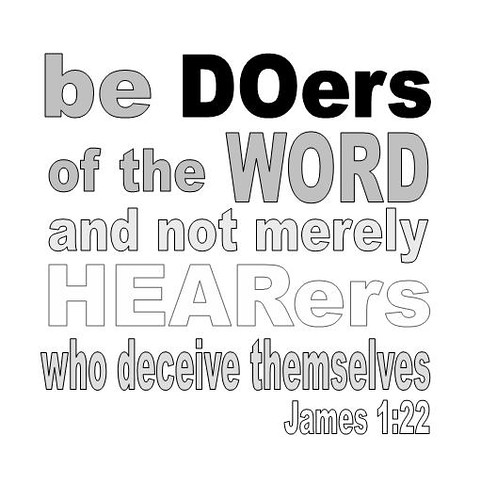
            Here, James is dealing with the Law. God’s rule book. James is a faithful Jewish follower of God, and as such is thoroughly steeped in the Mosaic Law code, or God’s rule book. Moreover, he has a pragmatic way of looking at the new way of living that comes from following his Messiah Jesus. Again, don’t just think the faith or hear the faith. Instead, do it!

            I return time and again to Carolyn Brown, retired Director of Children’s Ministry and commentator on the nuts and bolts of the Bible. She breaks things down to simple, straight forward truths. She says of this reading, “At the beginning of the school year children are learning the rules for their new classes, teams and clubs.  The rules tell them who they are and how they act in each situation.  Knowing that is important to them.” [5] 

            Just so with James. God’s rule book is important to him, too! Plus, following the way of God, following these acts of giving, acts of mercy, or advocacy, or support, or friendship are available to any of us. All of us, all the time. This manual for Christian living is NOT just something we do on Sundays, not just when we are in church or thinking heavenly thoughts. We can go to work for God anytime. All the time. Anywhere. Everywhere.  

            Dr. David Lose suggests that we try something for this coming week. Each of us consider this challenge. “write down one place [you] will be in the coming week where God could use [you] to listen, to be patient, or to care for those in need.” [6]  We are hereby all commissioned as God’s co-workers and partners. We all can continue to help make this world a more trustworthy, safe and healthy place, to work for God on this Labor Day, and every day. Alleluia, amen!

@chaplaineliza

(Suggestion: visit me at my other blogs: matterofprayer: A Year of Everyday Prayers. and  A Year of Being Kind . Thanks!


[1] https://www.dol.gov/general/laborday/history

[2] https://www.workingpreacher.org/dear-working-preacher/ordinary-saints

[3] Ibid.

[4] Ibid.

[5] http://worshipingwithchildren.blogspot.com/2015/08/year-b-proper-17-22nd-sunday-in.html

[6] https://www.workingpreacher.org/dear-working-preacher/ordinary-saints

Unknown's avatar

Written on Our Hearts!

“Written on Our Hearts!”

Jeremiah 31:31-34 (31:33) – March 17, 2024

            Relationships are foundational to life. Positive, negative, distant, close.  Both of my parents are gone now, but I had a loving relationship with both of them. My sisters and brothers—again, I have relationships with them. Members of my extended family, too, are included in my list of relationships. Also my friends, acquaintances, colleagues, even my enemies. All of these people have relationships with me.

Think about yourself. You have relationships with many, many people, too. Most of your relatives and acquaintances I just mentioned, if not all of them. Positive or negative, distant or close. We all have relationships—or friendships—with many people.

            But what about God? What kind of relationship do you and I have with God? Is that relationship good? Even wonderful? Is it close? Or distant? Bumpy at times? Our Scripture reading for today talks about this relationship. The prophet is talking about it from God’s perspective. God’s view of the relationship, or the friendship, if you will.

            If we think about the nation of Israel in the time of Jeremiah, the nation was devastated, and destroyed by the conquering nation of Babylon. The nation of Israel was probably not thinking about keeping up their relationship with God at all – with so much chaos and destruction surrounding each individual, each family, across the whole country.

            Centuries before the time of Jeremiah, God gave the Ten Commandments to Moses, and the whole law code of Moses in the years after that. This law code or rule book was meant to be a structure for the nation of Israel to follow, to live their lives, on a daily basis. And, this structure was a way for them to have a relationship with their God, their helper and deliverer – if they chose to follow God and God’s ways.

            Isn’t that the main problem? The nation of Israel had continuing problems following God’s rule book, God’s law code. Isn’t it exactly the same thing today, that you and I have the same problems following God, too?

            We’re not talking about a distant God, a God Who wound up the universe like a watch, put it on some shelf, and then walked away and promptly forgot all about it. No! The Lord wants to be in a relationship – with us!

            If we look at this reading, we see that God did have a relationship—a friendship, we could say—with the nation of Israel. God was the one Who started it. See what verse 32 says? God took the nation of Israel by the hand when God led them out of Egypt. God wanted the friendship. Israel did not start the relationship.

            We can compare that friendship to God’s relationship with us. God wants us as friends, too!  Just as with the nation of Israel, God goes out of God’s way to make friends with us. You and me. Each and every one of us. God approaches us.

            But something happened. Something awful! The nation of Israel was not a faithful friend to God. The relationship was disrupted, broken. But, God didn’t break it. No! Israel did. Remember the many, many times  in the Hebrew Scriptures that Israel ran away from God? Or forgot about God? Or just plain ignored God? Time after time, we can read about how the nation stumbled, resisted, or was unfaithful to their friendship. Their relationship.

            We can see the number one reason the people of Israel were taken out of the land and sent into exile: because the people broke their Covenant and God’s rule book time after time after time again. That’s the big reason for the nation of Israel’s exile to Babylon.

            What about us? What about you and me, in our relationship with God? Isn’t it a lot the same? Don’t we stumble, or fall? Haven’t we forgotten about God, or even broken God’s rules? I’m thinking of sin. Putting other things in God’s place. Making other things or other people in our lives more important to us than God. 

            Our relationship with God is broken! Disrupted. Sometimes we grow so used to sinning, to being apart from God, that you and I cannot choose to do anything else. What a predicament! Our relationship with God—under the Old Covenant—is gone. Destroyed. We are sunk, there is not a chance for you and for me.

            What about the nation of Israel? What did God do for them? Rev. Sharon Blezzard said, “God does not abandon the people, even when their hearts have turned from God’s divine love and life-giving law. God is faithful and promises to be known – not just in word and in teaching, but in the very DNA of the people.” [1]

            The Lord does not leave us abandoned, either! God still wants to be in relationship with us! With you, and with me. God’s nature is not punishing or arbitrary, but instead loving and forgiving. This forgiveness is heart language, from God. And, God will write this new covenant, this new relationship upon our hearts.

            The foundation of this forgiveness comes from our new knowledge of God, written on our hearts. And what is our response to God’s love? God’s forgiveness? God’s reconciling embrace? You and I have the opportunity to live changed lives, as changed people—from the inside out. God is not willing that anyone should be strangers, but instead that all would have the opportunity to be friends with God. Best friends.

God will be our God. We will be God’s people. And that’s a promise. That’s forgiveness. That’s the opportunity that each of us has to be with God, forever. Amen, and amen.

@chaplaineliza

(Suggestion: visit me at my other blogs: matterofprayer: A Year of Everyday Prayers. and  A Year of Being Kind . Thanks!


[1] https://www.stewardshipoflife.org/2015/03/language-of-the-heart/

Unknown's avatar

The Lord’s Great Love!

“The Lord’s Great Love!”

Lamentations 3:19-23 (3:22) – October 2, 2022

I know everyone here has been sad, at one time or another. Who hasn’t? Lots of things cause sadness. Just think of things that have caused you sadness, either long time ago, or more recently. Being sad is part of having emotions, and is part of the human condition.

Looking at our Scripture reading today, we see the word “affliction.” This is a more serious state than simply being sad. Feeling sadness can affect us enough, emotionally speaking! Who hasn’t been downcast and sorrowful from time to time? But, being afflicted, with bitterness? That is a different aspect to being sorrowful, even grieving deeply.

Listen to these verses from today’s reading, again: 19 I remember my affliction and my wandering, the bitterness and the gall. 20 I well remember them, and my soul is downcast within me.” Affliction is more than sadness. The prophet Jeremiah knew that very well! He was called to be a prophet to the nation of Judah and its people during one of the most challenging periods of its history! Jeremiah could not help but cry bitter tears when all of this prophecy and future trauma was revealed to him by the Lord.  

Any healthcare worker who works in a critical care area or trauma care unit is familiar with great sadness and affliction, in the lives of patients and their families. For some seriously ill patients, they have indeed been afflicted, and some for a long time. This can be devastating. As a hospice chaplain, I have the privilege of walking with some of these families during some of the darkest times of their lives – when they are drinking from the cup of affliction.

The prophet Jeremiah was quite familiar with the cup of affliction, too. He walked with, traveled with, the whole nation of Judah as they made their way through the valley of the shadow, and through some of the most difficult times of the nation.

The people of Judah had stubbornly rejected the Lord their God, and their stubbornness and selfishness would bring them suffering, destruction of their capital city of Jerusalem, and finally, an extended exile in Babylon for almost a century. Are people today any better? Do they follow the Lord, or do they run off after gods of their own devising? Their own creation? And by referring to “people today,” can’t that refer to you and me, too? Do we faithfully follow God and what God has directed? Or, do we stubbornly stamp our feet and go our own way?  

We can see how great is Jeremiah’s grief if we look closely at this book of Lamentations, and see him grieve with God. No wonder Jeremiah’s heart was breaking for his people; he knew what God was going to allow to happen to them, as a result of them forsaking their loving God!

I know there are some here who have experienced that deep affliction, much more than sadness. What have you done when you have experienced that deep trauma? That agonizing depth of despair and wordless, breathless sighing? What is your help and stay?

Carolyn Brown tells us: “Sometimes, it just feels like we’re yelling and God is not listening. That is the hardest time.  But even then, lots of people tell us that if you keep talking to God about it, eventually, sometimes after a very long time, it helps. No one can say exactly how or why. But it helps. So, we need to tell children that, when they are really, really angry and hurt and sad, they can tell God all about it.” [1] 

Jeremiah has a clear answer, too. “21 Yet this I call to mind and therefore I have hope: 22 Because of the Lord’s great love we are not consumed, for Gods’s compassions never fail.” Yes, we can run away like disobedient preschoolers, dashing away across the playground. But, God never stops loving us. God may be grieved with us, as God was very grieved with the nation and the people of Judah, in Jeremiah’s time. But, God never stops loving us. Ever.

 “Because of the Lord’s great love we are not consumed, for God’s compassions never fail.23 They are new every  morning; great is your faithfulness.” And, these are the bible verses where the lyrics for that marvelous hymn come from: “Great is Thy faithfulness, great is Thy faithfulness. Morning by morning, new mercies I see. All I have needed Thy hand hath provided; great is Thy faithfulness, Lord, unto me.” Yes, no matter how stubborn God’s children are, no matter how much they ignore or run away from God, the Lord’s love and mercy and faithfulness are great. God’s compassions never fail. Never.

We can see how great God’s love is for humanity through the incarnation. Yes, God sent God’s son to earth to become human, live among us, and die for us. And, on this World Communion Sunday, we remember how our Lord Jesus provided communion for us, as a sacrament, a means of grace, and to remember Him. Through the centuries, all believing Christians have celebrated this meal, this Lord’s Supper, in remembrance of Him.

“Today, through World Communion, we are also celebrating that though each church does things differently, we each and all of us need God and His grace. By participating together around the world in Holy Communion, we celebrate our common need for God, and together we celebrate receiving His love and grace.

“There are many different people. There are many different churches. There are many different ways of worshipping and serving God. But in the end, we all need God and we all are God’s children. Today we celebrate that we are different, yet we are the same.” [2] Yes, we can celebrate our particular way of observing the Lord’s Supper. And, we can respect and appreciate the many different practices of taking Communion, from all across the world.

So, let us come to the Lord’s Table, along with countless people around the world today, as well as through the ages. It does not matter whether we join together in a cathedral with elaborate ritual and reverence, or in a simple house church with plain words and equal reverence.

Thank God we all have God’s love, and we all have been gifted with the Lord’s Supper. We all do this, in remembrance of our Lord Jesus Christ. Alleluia, amen!

@chaplaineliza

(Suggestion: visit me at my other blogs: matterofprayer: A Year of Everyday Prayers. #PursuePEACE – and  A Year of Being Kind . Thanks!


[1] http://worshipingwithchildren.blogspot.com/2013/09/year-c-proper-22-27th-sunday-of.html

[2] https://onthechancelsteps.wordpress.com/2013/09/22/same/

Unknown's avatar

Delight in God’s Word!

“Delight in God’s Word!”

Psalm 119:9-16 (119:11) – March 24, 2021 (Midweek Lenten Service, Week 5)

            I have been fascinated by Psalm 119 for decades. Since I was a teenager, in fact. These many verses describe what so many seek – a close relationship with God through God’s Word. Psalm 119 is the longest psalm in our Bible book of Psalms, and an acrostic psalm. That means that each group of eight verses begins with the same Hebrew letter. In verses 9-16, each verse begins with the second letter “B” or “bet” in Hebrew.  

What’s more, this psalm is all about God’s Word – the Bible. This psalm uses many instructive and innovative descriptions of speaking, meditating, pondering and just plain reading the Bible. One of the first verses I ever memorized as a teen is found here, in Psalm 119:11 – “Thy Word have I hidden in my heart, that I might not sin against Thee.” (King James version)

A helpful way for me to consider these verses is to focus on the verbs: how does the psalmist ask us to think about the Word of God? Bible commentator Joan Stott broke the verbs down into three sections, the past tense, present tense and future tense. (Such wise assistance.) First, the present tense: verse 12. “I praise You, Lord.” That is a continuous song of praise! Hebrew has a continuous action for the present tense, and this is it! I’ve been trained as a musician, and Nancy is a professional musician, too. Praising God with music can be amazing!

The church musician Johann Sebastian Bach inscribed almost every piece of music he ever wrote with the initials “SDG,” or Soli Deo Gloria. To God alone be the glory. That is what Bach intended for all of his glorious music – that it glorify God alone. And then, the second half of verse 12 is “teach me Your laws.” Again, “teach” is in the present tense. Continuous action! We need to be taught (or, reminded) about God’s Word, regularly.

            Then, the past tense. As Stott says, “The past tense section of these verses can also teach us more about reflecting on and confessing our sin; and praying for God’s help to overcome these temptations. “…I have tried hard to find you – don’t let me wander from your commands. I have hidden your word in my heart, that I might not sin against you.”  [1]

            We need to keep trying, keep striving to find God. One of my all-time favorite hymns has the lines “prone to wander, Lord, I feel it, / Prone to leave the God I love.” “Come, Thou Fount of Ev’ry Blessing” is a gentle reminder that we do need to keep following, and to ask God for help when you and I are prone to wander.

             “The future tense section of verses is about the various commitments we make to God—but do we keep them? “…I will study your commandments and reflect on your ways. I will delight in your decrees and not forget your word…” [2] Ahh. I find myself reflected in this section, more than I would like. I do not study God’s Word much now. (I confess.) Yes, I do reflect on it, but I don’t dig in and truly study hard. I used to! But now, not as often.

            However, there is the verb “delight.” This is a word we all can choose to do. And, God will be so pleased when we delight in God’s Word! We have such wonderful verses to reflect upon. Not only in Psalms, but in Isaiah, and sprinkled in the historical books of the Hebrew Scriptures. Large parts of the New Testament are a delight and comfort for us to read, too. This is what God wants us to do, you understand! Psalm 119 is a wonderful place to start, too.

            Delight is joy, satisfaction, enchantment, or even glee. We are invited to love God, and sing praises to God’s name! Have you delighted in the Lord lately? And if not, why not start now? Plus, perhaps we can memorize a verse or two, and hide God’s Word in our hearts, too. That will please God so much, too. Amen!


[1] http://www.thetimelesspsalms.net/w_resources/lent5b_2018.htm

The Timeless Psalms: Psalm 119:9-16, Joan Stott, prayers and meditations based on lectionary Psalms, 2018.

[2] Ibid.

@chaplaineliza

(Suggestion: visit me at my other blogs: matterofprayer: A Year of Everyday Prayers. #PursuePEACE – and  A Year of Being Kind . Thanks!

Unknown's avatar

In Whom I Delight

“In Whom I Delight”

Matt 3-16 baptism word cloud

Isaiah 42:1-8, Matthew 3:13-17 – January 12, 2020

Most people are familiar with job descriptions. A job description for a bus driver would highlight their ability to be able to transport people safely and efficiently from one place to another. A job description for a magazine editor would feature their skill at editing and synthesizing copy for publication. But, what would the job description be for the Messiah, the Chosen One of the Lord?

We turn to our Gospel reading for this morning, from Matthew chapter 3. We meet Jesus at the very beginning of His public ministry at the River Jordan. He presents Himself to John the Baptist, along with a whole crowd of other people. They all want to be baptized, yes. But, what will Jesus do after baptism? What is His ministry going to look like? Do we know the requirements of His position as Servant of the Lord?

If we step back from this close-up view of Jesus and His cousin John the Baptist, we might be surprised at what we see. John had made a big splash in Jewish society, and in fact that whole geographical region. There were many, many people coming to where he was stationed at the River Jordan. Sure, many of them had heard the fire-and-brimstone way he preached. Many others wanted the first-hand experience with a true prophet of God. He called for serious repentance! Not a simple, breezy “I’m sorry” sort of thing. No, John preached a genuine, heartfelt, sometimes gut-wrenching repentance.

Isn’t that what you and I are supposed to do, before we come to the waters of baptism? Repent? Follow God? Or, if we are bringing babies or small children to be baptized, aren’t the parents and godparents supposed to answer for the children and affirm that these little ones are going to strive to follow God all the days of their lives? Serious matters. Serious vows.

But, Jesus was sinless! He did not need to be baptized! Why on earth did Jesus do this? Two of the reasons I believe Jesus went through the waters of baptism: He publicly inaugurated His public ministry, and He closely identified with the penitent people of God. How better to let people know that He was one of them than to experience all things in the same way that they did, go through all of life’s ups and downs, striving to live life as God would have Him live it.

Yet, John also prophesied the coming of the Lord’s Messiah—or as translated into Greek, the Christ. The Servant of the Lord, as mentioned by several prophets in the Hebrew Scriptures. There has got to be a job description in one of those Servant-of-the-Lord sections. Isn’t there?

Many organizations and businesses have detailed job descriptions for each of their positions. In want-ads on line, you can see details of each job, listing required qualifications, desired expectations, practically everything an applicant would need to know in order to apply for the featured position.

In our Hebrew Scripture reading from Isaiah 42, we see a clear description of the prophesied Servant of the Lord. In other words, a job description for the Messiah. We can also think of this as a checklist for the several years of the Rabbi Jesus’s public ministry.

The first qualification the prophet talks about? “I have called you in righteousness.” This is answered directly by Jesus, in Matthew 3. Why was one of the reasons for Jesus’s baptism? As Jesus said, “to fulfill all righteousness.” I suspect Jesus may have had this very section in Isaiah 42 in mind when he responded to John the Baptist.

We hear this job description repeated again and again, by various prophets in the Hebrew Scriptures, as well as prophecy fulfilled in the Gospels. Sort of like a first-century job board. Is it any wonder that many people already knew what was ahead of the Rabbi Jesus as He begins His ministry among the people of Israel?

The prophet Isaiah writes God “will make you to be a covenant for the people and a light for the Gentiles,” We go back to that jam-packed chapter 2 of the Gospel of Luke. After the angels and the shepherds went away, Mary and Joseph took the eight-day old baby Jesus to be presented at the Temple in Jerusalem. When he saw this Baby, the devout man Simeon also made a prophesy about this Gift from God. It is almost word-for-word out of Isaiah 42. Simeon said “For my eyes have seen [God’s] salvation, which you have prepared in the sight of all nations: a light for revelation to the Gentiles, and the glory of your people Israel.” As Luke said, Simeon had been told by the Lord that he would live to see the Messiah. Lo and behold, when Mary and Joseph brought the Baby into the Temple, Simeon was there, to be a witness.

Another phrase from Isaiah 42: “to open eyes that are blind.” A number of times in the Gospels, we see Jesus healing people who are blind, restoring their sight. One of these healings is recorded in John 9, where Jesus publicly heals a man born blind, and argues with the religious leaders while He was doing the healing. (Plus, an editorial comment: I cannot believe Jesus would heal anyone’s sight to less than 20/20. Perfect sight.)
The prophet Isaiah foretold that the Servant of the Lord would “free captives from prison and release from the dungeon those who sit in darkness.” When Jesus proclaimed in His hometown synagogue that He was the Servant of the Lord, He read from another section of Isaiah. Jesus said these same words: He would free the captives and set the oppressed free.
Last but certainly not least, Isaiah 42 begins with a summary statement: “Here is my servant, whom I uphold, my chosen one in whom I delight.” Could this be any more clearly the voice of the Lord, echoing across the waters of the River Jordan? “A voice from heaven said, “This is my Son, whom I love; with him I am well pleased.” What love. What affirmation. What blessing.

If only we all could have that approval from our earthly parents and families. As one of my favorite commentators David Lose said, “Baptism is nothing less than the promise that we are God’s beloved children. That no matter where we go, God will be with us.” [1]

Certain job descriptions designate people with specific titles or names. I suspect you are familiar with a number of them, too. “Nurse,” “doctor,” “judge,” “teacher,” and even “pastor.” Jesus had the job titles “rabbi,” “teacher” and even “Messiah” or “Christ.” Names or titles are important; some lifting up, and others tearing down.

Think of the various titles or names you have had in your life, as will I. Were all those names or titles positive, good, or helpful? Or, were some of these hurtful, hateful, or demeaning? Some of these names or titles can stay in the memory for years, or even longer, when said in a mean or nasty way. Think of names or titles like “Stupid” or “Egghead,” “Fatso” or “Ugly.” Names like “Loser” or “Prissy,” “Know-it-all” or “Victim”.

As I remind all of us about these negative, hateful names or titles, and we sit with them for a moment, it is just for a moment. Each of us has a God-inspired job description, too. Each of us has the title or name of beloved child. Think about it. We may hold this title, this name, to our hearts—Christian. What an affirmation. What a blessing!

Just as Jesus had the title God’s beloved in His job description, so do we. We have God’s word on it.  

(I would like to thank the commentator David Lose for his article on the Baptism of Jesus and Matthew 3 from Dear Working Preacher. For this sermon, I have borrowed several ideas and quotes from this devotional. Thanks so much!)

[1] http://www.workingpreacher.org/craft.aspx?post=1580

“The Power of a Good Name,” David Lose, Dear Working Preacher, 2011.