Unknown's avatar

Faith, Birth from Above

John 3:1-17 – March 12, 2017
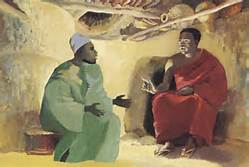
Jesus and Nicodemus, JesusMAFA

“Faith, Birth from Above”

Got faith? Really, do you have faith in anything? Perhaps, faith in electricity, to keep the lights and appliances working in our houses. What about faith in our doctors, or in the medical profession in general? Some people would say “yes” and others “not so much.” How about faith in the Chicago sports teams? That kind of faith is getting more and more difficult to keep up.

What about in our Scripture readings today? We have already heard about Abraham, and how he had faith in his God. In each reading, we have a person in our list of faith recipients. A person who tried to have faith and trust in someone or something outside of themselves.

Let’s take a closer look at Abraham’s situation. Reading from Genesis 12: “Now the LORD said to Abram, “Go from your country and your kindred and your father’s house to the land that I will show you.” Everything the Lord was saying sounded strange and unfamiliar. God did not even name the country where Abram was supposed to go.

Turning to John 3, Eileen and I acted out the encounter Nicodemus had with the Rabbi Jesus; let’s remind ourselves of that situation. “Now there was a Pharisee named Nicodemus, a leader of the Jews. He came to Jesus by night and said to him, “Rabbi, we know that you are a teacher who has come from God; for no one can do these signs that you do apart from the presence of God.”

Nicodemus was trying to have faith in someone or something, but faltering. That sounds a lot like us. Don’t we hesitate and falter sometimes, when trying to have faith?

“Jesus answered Nicodemus, “Very truly, I tell you, no one can see the kingdom of God without being born from above. Nicodemus said to him, “How can anyone be born after having grown old? Can one enter a second time into the mother’s womb and be born?”

This is a real puzzle for Nicodemus.  Added to that, Nicodemus had heard Jesus a number of times, thought He was right about a lot of things, but still was cautious.  Put yourself in Nicodemus’s situation. How would you like to be a big-shot teacher of Israel, well known not only among the common people, but also with his colleagues among the Pharisees? He brought his questions to Jesus at night when no one would see him and maybe make fun of him. [1]

Perhaps we are in a similar position, too, where some of us here are cautious or hesitant about finding out more about Jesus. For sure we are in the same boat as Abram: we don’t know quite where we are going, or where this new land really is.

This whole trusting-Jesus-business requires some faith.

Another way of looking at this is that we need to find a new perspective, too, like the Apostle Paul said about Abram in Romans, our New Testament reading today.

Leaving everything familiar to begin a new life? Going to an unknown land, you don’t even know where it is, or how far away? Look, Abram is not coming back. This is certainly no there-and-back-again journey. This is no pilgrimage, either.

I was fascinated to learn some things from one of the commentators. “On a pilgrimage, one sets out to a new place or a holy place to learn something and return where one came from with some new insight for living back home. Abram’s is to be a permanent relocation, something far more like the experience of the millions since Abram who have immigrated to other countries, including the vast majority of the population of the current United States or at least their ancestors.” [2]

I know some of you here are familiar with computers. You might even know how to “reset” or “restart” your computer with a CTRL-ALT-DEL move on a Microsoft Windows®-based computer. Maybe that was what Nicodemus really wanted to do. (It does get frustrating, being uncertain and unsure, not knowing where on earth we are going!) Let’s look at the situation from Jesus’s point of view. Jesus wanted to bring Nicodemus into a whole new world. He started talking about a new birth, or birth from above.

A sermon website I go to from time to time had a superb illustration. (I’m sorry, but I don’t know the name of the anonymous pastor.) “When I was a country pastor trying to get directions to a farm that I had never been to before, if the directions were complicated, the directions sometimes began with “you can’t get there from here.” It was their way of saying that starting from a different place would make the trip easier. Sometimes the best spiritual advice is like that — in order to get to life in the kingdom/reign of God, we have to start from a new place, a reborn place in our lives; and that we can’t get there (to the kingdom) from here (our life of sin apart from God). Nicodemus has trouble thinking that you can start from a new place, that you can’t take along all the history and baggage of the past — “how can these things be?” (vs. 9)” [3]

In computer terms, it is almost as if Jesus tells Nicodemus that he has to “reboot” — that he can’t run his program any more because there are too many error messages flashing in his life. We need, and God is ready to supply, an entirely different operating system.

Too true! Jesus offered the cautious Nicodemus more than a new perspective. It’s a new birth, and whole new world. And, how is he able to reach it? By faith, that’s how.

When God called Abraham, Abraham left everything he knew to move to a place that had not been named.  That is brave and bold.  That takes faith.

All that faith business is centuries in the past. Nicodemus lived when Jesus lived, and Abram lived a lot of centuries before that. What does all that have to do with today? With modern life, and with us here at St. Luke’s Church? Don’t we hesitate and falter sometimes, when trying to have faith? Today, Jesus would tell us the exact same thing.

Some people treat our relationship with God as something we earn by what we do, by “being good” or at least “not being bad” on the basis of some checklist of good or bad behavior. Have we reduced a life of discipleship to Jesus to morality and status instead of actual faithfulness to trust Him and follow where he leads every day? [4]

When we gather together our courage and go to see Jesus under the cover of darkness—like Nicodemus—He welcomes us. He enters into a relationship with us. We are in the same boat as Abram: we don’t know quite where we are going, or where this new land really is.

What about when we get to the end of that lifelong journey, and cross the River Jordan? There will be a welcoming party when we arrive in the Promised Land, for sure!

My original question at the beginning of the sermon: got faith? This whole trusting-Jesus-business requires some faith. The best part is that Jesus will help us. He understands our difficulties. He is patient, and will walk with us as we journey towards that new land. He’ll be right by our side in the valley of the shadow. Step by step, we strive to have faith in God.

What a Savior. What a Friend we have in Jesus. Amen.

[1] http://worshipingwithchildren.blogspot.com/2014/02/year-second-sunday-in-lent-march-16-2014.html 

[2] https://www.umcdiscipleship.org/worship/lectionary-calendar/second-sunday-in-lent4#bow

[3] http://desperatepreacher.com//bodyii.htmhttp://javacasa.com/resources/dps_form_results/jon3_1.htm

[4] https://www.umcdiscipleship.org/worship/lectionary-calendar/second-sunday-in-lent4#bow

@chaplaineliza

(Suggestion: visit me at my regular blog for 2017: matterofprayer: A Year of Everyday Prayers. #PursuePEACE – and my other blog,  A Year of Being Kind . Thanks!)

(Thanks so much to the good folks at UMC Discipleship.org! I am following their Lenten series. Their online Lenten sermon notes and worship helps are invaluable.)

Unknown's avatar

By Grace through Faith

“By Grace through Faith”

grace = by grace through faith Lutheran

Romans 3:24 – October 25, 2015

I have a confession to make. I was raised a Lutheran. Baptized and confirmed in a Lutheran church on the northwest side of Chicago, I loved everything about that church. When I was in grammar school and high school, I learned all I could about my church, about being a Lutheran, and even about Martin Luther. I studied Luther’s Small Catechism during my two years of confirmation classes in seventh and eighth grades. So, you could say I know a thing or two about Martin Luther and about the church that to this day bears his name.

This Saturday, October 31st, is the 498th anniversary of the day Martin Luther tacked up the 95 Theses, his 95 points of disagreement he had with the Catholic Church. In 1517, the priest and doctor of theology Martin Luther posted his 95 Theses on the chapel door in Wittenberg, Germany, at the university where he served as professor. Thanks to the printing press, these 95 points of disagreement spread like wildfire. Not only in Germany, but throughout Europe. The Reformation began in earnest.

Why was Martin so upset? To understand that, we need to take a closer look at Martin’s beginnings. When he was a very young man, Martin Luther felt unworthy of God’s love. He felt lower than a worm sometimes, and tried his hardest to get into God’s good graces! He would go to confession several times a week, do penance after penance, and he made several pilgrimages. All of these things and more to stop feeling unworthy and sinful.

Taking a quick look at the letter the Apostle Paul wrote to the Roman church, you and I might get that same message, too. From chapter three, “There is no difference between Jew and Gentile, 23 for all have sinned and fall short of the glory of God.” Martin felt that so deeply! All have sinned! All fall short of God’s glory! All means everyone. All of us.

Romans 3:23 is not good news! This verse is pretty bad news. Rotten news. Really hopeless news, if you ask me. And, that is the news Martin Luther faced, the more and more he read and studied the Bible, meditated, and prayed.

Martin was right. According to the Law of Moses, given to the nation of Israel in the Old Testament, there is no one who can follow the Law one hundred percent. Not the Old Testament Jews, not Jews in Jesus’s day, not Martin Luther, five hundred years ago. And, not you and me, today, either. There is no way anyone can keep every single one of God’s commands! (Even though the Pharisees of Jesus’s day—and the Pharisees of today—try their very hardest.)

Martin Luther regularly reflected on his life and his thoughts, and how far short he fell, compared to where he knew that God wanted him to be. That was what I felt, when I was a teenager, too. I knew I couldn’t keep all of God’s rules, even if I tried really, really hard. Remember Romans 3:23? “For all have sinned and fall short of the glory of God.”

When I was a teenager, I was a particularly studious teen. I would read books on the Bible and on theology when I was in high school. I prayed regularly, and tried my hardest to get closer to God. I had low self-esteem. I felt sinful, unlovely and unlovable a good deal of the time.

Martin Luther tried even harder to get close to God! He did a ton of good works. He got a university degree in theology, and started teaching from the Old and New Testament at the university in Wittenberg. He studied even more about God, and preached regularly in a church in town. And yet—he still felt sinful and far from God! He still felt unlovable!

Can anyone relate to Martin? Are there times when you—when I—feel unlovable?
I remember hearing the story of a woman, horribly burned in a fire. Her husband came to see her in the hospital and was disgusted and horrified by what he saw. “You are not the woman I married,” he said, and promptly divorced her. Are we so unlovable? Is that what we are afraid God might do to us?

Martin felt sinful and unlovable, too. What’s more, even after lots and lots of good works and all these years of reading and study, he still felt so inadequate. He felt God could not possibly love or forgive him. That is—until he was reading the letter to the Romans, chapter 1, verse 17: “ For in the gospel the righteousness of God is revealed—a righteousness that is by faith from first to last, just as it is written: ‘The righteous will live by faith.’”

Do you hear? Do you understand? It wasn’t about Martin. It wasn’t about how sinful or unlovable he was. Or, how hard he tried to do good things, or tried to get on God’s good side, or tried to live by good works. God’s righteousness comes by faith. Faith alone! Faith in God!

Remember Romans 3:23? “For all have sinned and fall short of the glory of God.” Yes. Yes! That is true. But—that isn’t the whole story! Reading, starting from 3:21: “21 But now apart from the law the righteousness of God has been made known, to which the Law and the Prophets testify. 22 This righteousness is given through faith in Jesus Christ to all who believe. There is no difference between Jew and Gentile, 23 for all have sinned and fall short of the glory of God, 24 and all are justified freely by His grace through the redemption that came by Christ Jesus.”

I can almost see Martin falling off his chair, once he realizes how huge this is. Our sin is taken away through the redeeming that came through Jesus. We are made lovable through God’s grace. Our low self-worth and low self-esteem is now viewed by God through Jesus. God looks at all of us, each one of us, through Jesus-tinted lenses.

We are now brothers and sisters of Jesus, God’s beloved children! We are now redeemed freely. By His grace, through faith, through the redemption that came by and through Christ Jesus. The best part of this gift? It’s a free, undeserved gift, so that no one can pridefully boast about it.

Another way to look at this gift from God comes from a sermon study board online I follow. I recently read this, written a few years ago by a preacher named Erik in Wisconsin.

“This Sunday we celebrate confirmation. As a part of their confirmation requirements, students have to meet with me for a brief discussion/interview. I ask them about faith, life, God, etc. – see if they learned anything during confirmation. One question I always ask is “How will you get into heaven? How are you saved?” Most often I get the answers – “Pray. Go to church. Do good deeds.” And I shake my head and ask myself “Didn’t I emphasize grace enough?”

“Finally, I said to the class, “Listen, you are saved purely by God’s grace as a gift. I will ask you how you are saved in your confirmation interview. If you don’t remember anything else I’ve taught during these two years, remember this: “You are saved by God’s grace!” Why is it so hard to remember? Probably because we’ve been taught not to trust anything we might get for free, even if it is from God.”

Martin Luther found out that we are saved by faith alone, through grace alone. No good works! No trying and trying really, really hard, and not making it after all that! Salvation is all from God and God’s grace! Romans 3:24 says,” and all are justified freely by His grace through the redemption that came by Christ Jesus.”

As Martin Luther studied scripture, he finally discovered he was saved by grace, not because of anything he did or deserved. The Rev. David Hansen tells us, “He discovered a God who would send the only Son—not for the perfect people, but for the sinners. He discovered, above all else, a God and a Savior that will NEVER abandon us, that will stand by our side no matter how often we fail or how short we fall.”

Is that good news? Jesus died for our sins. Jesus showed us radical, God-sized grace, and radical, God-sized love.

As I proclaim each week after the Confession of Sin during the Assurance of Pardon, “Believe the Good News of the Gospel: in Jesus Christ, we are forgiven!”

Alleluia, amen!

Thanks to Rev. David L. Hansen and Pastor Erik from Wisconsin for their assistance in the formulation of this sermon!

@chaplaineliza

Suggestion: visit me at my daily blog for 2015: matterofprayer: A Year of Everyday Prayers. and my other blog,  A Year of Being Kind .  Thanks!