Unknown's avatar

Returning to the Shepherd

“Returning to the Shepherd”

1 Peter 2:19-25 – April 30, 2023

            How many here know the 23rd Psalm by heart? The 23rd Psalm is probably one of the most familiar Bible passages in either the Hebrew Scriptures or the New Testament. I myself memorized it when I was younger, when I was regularly memorizing verses from the Bible. These verses can be by turn comforting, soothing, encouraging, and supportive. Just what many people need at challenging or difficult times in their lives!

            Today’s Bible reading hearkens back to Psalm 23. In 1 Peter 2, the apostle is straightforward in his statements. He talks clearly of suffering: the suffering of believers, and about Christ’s suffering on our behalf. Wait a minute! I thought that since I became a Christian that I would not have to suffer! Didn’t you? When we become Christians, we get a nice, easy life, don’t we? Who said anything about suffering?

Here in 1 Peter 2 is one of many places in the New Testament that talk about suffering, certainly. A number of other places in the apostle Paul’s letters mention suffering, too. Paul’s suffering, as well as that of his friends’. And, what about the Gospels? Our Lord Jesus does not shy away from talking straight about suffering. Carrying the cross, and following Him.

            Sadly, I regularly have contact with people for whom life has become very difficult. Living one day at a time becomes the only way that some can possibly make it. Sure, since I am a hospice chaplain during the week, many of the patients and families I interact with are dealing with huge difficulties. And, usually these difficulties are physical in nature.

            Except, life does not always send us physical problems. (Or, just physical difficulties.) Life happens, as we all can attest. Life can throw many of us curve balls, and even see us (or our friends) striking out at home plate. Not only reverses in health, but emotional upsets, lack of financial security, even spiritual distress of many kinds.

            For many, many people throughout the centuries, Psalm 23 has been a help and a stay when the unexpected challenges and difficulties in life happen. This 4th Sunday of Easter is Shepherd Sunday, the day when we not only lift up the many blessings of Psalm 23, but on this Sunday we also look at other Shepherd-related Scriptures.  

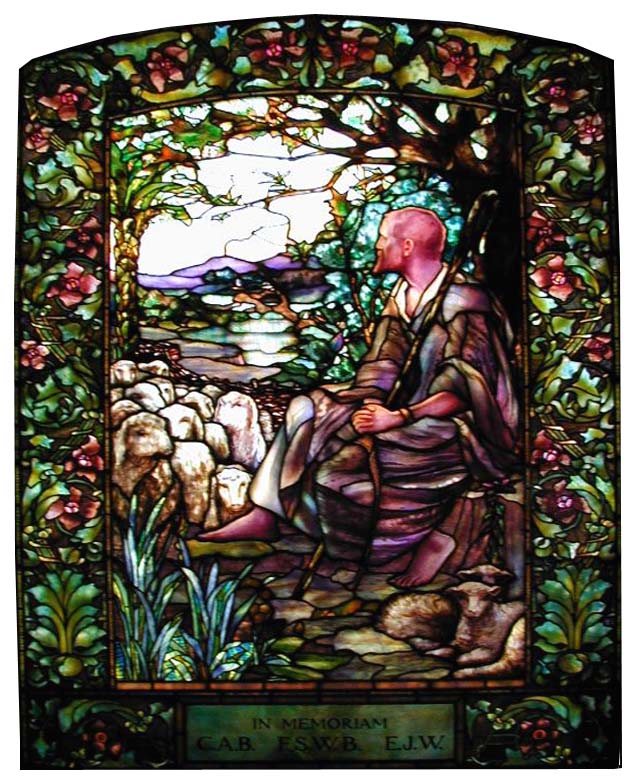
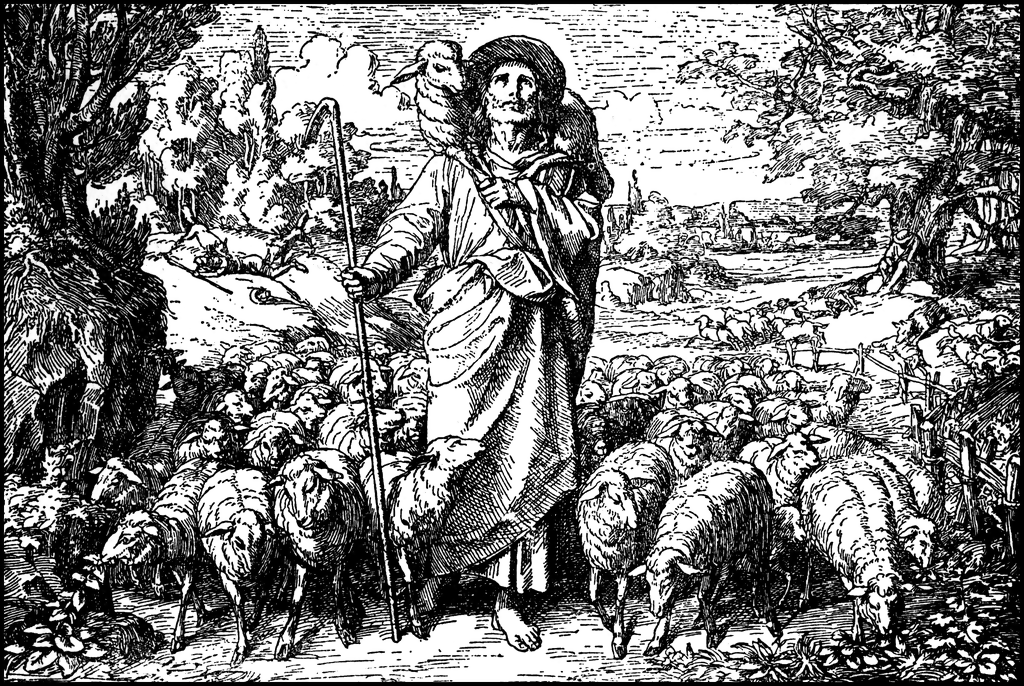
             “Perhaps it was the image of Jesus tenderly carrying a lamb over his shoulders. Or the memory of shepherds in a field hearing the good news of God’s love born for them in Bethlehem. Or the Sunday School story of a shepherd boy becoming king. Even if they’d never met a shepherd. Even if they had only encountered sheep from a distance.” [1] Just about everyone attending church during Eastertide has some kind of connection to sheep and shepherds.

            What happens when this Psalm 23, these familiar verses just do not fit with our state of mind, or specific situation. What happens, then? People still get very much afraid, still have health reversals, still get into financial difficulties, still walk through dark valleys.

            This reading from 1 Peter 2 has some difficult words for us to listen to. Difficult words for us to swallow. “To this you were called, because Christ suffered for you, leaving you an example, that you should follow in his steps.” I can attest that I have seen people who know that they will greatly suffer for the sake of and for the name of Christ, and yet they still believe. They can do no other but believe!

I am remembering my trip to Egypt, just a few weeks ago. I had the experience of being in a Muslim-majority country. Just like many believers today in North Africa and the Middle East, “This letter was written [during the first century] when the church was under constant threat; when the benediction was spoken in a whisper because everyone knew when they gathered again someone likely would be missing, caught up in the cleansing, deportations, and imprisonment. They were afraid of their neighbors. They were afraid people might discover that they practiced a minority religion, a suspect faith. They worried that neighbors might turn them in to the increasingly vigilant authorities who were out to make the nation safe.” [2]

            This was the situation for these scattered believers in Christ, in the first century. And, this is the current situation – the suffering – for countless believers throughout the world today. Life continues to throw us curve balls, unexpected and sometimes unrelenting. Life continues to happen to all of us, in any number of ways. It does not matter how strong of a believer you or I may be, it can be terrifying to walk in the darkest valley, whatever that dark valley of our life may be. But – Jesus, that Shepherd of our souls is walking right beside us. Gathering His sheep together.

“The promise is that this one understands; this one has been where we are. This one walks with us into the suffering. This guardian is a close companion, not one who waits until we make it through on our own and then gives us a gold star or some other commendation. No, this one is right there with us. This one knows us. This [shepherd] cares for us.” [3]

In my chaplain’s work, I meet with patients and their loved ones who are in denial, fearful, or angry. Sometimes, they even are serene and accepting of that valley of shadow. What I have been moved to say, again and again, is that our Great Shepherd Jesus is right by our sides. Right there in the room or the hallway, whether they or their loved is sleeping or awake, in pain or pain-free.

            To be sure, our reading from 1 Peter does not just leave us wallowing in suffering. No! Our reading “presents the [shepherd] of our souls as the one who brings us back together, who brings us home. We celebrate that [shepherd] today, the one who walked through the world and showed us what a life of meaning and purpose looked like.” [4]

The message from 1 Peter for us today? Our Shepherd Jesus is with us always. Always! And, He will bring us home. No matter where, no matter what. And, that’s a promise.

            Alleluia, amen.

@chaplaineliza

(Suggestion: visit me at my other blogs: matterofprayer: A Year of Everyday Prayers. #PursuePEACE – and  A Year of Being Kind . Thanks!


[1] http://words.dancingwiththeword.com/2012/04/of-sheep-and-shepherds.html

[2] https://www.umcdiscipleship.org/worship-planning/a-living-hope/second-sunday-of-easter-year-a-lectionary-planning-notes/second-sunday-of-easter-year-a-preaching-notes

[3] https://www.umcdiscipleship.org/worship-planning/a-living-hope/fourth-sunday-of-easter-year-a-lectionary-planning-notes/fourth-sunday-of-easter-year-a-preaching-notes

[4] https://www.umcdiscipleship.org/worship-planning/a-living-hope/fourth-sunday-of-easter-year-a-lectionary-planning-notes
Unknown's avatar

Surely Goodness and Mercy

“Surely Goodness and Mercy”

Psalm 23 (23:6) – May 8, 2022

            Words matter. The words you and I choose to use really do matter. How do you speak about God? Do you – do I – speak of God as being a strict, even punitive taskmaster? Perhaps we speak of God as distant, and really far away, not to be bothered with our petty little affairs here on earth. Do the words you and I use about God show others God’s marvelous love and care? Or do those words show how scary and intimidating God is, instead?

            Our Scripture reading today comes from the book of Psalms, and is one of the most familiar and beloved readings in the whole Bible, in either the Hebrew Scriptures or the New Testament. Countless people have turned to Psalm 23 for peace, for reassurance, in times of anxiety or struggle, and even in times of great joy. This psalm is a psalm for the ages, and has been read for centuries by believers, skeptics and atheists alike.

            What words does King David have to say about the Lord? We can see those words of trust and encouragement throughout this psalm. For, this is indeed a song of praise to God and comfort to one another!

            Except, what if David’s trusting expressions for the Lord are not what you and I might say to God? Or, about God? What if we think of the Lord as something other than a loving Shepherd? What other words do you and I have to describe our Shepherd? Strict? Angry? Distant? What about disapproving? Even, unforgiving? This is not the way that I came to know the Lord Jesus, as a child in Sunday school. I came to know Him as a loving Shepherd!

            One of my favorite commentators Carolyn Brown reminds us that “it is important to recognize that the Good Shepherd is a metaphor and children have a hard time with metaphors.  Studies show that most children do not develop the brain skill of transference that is necessary to understand metaphors until they are into adolescence.  But, the Bible and our worship is filled with metaphors.  I suspect that we help the children claim them when we carefully explore the details of a few key ones, expecting them to become familiar with the concrete part of the metaphor and some of the spiritual realities it embodies, but not fully making the connection until later.  The Good Shepherd is definitely one of those key metaphors. 

“Dr. Maria Montessori reports that while working in a children’s hospital she found that when she told sick children stories about the Good Shepherd using small wooden figures, they almost all grabbed the [shepherd] figure and held onto it “for keeps.”  So the Good Shepherd made sense to them in some way.” [1]

That is all very well, to talk about the Shepherd psalm as literature and as a metaphor. But, can I personalize this scripture reading, and get some meaning out of it for me? Where am I in this psalm? Where are you? Can we see ourselves in this scripture passage?

            Yes, I certainly can, and I hope you can, too. I can recognize myself throughout. David compares himself to a sheep, here, and the Lord God is the Good Shepherd. So, when I look at this psalm, I find I have no problem seeing myself as a sheep, too. If you imagine with me here, we can all identify as sheep in the flock that Jesus our Good Shepherd herds.

I want us to focus on one particular idea from verse 4 of this very personal psalm. “Even though I walk through the darkest valley . . . “  King David had some scary experiences, and downright dangerous ones, as well. Even though he had already been anointed as king by the prophet Samuel, there was a problem . . . in the person of King Saul. King Saul was still claiming to be king, and he sent his soldiers after David for a whole bunch of years. So, David was seriously on the run for his life, for a long time. He got into some really tight situations after being acknowledged as king by the people of Israel, too. He lost friends and family to illness and death. And I am sure he was scared over the years, much more than once or twice.

In the same way, it does not matter how strong of a believer you or I happen to be, it can be terrifying to walk in the darkest valley, whatever that dark valley of our life may be. Believers, whatever their personal or inner strength may be, cannot help but be frightened.

It is scary to walk through the dark valleys of life. I see people who are walking through some of life’s darkest valleys on a weekly basis, even on a daily basis. In my chaplain’s work at Unity Hospice, I meet with patients and their loved ones who at times are in denial, fearful, or angry. Sometimes, they even may be serene and accepting of that valley of shadow.

            Phillip Keller, a pastor who had also been a sheep farmer, or shepherd, for about eight years, wrote a book called A Shepherd Looks at Psalm 23. Rev. Keller was brought up in East Africa, surrounded by native herders. Their manner of herding sheep was very similar to the way their counterparts in the Middle East herded sheep.

            In talking about this verse from the psalm, Rev. Keller mentions that a good shepherd knows every step of the rough terrain his sheep are likely to tread upon. The good shepherd knows the difficulties and the dangers of the land, as well as the easy places, the pleasant, sheltered places. That’s true, in our case, too. God knows where each of us has been, and where each of us is going. God knows our every step, and our every misstep, too. God goes ahead of us, to look over the terrain, and check out any adverse conditions. There are no surprises to God.

            So, is it any wonder that this psalm ends with the marvelous words “Surely goodness and mercy shall follow me all the days of my life, and I will dwell in the house of the Lord forever.” God knows where we have been, and God knows where each of us is going. And, God is right by our sides all the way. God will lead us home, no matter what. That is good news for all of us! Alleluia, amen.


[1] http://worshipingwithchildren.blogspot.com/2015/03/year-b-fourth-sunday-of-easter-april-26.html

@chaplaineliza

(Suggestion: visit me at my other blogs: matterofprayer: A Year of Everyday Prayers. #PursuePEACE – and  A Year of Being Kind . Thanks!

Unknown's avatar

Calling by Name

“Calling by Name”

John 10 parable-of-the-good-shepherd_lg

John 10:1-10 (10:3-4) – May 3, 2020

Have you ever felt lost? Lonely? Like everything was dark and stormy? I know I have, from time to time. Especially right now in this time of the coronavirus pandemic, that is the big difficulty with being separated from our friends and from one another: we run the risk of feeling lost and alone.

On a number of occasions, our Lord Jesus talked about being lost and alone—or rather, about being found, about living in community, in a group. Several times in the different Gospels, Jesus compares Himself to a Shepherd. Our Scripture reading today from John chapter 10 is one of those situations.

This is familiar territory, a common metaphor in the Bible. God is the Shepherd, and the nation of Israel is the flock of sheep. Though most of us today in suburban Chicago don’t know much about farm animals, this topic was an everyday subject to the people listening to Jesus. In villages and small towns, most families had a few sheep or goats. There were a few shepherds who would take all the animals from the different townspeople’s houses out of town to pasture.

As Jesus taught the people, He made sure to give a detailed account of the bad things that could threaten the sheep. Thieves and robbers sometimes waited to grab a lamb. They might even lie in wait to come over the wall of a sheepfold at night, and steal a couple of sheep away. That was one important reason for the shepherd to guard the sheep and sleep across the entrance to the sheep’s pen at night. In other words, to serve as the door for the sheep.

I know many today are fearful and anxious at such an uncertain time. Some people do not even want to hear another word about the topics of coronavirus and COVID-19. Radio, television and other social media have broadcast every variation of news about the pandemic for many weeks. Are coronavirus and COVID-19 robbers and thieves of our peace and security? Do these fearful and very real threats seek to heighten danger to all the people? All the sheep? These are things for all of us to think about and ponder in our hearts.

I attended a number of intensive summer seminars taught by the retired professor and Presbyterian pastor the Rev. Dr. Kenneth Bailey. Sadly, he died four years ago, but he greatly enriched the general understanding of Christianity and the Bible. He drew upon his many decades of familiarity with the culture and practices of the Middle East, and strongly encouraged his readers to view the Biblical texts through a Middle Eastern cultural lens.

In his book The Good Shepherd, John chapter 10 is one of the chapters in the Bible Ken Bailey tells us about. As he so often does, Dr. Bailey gives example after example of Middle Eastern accounts, described in the reading. A Syriac bishop from the 12th century discusses the thieves and robbers coming after his sheep—his parishioners—so realistically. [1] I almost was persuaded that he was describing evil and greedy fake ministers of today, out to “fleece” the unsuspecting sheep who were shepherded by the Syrian bishop Ibn-al-Salibi.

As this book describes the voice of the Shepherd, we come to see how the sheep quickly learn to recognize their own Shepherd’s voice. Even though there are other shepherds in the same area, the Good Shepherd’s sheep hear that distinctive voice and follow the one they know.

“But, wait!” you say. “Other voices might be just as loud,” or “Other noise can drown the Good Shepherd out.” Perhaps, even, the sheep get confused or anxious or downright lost, and wander away from their Shepherd. What then? What about a situation like right now, in a pandemic, where lots of fear, anxiety, emotional and economic uncertainty, worry, grieving and mourning distract us from the voice of our Good Shepherd? What about loss of jobs, loss of homes, loss of loved ones, loss of all kinds of things people hold dear?

Jesus, our Good Shepherd, knows about every situation. Nothing surprises Him. Jesus will stay by our sides and walk with us through each scary situation, each grief-filled event, and each dark valley we cross.

I know—from experience—the malicious, nagging murmur in my ear that says, “Why should the Shepherd want to call me? I’m not important. He probably does not even have a name for me, let alone know who I am.” The Syriac bishop has an answer for that. Reaching across the centuries to reach us today, Bishop Ibn-al-Salibi tells us “The shepherd expresses his true knowledge of [the sheep] by calling their names. For the one who calls another by name makes clear that he knows him.” [2]

Just think. Our Lord Jesus describes Himself as the Good Shepherd. Jesus knows the name of each of His sheep. It isn’t just a “Hey, you!” or “What’s your name?” No! Jesus calls each of us, His sheep, by personal name. Jesus knows each of us so well, He knows everything about us. And, what’s more, He still loves us!

Praise God, just as the risen Christ called Mary by name in the garden that Easter morning, so Jesus calls each of us by name. I rejoice in the knowledge that I am a much beloved sheep of our Good Shepherd. We all have a beloved relationship with Jesus! Each one of us is His dear sheep—we can trust Jesus’s word on it. Praise God! Alleluia, amen.


[1] Bailey, Kenneth E., The Good Shepherd (InterVarsity Academic: United States of America, 2014), 216-17.

[2] Bailey, Kenneth E., 218.

@chaplaineliza

(Suggestion: visit me at my regular blog for 2020: matterofprayer: A Year of Everyday Prayers. #PursuePEACE – and my other blog,  A Year of Being Kind . Thanks!