Unknown's avatar

The Word Became Flesh

“The Word Became Flesh”

John 1:1-14 – December 25, 2025

            Words, words, words, words!! Words of every kind, of every description. Words that tell, words that show, words that praise, words that criticize. Words separate and draw together. Words fill people with joy and peace as well as with suspicion and animosity. Words have power. Whether insightful words or divisive words, encouraging words or capitulating words, words have the ability to shake emotions and to inflame passions for good or for evil.

            How do people use words and language, anyway? People speaking a common language need to agree upon the sense of what they say. It helps to be bound together by social convention as well as language rules of practice and use. In fact, language provides the structure of our common experience, understanding and perspectives. But I don’t want to get all high-falutin’ and theoretical. I want to bring this home to where we live.

            We all use language. Every day. In conversation at home, or on the telephone, or at work. Reading a newspaper or writing e-mail. All of these uses of language use words. Words communicate meaning, ideas, stories. Each one of us has a personal story, of what it was like, what happened, and what it’s like now. Our stories are communicated using words and language, and each individual has a creative, unique way to tell his or her story.

            The story of an individual’s own personal life makes sense because it is part of a larger story, the Story that has the story of Jesus Christ at its center. It is a story of God’s initiative which calls for my gratitude and response, a Story some theologians have called ‘the history of salvation.’ It is the Story of Jesus, the Story set forth in the Word of God that attracts, crossing boundaries and transcending lines of race, class, culture and age.

            Our gospel text for today, the first 14 verses of the Gospel of John, is a restatement of an old theme. Remember Genesis 1:1? “In the beginning, God created the heavens and the earth.” Most scholars today believe the apostle John was thinking of that introduction to the Greatest Story ever told when he wrote his own portion of it. John 1:1: “In the beginning was the Word.” John reframed that Story, and gave it a new look from a different perspective.

            In John, Chapter 1, we have God, the creative God who made heaven and earth. The almighty God wanted to communicate with us puny, limited human beings. But how was God supposed to communicate His Story?

            I can remember when my children were younger, in first and second grades. Sometimes they would need help with their homework at night. Years before, I had taken several courses of math in college . . . college algebra, trigonometry, analytical geometry. But, after considering more advanced mathematical ideas, how was I supposed to explain simple addition and subtraction to my young children in language they would understand?

            That’s the way I look at God’s problem sometimes. It’s sort of like God, able to do the most advanced mathematics possible–in God’s head!!–and God needed to be able to explain the simplest addition and subtraction problems to us ordinary, simple-minded human beings.

            There was another problem, as if the simple-mindedness of humanity wasn’t enough. That problem was (and is!!)  sin. Funny thing, how sin keeps cropping up in our lives and getting in the way. Sin divides people from one another as well as from God. Sin isolates and forces apart. Sin happens on a horizontal plane with other people as well as on a vertical plane with God. And sin causes humanity to walk in darkness and to run from God’s presence.

            So here we have a loving God, a God of light, a God who wants so much to communicate with us fallen, sinful human beings. But how was God supposed to communicate God’s Story?

            The Gospel of John tells us how. In the beginning was the Word. The Word was God. The Word is God. Jesus is the Word. John 1:14 says that the Word, Jesus, became flesh,  and . . . the Word dwelt among us.

            Think about it: the whole idea of God becoming a helpless baby, a human being, able to feel cold and heat, able to be hungry and thirsty, with blood and bones and a nervous system and a digestive system. So staggering was this idea that some of the people in John’s day could not believe it. God? the creative God who made heaven and earth? Coming to earth as a helpless, human baby? No way!!

            And, that’s not all!! Not only did this Creator God appear in creation so that our eyes could see Him, this almighty God, after making Himself flesh and blood, has the crazy idea of dwelling among people. Becoming one of us limited human beings, sharing our food and living in our midst. Jesus became fully man. He didn’t just seem to be a man, and pretend to be human. He really and truly became human, living with us as one of us.

            What a way for the almighty, eternal, creative God to communicate to us in a way that we limited human beings might possibly understand. God wanted humanity to understand His Story of good news, the Bible, but God also wanted humanity to understand God’s Word made flesh, the one called Jesus of Nazareth.

            Jesus (the Word incarnate) is the central principle of Scripture as well as the central character of the Greatest Story ever told. Reformed believers have throughout the centuries been finding new ways to confess their faith, using the fallible, limited resources of language that have been handed down to humanity throughout the generations. God helps us understand His Story, and there is nothing God wants more than for us to want to understand God’s Story better and better.

            A good many years ago, a bible translator went to a remote, mountainous region in the interior of Africa. He worked hard at turning an obscure oral language into a written language, which involved decoding the language, writing a grammar, learning extensive vocabulary, and finally translating a portion of the Bible into the heart language of that particular people-group.

            After several years of intense work and language preparation, when he felt he was ready, the missionary made his first presentation of the Story of Jesus to a group of headmen from the tribe. He was surprised at their response, which was unlike any he had ever had before in all his years of being a missionary and telling people the Story of Jesus. The group of men just sat there in silence, and then the chief came forward.

            The chief grasped the missionary’s hands and, with tears in his eyes, thanked him for coming to tell them the Story of Jesus. “This Story of good news is the one my people have waited for, all their lives long!!” And then came the clincher: the chief asked, “Your tribe has had this Story for many, many years. What took you so long to tell us?”

            Communicating the Story of Jesus has power! Awesome power! This is a Story that can change people’s lives for eternity. Telling the Story in someone’s heart language is one of the best ways to communicate how much God loves us.

            When Jesus came to this earth, He spoke the language of the people of His region, and He communicated ideas in ways people could understand. Yes, He was the Word become flesh, and yes, He showed us how to live this life that we have to live. Jesus, ‘the one Word of God which we have to hear and which we have to trust and obey in life and in death.’

            Praise God that God sent the Son Jesus into this world, the Word incarnate, the Word that became a helpless baby in Bethlehem. Praise God that God has given us the right to repair that broken relationship with us, and to be called the children of God. And praise God that God loved us so much that He gave His only begotten Son on our behalf, to reconcile us to God for eternity.

            Gloria in excelsis Deo.

@chaplaineliza

(Suggestion: visit me at my other blogs: matterofprayer: A Year of Everyday Prayers. #PursuePEACE – and  A Year of Being Kind . Thanks!

Unknown's avatar

Stand Firm in Benediction!

“Stand Firm in Benediction!”

2 Thessalonians 2:13-17 (2:16-17) – November 9, 2025

            It’s sometimes difficult to be persistent! To hold on, and continue working, continue trying, despite delays and disappointments and detours. Isn’t it? Continuing to work all alone, standing by and standing up when others fall away. Even just being faithful, and doing what you promised to do can be a real trudge up a long, winding road, up a steep and lonely hill.

            It’s a good thing that as we live the Christian life, so often we are in community with each other! Isn’t it easier and more companionable to be traveling together, or working on a project together, or carrying a load together, with a group of friends?

            That’s what the Apostle Paul was writing about, here in this second letter to the young church in Thessalonica. When Paul and his friends were on their second missionary journey, they had only spent a short time in that city before they needed to leave. This was a young church that Paul planted, and Paul had already sent one letter to the believers there. He sent this second one to correct some misunderstandings and to renew the Thessalonian believers’ hope in Christ.

            We are focusing on this small section right in the middle of Paul’s letter. He breaks away from giving further instruction on the confusing timing of our Lord Jesus Christ’s return to giving encouragement to his fellow believers. “But we ought always to thank God for you, brothers and sisters loved by the Lord, because God chose you as firstfruits to be saved through the sanctifying work of the Spirit and through belief in the truth. 14 He called you to this through our gospel, that you might share in the glory of our Lord Jesus Christ.”

            When I hear about churches and pastors today who really focus on the “end times,” and about the prophecies in both the Hebrew Scriptures as well as the few times in the New Testament that refer to the Second Coming, I often roll my eyes. If you have ever read or heard of the books on the End Times, the books are so much dominated by fear and anxiety, by persecution of Christians by cartoonish bad guys. Those same churches and pastors so often advise their congregations of strict rule-following, and black-and-white do’s and don’ts.

            Yes, I did read that first portion of the assigned reading from 2 Thessalonians 2 this past week, and I did not feel led to write a sermon on it. However, I continued reading in chapter 2, and found Paul encouraging his Thessalonian friends, and thanking God for them!

As commentator Mariam Kamell says, “Christians can be confident, encouraged people because we know that we are held as first fruits by God’s choice, preserved through the Spirit. In Paul’s paradigm there is neither room for pride in our efforts to improve the world, nor despair at the state of the world around us. For Paul, all of this talk about the end is to encourage us in our security in Christ and draw us ever further in the Spirit’s sanctifying work.” [1]

            So, we are not to despair over the End Times! We are not to be fearful and cower in the shadows, dominated by fear and anxiety! Instead, we are to rejoice, and be hopeful in our security and salvation in our Lord Jesus Christ.

            Paul then says, “so then,” which is very similar to his connecting word “therefore.” As one of my Bible instructors used to say when I was attending a Christian college for undergrad, “See what “therefore” is there, for! Why is Paul using this particular connecting word?  “15 So then, brothers and sisters, stand firm and hold fast to the teachingswe passed on to you, whether by word of mouth or by letter.”

            I know things and people and situations in this world today can be really scary, and even make us want to hide under the covers! Especially when we consider persecution and lawlessness – however, God has the final word. “Don’t worry about what will happen when you (or people you love) die and don’t worry about what will happen when you grow up or get to be a teenager or [grown-up].   Instead, think about today.  Live as God’s person today.  Do the best you can and know that God is with you.” [2]  

            Isn’t that wonderful encouragement for all of us? Instead of cowering in fear, or being a strict rule-follower or else! We are to know we are God’s people, followers of Jesus Christ, and led by the Spirit of God. Paul prays that the Thessalonian believers are to be encouraged – in their inner being.

“This is clearly a ministry of the indwelling Spirit of Christ. Against the wiles of this age, may we look in faith to the one who constantly surprises us with his love and inspires us with courage and confidence, enabling us to stand firm and not be overwhelmed by the vagaries of life. Our God will buttress us in our faith; this we can rightly ask in prayer, believing.” [3]

            The apostle Paul is truly being encouraging to his friends. Yes, they had some misunderstandings about what Paul preached to them, which Paul clarified. Yes, some of these believers were acting in ways displeasing or disappointing to our God, but at the end of the day and the end of this letter, Paul wanted to give encouragement and hope, not fear and dismay! We are to be cautious around churches and ministers who want to fix, manage and control every aspect of life! Paul leads with the grace of Christ, and the love of God. Period.

            And then, what should burst out of Paul but a benediction! Just as in the middle of the letter to the Ephesians, here at the end of the second chapter to the Thessalonians is a marvelous benediction. We will close with Carolyn Brown’s wonderful paraphrase of Paul’s words:

            “Remember that God loves you.  God chose you to hear about that love and to know the stories of Jesus.  Do not forget them.  Live by them every day.  And may God who created the whole universe, Jesus who showed us how much God loves us, and the Holy Spirit who guides us be with you giving you courage and strength to be God’s people every day.” [4]

@chaplaineliza

(Suggestion: visit me at my other blogs: matterofprayer: A Year of Everyday Prayers. #PursuePEACE – and  A Year of Being Kind . Thanks!


[1] https://www.workingpreacher.org/commentaries/revised-common-lectionary/ordinary-32-3/commentary-on-2-thessalonians-21-5-13-17-3

[2] https://worshipingwithchildren.blogspot.com/2016/09/year-c-proper-27-32nd-sunday-in.html

[3]  https://www.lectionarystudies.com/sunday32caiie.html

[4] https://worshipingwithchildren.blogspot.com/2016/09/year-c-proper-27-32nd-sunday-in.html

Unknown's avatar

Continue – Persist – Be Faithful!

“Continue – Persist – Be Faithful”  

2 Timothy 3:14-4:5 (4:1-3) – October 19, 2025

Have you seen the comics lately? I’m sure everyone here is familiar with the comics section of the newspapers–the daily comics in black and white, and the Sunday comics in full color–even if you don’t read them regularly. Can you picture this scene from the comics? A single panel, showing two business men by an office water cooler. One looks like a boss, and he says to the other, “If there’s one thing I hate, it’s a yes-man. Isn’t that right, Baxter?”

We chuckle, because we all are familiar with that kind of attitude. I’m sure we can recognize that tendency in other guises, other forms. In some other places, not only a place of employment but also clubs, associations, even places of worship. Getting some yes-man to tell us what we want to hear . . . not what’s good for us to hear, not what we need to hear, but instead what we want to hear. This kind of black-and-white attitude is going way overboard!  

            As we consider this Bible reading from 2 Timothy chapter 3 today, let us reflect again on these words from the older man Paul to his young friend Timothy: “But as for you, continue in what you have learned and have become convinced of, because you know those from whom you learned it, 15 and how from infancy you have known the Holy Scriptures, which are able to make you wise for salvation through faith in Christ Jesus.”

            I suspect that Paul – and his friends, the other disciples, and other, older believers – could easily relate dozens of times that they had experiences in the faith communities they called home. Experiences where “yes-men” (or, “yes-people”) put in their definite opinions, where one group of people held up “tradition” as the gold medal standard, and everything had to bow before “tradition.” This “traditional” group of believers sound as intolerant as the “black-and-white” people I mentioned just before. A pendulum swinging way to one side or the other.

            Our commentator Dr. Dirk Lange says, “We have always done it this way” can mean anything from the worship of the early church to what a congregation has done for just the past twenty years. The writer to this particular church community, and especially to this follower named Timothy calls upon tradition. It is not to be ignored! “Continue in what you have learned” and not just recently but since your childhood.” [1]  You and I need to sit up straight and find out exactly what the older man Paul had to say about tradition! Or, is it about the Word of God, instead?

            The Hebrew Scripture reading for this Sunday comes from Jeremiah 31, and tells us that “The day will come when God’s word will not be on stone tablets or in books, but written into our very hearts.” This reading from 2 Timothy and the reading from Jeremiah are all about the Word of God! Except, how does that square with a concentration on tradition?

            When a pendulum swings, especially if it swings widely, we can watch the wide swing get more and more extreme. This is so similar to observing people with firm, set-in-their-ways opinions and manner of thinking and behavior.    

            Our writer Paul tells Timothy he could be sure of one thing: his firm foundation of the Word of God, taught to him by reliable elders in the faith. Not twisting this way and that, not susceptible to following “tradition” blindly, like so many sheep.

             But, Paul does not stop there. This is a letter to Timothy, after all. Timothy is a church leader, a pastor of a congregation, and Paul uses this letter to not only give advice to his younger friend, but to advise and instruct. “Timothy is instructed to be a faithful student and teacher of the Word.  Under that is the belief that to be a strong, true church a congregation must be made up of people who know their Bible well.” [2]  Not in the sense of bashing others over the head with their superior biblical knowledge, no! No, we are to use the Bible as a standard, as a measuring tape or yard stick to guide others along the road of journeying with Jesus.

            We have the assurance, from our scripture passage today, that Timothy had the opportunity to know God. He had the opportunity to read some of the same texts we have to read today! Timothy was instructed, from the time he was very young, in the way of salvation through Jesus Christ. His mother and grandmother were both women of faith, and Timothy grew up in a believing household, a household that put God first.

            The descriptive words to Timothy that Paul uses here are important: teaching, correcting, training. “The Scripture invites us into a pattern of gospel living. It does not provide “yes” and “no” answers to every situation, every question, every dilemma. Those who have “confessed” the faith in life-threatening situations understand that there are many gray areas, hard to resolve through Scripture alone (take the example of Dietrich Bonhoeffer or Martin Luther King, Jr.).”  [3]

I consider the commands in this passage to be good advice to anyone wanting to follow Christ more nearly, even in gray areas, even through difficult times. We are to proclaim the message. Communicate the Good News! In whatever way we can. How do we put it into practice? How do we live the Christian life? Now what, in other words?

            This command may give some people pause. How can I preach the Good News? Another way of thinking about it is . . . telling what God has done in your life. What has God done for you? How has God made a difference in your life? How has God made a difference in mine? What new things have you and I learned from the Lord lately? What an opportunity it is to share these things with others, with our friends, with those who might not know God.

            Thank God we have been given this Good News! I can tell about God’s faithfulness in my busy, hectic life. I can praise God for helping me to walk the Christian walk, one day at a time, and so can you. That’s truly something to celebrate. That’s truly Good News to share. Alleluia, amen.

@chaplaineliza

(Suggestion: visit me at my other blogs: matterofprayer: A Year of Everyday Prayers. #PursuePEACE – and  A Year of Being Kind . Thanks!


[1]  https://www.workingpreacher.org/commentaries/revised-common-lectionary/ordinary-29-3/commentary-on-2-timothy-314-45

[2] https://worshipingwithchildren.blogspot.com/2013/09/year-c-proper-24-29th-sunday-in.html

[3] https://www.workingpreacher.org/commentaries/revised-common-lectionary/ordinary-29-3/commentary-on-2-timothy-314-45

Unknown's avatar

Have Mercy on Us!

“Have Mercy on Us!”

Luke 17:11-19 (17:13) – October 12, 2025

            Ever been to the dentist, or the doctor, with a health complaint? Of course, you have! You all—we all have, at one time or another. Thank goodness, we live here, in the suburbs of Chicago. It is fairly easy to get good—or even, excellent medical and dental care, as opposed to the rural spaces in the United States, where health care is not as accessible. And, can you imagine outside of this country?

            Imagine living in the first century of the Common Era. In Jesus’ day, doctors were rare even in mid- to large-sized towns. When people had health complaints, there were some homeopathic remedies, true. And local healers, people who were good with herbs, poultices, and ointments. But for continuing problems or chronic diseases? There weren’t many options for any other kind of health care.

            Let us set the scene. Dr. Luke tells us, “Now on his way to Jerusalem, Jesus traveled along the border between Samaria and Galilee. 12 As he was going into a village, ten men who had leprosy met him.”  We have a situation with some chronically ill people. These people had skin diseases. Commonly referred to as leprosy, these skin afflictions could be anything from severe eczema to Hansen’s disease, what we now know today as leprosy. And any disfiguring skin problem, in between.chronic

            In Jesus’ day, there were priests and Levites stationed all throughout the land of Israel. These official people were not only on duty for the Sabbath day, for religious observance, but they had several other important duties under the law of Moses. Did you know that the priests and Levites could make rulings on whether a person was too disfigured, too blemished to live in close quarters with the rest of the townspeople?  True facts!

            This was an early example of a health code. The priests and Levites were among the first health inspectors! Because some of these skin diseases were contagious, and so the people who had them would contaminate others, the priests and Levites would have to exile them. Kick these former upstanding people out of town. Out of society, and isolated. Marginalized. Exiled. Called ‘unclean.’ Living far away from everyone and everything they once held dear. Ringing bells to warn others not to come near them. That was the situation for these ten lepers we read about in Luke’s Gospel today. What a lonely existence for these poor people.

            The Rabbi Jesus was on His way to Jerusalem with His disciples when he met these ten men, on the border between Galilee and Samaria. This is yet another time that our Gospel writers tell us that “Jesus is again in a border region, again crossing boundaries and wandering where he probably shouldn’t go, and again healing people with whom he has no business interacting.” [1] Commentator Dr. Davis Lose reminds us that Jesus is again doing something out of the ordinary. In fact, extraordinary!  

            Let us consider that this unconventional Rabbi Jesus is not only crossing geographical boundaries and wandering – traveling where “good, rule-keeping Jews” just don’t go. But, Jesus is also interacting with these ten lepers! These men obviously kept at a distance from all other “normal” or “regular” people, except I am certain they had heard of this miracle-working Rabbi! Can’t you just hear the anguish and the hoping-against-hope in their voices as they cry out, “Jesus, Master, have mercy upon us!”  

            Jesus’ response is simple. Straight-forward. “Go, show yourselves to the priests. I can just imagine these ten men, told by Jesus to go and show themselves to the priests in town. Except, Jesus told them to go before He had done the act of visibly healing them from their skin disease. They needed to act, they needed to start to go before they saw what had happened.

            Have you ever needed to go on faith, and start an action, go on a trip, take a step without knowing for sure that God is right there with you? And, the whole idea of a borderland, an in-between place that is neither one place or the other. Doesn’t God meet us right there, before healing is completely complete?  [2]

That’s all Jesus says to them. The verb in Greek means ‘show, or point out something to someone.’ Remember, I said the priests were the health inspectors of that day? Can you understand these ten guys, isolated, banished, marginalized. And Jesus says, “Go, show yourselves to the priests.”

            Lo and behold, “as they went”—that is, in the going—“they were cleansed.” Do you understand? These poor, lonely people believed Jesus, had faith, and were healed as a result. We are not told exactly how they discovered it, but it probably didn’t take too long.

            One ex-leper, out of the original ten—one ex-leper comes back to thank Jesus. Glorifies God! Comes to Jesus and prostrates himself at His feet. Once the Samaritan realized he’d been healed, he couldn’t help but turn back and share his joy and thanksgiving with Jesus.

            Thanksgiving is like that. When it’s genuine, it’s spontaneous—you recognize you’ve been blessed and can’t help but share your joy through thanksgiving.

“Have you ever noticed just how powerful it is not only to receive blessing but also to name it and give thanks for it? Maybe you’re at dinner with family or friends, then you lean over to another, or maybe raise your glass in a toast, and say, “This is great. This time, this meal, you all. Thank you.” And in seeing and giving thanks, the original blessing is somehow multiplied. You’ve been blessed a second time.” [3]

The Samaritan knows he’s been given a gift and can’t help turning around to say something. In doing so, he’s given a second gift: He leaves his encounter with Jesus not only healed but also blessed in his own recognition of healing, blessed at being drawn into deeper relationship with the one he thanks, blessed at hearing himself commended for having great faith.

Imagine the huge difference that must have made in his life. That’s the way thanksgiving works—in giving thanks for gifts given to us, we are blessed again. We can all say alleluia, Thanks be to God!

@chaplaineliza

(Suggestion: visit me at my other blogs: matterofprayer: A Year of Everyday Prayers. #PursuePEACE – and  A Year of Being Kind . Thanks!


[1] https://www.workingpreacher.org/dear-working-preacher/second-blessing

[2] https://www.umcdiscipleship.org/worship-planning/choosing-faith/eighteenth-sunday-after-pentecost-year-c-lectionary-planning-notes/eighteenth-sunday-after-pentecost-year-c-small-groups

[3] https://www.workingpreacher.org/dear-working-preacher/second-blessing

Unknown's avatar

In These Last Days

“In These Last Days”

Hebrews 1:1-4 (1:2) – October 5, 2025

            Can you think of an excellent host or hostess you know? Perhaps one or your friends or family? Celebrating or hosting is a big part of coming together as friends, as family, for all kinds of festive occasions. Some people are especially blessed with the skills, gifts and graces that are part and parcel of being a wonderful host or hostess. Today is World Communion Sunday, and our Lord Jesus is our heavenly Host today at this service.

But first, we need to take a closer look at our Scripture reading for today. The letter to the scattered Hebrews (Jews who believe in Jesus as their Messiah) was a circulating letter, traveling from place to place, copied and sent from one small group of believers, one congregation to the next. In order to understand this letter more deeply, we need to look at it as directed to people with a Jewish understanding, and a Jewish viewpoint.

“God spoke to our ancestors in many times/ways through the prophets, but now God speaks through the Son” – in the same way, we can view the older Hebrew Scriptures as God speaking through the prophets (and writers of narrative and poetry), but now (as in the New Testament), God speaks through the Son, our Lord Jesus Christ – especially in the Gospels.

Jesus – before He came to the earth and emptied Himself of all God-hood to become a little baby born in Bethlehem – created the universe at the beginning of time, and Jesus is the one who will possess all things at the end of time. So, before the beginning and after the end – there was the Son long before His incarnation, the second person of the Trinity. Before the universe, before the Big Bang and all things were created, there was the pre-incarnate Son.

 Plus – Jesus sustains/continues/upholds the universe with His powerful Word. The Word that had the creative force in the beginning of time!

Let’s think about that creative force for a moment. In chapters 8 and 9 in The Magician’s Nephew, one of the Chronicles of Narnia, C.S. Lewis has the Great Lion Aslan walking around on a brand new world. The Lion is singing, and the sheer creative force is magnificent, as shown by the reaction of all creation, land, water and sky to the sounds and the notes of Aslan’s powerful, creative voice. [1]

Yet, that is not all! We can see the writer of the letter to the Hebrews goes on to tell us more about what Jesus did. After Jesus finished His work on earth and achieved forgiveness for all sins for all human beings (for all time), the resurrected, ascended Jesus SAT DOWN in heaven. This goes along with what Paul says in the first chapter of the letter to the Ephesians, 1:20-22, which sounds quite a lot like Hebrews 1:3 from our reading today.

In the worship in the Temple before the first century CE, even at the time that the Rabbi Jesus was walking around Palestine for three years before His death, resurrection and ascension into heaven, Jewish priests continually stood up when they did their work in the Temple. That was the way of it. That was how priests went about their priestly duties, continually standing before the Lord, continuing to offer sacrifices for sins, making atonement for the sins of everyone who came to them.

Except – our Lord Jesus was not like the earthly priests. The apostle Paul said Jesus sat down in heaven, and no longer had to continually stand and continue to offer sacrifices to the Lord. Here in our reading today, the writer of the letter to the scattered Hebrews (or, Jews) tells them that Jesus “sat down in heaven at the right side/hand of God, the Supreme Power.”

As our commentator Carolyn Brown retells these three verses from Hebrews chapter 1, she says “Jesus was one with God at the beginning of everything and will be one with God after everything ends. Jesus worked with God on creating the whole world and keeps taking care of it. In Jesus of Nazareth God lived among us as a person and allowed himself to be crucified. Jesus is God in human skin.  Everything we know about Jesus tells us what God is like.  Jesus Christ forgives us.” [2]

Do you understand how powerful that declaration is? As one of what I consider one of the most meaningful gospel songs says, “Jesus paid it all! All to Him I owe, Sin had left a crimson stain, He washed it white as snow.” This is one of the reasons we celebrate Communion, or the Lord’s Supper, because we are so grateful to Jesus for being the Lamb of God, who as our reading today tells us, “achieved the forgiveness of sins for all human beings.”

The first Sunday of October is World Communion Sunday in most congregations.  Not only set apart for children and young people, but for everyone. “That means raising awareness that Christians all around the world are one big family.  We may have skin of different colors, wear different clothes, speak different languages, and do all sorts of different things, but we are all baptized and we all share communion.” [3] 

Do you hear? All believers, worldwide, are all one big family. That means that we all come together around the communion table, from north and south, from east and west, from every tribe and people-group and nationality. Across national borders, regardless of languages spoken, paying no attention to differences of politics, or of allegiances, of national dress, or of regional separations.

All of these earthly differences do not matter to eternity. Jesus tells us so. All are welcome at the Lord’s table. And, it is His table. As I have said many times before, on many Communion Sundays in the past 11 and a half years, this is not St. Luke’s table. It is not the United Church of Christ’s table. It is not the Protestant Church’s table. Instead, this is the Lord’s table, and our Lord Jesus says all are welcome.

We can see how great God’s love is for humanity through the incarnation. Yes, God sent God’s son to earth to become human, live among us, and die for us. And, on this World Communion Sunday, we remember how our Lord Jesus provided communion for us, as a sacrament, a means of grace, and to remember Him.

Through the centuries, all believing Christians have celebrated this meal, this Lord’s Supper, in remembrance of Him. “Today, through World Communion, we also celebrate that though each church does things differently, we each and all of us need God and God’s grace. By participating together around the world in Holy Communion, we celebrate our common need for God, and together we celebrate receiving His love and grace.” [4]

This weekend is a jam-packed weekend, indeed. Not only is today World Communion Sunday, but yesterday was the feast day of St. Francis of Assisi. Many faith traditions celebrate with a Blessing of the Animals this weekend. St. Francis is not only a patron saint of animals, he is also the patron of all creation, or the natural world.

As we reflect on our Lord Jesus, God’s Son before the beginning of time and after the end of time, I want to end our sermon today with a benediction; the final verse from the hymn that is attributed to Francis, “All Creatures of Our God and King.”

Let all things their Creator bless, and worship Him in humbleness,
O praise Him! Alleluia!
Praise, praise the Father, praise the Son, and praise the Spirit, Three in One! O, let us praise God, indeed! Alleluia, amen.

@chaplaineliza

(Suggestion: visit me at my other blogs: matterofprayer: A Year of Everyday Prayers. #PursuePEACE – and  A Year of Being Kind . Thanks!


[1] Lewis, C.S., The Magician’s Nephew (Macmillan Publishing Co., New York NY, Collier Books edition: 1970), 101, 104-07.

[2] https://worshipingwithchildren.blogspot.com/2012/09/year-b-proper-22-27th-sunday-in.html

[3] Ibid.

[4] https://onthechancelsteps.wordpress.com/2013/09/22/same/

Unknown's avatar

Losing and Finding!

“Losing and Finding!”

Luke 15:1-7 (15:7) – September 14, 2025

            Lost and found—this concept is very real and meaningful to many people, especially children. I have four children, and at various times, they have had to go looking for various possessions of theirs. You know, small items, things that were very precious to them somehow got lost. And oftentimes, they went looking everywhere for those precious things.

            I can remember when my son was younger, probably in first grade. He had a favorite stocking cap he wore almost every day in the winter. He wore it to school, out to play, on the weekends, almost everywhere. And then, one day it got lost. My son could not find it anywhere. He was heartbroken at the loss of this precious stocking cap—precious to my son, at least. We searched everywhere—and I mean everywhere—in the house, in the car, in his classroom, in his locker. He even looked in the lost and found at his school. Sadly, we never could find it.

Can you relate? Have you ever lost anything that was precious to you? Maybe not valuable in a monetary sense, but precious to you, your very favorite. And let’s go further. What about the things that are worth a great deal? Valuable in a very special way, in terms of both monetary and sentimental value. Losing something precious can be quite a blow.

            This is exactly what our Lord Jesus talked about in our scripture passage today. He tells the parables of the lost things. In fact, one nickname for this chapter, Luke 15, is the chapter of the lost things—the parables of the lost sheep, the lost coin, the lost son.

            Dr. Luke sets the scene for us. He says, “Now the tax collectors and sinners were all gathering around to hear Jesus. But the Pharisees and the teachers of the law muttered, “This man welcomes sinners and eats with them.” Tax collectors and “sinners” were two groups of people who were especially hated by the good, synagogue-going Jews! And, especially by the Jewish leaders, the Pharisees and teachers of the Jewish law, who had particularly high standing in their local community! How dare that upstart Rabbi Jesus waste His time with riff-raff, with no-good, low-class, dregs of society?  

            And, that’s not all the Rabbi Jesus is doing! “Eating — that is, sharing table fellowship — is a mark of camaraderie, acceptance, and friendship. And so in eating with tax collectors and sinners, Jesus is demonstrating a deep and abiding acceptance of those society has deemed beyond the moral pale.” [1] 

            In response to this complaining and carping from the Jewish leaders, Jesus has a response. Three responses, in fact. This week we look at His first parable, the parable of the Lost Sheep. As with many of the parables of Jesus, this one starts out in a straight-forward manner, but somehow doesn’t set quite right.

Jesus says, “Suppose one of you has a hundred sheep and loses one of them. Doesn’t he leave the ninety-nine in the open country and go after the lost sheep until he finds it?” In other words, if you are a shepherd, you put the other 99 sheep at risk! You leave them in the wilderness, with no protection or shelter while you go seeking the one that is lost! And, how about that lost sheep? How does that sheep feel? Lonely? Hungry? Injured? Scared?

From an accounting, balance-statement point of view, the loss of one percent of your stock or flock is an acceptable business loss. Why do we need to leave 99 sheep at dangerous risk? Just for one, single, measly little sheep? But, God does not take that point of view!

Sometimes, people – individuals – get lost. Can you and I relate? “Sometimes you can identify why you feel lost and other times you simply feel unmoored — unable to give a name or reason for a sense of confusion, disorientation, bewilderment, abandonment, loneliness — all of which can be manifestations of lostness.” [2]

            I work during the week as a full-time hospice chaplain. It is sometimes my heartbreaking job to go to see patients in dementia, and sometimes even severe dementia. I would like us to listen to this heartfelt vignette from Pastor Janet Hunt, about a longtime family friend.

“Norma became not only a family friend. She was our church secretary (back when we called them that) at my home congregation for forty years. What I especially remember most about that time was that she would listen and answer and go deeper with me about whatever it was we had learned in class that morning. There are a lot of people whose influence factors into one heeding the call to become a pastor. Norma was certainly one of those for me.

“I know that I am blessed to serve not so far from home for I have the chance sometimes, still, to connect with those I knew when I was young. I especially knew it this last Saturday morning for Norma’s son called me up to ask my thoughts about nursing home options here. Both of their parents’ health are failing and her Alzheimer’s Disease, in particular, is making this next move necessary. 

“Sunday afternoon I went to see Norma. I sat down next to her daughter and we visited a while. I don’t know for sure if she really remembered me or not, but her smile was as radiant as it ever was. Before I left, I asked if I could pray with her. She placed her hand palm down on the tray table in front of her. I put my hand on top of hers and her daughter put her hand on top of mine. I prayed simply and briefly – asking for God’s protection and strength and peace. When Norma took her hand back, she wiped her eyes for those words had somehow broken through. 

“She may only have pretended to remember me, but still she knows somehow that God remembers her. Slowly but surely the disease that is erasing her memory will not finally erase what matters most. In some ways, she may seem ‘lost’ to those who have loved her, but she is not lost to God. I expect, or at least I hope, that in that moment she knew God’s persistent love embracing her once more. ‘Found’ once more, I hope her comprehension of God’s tender love for her never leaves her.” [3]

No matter how we are lost, how we are wandering in the wilderness, in the hospital or care center, or when we concentrate so much on our physical or financial situation, or in the busy-ness of life, running from place to place – God never stops seeking us. We know who is loving and caring and seeking for each of us.

Which of you, Jesus asks, would go to such lengths to search and find and then welcome back and celebrate? Truth be told, none of us would. But God would. [4] Our Good Shepherd goes after me, and after you, too. He searches for us, and makes sure that we are back with Him, in the place of security and protection, and says, “Rejoice with me! For I have found my sheep that was lost!” To me, the news about our good Shepherd is the best news in the world. Alleluia, amen.

@chaplaineliza

(Suggestion: visit me at my other blogs: matterofprayer: A Year of Everyday Prayers. #PursuePEACE – and  A Year of Being Kind . Thanks!


[1] https://www.workingpreacher.org/dear-working-preacher/lost

[2]  https://www.workingpreacher.org/dear-working-preacher/lost-and-found

[3] http://words.dancingwiththeword.com/2013/09/lost-and-found.html

[4] https://www.workingpreacher.org/dear-working-preacher/lost

Unknown's avatar

Sacrifice of Praise

“Sacrifice of Praise”

Hebrews 13:5-8, 15-16 (13:15) – August 31, 2025

            Have you ever known anyone who was really proper? Always every hair in place, always did the socially acceptable thing, and never put a toe out of line? Imagine a stern teacher, keeping order in the classroom by a mere look and a slow stare. Someone with high standards. Thinking about satisfying this kind of person makes me anxious, and nervous. I always need to be on my best behavior, minding my p’s and q’s. Just being around someone like this puts me on edge.

            But, what about putting God into the conversation? I know we are probably stretching our imaginations, but it is hard to imagine God wearing a wrinkled shirt, or with a sloppy haircut, or having a dirty face. For that matter, isn’t God perfect? Isn’t God prim and proper, always doing the right thing, never stepping out of line? Doesn’t God have incredibly high standards? Don’t we need to be on our best behavior with God, minding our p’s and q’s? Doesn’t that sum up many people’s conception of God?

Our Scripture reading today can sound like a list of rules. Do this! And, do that! And, don’t do this other thing! I can just imagine several stern Heavenly angels frowning, shaking their fingers at me if I step out of line!

However, the letter to the Hebrews was written to a bunch of scattered Jews who believed in Jesus as their Messiah, scattered in small groups throughout Asia Minor. What we know as Turkey, today. They had been chased out of Palestine by the Jewish and Roman authorities. Many of these scattered Hebrews were refugees. Migrants. People chased out of the land of their birth by an oppressive government that was out to imprison them, if not kill them, because they claimed Jesus as Lord and Messiah. So similar to migrants throughout history who come to other countries seeking asylum, because the place where they were born is very dangerous.

That is the background of the small congregations receiving this letter. This letter was copied and sent from place to place, a breath of fresh air, sound biblical teaching coming to these small groups of believers in Jesus.

Let us turn to our reading today, from Hebrews 13. At the beginning of the reading, the writer of this letter talked about sacrifice—the sacrifice for sin, which was one major way the Jews came before God in worship. In the time of the Jewish temple, it was common for Jews to bring animal offerings to God to make up for sins, to cover their sins and the sins of their loved ones, under the old covenant. One first-century Jewish idea of God was distant, angry, and even vengeful. God had incredibly high standards. God was someone to be placated. Even today, many people have that kind of view of God—a scary view. Not the view of God as loving, caring, and kind, at all.

However, we are going to flip that idea of a distant, angry, scary God. Many, many people are in fear for their religious beliefs. Governments throughout history have been cruel, indeed. Is the fear, anger and disturbance of the powerful governments today much different from the fear, anger and disturbance of the powerful people of Jesus’ day? I think not.

If we consider the wider picture today, around the world, countless followers of Christ are being actively and bitterly persecuted. It’s happening right now, in dozens of countries, officially sanctioned by their governments. Just as it was in the first century, for the small scattered congregations of Jesus followers.  

True, these scattered Hebrews in small groups have good reason to be afraid! On edge! Ready to run again. However, at the heart of this letter is a Kingdom ethic that turns worldly values upside down. Much like my summer sermon series of three years ago, when I preached on the Beatitudes, the first section of our Lord Jesus’s Sermon on the Mount from Matthew 5. That summer we looked at the Topsy Turvy Teachings of Jesus, talking about our service to others, loving mercy and kindness, and even being glad when we are persecuted, for Christ’s sake

Here, today, we can see the practical teachings in Hebrews chapter 13 as teachings of God’s Kingdom, a topsy turvy teaching which tells us that “greatness is revealed through serving others, worship is expressed in doing good, and righteousness is rooted in trusting God and acting with love. This radical re-ordering of values calls believers to live in a way that reflects the grace, justice and compassion of Christ.” [1] Truly, a topsy turvy way of living, then and now.

Instead of “pie in the sky” theological platitudes, this reading today talks about practical ways of living – and acting. These are practical ways to love others, just as Jesus told us to do. When Meier’s Bakery was donating many baked goods to our church, up until just a few years ago, we would donate those baked goods in turn to a local YMCA, for their men’s residence, which had many low-income residents. And then when we needed to stop that during the COVID shutdown, I quickly found another mission that was very grateful to receive those baked goods.

I’ve spoken about this worthy mission outreach before. A Just Harvest, which is located a block from the Howard Street El station, serves a hot meal to 200 to 250 low-income people every day, 365 days a year. This Christian group with their radical hospitality has boots on the ground. They truly welcome the stranger and reach out. They truly experience Christ’s constancy and amazing grace on a regular basis. In their daily ministry and outreach, they also rely on the Lord, as do the people in poverty they serve.[2]

            As we imitate these friends in welcoming the stranger, can there be a better way for any of us to be freed from fear, and become free to serve and praise and really live for God?

            And finally, as our instructions from Hebrews tell us, we can expand our vision of worship. Not just worship at 10:00 on Sunday morning! No, “True worship, the writer says, includes not just praise on our lips, but generosity and good works. I remind everyone: we are not doing these good works to get on God’s good side! No, the point of our good works is in response to what Jesus has done for us. Just as the whole book of Hebrews tells us!

Our freely given good works, generosity and radical welcome to all are “sacrifices pleasing to God.” It’s a complete picture of faith—one that blends word and deed, praise and practice, belief and behaviour.” [3]

            Yes, we truly bring God our sacrifice of praise! And, with boots on the ground, we can truly welcome the stranger and reach out in radical hospitality. And, we truly experience Christ’s constancy and amazing grace on a regular basis. What a way to live, the Jesus way.

Alleluia, amen.

@chaplaineliza

(Suggestion: visit me at my other blogs: matterofprayer: A Year of Everyday Prayers. #PursuePEACE – and  A Year of Being Kind . Thanks!


[1] https://www.churchofscotland.org.uk/worship/weekly-worship/weekly-worship-2025-august/31-august-twelfth-sunday-after-pentecost-year-c

[2] https://www.stewardshipoflife.org/2016/08/to-be-continued/

[3] https://www.churchofscotland.org.uk/worship/weekly-worship/weekly-worship-2025-august/31-august-twelfth-sunday-after-pentecost-year-c

Unknown's avatar

A Foreign Neighbor’s Thankfulness

“A Foreign Neighbor’s Thankfulness”

The Healing of the Ten Lepers – Luke 17:11-19

Luke 17:11-19 (17:19) – August 10, 2025

One thing I have noticed that is really sad is when someone is left all alone – on purpose! Not necessarily picked on and jeered at, although that can be horrible, too! But, sometimes a person can just be left alone, left out, isolated, even shunned.

In our Scripture reading today, we have exactly that happening. Except, the Jewish community was required to do this, to ignore or turn their backs on someone! This was a serious matter. Skin diseases were not anything anyone wanted to fool around with. Because medicine and treatment centuries ago was rudimentary and simple, there were not many things doctors and medical providers had that was in any way effective.

Plus, the Law of Moses specifically instructed the Jewish people to keep their distance from anyone with a skin disease, and not allow them to mingle with people who did not have skin diseases. All of these people with skin diseases were referred to as “lepers,” and they had to cry out, “Leper! Unclean!” so everyone else would get a warning not to get anywhere near. These people were outside of their society, forever out of reach. Forever away from their families, their friends, their community, and their synagogue.

Just so everyone here knows what the situation was, for these ten people, as we consider our Scripture reading today, this severe, shunning treatment was what happened wherever these poor people with skin diseases went.

Let us listen again to these words from Dr. Luke, chapter 17: “Now on his way to Jerusalem, Jesus traveled along the border between Samaria and Galilee. 12 As he was going into a village, ten men who had leprosy met him. They stood at a distance 13 and called out in a loud voice, ‘Jesus, Master, have pity on us!’”

Here is the situation, the set-up. We have ten men who have banded together, as a group of lepers. They obviously have heard of this Jesus of Nazareth, and are actively seeking healing! The Rabbi Jesus hears them cry out, and responds immediately. Jesus offered immediate and profound healing to all ten men!

This kind of immediate healing is sometimes difficult for us to wrap our heads around. From time to time, I have faithful believers who come to me as a hospice chaplain and tell me, trustingly, “I have faith to believe God, and believe that my loved one in hospice will get well.” Or, “I believe in miracles, and I know that God will hearken to our voice.”

Yes, I believe in God, I believe in miraculous healing, and I believe that God heals in many different ways. Perhaps God wants to have the patient receive ultimate healing, to leave this world and enter God’s presence? Perhaps God wants to see that person face to face? And yes, we all have an expiration date.  

Whatever the reason, nine of the ten men did not return to the Rabbi Jesus to thank Him for their immediate healing. Except – one man did. “The others are too busy getting back into their proper societal position. And who could blame them? After all, they were just following Jesus’ instructions, right? The one who returns is a real outsider – a Samaritan – who took a chance, who followed his heart and gave thanks to the one who really mattered.” [1]

This man, this Samaritan was in a precarious position. Not only was he rejected by the Jewish community because of his ethnicity, he was also ostracized because of his health condition. If you all remember, I have been preaching a summer sermon series on Fred Rogers. Many of these sermons have also been about outsiders, about people rejected by their communities, rejected from their neighborhoods.  

No one enjoys being shut out of their community, and ignored by their neighbors! Not in the first century, and not in the twenty-first, either.

This is the last week in our summer sermon series on Fred Rogers, of the television show Mister Rogers’ Neighborhood, which aired on PBS for more than 30 years. As I’ve said in weeks past, I have great respect for Fred Rogers. I have even said a number of times (only partly humorously) that when I grow up, I want to be Mister Rogers.

 Fred Rogers was revolutionary in his treatment of people, especially children. He considered children to be very significant individuals, worthy of respect and caring and love. “The most controversial thing Fred Rogers ever did is tell children that they are special. That their lives have value simply because they exist. That they don’t have to do anything sensational to be deserving of love.” [2] The same could be said of these people with skin diseases, and the same could be said of each and every person in the whole wide world.

These ten lepers were shunned, were passed over, were not even considered “people” by most of those at a distance from them. But, none of that mattered to Jesus. He considered each one a valued, special person, a creation of God. No matter what their health condition, no matter what their ethnicity.

Jesus offered a gift of profound healing to the ten who approached him that day. I wonder how you and I might be agents of such healing in our world today. Indeed, in a world too often marked by fear and division, might healing just be ours to offer (and in turn, receive) if we simply reached out with a word of kindness, curiosity, or affirmation even to someone we have never seen before who we may never see again? Or to one who we have passed by a thousand times (as those ten lepers must have been passed by a thousand, thousand times) without even noticing before?” [3]

I know I often ask in my sermons “what would Jesus do?” Who would Jesus heal? Who would Jesus love?”

This week, again, I am going to change up my question, and ask “what would Fred Rogers do?” Who would Fred love? Who would Fred call his neighbor? I think, everyone. Each and every person. Go. Go, and do that.

Alleluia, amen.

(A big thank you to the online resources for Mr. Rogers Day – the Sunday nearest March 20th, Fred Rogers’ birthday. These resources come from the Presbyterian Church (USA). https://www.pcusastore.com/Content/Site119/Basics/13792MrRogersIG_00000154465.pdf )

@chaplaineliza

(Suggestion: visit me at my other blogs: matterofprayer: A Year of Everyday Prayers. #PursuePEACE – and  A Year of Being Kind . Thanks!


[1] https://www.stewardshipoflife.org/2013/10/first-and-always-give-thanks/

[2] https://www.thedailybeast.com/we-need-mr-rogers-now-more-than-ever-but-do-we-deserve-him/

[3] http://words.dancingwiththeword.com/2016/10/the-tenth-leper-and-how-god-is-already.html

Unknown's avatar

Ganging Up on a Neighbor

“Ganging Up on a Neighbor”

John 8:1-11 (8:7) – August 3, 2025

Have you ever watched a bunch of people gang up on one poor person? I’m thinking in elementary school, in the playground. Or, what about at the lunch table in high school? Even in the break room at work? A few mean words can turn nasty, fast! Sometimes if it goes too far, a group of people really start to pick on one poor person, or shun them, even ostracize them! And worst of all, the people doing the shunning can be such hypocrites!

Now we are entering the sketchy neighborhood of our Scripture reading for this morning. We have a group of Jewish leaders, big shots in their synagogues. You know what happened. These Jewish leaders have grabbed a woman in the very act of adultery. She may have been a married woman, and she was having sex with a man who was not her husband.  

The Rabbi Jesus has been talking with and discussing with groups of these leaders for some time. And, Jesus has been very successful at dialoging with these leaders, too! But, wait – they finally think they have got a situation that the Rabbi Jesus cannot squirm out of!

“Imagine the sense of urgency and the heightened emotions of the crowd swarming in on Jesus as he taught in the temple. They put this woman in front of the crowd. The Pharisees used her as an item, an object, a thing to entrap Jesus. I can imagine the contempt in the Pharisee’s voice as he asked, ‘Teacher, this woman was caught in the act of adultery. . . . Moses commanded us to stone such women. Now what do you say?’” [1]

Now, wait just a moment! The Jewish leaders have dragged this woman in front of Jesus, in front of the crowd in the Temple, and are accusing her, with baited breath! I can just see the crowd getting all agitated and upset! “Of course the Law of Moses tells us that adultery is bad! Of course this woman is guilty – our Jewish leaders say so! Of course she should be punished!” I can just hear the voices and noises of the crowd becoming more and more frantic and angry!

And, what does Jesus do? Nothing. He does not respond. He does not fly off the handle, as some people would. He does not react abruptly to the leaders or the crowd, either. Instead, Jesus stooped down and began writing on the ground with His finger. Finally, after the Jewish leaders kept badgering Him with questions, the Rabbi Jesus does respond.

Except, that makes me wonder. I know in our culture, in the United States, we do not stone people. Except, we still will ignore, and even jeer at people sometimes. We still practice shunning individuals in this country, sometimes.

These Jewish leaders and big shots at their synagogues seemed to have it all together. Except, these men were hypocrites, all the way! Saying one thing and doing another is the height of hypocrisy! I suspect these men – because the Jewish leaders were all men – these men felt fully justified in themselves. Fully self-righteous, and they couldn’t be bothered with pesky little things like their own repeated sin, or their conscience pricking them on the inside.

 I want each of us to understand how damaging it is to say one thing but do something totally different. “Do as I say, not as I do!” This is definitely the work of a hypocrite.

 “Hypocrisy creates barriers, harms relationships, and leads people away from God. In Matthew 23:27, Jesus calls out the Pharisees, saying, ‘Woe to you, scribes and Pharisees, hypocrites! You are like whitewashed tombs, which appear beautiful on the outside, but inside are full of dead men’s bones.’ The Pharisees focused on appearing holy, while ignoring God’s call to live with integrity and compassion.” [2]

The angry leaders who brought the woman to Jesus clearly were accusing and vicious towards the unnamed woman, and considered her simply a thing, an object of sin. I wonder whether they even considered the fact that this woman was a person of worth, or that she was created by God, just as much as each of them were? These were ways in which these leaders of the community could certainly live out God’s call to live each day with integrity and compassion – which the Rabbi Jesus did each day.

Jesus did not suddenly react or defend either Himself or the woman. Instead, He slowed down the frenetic emotion and action. Jesus reflected, and listened. Finally, Jesus made a comment. I imagine Him making that comment in a quiet but firm voice: “Let any one of you who is without sin be the first to throw a stone at her.” Then, “those who heard began to go away one at a time, the older ones first, until only Jesus was left, with the woman still standing there.”

Our summer sermon series features Fred Rogers, of Mister Rogers’ Neighborhood. We have considered several serious narratives from the Gospels during this series, and this week is no exception. Fred Rogers was no stranger to serious matters. A number of his television shows discussed very serious things – to children, yes, but also to adults. Divorce, death, war, and even the terrorist activity in 2001, on 9/11.

Fred Rogers excelled at listening to people. “Reflective listening, which does not imply agreement, pauses your agenda and aims to understand first. Fred listened intently and often agreed with the children since he was tuned into their fears and frustrations. [One of Fred’s signature messages,] ‘I like you just the way you are’ can’t get any more validating – pure emotional gold.” [3]

When Jesus practiced reflective listening in this extremely emotional situation in the Temple, we can see how tuned in Jesus was to the crowd’s fears and frustrations. And then, He turned the situation around, even turned it on its head by stating to the accusers in a quiet but firm voice: “Let any one of you who is without sin be the first to throw a stone at her.”

Jesus saw this woman as someone worthy of respect, a creation of God, unlike the men who accused her. Jesus’ words and actions offers this woman self-reflection and changed behavior at the realization of sin, just as He offered to the Jewish leaders and the crowds, multiple times throughout His ministry.  “Jesus’s actions were scandalous because they broadened acceptance, extended mercy and forgiveness to the undeserving, and brought justice to the overpowered and abused. Will the church ever do the same?[4]

Yes, today’s Scripture reading is extremely serious. And yes, Jesus makes His offer of grace and mercy, forgiveness and compassion to this woman, to the Jewish leaders who accused her, to the crowd, and to each one of us today. We can live honest, compassionate lives, with kindness and humility, today.

Here’s a challenge: “try to pay close attention to any moments when you might feel yourself slipping into judgment or hypocrisy. Maybe it’s a small thought about someone’s behavior, or a reaction to something they said. When you notice this, take a step back and remind yourself that we aren’t perfect either. Instead of letting judgment grow, try saying a silent prayer—for that person and for yourself. Ask God to help you see them through His eyes, with compassion and understanding.” [5]

I know I often ask in my sermons “what would Jesus do?” Who would Jesus forgive?

This week, I am going to change up my question, and ask “what would Fred Rogers do?” Who would Fred listen to? Who would Fred call his neighbor? I think, everyone. Each and every person, no matter who. Go. Go, and do that.

Alleluia, amen.

(A big thank you to the online resources for Mr. Rogers Day – the Sunday nearest March 20th, Fred Rogers’ birthday. These resources come from the Presbyterian Church (USA). https://www.pcusastore.com/Content/Site119/Basics/13792MrRogersIG_00000154465.pdf )

@chaplaineliza

(Suggestion: visit me at my other blogs: matterofprayer: A Year of Everyday Prayers. #PursuePEACE – and  A Year of Being Kind . Thanks!


[1] https://www.cbeinternational.org/resource/four-important-lessons-we-can-learn-from-jesus-and-the-woman-in-john-8/

[2] https://young-catholics.com/14808/exploring-hypocrisy-free-lesson-plan/

[3] https://www.psychologytoday.com/us/blog/the-full-picture/202302/mister-rogers-remembered-since-we-need-him-now

[4] https://www.cbeinternational.org/resource/four-important-lessons-we-can-learn-from-jesus-and-the-woman-in-john-8/

[5] https://young-catholics.com/14808/exploring-hypocrisy-free-lesson-plan/

Unknown's avatar

A Neighbor and His Daughter

“A Neighbor and His Daughter”

Matthew 9:18-26 (9:25) – July 20, 2025

Welcome to the neighborhood! St. Luke’s Church neighborhood, that is.

I am continuing with our summer sermon series on Mister Rogers. You know, Fred Rogers, of Mister Rogers’ Neighborhood. I watched the television show with my small children – all four of them, at various times. I so appreciated Fred’s gentle, caring, loving way of speaking to everyone. Not only the children. He was the real deal. Fred was a genuine, caring, compassionate person, interested in everyone and everything. And, especially in children.

We are looking at a Scripture reading today that highlights a child, this week. Actually, it highlights both a girl child and a sick, unmarried woman, two people who were second-class citizens in the society of Jesus’s day. Women, especially unmarried women, were second-class, as were children. The only people who were of any worth in first-century society were males, and especially free males who owned property.  

But, let us leave this social class commentary for another day. I want us to concentrate on, first of all, the man who approaches the Rabbi Jesus, to ask if He could come and heal his daughter who is very sick. Actually, this narrative appears in three of the four Gospels: Matthew, Mark and Luke. There are slight differences in the telling of the narrative. In two accounts, the sick girl is still living, but at the point of death. In Matthew’s account, she has already died. In any of these narratives, it is a terrible tragedy for this father.

We understand that if two individuals are eye-witnesses to a car accident, but see it from the opposite sides of the street, we will have two different perspectives of the same accident. Just so here. Just so with the three writers of the Gospels. We see slightly different accounts of the same incident. With Matthew’s account, the father comes to Jesus, begging Him to come and heal his daughter – his dead daughter.

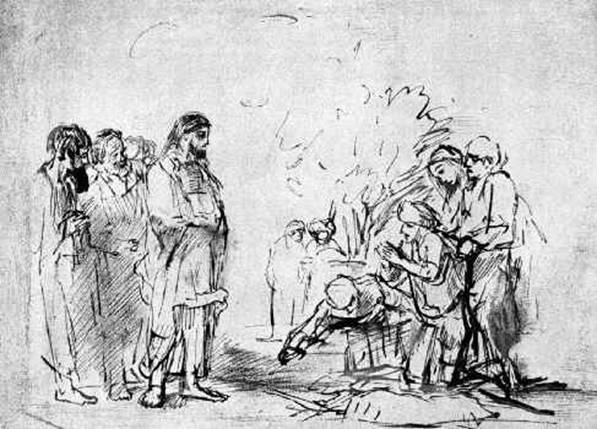
The father Jairus is the leader of the local synagogue. Not just a common attender or member, but the leader. He comes to the rabbi Jesus for help in a time of severe need. He must have been at the end of his rope, the end of all of his resources. Except – as the leader of his synagogue, leaders are trained to be competent and in control, and not supposed to be in desperate agony or heartbreaking fear of losing a much beloved family member. In fact, Jairus threw himself at Jesus’s feet, begging Him to come and raise his daughter from the dead. “He is desperate; his love for his daughter has left him utterly vulnerable.[1]

As the rabbi Jesus agrees and starts to go with the distraught father, we meet the second of these three people we are concerned with today. This unmarried woman has been sick for a long, long time. Twelve years. She has no standing in her community, and “apparently has no advocate to beseech this teacher on her behalf….Mark’s [account] doesn’t make a point of her impurity or isolation from the community, but because this was most likely vaginal bleeding it would have rendered her impure and, just as important, likely unable to bear children.” [2]

So, we have two desperate people. Two people at the end of their rope, vulnerable for different reasons. This unnamed woman was brave enough, desperate enough, to try to touch the cloak of this Rabbi. As she said to herself, “If I only touch his cloak, I will be healed.” Both of these people were seriously grieving, and were reaching out for help.

Both of these dear people – dear to our Lord Jesus – displayed tremendous vulnerability. Vulnerability was and is not a trait that is held up to be something that leaders of groups or CEOs of companies or corporations strive to emulate. Actually, Fred Rogers was vulnerable to lots of people, places and things. Willingly so. He considered vulnerability a strength, considering other people and their feelings and emotions. Just like Jesus did, too.  Fred Rogers saw the neighbor in people, just like Jesus, too.  

Mister Rogers said, “It takes strength to face our sadness and to grieve and to let our grief and our anger flow in tears when they need to. It takes strength to talk about our feelings and to reach out for help and comfort when we need it.” [3]

We are forgetting the third person in this narrative, though. The girl, terribly sick, at the point of death. It is easy to forget about her. She’s twelve years old, utterly helpless and passive, dependent on others, helpless to do anything about anything.

Here are three characters, three people that Jesus touches, heals in different ways. Life-changing ways. Which one do you identify with? “The leader who finds that all the usual advantages and experience that go with his office suddenly avail him nothing? The one who has endured much and isn’t sure she can bear any more? Or the one who is helpless, utterly dependent on others? Which one do you identify with?” [4]

It is only in our admitting our vulnerability that we are able to receive help, and only by admitting our desperation are we willing to try something, anything, that may give us hope. These admissions are not the end of the world! These admissions – these cries for help show that we are not rugged individualists, going it all alone, after all. We can show that we are part of a community, part of a neighborhood. This is a true way of showing courage, leaving behind the false culture of perfection, individualism and stiff upper lip.

This is what being a neighbor is all about, and what both Jesus and Fred Rogers advocate. Can we show mutual respect to others – all others? These three individuals are certainly from three widely different parts of society, and Jesus met them all where they needed Him most. Can we display inter-dependence freely, even call it what it is – the inter-dependence of the Kingdom of God that Jesus keeps preaching about?

Each of us has our own vulnerable, secret (or, not so secret) places inside that call for attention, call for healing and nurture and comfort. All of us have those places and spaces where we grieve and where we wish we could reach out. We all need a nurturing, healing neighborhood of trust, respect and caring.

 Can we – can you and I commit to being that caring community for others? That safe space where others who are hurting and need healing feel the trust and openness? Jesus definitely had that safe space and healing presence all around Him. Fred Rogers did, too. I strive to be that safe space and healing presence for others. See if you can be that for others, too. For all others, just like Jesus. Just like Fred Rogers, too.

And, the best part about this is that you and I do not need to have it all “together” and perfect to do this, to be that safe space. We just need to be open, willing and available to welcome all others into the neighborhood. What would Jesus do? What would Fred Rogers do? Go, do that.

(Thank you so much to David Lose and workingpreacher.org for the wonderful article on Jesus’ very busy day, https://www.workingpreacher.org/dear-working-preacher/come-as-you-are. Much appreciated!)

@chaplaineliza

(Suggestion: visit me at my other blogs: matterofprayer: A Year of Everyday Prayers. #PursuePEACE – and  A Year of Being Kind . Thanks!


[1] https://www.workingpreacher.org/dear-working-preacher/come-as-you-are

[2] Ibid.

[3] https://www.fredrogersinstitute.org/resources/reflections-on-fred-rogers-healing-power-of-presence

[4] https://www.workingpreacher.org/dear-working-preacher/come-as-you-are