Unknown's avatar

Flight into Egypt

“Flight into Egypt”

Matthew 2:13-23– December 28, 2025

            From time to time, I enjoy listening to radio serials. I suspect you all know the kind I’m thinking of. Old time radio shows like “Those Were the Days” broadcasts feature classic radio shows from the 1930’s, 40’s and 50’s. Periodically, I tune in to the show, and sometimes get caught up in an exciting, suspenseful adventure serial. Each installment usually ends with a cliffhanger, and the next installment of the serial begins: “When last we left our story . . . “

            Here, in our lectionary reading from the Gospel of Matthew, we have just such an installment. We come into the story right smack dab in the middle of things, with loose ends left hanging all over the place. It is not a pleasant story. The topic of this sermon is not pleasant, either—I’m telling you right now, up front.

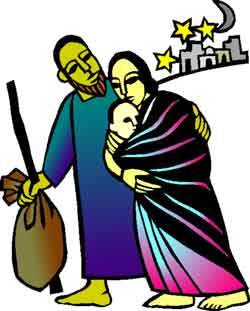
            We are breaking into the Gospel account at one of the really gripping, gut-wrenching parts, but I’d like to zoom in on this particular scene. We look at Joseph, in Bethlehem, with his fiancée Mary and newborn baby Jesus. Joseph gets an emergency communique from an angel, in a dream. The angel says, “Get up, take the child and his mother and escape to Egypt. Stay there until I tell you, for Herod is going to search for the child to kill him.”

What would you do if you had to flee from danger, immediately? Be on the run at very short notice? Can you imagine you and your family traveling on an emergency basis, with the added complication of transporting a very young child?

            It may not be physical harm threatened against you or your family. However, there are many other traumatic or life-shattering things that can up-end our lives. “When you are plunged underwater by news you can scarcely comprehend, let alone respond to, how do you take your next breath? When all your visions of a joyous tomorrow are spoken out of existence by whispered words of tragedy or denial, how do you put one foot in front of another on your way into the void?” [1]

            I cannot even imagine what went through Joseph’s mind at that moment. From all accounts of King Herod and his life and reign, he was a tyrant. Looking at writings from contemporary authors of that period, Herod was cruel and bloodthirsty. He was also two-faced, as we can see from a few verses before our lectionary reading today, from his response to the Magi. He sent the Magi to Bethlehem, and requested that they come back after they find this “King of the Jews,” because Herod wished to “worship” this King as well. I have a pretty good idea of exactly what Herod wished to do to the baby Jesus from what follows.

            The Holy Family fled Bethlehem in a hurry. We know that. They fled across a distance, across boundaries, racial lines and cultural spaces. They encountered ethnic differences and language barriers, too, as they made their flight into Egypt.           

            Father James Martin wrote in a recent social media post, “It’s not surprising that in 1952, Pope Pius XII wrote: “The émigré Holy Family of Nazareth, fleeing into Egypt, is the archetype of every refugee family. Jesus, Mary and Joseph, living in exile in Egypt to escape the fury of an evil king, are, for all times and all places, the models and protectors of every migrant, alien and refugee of whatever kind who, whether compelled by fear of persecution or by want, is forced to leave his native land, his beloved parents and relatives, his close friends, to seek a foreign soil.” [2]

            I live in a suburb of Chicago, with the months-long Operation Midway Blitz occurring right here in Chicago and surrounding area. I have been praying with and for the clergy who go regularly to the federal facility in Broadview, on what has been named Faithful Fridays. I mourn with so many because of the injustice. Yes, I take the words of Jesus in Matthew 25 quite seriously. I regularly consider: what would Jesus do?

            Let us go back to the Holy Family fleeing to Egypt, in fear of King Herod and his military goons. But – I want to check in with you all as I am preaching. I know very well that these issues I am talking about are difficult for many people, traumatic for some, and even so upsetting that certain dear ones cannot even sit here and listen any longer. And – that is absolutely okay, to excuse yourself or leave the room or the sanctuary. Please, take this as an invitation for us all to tend to each other’s well-being.

            As we consider the Holy Family on the run, I would like to remind us all of countless families on the move for all kinds of reasons. Of course, some in danger for their lives! And, some on the move because of catastrophic natural disasters, or wars, or widespread extreme poverty. Sometimes, fleeing your safe, familiar town and place where you grew up is the only painful option left after heart breaking and gut-wrenching trials and traumas.

            I would like to highlight something important from Fr. Martin: “the Greek word that Matthew’s Gospel uses is a key: it’s ‘pheuge,’ to flee, one of the ancient roots of the word “refugee.” When we think of refugees, migrants and internally displaced peoples today, we are invited to remember the Holy Family, the ‘archetype,’ as Pope Pius XII said, of ‘every refugee family.’ And we should treat them accordingly.” [3]

            As we reflect upon the situation of the Holy Family as refugees, in the first century, we need to seriously consider the heartbreaking situations of so many refugees today. We are confronted with the serious question: what does God ask of us? If we look to the Bible, to both the clear commands from Micah 6:8 and from Matthew 25, consider these ringing words of Rev. Sharon Blezzard, Lutheran pastor, It does not matter whether we are considering refugees, strangers, aliens, migrants or immigrants. All are human beings, all created by God.

“We can be God’s presence to others in the midst of their suffering, and we can work to alleviate suffering, injustice, and pain in the world. Encourage [all of us] to find their voice and place of power to make a difference through small steps grounded in faithful community and fervent prayer.” [4]

            May it be so! Alleluia, amen.

@chaplaineliza

(Suggestion: visit me at my other blogs: matterofprayer: A Year of Everyday Prayers. #PursuePEACE – and  A Year of Being Kind . Thanks!


[1] https://www.umcdiscipleship.org/worship-planning/toda-la-tierra-espera/first-sunday-after-christmas-day-year-a-lectionary-planning-notes/first-sunday-after-christmas-day-year-a-preaching-notes

[2] https://x.com/JamesMartinSJ/status/2005287734017950134

[3] https://x.com/JamesMartinSJ/status/2005287734017950134

[4] https://www.stewardshipoflife.org/2013/12/refugees-all/

Unknown's avatar

The Word Became Flesh

“The Word Became Flesh”

John 1:1-14 – December 25, 2025

            Words, words, words, words!! Words of every kind, of every description. Words that tell, words that show, words that praise, words that criticize. Words separate and draw together. Words fill people with joy and peace as well as with suspicion and animosity. Words have power. Whether insightful words or divisive words, encouraging words or capitulating words, words have the ability to shake emotions and to inflame passions for good or for evil.

            How do people use words and language, anyway? People speaking a common language need to agree upon the sense of what they say. It helps to be bound together by social convention as well as language rules of practice and use. In fact, language provides the structure of our common experience, understanding and perspectives. But I don’t want to get all high-falutin’ and theoretical. I want to bring this home to where we live.

            We all use language. Every day. In conversation at home, or on the telephone, or at work. Reading a newspaper or writing e-mail. All of these uses of language use words. Words communicate meaning, ideas, stories. Each one of us has a personal story, of what it was like, what happened, and what it’s like now. Our stories are communicated using words and language, and each individual has a creative, unique way to tell his or her story.

            The story of an individual’s own personal life makes sense because it is part of a larger story, the Story that has the story of Jesus Christ at its center. It is a story of God’s initiative which calls for my gratitude and response, a Story some theologians have called ‘the history of salvation.’ It is the Story of Jesus, the Story set forth in the Word of God that attracts, crossing boundaries and transcending lines of race, class, culture and age.

            Our gospel text for today, the first 14 verses of the Gospel of John, is a restatement of an old theme. Remember Genesis 1:1? “In the beginning, God created the heavens and the earth.” Most scholars today believe the apostle John was thinking of that introduction to the Greatest Story ever told when he wrote his own portion of it. John 1:1: “In the beginning was the Word.” John reframed that Story, and gave it a new look from a different perspective.

            In John, Chapter 1, we have God, the creative God who made heaven and earth. The almighty God wanted to communicate with us puny, limited human beings. But how was God supposed to communicate His Story?

            I can remember when my children were younger, in first and second grades. Sometimes they would need help with their homework at night. Years before, I had taken several courses of math in college . . . college algebra, trigonometry, analytical geometry. But, after considering more advanced mathematical ideas, how was I supposed to explain simple addition and subtraction to my young children in language they would understand?

            That’s the way I look at God’s problem sometimes. It’s sort of like God, able to do the most advanced mathematics possible–in God’s head!!–and God needed to be able to explain the simplest addition and subtraction problems to us ordinary, simple-minded human beings.

            There was another problem, as if the simple-mindedness of humanity wasn’t enough. That problem was (and is!!)  sin. Funny thing, how sin keeps cropping up in our lives and getting in the way. Sin divides people from one another as well as from God. Sin isolates and forces apart. Sin happens on a horizontal plane with other people as well as on a vertical plane with God. And sin causes humanity to walk in darkness and to run from God’s presence.

            So here we have a loving God, a God of light, a God who wants so much to communicate with us fallen, sinful human beings. But how was God supposed to communicate God’s Story?

            The Gospel of John tells us how. In the beginning was the Word. The Word was God. The Word is God. Jesus is the Word. John 1:14 says that the Word, Jesus, became flesh,  and . . . the Word dwelt among us.

            Think about it: the whole idea of God becoming a helpless baby, a human being, able to feel cold and heat, able to be hungry and thirsty, with blood and bones and a nervous system and a digestive system. So staggering was this idea that some of the people in John’s day could not believe it. God? the creative God who made heaven and earth? Coming to earth as a helpless, human baby? No way!!

            And, that’s not all!! Not only did this Creator God appear in creation so that our eyes could see Him, this almighty God, after making Himself flesh and blood, has the crazy idea of dwelling among people. Becoming one of us limited human beings, sharing our food and living in our midst. Jesus became fully man. He didn’t just seem to be a man, and pretend to be human. He really and truly became human, living with us as one of us.

            What a way for the almighty, eternal, creative God to communicate to us in a way that we limited human beings might possibly understand. God wanted humanity to understand His Story of good news, the Bible, but God also wanted humanity to understand God’s Word made flesh, the one called Jesus of Nazareth.

            Jesus (the Word incarnate) is the central principle of Scripture as well as the central character of the Greatest Story ever told. Reformed believers have throughout the centuries been finding new ways to confess their faith, using the fallible, limited resources of language that have been handed down to humanity throughout the generations. God helps us understand His Story, and there is nothing God wants more than for us to want to understand God’s Story better and better.

            A good many years ago, a bible translator went to a remote, mountainous region in the interior of Africa. He worked hard at turning an obscure oral language into a written language, which involved decoding the language, writing a grammar, learning extensive vocabulary, and finally translating a portion of the Bible into the heart language of that particular people-group.

            After several years of intense work and language preparation, when he felt he was ready, the missionary made his first presentation of the Story of Jesus to a group of headmen from the tribe. He was surprised at their response, which was unlike any he had ever had before in all his years of being a missionary and telling people the Story of Jesus. The group of men just sat there in silence, and then the chief came forward.

            The chief grasped the missionary’s hands and, with tears in his eyes, thanked him for coming to tell them the Story of Jesus. “This Story of good news is the one my people have waited for, all their lives long!!” And then came the clincher: the chief asked, “Your tribe has had this Story for many, many years. What took you so long to tell us?”

            Communicating the Story of Jesus has power! Awesome power! This is a Story that can change people’s lives for eternity. Telling the Story in someone’s heart language is one of the best ways to communicate how much God loves us.

            When Jesus came to this earth, He spoke the language of the people of His region, and He communicated ideas in ways people could understand. Yes, He was the Word become flesh, and yes, He showed us how to live this life that we have to live. Jesus, ‘the one Word of God which we have to hear and which we have to trust and obey in life and in death.’

            Praise God that God sent the Son Jesus into this world, the Word incarnate, the Word that became a helpless baby in Bethlehem. Praise God that God has given us the right to repair that broken relationship with us, and to be called the children of God. And praise God that God loved us so much that He gave His only begotten Son on our behalf, to reconcile us to God for eternity.

            Gloria in excelsis Deo.

@chaplaineliza

(Suggestion: visit me at my other blogs: matterofprayer: A Year of Everyday Prayers. #PursuePEACE – and  A Year of Being Kind . Thanks!

Unknown's avatar

Joy for Those Who Wander

“Joy for Those Who Wander”

Luke 2:1-7 (2:4-5) – December 14, 2025

            When some thing or some reading or some sermon is so familiar, so recognizable, are you tempted to tune it out? Turn it off?

I am preaching from an alternative lectionary, enlarging our Advent meditation on Dr. Luke’s so-familiar chapters. Today, I preach from the beginning of Luke chapter 2. Such a recognizable narrative! It has everything a story needs! Not only promise and heritage, not only memory and mystery. But, hearing an old story yet again brings its own kind of anticipation!

Although, the familiarity surrounding today’s reading is a particular problem for preachers. How do we make the reading fresh, bring it to life again, imbue it with that something extra special enough to cause people to tune in rather than tune out?

            Let us listen again to a portion of today’s reading: “And everyone went to their own town to register.So Joseph also went up from the town of Nazareth in Galilee to Judea, to Bethlehem the town of David, because he belonged to the house and line of David. He went there to register with Mary, who was pledged to be married to him and was expecting a child.”

            Joseph and Mary began to travel from Nazareth in the north of Galilee up to Bethlehem. A suburb of Jerusalem, really. A small town on the outskirts of the capital city, a good ways to the south of Galilee. We find Mary and Joseph (probably without a donkey – sorry to all of the lovers of traditional Christmas cards, everywhere) on the road, walking south to register for the census. And, they were not the only ones on the road.

            Can you see yourself – can I see myself – on the road? Are we all in transit, traveling along, not anywhere particularly fixed? Even those of us who have lived in the same place for a long time, is there something about your life, about our walk with God that makes you think that we all are on the road? Could it be that we all are wandering from one place to another, and not having a definite place to call home?

            The apostle Paul speaks of the temporary nature of this world, of this earthly tent we all inhabit. He says in 2 Corinthians 5, “For we know that if the earthly tent we live in is destroyed, we have a building from God, an eternal house in heaven, not built by human hands.” So, with that to look forward to, it gives us all a heavenly perspective to view our earthly tents, and the journey each of us is on, in this wide world today.

            Which brings us back to considering: the long trip for the census. And, since Bethlehem was the ancestral home of King David, that meant there were quite a lot of people who had to be counted who were descended from David. Including Joseph. Remember the genealogy written in the Gospel of Matthew?

            Speaking of descendants of David, I am sorry to prick the other balloons of belief in the traditional Christmas carols and traditions. “It would be unthinkable that Joseph, returning to his place of ancestral origins, would not have been received by family members, even if they were not close relatives.” Presbyterian missionary and pastor Dr. Kenneth Bailey, who is renowned for his studies of first-century Palestinian culture, comments:

“Even if he has never been there before he can appear suddenly at the home of a distant cousin, recite his genealogy, and he is among friends. Joseph had only to say, ‘I am Joseph, son of Jacob, son of Matthan, son of Eleazar, the son of Eliud,’ and the immediate response must have been, ‘You are welcome. What can we do for you?’” [1]

            I know this might be news to you – and it was to me. Jesus was not born in a cave or far on the outskirts of town, out adjacent to the field surrounding Bethlehem. However, this still does not let us off the hook for considering the larger question. Mary and Joseph were traveling, and were on the way, in between. According to Biblical record, they did not have very much money at all. (Although, because of the generous dictates of hospitality, they must have been put up in some cousin’s home while they were sojourning in Bethlehem.)

            I still would like to know! Our position as believers in the one true God makes us sojourners in this world; and this position is so similar to Mary and Joseph’s position as sojourners or travelers, too. Is there any solidarity for others today who are transient, who are traveling or sojourning, especially young families? Perhaps with mothers who are great with child at this time of the year, and are looking for even a temporary place to lay their heads?

             We can take this unexpected look at the Holy Family one step further. I remember a suburban church I attended a number of years ago. One of the smaller trees near the front door to the sanctuary was practically covered with blue ribbons. A sign was posted next to the tree, saying “While celebrating One homeless Family, these ribbons ask us to remember the homeless with us today.” I had never thought about the Holy Family in that way before. It’s God’s unexpected manner of opening our eyes, and displaying the new or different way we can look at Mary and Joseph and the baby Jesus.

            As we consider the birth of the baby Jesus in Bethlehem, as the Holy Family was traveling through, we can see this birth as so much more than simply a claim or confession of the church. As you and I are sojourners through this world, so we also are traveling through. Jesus, God’s eternal Son, the Second Person of the Trinity, emptied Himself. He willingly put Himself in this human flesh and became incarnate of the Virgin Mary. And, this is the most important part! This miraculous birth shows us the truth of our God. Our God loves us so much that the only way to really, truly show us how much was to become one of us. The Baby born in Bethlehem. [2]

            The baby Jesus, His parents Mary and Joseph – the Holy Family was on the way, traveling. Sojourning, and so are we. We are travelers, looking forward to that heavenly home, prepared for us in heaven. Are you on the road with us? On the way with Jesus?

            I close with two verses from a much beloved Christmas carol, collected in Appalachia by John Jacob Niles around 1900. Listen and hear the words of traveling, of being on the way.

 When Mary birthed Jesus, ’twas in a cow’s stall/with wise men and farmers and shepherd and all.
but high from God’s heaven a star’s light did fall, /and the promise of ages it did then recall.

I wonder as I wander, out under the sky, /how Jesus the Savior did come for to die
for poor ordinary people like you and like I; /I wonder as I wander, out under the sky.

            Alleluia, amen.

@chaplaineliza

(Suggestion: visit me at my other blogs: matterofprayer: A Year of Everyday Prayers. #PursuePEACE – and  A Year of Being Kind . Thanks!)


[1] https://www.psephizo.com/biblical-studies/once-more-jesus-was-not-born-in-a-stable/

[2] https://www.workingpreacher.org/dear-working-preacher/christmas-preaching

Unknown's avatar

Stand Firm in Benediction!

“Stand Firm in Benediction!”

2 Thessalonians 2:13-17 (2:16-17) – November 9, 2025

            It’s sometimes difficult to be persistent! To hold on, and continue working, continue trying, despite delays and disappointments and detours. Isn’t it? Continuing to work all alone, standing by and standing up when others fall away. Even just being faithful, and doing what you promised to do can be a real trudge up a long, winding road, up a steep and lonely hill.

            It’s a good thing that as we live the Christian life, so often we are in community with each other! Isn’t it easier and more companionable to be traveling together, or working on a project together, or carrying a load together, with a group of friends?

            That’s what the Apostle Paul was writing about, here in this second letter to the young church in Thessalonica. When Paul and his friends were on their second missionary journey, they had only spent a short time in that city before they needed to leave. This was a young church that Paul planted, and Paul had already sent one letter to the believers there. He sent this second one to correct some misunderstandings and to renew the Thessalonian believers’ hope in Christ.

            We are focusing on this small section right in the middle of Paul’s letter. He breaks away from giving further instruction on the confusing timing of our Lord Jesus Christ’s return to giving encouragement to his fellow believers. “But we ought always to thank God for you, brothers and sisters loved by the Lord, because God chose you as firstfruits to be saved through the sanctifying work of the Spirit and through belief in the truth. 14 He called you to this through our gospel, that you might share in the glory of our Lord Jesus Christ.”

            When I hear about churches and pastors today who really focus on the “end times,” and about the prophecies in both the Hebrew Scriptures as well as the few times in the New Testament that refer to the Second Coming, I often roll my eyes. If you have ever read or heard of the books on the End Times, the books are so much dominated by fear and anxiety, by persecution of Christians by cartoonish bad guys. Those same churches and pastors so often advise their congregations of strict rule-following, and black-and-white do’s and don’ts.

            Yes, I did read that first portion of the assigned reading from 2 Thessalonians 2 this past week, and I did not feel led to write a sermon on it. However, I continued reading in chapter 2, and found Paul encouraging his Thessalonian friends, and thanking God for them!

As commentator Mariam Kamell says, “Christians can be confident, encouraged people because we know that we are held as first fruits by God’s choice, preserved through the Spirit. In Paul’s paradigm there is neither room for pride in our efforts to improve the world, nor despair at the state of the world around us. For Paul, all of this talk about the end is to encourage us in our security in Christ and draw us ever further in the Spirit’s sanctifying work.” [1]

            So, we are not to despair over the End Times! We are not to be fearful and cower in the shadows, dominated by fear and anxiety! Instead, we are to rejoice, and be hopeful in our security and salvation in our Lord Jesus Christ.

            Paul then says, “so then,” which is very similar to his connecting word “therefore.” As one of my Bible instructors used to say when I was attending a Christian college for undergrad, “See what “therefore” is there, for! Why is Paul using this particular connecting word?  “15 So then, brothers and sisters, stand firm and hold fast to the teachingswe passed on to you, whether by word of mouth or by letter.”

            I know things and people and situations in this world today can be really scary, and even make us want to hide under the covers! Especially when we consider persecution and lawlessness – however, God has the final word. “Don’t worry about what will happen when you (or people you love) die and don’t worry about what will happen when you grow up or get to be a teenager or [grown-up].   Instead, think about today.  Live as God’s person today.  Do the best you can and know that God is with you.” [2]  

            Isn’t that wonderful encouragement for all of us? Instead of cowering in fear, or being a strict rule-follower or else! We are to know we are God’s people, followers of Jesus Christ, and led by the Spirit of God. Paul prays that the Thessalonian believers are to be encouraged – in their inner being.

“This is clearly a ministry of the indwelling Spirit of Christ. Against the wiles of this age, may we look in faith to the one who constantly surprises us with his love and inspires us with courage and confidence, enabling us to stand firm and not be overwhelmed by the vagaries of life. Our God will buttress us in our faith; this we can rightly ask in prayer, believing.” [3]

            The apostle Paul is truly being encouraging to his friends. Yes, they had some misunderstandings about what Paul preached to them, which Paul clarified. Yes, some of these believers were acting in ways displeasing or disappointing to our God, but at the end of the day and the end of this letter, Paul wanted to give encouragement and hope, not fear and dismay! We are to be cautious around churches and ministers who want to fix, manage and control every aspect of life! Paul leads with the grace of Christ, and the love of God. Period.

            And then, what should burst out of Paul but a benediction! Just as in the middle of the letter to the Ephesians, here at the end of the second chapter to the Thessalonians is a marvelous benediction. We will close with Carolyn Brown’s wonderful paraphrase of Paul’s words:

            “Remember that God loves you.  God chose you to hear about that love and to know the stories of Jesus.  Do not forget them.  Live by them every day.  And may God who created the whole universe, Jesus who showed us how much God loves us, and the Holy Spirit who guides us be with you giving you courage and strength to be God’s people every day.” [4]

@chaplaineliza

(Suggestion: visit me at my other blogs: matterofprayer: A Year of Everyday Prayers. #PursuePEACE – and  A Year of Being Kind . Thanks!


[1] https://www.workingpreacher.org/commentaries/revised-common-lectionary/ordinary-32-3/commentary-on-2-thessalonians-21-5-13-17-3

[2] https://worshipingwithchildren.blogspot.com/2016/09/year-c-proper-27-32nd-sunday-in.html

[3]  https://www.lectionarystudies.com/sunday32caiie.html

[4] https://worshipingwithchildren.blogspot.com/2016/09/year-c-proper-27-32nd-sunday-in.html

Unknown's avatar

A Time for Everything

“A Time for Everything”

Ecclesiastes 3:1-8, 11 (3:1, 11) – November 2, 2025

Time has a funny way of getting away from us, doesn’t it? Time can be rushing by while you and I are sitting, watching, on a treadmill or a big hamster wheel. Time is elastic, sometimes stretching out, tedious while we are waiting, other times jam-packed with events and decisions and happenings all on top of each other!

Our reading from Ecclesiastes 3 tells us a lot about time. This reading tells us about different facets of life, too. There is a time for everything. Everything under the sun.

This book of Ecclesiastes is traditionally thought to be written by the older King Solomon. We are pretty clear about Solomon’s birth and death dates. Scholars place this book about 935 or so, BCE. Again, this was late in Solomon’s life. As you and I consider this chapter 3, I invite you to consider the older Solomon. He was born with a silver spoon in his mouth, for sure. One of the favored sons of King David, he had it all! Money, property, women, power. The country of Israel was at peace, too! So, as he wrote this book, he was writing from a reflective, almost contemplative point of view.

I want us to zero in on Ecclesiastes chapter 3. One of my favorite commentators is Carolyn Brown, now retired Director of Children’s Ministry at a PC/USA church. She wrote a comprehensive collection of readings for each of the weeks of the 3-year Revised Common Lectionary cycle. I have often quoted her insights, as I will today.

            In this reading, our preacher lists 14 pairs of opposites. These opposites come from all areas of life, and some of these opposites are stark, and some are especially illuminating. In verse 2, as we see in a large part of the world, there are the changes of the seasons. All you and I need to do is to look outside and view the glory of the changing seasons in the colorful display of the leaves on the trees! We cannot plant seeds outside right now. It is not the time of year for that.  We can’t plant seeds in the winter, or harvest them in the spring.

            Verse 6 reminds us there are times we need to save things carefully – like putting aside clothes to wear again, or wear at a different season. There are other times when we need to let things go – like giving away old clothes or toys or other stuff we have outgrown. And, in verse 7, we see there is a time to be silent, and conversely, definitely a time to speak out! Sometimes, it is hard to know which time it is. [1] Hard, even soul-searching, indeed!

            As I considered this reading in depth, and in particular for my sermon preparation, my thoughts return again and again to verses 1 and 2. “There is a time for everything, and a season for every activity under heaven: a time to be born and a time to die.” Both birth and death are  part of God’s plan for our lives. Both birth and death are part of the cycle or circle of life.

            My online friend Michelle van Loon had this penetrating reflection. “King David’s last recorded message to his people includes words that foreshadow the message of the book of Ecclesiastes, which was written long after David’s death: David said, “We are here for only a moment, visitors and strangers in the land as our ancestors were before us. Our days on earth are like a passing shadow, gone so soon without a trace.” (1 Chron 29:15 NLT)” [2]

            These times today are uncertain times. As workplaces are restructured, businesses merge or close, or other structures in our lives are disrupted, many people lose their livelihoods. People across the country, even across the world, are in a place of not knowing, not understanding what is going on. Moreover, during the past week here in Chicago there is the uncertainty, even the trauma for our children, young people and seniors of watching masked, armed men pull people out of cars and off of sidewalks. Disappearing them, as unnamed troops habitually do in other countries with strong-arm governments. What kinds of long-term, traumatic reactions and effects are being sown in countless lives, hearts and brains here and now?

I have now been studying trauma and its effects on people observing traumatic events for almost two years, for my doctoral studies. This devastating activity in my own hometown and suburbs is completely beyond my understanding, given what I know about the founding of this country, and its welcome to immigrants from Germany, Poland, and an orthodox Jewish family – who I count as my ancestors. Which brings us full circle to All Saints Sunday, and lifting up the saints from this church, and from other churches and places and spaces throughout the world.

            Verse 4 from Ecclesiastes chapter 3 tells us, “a time to weep and a time to laugh, a time to mourn and a time to dance.” There are times when life is sad and we cry, for good reason. There are other times when life is so happy that we laugh a lot. We may prefer the happy, laughing times. But, God is with us in both happy and sad times. [3]  

            What is dawning on my mind and heart from this Scripture reading is that God has indeed set times and places in all of our lives. Yes, there are appointed times, and seasons for things and events to happen. Yes, there even is a time for churches to be planted, just as there is for churches to close. God indeed has the last word. God can make a way through. God opens a window in the skies, in the everlasting, sometimes sunny, sometimes cloudy day Solomon paints for us. God does indeed make everything beautiful in its time! Everything is in God’s time.

            I remind myself that I can be reassured, and comforted by these thoughts. We need to remember that God holds everything and all of us through it all, in all of our times. We can have certainty of God’s unending love. After all, it is because of my surety in God’s amazing and unending love that I have allowance and ability to explore, to even wonder about these important questions about time and the different facets of life, as highlighted by Ecclesiastes 3. As we pass from one season of time into another, I invite us all to ask: what comes to mind as we reflect on what has been, and as we begin to think about and articulate our hopes for what will be? [4]

We can reflect upon the saints who were in this place, and in other places we remember. “It is a ‘yes’ to God’s life moving through all things, calling us forward to changed lives and changed communities.” [5] And, we can look forward to the time that God has for all of us that lies ahead of each one of us.  

         As the litany we will share later in this service tells us, “Now, as we journey from this house into the future, we give you thanks O God. Be with us in thanksgiving as we move into other communities that will allow us to share the story, break the bread and live abundantly with God.  Alleluia, amen.

@chaplaineliza

(Suggestion: visit me at my other blogs: matterofprayer: A Year of Everyday Prayers. #PursuePEACE – and  A Year of Being Kind . Thanks!


[1] https://worshipingwithchildren.blogspot.com/2013/11/new-years-day-years-b-c.html

[2] A reflection post from Facebook, from Michelle Van Loon on October 23, 2025.

[3] https://worshipingwithchildren.blogspot.com/2013/11/new-years-day-years-b-c.html

[4] http://words.dancingwiththeword.com/2013/12/a-new-years-reflection.html

[5] https://www.patheos.com/resources/additional-resources/2010/12/happy-sacred-new-year-bruce-epperly

Unknown's avatar

God’s Law in Our Hearts

“God’s Law in Our Hearts”

Jeremiah 31:31-34 (31:33) – October 26, 2025

            Relationships are foundational to life. Positive, negative, distant, close.  Both of my parents are gone now, but I had a relationship with both of them. My sisters and brothers—again, I have relationships with them. Members of my extended family, too, are included in my list of relationships. Also my friends, acquaintances, colleagues, even my enemies. All of these people have relationships with me. Think about yourself. You have relationships with many, many people, too. Most of these people I just mentioned, if not all of them. Positive or negative, distant or close. We all have relationships—or friendships—with many people.

            But what about God? What kind of relationship do you and I have with God? Is that relationship good? Even wonderful? Is it close? Or distant? Bumpy at times?

            Our scripture reading for today talks about this relationship. Here. On this Reformation Sunday, we celebrate our clear relationship with God, the relationship that Martin Luther celebrated! But, the prophet is talking about it from God’s perspective. God’s view of the relationship, or the friendship, if you will.

            God wants to be friends. We’re not talking about a distant God, a God Who wound up the universe like a watch, put it on some shelf, and then walked away and promptly forgot all about it. No!! God wants to be in a relationship.

            If we look at this passage, we see that God had a relationship—a friendship, we could say—with the nation of Israel. God was the one Who started it. See what verse 32 says? God took the nation of Israel by the hand when God led them out of Egypt. God wanted the friendship. Israel did not start the relationship.

            We can compare that friendship to God’s friendship with us. God wants us as friends, too!  Just like the nation of Israel, God goes out of His way to make friends with us. You and me. Each and every one of us. God approaches us.

            But something happened. Something awful! The nation of Israel was not a faithful friend to God. The relationship was disrupted, broken. But God didn’t break it. No! Israel did. Remember the many, many times in the Hebrew Scriptures that Israel ran away from God? Or forgot about God? Or just plain ignored God? Time after time, we can read about how the nation stumbled, resisted, or was unfaithful to their friendship. Their relationship.

            A number of times in the various prophets’ writings, the relationship between God and Israel is pictured as a marriage. God is the husband, and Israel is the wife. God is always faithful, and Israel is not. Israel stumbles, falls, ignores her God, or just plain runs away in disobedience. Here in verse 32, the prophet tells us that Israel is unfaithful.

            What about us? What about you and me, in our on-again, off-again relationship with God? That is what Martin Luther talked about, so often. He had a real and abiding sense of his own sinfulness, his own unfaithfulness to God.

Isn’t it a lot the same with us? Don’t we stumble, or fall? Haven’t we forgotten about God a lot of the time, or even been unfaithful to our Lord? I’m thinking of sin. Putting other things in God’s place. Making other things or other people in our lives more important to us than God. 

            Our relationship with God is broken! Disrupted. Sometimes we grow so used to sinning, to being apart from God, that you and I cannot choose to do anything else.

            What a predicament! Our relationship with God—under the Old Covenant—is gone. Destroyed. We are sunk, there is not a chance for you and for me. But, wait! God does not leave us there! God still wants to be friends with us! With you, and with me.

God loves us so much that God is ready and willing to forgive our sin. Forgive us when we stumble and fall, when we put other things or other people in God’s place. God is ready to forgive absolutely. Unconditionally.

God’s nature is not punishing or arbitrary, but instead loving and forgiving. As Rev. Sharon Blezzard says, “as a Lutheran Christian I am called to re-formation on a continual basis. Even though I do die daily to sin, I also rise to newness of life; therefore, I am indeed always being made new. Thanks to the amazing gift of grace in Christ Jesus, I have options! I have a future, right here and right now.” [1]

            Just like Joseph, ruler of Egypt, freely forgave his brothers at the end of Genesis when they stood before him, God is more than willing to forgive us. Joseph’s brothers did some awful things to Joseph, but Joseph was ready and willing to forgive their treachery because of his love for them and for his father Jacob. How much more then is God able to forgive us for our falling short, for our running away, even for our disobedience! God loves us so much! . . .  God loves us this much! (spreads arms wide)

            This forgiveness is heart language, from God. The foundation of this forgiveness comes from our new knowledge of God, written on our hearts. And what is our response to God’s love? God’s forgiveness? God’s reconciling embrace? You and I have the opportunity to live changed lives, as changed people—from the inside out. God is not willing that anyone should be strangers, but instead that all would have the opportunity to be friends with God. Best friends.

God says it! Our Lord will be our God. We will be God’s people. And that’s a promise. That’s forgiveness. That’s the opportunity that each of us has to be with God, forever.

            Alleluia, amen.

@chaplaineliza

(Suggestion: visit me at my other blogs: matterofprayer: A Year of Everyday Prayers. #PursuePEACE – and  A Year of Being Kind . Thanks!


[1] https://www.stewardshipoflife.org/2015/10/oh-the-options/

Unknown's avatar

Continue – Persist – Be Faithful!

“Continue – Persist – Be Faithful”  

2 Timothy 3:14-4:5 (4:1-3) – October 19, 2025

Have you seen the comics lately? I’m sure everyone here is familiar with the comics section of the newspapers–the daily comics in black and white, and the Sunday comics in full color–even if you don’t read them regularly. Can you picture this scene from the comics? A single panel, showing two business men by an office water cooler. One looks like a boss, and he says to the other, “If there’s one thing I hate, it’s a yes-man. Isn’t that right, Baxter?”

We chuckle, because we all are familiar with that kind of attitude. I’m sure we can recognize that tendency in other guises, other forms. In some other places, not only a place of employment but also clubs, associations, even places of worship. Getting some yes-man to tell us what we want to hear . . . not what’s good for us to hear, not what we need to hear, but instead what we want to hear. This kind of black-and-white attitude is going way overboard!  

            As we consider this Bible reading from 2 Timothy chapter 3 today, let us reflect again on these words from the older man Paul to his young friend Timothy: “But as for you, continue in what you have learned and have become convinced of, because you know those from whom you learned it, 15 and how from infancy you have known the Holy Scriptures, which are able to make you wise for salvation through faith in Christ Jesus.”

            I suspect that Paul – and his friends, the other disciples, and other, older believers – could easily relate dozens of times that they had experiences in the faith communities they called home. Experiences where “yes-men” (or, “yes-people”) put in their definite opinions, where one group of people held up “tradition” as the gold medal standard, and everything had to bow before “tradition.” This “traditional” group of believers sound as intolerant as the “black-and-white” people I mentioned just before. A pendulum swinging way to one side or the other.

            Our commentator Dr. Dirk Lange says, “We have always done it this way” can mean anything from the worship of the early church to what a congregation has done for just the past twenty years. The writer to this particular church community, and especially to this follower named Timothy calls upon tradition. It is not to be ignored! “Continue in what you have learned” and not just recently but since your childhood.” [1]  You and I need to sit up straight and find out exactly what the older man Paul had to say about tradition! Or, is it about the Word of God, instead?

            The Hebrew Scripture reading for this Sunday comes from Jeremiah 31, and tells us that “The day will come when God’s word will not be on stone tablets or in books, but written into our very hearts.” This reading from 2 Timothy and the reading from Jeremiah are all about the Word of God! Except, how does that square with a concentration on tradition?

            When a pendulum swings, especially if it swings widely, we can watch the wide swing get more and more extreme. This is so similar to observing people with firm, set-in-their-ways opinions and manner of thinking and behavior.    

            Our writer Paul tells Timothy he could be sure of one thing: his firm foundation of the Word of God, taught to him by reliable elders in the faith. Not twisting this way and that, not susceptible to following “tradition” blindly, like so many sheep.

             But, Paul does not stop there. This is a letter to Timothy, after all. Timothy is a church leader, a pastor of a congregation, and Paul uses this letter to not only give advice to his younger friend, but to advise and instruct. “Timothy is instructed to be a faithful student and teacher of the Word.  Under that is the belief that to be a strong, true church a congregation must be made up of people who know their Bible well.” [2]  Not in the sense of bashing others over the head with their superior biblical knowledge, no! No, we are to use the Bible as a standard, as a measuring tape or yard stick to guide others along the road of journeying with Jesus.

            We have the assurance, from our scripture passage today, that Timothy had the opportunity to know God. He had the opportunity to read some of the same texts we have to read today! Timothy was instructed, from the time he was very young, in the way of salvation through Jesus Christ. His mother and grandmother were both women of faith, and Timothy grew up in a believing household, a household that put God first.

            The descriptive words to Timothy that Paul uses here are important: teaching, correcting, training. “The Scripture invites us into a pattern of gospel living. It does not provide “yes” and “no” answers to every situation, every question, every dilemma. Those who have “confessed” the faith in life-threatening situations understand that there are many gray areas, hard to resolve through Scripture alone (take the example of Dietrich Bonhoeffer or Martin Luther King, Jr.).”  [3]

I consider the commands in this passage to be good advice to anyone wanting to follow Christ more nearly, even in gray areas, even through difficult times. We are to proclaim the message. Communicate the Good News! In whatever way we can. How do we put it into practice? How do we live the Christian life? Now what, in other words?

            This command may give some people pause. How can I preach the Good News? Another way of thinking about it is . . . telling what God has done in your life. What has God done for you? How has God made a difference in your life? How has God made a difference in mine? What new things have you and I learned from the Lord lately? What an opportunity it is to share these things with others, with our friends, with those who might not know God.

            Thank God we have been given this Good News! I can tell about God’s faithfulness in my busy, hectic life. I can praise God for helping me to walk the Christian walk, one day at a time, and so can you. That’s truly something to celebrate. That’s truly Good News to share. Alleluia, amen.

@chaplaineliza

(Suggestion: visit me at my other blogs: matterofprayer: A Year of Everyday Prayers. #PursuePEACE – and  A Year of Being Kind . Thanks!


[1]  https://www.workingpreacher.org/commentaries/revised-common-lectionary/ordinary-29-3/commentary-on-2-timothy-314-45

[2] https://worshipingwithchildren.blogspot.com/2013/09/year-c-proper-24-29th-sunday-in.html

[3] https://www.workingpreacher.org/commentaries/revised-common-lectionary/ordinary-29-3/commentary-on-2-timothy-314-45

Unknown's avatar

Have Mercy on Us!

“Have Mercy on Us!”

Luke 17:11-19 (17:13) – October 12, 2025

            Ever been to the dentist, or the doctor, with a health complaint? Of course, you have! You all—we all have, at one time or another. Thank goodness, we live here, in the suburbs of Chicago. It is fairly easy to get good—or even, excellent medical and dental care, as opposed to the rural spaces in the United States, where health care is not as accessible. And, can you imagine outside of this country?

            Imagine living in the first century of the Common Era. In Jesus’ day, doctors were rare even in mid- to large-sized towns. When people had health complaints, there were some homeopathic remedies, true. And local healers, people who were good with herbs, poultices, and ointments. But for continuing problems or chronic diseases? There weren’t many options for any other kind of health care.

            Let us set the scene. Dr. Luke tells us, “Now on his way to Jerusalem, Jesus traveled along the border between Samaria and Galilee. 12 As he was going into a village, ten men who had leprosy met him.”  We have a situation with some chronically ill people. These people had skin diseases. Commonly referred to as leprosy, these skin afflictions could be anything from severe eczema to Hansen’s disease, what we now know today as leprosy. And any disfiguring skin problem, in between.chronic

            In Jesus’ day, there were priests and Levites stationed all throughout the land of Israel. These official people were not only on duty for the Sabbath day, for religious observance, but they had several other important duties under the law of Moses. Did you know that the priests and Levites could make rulings on whether a person was too disfigured, too blemished to live in close quarters with the rest of the townspeople?  True facts!

            This was an early example of a health code. The priests and Levites were among the first health inspectors! Because some of these skin diseases were contagious, and so the people who had them would contaminate others, the priests and Levites would have to exile them. Kick these former upstanding people out of town. Out of society, and isolated. Marginalized. Exiled. Called ‘unclean.’ Living far away from everyone and everything they once held dear. Ringing bells to warn others not to come near them. That was the situation for these ten lepers we read about in Luke’s Gospel today. What a lonely existence for these poor people.

            The Rabbi Jesus was on His way to Jerusalem with His disciples when he met these ten men, on the border between Galilee and Samaria. This is yet another time that our Gospel writers tell us that “Jesus is again in a border region, again crossing boundaries and wandering where he probably shouldn’t go, and again healing people with whom he has no business interacting.” [1] Commentator Dr. Davis Lose reminds us that Jesus is again doing something out of the ordinary. In fact, extraordinary!  

            Let us consider that this unconventional Rabbi Jesus is not only crossing geographical boundaries and wandering – traveling where “good, rule-keeping Jews” just don’t go. But, Jesus is also interacting with these ten lepers! These men obviously kept at a distance from all other “normal” or “regular” people, except I am certain they had heard of this miracle-working Rabbi! Can’t you just hear the anguish and the hoping-against-hope in their voices as they cry out, “Jesus, Master, have mercy upon us!”  

            Jesus’ response is simple. Straight-forward. “Go, show yourselves to the priests. I can just imagine these ten men, told by Jesus to go and show themselves to the priests in town. Except, Jesus told them to go before He had done the act of visibly healing them from their skin disease. They needed to act, they needed to start to go before they saw what had happened.

            Have you ever needed to go on faith, and start an action, go on a trip, take a step without knowing for sure that God is right there with you? And, the whole idea of a borderland, an in-between place that is neither one place or the other. Doesn’t God meet us right there, before healing is completely complete?  [2]

That’s all Jesus says to them. The verb in Greek means ‘show, or point out something to someone.’ Remember, I said the priests were the health inspectors of that day? Can you understand these ten guys, isolated, banished, marginalized. And Jesus says, “Go, show yourselves to the priests.”

            Lo and behold, “as they went”—that is, in the going—“they were cleansed.” Do you understand? These poor, lonely people believed Jesus, had faith, and were healed as a result. We are not told exactly how they discovered it, but it probably didn’t take too long.

            One ex-leper, out of the original ten—one ex-leper comes back to thank Jesus. Glorifies God! Comes to Jesus and prostrates himself at His feet. Once the Samaritan realized he’d been healed, he couldn’t help but turn back and share his joy and thanksgiving with Jesus.

            Thanksgiving is like that. When it’s genuine, it’s spontaneous—you recognize you’ve been blessed and can’t help but share your joy through thanksgiving.

“Have you ever noticed just how powerful it is not only to receive blessing but also to name it and give thanks for it? Maybe you’re at dinner with family or friends, then you lean over to another, or maybe raise your glass in a toast, and say, “This is great. This time, this meal, you all. Thank you.” And in seeing and giving thanks, the original blessing is somehow multiplied. You’ve been blessed a second time.” [3]

The Samaritan knows he’s been given a gift and can’t help turning around to say something. In doing so, he’s given a second gift: He leaves his encounter with Jesus not only healed but also blessed in his own recognition of healing, blessed at being drawn into deeper relationship with the one he thanks, blessed at hearing himself commended for having great faith.

Imagine the huge difference that must have made in his life. That’s the way thanksgiving works—in giving thanks for gifts given to us, we are blessed again. We can all say alleluia, Thanks be to God!

@chaplaineliza

(Suggestion: visit me at my other blogs: matterofprayer: A Year of Everyday Prayers. #PursuePEACE – and  A Year of Being Kind . Thanks!


[1] https://www.workingpreacher.org/dear-working-preacher/second-blessing

[2] https://www.umcdiscipleship.org/worship-planning/choosing-faith/eighteenth-sunday-after-pentecost-year-c-lectionary-planning-notes/eighteenth-sunday-after-pentecost-year-c-small-groups

[3] https://www.workingpreacher.org/dear-working-preacher/second-blessing

Unknown's avatar

In These Last Days

“In These Last Days”

Hebrews 1:1-4 (1:2) – October 5, 2025

            Can you think of an excellent host or hostess you know? Perhaps one or your friends or family? Celebrating or hosting is a big part of coming together as friends, as family, for all kinds of festive occasions. Some people are especially blessed with the skills, gifts and graces that are part and parcel of being a wonderful host or hostess. Today is World Communion Sunday, and our Lord Jesus is our heavenly Host today at this service.

But first, we need to take a closer look at our Scripture reading for today. The letter to the scattered Hebrews (Jews who believe in Jesus as their Messiah) was a circulating letter, traveling from place to place, copied and sent from one small group of believers, one congregation to the next. In order to understand this letter more deeply, we need to look at it as directed to people with a Jewish understanding, and a Jewish viewpoint.

“God spoke to our ancestors in many times/ways through the prophets, but now God speaks through the Son” – in the same way, we can view the older Hebrew Scriptures as God speaking through the prophets (and writers of narrative and poetry), but now (as in the New Testament), God speaks through the Son, our Lord Jesus Christ – especially in the Gospels.

Jesus – before He came to the earth and emptied Himself of all God-hood to become a little baby born in Bethlehem – created the universe at the beginning of time, and Jesus is the one who will possess all things at the end of time. So, before the beginning and after the end – there was the Son long before His incarnation, the second person of the Trinity. Before the universe, before the Big Bang and all things were created, there was the pre-incarnate Son.

 Plus – Jesus sustains/continues/upholds the universe with His powerful Word. The Word that had the creative force in the beginning of time!

Let’s think about that creative force for a moment. In chapters 8 and 9 in The Magician’s Nephew, one of the Chronicles of Narnia, C.S. Lewis has the Great Lion Aslan walking around on a brand new world. The Lion is singing, and the sheer creative force is magnificent, as shown by the reaction of all creation, land, water and sky to the sounds and the notes of Aslan’s powerful, creative voice. [1]

Yet, that is not all! We can see the writer of the letter to the Hebrews goes on to tell us more about what Jesus did. After Jesus finished His work on earth and achieved forgiveness for all sins for all human beings (for all time), the resurrected, ascended Jesus SAT DOWN in heaven. This goes along with what Paul says in the first chapter of the letter to the Ephesians, 1:20-22, which sounds quite a lot like Hebrews 1:3 from our reading today.

In the worship in the Temple before the first century CE, even at the time that the Rabbi Jesus was walking around Palestine for three years before His death, resurrection and ascension into heaven, Jewish priests continually stood up when they did their work in the Temple. That was the way of it. That was how priests went about their priestly duties, continually standing before the Lord, continuing to offer sacrifices for sins, making atonement for the sins of everyone who came to them.

Except – our Lord Jesus was not like the earthly priests. The apostle Paul said Jesus sat down in heaven, and no longer had to continually stand and continue to offer sacrifices to the Lord. Here in our reading today, the writer of the letter to the scattered Hebrews (or, Jews) tells them that Jesus “sat down in heaven at the right side/hand of God, the Supreme Power.”

As our commentator Carolyn Brown retells these three verses from Hebrews chapter 1, she says “Jesus was one with God at the beginning of everything and will be one with God after everything ends. Jesus worked with God on creating the whole world and keeps taking care of it. In Jesus of Nazareth God lived among us as a person and allowed himself to be crucified. Jesus is God in human skin.  Everything we know about Jesus tells us what God is like.  Jesus Christ forgives us.” [2]

Do you understand how powerful that declaration is? As one of what I consider one of the most meaningful gospel songs says, “Jesus paid it all! All to Him I owe, Sin had left a crimson stain, He washed it white as snow.” This is one of the reasons we celebrate Communion, or the Lord’s Supper, because we are so grateful to Jesus for being the Lamb of God, who as our reading today tells us, “achieved the forgiveness of sins for all human beings.”

The first Sunday of October is World Communion Sunday in most congregations.  Not only set apart for children and young people, but for everyone. “That means raising awareness that Christians all around the world are one big family.  We may have skin of different colors, wear different clothes, speak different languages, and do all sorts of different things, but we are all baptized and we all share communion.” [3] 

Do you hear? All believers, worldwide, are all one big family. That means that we all come together around the communion table, from north and south, from east and west, from every tribe and people-group and nationality. Across national borders, regardless of languages spoken, paying no attention to differences of politics, or of allegiances, of national dress, or of regional separations.

All of these earthly differences do not matter to eternity. Jesus tells us so. All are welcome at the Lord’s table. And, it is His table. As I have said many times before, on many Communion Sundays in the past 11 and a half years, this is not St. Luke’s table. It is not the United Church of Christ’s table. It is not the Protestant Church’s table. Instead, this is the Lord’s table, and our Lord Jesus says all are welcome.

We can see how great God’s love is for humanity through the incarnation. Yes, God sent God’s son to earth to become human, live among us, and die for us. And, on this World Communion Sunday, we remember how our Lord Jesus provided communion for us, as a sacrament, a means of grace, and to remember Him.

Through the centuries, all believing Christians have celebrated this meal, this Lord’s Supper, in remembrance of Him. “Today, through World Communion, we also celebrate that though each church does things differently, we each and all of us need God and God’s grace. By participating together around the world in Holy Communion, we celebrate our common need for God, and together we celebrate receiving His love and grace.” [4]

This weekend is a jam-packed weekend, indeed. Not only is today World Communion Sunday, but yesterday was the feast day of St. Francis of Assisi. Many faith traditions celebrate with a Blessing of the Animals this weekend. St. Francis is not only a patron saint of animals, he is also the patron of all creation, or the natural world.

As we reflect on our Lord Jesus, God’s Son before the beginning of time and after the end of time, I want to end our sermon today with a benediction; the final verse from the hymn that is attributed to Francis, “All Creatures of Our God and King.”

Let all things their Creator bless, and worship Him in humbleness,
O praise Him! Alleluia!
Praise, praise the Father, praise the Son, and praise the Spirit, Three in One! O, let us praise God, indeed! Alleluia, amen.

@chaplaineliza

(Suggestion: visit me at my other blogs: matterofprayer: A Year of Everyday Prayers. #PursuePEACE – and  A Year of Being Kind . Thanks!


[1] Lewis, C.S., The Magician’s Nephew (Macmillan Publishing Co., New York NY, Collier Books edition: 1970), 101, 104-07.

[2] https://worshipingwithchildren.blogspot.com/2012/09/year-b-proper-22-27th-sunday-in.html

[3] Ibid.

[4] https://onthechancelsteps.wordpress.com/2013/09/22/same/

Unknown's avatar

Abide in God’s Shelter!

“Abide in God’s Shelter!”

Psalm 91:1-6, 14-16 (91:2) – September 28, 2025

            I have had a number of times in my life where there was a lot of uncertainty. I am thinking of one extended time, in particular. When my older daughters were toddlers and preschoolers, my former husband and I did not have any health insurance. For years. Our girls were small, and we lived paycheck to paycheck, barely scraping by. For years.

            Times like these are downright scary, whether people have economic problems (like my family did), or health reversals, emotional or psychological concerns, or physical safety!  

            Listen to a first-person account from one of our commentators. This happened to him in rural India while he visited a missionary outpost. “As we were climbing a steep rugged narrow path, Premakar, our home missionary of Dangs cautioned us, “Wagh, Wagh” (tiger). We stopped and our torches flashed at the beast which was 200 yards away. Its glittering eyes menacingly glared at us. In spite of the blinding lights it was advancing towards us. Helpless we turned to Jesus in prayer. To our great relief the beast slinked away. We continued our journey. But within a few yards our petromax [our bright lights] failed. Just imagine our plight! It seemed ages before the petromax was fixed. After a short while a poisonous snake slithered past us and the promises of Psalm 91 sustained us.” [1]

I am not sure if you have ever had such a wild time of uncertainty in your life, but it can be beyond worrisome. Times like that can make a person anxious, fearful, even frantic. Our commentator goes on: “Thankfully the cobras and other poisonous vipers were in hibernation during my stay in the mountain village of Chikaldara. The tigers and bears, while inhabiting the area, did not harm me either. Nevertheless, my sense of danger was much more intense while walking in the darkness or through the tall grass, where some creatures could be lurking.” [2]

Just listen to these words from our reading today, Psalm 91. “Surely he will save you from the fowler’s snare and from the deadly pestilence. You will not fear the terror of night, nor the arrow that flies by day, nor the pestilence that stalks in the darkness, nor the plague that destroys at midday.”

            This reading describes a lot of unpleasant, downright dangerous things that can happen to a person. “There is a thread in this psalm that feels … dangerous. Angels will bear you up so you won’t dash your foot on a stone? Treading on lions and snakes? No scourge will come near your tent? Dangerous, and conditional: Those who love me I will deliver; I will protect those who know my name. What about those who don’t know, because they haven’t been told or haven’t been told in a way that makes sense to them? What about those who don’t know how to love You yet? Are they, are we just on our own if we find ourselves in that category, temporarily or permanently?” [3]

            I care deeply and feel for any frightened, anxious people. For, that is exactly what this psalm mentions. This psalm cautions, and gives insight, allowing you and me to get a picture of what part God plays as we go through all the trials and struggles of life.

            Verse 1 is the starting point for this psalm, the lens that aids us in reading the rest of the psalm. “God delivers because God is our shelter. God will rescue us when we call because we live in God’s shadow. People need to feel safe and secure to be brave. Notice that the psalmist encounters pestilence, arrows, and destruction as they live in the shadow of the Almighty. We need the security of abiding in God so that we can brave the trials and struggles of this life together.[4]  Can you think of a time of uncertainty in your life when you felt for sure that God was with you? When you knew for sure that God was your shelter, or shadow, or refuge? God can send this assurance into our hearts.

            And sometimes, even if it’s an extended time of uncertainty like the one my family with young children and I went through for several years straight – economic insecurity – God is still there. There is a saying: I believe in the sun even if it is not shining. In the same way, I believe in God even if the path ahead is rocky. You and I can have a deep sense of being held by God, even when answers are unclear. God can be trusted!

God is present even though we go through scary times or personal difficulties. Whether people have economic problems (like I did), or health reversals, or emotional or psychological concerns, we can trust in God’s presence. Even at the same time while we are afraid! The two feelings are not mutually exclusive, especially when we consider some really serious things like natural disasters, regional conflicts, or other catastrophes that happen beyond our control.   

            Let’s look at the last verses of this psalm. 14 “Because he loves me,” says the Lord, “I will rescue him; I will protect him, for he acknowledges my name.15 He will call on me, and I will answer him; I will be with him in trouble, I will deliver him and honor him.”

Can you imagine God speaking these words directly to you? Can you hear God saying to you, “I will rescue you, I will protect you. I will be with you in trouble and deliver you.” How does that feel, to have God lovingly responding with words of rescue, protection and long life? It is so comforting and protecting, to have God saying these things to me, personally! It is a promise I – we – didn’t even know we needed. Truly, it is a reminder that God really does see and respond to our deepest needs and cries of our hearts. [5]

            Right now, we can create a sense of safety. Here and now. We can take time to breathe. Right now. Breathe in, deeply – and breathe out, slowly. Let’s do it again. Breathe in, deeply – and breathe out, slowly. Breathing calms each of our collective nervous systems. Roll your shoulders slowly, backwards, and forwards. And, continue to breathe.

            We are, indeed, safe, living in the shelter of God. Please, bring that safety to others. Invite others to abide in God’s shelter, no matter what is happening in each individual life, in each personal situation. Because, difficult things will continue to happen. Troubles and challenges continue to crop up unexpectedly. And – and, each of us is held in God’s hand. We all can bravely face the world with strength and hope. We can all trust in God’s presence, knowing that our security comes from our God, who truly is our refuge and fortress. Alleluia, amen.

@chaplaineliza

(Suggestion: visit me at my other blogs: matterofprayer: A Year of Everyday Prayers. #PursuePEACE – and  A Year of Being Kind . Thanks!

(I would like to express appreciation for the Rev. Anthony J. Tang, one of the ministers at First United Methodist Church of Dallas TX, and his excellent small groups presentation featured on www.umcdiscipleship.org. Several of these suggestions come from that presentation.)


[1] https://bible.org/seriespage/9-psalm-91-psalm-safety

[2] Ibid.

[3] https://www.umcdiscipleship.org/worship-planning/i-will-call-upon-the-lord/sixteenth-sunday-after-pentecost-year-c-lectionary-planning-notes/sixteenth-sunday-after-pentecost-year-c-preaching-notes

[4] https://www.umcdiscipleship.org/worship-planning/i-will-call-upon-the-lord/sixteenth-sunday-after-pentecost-year-c-lectionary-planning-notes

[5] https://www.umcdiscipleship.org/worship-planning/i-will-call-upon-the-lord/sixteenth-sunday-after-pentecost-year-c-lectionary-planning-notes/sixteenth-sunday-after-pentecost-year-c-small-groups