Unknown's avatar

Prescription for Prayer

“Prescription for Prayer”
1 Timothy 2:1-8 (2:1-3) – September 21, 2025

It’s good to be in the habit of doing certain things. Say, going to the gym. Exercise is a beneficial thing, and if I go to the gym on a regular basis, like three times a week, I will be healthier for it. Same for other things—like practicing the piano, practicing swimming or square dancing—it’s beneficial to get into the habit of regular repetition, week in, and week out.   

Worship and prayer are regular, comfortable things, things many churches do the same way, week in and week out. Here in our scripture reading today, Paul gives his younger friend Timothy some words of wisdom. Recommendations, if you will, of some things Timothy’s church can do in worship and prayer that will be beneficial to them all.

Reading again from 1 Timothy 2, “I urge, then, first of all, that petitions, prayers, intercession and thanksgiving be made for all people— for kings and all those in authority, that we may live peaceful and quiet lives in all godliness and holiness. This is good, and pleases God our Savior.”

I’ll stop right there. Not because the rest of the reading is unimportant. No! But, because Paul has so many ideas that are bursting out of him one on top of the other, I am afraid we might be overloaded if I read them all.

I am on social media, daily. I feature some things regularly, including my Daily Prayer posts. I have posted Daily Prayers on my public Facebook page for five years now. I see it as something I can contribute for my Facebook friends, and for friends of friends, too. I post a prayer each evening that I find meaningful, and I hope they can be helpful to others, too.

Other people have regular habits or practices of prayer and meditation. That is what the Apostle Paul talks about here! I am in a doctoral program for Spiritual Direction, which some people refer to as spiritual companionship. That’s coming alongside of another person, or a small group of people, being a long-term companion. Walking with them, sitting with them through their joys and through their difficulties and sorrows. I have a heart for listening to people’s stories, challenges, and difficulties in their lives. Plus, I pray with people through these things.

You recognize that is what we do in church, don’t you? In our Intercessory Prayers each week, we – as a congregation – come alongside of individuals and families and pray with them through their joys, challenges, and various difficulties. That is exactly what Paul tells Timothy to do here! This reading is a prescription for intercessory prayer in a worship service!

I know that believers and followers of Christ, Paul and Timothy were very much in the minority in their communities. The majority opinion and the overwhelming cultural context for both of them was one of a worldly avarice, where people were concerned about “me, first!” and “where’s mine?” This call to intercessory prayer was very counter-cultural!

Let’s look again at what Paul recommends. Paul begins the chapter by encouraging Timothy to offer prayers for all members of the human family during church services.He wants petitions, prayers, intercession and thanksgiving – all integral parts of praying – to be made for all people. That is not just for a few, or a family, or “only for our little, insular group of people.” No! Paul is recommending to Timothy that we pray for ALL people.

He mentions prayer in the terms of: petitions (humble, general requests to God), intercessions (requests, pleading for those in need), supplications (requests for ourselves, especially when faced with a crisis) and thanksgivings (expressing gratitude for blessings we receive). [1] All people need to be held up to God in prayer.

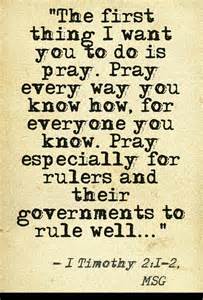
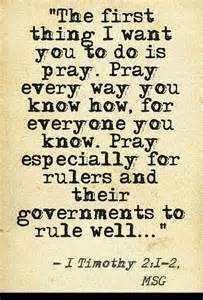
That means for everyone. Period. Even for mean people. Even for people we disagree with. Even for people who don’t look like us. As the modern translation from “The Message” of this reading begins, “Pray every way you know how for everyone you can.” Period.

Especially in the past few years in this country, division, discord, and dissension of large portions of the American population has only speeded up in the last few years, fueled by increasingly divisive rhetoric, shrill podcasts, and fraught news reports, as well as the regional and national conversations.

As Rev. Sharon Blezzard said, “Good news doesn’t usually sell publications or improve ratings. It takes bombast, divisiveness, and catty, snarky repartee to make headlines, not prayerful peacemakers standing in the breach attempting to reknit brokenness in quiet relationship building and listening. But we are called to a different way of being, to a stewardship of self and other that places value on people, on relationships, and on the building up of community.[2]

God has not called us to be snarky or mean, nasty or divisive. God does not want big bullies on God’s team. I have never heard of God approving of or cheering on hateful, spiteful Christians, either.

Instead, when we “Pray every way you know how for everyone you can.,” Paul reminds Timothy that “This is good, and pleases God our Savior, who wants all people to be saved and to come to a knowledge of the truth.”

Remember what the situation was for Paul and Timothy, and for all other believers in that first-century time and place. It is the same for us, today!  “We are called to be counter-cultural witnesses to God’s love, mercy, and saving grace. We cannot be a witness if our hearts are filled with hate. We cannot love our neighbors if we aren’t willing to get to know them, and certainly not if we aren’t willing to stop working violence against one another.” [3]

      Paul tells us we are to pray for all people; and we are to follow Paul’s lead in supplications, prayers, intercessions and thanksgivings. The intention of such prayers is so that we Christians in society will be able to live tranquil and quiet lives. This isn’t me saying it. It’s the apostle Paul! 

Regardless of whether there is peace in our church, peace in our neighborhood, or peace in our country, prayer is always a good idea. Having a close relationship with our Lord and Savior Jesus Christ is the reason we are here. Praise God! Thank You, Jesus. Alleluia, amen.

@chaplaineliza

(Suggestion: visit me at my other blogs: matterofprayer: A Year of Everyday Prayers. #PursuePEACE – and  A Year of Being Kind . Thanks!


[1] http://www.lectionarystudies.com/sunday25ce.html Rev. Bryan Findlayson, Lectionary Bible Studies and Sermons, Pumpkin Cottage Ministry Resources.

[2] https://www.stewardshipoflife.org/2016/09/calling-all-prayerful-peacemakers/

[3] Ibid.
Unknown's avatar

Peaceful and Quiet Lives

“Peaceful and Quiet Lives”

1-tim-2-2-pray-message

1 Timothy 2:1-8 – September 18, 2016

It’s good to be in the habit of doing certain things. Say, going to the gym. Exercise is a beneficial thing, and if I go to the gym on a regular basis, like three times a week, I will be healthier for it. Same for other things—like practicing the piano, or practicing football or baseball—it’s beneficial to get into the habit of regular repetition, week in, and week out.

Worship and prayer are regular, comfortable things, things many churches do the same way, week in and week out. Here in our scripture passage today, Paul gives his younger friend Timothy some words of wisdom. Recommendations, if you will, of some things Timothy’s church can do in worship and prayer that will be beneficial to them all.

Reading again from 1 Timothy 2, “I urge, then, first of all, that petitions, prayers, intercession and thanksgiving be made for all people— for kings and all those in authority, that we may live peaceful and quiet lives in all godliness and holiness. This is good, and pleases God our Savior.”

I’ll stop right there. Not because the rest of the reading is unimportant. No! But, because Paul has so many ideas that are bursting out of him one on top of the other, I am afraid we might be overloaded if I read them all.

Paul begins the chapter by encouraging Timothy to offer prayers for all members of the human family during church services. He mentions prayer in the terms of: petitions (humble, general requests to God), intercessions (requests, pleading for those in need), supplications (requests for ourselves, especially when faced with a crisis) and thanksgivings (expressing gratitude for blessings we receive). [1] All people need to be held up to God in prayer. All. That is, everyone. Not just one particular neighborhood, not just one particular ethnicity, not just one particular denomination. Paul tells Timothy—Paul tells us—pray for all people.

Yes, this is a wonderful passage that gives us the basics of prayer and worship, and lets us know more about Paul’s ideas concerning this important aspect of our lives. However, I was drawn to one particular phrase in this passage that went beyond the basics of worship: that we may live peaceful and quiet lives in all godliness and holiness.” I pursued it all week.

I was fascinated to dig into this passage of scripture. I have not read the Pastoral Letters as often as the rest of the New Testament. So, this week was a good excuse for me to dust off those seldom-opened commentaries and brush up on what was going on in this highly charged situation. For, highly charged it certainly was!

There was a complication, in the case of these house churches. Let’s take a look at the historical context. In the first century, small house churches like the ones where Timothy and Paul worshipped were in a precarious situation. They were constantly involved in “the struggle to secure and maintain a foothold within a hostile environment, where political authorities would always tend to be suspicious of the little house groups whose legal status was at best ambiguous and be ready to act against them at short notice with little excuse.” [2] Many of these small groups of emerging Christians desperately wanted to gain basic respect. Not even respectability, but hoping for just a bit of respect from the authorities.

These groups, or house churches, are identical to house churches meeting all over the world today, in fear for their leaders, if not the group members’ very lives. House churches in parts of Vietnam and Thailand, China, Pakistan, Nepal, and large parts of the Middle East. These groups are—today, here and now—struggling to survive in precarious political situations.

Is it any wonder that these small house churches wanted to pray for those in authority over them, so that they might have some peace and quiet? Quiet and tranquil lives?

Good habits—beneficial, certainly! Habits like prayer and worship are something that Paul would tell Timothy that his house church ought to follow, each time they gather.

How does this prayer and worship counteract the complication of overbearing and even unjust authorities that hold sway over these little groups of believers?

Both Paul and Peter tell their friends that the Godly thing to do is to pray for the authorities. I read from Romans 13:1: “Let everyone be subject to the governing authorities, for there is no authority except that which God has established.” And 1 Peter 2:17: “Show proper respect to everyone, love the family of believers, fear God, honor the emperor.” The New Testament tells us so, in several places, including this letter from Paul to Timothy.

We can see Timothy and his church are prompted to pray for the government. As Rev. Findlayson comments, “We are encouraged to pray for the political process such that it provides an environment where ‘we may live peaceful and quiet lives in all godliness and holiness’ (verse 2:2). This verse actually contains a clue to the content of our prayer for government. We are to pray for “peace”, but what kind of peace? Is it peace in the sense of freedom from war, social and industrial strife and revolution?” [3]

Ah. We have arrived at the topic of the day. The theme of our service today. What kind of peace do we pray for, indeed?

I have been talking about peace ever since February, the beginning of Lent. Remember, I went to a number of different churches, church groups, and schools to ask individuals what their personal definition of peace was. What is peace to you?                I got many fascinating definitions and expressions. Everything ranging from “Peace is serenity” to “Peace is Jesus Christ in my heart” to “Peace is quiet and calm” and “Peace is no war and no fighting.” And, a whole lot of other things, besides.

This kind of peace Paul describes is not just personal peace, and individual peace. This kind of peace Paul talks about is peace in the larger sense. Peace among regions, between people groups, and even between countries. We can see the progression in Paul’s thought. The spread of truth and of the Good News of Jesus Christ is facilitated when peace exists among the nations. In Paul’s day, the Roman Empire, the Roman transportation system and the Pax Romana made the spread of the Gospel easier. Then as today, peaceful interaction between countries and regions opens doors for the Good News.

See what Paul says in verse 4. God “wants all people to be saved and to come to a knowledge of the truth.” So then, when we pray for government and for the authorities, we can confidently pray that there be peace for the maximizing of the spread of the Good News.

Paul gives us the basics of prayer and worship. Remember what I often say? Prayer time is one of my favorite times in the worship service. Paul tells us we are to pray for all people; and we are to follow Paul’s lead in supplications, prayers, intercessions and thanksgivings. The intention of such prayers is so that we Christians in society will be able to live tranquil and quiet lives. This isn’t me saying it. It’s the apostle Paul!

Regardless of whether there is peace in our church, peace in our neighborhood, or peace in our country, prayer is always a good idea. A close relationship with our Lord and Savior Jesus Christ is the reason we are here. Praise God! Thank You, Jesus. Alleluia, amen.

If anyone would like to know more about how to come to know God in a closer, more intimate way, I would be glad to tell you.

[1]  http://www.lectionarystudies.com/sunday25ce.html Rev. Bryan Findlayson, Lectionary Bible Studies and Sermons, Pumpkin Cottage Ministry Resources.

[2] New Interpreter’s Bible Commentary on 1 Timothy, James D.G. Dunn, (Nashville, TN: Abingdon Press, 1994)

[3] http://www.lectionarystudies.com/sunday25ce.html Rev. Bryan Findlayson, Lectionary Bible Studies and Sermons, Pumpkin Cottage Ministry Resources.

@chaplaineliza

(Suggestion: visit me at my regular blog for 2016: matterofprayer: A Year of Everyday Prayers. #PursuePEACE – and my other blog,  A Year of Being Kind . Thanks!)