Unknown's avatar

Believe the Message!

“Believe the Message!”
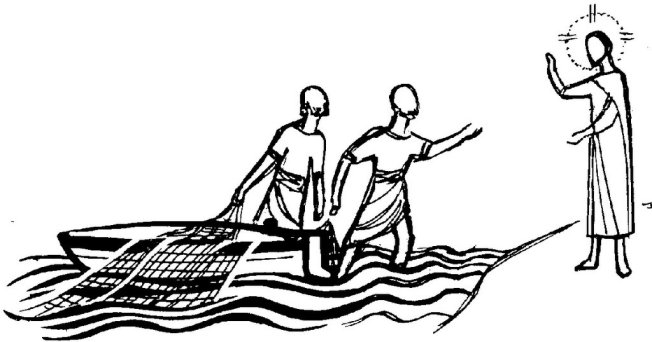
Mark 1-17 fishers of people

Mark 1:14-20 (1:15) – January 21, 2018

What is news? There are lots of different kinds of news. National news, local news. Partisan news, news that is slanted one way or another. What’s more, we hear so much about “fake news” today. News fit to scare the pants off of some people, and news meant to get some people really upset. News brings about all kinds of reactions. What kind of news can we possibly trust? How do we know which kind of news to believe?   

If we take a closer look at our Gospel reading for today, the Gospel writer Mark talks about news, too. Good News. God’s news—God’s wonderful message of Good News, brought by the greatest newsman, the greatest news announcer of all time, our Lord Jesus Himself.

Mark doesn’t waste any time with genealogies (like Matthew) or with long backstories of how Jesus came into the world (like Luke and John). No, Mark starts right off with a bang, with the baptism of Jesus. Then, shortly after He is baptized, Jesus starts to travel about saying, “Time’s up! God’s kingdom is here. Change your life and believe the Message.”

I love the relevance, the immediacy of Eugene Peterson’s modern translation. How appropriate that this translation of the Bible is called “The Message.” The whole Bible is God’s Good News to humanity, and most especially right here, in the Gospel of Mark.

Here we are, right at the beginning of Jesus’s ministry. John the Baptist (the cousin of Jesus) was already on the scene. A sort of a warm-up act for the main event, for some time John had already been proclaiming “Repent! And, believe God’s Good News!” First Jesus came to John to be baptized, and now was the time for Him to begin His own ministry, His own preaching of God’s Good News.

What do we hear first thing in our Gospel reading today? John the Baptist has been arrested. Next thing, Jesus begins to gather a group of disciples around Himself. Mark tells us that the way Jesus does this is by proclaiming God’s Good News. The Kingdom of God has come to us. Or, as Eugene Peterson translates it, “Believe God’s Message!”

One sure way to know when the writers of the Bible really want readers to pay attention is when a word or phrase is repeated. “The emphasis of Mark’s gospel is that Jesus’ coming is the gospel, the “good news,” a term that in the first fifteen verses of the gospel occurs three times.” [1]  Today’s text continues the story from last Sunday, that is, the beginning of Jesus’ ministry as He tells God’s Good News to His first disciples. In today’s reading Jesus calls four fishermen at the Sea of Galilee — Simon Peter, Andrew, James and John.

Our Gospel reading last week was from John chapter 1, and there are some differences between John’s account and Mark’s account from today’s scripture reading. In that sermon, I also mentioned how Jesus called several of His first disciples—this time it was John and James first, and then Simon Peter and Andrew. Some people have said, “I don’t understand. Which story is true, the Gospel of John or the Gospel of Mark?” Great question.

When a car accident happens in the middle of a busy intersection, that is a real tragedy. I understand when the accident is serious enough, the police sometimes get involved to find out exactly what happened. Imagine the surprise and even consternation when eyewitnesses on different street corners have different perspectives and impressions of the same event!

In the case of the car accident, the different people all saw the same vehicles collide, but from opposite angles and varying positions. Different things may have made a strong impression on one witness, more than another.

It’s no wonder that their eyewitness accounts are somewhat different from each other. And, in the case of the four different Gospel accounts, that adds to the richness and depth of the separate narratives. Each Gospel writer had a separate emphasis and perspective, and different things he wanted to highlight and point out.

However, we need to drill down to what is common between these readings. Jesus calls His first disciples, and Jesus tells them all, “God’s kingdom is here. Change your life and believe the Message.” What is the definition of God’s Good News, anyway? In Greek, the word is euaggelion, or Gospel. God’s Message of Good News to all humanity.

As we trace this Good News through the four Gospels and the rest of the New Testament, we get some more information. God’s Good News is truth. With the coming of the man Jesus here on the earth, humanity has the opportunity to see and touch and experience what God is like. A key feature of this Good News is hope. The fallen world is pretty hopeless and dark, but Jesus brings hope to the hopeless heart. And, last, God’s Good News means salvation. Salvation is not just being saved from the negative aspects of escape from sin and death. No! Salvation is eternal life, and the power to live life victoriously. [2]

God’s Good News is something new to many; something different, even radical. Why on earth should anyone want to adopt this strange, new life from Jesus? Maybe, this way of being and living is even a bit frightening? Many people may well be afraid of taking such a big step.

As Dallas Willard writes, “when he was a boy, rural electrification was just happening and power lines were being strung throughout the countryside.  But suppose even after the lines were up and running you ran across a house where the weary family still used only candles and kerosene lanterns for light, used scrub boards, ice chests, and rug beaters.  A better life was waiting for them right outside their door if only they would let themselves be hooked into the power lines.  “My friends,” you could proclaim, “electricity is at hand!”  But suppose they just didn’t trust it, thought it was too much of a hassle, and anyway didn’t believe the promises that things might be easier with this newfangled juice running into their house.  “If it’s all the same to you, we’ll stick with the old ways.” [3]

You see the difficulty? How some people are afraid of change? Or, prefer not to change their lives? How some don’t want to accept this Good News from God because it’s different, or new, or out of their experience? Can you hear Jesus saying, “My friends, God’s Kingdom is at hand! God’s Good News of eternal life is right here, waiting for you!”

Jesus still offers this gift of God in our world today, proclaiming His Message of God’s Good News, His Message of God’s truth, hope and salvation.

God’s Good News actually makes our job simple. We need to widely and clearly communicate the Message of God. “What mustn’t be lost on us is the urgency of its communication, for the day of judgement is at hand. We point to the hope of eternal life in Christ and call on everyone everywhere to turn and put their trust in Jesus.” [4]

Have you responded as the disciples did, by dropping everything and embracing the Good News? Jesus is calling, waiting for you and for me. Jesus says, “Believe the Message! Come, follow Me.”

[1] http://www.workingpreacher.org/preaching.aspx?commentary_id=2315

Commentary, Mark 1:14-20, Michael Rogness, Preaching This Week, WorkingPreacher.org, 2015.

[2] Barkley, William, The Gospel of Mark (Westminster Press: Philadelphia, 1975), 25-26.

[3] http://cep.calvinseminary.edu/sermon-starters/epiphany-3b-2/?type=the_lectionary_gospel

Commentary and illustration idea, Mark 1:14-20, Scott Hoezee, Center for Excellence in Preaching, 2015.

[4] http://www.lectionarystudies.com/studyg/sunday3bg.html   “Repent and Believe in the Good News,” Rev. Bryan Findlayson, Lectionary Bible Studies and Sermons, Pumpkin Cottage Ministry Resources.  

@chaplaineliza

(Suggestion: visit me at my regular blog for 2018: matterofprayer: A Year of Everyday Prayers. #PursuePEACE – and my other blog,  A Year of Being Kind . Thanks!)

Unknown's avatar

They Recognized Jesus!

Luke 24:19-35 (24:31) – April 30, 2017

Luke 24 Supper at Emmaus, Rembrandt

“They Recognized Jesus!”

In centuries past, people did not have many options when it came to traveling places over land. Sometimes, when they had a little more money, they would ride horses, or donkeys—or, use wagons or carriages. However, most people did not have that luxury. So, people would walk.

We are going to consider our Gospel lesson this morning. It is a lengthy reading, most of Luke 24. Luke talks about two disciples who are walking to a nearby village called Emmaus, which was seven miles from Jerusalem. Does anyone here know how far seven miles is? I wanted to give you all a real-life example. If you left St. Luke’s Church here in Morton Grove and walked seven miles east down Dempster, you would end up in Evanston. Right about at Dempster and Ridge, at the Jewish synagogue Beth Emet. It would take me between two and a half to three hours to walk that far, at a moderate pace. (Just so we all know how far the two disciples walked.)

From Luke 24, this is a reading about two people on the road. (start walking from the front of the church)  “13-16 That same day two of them were walking to the village Emmaus, about seven miles out of Jerusalem. They were deep in conversation, going over all these things that had happened. In the middle of their talk and questions, Jesus came up and walked along with them. But they were not able to recognize who He was.

17-18 He asked, “What’s this you’re discussing so intently as you walk along?’ (full stop)

Ah. We can see that they were busy talking, pouring over the information, and trying to understand what had happened.  These disciples were people who both knew the need for and had hope for the coming of a Messiah who could redeem God’s people. [1]

“They just stood there, long-faced, like they had lost their best friend.”

How often have we been hoping against hope for something wonderful? Something dynamic, that will knock everyone back on their backsides? And then—and then—hope fizzles. Hope is gone. The Messiah, their leader is put to death on Good Friday (what a misnomer!), and nothing more is possible.

“Then one of them, his name was Cleopas, said, ‘Are you the only one in Jerusalem who hasn’t heard what’s happened during the last few days?’

Cleopas is not mentioned in any other biblical reference. He and his unnamed companion had been followers of Jesus. There must have been a number of these lesser-known people, disciples who knew Jesus as a prophet mighty in deed and word. A Miracle Worker whom they had hoped would be the Messiah, the one to redeem Israel. [2]

(Then, Jesus asked a leading question.) ”19-24 Jesus said, “What has happened?”

(Continue walking and reading.) “They said, “The things that happened to Jesus the Nazarene. He was a man of God, a prophet, dynamic in work and word, blessed by both God and all the people. Then our high priests and leaders betrayed Him, got Him sentenced to death, and crucified Him. We had our hopes up that He was the One, the One about to deliver Israel. And it is now the third day since it happened. But now some of our women have completely confused us. Early this morning they were at the tomb and couldn’t find His body. They came back with the story that they had seen a vision of angels who said He was alive. Some of our friends went off to the tomb to check and found it empty just as the women said, but they didn’t see Jesus.”

(Be at the back of the church by now.) Did everyone hear? Jesus chose to appear to some women, first thing. And now, Jesus appears to two unimportant, minor followers. Not even the big three disciples, Peter, James, and John. How Jesus cares for and is concerned for those who are unimportant, and sometimes shunted aside. The risen Jesus comes to them, especially! (Continue walking.) The seeming unimportant, the ones behind the scenes, the forgotten ones.

25-27 Then He said to them, “So thick-headed! So slow-hearted! Why can’t you simply believe all that the prophets said? Don’t you see that these things had to happen, that the Messiah had to suffer and only then enter into His glory?” Then Jesus started at the beginning, with the Books of Moses, and went on through all the Prophets, pointing out everything in the Scriptures that referred to Him.”

Wouldn’t you like to be on that trip, with Jesus and the two lesser-known disciples? Imagine, Jesus Himself, explaining how the scarlet thread of salvation is found throughout the Hebrew Scriptures. What insights! What glory! (Walk up to the front.)

Now, we arrive at the village of Emmaus: “28-31 They came to the edge of the village where they were headed. He acted as if He were going on but they pressed Him: “Stay and have supper with us. It’s nearly evening; the day is done.”

These two caring disciples were people who were concerned for others—or at least for this traveling companion of theirs who thought He’d continue on in the evening.  “Cleopas and his friend knew how unsafe the roads were.  Surely the man who had spent so much time with them talking about Scripture would be better served by a simple meal and safe accommodations for the night.” [3]

“So Jesus went in with them. And here is what happened: He sat down at the table with them. Taking the bread, He blessed and broke and gave it to them. At that moment, open-eyed, wide-eyed, they recognized Him. And then—He disappeared.”

What was that all about? Were these two men dreaming? All the talking, all the pondering of what-ifs, suppositions, different theological opinions, pro and con. There is a kind of resignation in all this, both in Luke’s story and often in our own lives.  Can’t you hear the cynical, long-suffering comments? “Get real.”  “Grow up.”  “Back to work.”  We can only imagine how the families and friends of Cleopas would offer snippy, unsolicited advice and opinions when the two got home to long untended work and family obligations. [4]

And then—and then—Jesus makes Himself known to them. Something nebulous, some intellectual and theoretical story changes in the twinkling of an eye to something real, wonderful, and concrete. Something these two men are eyewitnesses of, and can testify to.

32 Back and forth they talked. “Didn’t we feel on fire as He conversed with us on the road, as He opened up the Scriptures for us?” 33-34 They didn’t waste a minute. They were up and on their way back to Jerusalem. They found the Eleven and their friends gathered together, talking away: “It’s really happened! The Master has been raised up—Simon Peter saw him!” 35 Then the two went over everything that happened on the road and how they recognized Him when He broke the bread.”

As we look back on the movement of this narrative from Luke: 1) the two travelers are met on the road, 2) have the Scriptures opened, 3) and share in a meal that reveals the identity and presence of Christ. Then, 4) the travelers are sent out to share and live the Good News. [5] Isn’t that what happens as the two lesser-known disciples waste no time in going back to Jerusalem to share their story?

Remember, these two disciples had been on the road. Aren’t we all traveling? All on the road through life? Doesn’t Jesus come alongside of each of us, as He opens the Scriptures and explains how He has come into the world to reconcile us to God? And then, Jesus enters the house (or, church) with us, and we recognize Him when He breaks the bread of life, for us, too?

The last, and most important part, is sharing the Good News. We can tell others how Jesus has risen from the dead. We can tell others how He has changed our lives through His Word, the Bible. We can tell others how He comes to be with us each time we break bread, too. Just like Cleopas and his friend, just like Peter and the other disciples, we can turn the world upside down, too.

I close with the words of a special prayer—the Collect for today, the third Sunday of Easter, from the Episcopal Church’s Book of Common Prayer. “O God, whose blessed Son made himself known to His disciples in the breaking of bread: Open the eyes of our faith, that we may behold Him in all His redeeming work; who lives and reigns with You, in the unity of the Holy Spirit, one God, now and for ever. Amen.”


(The Gospel reading is from the modern translation The Message, by Eugene Peterson. With gratitude, I appreciate Rev. Peterson’s translation and use his words in my sermon today.)

(I thank Carolyn Brown for her wonderful idea of traveling, of walking around the congregation in my sermon today. From Worshiping with Children, Easter 3, Including children in the congregation’s worship, using the Revised Common Lectionary, Carolyn C. Brown, http://worshipingwithchildren.blogspot.com/2014/03/year-the-third-sunday-of-easter-may-4.html )

[1]  http://www.workingpreacher.org/preaching.aspx?commentary_id=933  Commentary, Luke 24:13-35, (Easter3A), Sarah Henrich, Preaching This Week, WorkingPreacher.org, 2011.

[2] Ibid, Sarah Henrich, Preaching This Week, WorkingPreacher.org, 2011.

[3] Ibid, Sarah Henrich, Preaching This Week, WorkingPreacher.org, 2011.

[4] Ibid, Sarah Henrich, Preaching This Week, WorkingPreacher.org, 2011.

[5] https://www.workingpreacher.org/craft.aspx?post=3188 David Lose President, Lutheran Theological Seminary at Philadelphia


Unknown's avatar

Don’t Doubt—Believe!

John 20:19-31 (20:27) – April 23, 2017

Jesus and Thomas John 20-24

“Don’t Doubt—Believe!”

Being skeptical can be a positive thing. Just think of ice in winter, covering a lake. Am I right in being skeptical that the ice is hard enough to hold me (and my weight)? And, think about engineers and scientists. They are often naturally, honestly skeptical and analytical; they hold things at arms’ length and consider all sides of a situation. That can be positive and helpful, in many situations. Even necessary, at times.

Consider Thomas. He missed the big event, the first time that the resurrected Lord Jesus came back to the rest of the disciples. Let’s look at this event from Thomas’s side. For some reason (we are not told the reason), Thomas missed the weekend gathering of the eleven disciples, plus some others who also were traveling with Jesus. Perhaps they were gathering for regular prayer, or for a worship service. Maybe to have a meal together. Maybe all of the above.

The gathering was secretive. Remember, the Roman and Jewish authorities were disgruntled and angry. The body of Jesus had disappeared completely, even though the tomb had been guarded by Roman soldiers. Therefore, the authorities were looking for a really high-profile body, and it was unbelievable to them that there was no trace of the Rabbi Jesus’s remains, anywhere. Of course the authorities would seek out this upstart Rabbi’s close companions, and keep them under surveillance, just in case any of them knew where the body was.

Whatever the reason, Thomas was not there the previous week. And, he—and the other disciples—had good reason to be jumpy, and cautious. Even, skeptical, as we will see.

Reading from our Gospel passage, “So the other disciples told him, “We have seen the Lord!” But Thomas said to them, “Unless I see the nail marks in his hands and put my finger where the nails were, and put my hand into his side, I will not believe.”

This passage comes to us from the Gospel of John. Throughout John’s Gospel, this writer has an understanding of believing that is active. To John, believing in Jesus is not just an intellectual exercise. No! Belief to John is very much an action verb.

Believing in Jesus is having a relationship with Jesus. As Jesus Himself said earlier in the Gospel of John, “I abide in you and you abide in Me.”  So, for this Gospel writer to say that skeptical Thomas was having trouble believing is not quite the same thing as making light of Thomas for doubting. Thomas had just seen his Rabbi and leader die on the cross, be executed by an extreme and cruel form of suffering and agony. I suspect Thomas’s relationship with his Rabbi was pretty close to being extinguished. Sure, Thomas was skeptical.

Are there times when you or I are skeptical, too? I mean, times of sincere questioning of our faith? When we might think, with Elijah, that the heavens are all closed up, and nothing can penetrate, not even a desperate prayer? If we were honest with ourselves, I suspect in almost every person’s life there are difficult times, challenging times, times when we  come to the end of ourselves and have no more hope, no more tears, no more swear words to say.

Desperate times, indeed. Who can blame Thomas for being skeptical? As Father Rick mentioned on a sermon preparation site I follow, how crushed Thomas must have been. Perhaps, to keep his heart safe, he refuses to believe… it hurts too much to believe. [1] Can you hear pain, and fear, and maybe stubbornness in his response?

Here is a slightly different translation of Thomas’s dramatic statement: “Unless I see the mark of the nails in his hands and shove my finger into the mark of the nails, and shove my hand into his side, I absolutely will not believe” (20:25, translation by Jaime Clark-Soles). Here, we look at the verb from a slightly different angle. The Greek verb ‘believe’ is a forceful one (ballo), as is the emphatic negative (ou me). “I absolutely will not believe.” Not a simple, “I’ll believe it when I see it” —Thomas has a lot of conditions;” [2] conditions that he speaks out of a dark place of anger and grief and anxiety, and conditions that will only be met by the resurrected Jesus.

But, what happens next?

Now, this is not resolved right away. Thomas is left doubting—rather, being skeptical, for a week. Reading from our Gospel passage: “A week later his disciples were in the house again, and Thomas was with them. Though the doors were locked, Jesus came and stood among them and said, “Peace be with you!”

What would that do to your faith? If your faith were wavering, and you were faint of heart, perhaps doubting, maybe even skeptical—what would we do if Jesus were to come among us today—right there—and say, “Peace be with you!” Would that cause people to believe in Jesus? Let’s find out.

“Then Jesus said to Thomas, “Put your finger here; see my hands. Reach out your hand and put it into my side. Stop doubting and believe.”

If Jesus appeared among us and said those things to us, would that cause you and me to have the kind of belief that John is talking about here—where we start or cement a deep, true relationship with our Lord and Savior Jesus, and believe in our hearts that God has raised Him from the dead? What did those words do for Thomas?

28 Thomas said to Jesus, “My Lord and my God!”

Did you hear? Thomas just made an earthshaking confession of faith as well as a crystal clear statement of belief.

(And, remember, we are using John’s definition of belief. A deep, true relationship with our Lord and Savior Jesus!) Praise God, this is a confession that Jesus is our Lord, He is our God. As John tells us in the beginning of his Gospel, He is the Word made flesh, come into this world to make His dwelling among us. To abide in us as we abide in Him. All this Thomas confesses in this statement of faith. This confession is made all the more powerful because skeptical, discouraged, frightened Thomas has made it.

I ask all of us, again. What would we do if Jesus were to come among us today—right there—and say, “Peace be with you!” What would we do if Jesus showed us the nail scars and where the spear went into His side? Oh, no! some might say. Jesus would never do that. Not here, not now. Perhaps in bible times, but not today.

Here we have a clear invitation to the skeptics, to the doubters, to those who are not sure about their faith any longer. This Gospel reading is also for those who have been hurt by the church, and perhaps are not sure there is Anyone up there listening to them any longer. This passage is for you, too.

Praise God, Jesus has conquered death, and He will be with us when we walk through fiery trials and dark places in our lives. Using John’s definition of belief, we all can have a true, deep relationship with Jesus as our Lord and our God, just like Thomas.

Have you heard? Do you know that Jesus has risen from the dead? This is not only Good News, it’s the best news ever shared, in the history of ever. It is much more than just the dry words from the Apostles Creed, written on a page. Jesus holds out His hands, shows us His side. Christ is risen, indeed!

[1] http://desperatepreacher.com//bodyii.htm Posted by Rick+ in Reno, March 31, 2016.

[2] http://www.workingpreacher.org/preaching.aspx?commentary_id=3222  Jaime Clark-Soles

@chaplaineliza

(Suggestion: visit me at my regular blog for 2017: matterofprayer: A Year of Everyday Prayers. #PursuePEACE – and my other blog,  A Year of Being Kind . Thanks!)

Unknown's avatar

Faith Begins at Home

“Faith Begins at Home”

2-timothy-opening-page

2 Timothy 1:1-5 – October 2, 2016

Today is the day we celebrate our children’s first communion. What a happy day! We all join together in praise for Claire, Edward and Noah. They learned more about the why of it, the beginnings of Communion yesterday, in the choir room.

We went through the events of that Passion Week two thousand years ago, and concentrated on that Maundy Thursday evening, that Passover seder our Lord Jesus and His friends celebrated. We talked about the crucifixion, and the resurrection of Jesus. Then, we talked about how Jesus ascended into heaven and is in heaven right now. And, that Jesus gave us the practice of communion—of the Lord’s Supper—for us to remember Him and to join together as a congregation of believers in Jesus and what He did for us on the cross.

Another really important thing we talked about was how Jesus forgives us for the bad and angry words we say, and the bad and wrong things we do. That is another important part of communion, too. We need to confess our sins before we come to the Lord’s Table. Then, just as I remind us all in the Assurance of Pardon each week, God will forgive us our sins and cleanse us from all unrighteousness. Believe the good news! In Jesus Christ we are forgiven.

These are central foundations of our faith. The Christian faith. That’s the same faith the Apostle Paul talked about in our Scripture lesson today, from 2 Timothy. Paul says to his protégé Timothy, “I am reminded of your sincere faith, which first lived in your grandmother Lois and in your mother Eunice and, I am persuaded, now lives in you also.”

This same faith, in these same things. Except, everything was very recent. There were still a number of people living who had actually seen Jesus and the events in Israel. (Can you imagine that?) So much more immediate.

Timothy was one of the first Christians brought up in a believing family; he received sound teaching about God from his mother and grandmother, Eunice and Lois. Yes, Paul was very close to Timothy, a young man whom he took under his wing. But we see here that Paul gave credit where credit was due: Paul raised up Timothy’s careful teaching from a believing family, and the sincere faith of both his grandmother and mother.

Eunice, Lois and Timothy were Jewish. As in any careful Jewish home, the mother and grandmother had a good deal to do with teaching the children. The Hebrew Scriptures are careful to tell faithful people to share about the ways of God within the home. Deuteronomy 4:9 reminds us, “Make them known to your children and your children’s children.” Worship services in the Temple were not sectioned off, with a separate place for babies and toddlers, and a junior Temple, and then Temple for adults. No, there were multiple generations present at all worship services. What a great way to celebrate the family of faith, the larger faith community.

Praise God for families that strive to live for God, and to raise children in the nurture and fear of the Lord. Wonderful opportunities to learn more and more about God in a familiar setting, and how to walk in God’s ways and will.

But—what if a person does not grow up in a believing family? What then? Can someone be raised in a secular family, or a non-Christian family, and still come to know God?

I did. I grew up in a home where there was no mention of God at all. When I was a preschooler and into my primary grades, I don’t believe I ever when to church at all. Maybe, once. (A vague memory.)

I’m the youngest of six children, and I grew up on the northwest side of Chicago. My parents were both raised in Catholic parishes in Chicago, but they stopped attending the Catholic church while they were in college. And, they never renewed their acquaintance with the church.

It was a combination of things that started me attending Christ Lutheran Church in Chicago when I was in elementary school. My older sisters sometimes went to the youth group of that church because their friends attended there. The church also had a volleyball team, and one of my sisters loved to play. They would occasionally go to church, and my mother pushed me out the door to go to Sunday school with my sisters. I found I liked it. I really liked it, more than anyone ever expected.

That congregation became my family of faith. I not only attended Sunday school and youth group, but I learned all about the Christian faith while at that church. The pastor, Pastor Wold, was a faithful and conscientious teacher in confirmation classes. I remember attending confirmation every Wednesday afternoon for almost two years after school, and we carefully went through Luther’s Small Catechism.

Just like Timothy, with a sincere faith living in him passed down from his blood family, so I had a sincere faith living in me. It was passed down to me through faithful Sunday school teachers and youth leaders. I remember with gratitude people like Pastor Wold, Mrs. Pabst and Mrs. Smallman. People who carefully taught me how much God loved me.

Here, at St. Luke’s Church, we have the opportunity to teach our children about the Christian faith. Not only Miss Karen teaches our young people, in Sunday School, but all of us do as we gather together in worship, sing, pray, repeat the stories of our faith. Even sit together in silence. All of these are ways we come together as a family of faith, before God. We all have the opportunity to learn from each other on a regular basis, when we gather for worship.

Today is a special day. Yes, it is the first communion of Claire, Edward and Noah. Praise God! We do rejoice with them! But, it is more than that. Much, much more.

Please take out your bulletins. Look at the front page. What does it say on the bulletin? World Communion Sunday. “World Communion Sunday (originally called World Wide Communion Sunday) is a gift of the Presbyterian Church to the larger ecumenical church.  The first celebration occurred at Shadyside Presbyterian Church in Pittsburgh, PA, in 1933 where Dr. Hugh Thompson Kerr served as pastor.”

“World Communion Sunday grew out of the Division of Stewardship at Shadyside. It was their attempt to bring churches together in a service of Christian unity—in which everyone might receive both inspiration and information, and above all, to know how important the Church of Jesus Christ is, and how each congregation is interconnected one with another.” [1]

So, not only are families interconnected by blood ties. Not only are congregations connected as families of faith. But, a multitude of congregations, of churches, are interconnected with each other. All over the world.

This celebration of the Lord’s Supper—called in different places Communion—or the Eucharist—is as different as are the many varied cultures where the Lord’s Supper is commemorated today. Some people today will meet out of doors, under a tree. Others will meet in a plain structure with only a roof over their heads. Some will meet in a fancy, ornate sanctuary, while still others will creep away by ones or twos to a hidden place for fear of being arrested, or worse. All of these are remembering our Lord Jesus as He instituted this holy meal, this sacrament.

We meet each Sunday as a family of faith. And, we meet today as fellow members of the family of Jesus Christ. Praise God for friendship, for fellowship, and praise God for the marvelous diversity of the families of faith throughout the world, in cities, small towns, rural churches, across denominations, transcending barriers and dividing lines, all through the power of the love of Christ. Truly, our sisters and brothers, all around the world.


[1] http://www.presbyterianmission.org/ministries/worship/special-days-and-emphases/world-communion-sunday/  John A. Dalles, a PCUSA pastor who has researched the history of World Communion Sunday notes this in his blog entry, reprinted from the October 7, 2002 Presbyterian Outlook.

@chaplaineliza

(Suggestion: visit me at my regular blog for 2016: matterofprayer: A Year of Everyday Prayers. #PursuePEACE – and my other blog,  A Year of Being Kind . Thanks!)

Unknown's avatar

Without Hesitation

“Without Hesitation”

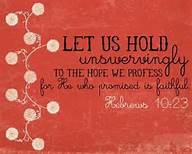
Heb 10-23 He who promised is faithful words

Hebrews 10:19 – November 15, 2015

Who here knows the words of the Apostles Creed? Who studied the Apostles Creed before they were confirmed? I know I did. I studied Martin Luther’s Small Catechism, and went over every part of the Lord’s Prayer as well as the Apostles Creed.

Today, we are going to take a closer look at the whys and wherefores of two phrases from the Apostles Creed: “He—Jesus—ascended into heaven, and sits on the right hand of God the Father Almighty.” You—I—all of us have been saying these words for years and years. It’s a part of our church culture. But, what do these words really mean? “Where is Jesus now?

We are departing from the Gospel of Mark. I’ve been preaching from Mark for the last two months. We have been following Jesus through His discussions with the Jewish leaders about all kinds of aspects of the proper religious life. Today, we make a big jump forward, to the New Testament passage from the letter to the Hebrews. This is after the Resurrection, after the book of Acts, and the Apostles have now been sent out into the world to tell all people about the risen Jesus, and about God’s love and forgiveness of their sins.

This letter to the Hebrews is a circulating letter. That means it and other circulating letters were sent from place to place in Asia Minor, so the small, struggling churches could receive encouragement and teaching in writing from the Apostles and other new church leaders. This particular letter was sent to Jews who lived a long way from Jerusalem. In essence, ex-pat Jews.

To give us some further background into this week’s reading, “This week’s text [from Hebrews] draws together the argument the author of this letter began six chapters ago, namely that Jesus is God’s final and ultimate High Priest. The author can point to the model of Israel’s priests to explain what Jesus does, but His priesthood differs in several fundamental respects. Beginning in verse 11 the author reiterates those differences once again.” [1]

What about those Old Testament priests in the Temple in Jerusalem, anyhow? They needed to keep on sacrificing animals over and over and over again. Why? The people of Israel had a Sin Problem. The priests had to keep sacrificing to cover the Sin Problem, to make it better. To atone for the sins of the whole people. And no matter how hard they worked, or how many animals they sacrificed, or how much they prayed to God, it was never enough. There was always more sin. The nation of Israel and all the individuals in Israel had a Sin Problem.

I know when my mother had a houseful of guests (usually several of her grown children all at once), she would try and try to keep the kitchen clean, the kitchen sink empty of dishes, and the bathroom ready and clean for anyone who needed to use it. Except—there were always so many people in the house. There was always more dirt. More mess. More dirty dishes. It seemed like it would never end! (Except, it periodically did when everyone went to their own homes, in the case of my mom’s house.)

How many people can relate to this example? Dirt, mess, dirty dishes and black marks in a crowded house never end. Just so, in the case of the priests and the sacrifices for sins that everyone commits, the Sin Problem never ends. For real! Never, ever! People are sinful. They keep doing and saying and thinking things that go against God’s laws, and sin never goes away. All the sacrifices ever brought before God could never make one dent in the Sin Problem.

When we look at our passage from Hebrews again, what do we read? Quoting from our scripture today, “As a priest, Christ made a single sacrifice for sins, and that was it!

What was that again?

Jesus Christ was the perfect High Priest. He was a better High Priest than any other of the priests throughout history who ever offered animal sacrifices to God at the Temple. What Jesus did for us on the cross (and I’m quoting again) “… was a perfect sacrifice by a perfect person to perfect some very imperfect people. By that single offering, He did everything that needed to be done for everyone who takes part in the purifying process.”

The whole repetitive process of endless animal sacrifice? Jesus came and broke that process. He ended it. He made that process obsolete, not necessary any more. Instead, Jesus and His death for us on the cross reaches way beyond animal sacrifice.

What’s more, Jesus our High Priest makes the perfect sacrifice once for all time. And then, He sits down. What about those other priests, the ones who continually stand and keep offering the imperfect animal sacrifices for all those centuries? From the Message, again: “As a priest, Christ made a single sacrifice for sins, and that was it! Then [Jesus] sat down right beside God and waited for His enemies to cave in.”

At first glance, some people might think that Jesus did not finish His work as High Priest. But, that is just the point! He did finish the work. The other priests had to continue to stand, because they had to continue to offer sacrifice after sacrifice on a daily basis. Because of the Sin Problem that just wouldn’t go away. Jesus did complete the perfect sacrifice. His sacrifice brought perfect, complete forgiveness of sins. Jesus was all done, and He sat down. The Sin Problem went away, once and for all.

But, wait! There’s more! Jesus doesn’t just sit down any old place. On any old bench, or in somebody’s creaky rocking chair. No. He takes a seat at the right hand of God. A place of great power and great authority. Jesus—the Son of God, the Second Person of the Trinity, incarnated by the Holy Spirit of the Virgin Mary—Jesus takes the number one seat in all of the universe, next to God the Father. The resurrected Lord Jesus is God the Father’s right hand man. It says so, right in our scripture text from Hebrews today.

To finish our passage from verses 19 and 20, “So, friends, we can now—without hesitation—walk right up to God, into “the Holy Place.” Jesus has cleared the way by the blood of His sacrifice, acting as our priest before God.”

I want everyone to notice that all the pronouns here are plural. That means we—all of us together—can have confidence. We—all of us—can walk right up to God. We can come into God’s presence and boldly bring our requests to God. As I say in our weekly pastoral prayers, we—all of us have free access to God. Not like the Jewish people before the time of Jesus, who were still dealing with the Sin Problem and still needed an intermediary between them and God. But because Jesus, our perfect High Priest, has cleared the way. Jesus has invited us to come. We are very welcome to enter into God’s presence!

Do you have a better understanding now of those two phrases from the Apostles Creed? “He—Jesus—ascended into heaven, and sits on the right hand of God the Father Almighty.”

This section from the letter to the Hebrews answers our questions about “where is Jesus now?”  The risen Jesus is with God and is Lord!

Do you have the confidence that your Sin Problem is taken care of? Do you dare accept the invitation that Jesus extends to us? Can we grasp that assurance that God welcomes us? This scripture passage clearly lets us know about that boldness. That “free confidence,” grounded on the consciousness that our sins have been forgiven.

As I say every week after the Confession of Sins and the Assurance of Pardon, believe the Good News of the Gospel. In Jesus Christ, our sins are forgiven.

Alleluia, amen!

[1] http://www.workingpreacher.org/preaching.aspx?commentary_id=142 Commentary on Hebrews 10:11-25 by Amy L. B. Peeler.

(Thanks to Amy for several ideas I wove into this sermon!)

@chaplaineliza

Suggestion: visit me at my daily blog for 2015: matterofprayer: A Year of Everyday Prayers. and my other blog,  A Year of Being Kind .  Thanks!


Unknown's avatar

Spinning Out of Control!

“Spinning Out of Control!”

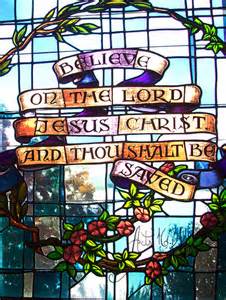
Acts 16-31 Believe in the Lord Jesus Christ stained glass

Acts 16:30-31 – September 6, 2015

Most people I know like things in order. Neat and tidy. Under control. I mean, most things. Steady income, check! Roof over our heads, check! Clothes to wear and food to eat? Check and double check. Sure, we can have little surprises now and then, but most people crave order. Everything’s hunky dory! Just the way it’s supposed it be.

Until, it isn’t. We experience things spinning out of control.

In our Scripture reading today, we have Paul, Silas, Dr. Luke and their missionary friends in the town of Philippi. This is another in our summer sermon series, Postcards from the Early Church. If you remember last week, we met Lydia, a Gentile woman. We are told she is from a city called Thyatira, and is a dealer in purple cloth, which for that time was a luxury item. What I suggested last week was that it’s similar today to a dealer in high-end designer clothing in our culture and context. She not only owns her own business, but she also has her own house.

The pertinent part for us in this week’s sermon is that after becoming a believer in the Lord Jesus Christ, Lydia invites Paul and his friends to stay at her large house in Philippi. Paul and friends start to carry out the challenging work of starting a church plant. That is, spreading the Good News of the risen Lord Jesus.

Paul is skilled at debate, and I suspect he and his friends went to gathering places all around town to talk with people. To tell them about the Good News about the Lord, how He died for our sins and was raised from the dead, conquered death, and has ascended to heaven.

Now we discover a slave girl starts to follow Paul and his friends around, as they travel about town. Listen to Acts 16: “We were met by a female slave who had a spirit by which she predicted the future. She earned a great deal of money for her owners by fortune-telling. 17 She followed Paul and the rest of us, shouting, “These men are servants of the Most High God, who are telling you the way to be saved.” 18 She kept this up for many days.”

Here Dr. Luke gives us a thumbnail sketch of this slave girl. Yes, she is telling the truth. Paul and his friends were telling people the way to be saved. But, the truth can be twisted. She refers to “the Most High God.” Meaning, a God among other Gods. And, in the polytheistic environment of Greece, the title “the Most High God” was also a common name for Zeus, ruler of the Greek pantheon of gods.

This slave girl was a factor completely out of the control of Paul and his friends. From what this looks like, she was a sort of a heckler. Walking after them, shouting and making a big fuss. And, the slave girl was a local. A known person to the inhabitants of the town. Paul and his friends were visitors, strangers in town. There was that dynamic, as well.

Not only is she starting to get irritating and annoying, following them around like a pesky little sister for many days, Paul realizes this slave girl is energized by a demon. The demon inside of her enabled her to tell fortunes, to tell people what would happen to them in the future. I suspect the demon knew with great certainty the exact identities of Paul, Silas, Dr. Luke, Lydia, and the rest of the believers in the risen Lord Jesus there in Philippi.

Let’s see what happened next! “Finally Paul became so annoyed that he turned around and said to the spirit, ‘In the name of Jesus Christ I command you to come out of her!’ At that moment the spirit left her.

What was that that happened? Paul got fed up with the persistent heckling the demon—I mean, the slave girl was doing. So, he cast the demon out of this slave girl. Next thing we know, the girl’s owners got really mad! That was a serious consequence, to be sure.

Let’s trace this back a bit. Why were her owners so angry and upset?

Apparently, the slave girl’s owners didn’t particularly care that she wandered around the city of Philippi shouting about Paul and his friends being servants of God and telling people how to be saved, as long as she pulled in the money. As long as she was a profitable cash cow, her owners were happy.

But in casting out the demon? Talk about things spinning out of control! The unexpected consequences of Paul’s action? It dried up all the profits the girl’s masters were making! Paul dried up the owners’ lucrative source of revenue! Talk about hitting them in the pocket book!

Continuing with Acts 16: “19 When her owners realized that their hope of making money was gone, they seized Paul and Silas and dragged them into the marketplace to face the authorities. 20 They brought them before the magistrates and said, “These men are Jews, and are throwing our city into an uproar 21 by advocating customs unlawful for us Romans to accept or practice.” 22 The crowd joined in the attack against Paul and Silas, and the magistrates ordered them to be stripped and beaten with rods.”

I owe thanks to John, a pastor on a sermon discussion board I follow, from time to time. His insight? The wallet. The billfold. “’Religion’ is all well and good, at least until it starts affecting my pocketbook. In this [passage], it’s only after the new religion affects the slave girl’s owners’ bank account that they have Paul and Silas arrested.”

With you and with me, today. What about us? Is “Religion” all well and good, until it hits us in the pocketbook, too? Is “Religion” affecting our bank accounts? Will following Jesus here in the United States affect us in a negative way? Affect our pocketbooks? Or, is that hitting too close to home for us? Hmm. I’ll let us think about that for a while. Let it sink in.

Let’s follow along with Paul and Silas. Dr. Luke tells us specifically about their time in the prison. “23 After they had been severely flogged, they were thrown into prison, and the jailer was commanded to guard them carefully. 24 When he received these orders, he put them in the inner cell and fastened their feet in the stocks.”

Things are spinning out of control again. Paul and Silas are thrown into the inner cell of a prison. I bet that was an especially secure place. But what do they end up doing? Instead of crying and desperately lifting their voices in prayer to God, they begin to sing. Imagine, singing hymns of praise to the Lord, at midnight. Securely locked, in a dark prison.

We continue with chapter 16: “26 Suddenly there was such a violent earthquake that the foundations of the prison were shaken. At once all the prison doors flew open, and everyone’s chains came loose. 27 The jailer woke up, and when he saw the prison doors open, he drew his sword and was about to kill himself because he thought the prisoners had escaped. 28 But Paul shouted, “Don’t harm yourself! We are all here!”’

We can see the economic effect this earthquake had on the jailer, for sure! Plus, the horrible sinking in his heart, seeing his jail destroyed, with the prisoners quite possibly running away, escaping in the middle of the night. No wonder he drew his sword, ready to kill himself.

The jailer is stopped by Paul, shouting out to him: “Don’t harm yourself! We are all here!”

29 The jailer called for lights, rushed in and fell trembling before Paul and Silas. 30 He then brought them out and asked, “Sirs, what must I do to be saved?” 31 They replied, “Believe in the Lord Jesus, and you will be saved—you and your household.”

Did you hear? What must we do to be saved? Believe on the Lord Jesus.

It doesn’t matter what is spinning out of control. It doesn’t matter what economic consequences are happening. It doesn’t matter what the authorities say or don’t say. Instead, we hear the Good News preached to us. Believe in the Lord Jesus, and we will be saved. All of us, and our households, too!

On this Labor Day weekend, we can see all levels of society hearing the Good News. We can see the slave girl—a slave, someone from the lower class, being freed and exposed to the saving grace of the Lord Jesus! And, we can see the jailer, a solid member of the middle class, receiving salvation with joy! And last week, we saw Lydia, a member of the upper class in Philippi, listening eagerly to the Good News. She came to faith in the Lord Jesus, too.

Our Lord Jesus is not only for the Gentile and the Jew, not only for male and female, but Jesus also transcends all class distinctions. All separations of caste, of nationality, of ethnicity, of background.

That’s how it was in the first century, and that’s how it is today, too. What about you? Do you believe in the Good News? Do you believe in the power of Jesus to forgive your sins, and help you to walk with Him day by day?

As I proclaim each week after our Confession of Sin at the beginning of the service, “Believe the Good News of the Gospel. In Jesus Christ we are forgiven!” Alleluia, amen!

@chaplaineliza

Suggestion: visit me at my daily blog for 2015: matterofprayer: A Year of Everyday Prayers. and my other blog,  A Year of Being Kind .  Thanks!