Unknown's avatar

Joy for Those Who Wander

“Joy for Those Who Wander”

Luke 2:1-7 (2:4-5) – December 14, 2025

            When some thing or some reading or some sermon is so familiar, so recognizable, are you tempted to tune it out? Turn it off?

I am preaching from an alternative lectionary, enlarging our Advent meditation on Dr. Luke’s so-familiar chapters. Today, I preach from the beginning of Luke chapter 2. Such a recognizable narrative! It has everything a story needs! Not only promise and heritage, not only memory and mystery. But, hearing an old story yet again brings its own kind of anticipation!

Although, the familiarity surrounding today’s reading is a particular problem for preachers. How do we make the reading fresh, bring it to life again, imbue it with that something extra special enough to cause people to tune in rather than tune out?

            Let us listen again to a portion of today’s reading: “And everyone went to their own town to register.So Joseph also went up from the town of Nazareth in Galilee to Judea, to Bethlehem the town of David, because he belonged to the house and line of David. He went there to register with Mary, who was pledged to be married to him and was expecting a child.”

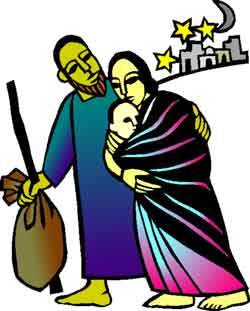
            Joseph and Mary began to travel from Nazareth in the north of Galilee up to Bethlehem. A suburb of Jerusalem, really. A small town on the outskirts of the capital city, a good ways to the south of Galilee. We find Mary and Joseph (probably without a donkey – sorry to all of the lovers of traditional Christmas cards, everywhere) on the road, walking south to register for the census. And, they were not the only ones on the road.

            Can you see yourself – can I see myself – on the road? Are we all in transit, traveling along, not anywhere particularly fixed? Even those of us who have lived in the same place for a long time, is there something about your life, about our walk with God that makes you think that we all are on the road? Could it be that we all are wandering from one place to another, and not having a definite place to call home?

            The apostle Paul speaks of the temporary nature of this world, of this earthly tent we all inhabit. He says in 2 Corinthians 5, “For we know that if the earthly tent we live in is destroyed, we have a building from God, an eternal house in heaven, not built by human hands.” So, with that to look forward to, it gives us all a heavenly perspective to view our earthly tents, and the journey each of us is on, in this wide world today.

            Which brings us back to considering: the long trip for the census. And, since Bethlehem was the ancestral home of King David, that meant there were quite a lot of people who had to be counted who were descended from David. Including Joseph. Remember the genealogy written in the Gospel of Matthew?

            Speaking of descendants of David, I am sorry to prick the other balloons of belief in the traditional Christmas carols and traditions. “It would be unthinkable that Joseph, returning to his place of ancestral origins, would not have been received by family members, even if they were not close relatives.” Presbyterian missionary and pastor Dr. Kenneth Bailey, who is renowned for his studies of first-century Palestinian culture, comments:

“Even if he has never been there before he can appear suddenly at the home of a distant cousin, recite his genealogy, and he is among friends. Joseph had only to say, ‘I am Joseph, son of Jacob, son of Matthan, son of Eleazar, the son of Eliud,’ and the immediate response must have been, ‘You are welcome. What can we do for you?’” [1]

            I know this might be news to you – and it was to me. Jesus was not born in a cave or far on the outskirts of town, out adjacent to the field surrounding Bethlehem. However, this still does not let us off the hook for considering the larger question. Mary and Joseph were traveling, and were on the way, in between. According to Biblical record, they did not have very much money at all. (Although, because of the generous dictates of hospitality, they must have been put up in some cousin’s home while they were sojourning in Bethlehem.)

            I still would like to know! Our position as believers in the one true God makes us sojourners in this world; and this position is so similar to Mary and Joseph’s position as sojourners or travelers, too. Is there any solidarity for others today who are transient, who are traveling or sojourning, especially young families? Perhaps with mothers who are great with child at this time of the year, and are looking for even a temporary place to lay their heads?

             We can take this unexpected look at the Holy Family one step further. I remember a suburban church I attended a number of years ago. One of the smaller trees near the front door to the sanctuary was practically covered with blue ribbons. A sign was posted next to the tree, saying “While celebrating One homeless Family, these ribbons ask us to remember the homeless with us today.” I had never thought about the Holy Family in that way before. It’s God’s unexpected manner of opening our eyes, and displaying the new or different way we can look at Mary and Joseph and the baby Jesus.

            As we consider the birth of the baby Jesus in Bethlehem, as the Holy Family was traveling through, we can see this birth as so much more than simply a claim or confession of the church. As you and I are sojourners through this world, so we also are traveling through. Jesus, God’s eternal Son, the Second Person of the Trinity, emptied Himself. He willingly put Himself in this human flesh and became incarnate of the Virgin Mary. And, this is the most important part! This miraculous birth shows us the truth of our God. Our God loves us so much that the only way to really, truly show us how much was to become one of us. The Baby born in Bethlehem. [2]

            The baby Jesus, His parents Mary and Joseph – the Holy Family was on the way, traveling. Sojourning, and so are we. We are travelers, looking forward to that heavenly home, prepared for us in heaven. Are you on the road with us? On the way with Jesus?

            I close with two verses from a much beloved Christmas carol, collected in Appalachia by John Jacob Niles around 1900. Listen and hear the words of traveling, of being on the way.

 When Mary birthed Jesus, ’twas in a cow’s stall/with wise men and farmers and shepherd and all.
but high from God’s heaven a star’s light did fall, /and the promise of ages it did then recall.

I wonder as I wander, out under the sky, /how Jesus the Savior did come for to die
for poor ordinary people like you and like I; /I wonder as I wander, out under the sky.

            Alleluia, amen.

@chaplaineliza

(Suggestion: visit me at my other blogs: matterofprayer: A Year of Everyday Prayers. #PursuePEACE – and  A Year of Being Kind . Thanks!)


[1] https://www.psephizo.com/biblical-studies/once-more-jesus-was-not-born-in-a-stable/

[2] https://www.workingpreacher.org/dear-working-preacher/christmas-preaching

Unknown's avatar

Hope, for Mary and for Us

“Hope, for Mary and for Us”

Luke 1:26-45 (1:38) – November 30, 2025

            I have a secret confession to make. I am greatly thankful that I have never had to take a job in retail. As I said to my husband this past weekend, I would have quit after the first day, simply because of the constant, cheesy, sometimes saccharin-sweet Christmas music that is piped in over the PA system at every retail store I go into. This is done for about two months before Christmas. And, that’s a long, long time to hear Christmas carols and songs, non-stop.

            And yet – and yet, as we consider this alternative Advent Bible reading from Luke chapter 1 today, I invite you to come with me back in time, to a time before there even was a Christmas. We are not only going to time-travel, but we are going to ocean-hop, too. Let us go to the modest home of a teenager named Mary, living with her parents in Palestine, around the beginning of the first century of the Common (or, Christian) Era.

            This teenaged girl – really, young woman, as she was in that time and place – had an angel visitation. We even find out the Angel’s name, Gabriel. The few times that the angel Gabriel appears in the Bible (that we know of), are times of great importance. Especially this appearance, when Gabriel heralds the birth of the coming Messiah! But, we haven’t gotten there yet. Mary is in her parents’ home when the angel suddenly arrives, about to upend everything concerning Mary and her life as she knows it.  

            Another very important fact: the country where Mary is living, and her people, the Jews, are under Roman rule. Palestine is an occupied country, like so many other regions and nations under the boot of Rome and the powerful Roman army. Palestine doesn’t sound much like a “Silent Night, Holy Night,” where “all is calm, all is bright.” Does it?

            Our mighty God does not wait until everything is perfect, or everything is calm and placid, to work wonders and miracles. God sent the angel Gabriel to a teenager in a modest house, in a country under military occupation. Not to the ruling classes, not to the king’s family in his luxurious palace, but to an unlikely young woman in a backwater town.

            Let us shift gears and move our focus to the modern day. Here in the United States, we have a great deal of internal struggle! Things today are certainly not perfect, or calm or placid. As we mark the first Sunday in Advent, the first candle on the Advent wreath is called the candle of Hope. Can you and I possibly find hope in an atmosphere of anxiety? Of uncertainty? Overwhelmed by pervasive negativity, with the American people’s attitudes filled with division, derision and defensiveness?

            Let’s return to Mary and the angel. How does Gabriel lead off in this conversation from Luke chapter 1? 28 The angel went to her and said, “Greetings, you who are highly favored! The Lord is with you.” Admittedly, Mary wonders what on earth is going on! Dr. Luke tells us, Mary “was greatly troubled at his words and wondered what kind of greeting this might be.” I dare say you and I would be greatly troubled, too, if we were to encounter an angel!

            Sure enough, Gabriel announces to Mary that she is highly favored, and that “you will conceive and give birth to a son, and you are to call him Jesus. 32 He will be great and will be called the Son of the Most High. The Lord God will give him the throne of his father David, 33 and he will reign over Jacob’s descendants forever; his kingdom will never end.”

Mary probably knew her place in society of her time, as a female, as a second-class citizen. Mary “is common, ordinary, of little account in her world and definitely not the stuff of legends…and she knows it. Only after expressing her wonder and dismay, and then hearing again Gabriel’s affirmation and promise, does she manage to summon the courage to believe that God has indeed favoring her by working in her and through her for the health of the world.” [1] What was Mary’s response to the angel? 38 “I am the Lord’s servant,” Mary answered. “May your word to me be fulfilled.”

We all know very well that our teenaged Mary became pregnant by the Holy Spirit, and gave birth to the baby Jesus in Bethlehem. We are well used to seeing Mary as a sweet, calm, quiet, almost docile follower of God’s will for her life. However, I would like to suggest that Mary was also a prophet! As a prophet, she would also be a bringer of hope to the world!

This prophetic role, this insight is a new way of looking at Mary for me. New for me, and I hope enlightening to you, too. As we consider the call of the prophets in the Hebrew Scriptures, and consider the call of Mary by the angel Gabriel, we see all the familiar, classic steps: we see God’s initial call, God’s task, the prophet’s objection, God’s reassurance, and the prophet’s acceptance of call. [2]

 I will say more about this next week, when we take a look at the Canticle that Mary sings, but I want to bring before us the earth-shattering idea that “Luke portrays her in a startling role: one that shakes up the way we’ve been brought up to think of her and invites us to stop observing her and start imitating her.” [3]

 I know that the Christmas carol “Once in Royal David’s City” calls mother Mary “mild,” and the typical portrayal of her on Christmas cards is calm, placid and docile. But, how can this mild depiction of Mary cause our hearts to be hopeful, today? Especially when it seems that the whole world is uncertain, the current political situation is contentious, and our society in the United States is fractured and broken?

            While Mary’s specific task is specific to her, the prophetic call remains open to everyone. God can call each one of us to a prophetic role, especially at this time of Advent, at this grateful and expectant time of year when people are looking up, looking outward, looking for hope. We can all be like Mary, the prophet, bearing good news to everyone.

            Alleluia, amen.

@chaplaineliza

(Suggestion: visit me at my other blogs: matterofprayer: A Year of Everyday Prayers. #PursuePEACE – and  A Year of Being Kind . Thanks!


[1] https://www.workingpreacher.org/dear-working-preacher/favored-ones

[2] http://www.patheos.com/progressive-christian/mary-reluctant-prophet-alyce-mckenzie-12-17-2012.html

[3] Ibid.

Unknown's avatar

God’s Birth Announcement

(St. Luke’s Church had an electrical outage over the weekend. The radiator pipes burst, and there was no worship service on Sunday, December 25, 2022. This sermon comes from my archives, from December 24, 2003.)

“God’s Birth Announcement”

Luke 2:1-14 – December 24, 2003

            I have several friends who have recently had babies. Welcoming babies into the world is such a joyous occasion. One of the first things most people I know do is spread the news about the new baby, letting other friends and acquaintances know about this new little one who has joined the human race. When and where the baby was born, how big it was, whether it was a girl or a boy, and what the parents decided to name the baby are all details that are joyously spread, as soon as possible.

             I wonder . . . what would God’s birth announcement look like?

            In the fullness of time, God sent His Son. Prophesied in many passages from the Hebrew Scriptures, foretold for centuries before His coming. Looking at the Old Testament passage for today, Isaiah 9, the prophet tells his readers about the Wonderful Counselor, Mighty God, Everlasting Father, and Prince of Peace, who is the coming Messiah.

            Throughout the Advent season, we’ve been preparing for the coming of this Messiah. Well, I have news for you. He’s here. Today is Christmas Eve, and tomorrow we celebrate once again the earthly birthday of the Babe of Bethlehem, the Savior of the World, the only begotten Son of the Heavenly Father. Our Lord Jesus Christ, our savior and redeemer, from age to age the same, came into this fallen world as a baby. Imagine that. Emptying Himself of all His vast, eternal God-ness, and being born as a human baby.

            I wonder: what would God’s birth announcement look like?

            I think we have a pretty good idea, if we take a look at the second chapter of Luke. Doctor Luke gives a full accounting of what went on in those days. This account here is God’s version of a birth announcement, but what an unexpected sort of announcement!

            Let’s look at the parents of the Baby, first of all. The mother, Mary of Nazareth, is not even married yet. Sure, she’s engaged to this carpenter, Joseph, but they haven’t yet been fully joined in marriage. Marriage in those days, in the Jewish culture, was a several-step process. Mary and Joseph hadn’t quite finished the whole marriage thing.

            We read in chapter 1 of Luke that the Holy Spirit came upon Mary, and she conceived. Is Joseph the father of this Baby? No. Joseph could not believe this part of the account at first, until assisted by some heavenly help. An angel came and reassured Joseph that Mary was on the up and up, and that the baby inside of Mary was really the Messiah, the Savior of the world. In other words, the Son of God.

            So, the birth parents are not the usual kind of parents. The circumstances of the birth are not quite the typical birth scenario, either. Imagine the birth of a baby today, here in Evanston. Chances are that the baby would be born either in St. Francis or Evanston Hospitals, with the latest medical technology available, just in case. Not so for Mary, the mother of Jesus. Not only did she have the baby Jesus in less than optimum circumstances, in terms of hygiene and medical needs, but she was also far from her home as well.

            Mary and Joseph were both far away from familiar people, places and things. They were travelers, like many people in the town of Bethlehem at that time. Luke 2 tells us that there wasn’t any place for them to stay–anywhere. Because of the census ordered by Caesar Augustus, the town of Bethlehem was mobbed.

            Since Bethlehem was the ancestral home of King David (who had a lot of children!), that meant that there were quite a lot of people who had to be counted who were descended from David. And not all of them had money. We can see, from the offering that Mary and Joseph offered to the Lord shortly after the birth of the baby Jesus, that they did not have very much money.       

            Bethlehem must have been very crowded indeed, if a woman about to give birth couldn’t find even a room to have her baby in. She and Joseph had to room in a stable. It would be similar to today, where a young woman might have a baby in any common garage. We could even take it a step further, and draw some definite similarities between Mary and Joseph and some other young, homeless couple going to have a new baby, searching for a place to spend the night.

            I don’t know whether any of you have currently had the opportunity to see a sign in front of the First Presbyterian Church in Evanston, but one of the smaller trees near the front door to the sanctuary is practically covered with blue ribbons. There is a sign posted next to the tree, saying “While celebrating One homeless Family, these ribbons ask us to remember the homeless with us today.” I had never thought about the Holy Family in that way before. Again, it’s God’s unexpected way of announcing the birth of His Son.

            While we’re thinking about the stable where Mary had her baby, what about that stable, anyway? Jesus, after all, was a descendant of King David, through both His mother Mary and His adopted father, Joseph. A stable is an unexpected place to find a king. I don’t know about you, but I’d expect royalty to be born in a palace, or at least in a nice house. Not in a stable, anyway.

            And who are the people who first receive this birth announcement? Are they influential members of the community? Rich, movers and shakers? Leaders of the local synagogues and teachers of the Law of Moses? Those would be the kinds of people who I might expect to have a birth announcement sent to them. But God doesn’t work that way. Again, God does the unexpected, and chooses the most unlikely people to receive a hand-delivered message from the Lord of Hosts, the King of Kings.

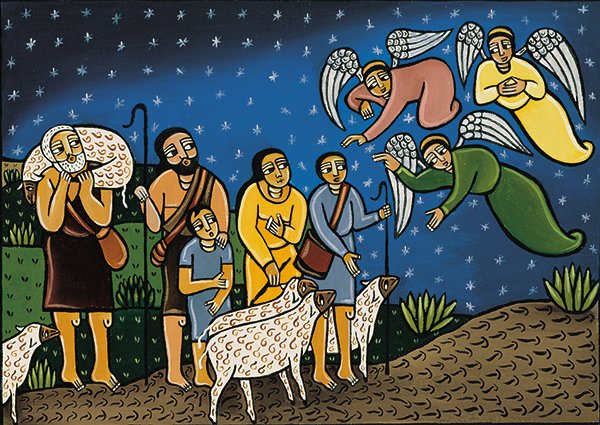
            Some people in the 21st century probably are so accustomed to the Christmas story that their idea of shepherds keeping watch over their flocks by night is somehow associated with Christmas cards. But it was life as usual for these working people. An everyday way of life in Palestine. What’s more, being a shepherd was not a particularly high class job. The lowly vocation of shepherd was on the outskirts of society. A possible comparison today is to think of a person selling “Streetwise,” the paper sold for $1.00 outside of grocery stores and coffee shops here around the Chicago area.

            And suddenly, the angel of the Lord came to these shepherds–came to people in homeless shelters, people selling “Streetwise,” people down on their luck, people on the edge, on the outs of society. The angel of the Lord came to them with good news. Good news. With news of God’s birth announcement. We can see God again breaking through, in an unexpected way, to an unexpected group of people.

            God sends a birth announcement in unexpected ways to unexpected people, in many situations, all over the world. The angel was the first to tell of the newborn Baby, born in Bethlehem, but then the shepherds spread the news about the new Baby, letting other friends and acquaintances know about this new little One who has joined the human race. When and where the Baby was born, the news that it was a boy, and that the parents decided to name this Baby Jesus–for He would save people from their sins–are all details that the shepherds joyously spread, as soon as possible.

            Again, it’s God’s unexpected way of announcing the birth of His Son. Can you think of someone who hasn’t heard about this birth announcement? We today have the opportunity to spread the news about this Baby born in Bethlehem. And we can joyously praise God, for Jesus is the savior and redeemer of the world, as the angel of the Lord proclaimed so long ago.

Unknown's avatar

Infant Holy, Infant Lowly

“Infant Holy, Infant Lowly”

Infant Holy, words

Luke 1:39-45, 56 (1:45) – December 9, 2018

The meanings of names are a fascinating subject. The particular meanings of certain names are more well-known. Just think of Peter—Greek for “rock” and Irene—Greek for “peace.” Three names from Hebrew, Rachel (“lamb”), David (“beloved”) and Daniel (“God is my judge”). Then, there is my own name, Elizabeth, which comes from the Greek and means “God is my oath” or “God’s promise.”

My parents did not have any particular person on either side of the family who they were thinking of, or who they wanted to name me after. They just liked that name. I have always really liked my name, too.

I don’t know whether you have ever thought about the meaning of your name. Did your parents name you after a beloved aunt or uncle? Or perhaps a dear grandparent or godparent? Or did they just happen to like your name when you were born?

There is another Elizabeth in the New Testament. Our Gospel reading from Luke 1 talks about her. She was the mother of John the Baptist. She was the older cousin of Mary, living some distance away in the hill country of Judea.

In the verses just before this reading, we meet Mary, a teenaged girl who is visited by the angel Gabriel. Of course, the angel informs Mary that she will become the mother of the Messiah; Mary is to name the baby Jesus, Yeshua, or Joshua, which is Hebrew for “he saves.” As the angel says, “He will save His people from their sins.”

The angel Gabriel gave Mary some important information about her cousin Elizabeth. Elizabeth, as well. Apparently, Elizabeth and her husband the priest Zechariah had tried to have a baby for years, but could not. Finally, when Elizabeth had just about given up hope, she found she was indeed pregnant. This was called a miracle by everyone. Imagine—Elizabeth pregnant at an advanced age. God certainly works miracles, mighty acts and acts beyond the explanation of human eyes and ears.

What about Elizabeth, and about her younger cousin Mary? They are both women. Females, usually discounted and considered second-class by the cultures of their day. What do we find that is different about Elizabeth and Mary?

”All four gospels support the equality of women, but Luke is the one who is most obvious about it.  The male in the story, Zechariah, had been visited by an angel, but he did not trust [the angel’s word] (1:20) and was made mute.  His wife Elizabeth, however, who was an older woman, turns out to be the heroine of the family and she, in stark contrast to her mute husband, speaks under the influence of the Holy Spirit (1:41).” [1]

Elizabeth greets her young cousin, and says “God has blessed you more than any other woman! He has also blessed the child you will have. 43 Why should the mother of my Lord come to me? 44 As soon as I heard your greeting, my baby became happy and moved within me. 45 The Lord has blessed you because you believed that God will keep his promise.”

We could list several facts. Elizabeth spoke by the power of the Holy Spirit. She announced that Mary was richly blessed, as was Mary’s baby, Jesus. She also stated that John, the baby inside of her, had responded to the nearness of the very young infant Jesus. Finally, Elizabeth praises Mary for believing in God’s promise. And, we can be sure that God does keep God’s promises.

When I was in grade school, I was fascinated by the meanings of names. It was at around this time that I happened to start attending a Lutheran church in Chicago, brought there by my older sisters. They attended sometimes because of several friends from high school in the church youth group. They stopped attending when they left for college, but I kept going to that church.

I was a voracious reader. I would read just about anything, and as I mentioned, one of the books my parents had on their shelf had many lists of names and their meanings. I would pore over that book, and I sincerely wondered about my name. “God is my oath,” or “God’s promise.” It was at about this time that I started learning a great deal about the Bible and theology, and about the various promises of God. Especially the promises fulfilled at Christmas, in the birth of the Messiah.

What an earthshaking event, the birth of that Infant Holy. What a marvelous miracle, lifted up by Elizabeth in our Scripture reading today.

Here we have two strong women. Two women who know their own minds, and two women who are not going to be put in the background. These are two women—one younger, one older—who have been chosen by God to do great things. Not only to be the mothers of John and Jesus, but also to have the responsibility of raising them.

What stands out even more is that Mary has unshakeable faith in God’s promises. Can you imagine? I do not have complete faith and trust in God. A pretty good faith, but not one hundred percent, not doubt-free.

Rev. Bryan Findlayson has an intriguing comparison. He talks about seeing faith in Jesus as if it is a good bet. “If we are wrong, we lose nothing, but if we are right, we gain everything. Jesus is certainly a good bet, but the bet is not faith.” [2]

Mary’s faith is faith in God’s promises. She took God at God’s word. Sticking to God’s promises, firmly resting on them, this is what the Bible means by faith. Isn’t that what we lift up in these weeks of Advent? We have faith in God’s promises, and we rely on the Bible’s words, both in the Hebrew Scriptures as well as the New Testament.

Tonight is the anniversary of the first showing of the “Peanuts Christmas Carol” in 1965. We can watch this Christmas television special and laugh as we watch the Peanuts characters. We can also take the Christmas message to heart, as read by Linus, when Charlie Brown wanted to know what Christmas was truly all about.

God deeply wants to send abundant peace into the world. The birth of the Prince of Peace helps us to welcome Jesus for ourselves. He may have many different names, like Jesus, Joshua—”He saves,” Wonderful Counselor, Mighty God—but our Lord Jesus is the one and only Savior. As we prepare to celebrate “God with us,” Emmanuel, we also can lift our voices to praise the Prince of Peace.

Alleluia, amen!

[1] https://www.progressiveinvolvement.com/progressive_involvement/2012/12/lectionary-blogging-luke-1-39-55.html

Lectionary Blogging, Luke 1:39-56, John Petty, Progressive Involvement, 2012

[2] http://www.lectionarystudies.com/studyg/advent4cg.html

“Mary Visits Elizabeth,” Rev. Bryan Findlayson, Lectionary Bible Studies and Sermons, Pumpkin Cottage Ministry Resources.  

@chaplaineliza

(Suggestion: visit me at my regular blog for 2018: matterofprayer: A Year of Everyday Prayers. #PursuePEACE – and my other blog,  A Year of Being Kind . Thanks!