Unknown's avatar

How Majestic!

“How Majestic!”

Psalm 8:1-9 (8:1) – June 15, 2025

            Have you ever been far from the city lights, at night? Have you ever looked up into the sky, and seen countless stars spread out, twinkling high above? When I went to the Upper Peninsula of Michigan, and again in rural central Indiana, the starry skies were absolutely breathtaking. Amazing. Majestic, as the psalmist King David said in our Psalm reading today.

            Listen again: “Lord, our Lord, how majestic is your name in all the earth! You have set your glory in the heavens.” I can just imagine King David sitting far away from the lights of the city of Jerusalem, perhaps contemplating the stars as he saw them in his youth, when he looked after his father’s sheep, or as a younger adult, a leader of men in the wilderness of Judah, David certainly had many opportunities to gaze up into the night skies and see the breathtaking stars.

            As we gaze up into the night and see the amazing sight of all the stars laid out above us, we marvel. Marvel just as countless people have done throughout the millenia. As we think about the vastness and sheer beauty of the heavens, other vast, even unanswerable questions may come to mind. Just as countless people have done, and have reflected upon. Questions like: What was God doing before God created the world? And, how can there never be a time before or after God? And, how can God pay attention to each person in the world all the time? [1]

            These kinds of big questions have puzzled people for millenia, too. You and I could get hung up on these kinds of questions, and totally lose sight of the sheer, magnificent, bottomless awesomeness of God. Or, are we simply to return to the first verse of today’s reading, and be totally in awe at God’s glorious majesty? “Lord, our Lord, how majestic is your name in all the earth! You have set your glory in the heavens.”

            My husband tells me when I am thinking about big ideas, I am sometimes too focused on individual trees, rather than looking at a whole forest. That is what comes to mind when I get sidetracked by wondering what God was doing before God created the world. Or, maybe, why did God create rattlesnakes and mosquitoes? Perhaps – it is okay just to contemplate the vastness of the heavens and the sheer beauty of all the stars, comets, moons and other creations in the universe! Just as Psalm 8 invites us to do.

“How majestic is your name.” That’s the line that stands out, maybe because the psalm begins and ends with those same words. “How majestic is your name.” That sounds wonderful, indeed! Our opening hymn was written by Michael W. Smith, and we sang these exact words at the beginning of our service. And, the words sung by the angels, the seraphs flying around the heavenly temple in Isaiah 6 – they kept singing, kept repeating “Holy, holy, holy is the Lord of hosts, the whole earth is full of God’s glory.”

            Over and over, the seraphs sang those words. And, it is sometimes in the singing and in the repetition that the majesty and awesomeness of God begins to make sense. I mean, as much as it can, to our puny, limited, human comprehension.

            The concept of the Trinity, one God, Three in One, is a difficult concept to start to believe, much less fully comprehend. For a small comparison, we can look at water. Water is liquid, at room temperature. Yet, when we freeze water, it turns hard. It becomes ice. Is it still water? Yes. And, when we heat up water, it turns into steam – becomes gaseous. Is it still water? Yes.

            This example of the three states of water is an imperfect way to talk about the Trinity. Yet, we can marvel at the awesome complexity of the doctrine of the Trinity just as we marvel at the glory and magnificence of our God and God’s creation, just as Psalm 8 leads us to do. Whether we sing about our awesome God, talk about the glory of God, or contemplate God and God’s magnificent creation, it’s all good. And, all these activities are exactly what we are led to do throughout the Bible, and especially here in Psalm 8.

            Looking to the skies and contemplating the glory of God may be a sincere way for people to begin to try to understand how huge God is. And, if we are coming at the theological concept of the Trinity – which is also a huge thought – perhaps it’s best for you and me to think about this huge thought from God’s end of things, from God’s point of view. Whether you and I “can fully grasp the nuanced theological understanding of what Trinity means, we can acknowledge that, in part, it means that God wants to be known and experienced by those who claim the majestic name of God as sovereign. We give thanks for an accessible God.” [2]

            I return to one of my tried and true ways of looking at biblical things, from a theological perspective. You all know that sometimes I view the topics or ideas from my sermons in a way that children see them, or in a way that young people more readily understand. Psalm 8 tells us about the wonders of God. Even little children can (and do) accept this as the truth of God! However, little children are definitely not interested in explaining how or why, or about lengthy sermons droning on about different theologians and their competing view on God and the Trinity.

            Very often, deep down, children understand that God made them and God loves them. This is a foundational truth! You and I can have – along with the children – a “simple” and “trusting” faith. We don’t need to use the “right” words in our prayers and creeds. Remember – God wants to be known by us, above all! And, our Lord wants to be experienced by all who claim the name of the majestic God. By those who praise God’s name.

            Yes, the theological understanding of the Trinity is also a deep theological truth. Yet – I can tell you right now that we as fallible, frail humans fall short of understanding God’s ways. I can also tell you that in the midst of everything, we can know we are loved. God wants each of us to know our Lord intimately! As my commentator the Rev. Dr. Derek Weber says, “We are being made more like the Christ we follow. Our love is being shaped by God’s love that is poured into us. We are God’s act of creation. That’s a part of the message of Trinity Sunday. The Creator works within us, choosing us to be a sign of God’s presence in the world.” [3]

            Yes, God’s message is quite simple. We can know we are loved by God. God wants each of us to know our Lord intimately! And, our awesome God works within each of us, choosing each of us to be a sign of God’s presence in the world. This is the best Good News we can bring to the world. Alleluia, amen!

@chaplaineliza

(Suggestion: visit me at my other blogs: matterofprayer: A Year of Everyday Prayers. #PursuePEACE – and  A Year of Being Kind . Thanks!


[1] https://worshipingwithchildren.blogspot.com/2016/04/year-c-trinity-sunday-may-22-2016.html

[2] https://www.umcdiscipleship.org/worship-planning/trinity-sunday-year-c-lectionary-planning-notes

[3] https://www.umcdiscipleship.org/worship-planning/trinity-sunday-year-c-lectionary-planning-notes/trinity-sunday-year-c-preaching-notes

Unknown's avatar

When God Shields Us

“When God Shields Us” – October 18, 2020

Exodus 33:12-23 (33:19-22)

Have you ever known someone who was really important? I mean, really, really a V.I.P.?

Moses was personally acquainted with the biggest V.I.P. in the whole world. Even, in the whole universe. Eileen just read today’s Scripture lesson from Exodus 33, and we heard what an awesome experience Moses had on top of that mountain. Just him and the Lord, they had personal one-on-one time.

Let’s take a closer look at this reading. An overview, so we can understand exactly what is at stake. We can simply take Exodus 33 as a striking word-picture of how awesome, mighty and all-powerful God is, and we would be absolutely correct. Our God is indeed an Awesome God. But, there is so much more involved here.   

Moses and the Lord talk about the presence of God. This is huge! The presence of God is a continuing theme in the book of Exodus, and right here is a particularly important exchange between our two protagonists.  

We could simply watch Moses and the Lord, almost like we are in the audience, or viewing on a television screen. Reading this story from Exodus, we might say “What does this story have to do with me?”  But, we can relate this to our personal situation – each one of us.

To come before the physical presence of God is truly rare – but it was something Moses greatly desired! What is more, he also wanted to be able to reassure the people of Israel with the reality of God’s presence. Is that something that reassures you, today?

Throughout the Hebrew Scriptures, again and again, we hear about how dangerous it is to approach the Lord. God’s presence is so fearsome that a number of people are immediately struck dead for daring to come in contact with the Lord. For much of Exodus, the Lord is not even sure whether Israel is even worthy enough to sit by and receive that Godly presence. Yet, Moses sees God’s presence and blessing as a beneficial thing, a good and necessary thing.

Have you ever been given the silent treatment? This could be by a parent or other grown-up when you were younger, or perhaps by a sibling or a friend? The silent treatment is particularly sad and jarring, especially when you really respect, even love the person giving you the silent treatment.

That is pretty close to what the Lord wanted to do to the whole nation of Israel by removing God’s presence and blessing from Israel. That would be horrible! Like, drinking water, and finding it was dry water. Or, going outside in the middle of the day, and finding there was an eclipse of the sun – permanently. What a traumatic, even cataclysmic event, having the Lord discuss permanently removing God’s presence and blessing from Israel. [1]

Yet – God said to Moses, ‘I know you by name and you have found favor with me.’ And, even further, “the Lord said to Moses, “I will do the very thing you have asked, because I am pleased with you and I know you by name.” That must be so heartwarming, hearing God say, “I know you by name and you have found favor with me.”

I remind you, looking on the face of God was fatal, for a number of those in the Hebrew Scriptures. I wonder: is it a fatal act to think that we see God’s glory, that we fully comprehend God, today? The hazard of thinking you’ve got it all figured out becomes a sign of our self-centered, self-involved problem. The idea that we’ve got it figured out, because once we figure that, WE become God to ourselves – our self-centered delusion is that WE are greater than God. This was certainly part of what was going on with the self-involved people of Israel, periodically thinking they were much more important than the presence of God.

If we step back from being self-centered and self-involved, we realize we are invited into a relationship – a relationship with the Lord. Moses knew that to become more aware of the presence of God, he needed to spend time with God. That is exactly what he and God were doing on top of that mountain. And, God and Moses had a number of one-on-one encounters that helped Moses get through his life’s journey.

Knowing that we are always in the presence of God will help us get through many difficult things. Though complicated questions and weighty issues overwhelm us on a regular basis, we can be certain that God walks beside each of us on our journey through life, too. [2]

Are you ready to have a relationship with the Lord? To have one-on-one conversations with God? Sure, our God IS a powerful, mighty, Awesome God. We are also freely invited into the generous, merciful presence of God.

Let us celebrate the presence of God, today. Amen, alleluia.


[1] Brueggemann, Walter, “Exodus,” The New Interpreters Bible Commentary, Vol. I (Abingdon, Nashville, TN: 1994), 938-39.

[2] https://www.umcdiscipleship.org/worship-planning/pressing-on/twentieth-sunday-after-pentecost-year-a-lectionary-planning-notes/twentieth-sunday-after-pentecost-year-a-preaching-notes

@chaplaineliza

(Suggestion: visit me at my regular blog for 2020: matterofprayer: A Year of Everyday Prayers. #PursuePEACE – and my other blog,  A Year of Being Kind . Thanks!

Unknown's avatar

Compassion = Just, Kind, Humble

“Compassion = Just, Kind, Humble”

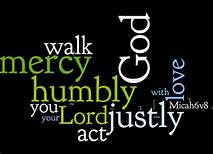
Micah 6-8 word cloud

Micah 6:6-8 – August 27, 2017

Familiar things, familiar words. Even familiar bible verses. When we see or hear familiar things—like a familiar family member, a familiar couch or chair, a familiar saying or expression our best friend says—what goes through our minds? Do we take it in? Do we pay attention? Do we understand that what we are seeing or hearing is important? Or, do we just dismiss it?

Do we dismiss a loved one who just happens to live with us because she or he is always underfoot? Do we even hear an expression from a friend because he or she says it all the time? Or, does familiarity encourage us to ignore the loved one, the sayings, or expressions?

Can this happen to familiar bible verses, too? I am thinking now of John 3:16. Can that beloved verse become so familiar, so same-old, same-old, that it has absolutely no power in our lives or hearts? What about some other super-familiar Scripture verses, too? What about them? What happens to our sensibilities now, now that I have highlighted this important point?

Let’s take a closer look. When we hear the same old thing (even in a bible verse) repeated over and over, week after week, our ears can stop hearing it. It might make some people sick and tired, or bored to tears. We can say, “yeah, yeah,” and ignore it. Go on our merry way. As bible commentator Tyler Mayfield said, “There is a danger to familiarity. The familiar can be overlooked or neglected.” [1]

We have for our Scripture passage today one of the most familiar commands from the Lord, ever. Micah 6:6-8. I will read it in the straight-forward modern translation for all ages provided for us by the Illustrated Children’s Ministry. Starting at verse 6: “How can I even begin to approach God? How can I honor who God is? What gift could I bring, what sacrifice could I make? Would God like it if I made offerings like those made in the past—rams, oil, or whatever is most precious? Does God want me to give up what means the world to me?”

That translation puts a new, different twist on things, doesn’t it?

In this chapter of Micah, the people of Israel pose several questions, and this one is a biggie. How can we even begin to approach the awesome God who made heaven and earth? Isn’t God huger than huge, more righteous and holy than anything else in the entire universe? How can you or I possibly bring anything to God that would please this Holy One?

As Dr. Mayfield says, the central issue with all of these questions concerns the gift, the sacrifice. “What is it, O God, that you want from us? What do you require? Just tell us your favorite offering, and we will surely sacrifice it—even if it is a rather extreme request.” [2]

This is a rhetorical question, of sorts. Micah follows it up with God’s response, in this very familiar verse, Micah 6:8. Is it “same old, same old,” or do you think we ought to sit up and pay attention? After all, this is a verse that lets us know God’s own requirements of how to come to God, this Holy One who made heaven and earth. Listen to this very familiar verse.

The prophet says: “No, listen, people, we already know the answer to this one.  God has told us, this is what counts; this is the compassionate life God wants for us: that we would do justice, and love kindness, and walk humbly, together with God.

Let’s turn to the playground and the schoolroom. What do you think children value? What are ways they like to be treated when they are together? Do you think children want things to be fair and equal in the classroom? Do they want people to be kind to them when they are in line at the store, or at the restaurant, or at home? And what about showing respect to other people? Do children want others to show them respect and courtesy on the playground, school, in the mall, or on the sidewalk? What about at home, too? These are important questions, since they not only apply to children, these questions apply to each of us. Every day.

“That’s not fair! He got more! She cut in line! They shoved me! That’s not fair!” Sound familiar? Does it sound like children bickering at home? This is exactly what the prophet Micah mentions, right off the bat. He tells us that God wants us—all of us—to act justly. And, to remind all of us, justice means fairness. Making things right. Got integrity? Do you act in an upright manner? That is exactly what God wants us—all of us—to do.

But, wait a moment! I know we have been through this before, but I thought the people of Israel were eager to know what kinds of stuff they could offer to God.

I can hear the conversations now: “Just tell me, I’m ready to bring the special animal offerings! I’ll bring really expensive stuff, Lord. Just tell me what it is that You want me to bring!” The problem is, the Lord may not give the answer the people expect. In fact, it is not the answer they seek. They have focused on expensive animals and special oils and fine wine offerings—small and large. The people of Israel have over-emphasized super-special sacrifices, and showy gifts in worship; they have ignored justice and kindness to others. [3]

Do you think children want other people to be kind to them? What about us? Do we want others to show care and consideration toward us? Let’s go even further. Being humble is a difficult concept for children to understand. (Gee, sometimes it’s difficult for me to understand!) However, being respectful is simpler to understand. Do I want others to be respectful to me? Just as important, am I—are you—respectful and courteous to others, no matter what? No matter who they are, and no matter where they come from, which side of the tracks they live on, or what they smell like, or who they vote for?

As we can see, Micah “turns the questions asked in verses 6-7 away from their focus on the types of offerings and toward a focus on the type of person. God does not want a specific type of offering. God wants a specific type of person.” [4]

Are you that type of person, the type God wants? Someone who regularly does just things with integrity? Someone who loves kindness and mercy and does kind and merciful things for others, regularly? What about someone who walks humbly, and is respectful and courteous to others, no matter what?

I think the prophet Micah would say that this is a truly compassionate life.

I wonder what this kind of life looks like, in our setting, here in the Chicago suburbs? How do you imagine this kind of life looks in our world today?

The prophet says our life is a journey, and we walk with the Lord, each day. We walk with integrity, in kindness, and we walk humbly. Imagine God is asking you to do one thing this week that would bring more compassion to those around you.

What would our lives look like if we lived like this? Would other people stop short in their tracks and say, “That person definitely is kind!” “That person goes out of her way to help people!” “That person certainly values the newcomer.” “That person displays genuine integrity, for sure!” I challenge all of us: choose one (or more) of these attributes each day for a week, and live it out.

Act justly—with integrity. Do kindness and mercy. Walk humbly with our God, showing compassion to all we meet. And, guess what? This is the way to truly please God.

Let those with ears to hear, let them hear. Amen.

[1] http://www.workingpreacher.org/preaching.aspx?commentary_id=3152 ; Dr. Tyler Mayfield, Assistant Professor of Hebrew Bible/Old Testament, Louisville Presbyterian Theological Seminary, Louisville, Ky.

[2] http://www.workingpreacher.org/preaching.aspx?commentary_id=3152

[3] http://www.workingpreacher.org/preaching.aspx?commentary_id=3152

[4] http://www.workingpreacher.org/preaching.aspx?commentary_id=3152

(A heartfelt thank you to An Illustrated Compassion: Learning to Love Like God. Many of these sermon ideas and thoughts came directly from this series.  I appreciate this intergenerational curriculum, which is the basis for my summer sermon series on compassion. This curriculum comes from Illustrated Children’s Ministry. Thanks so much for such great ideas!)

@chaplaineliza

(Suggestion: visit me at my regular blog for 2017: matterofprayer: A Year of Everyday Prayers. #PursuePEACE – and my other blog,  A Year of Being Kind . Thanks!)