Unknown's avatar

Cleanse Your Hearts!

“Cleanse Your Hearts!”

Acts 15 Jerusalem council stained glass

Acts 15:8-9 – August 23, 2015

Conflict resolution is never an easy thing.

I hate to make sweeping statements, but I definitely think that that is one everyone can agree upon. Conflict resolution is never an easy thing.

We could be talking about the rough and tumble of sibling rivalry: “Mom! He started it!” “Did not!” “Yes, you did, too!” Or, a difficulty between neighbors that might get worse and worse, and escalate out of control until someone puts up a spite fence. Or, what about a problem between two employees in the workplace? You know the sort of thing. A disagreement starts between two people. Words are exchanged. Each side is sure they are right! Next thing you know, the whole office has chosen sides, and is squared off against each other.

We have a situation very much like this, in Acts 15. The whole group of believers—in all of the congregations scattered around the Mediterranean by this point—has escalated to the point that we heard about today, during the New Testament reading.

To recap, back in Acts 2, a number of days after our Lord Jesus ascended in to heaven, the few dozen believers have a Pentecost experience! The Holy Spirit comes upon them all, and Peter preaches his remarkable sermon. Not remarkable in and of itself, but remarkable because of the incredible response he got. Hundreds and hundreds of people came to belief in the risen Lord Jesus, in just one day! These were all Jewish believers. And, they continue spreading the Good News to any Jew they encounter. Many more believe, too.

Then, in Acts 8, Philip preaches in Samaria. The Holy Spirit comes upon these half-Jews, and even more people believe in the Good News! The circle of belief and faith continues to become wider and wider. In Acts 10, Peter preaches the Gospel to a Gentile—Roman centurion named Cornelius, and his whole Gentile household. They all believe, too! And, the Holy Spirit comes upon all of them, as well. Peter and the other apostles have the witness of their own eyes. They see that “God shows no partiality, but in every nation anyone who fears God and does what is right is acceptable to Him.” (Acts 10:34b-35)

The Holy Spirit continues to move. The believers continue to preach the Good News to anyone and everyone. It doesn’t matter whether they are Jew or Gentile, slave or free, high class or low born, or any other distinction. All are welcome to come to faith in the risen Lord Jesus.

Which brings us to the beginning of Acts chapter 15. A large number of believers has squared off, one side against the other, over keeping the Jewish laws. Should we, or shouldn’t we? What about Jewish people who never really kept kosher, before they started believing in the risen Jesus? Should they keep 600-plus rules in the Jewish law, now? And what about Gentiles who might have never had any idea about the Jewish laws, before? Should they turn themselves inside out and start keeping kosher, and wearing special clothes, and observing special holidays?

I went to one of the textbooks I had for one of my seminary classes, called Church Administration. (One of the best classes I ever had, in all my years of school!) This book is called Never Call Them Jerks: Healthy Responses to Difficult Behavior by Arthur Boers. Such helpful material on church conflict in this book!

Our situation at the beginning of Acts 15 seems black-and-white. We can see that from verse 5: Then some of the believers who belonged to the party of the Pharisees stood up and said, “The Gentiles must be circumcised and required to keep the law of Moses.”’ We have group A (or, Aleph) on this side, yelling ‘You’ve got to keep Jewish Law!” and group B (or, Bet) on the other side yelling back, “No, we don’t!” As they continue to bicker and snarl at each other, the argument gets worse and worse!

This argument is a classic case of polarizing! “Reducing issues to ‘black-and-white’ solutions and giving little time to discovering other options.” [1] What will they do now?

Yes, the controversy has busted wide open. Sometimes, people get stuck. They either don’t or can’t move. There they are, in that big, black-and-white argument, no way out. Or, so they think.

At the church council in Jerusalem, there was some discussion. I don’t know how long the discussion went on. There may have been some name-calling, or possibly even getting into fist fights. (I don’t know for sure—this was before the days of reality television.) Adversarial comments could have happened! “using ‘we/they’ language and ignoring or dismissing what is held in common.“ As the argument escalated, I can imagine threatening ultimatums being issued, back and forth. [2]

Here’s an illustration Boers uses: “One snowy morning I drove the high school car pool. I backed my fully loaded van onto a downwardly sloped street. On the slippery pavement, the van would not budge uphill in a forward gear. I could have pushed the accelerator, spun the wheels harder and faster, and gotten nowhere. Instead, I backed partway down the hill, tried the forward gear again, discovered my wheels had found a purchase, and was able to move forward.” [3]

Similarly, we find the apostle Peter taking a step back. Just like the van in this illustration, he backs up. And, he “seeks the common good over the interests of particular parties.” [4] He tries to find some common ground that all can agree on. Peter says, “God, who knows the heart, showed that He accepted the Gentiles by giving the Holy Spirit to them, just as God did to us. He did not discriminate between us and them, for God cleansed their hearts by faith.”

Did you hear? Peter makes the statement, again, that God wants to enter into a relationship with each and every person. That means, each person in his time, in the first century, just as much as today, in the twenty-first century. God does not discriminate! And, neither should we.

What’s more, God cleanses everyone’s heart! Praise God, we don’t need to meticulously follow the Jewish Law code. We don’t have to wear special clothes, or observe special holidays, or have restricted food choices. God has cleansed each of our hearts, through faith! Peter goes on to say, “Now then, why do you try to test God by putting on the necks of Gentiles a yoke that neither we nor our ancestors have been able to bear? 11 No! We believe it is through the grace of our Lord Jesus that we are saved, just as they are.”

Praise God! Alleluia! We are not saved by following each and every little rule in the Jewish Law code. We are not saved by following each and every little rule in recent rulebooks, like no dancing, and no card-playing, no movies, and no mixed bathing.

It was a little early in the formation of Christianity for the apostle Paul to formulate his theological statement in the letter to the Ephesians, some years down the road. But I can hear the beginnings of it being hammered out, right here. Paul’s triumphant words from Ephesians 2:8-9. “For by grace you have been saved through faith, and this is not your own doing; it is the gift of God—not the result of works, so that no one may boast.”

Praise God! Not just Jews, not just Greeks, not just people with brown hair, not just people who are right-handed. But everyone. God does not discriminate! What’s more, God cleanses everyone’s heart! We can all say Alleluia! Amen!

@chaplaineliza

Suggestion: visit me at my daily blog for 2015: matterofprayer: A Year of Everyday Prayers. and my other blog,  A Year of Being Kind .  Thanks!

[1] Boers, Arthur Paul, Never Call Them Jerks, (United States of America: the Alban Institute, 1999.), 72.

[2] Ibid.

[3] Ibid, 64.

[4] Ibid, 72.
Unknown's avatar

To the Ends of the Earth!

To the Ends of the Earth!

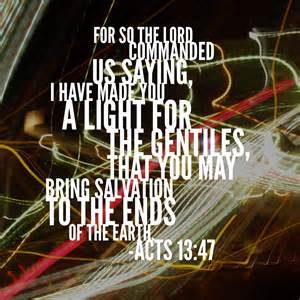
Acts 13-47 go into all the world

Acts 13:47 – August 16, 2015

Every month, St. Luke’s Church has a Church Council meeting to deal with the everyday business of running the church. We are going to have our August meeting this coming Friday. This being a congregational church, any member is more than welcome at our council meetings.

Let me ask: what would you think if someone from the Church Council were to get up in front of the congregation next Sunday morning, and say something like, “This past Friday at the Council meeting, the Holy Spirit told us to send two of our church leaders—two Council members—off to the mission field full time. We prayed over them, and we sent them off. They’re gone, and we’re not really sure where they’ll end up”? What would your reaction be to such a statement?

That’s just what happened. That’s just the situation, here at the beginning of Acts chapter 13. Except, I suspect the whole congregation gathered around Paul and Barnabas, as well as several others who intended to travel with them. Dr. Luke doesn’t specifically say, but I think the whole congregation prayed over them before they sent them out.

Paul and Barnabas were chosen by the Holy Spirit to go out. To tell others about the Good News of the risen Jesus. They, and several of their friends, left for parts unknown.

It’s a wonderful thing, to be noticed, recognized. Chosen as a messenger, a missionary for God. In the several churches I have attended over the years, I have seen dozens of people go on both short- and long-term mission trips, just like Paul and Barnabas. I’ve been involved with mission committees, and led prayer teams and prayer efforts in support of many of those same missionaries. However, I—myself—have never gone anywhere on a mission trip. Nope. Not even a short-term one.

How many of us, here, can say the same thing? I am not asking for anyone to raise hands or otherwise identify themselves. But, in your hearts, how many of us know that we have never gone to the mission field? Either overseas, or in this country?

Let’s define terms. What is a mission field, anyhow? What does it mean to be a missionary?

A simple definition? A mission field is somewhere on the other side of a boundary or barrier. I know seminary professors and people who study the history of missions might quibble with the specifics of this definition. However, I think most everyone would agree that a mission field involves crossing some sort of a boundary. That can be a boundary or barrier of race, nationality, language or culture. Those are the easiest to see and recognize! But a mission field can also be on the other side of an economic boundary, or a societal barrier.

Take my friends, Jim and Amy. Both trained as doctors, they both worked here in the Chicago area for a long time. But, they were mission-minded. They intentionally went to the South side of Chicago regularly, for years, to work at a Christian medical clinic. An inner city mission, right here in Chicago. They are now in sub-Saharan Africa, working as missionary doctors. Still with that mission mindset. But, it was only recently that they went to Africa.

For years, before that, they were using the training they had to work for God—as medical doctors. To communicate the Good News that God loves everyone. Here in Chicago, but in a radically different community, with a different culture. Were they missionaries then, in Chicago? Are they missionaries now, in Africa? I say, in both cases, yes!

Let’s consider our scripture passage for today. Pretty new idea, for these early believers to preach the Good News to a multi-cultural audience! Take a look at the list of prophets and teachers from the beginning of Acts chapter 13. “1-2 Now there were in the Church at Antioch both prophets and teachers—Barnabas, Simeon surnamed Niger, Lucius the Cyrenian, Manaen the foster-brother of the governor Herod, and Saul.”

Just looking at this list, off the top of my head, I might not notice anything particularly different. But, let’s dig a little deeper. My research tells me that this assembly of believers in Antioch was the first truly multi-ethnic local church. This church had Jews and Gentiles together in one local congregation, according to Acts 11:19–22.

            We have Barnabas, a Jewish man, a Levite from the priestly class, born in Cyprus. Next, Simeon—he’s also called Niger. That’s a black man, from Africa. Then, Lucius, the North African from a large town called Cyrene. Then, there is the upper-class Manaen, the foster-brother of Herod—raised in the palace of the ruler Herod Antipas. And finally, we have Saul (or Paul), one of the most pre-eminent Pharisees of his day, born a Roman citizen in Asia Minor, and educated in the equivalent of an Ivy League school.

            We have some heavy hitters. Men of spiritual substance, described by Dr. Luke as both prophets and teachers of the church in Antioch. And, they are VIP’s. Very Important People, from many different regions and cultural backgrounds! It was these church leaders—the Church Council of the church in Antioch—who commissioned Paul and Barnabas and their friends. These missionaries left a multi-cultural local congregation to go to the multi-cultural world.

            As we read further in the chapter, Paul, Barnabas and their friends traveled further. “13-15  They continued their journey through Perga to [another] town called Antioch. They went to the synagogue on the Sabbath day and took their seats. After the reading of the Law and Prophets, the leaders of the synagogue sent to them with a message, “Men and brothers, if you have any message of encouragement for the people, by all means speak.”

We can see Paul goes first to the congregation at a synagogue. Dressed as a Pharisee (because they did wear distinctive clothing), the synagogue leaders knew he was learned in the Law and the Prophets. Paul gets up to speak. He gives them the Gospel, in a way they could understand.

Using the Hebrew Scriptures, he spoke about the coming Messiah, and about the death and resurrection of the risen Jesus. He spoke in a clear way that Jewish people could easily relate to. And, many of them came to faith in the risen Jesus, the Messiah.

However, Paul did not stop there! He spoke of the risen Jesus to God-fearing people who were not Jewish! He spoke of the resurrection to Gentiles, to Romans, to people without regard of their ethnic origin, or of the color of their skin.

Listen as chapter 13 continues: “44-47 On the next Sabbath almost the entire population of the city assembled to hear the message of God, but when the Jews saw the crowds they were filled with jealousy and contradicted what Paul was saying, covering him with abuse. At this Paul and Barnabas did not mince their words but said, “We felt it our duty to speak the message of God to you first, but since you spurn it and evidently do not think yourselves fit for eternal life, watch us now as we turn to the Gentiles! Indeed the Lord has commanded us to do so with the words: ‘I have set you to be a light to the Gentiles, that you should be for salvation to the ends of the earth.’”

“48-50 When the Gentiles heard this they were delighted and thanked God for God’s message. All those who were destined for eternal life believed, and the Word of the Lord spread over the whole country.”

Did you hear? The Gentiles were delighted when they heard that they were welcomed by God, too! The Gentiles were—are as much God’s beloved children as are the Jews. All people are welcome to be saved. Salvation is for anyone, to the ends of the earth!

            What about the rest of the church, where Paul and Barnabas came from? Were they just sitting at home, twiddling their thumbs, or hiding their heads in the sand like ostriches?

I think the other believers in the church at Antioch had an important job to do, too. True, they may not have been sent out, called by the Holy Spirit to be missionaries. To go far away, like Paul and Barnabas, to suffer hardship and travel and preach the Good News in a different town every few weeks. However, God called these believers who stayed in Antioch to follow God, too. The Lord wanted each of them to share their story to the people around them, to share the Good News of the risen Jesus, too.

And, what about us, today? Do we have to be sent out as missionaries to Africa, like my friends, Jim and Amy? Or, can we share our stories, here? Can we show others the Good News of the risen Jesus? Tell them what Jesus has done for us, lately? Or, show them God’s love? Or what God has done in the lives of people we know?

What can you say about what God has done for you, or for a loved one? People almost always listen to stories. So, tell a true story. Tell how God has worked in your life.

How can you share about God, today?

I’d like for everyone to think of one person you might talk to. And, think of something that God has done in your life. And, prayerfully, go and tell! Here in multi-cultural Morton Grove—and Niles, and Des Plaines, and Skokie, and Chicago—most people we meet are from different ethnic groups or various cultural backgrounds. Just like the church in Antioch, the first truly multi-ethnic local church. So, go forth! Go and tell! That’s our challenge today.

Alleluia, amen!


(The scripture readings of Acts 13 were taken from the excellent translation by J.B.Phillips; ; J. B. Phillips, “The New Testament in Modern English”, 1962 edition by HarperCollins.”  And, thanks to the wonderful people who prepared the bible studies on Acts at http://www.intervarsity.org/bible-studies – The study on Acts 13 was quite helpful, and gave me some great jumping-off places from which to preach!)

@chaplaineliza

Suggestion: visit me at my daily blog for 2015: matterofprayer: A Year of Everyday Prayers. and my other blog,  A Year of Being Kind .  Thanks!

Unknown's avatar

Jesus is Lord of All!

Jesus is Lord of All!

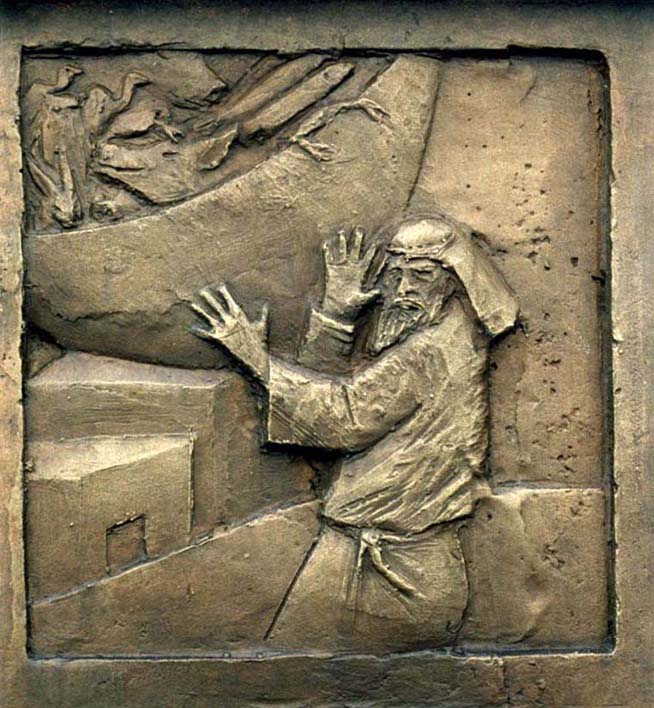
Acts 10 Peter's Vision bas relief

Acts 10:45 – August 9, 2015

Here in the church, we sometimes talk about missionaries going to far-flung places in distant parts of the earth. They navigate visible and invisible borders and boundaries. But not me! I’ve always lived here in the Chicago area. One big similarity? I served in three multi-cultural hospitals. For almost ten years, in several hospitals and extended care centers around Chicago, I worked as a chaplain. I dealt with patients, their loved ones, and health care staff—on a regular basis. Instead of going to the world, I had the world come to me, in the hospital.

What in the world does this have to do with our sermon today? I’ll tell you, in a story-telling kind of way. We start off in Caesarea, a Roman city on the coast of the Mediterranean Sea, the Roman capital of the Roman province of Judaea. Thoroughly Roman in every way, from its pagan temples, amphitheater and other architecture to the brand new deep harbor, thanks to superior Roman engineering skills.

Here we meet Cornelius, a Roman centurion, in charge of one hundred soldiers. (He’s a Gentile, by the way.) Let me tell you what Dr. Luke has to say in Acts chapter 10. I’m reading again from the excellent version translated by J.B. Phillips. “1-3 There was a man in Caesarea by the name of Cornelius, a centurion in what was called the Italian Regiment. He was a deeply religious man who reverenced God, as did all his household. He made many charitable gifts to the people and was a real man of prayer.”

Did you all catch that? Cornelius reverenced/revered God! The God who made heaven and earth. The God of the Jews. But, he was a . . . Gentile! Not a drop of Jewish blood in him.

What happens next? “About three o’clock one afternoon he saw perfectly clearly in a dream an angel of God coming into his room, saying, “Cornelius!” 4a He stared at the angel in terror, and said, “What is it, Lord?” 4b-6 The angel replied, “Your prayers and your deeds of charity have gone up to Heaven and are remembered before God. Now send men to Joppa for a man called Simon, who is also known as Peter.”

The town of Joppa was not just a mile or two down the road. No, the soldier Cornelius needed to send his servants between thirty and forty miles away in order to fetch this Simon Peter guy. Which, Cornelius did, right then and there.

Meanwhile, in Joppa—I imagine a split-screen sort of a deal here. On this side, here is the city of Caesarea. A large, Roman-style house. The camera zooms in on the centurion Cornelius, just having dispatched his men to go fetch Peter. And—on the other side of the screen, we have the camera: starting out in a long shot. We see the street scene on an afternoon in Joppa. The camera pans in, coming closer and closer to a particular building. A smaller house. Simon Peter is sitting up on the flat roof, catching some breeze off the ocean in that coastal town.

Dr. Luke continues: “9-13 Next day, while these men were still on their journey and approaching the city, Peter went up about mid-day on to the flat roof of the house to pray. He became very hungry and longed for something to eat. But while the meal was being prepared he fell into a trance and saw the heavens open and something like a great sheet descending upon the earth, let down by its four corners. In it were all kinds of animals, reptiles and birds. Then came a voice which said to him, “Get up, Peter, kill and eat!” “

In the Mosaic Law, recorded in the books of Exodus, Leviticus and Deuteronomy, the Law code has definite restrictions on what any good, kosher-keeping Jew is and is not allowed to eat. A few well-known forbidden foods are no pigs—no pork. No shrimp or other shellfish. Also, no rabbits or snakes, and no owls or birds of prey. These are just a few of the kinds of animals, fish and birds that are forbidden, for various reasons. So, let’s see what happens next!

14 Peter said, “Never, Lord! For not once in my life have I ever eaten anything common or unclean.” 15 Then the voice spoke to him a second time, “You must not call what God has cleansed common.” 16 This happened three times, and then the thing was gone, taken back into heaven.”

Wow! Amazing vision that Peter had! Talk about totally blowing Peter away. Peter had always—all of his life—kept kosher. Eaten only the things that the Mosaic Law code said he could eat. Now, out of a clear blue sky, this vision is telling him that God calls all things clean!

I want to take a little detour. Tell you a bit about my two chaplain internships, after graduating seminary. I dug right into learning about various faith traditions. I learned about widely different cultural traditions, too. This was a natural progression for me, learning more of how to accompany diverse people in crisis, critical care, trauma and end of life. It sounds rather odd, talking about my years of intensive learning and stressful internship in this way, but I very much appreciated every intense, multicultural experience I had: both in the classroom, as well as on the floors and units of the hospitals and care centers.

Let’s come back to Acts, chapter 10. “17-20 While Peter was still puzzling about the meaning of the vision which he had just seen, the men sent by Cornelius had arrived asking for the house of Simon. They were standing at the very doorway of the house calling out to enquire if Simon, surnamed Peter, were lodging there. Peter was still thinking deeply about the vision when the Spirit said to him, “Three men are here looking for you. Get up and go downstairs. Go with them without any misgivings, for I myself have sent them.”

“23b-26 On the next day Peter got up and set out with them, accompanied by some of the believers from Joppa, arriving at Caesarea on the day after that. Cornelius was expecting them and had invited together all his relations and intimate friends. As Peter entered the house Cornelius met him by falling on his knees before him and worshiping him. But Peter roused him with the words, “Stand up, I am a human being too!”

I need to interrupt, to let you know—Peter and his Jewish friends from Joppa, being good observant Jews, were forbidden by the Jewish Law code to enter the house of a Gentile. Yet—that is exactly what Peter intended to do! Let’s continue.

27-29 Then Peter went right into the house in deep conversation with Cornelius and found that a large number of people had assembled. Then he spoke to them, “You all know that it is forbidden for a man who is a Jew to associate with, or even visit, a man of another nation. But God has shown me plainly that no man must be called ‘common’ or ‘unclean’. That is why I came here when I was sent for without raising any objection.”

As for me? All three of the hospitals where I served were in the middle of multicultural areas, a crossroad of the multicultural communities of Chicago and the surrounding area. One of these hospitals has the distinction of sitting in one of the most diverse ZIP codes in the country. (The U.S. Census Bureau says so.) I never knew who was going to be in that next room I entered, or what situation I was going to encounter next.

34-43 Then Peter began to speak, “In solemn truth I can see now that God is no respecter of persons, but that in every nation the one who reverences Him and does what is right is acceptable to Him! God has sent His message to the children of Israel by giving us the good news of peace through Jesus Christ—He is the Lord of us all.” Ahh. We can see that slowly, very slowly, Peter is taking baby steps towards being open to more than just Jews.

When I served as a chaplain, I didn’t just serve Protestant Christians. I remember a Buddhist Asian family in critical care, as their loved one died just as I came in—complete silence and intense sadness greeted me as I joined them in the room. Another time, I entered the packed ICU cubicle—wall to wall with a Pentecostal Latino family, who wanted me to pray their brother (and uncle) across the River Jordan. (The crashing, palpable waves of grief struck me again and again…I vividly remember.) It wasn’t all end of life. I remember being asked to pray the Rosary with a Filipino family around their ill auntie, lying in the hospital bed. There was the situation with an older Muslim patient, and the 20-something relative wearing black hijab and very conservative dress, sitting next to the bed; she earnestly asked me to pray. Of course I did!

In fact, Peter goes on to say: “We are those witnesses, we who ate and drank with Him after he had risen from the dead! Moreover, we are the people whom He commanded to preach and bear fearless witness to the fact that He is the one appointed by God to be the judge of both the living and the dead.”

This sermon Peter preached—for it was a sermon!—had its effect. The Gentile audience heard Peter, and what happened? “44-46a While Peter was still speaking these words, the Holy Spirit fell upon all who were listening to his message. The Jewish believers who had come with Peter were absolutely amazed that the gift of the Holy Spirit was being poured out on Gentiles also; for they heard them speaking in foreign tongues and glorifying God.”

Did you hear what happened? Praise God! These Gentiles believed, and the same thing happened to them that had happened to the Jewish believers in Acts chapter 2! The gift of the Holy Spirit came upon the Gentiles, too.

Remember what Peter told his Jewish audience, at Pentecost? Acts chapter 2? Joel’s prophecy regarding the outpouring of the Holy Spirit had been fulfilled. All who call upon the name of the Lord will be saved (Joel 2:32a). At first, Peter and the rest of Jesus’ followers thought that all only meant Jews. And then, Samaritans were added.

I have Good News for you. I have Good News for us all. Jesus is the Lord of all (10:36b). All Jews and all Gentiles who believe in Him receive forgiveness of sins through His name (10:43). As the commentator Richard Carlson said, the Apostle Paul had it exactly right, “In Christ there is neither Jew nor Gentile, slave nor free, male nor female” (Galatians 3:28). In Christ, there is neither Republican nor Democrat, citizen nor undocumented visitor, gay nor straight, for all are one in Christ Jesus.

In God’s salvation plan, all now really means all.

Alleluia, amen!

@chaplaineliza

Suggestion: visit me at my daily blog for 2015: matterofprayer: A Year of Everyday Prayers. and my other blog,  A Year of Being Kind .  Thanks!

Unknown's avatar

“Who Are You, Lord?”

Who Are You, Lord?

Acts 9 conversionofsaintpaul - ethiopian icon

Acts 9:1-19 – August 2, 2015

Sometimes, asking good questions can be difficult.

In the 1400’s and 1500’s, the astronomers in Europe were discovering wonderful things about our solar system. It wasn’t until 1543 that astronomer Nicolaus Copernicus asked, “Could it be that the Earth orbits the Sun?” This was a dangerous question to ask, in his time. Common knowledge and expert opinion were in agreement, in the 1500’s: the Earth was the center of everything. But Copernicus had the courage to ask this simple—and profound—question, which turned the scientific community on its heads, and changed the world.

We turn to our Scripture passage for today. Acts chapter 9. Saul, a Pharisee of the Pharisees, was one of the chief persecutors of the early Church in the area of Jerusalem. He had been a witness to the stoning of Stephen, a short time before this reading today. Saul’s zeal in pursuing these “Jewish heretics,” these followers of “The Way” had become legendary. Let me read the Acts passage from an excellent translation by J.B. Phillips.

“1-2 But Saul, still breathing murderous threats against the disciples of the Lord, went to the High Priest and begged him for letters to the synagogues in Damascus, so that if he should find there any followers of the Way, whether men or women, he could bring them back to Jerusalem as prisoners.”

That was the situation. Saul was filled with religious zeal! It wasn’t enough that he had been instrumental in kicking out most of the believers and breaking up the Jerusalem church. He was going to round up these Jewish heretics in Damascus, more than one hundred miles away. Nab these false believers! And, extradite them. Bring them back to face the Chief Priest and the Sanhedrin in Jerusalem.

Who was Saul, anyway? Born a Roman citizen in Asia Minor, he was one of the graduates of the equivalent of an Ivy League school—the University of Tarsus, one of the finest universities of the first century. He had been a student of the Rabbi Gamaliel, one of the most prominent Jewish scholars of that day. As far as knowledge and book learning was concerned? Saul had it, in abundance! He was trained as a Pharisee, in every aspect of the Jewish religion. And, he was on fire to haul in every upstart Jewish heretic he could lay his hands on!

Just like the scientific establishment in the 1500’s in Europe, Saul had his mind set, for once and for all. He knew he was right, and nothing could make him swerve from his desire, his zeal to see justice done. Let’s go back to our reading from Acts. “3-4 But on his journey, as Saul neared Damascus, a light from Heaven suddenly blazed around him, and he fell to the ground. Then he heard a voice speaking to him, “Saul, Saul, why are you persecuting Me?””

Whoa! Wait a minute, here! Saul is one of the top religious law-followers in Jerusalem. As he said himself, a Pharisee of the Pharisees! But, BAM! Here is a clear, Heavenly event happening to Saul. You might have heard about “a Damascus road experience,” meaning a sudden, dramatic conversion experience? This is it. Right here, right now. Paul’s—I mean, Saul’s dramatic conversion experience.

Time after time in the Hebrew Scriptures, the prophets have encounters with the living God. We can see from descriptions in the books of Isaiah, Ezekiel and Daniel, just to name several. And the most significant—that of Moses, in Exodus, at the burning bush. Just as God called Moses twice: “Moses, Moses!” So the risen Lord Jesus also calls twice: “Saul, Saul!”

I have a suspicion that Saul immediately “got it.” The mental puzzle pieces started falling into place. Saul finally asked a really good question: “Who are you, Lord?

Isn’t that the way it is with you or with me, sometimes? Here we are, headed down Life Road, going about our business. When, boom! A sudden event happens. Maybe not as serious as Paul’s Damascus Road encounter, but all the same, earth-shaking. It could be something that happens to our health, or our jobs, an accident or some type of traumatic or sudden happening. Or, if it doesn’t happen to us, it happens to one of our loved ones. Our best friend. Or a next door neighbor.

Even if it’s something really fantastic, it can still be earth-shaking. Just as much of a shift or a change in life. Similar to the dramatic shift in the scientific world after Copernicus proved that the Earth really did orbit the Sun. He turned the whole world’s attitudes and ideas on their heads and paved the way for a whole new way of thinking. New frames for good questions.

As Saul was lying there in the dust of the road, I am sure a few new thoughts broke into his mind. “Who are you, Lord?” As one commentary says, Saul’s really good question was that “of a devout Jew who understands the significance of his experience from reading Scripture.”

Let’s continue with our reading: “6-7 “I am Jesus whom you are persecuting,” was the reply. “But now stand up and go into the city and there you will be told what you must do.”

His companions on the journey stood there speechless, for they had heard the voice but could see no one.”

Do you understand what’s going on here? The others in this vigilante posse can hear a voice, but have no idea Who is speaking. On top of that, Saul is suddenly struck blind. The companions don’t have a clue what is going on. They need to lead Saul by the hand into Damascus, blind and helpless. There he sits, and fasts, for three whole days.

I need to finish the narrative. It doesn’t end here! Not by a long shot!

10 Now in Damascus there was a disciple by the name of Ananias. The Lord spoke to this man in a dream. calling him by his name. “I am here, Lord,” he replied. 11-12 Then the Lord said to him, “Get up and go down to the street called Straight, and inquire at the house of Judas for a man named Saul from Tarsus. At this moment he is praying and he sees in his mind’s eye a man by the name of Ananias coming into the house, and placing his hands upon him to restore his sight.” 13-14 But Ananias replied, “Lord, I have heard on all hands about this man and how much harm he has done to Your holy people in Jerusalem! Why even now he holds papers from the chief priests to arrest all who call upon Your name.” 15-16 But the Lord said to him, “Go on your way, for this man is My chosen instrument to bear My name before the Gentiles and their kings, as well as to the sons of Israel. Indeed, I Myself will show him what he must suffer for the sake of My name.”

17 Then Ananias set out and went to the house, and there he laid his hands upon Saul, and said, “Saul, brother, the Lord has sent me—Jesus who appeared to you on your journey here—so that you may recover your sight and be filled with the Holy Spirit.” 18-19a Immediately something like scales fell from Saul’s eyes, and he could see again. He got to his feet and was baptised. Then he took some food and regained his strength.”

We see how a persecutor of Christians became the foremost preacher of Christ. By asking a really good question.

John Holbert mentions in his study on Acts 9, “Luke seals his portrait of the great apostle by reminding us that God is forever in the business of choosing the least likely of persons to do the great work of God.” Remember God’s “chosen instrument” mentioned in Acts 9:15? Paul refers to himself again as a cracked pot (in Greek, skeuos) for Jesus, in 2 Corinthians 4:7. We are all flawed, cracked pots. Each of us is a chosen instrument for God, yes! And a less-than-perfect cracked pot, too.

Do I have the amazing gifts of planning, leadership and public speaking that the Apostle Paul had? Not likely. However, I do what I can with what God has given me. You can, too! God calls each of us. Some to small tasks, others to larger ones. We are all flawed vessels—less-than-perfect cracked pots for Jesus.

Saul—shortly to become the Apostle Paul—was called by God to go to the Gentiles. To go to the nations, and not to just preach to Jews. I wonder. The Lord has called each one of us. God has welcomed each of us into a heavenly relationship. I wonder. The nations are coming to us—to Morton Grove, to Glenview, to Niles, to Des Plaines, and all over the Chicago area. Is God calling us to be God’s chosen instruments to our neighbors? To those we work with? To the person at the coffee shop or the clerk at the grocery store?

I offer you—I offer all of us the opportunity to hear God’s call! Chances are, it won’t be as dramatic as Saul’s conversion. But can you hear God’s call with gladness? God calls each of us. Some to small tasks, others to larger ones. Paul’s conversion narrative fires the imagination! May we find in its depths a call on every single one of us, for change and new possibility.

Alleluia! Amen.

@chaplaineliza

Suggestion: visit me at my daily blog for 2015: matterofprayer: A Year of Everyday Prayers. and my other blog,  A Year of Being Kind .  Thanks!


Unknown's avatar

God Sends Us Out!

“God Sends Us Out!”

Acts 8-5-8 Philip preaching in Samaria

July 26, 2015 – Acts 8:4-8, 12, 14-17

Did you ever have something unexpected happen? Let’s say, you’re going about your everyday business, everything perfectly normal. When, something out of the ordinary happens. Comes out of left field. Knocks your socks off! Could be called a miracle, even!

That’s what happened in our Scripture passage from Acts chapter 8 today. Something certainly out of the ordinary happened to the Samaritans!

I’m continuing with my Summer Sermon Series from the book of Acts, Postcards from the Early Church. But before I continue, I’d like to thank everyone for the opportunity to take a week to go to a church conference, the New Wilmington Mission Conference in western Pennsylvania. I hope everyone enjoyed Pastor Gordon as he preached and led the service last week in my absence. The mission conference was a marvelous opportunity to see what God is doing around the world in mission and outreach. Reaching out to people with the Good News of Jesus Christ. Surprise! It’s just what the apostle Philip was doing, in our Scripture reading today.

It’s only a number of months after that first Pentecost. The apostles have been preaching and teaching up a storm. The fellowship of new believers in the risen Messiah has been growing by leaps and bounds! When—we have the super-deacon Stephen get hauled up before the authorities. You remember, just like a radio serial. “When last we left our intrepid heroes . . . !” Only, things went from bad to worse for Stephen. Some things he said about God really got the authorities mad. They thought he was saying blasphemous words, so they stoned him to death. And, God rest his soul. Stephen was the first martyr of the Church.

You might have guessed that Jerusalem was no longer a safe place to stay for many early believers in the risen Jesus. The apostles and other church leaders left town in a hurry!

The early believers in the risen Messiah were ALL Jewish. Everyone in the first church in Jerusalem was Jewish! The first few months were like a greenhouse; this growing church was spreading like a wild fire! But the sudden death of Stephen brought the rapidly growing situation in Jerusalem to an abrupt end.

Which brings us to Philip, one of the apostles. His task is a continuation of sending. The Greek—the original language definition for apostle is ‘one sent on a mission.’ So, Philip is doing his job! Doing what Jesus told him to do.

One problem: Philip was not preaching to Jews. This is unheard of, at this point.

Preaching to Jews? Acts 8 says clearly that Philip—one of the Jewish apostles—went to Samaria, an area some ways north of Jerusalem. There’s a problem: no self-respecting, kosher-keeping Jew would willingly go to Samaria!

Let me tell you a little about the Samaritans, a tribe of people forcibly brought to Israel several centuries before. As John Petty says in his Lectionary blog, “Samaritans and Jews were all-but-enemies.  Centuries of insults and provocations had made each group so disgusted with the other that Jews travelling to Galilee or Judea would usually opt to take the longer route through the area across the Jordan River rather than set foot in Samaria.

“The Samaritans shared some aspects of faith with the Judeans.  Their sacred book was the Pentateuch, and, in their minds, they worshipped Yahweh.  They rejected, however, the focus on Jerusalem that was integral to the Judeans’ Jewish faith. As far as the [Jewish people] were concerned, the Samaritans were some form of ‘half-breed’ and their theology was heretical.”

I think you all can see where the problem lies. Jews hated Samaritans! Samaritans hated Jews! A racial issue! A huge barrier in relationship stood between them!

Just a minute. Let’s step back. Barriers between people? Misunderstood and marginalized people? Differences in religion, even heretical viewpoints? Sounds like a mission field to me!

This past week at the mission conference, I heard about mission outreaches that crossed all kinds of barriers. Differences in language, religion, culture, and viewpoint. Differences in urban people going to rural places, Christian worldview meeting Buddhist or Hindu or Moslem worldview. Wide differences in cultural views and assumptions. And—that’s just on the missionaries’ side.

So, when we consider the apostle Philip crossing a barrier of hatred and disdain and religious difference to reach the Samaritan people with the knowledge and understanding of the risen Messiah, we know for sure this was missionary activity. Listen to verses 5 and 6:

“5 Philip went down to a city in Samaria and proclaimed the Messiah there. When the crowds heard Philip and saw the signs he performed, they all paid close attention to what he said.” This verse mentions “signs.” I think I know what those signs were. In the very next verse, Dr. Luke explains: “For with shrieks, impure spirits came out of many, and many who were paralyzed or lame were healed.”

I don’t have time to go into the topic of evil, or impure, spirits at this time. I’ve been preaching a midweek bible study for the past few weeks on Angels: Elect and Evil. I’m going to do a “coming attractions spiel.” If you’re available this coming Wednesday at 11:00 am, step on down to this very room! If the weather is hot and toasty outside, come on in. We have air conditioning. This week will be the final session, on demons. Or as they are sometimes referred to, evil spirits.

Let’s move on—to Philip and his effective evangelism. He reached out with the Good News, to this despised and disdained group of people. Guess what? Many believed! Continuing with Acts 8: “12 When they believed Philip as he proclaimed the good news of the kingdom of God and the name of Jesus Christ, they were baptized, both men and women.”

But, wait! There’s more! Apostles Peter and John show up, wondering what is going on.

What did Peter and John think of the Samaritans? Dr. Luke doesn’t tell us, but I suspect they had similar feelings to their fellow countrymen.

I have another question for you: What do you think about crossing barriers today? What about outreach right here, right now? What about an Indian church, culturally different from St. Luke’s ? Oh, wait! The dancing classes St. Luke’s Church hosts during the week come from a Catholic Indian church. What about a language barrier, where a different group of people uses a completely different alphabet? Oh, wait! What about Love Sharing Disciple Church? Our Korean friends who worship in the sanctuary here at 12:30 pm.

Do you think Jesus included everyone in His invitation to come to Him? Or, did He say, “Oh, everyone is invited, except for people with physical problems.” That would put my friend and church elder Bob out of the picture, because he has a withered arm, withered from birth. Or, did Jesus say, “Everyone is invited, except for people with disabilities.” No! Remember my friend Pastor Joe, who was at my commissioning service? He’s blind.

Jesus loved Samaritans just as much as Jews. Remember the woman at the well from John 4? Yup, she was Samaritan. And a woman of loose morals. No self-respecting Jewish man would even talk to her. The Rabbi Jesus crossed lots of barriers to bring her to faith! What about the Good Samaritan? Jesus made a Samaritan the star of one of His best-loved parables! And, here’s the kicker. Jesus’ last words, just before He was taken up into heaven, Acts 1:8b. “and you will be my witnesses in Jerusalem, and in all Judea and Samaria, and to the ends of the earth.”

Did you all hear? It doesn’t matter whether the Jews despised the Samaritans. God would help the Jews to love the Samaritans. They still needed to introduce Samaritans to Jesus.

Did you all hear? The apostles needed to go to the ends of the earth. Praise God! That’s just what they did. Did you all hear? It doesn’t matter what kind of barrier you and I are need to cross, God is there to help. We can overcome language differences, culture or worldview problems, religious differences. Remember John 3:16? For God so loved the world that He gave His only-begotten Son.” For you, for me. For everyone.

God loves the whole world. What part of “whole world” do we not understand?

Peter and John were finally convinced. God does not divide or isolate persons one from another. Instead, Peter and John prayed and laid hands on the Samaritan believers. What happened? The Holy Spirit came upon the Samaritans. The Holy Spirit came with power to the Samaritan believers as well as the Jewish believers.

God is all about mission. Outreach. God is a sending God. It doesn’t matter if we are moved to reach out to our neighbor across the alley, to our community with the Maine Township Food Pantry, to the poor and marginalized of Chicago with Bundled Blessings diaper pantry, or to a mission outreach halfway around the world with Dana and Carolyn Belton, with SIM Ministries in Zambia.

In this way, we are following the command of Jesus—to go to our Jerusalem, our Judea, our Samaria, and to the uttermost parts of the earth. We have that opportunity, too. We can reach out, say ‘hello’ to someone who looks different—sounds different—worships differently. I have accepted this challenge! This opportunity. This challenge. God would like you to accept it, too!

Alleluia, amen!

@chaplaineliza

Suggestion: visit me at my daily blog for 2015: matterofprayer: A Year of Everyday Prayers. and my other blog,  A Year of Being Kind .  Thanks!

Unknown's avatar

Radical Stewardship!

“Radical Stewardship!“

Stephen stoning Acts 7

Acts 7:8-9, 57-59 – July 12, 2015

When you have a crisis or serious situation around the house, or personal matters that require some assistance, who is the first person you think of? Who is dependable, helpful, and downright handy to know? Who always seems to have the answers, provides service, and responds in a cheerful, friendly manner? Do you have someone in mind? That’s who, that’s what I think of when I think about Stephen, one of the first deacons of the Early Church.

Here we are, in the next installment of our summer sermon series from the Book of Acts, Postcards from the Early Church. I’ve mentioned this before, of how this sermon series reminds me a bit of a radio serial. “When last we left our intrepid heroes . . . “ Last week, we took a look at the first recorded church conflict, in Acts 6.

This tension and conflict revealed itself in a dispute over the care of widows. It escalated into a problem between two separate groups of believers in the early Church. Jews separated by language and by culture. One Greek-speaking group of Jews—a minority group—claimed they were being overlooked, and were being left out in the charity distribution to widows.

Remember, the twelve Apostles needed help, so they called upon the whole congregation to choose deacons, people of good standing, stature, and wisdom to serve the congregation. Among these Greek-speaking men was someone named Stephen. Like the others, he was appointed and ordained to take care of social welfare matters in the congregation.

Let’s take a closer look at Acts 6, and see what it has to say about Stephen and the other deacons. I’ll be reading from a modern translation, called The Message, translated by Eugene Peterson. “[The congregation] went ahead and chose [seven Greek-speaking men.] Praying, the apostles laid on hands and commissioned them for their task. The Word of God prospered. The number of disciples in Jerusalem increased dramatically. Not least, a great many priests submitted themselves to the faith.”

In these deacons, we have seven respected believers, people of wisdom, with Greek names. What’s more, one man was even a proselyte, a convert to Judaism. These Greek-speaking believers were good stewards of the gifts God had entrusted to them. They were also good stewards of what the congregation in Jerusalem had entrusted to them, too.

The book of Acts is not specific, but I can imagine them taking up their new duties. Going around the main part of Jerusalem and perhaps the suburbs, too. Checking up on the widows and those who could not come to services regularly. Making sure that the elderly, the young ones, and the infirm had enough to eat, and if need be, medical care. In this way, the deacons freed up the Apostles to continue in prayer, and preaching and teaching God’s Word.

Whatever they were doing must have done the job. We can see, as Dr. Luke said, the number of believers continued to grow—and grow!

What about us, here, today? Think about the things God has given you stewardship over. What gifts and talents do you have to offer the church? What can you offer to your neighbors? I’d like you to think about that, as we continue to look at Stephen.

Acts 6 lifts him up as a stand-out, as far as the new deacons are concerned. Stephen does an exceptional job. If there were Olympic-level competition in being a deacon, I suspect Stephen would be right up there, competing for a medal. He is a stellar deacon, serving the congregation! Listen to our passage from Acts: “Stephen, brimming with God’s grace and energy, was doing wonderful things among the people, unmistakable signs that God was among them.”

Remember how I opened this sermon? How I asked everyone here to think of someone who is dependable, helpful, and downright handy to know? Who always seems to have the answers, provides service, and responds in a cheerful, friendly manner? I just so happen to have someone like this in my extended family. My brother-in-law, married to my husband’s sister. Rick is one of the nicest guys you could meet. He was a volunteer fireman in his small town. Now he’s a fire inspector in his region of Michigan.

But that’s not what I wanted to highlight about Rick. Instead, he goes above and beyond when he’s asked to help. Now that my father-in-law is in his mid-eighties, my husband and I are sure glad that Rick lives only about a half hour’s drive away from Grandpa Jones. Rick is handy around the house, always keeps a cool head no matter what, and is just a swell guy to have around. Not only that, he’s an elder in his Presbyterian church, and a pillar of the community. Very much the kind of person I imagine Stephen to have been.

Back to Acts 6: “Then some men went up against Stephen trying to argue him down. But they were no match for his wisdom and spirit when he spoke.”  

It seems that Stephen is not only an outstanding deacon, excellent at serving others in the congregation, but I understand God has blessed him personally. Abundantly. He is an excellent steward of both his personal gifts, as well as God’s gifts of life and blessing for others. He must have been articulate, too. Fantastic at expressing himself, with wisdom and holy insight.

Remember, the Early Church was located in Jerusalem in these early days. Jerusalem was not friendly to the group of believers in the Risen Messiah Jesus. (I’m getting worried about what is going to happen.) Let’s read some more from Acts. “So in secret, the men bribed others to lie: ‘We heard him cursing Moses and God.’ That stirred up the people, the religious leaders, and religion scholars. They grabbed Stephen and took him before the High Council. ”

Ah. The High Council. In other words, the religiously powerful. I see them as those who block access to God. As a United Methodist commentary says, “those who use and interpret the Law in order to control access to God’s gifts. It seems that Stephen is so good at doling out ‘life abundant’ to anyone and everyone, that the religiously powerful go to unscrupulous lengths to stop him from doing what they perceive to be their job exclusively.”

Stephen continues to be a stand-out steward of the gifts God has given him. Even in his lengthy defense to the High Council—he takes almost all of Acts chapter 7 to go through the history of the nation of Israel, showing how ungrateful and stiff-necked the Jewish people are.

Just listen to the climax of Stephen’s defense: “And you continue, so bullheaded! Calluses on your hearts, flaps on your ears! Deliberately ignoring the Holy Spirit, you’re just like your ancestors. Was there ever a prophet who didn’t get the same treatment? Your ancestors killed anyone who dared talk about the coming of the Just One. And you’ve kept up the family tradition—traitors and murderers, all of you. You had God’s Law handed to you by angels—gift-wrapped!—and you squandered it!”

“At that point [the Council] went wild, a rioting mob of catcalls and whistles and invective. But Stephen, full of the Holy Spirit, hardly noticed—he only had eyes for God, whom he saw in all his glory with Jesus standing at his side. He said, ‘Oh! I see heaven open wide and the Son of Man standing at God’s side!’

57-58 “Yelling and hissing, the mob drowned him out. Now in full stampede, they dragged him out of town and pelted him with rocks. The ringleaders took off their coats and asked a young man named Saul to watch them. 59-60 As the rocks rained down, Stephen prayed, ‘Master Jesus, take my life.’ Then he knelt down, praying loud enough for everyone to hear, ‘Master, don’t blame them for this sin’—his last words. Then he died.”

As a commentator says, “Even as the council is extinguishing Stephen’s life – stone by hideous stone – he continues to dole out life and grace to them, his killers.”

Radical stewardship, indeed. He gave generously of God’s gifts of life and blessing for other believers. Such a stand-out, he was martyred for his stewardship of his gifts.

Stephen and his example of stewardship stand not only as an example for us, but for the Church Universal, and for the centuries. We can see that “The first Christian martyr comes not from those preaching the word, but from those feeding the hungry.”

This is what this church does. This church has a regular collection of food for the Maine Township Food Pantry. We feed the hungry and provide for God’s table of grace. This congregation shares food—and we share God’s gifts of life—with the hungry, with the vulnerable, with those in need. This is serving in the way that God wants us to serve.

I will adapt Paul Waddell’s words, as he writes for the Center for Christian Ethics: “Christian [stewardship] is a matter of welcoming, caring for, and befriending the stranger, the poor and needy, the homeless and destitute, the unloved and the unlikable, the weird and the strange, in gratitude to God and in imitation of Christ. For Christians, [stewardship] is not an occasional gesture but a whole way of being. It is not an interruption to our normal way of life but a habit, practice, or virtue that ought consistently to characterize our lives.”

Do you share God’s gifts of life, every day? Do we provide God’s table of grace for others, regularly? God calls each of us to be generous, each day. Be of service, one on one. Be excellent stewards—personally. God is calling, to you, and to me. Won’t you answer?

Alleluia, amen!

@chaplaineliza

(My thanks to “Radical Gratitude,” http://www.umfnw.org for several excellent ideas and quotes I used in this sermon. And, my thanks and deep appreciation for Eugene Peterson’s translation of selected verses from Acts 6 and 7;  “Scripture taken from The Message. Copyright © 1993, 1994, 1995, 1996, 2000, 2001, 2002. Used by permission of NavPress Publishing Group.”)

Suggestion: visit me at my daily blog for 2015: matterofprayer: A Year of Everyday Prayers. and my other blog,  A Year of Being Kind .  Thanks!

Unknown's avatar

Hospitality + Service = Discipleship!

“Hospitality + Service = Discipleship!“

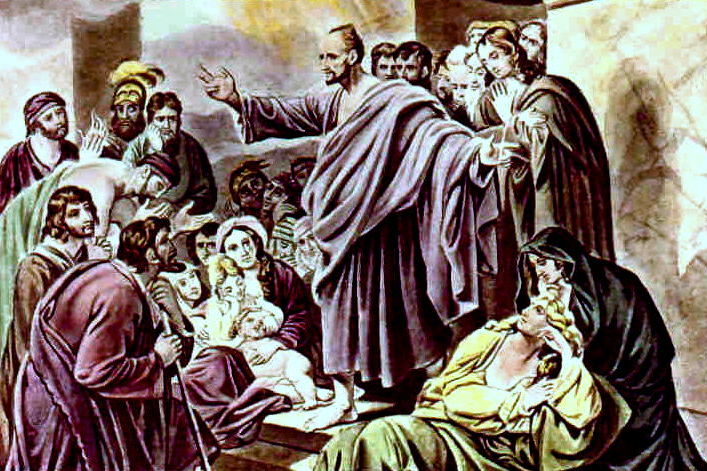
Deacons Greek Jews Acts 6

Acts 6:1-7 – July 5, 2015

I attended an Interfaith Panel discussion last Tuesday evening at the Muslim Community Center here in Morton Grove. The panel had representatives from five major faith traditions here in the Chicago area: Baha’i, Christian, Jewish, Muslim and Sikh. Each gave their religion’s basic approach to serving those in need. Charity. Service to those less fortunate than ourselves. I appreciated listening to diverse views on charity and assisting the needy.

I want us to focus on the New Testament reading from Acts on—surprise! Charity and assisting the needy! My recent evening with the Interfaith panel has an unexpected tie-in to the bible passage from Acts this morning. I planned and set out these passages and these sermon topics almost two months ago, before I was ever contacted by the Interfaith Outreach Committee at the Community Center. Was I surprised to find out that the topic of last Tuesday’s evening fit right in with today’s reading from Acts—and today’s sermon.

What is the situation for the group of believers in the Risen Jesus? The early church?

Let’s turn back to the beginning of Acts 6, and take a look at this particular Postcard from the Early Church. The first sentence of the chapter tells us a lot: “In those days, the number of disciples was increasing.”

That’s the situation. Everything seems to be going well for this growing group of believers! Attendance in services is up. Plate income is increasing. The apostles—the pastors of this growing flock—are busier than ever. Everything is on the upswing. When—a complication comes up.

I need to give you all some backstory, so you can get the full picture. (I appreciate the Rev. Bryan Findlayson’s concise explanation.) At this point, just a couple of months after that first Pentecost, the birthday of the Church, all the believers were Jewish. Jerusalem was a large city in that area. It was the time of the Pax Romana, the Roman peace, and Jews from all over the known world returned to the city of Jerusalem and settled there.

As Rev. Findlayson mentions, “The Jewish world was divided between Aramaic-speaking Jews from Palestine [Hebrews—home grown], and Greek-speaking Jews from the dispersion [or Hellenists—who had grown up outside Palestine]. Racial tension, often focused on religious purity, existed in the wider Jewish community and found its way into the New Testament church. [The tension] revealed itself in a dispute over the care of widows. The [Greek-speaking Jews] claimed that their widows were not getting a fair share of the church’s welfare budget.”

Do you hear the problem? Two separate groups of people in the early Church, and one group—a minority group, no less—claimed they were being overlooked. Discriminated against. Or, rather, that their poverty-stricken widows, who were part of the group of believers, were being left out in the charity distribution. Welfare budget. Or almsgiving to the poor. Whatever you call it, a group of people was getting left out.

I don’t think that anyone was left out on purpose. What I do know—by Dr. Luke’s report—is that the Church in Jerusalem was growing by leaps and bounds! This is a good problem to have! In a large group of people going through such rapid growth, unfortunate things happen. And, it’s inevitable that someone ends up getting overlooked. Some people’s needs just aren’t met.

What happens next? This is the perfect situation for a church-splitting conflict. Hospitality was huge in the Middle East, as well as in other areas throughout the world. Of course people opened their homes to friends and acquaintances, even strangers, invited them in, offered things to them of what they had. Listen to Chapter 6: “So the Twelve apostles gathered all the believers together and said, “It would not be right for us to neglect the ministry of the word of God in order to wait on tables. Brothers and sisters, choose seven men from among you who are known to be full of the Spirit and wisdom. We will turn this responsibility over to them and will give our attention to prayer and the ministry of the word.’”

These verses in Acts show us the first rumblings of church conflict. The Apostles could have gotten anxious and started to fret. Or, possibly started micro-managing and overseeing each little thing in the distribution of food. Or, called a board meeting, and appointed a task force to study and look further into the treatment of the Greek-speaking widows. But did they? No. The Apostles faced the conflict directly, and responded in a proactive way.

What about today? People have definitely not stopped being hungry. What about communication problems? What about the local food preferences? How should those be handled? What if several different faith traditions in our area have conflicting methods in the distribution of food? Are there any hungry or needy people—unintentionally—getting left out?

Let me tell you more about the panel discussion and dinner at the Muslim Community Center last week. I heard diverse views on charity and assisting the needy. Yet—they were not so diverse, after all. I saw in all five faith traditions a deep concern for those with less, and a desire to come alongside and help where possible. I also appreciated breaking bread with such a diverse group of friends, after the evening service.

Yes, Baha’i, Christians, Jews, Muslims and Sikhs do come from different faith traditions. Yes, the Muslims are observing the holy month of Ramadan. Yes, Muslims commonly fast every day during the daylight hours during this month. The Community Center invited a large group of people to join together with them for this discussion and for the Iftar dinner after sunset, to break the fast at the end of the day.

Back to Acts. True, these Aramaic-speaking Jews and Greek-speaking Jews from the book of Acts were both of the same faith tradition. However, there were big cultural and language differences between them. So, what happened? How did they solve this problem? The Apostles had the whole group of believers choose seven upright, worthy individuals to be responsible for the distribution of food and goods to this minority group.

What I find the most interesting? The seven men all had Greek names. I suspect they all were Greek-speaking Jews, themselves! How awesome is that. The other believers showed great sensitivity in selecting seven servers, seven people who could oversee distributing of food. Seven men with Greek names. What’s more, one Greek man was even a proselyte, a convert to Judaism. Imagine that!

Paul Waddell, writing for the Center for Christian Ethics, tells us more about this calling, this service to the church: “Christian hospitality is a matter of welcoming, caring for, and befriending the stranger, the poor and needy, the homeless and destitute, the unloved and the unlikable, the weird and the strange, in gratitude to God and in imitation of Christ. For Christians, hospitality is not an occasional gesture but a whole way of being. It is not an interruption to our normal way of life but a habit, practice, or virtue that ought consistently to characterize our lives.”

Dr. Waddell asks: how do we become this kind of person/or these kinds of congregations in the Church and for the world today? Great question! We can start small, with a small act of kindness each day. A small act of hospitality, of welcome and greeting each day. Each one of us is called to be welcoming members of this church today. Each of us is an individual, true. However, Lone Ranger Christians are not a good idea. We need to support each other, be kind to each other, and support the wider community.

What about you? Are you going to be a welcoming person, both here at church, and at home, as well? No matter what the cultural differences, no matter where people come from, we are all called to be welcoming. Just as Jesus was kind and welcoming to all people, throughout the Gospels, we can all follow His excellent example. That’s what His disciples do, to the best of their ability, in the book of Acts. And, that’s what all of us can do, here in the church, and everywhere else, too!

Alleluia, amen!

@chaplaineliza

(Suggestion: visit me at my daily blog for 2015: matterofprayer: A Year of Everyday Prayers. and my other blog,  A Year of Being Kind .  Thanks!)

Unknown's avatar

“We Must Obey God!”

“We Must Obey God!”

Acts 5-29 floral saying

Acts 5:12-29 – June 28, 2015

I remember an older documentary I saw on PBS about fifteen years ago, about classic comedy shorts. Tracing the history of comedy, I was introduced to a serious study of the silent comedy shorts of the teens and 1920’s. Including the Keystone Kops. I immediately recognized their wacky, incompetent ways as similar to other, more recent comedy acts I had seen. Running around, like chickens with their heads cut off. Bumbling, yet energetic, inevitably they would end up floundering around helplessly.

This reminded me so much of the Temple guards from our reading today.

You remember our Summer Sermon Series, from the book of Acts. Postcards from the Early Church. When last we left our intrepid heroes, Peter and the other apostles were regularly preaching in and around the Temple in Jerusalem. In the city center, getting lots of attention from all passersby. And especially getting negative attention from the Jewish leaders, the Sanhedrin.

Peter and his fellow apostles remind me of some modern-day radicals—I mean, street preachers. People like those calling for a living wage, or like those advocating for wider access to decent education for all people, or those clamoring for clergy accountability for hidden sexual abuse. Even though the Jewish authorities told Peter and company to pipe down! The disciples refused to do so. Just like the modern-day street preachers protesting today.

Remember, last week I talked about how those pesky, persistent disciples were like the carnival game Whack-a-Mole? How they kept popping up, all over the place, no matter how much the Jewish leaders whacked at them? Here they are again, those pesky, persistent preachers. This resistance was serious! This was major disruption!

Of course the Jewish leaders and Temple police needed to round up these pesky, disruptive upstarts!

We pick up the narrative at verse 17 of chapter 5 of Acts: “Then the high priest and all his associates, who were members of the party of the Sadducees, were filled with jealousy. 18 They arrested the apostles and put them in the public jail. 19 But during the night an angel of the Lord opened the doors of the jail and brought them out. 20 “Go, stand in the temple courts,” the angel said, “and tell the people all about this new life.” 21 At daybreak they entered the temple courts, as they had been told, and began to teach the people.”

You heard it again, right here. An angel of the Lord supernaturally went into the prison by night, and miraculously released this group of men. (They probably all were men, in prison. Although, there were women disciples of the Risen Jesus, too!)

Next thing you know, the angel of the Lord told the disciples to continue to preach, and to continue spreading the good news. If I had just had an angel perform a miracle especially for me, chances are that I would listen to that angel, too!

Moreover, the disciples did not hightail it for the hills. Instead, they stayed put, in Jerusalem, and got right back in the thick of things.

Even though the Sanhedrin specifically told them NOT to preach any more, what do you think they are doing? You guessed it. They are out in the Temple again, and on the downtown street corners, preaching away. Telling everyone who would listen about the Risen Lord Jesus, the resurrected miracle-working Rabbi who rose from the dead, ascended into heaven, and is seated at the right hand of the Father, God Almighty.

Despite being sternly told not to say a word about what had happened in Jerusalem in the past few weeks.

Now, let’s look at the flip side. The side of the Jewish leaders. Starting at verse 21: “When the high priest and his associates arrived [in the morning], they called together the Sanhedrin—the full assembly of the elders of Israel—and sent to the jail for the apostles. 22 But on arriving at the jail, the officers did not find them there. So they went back and reported, 23 “We found the jail securely locked, with the guards standing at the doors; but when we opened them, we found no one inside.” 24 On hearing this report, the captain of the temple guard and the chief priests were at a loss, wondering what this might lead to. 25 Then someone came and said, ‘Look! The men you put in jail are standing in the temple courts teaching the people.’”

I can’t help but keep going back to the Keystone Kops! The Temple guards and Jewish leaders, who threw all these guys in prison. Even the bars and locked doors couldn’t hold the disciples! As one commentary said, the opposition—the priestly establishment—could not stop these determined preachers. The guards’ and leaders’ befuddled incompetence highlights how useless it is to oppose God and God’s purposes.

Rev. Daniel B. Clendenin preached a sermon on this text from Acts 5 a few years ago. He noted that “in July 2003, Dominican nuns Ardeth Platte, Carol Gilbert and Jackie Hudson, members of a peace community in Baltimore called Jonah House, were sentenced to 34 months each in federal prison for sabotaging the national defense and damaging government property. They had protested nuclear weapons by smearing a cross on a Minuteman silo with their own blood and pounding on it with hammers.”

Regardless of what anyone’s personal feelings about national defense may be, I can palpably feel how deeply these women believed in what they were doing. How they said, like Peter and the other apostles, “We must obey God rather than human beings!” How strongly theses nuns felt that these deadly nuclear bombs killed innocent civilians as well as opposition soldiers. Not just “collateral damage,” but individuals. Women, children, seniors, clergy, medical personnel. All creations of God, and all much loved by God. Just like all of us. Each one of us.

Did you hear? “We must obey God rather than human beings!” That’s how Peter and the other disciples responded to the Sanhedrin! That was their answer, and then they kept on preaching! They kept on spreading the Word of God!

The Jewish leaders desperately wanted to get these disrupters out of the way. But the public response and reaction to the outspoken disciples and their preaching—plus their very public miracles!—was overwhelming! The guards knew it very well, and they didn’t want to get hurt, or even stoned! Popular opinion? Very much in the disciples’ favor.

Looking at the present day, what is our situation? If we were to stand before a modern-day group of civic leaders, if we were on trial for being a Christian, would there be enough evidence to convict us?

Are we telling people about the Risen Jesus? Are we witnessing to His mighty power? Are we telling people of Jesus’ awesome, affirming, welcoming acceptance? Do we let people know about Jesus’ all-inclusive love?

We can see, again and again in the Gospels, Jesus loves everyone! The loose-living Samaritan woman at the well. Nicodemus, member of the Sanhedrin. The thief on the cross. The chronically unclean woman with the flow of blood. That chiseling, tax collector-turncoat Zaccheus. I think that message of unconditional love and acceptance, told to each and every person the disciples met, changed people’s lives. Changed people’s hearts.

I ask again—what about you, and what about me? If we were on trial for being a Christian, would there be enough evidence to convict us? Yes, we answer to God. And, yes, we offer each person Jesus Christ. His loving, welcoming embrace is ready, today! Are you? His life-changing message is here and now. Do you offer it freely, to everyone you meet?

God willing, I can. God willing, you can, too! Let us pray for the power, for the openness, for the willingness to share God’s good news. The Risen Jesus loves you. The Risen Jesus loves me. And He is ready to welcome all those who would come to the Family of God. In Jesus’ blessed, powerful name we pray, Amen!

@chaplaineliza

(Suggestion: visit me at my daily blog for 2015: matterofprayer: A Year of Everyday Prayers. and my other blog,  A Year of Being Kind .  Thanks!)


Unknown's avatar

We Cannot Keep from Speaking!

“We Cannot Keep from Speaking!”

Peter - cannot stop Acts-4-20_2

Acts 4:1-20 – June 21, 2015

Ever had this situation happen to you? Just when you thought you had taken care of some pesky problem, here it comes, all over again! Sort of like the carnival game Whack-a-Mole. Just when you whack at all the moles, and think that they are all gone—that your problems are all solved—here they come again! Popping up all over the place.

I suspect the ruling council in Jerusalem felt this way just about now. Here they had rid themselves of that troublesome Rabbi Yeshua, or Jesus, some weeks ago. They had even gone to their Roman governor, Pontius Pilate, to get his permission to put this upstart Rabbi to death. They got some people to accuse Jesus of insurrection and treason, so He would be killed by crucifixion. That was it! Done! One great, big, pesky problem taken care of!

True, there were some rumors about Jesus coming back to life a few days later, but that was just a rumor. Resurrection? Hah! Sounds pretty far-fetched to me. It was far-fetched to the ruling council, to the Sanhedrin, too.

They didn’t figure on Peter, John, and the rest of the disciples. They didn’t figure on the blowing of the Holy Spirit at Pentecost, or the energy of the new believers in the Risen Jesus.

Our summer sermon series, Postcards from the Early Church, reminds me a bit of a radio serial. You might remember those! “When last we left our intrepid heroes . . . “ Last week, we saw Peter and John about to enter the Temple in Jerusalem for daily afternoon prayers. A long-time beggar, lame from birth, asked Peter and John for alms—for money. Peter made that extraordinary statement to the lame beggar: “Silver and gold I have none, but what I have I give to you. In the name of Jesus of Nazareth, stand up and walk!”

As I mentioned in my sermon last week, Peter suits the words to his action. He leans forward, grasps the lame man’s right hand, and raises him to his feet.

What happens next? “Immediately his feet and ankles were made strong.” Whatever congenital defect there was in his feet and ankles was immediately, miraculously healed. The ex-lame-beggar could walk. And not only totter around, but leap in the air! He praised God right there inside the Temple, giving immediate public testimony to God’s mighty power!

This was a big problem for the Jewish leaders in Jerusalem, believe me! Just when they thought that pesky Rabbi Jesus was all gone, permanently taken care of, they have even more miracle-workers on their hands. The disciples, the friends who had been with Jesus.

The Sanhedrin—the Jewish leaders—quickly grabbed Peter and John, and threw them into prison. Right after this marvelous miracle! I am sure the bystanders were asking, “What gives? These men did a miracle! Why are you arresting them?”

But—are we surprised? Looking at the Hebrew Scriptures, many of the miracle-working prophets were misunderstood, mistreated, imprisoned. Exiled, and even put to death, sometimes.

The Jewish leaders needed to get on this miracle stuff right away. Try to hush it up. See whether they could sweep the whole business under the rug. But—there was a problem. This was a very public miracle, done in downtown Jerusalem, at the height of rush hour. Or, the equivalent. Afternoon prayer time at the Temple in the city center.

We see from this reading today that the leaders had Peter and John thrown into prison overnight. For working a miracle! For doing what God had called them to do!

This makes me think of the Civil Rights movement and marches of the 1950’s and 1960’s. A friend of mine, Ken, (a recently retired seminary professor) marched alongside of African-American activists. A good friend of this church, Pastor Gordon, attended several marches in the South during the 1960’s. It was a tense, even dangerous time. Both my friends were jailed in the aftermath of the marches. Both are proud to say that they were imprisoned for standing up for a Godly cause.

Back in Jerusalem, the day after the miracle occurred, Peter and John were hauled out of prison and brought in front of the Sanhedrin. The ex-lame-beggar was there, too! The Jewish leaders could not deny that this man—who everyone knew as lame from birth—now had full use of his fully-restored feet and ankles. The news of the miracle was traveling around Jerusalem like wildfire! The leaders knew they had to let Peter and John go free.

But Peter wasn’t done yet! Just like the carnival game Whack-a-Mole, where the Sanhedrin desperately wanted to make all those pesky miracle-working moles go away, Peter kept on popping up. And, he spoke to the learned Jewish leaders and teachers, too.

Peter quoted from Psalm 118 in his defense of the miracle he and John had done. He said to the Sanhedrin, “by the name of Jesus Christ the Nazarene, whom you crucified, whom God raised from the dead—by this name this man stands here before you in good health. 11 He is the stone which was rejected by you, the builders, but which became the chief corner stone. 12 And there is salvation in no one else; for there is no other name under heaven that has been given among men by which we must be saved.”

Talk about in your face! Peter had a lot of guts, speaking to the ruling leaders of his country like that!

As commentator Scott Hoezee brings out, “the Spirit led them to a lowly little textual nugget embedded deep inside one of the lesser known of all the psalms and prompted Peter to use that little verse as the perfect summary of what God’s ways are all about.” This idea is something that Peter repeats again and again. The stone which the builders rejected has become the cornerstone of the building. The most important part of the whole structure. “That’s my Rabbi, Jesus of Nazareth. Oh, and by the way? You Jewish leaders crucified Him!” (That’s guts.)

By Peter quoting this psalm, he reminded these leaders of an unpleasant confrontation between Jesus and the Jewish leaders, shortly before His death. I appreciate another commentator’s words: “It was to say, in effect, “Jesus told you so.” How this citation must have stung in the ears of the Sanhedrin. The One they thought they had rid themselves of was still speaking to them, through the apostles.” The Jewish leaders didn’t have just one pesky problem any longer. The problem had multiplied.

Oh, my goodness. The Sanhedrin tries to tell Peter and John and the rest to shut up. To keep quiet about this Jesus person!

But it does just as much good as attempting to hold back the wild waves of the ocean. In other words, it doesn’t work at all. There is far too much power, far too much momentum behind that crashing ocean wave of testimony.

Despite the stern orders to “pipe down! Sit down and shut up!” Peter and John refuse. Their response? “Whether it is right in the sight of God to give heed to you rather than to God, you be the judge; 20 for we cannot stop speaking about what we have seen and heard.”

What about us? Are we eager to tell people about what we have seen or heard? What about the mighty deeds we have experienced? Or, perhaps you haven’t had God do anything extraordinary in your life lately. Can you tell people about how God has been faithful? God has continued to walk with you, each and every day. I encourage you to tell someone! Amen!

Praise God, each of us can talk about something God has done—for each of us. God has given each of us a new day, each and every day. Praise God! That is truly something to praise and thank God about. Can we all say Amen? Amen! And again! Amen!

@chaplaineliza

(Suggestion: visit me at my daily blog for 2015: matterofprayer: A Year of Everyday Prayers. and my other blog,  A Year of Being Kind .  Thanks!)

Unknown's avatar

What I Have I Give You

“What I Have I Give You”

Peter healing lame man - Acts 3-6

Acts 3:1-10 – June 14, 2015

Expectations! When people expect some situation to turn out a particular way, anything else is a big upset, or even a huge disappointment. Perhaps the expectation is negative; sometimes, a different outcome is not expected. Expectations about work, or about family. Did we expect the Blackhawks to win another game in the Stanley Cup series last night?

Let’s not go off on a tangent—though discussing hockey is tempting. Back to the book of Acts. We continue this summer sermon series with a miracle recorded for us in Chapter 3 of the book of Acts. Dr. Luke—a medical man—gives us lots of detail and description. This healing miracle comes right out of the Acts photo album. Showing memorable photos, distinctive times to remember. Or, if not the most wonderful times, at least the most significant times.

Not long after Pentecost and its immediate aftermath, right after the great big revival meeting in the city of Jerusalem, Dr. Luke focuses on Peter and John going to daily prayers at the Temple. He even mentions the time: it’s 3:00 in the afternoon.

But Dr. Luke’s attention doesn’t stay on Peter and John. Instead, he wants us to change our focus and take a closer look at the lame man they encountered. Again, Dr. Luke gets specific and gives us some detailed information about this man. Verse 2 tells us “A man lame from birth was being carried in. People would lay him daily at the gate of the temple called the Beautiful Gate so that he could ask for alms from those entering the temple.” Important information. We get a snapshot of what this lame man’s life must have been like. Even though the term is not politically correct now, he was crippled. And, he begged. Day after day, every single day.

I have a question for all of us, today. How many here have had physical therapy? Or, if not you specifically, has anyone in your family had physical or occupational therapy? The therapists today are just wonderful. They know how to instruct patients in specific exercises to improve movement, and increase range of motion. And, after patients have completed their physical therapy, they almost always experience fantastic rehabilitation!

How different would this man’s life have been, if he had been born in America, in the 20th century! With all of the medical advances in the past few decades, I suspect he would have had a much more mobile, worthwhile life than just being a beggar.

I’d like us to think hard about this man with a congenital defect in his feet and ankles. Either lying on a mat, or perhaps sitting by one of the gates of the Temple in Jerusalem. He is called “a beggar” by Dr. Luke. What do you think were his expectations in life? Pretty low, I suspect. Perhaps all he hoped for was a good take, a sizable number of donations. Maybe a decent meal when he got home to his mother or sister. But not a lot else. He couldn’t even stand up, not even for a second.

Imagine his perspective. Ignored by almost everyone. Always close to the ground physically, not to mention his sense of low self-esteem. Not able to look people in the eye, or carry on a relatively normal conversation. I feel extremely sad about his situation, just thinking about it for this short time! And, we are told this lame man was not quite in position yet, next to the gate. His friends were still in the process of positioning him for his daily task of begging.

In most places in the world today, I am sorry to say, this is a common sight. My friend Cody, another mission connector like my other friend Dan, served overseas in Asia for some years. He speaks of beggars on the streets as a common, sad, depressing matter of course.

On a sermon preparation website, I recently found this heartbreaking description of present-day beggars: “On my two trips to India, I saw a large number of beggars. There were so many beggars there was no way one could respond to all of them. The solution was often not to “see” any of them. But the beggars made this difficult. Those who were mobile would press themselves on you. They would approach your taxi at an intersection, tugging at your sleeve and pleading for help. Those not mobile would call out for charity. The beggars would be aggressive, something like the salesmen as you try to walk through the appliance section at Sears. You would concentrate on not seeing them as they converged on you, and you hurried to get through the section before you were trapped.”

Feeling uncomfortable yet? Feeling like hurrying, rushing by, not even noticing the beggars pulling at your sleeves?

Let’s go back to our beggar, to the man mentioned in Acts 3, starting at verse 4: “When the man saw Peter and John about to go into the temple, he asked them for alms. Peter looked intently at him, as did John, and said, “Look at us.” And he fixed his attention on them, expecting to receive something from them.”

What was this man’s expectation? Was it optimistic and positive? Or, pessimistic and downhearted? What did he expect from Peter and John? Alms? Money? A blessing?

How does Peter respond? “Peter said, “I have no silver or gold, but what I have I give you; in the name of Jesus Christ of Nazareth, stand up and walk.”

This wasn’t what this lame man was expecting, at all!

I dare say the beggar was disappointed at the initial response. “Sorry, guy. I don’t have any silver or gold.” Money was what the beggar asked for, day in and day out. Begging was the only thing he knew. Peter and John didn’t have a single cent, by Peter’s own admission.

But let’s hurry up and get to the second half of Peter’s statement: “but what I have I give you; in the name of Jesus Christ of Nazareth, stand up and walk.” Peter suits the words to his action. He leans forward, grasps the lame man’s right hand, and raises him to his feet.

What happens next? “Immediately his feet and ankles were made strong.”  (I suspect the man felt strength and health flowing into his withered muscles, joints and tendons.) “Jumping up, the man stood and began to walk, and he entered the temple with them, walking and leaping and praising God.

I don’t know what kind of congenital defect this ex-lame-beggar had in his feet and ankles, but it was suddenly and immediately gone. The next thing you know, this ex-beggar went into the Temple with Peter and John. Not just entering, but walking, leaping, and praising God! A miracle! Praise God!

Again, this wasn’t what this ex-beggar was expecting, at all! Peter’s miraculous healing went far above and beyond anything this man could imagine! Far beyond anything the man could possibly have expected, too.

A follow-up question is directed toward each of us: what do we expect today? What is our expectation from this sermon? From this worship service? From God, on a daily basis?

God is a God who goes way above and beyond expectation! We can praise God with this ex-beggar because his feet and ankles were miraculously made strong, so long ago. But there are miracles that happen on a regular basis, today. Look at Levi, our growing, developing miracle boy. He is a testament to God’s mighty acts today. Look at my tracheotomy scar. Remind me to tell you the miraculous story behind that. And I am sure each of you can relate similar stories in your lives, or your loved ones’ lives. Expect wonderful things from God!

Yes, we can expect God’s gracious hand in our lives, every day. God reaches down to touch us, to provide for our needs, our lives, and our expectations, too. Praise God! Amen!


@chaplaineliza

(Suggestion: visit me at my daily blog for 2015: matterofprayer: A Year of Everyday Prayers. and my other blog,  A Year of Being Kind .  Thanks!)