Unknown's avatar

We See Your Salvation

“We See Your Salvation”

Luke 2-30 Simeon words

Luke 2:22-40 (2:30) – December 31, 2017

Many of us had a marvelous celebration last week for the Christmas holidays. Gatherings with extended family and friends, special parties and programs, holiday concerts and pageants, often ending with the caroling around the fireplace. And the stockings hung with care, and mounds of gaily wrapped presents around the Christmas tree.

But, too soon after the grand holiday, the main event, and the wonderful days of celebrations, everything is ended. The crumpled wrapping paper is in the trash, the many leftovers packed in the refrigerator. The unexpected visitors have gone home, and we have returned back to the plain old mundane, ordinary routine. What happens now? What next?

Mary and Joseph might have been wondering a similar thing. After the marvelous birth announcement given to the shepherds by the chorus of the heavenly hosts, and after the impromptu visit by the shepherds and others to the newborn Baby in Bethlehem, what happens now? What next? Great question! What does happen?

Reading from the second chapter of Luke: “22 When the time came for the purification rites required by the Law of Moses, Joseph and Mary took the child to Jerusalem to present him to the Lord 23 (as it is written in the Law of the Lord, “Every firstborn male is to be consecrated to the Lord”), 24 and to offer a sacrifice in keeping with what is said in the Law of the Lord: “a pair of doves or two young pigeons.”

We are told that Mary recuperates and takes the time prescribed for mothers of a first-born son from Leviticus chapter 12. Then, she and Joseph bring Jesus up to the Temple for the Child’s dedication. The Mosaic Law Code is very specific about what needs to be done for a first-born son: forty days after the birth, the parents of the newborn son take their Child to present Him before the Lord.

Now that the grand celebration of the birth is over, Mary and Joseph get down to the ordinary, everyday matter of living. The main way they do that is to follow the laws and rules prescribed for them in the Mosaic Law Code. The laws and rituals of the Jewish people were ancestral traditions. It’s pointed out that these “are a reminder to [the parents] that Jesus is born in the context of the covenant established between God and the people Israel.” [1]

The Jewish people were supposed to be sensitive to the Holy God, and this rite of purification in the Temple is a reminder of that relationship to God. “One way a woman encounters the holy is through the miracle of giving birth. It is a holiness which belongs to and describes the natural rhythm of life.” [2]

Our Gospel writer Luke breaks in right here with a new figure in his narrative. A cameo appearance by a guest star, if you think of things in terms of television or movies, in the birth narrative of Luke chapter 2. We meet the older man Simeon, and we find out about his backstory.

25 Now there was a man in Jerusalem called Simeon, who was righteous and devout. He was waiting for the consolation of Israel, and the Holy Spirit was on him. 26 It had been revealed to him by the Holy Spirit that he would not die before he had seen the Lord’s Messiah. 27 Moved by the Spirit, he went into the temple courts. When the parents brought in the child Jesus to do for Him what the custom of the Law required, 28 Simeon took Him in his arms and praised God.”

It is similar to what we covered in the weeks of Advent this year. In the midweek bible study during December, we studied the genealogy of Jesus from Matthew chapter 1. Pretty dry stuff, all of those names, and all of those “begats.” So-and-so the son of the other guy, the grandson of such-and-such. Genealogies were extremely important to the Jewish people, because keeping an orderly and exact account of who was related to whom helped cement the lines of ancestry and inheritance.

Except—the genealogy of Jesus had some surprises. Four women were mentioned in Matthew’s account. We studied the backstory of each of those four women, and found out exactly why each one was included in the genealogy of Jesus. In Luke’s birth narrative, he tells us some backstory, so we can find out exactly what the godly man Simeon is doing here.

Luke tells us that Simeon is called “just and devout,” and was waiting for the dawning of the kingdom of God – “the consolation of Israel”. The Holy Spirit had revealed to him that he would not die until he saw the Messiah. He now sees the fulfillment of this promise. In the power of the Spirit, he sings a song of praise and utters a prophecy concerning Jesus. [3]

What a marvelous expression of faith and trust in God comes from Simeon. He sings to God: “29 “Sovereign Lord, as You have promised, You may now dismiss Your servant in peace.
30 For my eyes have seen Your salvation, 31 which You have prepared in the sight of all nations:
32 a light for revelation to the Gentiles, and the glory of Your people Israel.” 33 The child’s father and mother marveled at what was said about Him.”

Sizeable words spoken about someone so small. Here we have the baby Jesus, and His mother and adoptive father did marvel at such weighty words!

However, Simeon is not finished yet. He prophecies after this wonderful expression of song. “34 Then Simeon blessed them and said to Mary, His mother: “This child is destined to cause the falling and rising of many in Israel, and to be a sign that will be spoken against, 35 so that the thoughts of many hearts will be revealed. And a sword will pierce your own soul too.”

Serious, solemn words, indeed. Simeon has waited for his whole life for this very moment. After years and decades of expectation and longing, the Messiah has finally arrived. What is more, Simeon spontaneously blesses Mary and Joseph, too, along with Jesus.

Simeon was right there, at the beginning, with Jesus as a baby. He gave witness that Jesus was as foretold, by many prophets throughout the Hebrew Scriptures. Jesus had the greatest future, here at the beginning of the Greatest Story Ever Told. “We are left in anticipation to watch as the Child grows strong, filled with wisdom and blessed with the favor of God.” [4]

Where are each of us in our understanding of Emmanuel, God being with us? Is this narrative from Luke just a fairy story, suitable only to be shared with children every December at the holidays? Or, is it more than that? Have we heard the Good News from the angels and are waiting for more assurance, more evidence that the Messiah has come to earth?

The faithful servant of God, Simeon, was waiting at the Temple for years.  He was waiting and hoping for the Messiah, the chosen One of Israel. When we come to church today, do we expect to have an encounter with the Messiah? We fall on our knees with those who came to worship. Jesus has his arms open wide to welcome all who would come to Him. Come to Jesus, today. Amen.

[1] http://www.workingpreacher.org/preaching.aspx?commentary_id=207

Commentary, Luke 2:22-40, Holly Hearon, Preaching This Week, WorkingPreacher.org, 2008. 

[2] Ibid.

[3] http://www.lectionarystudies.com/studyg/christmas1bg.html

“Jesus Grew in Wisdom and Stature,” Rev. Bryan Findlayson, Lectionary Bible Studies and Sermons, Pumpkin Cottage Ministry Resources.  

[4] http://www.workingpreacher.org/preaching.aspx?commentary_id=207

Commentary, Luke 2:22-40, Holly Hearon, Preaching This Week, WorkingPreacher.org, 2008

Unknown's avatar

The Christmas Story

“The Christmas Story”

zp_ethiopian-nativity-scene-painted-in-a-traditional-style

John 1:1-18 (1:14) – Christmas Eve night, December 24, 2017

The holiday season is coming to a grand crescendo. Tonight is Christmas Eve. Tonight is a wonderful service at our church, and lots of warm and fuzzy feelings. Christmas carols sung, special music at the service, candles lit, closing with “Silent Night.” Remembering the Light that has come into the world at Christmas. Glory, hallelujah!

Yes, all of those things, and more, are wonderful. Special. One of a kind, even.

But, Father Henri Nouwen’s words bring me up short. “Somehow I realized that songs, music, good feelings, beautiful liturgies, nice presents, big dinners, and many sweet words do not make Christmas.” [1]

So, what does make Christmas?

I feel like Charlie Brown at the Christmas pageant rehearsal. “Isn’t there anyone who knows what Christmas is all about?” I know Linus responds, “Sure, Charlie Brown. I can tell you what Christmas is all about.” He then recounts the Nativity narrative from Luke 2. Except—it doesn’t penetrate into Charlie Brown’s head. Yet.

The Light of all the world—of all the universe—born as a Baby in Bethlehem? The cosmic Word, the divine Logos, made human flesh as a Baby? That just doesn’t make sense to me, either, sometimes. Sometimes, it can’t penetrate into my head, either.

There is a disconnect here. I know I have difficulty believing in the miracle of the Incarnation—sometimes! But, God wanted to bridge that cosmic chasm between divinity and humanity. That is one huge reason why God became human, why God divested Godself of all divinity and became a tiny baby named Jesus.

Can we possibly listen to Linus reading the Nativity narrative from Luke chapter 2, and not feel the specialness of this heavenly visitation? As the lights come down on the stage and the spotlight shines on the narrator, is there anyone here who cannot be moved by the marvelous cry of the shepherds, telling everyone around Bethlehem about this super special Baby they found that night?

How unimaginable—that the God who created heaven and earth, who holds the universe between the span of the fingers on one hand, could empty Godself of all God-ness. How amazing. How miraculous. Jesus came to earth to journey with us, to walk and talk and sit by our sides. So we wouldn’t ever be separated from God. Never be alone again.

I realize that “Christmas is believing that the salvation of the world is God’s work and not mine….it is into this broken world that a child is born who is called Son of the Most High, Prince of Peace, Savior.” [2] Human feelings and sentiment only partly come into the equation. It is, in fact, something far beyond all feeling and emotion, as Fr. Nouwen says.

Yet, God wants all of me. God wants all of us. God wants to save all parts of us. Not just emotions and feelings. Not just our intellect and brain. Intellect, physicality, emotions, and feelings, and all. The salvation of the world is, indeed, God’s doing.

As Christmas comes again, we can say “Thank God.” Or is it, “Thank You, God.” Thank God for the birth of Jesus. Thank God for loving us so much that You sent Your Son.

Thank You, God, for sending Jesus, the Word made flesh. Sometimes, a quiet “Thank You” speaks volumes.


[1] Advent and Christmas: Wisdom from Henri J. M. Nouwen (Linguori, Missouri: Redemptorist Pastoral Publications, 2004), 50.

[2] Ibid.

@chaplaineliza

(Suggestion: visit me at my regular blog for 2017: matterofprayer: A Year of Everyday Prayers. #PursuePEACE – and my other blog,  A Year of Being Kind . Thanks!)

Unknown's avatar

My Soul Magnifies the Lord!

“My Soul Magnifies the Lord!”

Luke 1-46 Mary Magnificat, colors

Luke 1:46-55 (1:46) – December 24, 2017

People have been writing songs about the Virgin Mary for centuries. Songs of praise, songs of worship, songs honoring God, and lifting up Mary for saying “yes” to God. Christmas carols might be the first thing that come to mind—but I am also thinking of music from centuries past. From the familiar first part of Handel’s Messiah, to the various settings of the Magnificat, with lyrics from the first chapter of Luke—our Gospel reading for this morning.

Some Protestants might not be as familiar with the Virgin Mary as many Catholics and Orthodox Christians. Mary is held in extremely high esteem in many denominations and faith traditions throughout the world, and for excellent reasons. I honor her greatly.

Did you know that Mary—an unwed teenager from an oppressed people-group in an occupied country under crushing Roman rule—was also a radical? A subversive? Was plotting to overthrow the existing oppressive government and replace it with the rule of God?

What surprising, even shocking things to say about the sweet, innocent Virgin Mary! Everyone associates her with travel to Bethlehem while nine months pregnant, and needing to deliver the infant Jesus in a stable, because there was no room for them in the inn.

That Mary? Radical? Subversive? Yes.

Let’s back up. Go back to last week’s sermon, where the angel Gabriel surprises Mary and tells her God would like for her to be the mother of the Messiah.

But, what about Mary’s opinion? For a teenager, Mary must have been mature and sensible. She acknowledges the angel’s statement and God’s will. Mary says “Yes, I see it all now: I’m the Lord’s maid, ready to serve. Let it be with me just as you say.”

Sure, the wonderful classical settings of the Magnificat were often sung in a foreign language, like Latin. Or, in text from the King James version of the Bible, full of “thee’s” and “thou’s” and all manner of archaic words. Listen to the first part of her Magnificat, as translated in the modern version by Eugene Peterson, “The Message.”

“I’m bursting with God-news; I’m dancing the song of my Savior God. God took one good look at me, and look what happened—I’m the most fortunate woman on earth! What God has done for me will never be forgotten, the God whose very name is holy, set apart from all others. His mercy flows in wave after wave on those who are in awe before Him.”

One well-known depiction of the Virgin Mary is one that is meek, docile, sweet, and not raising a fuss at all. But, wait a moment. Do we realize what Mary is going to sing next? How revolutionary were many of the statements in her song?

“Even more importantly, Mary’s song is an overture to the Gospel of Luke as a whole. Mary’s lyrics set the tone for Jesus’s radical and controversial ministry that is to come:

You have shown strength with your arm;

You have scattered the proud in the thoughts of their hearts.

You have brought down the powerful from their thrones, and lifted up the lowly;

You have filled the hungry with good things, and sent the rich away empty.

“In contrast, the Christmas season leaves too many still hungry, and too many even further in debt.” [1]

Do you hear what radical things Mary is saying? If these lyrics of her song were more well-known, would our understanding of Mary be changed? Here Mary is advocating social change, rescuing victims—neglected women, forgotten elders and children, abused strangers and refugees—from being trodden underfoot, even ground under the heel of bragging, bluffing tyrants and braggarts. Turning all society as it was in her day—and ours—upside down.

What subversive idea is our revolutionary Mary advocating now? Feeding the starving? Giving the poor a banquet? Turning the unfeeling, callous rich people out into the cold? Yes, these radical words are the words found in Luke chapter 1, before we rush on to the narrative of the birth of the Baby in Bethlehem from Luke 2.

Mary was singing two thousand years ago. But, things haven’t changed much. Political leaders are still calling one another names while people starve. “Refugees struggle to find a home in a world with increasingly closed doors. The poor sleep under bridges while the rich build homes with rooms they will never need. And Abraham’s descendants—Jews, Christians, and Muslims—continue to fight over the lands where God’s messengers first spoke to all humanity.”[2]

As the Rev. Dr. Carl Gregg stated in his article on the radical nature of Mary’s Magnificat, “The Christmas story has, over time, too frequently come to have a sense of ‘preciousness,’ of saccharine sentimentality, of almost sickening sweetness as if you had eaten all the candy in your stocking all at once on Christmas morning. When this super-sweetening of the story happens, we can miss the radicality of the claim that God is found, not as the royal child of a queen in a palace, but as the son of an unwed teenager, born in a stable in a religiously-conservative small town.” [3]

Sure, we can see this saccharine sweetness of Luke chapter 2, once it is pointed out to us. But, in reality, life was not so pretty for teenaged Mary, pregnant without the benefit of marriage.

We are still in the season of Advent, the season of waiting. Today is the fourth Sunday of Advent. We still watch as Joseph and his greatly pregnant wife Mary walk one hundred miles to the town of Joseph’s ancestors (and Mary’s, too).

We still wait for the baby Jesus to be born in Bethlehem. We still hold our collective breath with all the rest of creation as we wait—and wait.

Luke, the writer of our Gospel, has a different take on things. Yes, he waits, too. But he waits with songs. Mary’s song—Mary’s Magnificat is a great example.

As Dr. David Lose says in his commentary, “Have you ever noticed how often Luke employs songs in the first several chapters of his story about Jesus? Mary sings when she is greeted by her cousin Elizabeth. Zechariah sings when his son John is born and his tongue is finally loosened. The angels sing of peace and goodwill when they share their “good news of great joy” with the shepherds. And Simeon sings his song of farewell once he has seen God’s promises to Israel kept in the Christ child.” [4]

These songs are deep expressions of the heart and soul to God and to the listeners—including us. These songs are hymns, psalms, songs of praise and exaltation, and even songs of resistance. Mary combined all of these into her song.

I’d like to close with a portion of a modern song written to Mary, asking her if she knew her infant son would truly be the Messiah, the Son of God. This song was written by Mark Lowry, and asks: “Mary, did you know that your baby boy is Lord of all creation? Mary, did you know that your baby boy would one day rule the nations?
Did you know that your baby boy is heaven’s perfect Lamb?
This sleeping child you’re holding is the great I am!

Mary, did you know? Mary, did you know?”  [5]

We are still waiting…


[1] http://www.patheos.com/blogs/carlgregg/2011/12/magnificat-learning-to-sing-mary%E2%80%99s-song-a-progressive-christian-lectionary-commentary-on-luke-146-55/

“Magnificat! Learning to Sing Mary’s Song,” Carl Gregg, Patheos, 2011.

[2] From An Advent Journey: Devotional Guide, Week Four. This curriculum comes from Illustrated Children’s Ministry.

[3] http://www.patheos.com/blogs/carlgregg/2011/12/magnificat-learning-to-sing-mary%E2%80%99s-song-a-progressive-christian-lectionary-commentary-on-luke-146-55/

“Magnificat! Learning to Sing Mary’s Song,” Carl Gregg, Patheos, 2011.

[4] http://www.davidlose.net/2015/12/advent-4-c-singing-as-an-act-of-resistance/

“Singing as an Act of Resistance,” David Lose, …in the Meantime, 2015.

[5] http://www.lyricsmode.com/lyrics/m/mark_lowry/mary_did_you_know.html

Mary Did You Know lyrics

(A heartfelt thank you to An Advent Journey: Devotional Guide. Some of these sermon ideas and thoughts came directly from this guide.  I appreciate this intergenerational curriculum, which is the basis for my Advent sermon series. This curriculum comes from Illustrated Children’s Ministry. Thanks so much for such great ideas!)

@chaplaineliza

(Suggestion: visit me at my regular blog for 2017: matterofprayer: A Year of Everyday Prayers. #PursuePEACE – and my other blog,  A Year of Being Kind . Thanks!)
Unknown's avatar

Do Not Be Afraid!

“Do Not Be Afraid!”

Luke 1-38 annunciation icon

Luke 1:26-38 (1:30) – December 17, 2017

Pictures of Christmas in the church bring to mind all sorts of things: Joseph and Mary entering a crowded Bethlehem, shepherds abiding in the fields, pictures of the Nativity scene. All manner of different pictures. But—we still haven’t gotten to Christmas. Christmas has not arrived yet. We are still in the waiting period; we are still in the third week of Advent.

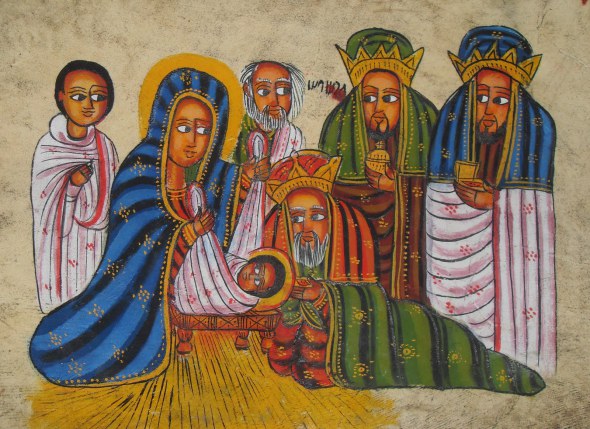
Our Gospel reading—and presentation this morning—comes to us from the first chapter of the Gospel of Luke. We look on with Mary, the teenaged girl engaged to Joseph, when she has a heavenly visitation. This Annunciation, or visit from the angel Gabriel, has been the subject of paintings, stained glass windows, mosaics, and other forms of artwork for centuries. About as long as the Gospel of Luke has been written down.

In many of these paintings, the teenaged girl Mary often looks relaxed and comfortable. She’s holding a book, she’s sewing, she’s arranging flowers, she is hardly startled at all. [1] Consider this situation another way. What are the first words out of the angel Gabriel’s mouth? “Do not be afraid, Mary!”

Look at another picture of Mary and the angel Gabriel, in the modern-day image of the Annunciation painted by Benedictine priest, John Giuliani. “In his rendition of the Annunciation, Have No Fear, Father Giuliani depicts Gabriel coming down from heaven, feet first, aimed right at Mary’s face, with a stem of lilies outstretched like a sword. For her part, Mary nearly falls out of her chair as she shields her face from Gabriel’s descent. The chair is pushed back on only two legs, swept over by the force of the messenger’s entry into time. It’s not as pretty a picture as the ones on Christmas cards, but it might be more accurate.” [2]

Before we go further into this Gospel reading, we need to consider Mary. A teenaged girl, can we even consider how frightened Mary must have been after she was greeted this way by a heavenly visitor, an angel? I am not sure, but I suspect I would have been at least as frightened as Mary at the totally unexpected visit of the angel.  How do you think you might feel if an angel appeared to you?

The separate branches of the Christian faith think of Mary in different ways.

I grew up on the northwest side of Chicago. For me, surrounded as I was by Roman Catholics, I knew that Catholics considered the Virgin Mary to be an extra-special woman. It was not until years later that I learned exactly how: “for Roman Catholics, Mary is a Co-Redeemer with Christ whose job description is to act as a go-between with us sinners on earth and God in heaven. During the Middle Ages, Mary became important in the prayer lives of the common folk, as one who could empathize with their plight and mediate forgiveness. In the councils of the Church through the centuries, she gradually gained supernatural qualities.” [3]

Again, we are getting way ahead of ourselves! Here in Luke chapter one, Mary is still a teenager. The angel Gabriel has just left. She travels to see her older cousin, and now we come to another great picture from the life of Mary. We have the Visitation of the Virgin Mary with her cousin Elizabeth, another picture that has been painted countless times throughout the centuries.

Women are so often overlooked, when we consider the Bible. In both the Old and New Testaments, as well as in general society, women are forgotten, ignored, shunted aside, and treated as second-class citizens. That is, unless we are reading the Gospel of Luke. Luke lifts up the characters of Mary and Elizabeth, and provides a memorable exchange.

“God is already at work to overturn the world’s structures and expectations.” [4]

At our neighboring church here in Morton Grove, St. Martha’s Catholic Church and Shrine of All Saints, we would discover something else about Mary—and about her cousin Elizabeth, and about many women of many periods and cultures. We would see that in many pictures at St. Martha’s Church, each woman has a covering on her head. Similar to certain cultural standards of dress today, many religious women cover their heads. Like religious Christian women today—like many Catholic nuns, and like many Orthodox women all over the world. We have religious Jewish women who cover—like observant married Jewish women. And, we know some observant Muslim women today, here in our area as well as in other places, cover their heads. They wear hijab. Head coverings. Just like Mary and Elizabeth did.

Returning to the many pictures and other artworks that portray the Virgin Mary, many of them show Mary interrupted from reading. A book is something that has been in pictures of Mary for centuries. Mary remembered as a literate young woman.

What a wonderful thing to tell our children and our children’s children! We have it on good authority that Mary could, indeed, read. Many Jewish women of that time could, unlike their contemporaries in other places. What a wonderful opportunity for the young Jesus to have both an earthly mother and father who were literate and able to teach their children.

Is there anything better that what Gabriel said?  The angel “assured Mary that God’s Holy Spirit would be with her. Even though she was frightened, Gabriel promised that God would take care of Mary. Mary learned from the Bible about God’s love, so she knew that she could trust the words of the angel when he said “Don’t be afraid!” [5]

Mary’s cousin Elizabeth adds some intelligent and insightful comments.  “When Elizabeth says, ‘Blessed is she who believed that there would be a fulfillment of what was spoken to her by the Lord,’ she implicitly contrasts Mary’s trust in God’s power and promise with her own husband Zechariah’s skeptical questioning.” [6]

The high-powered priest Zechariah was skeptical when the angel came to him, a few months before. He asked for proof that the angel’s word was true. In contrast, Mary asked for an explanation of what was going to happen to her, and then gave her willing consent. Zechariah the religious professional doubted God, but Mary the girl from a poor family believed what the angel Gabriel said. “Her trust in God’s word opened the door for God to bless her and to bless the whole world through her. Elizabeth celebrates Mary’s willingness to say “yes” to God.[7]

We know God’s call is not always convenient. And sometimes, God asks us to set aside everything we think we know about reality in order to accomplish the Divine agenda. Such was the case with Mary. Thankfully, we know the end of the story. All of us can listen to the angel when he tells us “Do not be afraid!” Those are good words for all of us to take to heart.


[1] From An Advent Journey: Devotional Guide, Week Three. This curriculum comes from Illustrated Children’s Ministry.

[2] From An Advent Journey: Devotional Guide, Week Three. This curriculum comes from Illustrated Children’s Ministry.

[3] http://www.patheos.com/progressive-christian/mary-reluctant-prophet-alyce-mckenzie-12-17-2012.html  “Mary, the Reluctant Prophet,” Alyce M. McKenzie, Edgy Exegesis, 2012.

[4] http://www.workingpreacher.org/preaching.aspx?commentary_id=2723  Judith Jones

[5] From An Advent Journey: Devotional Guide, Week Three. This curriculum comes from Illustrated Children’s Ministry.

[6] Ibid.

[7] http://www.workingpreacher.org/preaching.aspx?commentary_id=2723  Judith Jones


(A heartfelt thank you to An Advent Journey: Devotional Guide. Some of these sermon ideas and thoughts came directly from this guide.  I appreciate this intergenerational curriculum, which is the basis for my Advent sermon series. This curriculum comes from Illustrated Children’s Ministry. Thanks so much for such great ideas!)

@chaplaineliza

(Suggestion: visit me at my regular blog for 2017: matterofprayer: A Year of Everyday Prayers. #PursuePEACE – and my other blog,  A Year of Being Kind . Thanks!)

Unknown's avatar

Prepare!

“Prepare!”

Mark 1-3 prepare, road

Mark 1:1-8 (1:3) – December 10, 2017

This is the second weekend in December, a time of year that many people consider festive, merry and bright. The holidays here in America—with Christmas quickly approaching—are associated with tinsel, holly, and bright lights. Chestnuts roasting on an open fire, silver bells, and jingle all the way.

But, that’s the secular way of welcoming the holidays. When we think of religious Christmas carols, we can remember O Little Town of Bethlehem, Angels We Have Heard on High, The First Nowell, and O Come, All Ye Faithful.

Except…it isn’t Christmas yet. We are still on the second Sunday of Advent. We are still preparing our hearts and minds for the coming of the Baby in Bethlehem. Sort of like in George Frederick Handel’s “Joy to the World,” Isaac Watts’s verse “Let every heart prepare Him room.”

The first two Sundays in Advent are more prophetic in tone. The bible readings for these two weeks look at prophecy referring to the coming of the Lord. In the case of the Apostle Peter, he is talking about the second coming of our Lord Jesus. The Gospel reading from the first chapter of Mark is about the forerunner of the Lord, John the Baptist. Mark starts off this gospel with “The beginning of the good news about Jesus the Messiah, the Son of God, as it is written in Isaiah the prophet.”  John the Baptist cries, “Prepare! Prepare the way of the Lord!”

What are we supposed to prepare, anyhow? That was always a question I asked myself.

Let’s back up. We learn more about John the Baptist from the Gospel of Luke. He was Jesus’s cousin. We know about John because his older mother Elizabeth was pregnant at the same time as the young Mary, the mother of Jesus. I suspect John and Jesus grew up fairly close to one another, perhaps even seeing each other on a regular basis.

What about the people at the time of the John the Baptist and his ministry, in the first century? What did they think of him? John comes across as—what some today might call—a lunatic or crazy person. Some homeless guy, spouting weird religious stuff about the coming of the Lord, or something. Really wacko, and not very appealing. Look at what he wears! Look at his weird diet, too!

John had quite a prophecy to live up to, as well. Listen to what Isaiah the prophet has to say! “I will send my messenger ahead of you, who will prepare your way”— “a voice of one calling in the wilderness, ‘Prepare the way for the Lord, make straight paths for him.’”

Yes, we can compare John to one of those doom-and-gloom prophets with a long, bushy beard. We might see them in cartoons, walking around a downtown area with a large sign that says “Repent! Prepare! The end of the world is near!”

I know I’ve heard street preachers downtown who preach fire-and-brimstone messages, warning everyone of the judgement to come, telling people to clean up their acts. Isn’t this similar to what John was preaching? Telling people to repent and to prepare for God’s coming?

Although, God did not just send a preacher like John the Baptist one time only, two thousand years ago. No, God regularly sends those preachers into our lives today to remind us that God’s arrival is indeed just around the corner.

What’s more, we hear from one of those preachers in the New Testament lesson for the Second Sunday of Advent. In Eugene Peterson’s great modern translation “The Message,” the apostle Peter asks, “Since everything here today might well be gone tomorrow, do you see how essential it is to live a holy life?” [1]

Living a holy life? That is exactly what John the Baptist wanted people to do, too. That is why he told people to clean up their hearts, and clean up their lives. Prepare! Get ready! John told people they had forgotten how to live like God’s people and needed to make changes. So, he baptized people who heard him, changed their minds and hearts, and wanted to make those changes permanent in their lives. [2]

We know that many people did change their hearts and minds, and did start living the way God wanted them to live, back in the time of John the Baptist. We know that many people repented and got baptized as an outward sign that they were repenting, and that God forgave their sins.

There are certain people who do not want to change. Certain people are stuck in their imperfect but familiar ruts, stuck doing the same thoughtless things, saying the same hurtful words, thinking the same inconsiderate thoughts. Everyone remembers Ebenezer Scrooge, from Charles Dickens’s story A Christmas Carol? Remember how mean and sour and nasty Scrooge was? He had absolutely no intention of changing his ways and becoming a kinder, more compassionate person—becoming more Christlike.

The people who John baptized certainly wanted to change, and they told John the Baptist so. They had a change of heart, and turned around to go a different way. They were preparing for the coming of the Lord. They were preparing the way for the Lord to work in their hearts, minds and lives. Can we do the same thing in our hearts, minds and lives, today? Or, will we cry, “Bah, humbug!” with Ebenezer Scrooge and continue on our stubborn way, away from God?

Another aspect of Scrooge’s life bears looking at. Another of Ebenezer Scrooge’s problems was that “he thought everything he had – his money, his possessions, his business – were the things that brought meaning to his life.” [3] The Ghosts of Christmas Past, Present and Future could be viewed as preachers. They came to him that evening and reminded him that all of those earthly things could be gone tomorrow. Sure, Scrooge had prepared all his earthly assets, but he had not prepared the inner sanctuary of his heart.

In the first century, in our Gospel lesson today, John the Baptist encouraged the crowds to prepare for the coming of the Messiah. We have preachers today to encourage us to do the same thing. We have the witness of conscience and the Holy Spirit to do the same thing—encourage us to change. By repenting; literally making a 180 degree turn. By stopping dead in our tracks, like old Ebenezer, and re-evaluating the course of our life.

What is more, John promised that someone was coming from God who was going to be very important. John told people that they could change and that Jesus would give them even more power to make even bigger changes.

What about us, here and now? We can hear the call of John the Baptist. We can prepare for the coming of the Messiah. We can prepare Him room, just as the Christmas Carol “Joy to the World” tells us. We can prepare the sanctuary of each of our hearts to welcome the Baby in Bethlehem who is our Lord and Savior Jesus Christ.

Won’t you prepare the way?

[1] From An Advent Journey: Devotional Guide, Week Two. This curriculum comes from Illustrated Children’s Ministry.

[2] http://worshipingwithchildren.blogspot.com/2014/11/year-b-second-sunday-of-advent-december.html

Year B – The Second Sunday of Advent (December 7, 2014)

[3] From An Advent Journey: Devotional Guide, Week Two. This curriculum comes from Illustrated Children’s Ministry.

(A heartfelt thank you to An Advent Journey: Devotional Guide. Some of these sermon ideas and thoughts came directly from this guide.  I appreciate this intergenerational curriculum, which is the basis for my Advent sermon series. This curriculum comes from Illustrated Children’s Ministry. Thanks so much for such great ideas!)

@chaplaineliza

(Suggestion: visit me at my regular blog for 2017: matterofprayer: A Year of Everyday Prayers. #PursuePEACE – and my other blog,  A Year of Being Kind . Thanks!)
Unknown's avatar

Keep Awake!

“Keep Awake!”

mark 13-26-artistic-christian-clouds-

Mark 13:24-27 (13:27) – December 3, 2017

How difficult it is to keep watch! Imagine how hard it is when you know the estimated time of arrival. There is even an acronym for this—ETA. We know about the estimated time of arrival of planes and trains and buses. People give relatives and friends their estimated time of arrival if they are traveling a long way. It is the polite thing to do, even courteous and helpful thing to do. Just so that the people on the receiving end know when visitors or relatives will be arriving.

We know when the Baby in Bethlehem arrived. Two thousand years ago, that’s when! God the Son, the baby Jesus, God made flesh, was born into this world as a helpless Baby a little more than two thousand years ago, as foretold in Bethlehem. He was born into an oppressed people group, in a land that was under occupation, under a conquering power; born to a young woman and her fiancé with very little money, power, or other prestige.

This is the first Sunday of Advent, the weeks the Church sets aside to wait quietly, expectantly, for the Baby in Bethlehem to be born. Yet, these first two weeks of Advent also give us a look at the future: predictions and promises for the second coming of Jesus Christ.

Here in our Gospel reading from Mark this morning, Jesus is asked about the timing of the second coming. When will this mysterious time come about?

Jesus—as is so often the case—does not give a direct answer. Instead, listen to His first example: “24 “In the days after that time of trouble the sun will grow dark, the moon will no longer shine, 25 the stars will fall from heaven, and the powers in space will be driven from their courses. 28 “Let the fig tree teach you a lesson. When its branches become green and tender and it starts putting out leaves, you know that summer is near. 29 In the same way, when you see these things happening, you will know that the time is near, ready to begin.”

Sure, the people of Jesus’s time were wondering when Messiah would return. When, Jesus? Please, just tell us when! How similar is that to our own time. Many, many people are dissecting both the Hebrew Scriptures and the New Testament writings. They, too, ask when Messiah is going to return the second time? When, Jesus? Please, just tell us when!

Next, Jesus gives His listeners a parable about a householder and his servants. As the Rabbi Jesus says in our Gospel reading today, “34 It will be like a man who goes away from home on a trip and leaves his servants in charge, after giving to each one his own work to do and after telling the doorkeeper to keep watch.”

We know that Jesus often tells His listeners stories about everyday things, with a twist. Somehow, Jesus uses these common, ordinary things to communicate powerful truths. In this parable, we see a bunch of servants working for a boss with a large household, a large piece of property. The boss goes away on a long journey, and his employees do not know when he will be back.

What would people at your workplace do in a situation like that, with the big boss gone for a really long time? Would your fellow employees continue working hard? Or, would some of them start fooling around? Maybe stop working altogether? How might you react, if this happened to you, or to someone you knew? Again, what would you do?

 Jesus totally skips over that part about exactly when the Messiah is coming back.

Instead, Jesus commands His listeners to “Keep watch!” Let’s look more closely at this story. We are not only supposed to wait expectantly, but we need to be alert. Not just to stand around and twiddle our thumbs like a bunch of do-nothings and know-nothings. Each servant—or employee has their own job to do. Each servant—or employee has an assigned task. The door-keeper has just about the most important job of all of them, which is to stay alert and to keep watch, no matter what. Keep an eye on things, and when the big boss unexpectedly returns, we are warned not to cut back or sleep or lie down on the job.

Let us consider today, in modern-day United States. When we think of Advent, what comes to our minds? Advent wreaths? Advent get-togethers after work or on the weekends? Maybe school holiday productions incorporating Advent?

Dr. David Lose, one of my favorite commentators, said “Each and all of it can be wonderful, and each and all of it can become rather overwhelming. So perhaps we might invite folks to make a short list – whether in their heads or on paper – of a few of the things that will occupy their Advent.[1]

What are you going to do for Advent? How are you going to get ready? How are you going to watch and keep awake?

I am not sure about anyone else here, but my December activities are threatening to become overwhelming. Can anyone else relate? Does anyone else have any idea about vulnerability and connecting with others?

The Church around the world is told to keep watch diligently. And then, “to think about how in each of those events and activities they might be more attentive to the vulnerability and need of those around them and more honest and open about their own need that they might receive the care of others.” [2]

Now, wait a minute, Jesus! I thought Advent was a time for us to wait and watch? A time for Advent calendars and Advent wreaths? I wanted to sit quietly in my corner and watch from the comfort of my easy chair. I did not want to step out of my comfort zone!

Guess what? The landlord—the big boss—has given all of us our jobs to do. In last week’s Gospel reading from Matthew, we are to welcome the stranger, feed the hungry, clothe the poor, and visit the people in hospitals and in prison. Yes, this may be a lot for us to take in. However, the commands of Jesus are pretty important! Don’t you think we ought to sit up and pay attention to His commands?

Jesus and His commands can lead us in new directions. Pastor Janet Hunt makes the following suggestion: “knowing that it will all one day end can also set us free, can’t it?

  • Free to speak words of truth and hope and love.
  • Free to reach out in generosity and kindness.
  • Free to forgive what before seemed unforgivable.
  • Free to let go of what we thought we would always need.” [3]

What an exciting opportunity to truly be what Jesus—the householder—the big boss—is calling each of us to be. “How do we “keep awake” in this kingdom time of already-not-yet? Simply by being faithful to the tasks God has given us to do – the tasks of kindness, mercy, justice, faithfulness, and love.” [4] When we are faithful in these things, we will become more and more like our Lord and Savior Jesus Christ.

Maranatha! Come, Lord Jesus!


[1] http://www.davidlose.net/2014/11/advent-1-b/  “Preaching a Participatory Advent,” David Lose, …in the meantime, 2014.

[2] Ibid.

[3] http://dancingwiththeword.com/raking-in-the-dark/  “Raking in the Dark,” Janet H. Hunt, Dancing with the Word, 2017.

[4] From An Advent Journey: Devotional Guide, Week One. This curriculum comes from Illustrated Children’s Ministry.

(A heartfelt thank you to An Advent Journey: Devotional Guide. Some of these sermon ideas and thoughts came directly from this guide.  I appreciate this intergenerational curriculum, which is the basis for my Advent sermon series. This curriculum comes from Illustrated Children’s Ministry. Thanks so much for such great ideas!)

@chaplaineliza

(Suggestion: visit me at my regular blog for 2017: matterofprayer: A Year of Everyday Prayers. #PursuePEACE – and my other blog,  A Year of Being Kind . Thanks!)

Unknown's avatar

For the Least of These

“For the Least of These”

Matt 25-35 for whatever, words

Matthew 25:31-46 (25:40) – November 26, 2017

This Sunday—today—is the last Sunday in the liturgical year. This Sunday is also called Christ the King Sunday. We celebrate and lift up the might of the exalted Lord Jesus Christ today! Dominion, honor, power, authority, glory, majesty! Crown Him with many crowns! Praise to the Lord, the Almighty, the King of creation!

We have many marvelous hymns we can choose from for today. I love many of the words and tunes of the hymns that refer to our Lord Jesus having all power and authority in heaven and on earth, being King and ruler of the universe, and all creation.

I think all of us are familiar with the stories Jesus tells in His ministry, featuring real life situations. The Rabbi Jesus tries to get His listeners to understand some deeper truths through these stories, or parables. Jesus Himself talks about an all-powerful King at the end of the world, in this final parable from Matthew 25. The all-powerful King from this parable is the exalted Lord Jesus, ascended to heaven, as we declare every time we say the Apostle’s Creed.

As we did two weeks ago, let’s pull back from this particular parable, and look at the larger situation where the Rabbi Jesus tells it. This is midway through Holy Week in Jerusalem, where Jesus is being asked when the end times will come. That’s why He gives this long discourse called the Olivet Discourse, several chapters long in Matthew’s Gospel. Similar to now, people all through the centuries have been aware that the Bible has certain mysterious, even unclear prophecies concerning the end times, just before when the Messiah will come.

However, something does not fit. Something is very puzzling about this parable.

Here in Matthew 25, we have the exalted Lord Jesus, the almighty King eternal, sitting in judgment over all the peoples of the earth.

At first reading, even at second, third, tenth or twentieth reading, this final parable from Matthew can be really scary. Just like in the reading from the Hebrew Scriptures, from the prophet Ezekiel, all sheep and goats are separated, just as all the people from every nation in the world are separated. All people are divided into two groups: those who the King is pleased with, and those who the King is not pleased with.

The people listening to Jesus in Jerusalem that day were extremely puzzled. Scratching their heads, they might have said, “Rabbi, you just don’t make any sense.” Especially the people who had followed Jesus for months might have been particularly lost. Things just don’t add up!

On one hand, we have Jesus, the caring, nurturing Shepherd. This is what the prophet Ezekiel starts off with in our reading today. In many parables, in many situations throughout His ministry for three years, Jesus has shown Himself to be loving, caring, gentle, and welcoming to everyone—no matter who, no matter what.

But, wait. Let’s go back to this final parable from Matthew, where the King at the end of all time is talking to the vast assembly of people from every nation, tribe and tongue. Let’s remind ourselves of the words of the Son of Man: “Then the King will say to the people on his right, “Come, you that are blessed by my Father! Come and possess the kingdom which has been prepared for you ever since the creation of the world.  I was hungry and you fed me, thirsty and you gave me a drink; I was a stranger and you received me in your homes, naked and you clothed me; I was sick and you took care of me, in prison and you visited me.”

I am certain that many people listening to Jesus and His parables were absolutely floored by these words. What on earth are You talking about, Jesus?

Dr. David Lose said, “When we think of God, we typically think in terms of power and might and glory and all the rest. And, indeed, the [final] parable begins by describing the coming of the Son of Man in glory to sit on his throne attended by angels, seemingly only reinforcing our preconceptions.” [1] This word picture is absolutely the picture we associate with Christ the King Sunday, with dominion, honor, power, authority, glory, and majesty!

Yet, we also see a loving, caring, nurturing Shepherd, as expressed by our Lord Jesus Himself any number of times during His ministry. And, there are glimpses of that Shepherd here in the parable, too. We have two different, disparate, even disconcerting pictures of Jesus here. What gives? Which is the real Jesus? What is going on here?

The people in the parable are puzzled, too. Let’s listen to their reaction: “When, Lord, did we ever see you hungry and feed you, or thirsty and give you a drink?  When did we ever see you a stranger and welcome you in our homes, or naked and clothe you?  When did we ever see you sick or in prison, and visit you?”

As if the two very different pictures of Jesus are not enough, the King in the parable adds a third. I tell you, whenever you did this for one of the least important of these members of my family, you did it for me!”

Here, Jesus tells us He is right with the chronically hungry and thirsty. He is among the strangers and refugees. He is among the indigent poor and sick, and is right there with the many hundreds of thousands all across the world who are in jail. Jesus, the Son of Man, would rather hang out with the bums on Skid Row rather than with the fancy people in their religious country clubs or with the fine Pharisees in their first-rate houses of worship.

Does anyone else feel challenged when they hear these serious words of Jesus?

As Dr. Lose tells us, “No one expects to see Jesus in the face of the disadvantaged, the poor, the imprisoned, and all those who are in manifest need.” [2]

Jesus gives us a judgment scene in this final parable. This is a cautionary scene described here, at the end of all time. Here, in this parable from Matthew, we have three separate pictures of Jesus. Yes, He is the King! All honor, power, majesty and glory be given to Him! Amen! Yes, Jesus is the Gentle Shepherd, the loving, caring, nurturing one who gathers the lost lambs into the fold. And, third, our Lord Jesus is seen in the faces of those who are difficult to love, and a challenge to care for.

Jesus shows up in those unexpected places, in the concrete and real needs of our neighbors next door, and around the world. But, you and I are not at the end times, yet. We can take action, and see the face of Jesus in others around us. The disadvantaged, the poor, the imprisoned, and in need.

Jesus calls us to serve others. By serving others, we will be serving—loving—caring for Jesus. How can we serve Jesus, today? How can we help others? How can we extend our hands and hearts to be loving, caring and giving, today? The best part? God will be right by our sides as we extend our hands to serve and care for others. And, God promises to change us from the inside out as we extend our hands—our hearts—ourselves—to others.

Here, in this final parable, Jesus the King tells us He is right with the vulnerable, the unlovely, the indigent, those difficult to love and those who are such a challenge to care for.

Next week, we will begin the liturgical year with the season of Advent, those weeks when we await the coming of the Baby in Bethlehem at Christmas. We await the mystery of the Incarnation, of the Eternal Almighty God the Son emptying Himself and becoming a baby. Becoming vulnerable, becoming human. Just like us.

Maranatha. Come, Lord Jesus.


[1] http://www.davidlose.net/2014/11/christ-the-king-a/ “The Unexpected God,” David Lose, …In The Meantime, 2014.

[2] Ibid.

(A heartfelt thank you to An Illustrated Compassion: Learning to Love Like God. Many of these sermon ideas and thoughts came directly from this series.  I appreciate this intergenerational curriculum, which is the basis for my summer sermon series on compassion. This curriculum comes from Illustrated Children’s Ministry. Thanks so much for such great ideas!)

@chaplaineliza

(Suggestion: visit me at my regular blog for 2017: matterofprayer: A Year of Everyday Prayers. #PursuePEACE – and my other blog,  A Year of Being Kind . Thanks!)
Unknown's avatar

Thanksgiving to God

“Thanksgiving to God”

2 Cor 9-11 thanksgiving, words

2 Corinthians 9:6-11 (9:11) – November 19, 2017

Today, the Sunday before Thanksgiving, many people across the United States celebrate as Thanksgiving Sunday. “According to the Internet there are 12 nations – large and small – who celebrate in one form or another their nation’s Thanksgiving Day; whilst other forms and styles of celebration include local “Harvest Thanksgiving” services.” [1]

Both scripture readings this morning feature words of gratitude and thanks to God for giving us our many blessings, and specifically for the blessings of the harvest. First, our psalm for this morning lets us know God has provided so much for us to enjoy. Not only the bounty of the harvest, but more than that. Our Psalmist lets us know God has made the earth and water, and everything else, and provides everything for humanity’s benefit.

Let me read again from Psalm 65: “You, God, soften the earth with showers and bless its abundant crops. 11 You crown the year with a bountiful harvest; even the hard pathways overflow with abundance. 12 The grasslands of the wilderness become a lush pasture, and the hillsides blossom with joy. 13 The meadows are clothed with flocks of sheep, and the valleys are carpeted with grain. They all shout and sing for joy!”

All this bounty is considered to be given to humanity to enjoy. All the harvest and bounty that this psalm celebrates is what the apostle Paul talks about in his letter to the church in Corinth, too. Except, Paul goes one step further.

When we read Paul’s suggestions in this passage today, he urges the believers in Corinth to be generous. Sure, in Paul’s previous letter, in 1 Corinthians, the people from that church were collecting for the poor and persecuted Christians in Jerusalem. Now, with this updated message to Corinth, Paul praises the church for continuing with the collection for the saints in Jerusalem, and urges them to be generous. He broadens his suggestion and encourages them to give gifts freely. “Each of you should give what you have decided in your heart to give, not reluctantly or under compulsion, for God loves a cheerful giver.”

What about that last phrase, anyway? “God loves a cheerful giver.” Sure, Paul is urging his fellow Christians to be generous. However, this goes over and above mere giving of alms, or slipping a dollar in a panhandler’s cup, or even a five-dollar bill in the Salvation Army kettle in the holiday season. Paul lets us know we ought to give cheerfully (Gr. hilaron), or “hilariously,” in the sense of very joyfully. But, he doesn’t want us to throw our money around needlessly. And, not in the sense of thoughtlessly, either.

Money, charity, and giving are discussed in the Bible in several places. I will highlight one: “cheerful” givers always receive God’s loving approval (Prov. 22:8). So, God wants all of us to be cheerful, generous, and open-hearted.

There is a problem here, and Paul mentions it. “Remember this: Whoever sows sparingly will also reap sparingly, and whoever sows generously will also reap generously.”

One of my favorite bible commentators, Bob Deffinbaugh, writes “Some people simply do not enjoy being generous. It causes them great pain to give up more of what they possess in order to bestow it upon someone who needs it more than they do. Once I suggested to a friend who was dying that she give away some of her possessions while she was alive, so that she could enjoy the act of giving while she was still alive. I had seriously misjudged the situation. This woman did not want to give anything away before she died, because she found no pleasure in giving. Only after her death, when she could keep her possessions no longer, would she reluctantly will them to someone else. How sad.” [2]

This is a cautionary tale for all of us. Certainly, the idea of reluctantly giving away money or worldly goods is something most of us associate with Ebenezer Scrooge of Charles Dickens’s Christmas Carol fame. I know very well that there are great numbers of people who only give “grudgingly.”

So many people love their stuff, don’t they? Or, if not “stuff,” then they are awfully attached to their money, or even their time. Some might hate to part with anything of value, period.  And, especially, “We should not give because we feel there is no alternative, or because we think others will look down on us if we fail to give.” [3] It’s sort of tGod’swisted and perverted, and just like the Pharisees. That is the exact opposite of the reason Paul tells us to give.

As Bob Deffinbaugh relates, “To use an analogy our Lord employs, when we see a brother who has no coat, we don’t have to own a coat factory; all we need is two coats (see Luke 3:11). The reason we may not have the means to give to the poor is because we have not sown from that which we have in order to reap more to give. We, like the widow who cared for Elijah, may need to give first to those in need, and then look to God to supply our needs.” [4]

We can follow Paul’s words and suggestions, and ask—how would we celebrate God’s blessings to us? How could we give thanks? Like I suggested to the children earlier today, we can be generous. Give of what we have. If we have a little extra food or canned goods or pasta, give that. If we have an extra coat, give it to a coat drive. If we have some free time, volunteer or donate that. If God has been good to us and we have some extra money, be generous with whatever God has blessed us with.

When my husband and I were hiking through a state forest some years ago, we came across a stream. The path turned and followed the bubbling, flowing stream. As my husband and I continued walking, we came to a little waterfall, where the water bubbled and traveled downward from one level to another, and then went rushing along its merry way. I think of giving like this. Paul lets us know that generous giving flows out of God’s generosity to us. If we dam up that trickle of giving, we might end up with a backload of water that can’t flow, can’t run free and clear, and cannot transmit God’s blessings to others.

When we understand that everything—every single thing!—we have comes from God, it is much easier to share what we have with others. God supplies both the seed and the harvest. He is the one who makes us rich so that we might be generous on every occasion. Our giving is a demonstration of thanks to God. We thank God for what God has given us by giving it away!

And, what is the final point of Paul’s suggestion? What is the most wonderful thing God gives us? Praise the Lord for God’s unmatchable, unspeakable, unsurpassable Gift—Jesus Christ! Jesus and the grace He freely gives to us is the reason we give to others.

We give thanks that our generosity is rooted in the generosity of our God in the person of our Savior, Jesus Christ. We can say “Happy Thanksgiving,” indeed.

Amen, alleluia.

[1] http://www.thetimelesspsalms.net/w_resources/pentecost23[30]c_2016.htm

The Timeless Psalms: Psalm 65, Joan Stott, prayers and meditations based on lectionary Psalms, 2016.

[2] Religious Affections: A Study of Paul’s 2 Corinthian Correspondence 12. Keeping Your Commitments (2 Cor. 8:16-9:15) https://bible.org/seriespage/12-keeping-your-commitments-2-cor-816-915  Robert L. (Bob) Deffinbaugh, Th.M.

[3] http://soniclight.com/constable/notes/pdf/2corinthians.pdf

2 Corinthians, Expository Notes, Dr. Thomas L. Constable, Dallas Theological Seminary, 2005 edition.

[4] Religious Affections: A Study of Paul’s 2 Corinthian Correspondence 12. Keeping Your Commitments (2 Cor. 8:16-9:15) https://bible.org/seriespage/12-keeping-your-commitments-2-cor-816-915  Robert L. (Bob) Deffinbaugh, Th.M.

@chaplaineliza

(Suggestion: visit me at my regular blog for 2017: matterofprayer: A Year of Everyday Prayers. #PursuePEACE – and my other blog,  A Year of Being Kind . Thanks!)

Unknown's avatar

Keep Watch!

“Keep Watch!”

Matt 25-12 I know you not

Matthew 25:1-13 (25:13) – November 12, 2017

Just two weeks ago, St. Luke’s Church had its big fall Spaghetti Dinner fundraiser. This dinner took quite a bit of planning and preparation. Just ask anyone who worked on planning, preparing, serving, or cleaning up. And, another big thank you to all of those who planned, worked, or ate at the Spaghetti Dinner. It all was much appreciated!

I am a person who is not naturally a planner. Or, rather, I was not the person who would be so very prepared. You know that sort of person. They always plan way in advance. They always bring more supplies, buy plenty of food, and especially are always there in plenty of time, for any occasion. I admire these people. Over time, I have learned how to copy certain aspects of their planning and preparation. However, I am not naturally one of these super-prepared people.

To recap from our scripture from Matthew 25, there are a bunch of young women—strictly speaking, the text calls them “virgins.” They are to accompany the bridegroom and the rest of the bridal party as he travels to the bride’s home, picks her up, and they all go to a large banquet hall to celebrate the ceremony. This was a common feature of weddings in that part of the world, and still is in places around the world, today.

Jesus’s parable from Matthew 25 is all about being prepared. Doing some advance planning. And, at face value, it seems really unfair.      As Dr. David Lose (one of my favorite commentators) said, “All the bridesmaids brought oil, all waited, all fell asleep. And the decision about who gets in comes down to who anticipated the bridegroom would be this incredibly late and so brought more oil. Okay, so maybe it’s not unfair. Maybe it’s just that I’m pretty darn certain that I would have been among the foolish bridesmaids.” [1]

Oh, Dr. Lose, I relate so much! I fear I would have been among the foolish bridesmaids, too! I am afraid I may not be welcomed to the wedding banquet, either.

I have a confession to make. I have never preached a sermon on this parable before. I have always been leery of it. Or afraid of it. I wrestled with the idea of preaching on this parable, and felt convicted by God. So, I decided—with God’s help, when this reading came up as a lectionary Gospel reading that I would definitely preach on it.

Let’s pull back from this brief parable, and look at the larger situation where the Rabbi Jesus tells it. This is sometime midway through Holy Week, where Jesus is being asked when the end times will come. That’s a big reason why He gives this long discourse called the Olivet Discourse, several chapters long in Matthew’s Gospel. Similar to now, people all through the centuries have been aware that the Bible has certain mysterious, even unclear prophecies concerning the end times, just before when the Messiah will come.

Jesus “lets them know that there will be signs, terrible signs, that will give people clues that the end is coming, encouraging them not to listen to idle rumors, but to trust His words. The parable of the bridesmaids compares the listeners to [bridesmaids], entrusted with a role,” [2] while waiting for the bridegroom to come.

Preparation and planning are often mixed up with waiting. Sure, we can plan the menu for a big dinner, and purchase the food for the big event. We prepare everything for the festive table, and get the table centerpieces and flowers and everything else. But sometimes, waiting is somehow involved in this process. Waiting for God to show up. How long do we wait? That was just what the disciples were anxious and worried about. That was one big reason why Jesus told several parables in this particular discourse.

A story one commentator told happened several years ago. Dr. Karoline Lewis relates: “My father-in-law was a World War II veteran and he died a year ago this past April at the age of 96. In the twenty-three years I have known my husband, it was only in the last few that Sam [my father-in-law] ever talked about the war. The last time I saw him was at his bequest to have as many of his grandchildren present, not necessarily for a final goodbye, but as you know, people can sense that death is soon. Of course, that truth elicits its own sense of what waiting is like.

“That day, Sam talked about the war. He talked about the waiting. You see, he had been selected, singled out, not to be sent to the front, but to stay behind. Why? He was good in math. He showed us his notebook in which he had calculated multiple ballistic measurements. And as he worked on his equations, he waited for his fellow soldiers, his friends, to return. Some did. Some did not. He could not understand how he was spared. Yet in the waiting and the wondering he knew God was there, and there was nothing else he could do but trust that truth.” [3]

I wonder how many of us can trust God when we are waiting and wondering? I wonder how many of us continue to have faith in God when things just don’t seem to make any sense? Like in the case of difficult scripture passages like this one, this parable from Matthew where the bridegroom—Jesus—sends the five foolish, unprepared bridesmaids away, not allowing them in to the wedding banquet?

All these bridesmaids were waiting. (As do we. We wait for Jesus to return, and we—the church—have been waiting for centuries.) Five of these bridesmaids were prepared, and had enough oil. Five did not. We can compare that to having extra batteries for your flashlight, like I told the boys during the children’s time before the sermon. But today’s parable does not highlight a shortage of oil for the lamps. No, the oil is plentiful. There is more than enough oil. However, the five bridesmaids forget they are going to need the oil. [4] I sometimes forget I need oil—which God bountifully supplies. Do you sometimes forget, too?

I want to highlight verse 13, where Jesus says “Therefore, keep watch, because you do not know the day or the hour.”

Yes, there is pain, suffering, loss, grief, sickness, anxiety, and all manner of other difficult things in this world. We are not certain when God will show up. Yet, we can glean some words of advice from this parable: Be prepared. Plan. Watch. Keep awake. And, wait.

“If only we will remember that we have a steady supply of precious ‘oil’ to help light our way. For we have already have Jesus as we await the ‘bridegroom’s’ return.’ We already have Jesus. If only we will pause long enough to recognize and receive this precious gift, it is already ours. All we have to do is fill our lamps.” [5]

We all have been called to lift our lamps—our lights—and lift them high, shining as signs of promise and hope in a dark world with little hope or brightness or light in it. The oil is provided for us. Jesus encourages us to lift our lights in an often dark world.

Indeed, isn’t this what the world needs most of all?


(A big thank you to David Lose, Liz Milner, Karoline Lewis and Janet Hunt for their helpful writings as I wrestled with this challenging text from Matthew 25.)

[1] http://www.davidlose.net/2014/11/pentecost-22-a/  “Hope and Help for Foolish Bridesmaids,” David Lose, …in the meantime, 2014.

[2] https://www.journeywithjesus.net/essays/1534-my-bad-dream  “My Bad Dream,” Liz Milner, Journey with Jesus, 2017.

[3] http://www.workingpreacher.org/craft.aspx?post=3413  “How To Wait,” Karoline Lewis, Dear Working Preacher, 2014.

[4] http://dancingwiththeword.com/oil-for-our-lamps/  “Oil for Our Lamps,” Janet H. Hunt, Dancing with the Word, 2017.  November 5, 2017

[5] Ibid.

@chaplaineliza

(Suggestion: visit me at my regular blog for 2017: matterofprayer: A Year of Everyday Prayers. #PursuePEACE – and my other blog,  A Year of Being Kind . Thanks!)

Unknown's avatar

All the Saints

“All the Saints”

Rev 7 multitude white-robes

Revelation 9:7-28 (9:7) – November 5, 2017

Today, we commemorate All Saints Sunday. The first Sunday of November, that day we remember all the saints who are now in heaven, worshiping God in that great cloud of witnesses. We also remember familiar people, relatives and friends known to us, dear to us, who died since last All Saints Day last year. What is it about these formal occasions of remembrance? Often, we remember those who have sacrificed much, displayed tremendous bravery, or were persecuted—even died—at tremendous risk to themselves.

What is it that causes you and me to be listed in among a great multitude of saints like these? Or, aren’t we even to be worthy to be listed on the same page as these rarefied superstar saints? These women and men who followed after God, no matter what?

One of our Scripture readings today comes from the book of Revelation, starting at verse 9: “After this I looked, and there before me was a great multitude that no one could count, from every nation, tribe, people and language, standing before the throne and before the Lamb.”

We break into the narrative as the elderly John has another vision, this time a scene of heaven. And, instead of seeing a predominance of Jews and only a sprinkling of other tribes and people groups, John sees a great multitude of all colors, all ethnicities, all languages and dialects, from every place on the globe.

I am blown away by that vision, the more I think about it. I am in awe, because the great multitude is of every possible description, every possible people group under the sun. Not just me and my family, not just me and the people from the neighborhood where I grew up. Not just people from one region, or one country, or one ethnicity. But, people from everywhere.       These people of the vision are called “saints,” and many people today have only one specific idea of what a “saint” is. St. Francis of Assisi, or St. John of the Cross, or St. Martha—the patron saint of our neighbor Catholic church, or the newly beatified saint, Mother Teresa.

Robert Louis Stevenson, writer of Kidnapped and Treasure Island, has a different definition of “saints.” “The saints are the sinners who keep on going.” And, both apostles Paul and Peter call their friends “saints” in the greetings, to all of the people who receive their letters.

But, we know very well that life often does not go smoothly. Not for us, not for our friends and families, and certainly not for the multitudes who lived in centuries past. Interesting, that “because we sinners are made holy by God’s grace, and not by our own actions, we are able to keep on going as Stevenson says.  Our keeping on in life often involves suffering.” [1] And, if we know anything about history, we know that believers in Christ often had to deal with grief, pain, suffering, and even persecution.

When John received this grand series of visions that he wrote down in the book of Revelation, he was often puzzled. He had to ask the people or elders or angels around him what it was he was seeing. As is the case here: “Then one of the elders asked me, “These in white robes—who are they, and where did they come from?” 14 I answered, “Sir, you know.”

Leading question, you may say! John persuades the elder to answer the question himself. ““they are before the throne of God and serve God day and night in His temple; and He who sits on the throne will shelter them with His presence. 16 ‘Never again will they hunger; never again will they thirst. The sun will not beat down on them, nor any scorching heat.”

It sounds like to me that these people in heaven, who are identified as “saints” in other places in the book, no longer have to go through that valley of the shadow here on the earth, where God walks right by their side as they are in difficulty. They no longer need to face challenges of health reversals or job loss or crushing poverty or horrible accidents, or various calamities of one sort or another. They are at God’s side in heaven, and never have to experience those trials, losses, hunger and anguish any more.

But we are still left on this side of the veil. On this side, on a troubled world where suffering and loss and fear and anxiety rear their heads all too often. Especially grief, where we mourn the loss of loved ones, friends and relatives who left us too soon.

Rev. Janet Hunt talks about a sad situation like this: “And yet, for all of those for whom I light a candle and remember each All Saints Sunday, there is still really just the one I carry closest of all. One whose dying has me yearning most deeply for the promises of this day.

“It came to me again last week when a beloved cousin came to visit. He had stopped to see his folks the night before he flew out and as he sat with them he told his dad he was going to see Kathleen. “You remember Kathleen, don’t you dad? She was Tommy’s wife.” (Kathleen is my mother.)

“Now in these recent years my dad’s brother does not remember as he once did. For a moment last week, though, there was clarity as he remembered his only brother and as he registered all over again the fact that he had died and with that remembering, his face fell along with his tears. And mine did, too, to hear of his remembering.” [2]

Grief, sorrow and loss are like that, sometimes. We can be fine, content, living our lives. Then, out of nowhere it seems, the thought of that special loved one, that dear friend who is no longer with us in this world, comes to mind.

And then, Janet Hunt reminds us, “nothing makes us more grateful than the gift of that time and place so vividly described in today’s words from Revelation. A time and place:

  • where the whole world will gather and join together in song and where we will be washed clean,
  • where hunger and thirst will no longer hold sway,
  • where there will be shelter from all that would harm,
  • where the very water of life will sustain us,
  • and where God Himself will bend low to wipe away our tears.” [3]

Is such a place even possible? In those times when you or I are grieving anew, remembering with sorrow or longing in our hearts, the apostle John assures us that “Salvation belongs to our God, who sits on the throne, and to the Lamb.” And, ““Amen! Praise and glory and wisdom and thanks and honor and power and strength be to our God for ever and ever. Amen!”

In plainer words, from his first letter to the scattered believers in Christ, John gives us further assurance: “Dear friends, now we are children of God, and what we will be has not yet been made known. But we know that when Christ appears, we shall be like Him, for we shall see Him as He is.”

Today, we have a foretaste of heaven from both Scripture readings. Revelation tells us of the wonderful worship service in heaven, where everyone is praising God. And 1 John lets us know that when our Lord Jesus appears to each of us, we shall be like Him in glory.

“So with all of you, I will light the candles this All Saints Day. In memory and in powerful hope we will light the candles. Standing confident in the very promises of God we will light them.[4]

Amen. May it be so. Amen.

[1] https://preachingtip.com/archives-year-a/pentecost-year-a/all-saints-day-all-saints-sunday/

[2] http://dancingwiththeword.com/all-saints-day-in-memory-and-in-hope/

[3] Ibid.

[4] Ibid.

@chaplaineliza

(Suggestion: visit me at my regular blog for 2017: matterofprayer: A Year of Everyday Prayers. #PursuePEACE – and my other blog,  A Year of Being Kind . Thanks!)