Unknown's avatar

Interconnected Gifts

“Interconnected Gifts”

1 cor 12-27 part of the body

1 Corinthians 12:11-31 (12:20) – January 27, 2019

Have you ever seen a Mr. Potato Head? A children’s toy, with a plastic potato body, and different holes you could stick different parts in. Eyes, ears, hat, nose, mouth, hands and feet. Can you imagine a Mr. Potato Head with all hands and no eyes, nose or ears? Or, how about a Mr. Potato Head with several mouths and no feet? I suspect some people would laugh at that children’s toy. Can you hear children saying, “Look at that silly Mr. Potato Head!”

Let’s take a closer look at our Scripture reading for today from 1 Corinthians chapter 12. We have been talking about gifts for the past few weeks. Not only in the weekly sermons, but also in other parts of our worship service, too. Here the Apostle Paul is continuing his discussion on gifts that God gives to every believer. Willingly, generously, God blesses each person with at least one spiritual gifts, and sometimes many gifts. And, as Paul tells us, the Holy Spirit decides who gets what, and when.

Let’s go back to our Mr. Potato Head. We can all see how the different parts fit into the toy. Any child could tell us that we need diverse parts. Eyes, nose, ears, mouth, hands and feet. Eyebrows, too. And mustache, and hat. All different parts, with all different functions.

Reading Paul’s words from 1 Corinthians 12 from Eugene Peterson’s translation The Message, “You can easily enough see how this kind of thing works by looking no further than your own body. Your body has many parts—limbs, organs, cells—but no matter how many parts you can name, you’re still one body. It’s exactly the same with Christ.”

So many parts, many pieces, many functions. And, one body, or one church.  Let’s let the Apostle Paul elaborate: “Each of us is now a part of Christ’s resurrection body, refreshed and sustained at one fountain—his Spirit—where we all come to drink. The old labels we once used to identify ourselves—labels like Jew or Greek, slave or free—are no longer useful. We need something larger, more comprehensive.”

Sounds like the Apostle Paul has already heard about a church or two that has had arguments or disagreements about their spiritual gifts. You would think these individual Christians would be thankful they have been given one special way to identify themselves!

In the past, and even in the present, Christians might identify themselves differently. They could concentrate on separate differences. For example, some of us here were born in the United States, and some were born overseas. There’s one difference. Some of us identify as male, and some as female. Some of us are right-handed. Some of us have brown eyes.

There are lots of ways to identify the people in this room. We could line up under these different signs, Or—and this is the important part—we could all identify as Christians.

What does the Apostle Paul have to say about this very question? Paul approaches differences from a functional point of view. “I want you to think about how all this makes you more significant, not less. A body isn’t just a single part blown up into something huge. It’s all the different-but-similar parts arranged and functioning together. If Foot said, “I’m not elegant like Hand, embellished with rings; I guess I don’t belong to this body,” would that make it so? If Ear said, “I’m not beautiful like Eye, lovely and expressive; I don’t deserve a place on the head,” would you want to remove it from the body? If the body was all eye, how could it hear? If all ear, how could it smell? As it is, we see that God has carefully placed each part of the body right where he wanted it.”

When Paul often talks about church to his friends in Corinth, he means them—the local church. That’s what Paul means right here. He is talking to the local churches. He is talking to me and you. He means St. Luke’s Church, right here on this corner in Morton Grove. Rev. Jeff Campbell, United Methodist minister, says “In the body of Christ, all of us and the gifts that we bring to the church are indeed interrelated. We cannot succeed in our mission of making disciples of Jesus Christ for the transformation of the world, unless we are working together, truly valuing and depending on the gifts that each disciple offers for the good of the whole.” [1]

Some parts of the Bible are confusing or troubling; they don’t make much sense. Strange and mysterious passages! This Scripture reading from Paul is not. It talks common sense. Understandable and clear. But, these instructions are not always simple and easy to follow. Sometimes, something inside does not want us to work together.  Something inside might not want to ask for help, or be willing to be a Good Samaritan, and give help to whoever needs it.

The Rev. Campbell suggests taking a not-so-very official poll, to let us understand a little better what he is talking about here. For the following statements, rate how much you agree or disagree. Be honest! You may keep the answers to yourself. But, try to be truthful, in your heart.

  • It is okay to need another person’s help.
  • All that I need I can provide.
  • Don’t ask me for help. I’ll offer help when I can.
  • I would come close to death before I would consider asking for help.
  • It makes me uncomfortable to ask for help.

This thoroughly unscientific poll reveals a few possibilities:

  • We are uncomfortable being vulnerable.
  • We are uncomfortable asking for help.
  • We don’t have extra time to help. [2]

Asking for help, even in the church, can be a challenge! Accepting help can be difficult, too. All kinds of things can get in the way. As Rev. Campbell says, “When it comes to recognizing the interrelated nature of our gifts, we must come to terms with our own vulnerability and dependency; and we must declare that it is okay to need one another!

“The reality is there are many parts of the body that aren’t always functioning, and those parts often don’t realize how it hurts the whole. This is not about guilt or telling you to do more. No, this is to say — with honesty and love — that we need you and we need one another. God has gifted you in ways that God has not gifted me. I need you to show up and share your gifts, because without your gifts, this body will not function the way it was meant to function.” [3]

Remember that Mr. Potato Head, with all hands, and no eyes, ears or nose? The apostle Paul tells us that everyone—each person in a local congregation has their role, and their gift. It may not be a prominent gift, it may be a humble gift, but every gift has its place. Each Christian has their place in the body of Christ, too.

We all need each other to show up, and to be here as a community, to use our gifts for the glory of God. There is no such thing as a solo, Lone Ranger Christian. We are a community of Christ! Paul reminds us of that blessed fact: mutual care, concern and encouragement of each other, and ministry to those who need to know about the Lord. Let’s get going, and do the work God has intended for us to do!

Alleluia, amen.

[1] https://www.umcdiscipleship.org/worship/season-after-epiphany-2019-part-1-worship-planning-series/january-27-third-sunday-after-the-epiphany-year-c/third-sunday-after-the-epiphany-2019-year-c-preaching-notes

[2] Ibid.

[3] Ibid.

(Many thanks to the Rev. Jeff Campbell and http://www.umcdiscipleship.org for ideas and assistance for this January series on spiritual gifts.)

@chaplaineliza

(Suggestion: visit me at my regular blog for 2019: matterofprayer: A Year of Everyday Prayers. #PursuePEACE – and my other blog,  A Year of Being Kind . Thanks!

Unknown's avatar

Proclaim Good News!

“Proclaim Good News!”

Luke 4:14-21 (4:18) and Romans 12:1-13 – January 20, 2019 – Ecumenical Prayer Service for Christian Unity, St. Martha’s Catholic Church, Morton Grove, Illinois

luke 4-18 proclaim good news

[The (Ecumenical) John 17 Fellowship is an informal group of Catholic and Protestant churches in the northwest Chicago suburbs. We celebrated the Week of Ecumenical Christian Unity with a prayer service for unity this afternoon, on Sunday, January 20. I was asked to preach. Here is my sermon.]

What do you want to be when you grow up? That is a familiar question to many children and young people. I dare say lots of people wonder what they will be as adults, today.

I wonder whether Jesus was asked that question while He was growing up? In our Gospel reading today from St. Luke, our Lord Jesus makes some bold statements while at worship with His fellow townsfolk in Nazareth. But first, we ought to set the scene.

Sure, this was the very beginning. Jesus was just starting to make a name for Himself as an itinerant rabbi. And, He came to His hometown, the place where He grew up. Maybe where the butcher and baker down the street were good friends with His parents from way back. Maybe the real estate agent across the square sold His parents their house some years before, the house where His mother Mary still lives. In other words—I suspect everyone in that town was there in the synagogue that day to hear what the Rabbi Jesus—their hometown boy!—had to say.

Jesus already had generated some buzz in the greater Nazareth area. “Have you heard the latest about that Jesus? The one who says He is a Rabbi? The one who was baptized in the River Jordan by that Baptizer fellow? And, there was something about the heavens cracking open, a dove flying out of a clear blue sky—and a voice from heaven! I’m not saying all this was for real or not, but that is what people are saying about this Jesus. You know, the guy from our town.”

Our Lord Jesus had hardly started to do His public ministry, and people were already talking about Him and what had happened in His life. Especially in Nazareth, the town where He had grown up.

In this scene from the synagogue in Luke chapter 4, the townsfolk did what they habitually did every week in worship. In addition to the prayers, the townsfolk read from the Bible, and then someone made an interpretation of the reading. Biblical exegesis, or midrash.

Isn’t that what we do in worship each week? In addition to the prayers, we also read from the Bible, and then someone (usually the priest or pastor or minister, but not always) makes an interpretation of the reading.

The Bible is so important, to all of us. Here in our Gospel reading today, the Rabbi Jesus reads from the book of the prophet Isaiah. Ecumenically, all of us here from different church traditions and even various places across the globe can agree that the Bible—the Word of God—is one important way that God communicates with us all.

When I was younger, a teenager and in my twenties, I memorized a number of verses from the Bible, from both the Hebrew Scriptures and from the New Testament. I have not kept up with my bible memorization, but I still remember a good deal. Like, for example, two verses from Psalm 119. Verse 11, “Your Word have I hid in my heart, that I may not sin against You.” And Verse 105, “Your Word is a lamp to my feet and a light to my path.”

These verses are just two of the many places in the Bible that remind us of the importance of God’s Word, and what a central role the Bible ought to have in our lives. Our Lord Jesus tells us so. What’s more, He shows us what we are to do.

Our Lord Jesus was attending worship services—as was His custom. He was reading the Bible. What’s more, Jesus always lived out what the Bible said to do. Always.

Listen again to what our Lord Jesus read: “He found the place where it is written:  “The Spirit of the Lord is on me, because God has anointed me to proclaim good news to the poor. He has sent me to proclaim freedom for the prisoners and recovery of sight for the blind, to set the oppressed free, and to proclaim the year of the Lord’s favor.”

In another sermon two and a half years ago, I preached on this same Gospel reading. I told my congregation that this was where our Lord Jesus preaches His first recorded sermon. It is quite a bit like political campaigns. The various candidates all have their position distilled down to a simple message. What they stand for. What they will strive to do. Just so, with Jesus. Jesus is here to proclaim the Gospel. Share the Good News, indeed!

The Apostle Paul was so moved and energized by the risen Jesus that he made it his life’s work to share that Good News. Paul went to endless places and preached the Gospel to just about everyone he met. What is more, he used his organizational skills to help the growing gatherings of believers, as we can see from our second reading from the book of Romans today.

These words from St. Paul not only tell his fellow believers about their gifts and how much God has blessed each of them, individually, but also to let them know how they ought to live together, and bless each other as a church community. We can take that one step further, and see how Paul’s fellow believers—that is all of us, as Christians—ought to live in love and justice in our neighborhoods, and with our fellow citizens.

Let’s go back to Luke chapter 4. My first thought is, I’m not poor! Or, a prisoner, or blind, or oppressed, either. I am not any of those things. Seriously, what is the Rabbi Jesus saying here? Does He have some kind of secret message? If these are the types of people Jesus says He is going to preach and minister to, I am not sure I would be comfortable with it.

All that talk about the poor and blind, grief-stricken and oppressed, that is giving me some hesitation about following this new Rabbi Jesus.

But, let’s take a closer, deeper look. Here Jesus is addressing the poor. Could that be the poor in spirit, as well as poor, materially-speaking? Next up, He addresses the prisoners. Perhaps, prisoners of sin? Then, speaking to the blind; blind to the love and gifts of God in their lives? And, our Lord Jesus came for the oppressed. Oppressed by anxiety, doubt, fear, anger, self-loathing, self-pity, self-righteousness. (I could go on, but I think you all have the idea.)

That is why Jesus has come to earth. That is His message. Our Lord gives His purpose statement, distilled down to the pure essence.  

Our Lord Jesus speaks to each one of us, as individuals. The Apostle Paul speaks to us as a group, to the church.

So—what do you want to be when you grow up? Do the words of Paul or the purpose statement of Jesus make a difference to you? Do these words change your life or your path? Following God’s Word can make all the difference in the world. It did for our Lord. It did for Paul. Will following God’s Word make a difference for you and me today?

            God willing, may it be so.

Alleluia, amen.


Unknown's avatar

Discover God-given Gifts

“Discover God-given Gifts”

1 cor 12-7 gifts given to all

1 Corinthians 12:1-11 (12:6) – January 20, 2019

When my children were little, from time to time we would go into toy stores—usually on the occasions when they were going to birthday parties. We would choose a present for them to take to the party. My children would not only enjoy giving gifts. All of their friends would see all the other presents given to the birthday boy or girl when they were opened at the party. And sometimes, they would tell me about some extra special gift given at the party. What gift-giving opportunities we all have had, whether at birthday parties, holidays, or other occasions.

We have been talking about gifts for the past few weeks. Not only in the weekly sermons, but also in other parts of our worship service, too. God gave us all the most wonderful gift of all at Christmas in the gift of God’s Son, the baby Jesus. We can all praise God for that super special Christmas gift.

Two weeks ago, the first Sunday of January was the day of Epiphany. Some might know this day as Three Kings Day, or the occasion the Wise Men came and brought gifts to the toddler Jesus. Whatever you call it, that was the day the foreign-born wise men came with their rich gifts to lay before the young Jesus. Last week was the celebration of the Baptism of the Lord Jesus. Another gift-giving occasion. What is a good reminder of God’s gift poured out upon us all. God’s grace. God’s rich, full and abundant grace, given to us all. Baptism is an outward sign of that God-given grace.

After all this talk about Christmas and birthday gifts, and how marvelous and generous our God is, there is even more to say about gifts. The Apostle Paul talks about gifts to the believers in Corinth in our Scripture reading today. God gives Christ-followers spiritual gifts.

I am certain everyone here has seen public service announcements on television, or heard them on the radio. These are announcements about public health, or about the public good. This is exactly what Paul was doing here. Paul made a general public service announcement about spiritual gifts. God is gracious, and God gives out spiritual gifts generously. Paul made sure that all his friends in Corinth—and all of us, by extension—knew this.

As is so often the case, Paul was making this announcement about gifts for a definite reason. Some Christians don’t even know about spiritual gifts. They might not be aware of them. Perhaps they have a great many things going on in their lives, or the lives of their families, and are too distracted.

Some Christians do know something about spiritual gifts, but think that they are for someone else. Not for regular folks like me, or maybe like you. Spiritual gifts are only for the superstars of the faith, for people like St. Francis of Assisi, or Mother Teresa, or perhaps Billy Graham. Everyday people can’t get spiritual gifts. Not much, anyway.

And, every so often, some Christians even think they are not good enough for spiritual gifts. Not worthy, or not saintly enough. They know they mess up, and do bad things, and say things that make God sad. There is no way—God couldn’t possibly give them spiritual gifts.

Guess what? I have good news for all of us. In fact, great news! God gives spiritual gifts to everyone. To you, to me, to the members of St. Martha’s Catholic Church, to the friends at Morton Grove Community Church, to the folks at Christmas Lutheran Church in Bethlehem and St. George’s Cathedral in Jerusalem. God freely and generously gives spiritual gifts to all of these folks. All Christians, all throughout the world.

This list of spiritual gifts here in 1 Corinthians 12 is not exhaustive. More spiritual gifts are listed in other passages. In Romans 12:6-8, Paul lists prophecy, serving, teaching, encouragement, giving, leadership, and mercy. Ephesians 4:11-13 has apostles, prophets, evangelists, shepherds, and teachers. And, even these three lists are only partial lists. God is endlessly inventive and full of generosity. If we were to check out modern assessment tools for spiritual gifts, we would find many more gifts.

Just like Paul and his friends, we would find out that spiritual gifts all come from the same source: the Holy Spirit. What is more, these gifts all have the same purpose: “the common good.” As commentator Carolyn Brown says, “we identify and celebrate all the gifts God gives us and recognize that we are meant to use these gifts not just for our own good but for the good of the people around us.” [1]

So, we all have spiritual gifts, and these gifts are a joy for us to use for others.

Except—what if we never use these gifts, and they sit in the bottom of some drawer, or in the back of a closet? What then? The Rev. Jeff Campbell uses a distinctive analogy to help us understand more thoroughly. He says, “Activation of your spiritual gift is essential. Activation is putting your gifts into practice “for the common good.” What good is a gift if it is never shared for the good of others?

“I have a few credit cards in my wallet, as I am sure many of you do. When you receive a new credit card, you usually find a sticker on it that provides an 800 number to call in order to do what?  To activate the card. Have any of you ever received the card and placed it in your wallet, never calling to activate the card? Not if you need to use the card! So why do some disciples clearly recognize a spiritual gift but leave the sticker on and never use it?” [2]

Our friends at the United Methodist Church have developed a bible study especially for this bible reading, and using this section of spiritual gifts. In it, the members are urged to listen for their own personal gifts. Discern the signs, and ask others.  “You may wonder what your spiritual gift is. God will help you discover it.”

“You may already know what your spiritual gift is. That’s good; keep sharing it! All of us should “be on the lookout” to help one another recognize their spiritual gifts. In this way, God encourages us to contribute to our community of faith in Jesus Christ.” [3]

So—what do you have in your spiritual wallet? What spiritual gift do you have? Find out, today. And if you already know, use it for the common good, for the community of faith, and for everyone you can.

[1] http://worshipingwithchildren.blogspot.com/2013/01/year-c-second-sunday-after-epiphany.html

Worshiping with Children, Epiphany 2C, Including children in the congregation’s worship, using the Revised Common Lectionary, Carolyn C. Brown, 2013.

[2] https://www.umcdiscipleship.org/worship/season-after-epiphany-2019-part-1-worship-planning-series/january-20-second-sunday-after-the-epiphany-year-c/second-sunday-after-the-epiphany-2019-year-c-preaching-notes

[3] https://www.umcdiscipleship.org/worship/season-after-epiphany-2019-part-1-worship-planning-series/january-20-second-sunday-after-the-epiphany-year-c/second-sunday-after-epiphany-2019-year-c-faith-formation 

(Thanks to Rev. Jeff Campbell and the other friends at http://www.umcdiscipleship.org for help and ideas for use in this sermon.)

Unknown's avatar

Baptism: A Gift of God

“Baptism: A Gift of God”

luke 3-21 african depiction baptism

Luke 3:21-22 – January 13, 2019

When I was a small child, I remember being so excited about gifts. Christmas gifts, birthday gifts, it did not matter. I remember how wonderful it was for me to receive gifts. I also remember when I was in middle school, when I first bought my mother a birthday present, a little vase from a gift store. I believe it was the first birthday present I had ever bought and given to anyone. I really hoped she would like it.

I also remember when I was a little older, being so excited to share my newly-opened gifts with one of my best friends. I would bring over to her house the sweater or special socks or wonderful book I had received, and be so happy when she rejoiced with me over my awesome gift. Can you think of any wonderful gifts that you wanted to share? Perhaps a brand new bicycle, or an engagement ring, or some extra-special news from far away. The wonderful joy of receiving the gift was made even more special by sharing the joy.  

One very special gift-giver is God. God gives wonderful gifts to God’s people. We can hear about that gift in our Gospel reading from Luke 3. “When all the people were being baptized, Jesus was baptized too.” When John the Baptist urged people to come forward and be baptized, Luke’s Gospel says all the people were baptized. That means all of them. All who heard John’s message and invitation came forward to receive God’s wonderful gift of grace through baptism.  

Who among us is perfect, here? Who never sins? Who never does anything wrong or never says mean or angry things, or never steps out of line? Not me. I know I fall short of where God wants me to be. I am hesitant to accept this free gift of God’s grace, at times. I know I sin, I know I miss the mark of God’s righteousness that is set for me in the Bible.

This is the case with you, and with everyone in the world, whether they admit it or not. Romans 3:23 tells us “For all have sinned and fallen short of the glory of God.” This is a heavy burden to lay on anyone. Yet, what does the Apostle Paul tell us in Romans 6:23? Yes, the wages of sin—our payment for sinning—is death. Yet, the free gift of God is eternal life through Jesus Christ our Lord.

As we watch in the baptism service, some may wonder. As we see, in Luke 3, some wondered there, too. Luke tells us they were questioning in their hearts whether John the Baptist might possibly be the Messiah. John redirected their questioning and their gaze by pointing to one who would come after him. John pointed to Jesus.

The Rev. Jeff Campbell relates, “A loving God is constantly reaching out, wanting to be at the center of our lives. And although we might still have questions, we are directed to Jesus, just as John directed those gathered who were seeking a Messiah.” [1]

Baptism is a sign of this marvelous, free gift of God. God’s rich and abundant grace is poured out. As we can see from our reading today in Luke, all the people present received this marvelous gift. Jesus was an extra-special case, since He already had an intimate relationship with His Heavenly Father. Looking at today’s reading, we can see what happened, from Luke’s account: “And as [Jesus] was praying, heaven was opened 22 and the Holy Spirit descended on him in bodily form like a dove. And a voice came from heaven: “You are my Son, whom I love; with you I am well pleased.”

Jesus showed, in part, that by being baptized He was dedicating His whole life to following His Heavenly Father. The Holy Spirit descending on Jesus was a visual sign of the gift of grace freely given that descends upon each one who is baptized. What a marvelous visual sign for all of us to treasure!

Then, as a sign of love and response, we strive to love and to serve God in Christian fellowship and service, all the days of our lives. Freely and without obligation.

I want to caution everyone here. Baptism is not something we do on our own, not some rung of the ladder we are building to get into God’s heaven. No, us building a ladder of good works will never work. God’s grace covers everything, and the free gift of God is given on our account. It’s not us at all. It is all God. God’s amazing love and indescribable gift.

When a baby is baptized, the parents tell God and the church, “Our child belongs to the Lord.” When an adult is baptized, he or she tells God, “I belong to you. I trust you with my whole life.” At Jesus’s baptism, God’s voice said aloud that Jesus is God’s beloved Son. Jesus is God’s well-loved Child. It pleases God that Jesus trusts and obeys God. That makes God glad beyond measure. [2]

Rev. Janet Hunt, ELCA pastor from DeKalb, relates the following: “Jesus’s life did not measure up to much by those standards you and I often hold dear. He never married or had a family. From all we can tell he owned no property, had no wealth to pass on once he died. The results of his work were awfully hard to measure: unless you kept track of the numbers healed and taught and fed. A whole lot of the time the crowd he hung around with was not the sort that could help him ‘get ahead.’ In fact, they were those most respectable folks then and now might mostly avoid. In the end, Jesus died a painful, shameful death, abandoned by his closest followers….being claimed and loved by God brings power and purpose — to Jesus, yes, but also to each and every one of us who have heard even a whisper of the promise Jesus hears today: “You are my Child, the beloved…” But that power and purpose are not only for this life alone. Oh, these must be promises which extend far beyond the physical and must carry us not only through this life but into life eternal, don’t you think? And isn’t it ours to begin and end each day wondering at the meaning of having been called by name… and belonging to God.” [3]

What wonderful gifts, to all of us. What an indescribable gift of grace, given freely in baptism, to us all!  

As the Holy Spirit descends like a dove from heaven, we all can hear the voice of God, whispering to each of us, “You are my son. You are my daughter. My beloved one. With you I am well pleased.”

Each of us can say, “I am God’s beloved.” Remember our baptismal vows, and rejoice!

[1] https://www.umcdiscipleship.org/worship/season-after-epiphany-2019-part-1-worship-planning-series/january-13-baptism-of-the-lord-sunday-year-c/baptism-of-the-lord-2019-year-c-preaching-notes

[2] https://www.umcdiscipleship.org/worship/season-after-epiphany-2019-part-1-worship-planning-series/january-13-baptism-of-the-lord-sunday-year-c/baptism-of-the-lord-2019-year-c-preaching-notes

[3] God’s Claim, God’s Protection…

http://dancingwiththeword.com/gods-claim-gods-protection/  January 6, 2019

Water Drop Words – Star Words

Marci Auld Glass is the pastor of Southminster Presbyterian Church in Boise, Idaho. She wrote a post several years ago in her blog Glass Overflowing where she said, “The premise is this: the magi followed the star to find baby Jesus, bringing their gifts. We are also seeking Jesus, trusting God can/does use many signs [or gifts] to guide us closer to the Divine presence.”

Marci says, “People are invited to take a star in worship. On each of the stars is a word. I invite people to trust the word that selects them, but we do not police the star choosing, so if people need to trade out a word, they are free to do so. When we first started doing this, people weren’t sure they wanted to trust the words they drew. Now it has become an important part of our congregation’s liturgical year.”

Here at St. Luke’s Church in Morton Grove, for the past few years we have been celebrating a Reaffirmation of Our Baptism on the second Sunday of January, the Sunday after Epiphany. Instead of star words, some churches have used water drops, and passed out water drop words to their congregations. That is what we are doing today.

The water drop gifts are passed around to the congregation using the same offering plates that we use later on in worship to gather up the tithes and offerings. As people help themselves to a water drop word (without looking—just reach in and grab!), the significance is not lost. In this moment, people are not asked to give; they are invited to receive. It reminds us that this is always the order of things in God’s kingdom—God always gives first, and then we are invited to respond with our gifts and ourselves.

As the Holy Spirit descends like a dove from heaven, we all can hear the voice of God, whispering to each of us, “You are my beloved one. With you I am well pleased.”

Each of us can say, “I am God’s beloved.” Remember our baptismal vows, and rejoice!


@chaplaineliza

(Suggestion: visit me at my regular blog for 2019: matterofprayer: A Year of Everyday Prayers. #PursuePEACE – and my other blog,  A Year of Being Kind . Thanks!


Unknown's avatar

Suit Yourselves

(I would like to post this sermon from October 2004. It seems applicable today. Sadly.)

“Suit Yourselves”

2 tim 4-3 ears tickled

2 Timothy 4:1-5  –  October 17, 2004

Have you seen the comics lately? I’m sure everyone here is familiar with the comics section of the newspapers–the daily comics in black and white, and the Sunday comics in full color–even if you don’t read them regularly.

Can you picture this scene from the comics? A single panel, showing two business men by an office water cooler. One looks like a boss, and he says to the other, “If there’s one thing I hate, it’s a yes-man. Isn’t that right, Baxter?”

We chuckle, because we all are familiar with that kind of attitude. I’m sure we can recognize that tendency in other guises, other forms. Getting some yes-man to tell us what we want to hear . . . not what’s good for us to hear, not what we need to hear, but instead what we want to hear.

Many people have a yearning to hear good news today. With all the worry and anxiety, trouble and danger in this modern world, people are actively searching for good news. Many don’t know where to start. Many are searching in all the wrong places. Commercialism and consumerism are rampant, with many people accumulating more and more stuff and always needing to get something else, something more, something new. Oftentimes, these people are trying to fill a hole deep inside.

Sometimes, some people search for thrills, for that adrenaline rush, for some kind of excitement in life. It doesn’t matter if thrills come from drag racing, gambling, or risky behavior, like a wild bender at the local bar. Regardless of how hard people try or how much they want a good time, something is lacking.

Other people turn inward, searching for spiritual fulfillment. There are many ways of experiencing some kind of spirituality, like through the martial arts, or through meditative practices. Fung shui, the Chinese method of arranging furniture (and other things in this material world) is an attempt to try to find balance and proper order in this life. Sure, doing an inside job, concentrating on the inside of ourselves is a great place to start, but . . . searching for inward, spiritual fulfillment on our own just won’t work. Anyway, not without God.

We have the assurance, from our scripture passage today, that Timothy had the opportunity to know God. He had the opportunity to read some of the same texts we have to read today! Timothy was instructed, from the time he was very young, in the way of salvation through Jesus Christ. His mother and grandmother were both women of faith, and Timothy grew up in a believing household, a household that put God first.

As we read further in our passage today, we find there are people who will not put up with sound doctrine. They will not even want to listen to the truth! Even when the truth is as clear as day, and presented to them in a straight-forward manner, still, some will turn away and disregard the truth.

You probably are all familiar with that modern phenomenon–tele-evangelists, some of whom are worthy people of God. However, there are those who are frauds. Charlatans. Fakes. Preaching not of sound doctrine or biblical teaching, but instead telling their listeners exactly what they –the listenerswant to hear.

Are you familiar with the health, wealth and happiness gospel, which focuses on only a few isolated passages from scripture? Most renditions of this false gospel tell the listeners that God wants us all to be healthy, wealthy and happy! All the time! And even shows us the example of Job–why, didn’t God give back to Job everything that was taken away? And in good measure, overflowing, in superabundance? But . . . and this is a big but here . . . we must have faith! And if anything is wrong in our lives, or if our house burns down, or if we get sick, or if someone we love loses a job, or if our child gets in trouble, or . . . or . . . or . . . you get the picture. Well, then, we just didn’t have enough faith, that’s our problem. Oh, and we didn’t send enough money to the tele-evangelist, either. So, God apparently must be withholding His blessing because of our lack of faith and our stinginess.

Not so!! No way!! This is a perverse, yet skillful, twisting of the truth! I bet you can see parts of the true Gospel here in what I’ve just described, but the rest is so skillfully bent and twisted!! It sounds so similar to the Good News of God we have come to know and to understand and to love. Like, and yet unlike. The true Gospel tells us that God does indeed want to bless us abundantly! And, it is an inside job! God wants to change us, to help us change ourselves, to make us new creations from the inside out, through faith in Jesus Christ.

This twisted health, wealth and happiness gospel is just one of the horrible perversions that is out there, on television, on the radio, on the Internet, just waiting to snare unsuspecting folks, and especially people who want to turn away from the truth in God’s Word.

What did our scripture passage today say about this sort of people? It mentions that they have “itching ears.” This is a Greek phrase that can be translated several ways–another way is “having their ears tickled.” In other words, having the preacher tell you exactly what you want to hear! These people with the itching ears, who wanted nice, warm, soft, fuzzy things, nonthreatening, reassuring things preached to them from the pulpit, these people turned their backs on the truth of God’s Word and of sound doctrine.

These rebellious people with the itching ears had an agenda–and that was to hear only what they wanted to hear, at all times. None of the challenging words, none of the admonishing words, none of the emotional words of Scripture. This is another form of idolatry–putting themselves first, putting God aside as an afterthought. You know the attitude–me, me, me! I’m the most important person around here! Everything needs to go my way! Nobody else counts!

As I was thinking and praying about this text over these past days, it came to me–what would Calvin say? John Calvin was one of the foremost theologians in the Reformed tradition, the tradition we as Presbyterians follow and adhere to. What would Calvin say about these false teachers, preaching a “health, wealth and happiness” gospel, or any other sort of false gospel, for that matter?

I would like to give you some background about me, since I am still new around here. In my early 20’s, I had a strong sense of God’s power and presence in my life. I read all kinds of books on bible and theology. One summer, I especially remember reading Calvin’s Institutes, his great systematic presentation of the Christian faith. I said an internal “yes!” to the biblical and theological concepts as presented by Calvin, and since that time, my personal theology began travelling down a Reformed path in earnest.

Since that time, I have always had a great appreciation for the great number of writings that John Calvin left to us. And so, it is natural for me to wonder, what would Calvin say? How would he deal with these false teachers, leading people astray? Checking the Institutes, I find that Calvin spoke strong words against these false teachers, saying that they, in fact, pose the greatest danger to the church! These false teachers take the lead! They lead people away from true scripture and sound doctrine, and are responsible for bringing in destructive heresies!

But . . . that’s not what we learned. That’s not what Timothy learned. We have the “sacred writings that are able to instruct us for salvation through faith in Christ Jesus.” We have the opportunity to come into a relationship with Jesus Christ. We have the Good News, in and through Jesus Christ our Lord. How wonderful, how awesome, and how sobering that Jesus entrusted us with the message of His Good News.


Now what? I’ve been teaching the adult Sunday school class here for several weeks, and I’ve said this phrase–now what?–each week as I’ve taught. The different New Testament letters do indeed tell us definite things about doctrine, about theology . . . but then . . . what do we do with all of this information? How do we put it into practice? How do we live the Christian life? Now what, in other words?

I consider the commands in this passage to be good advice to anyone wanting to follow Christ more nearly. We are to proclaim the message. Communicate the Good News! In whatever way we can.

This command may give some people pause. How can  I  preach the Good News? Am I supposed to go to some cable television station and get on the air as yet another tele-evangelist? Or how about standing out on a street corner, preaching with a megaphone? Both of these are perfectly valid ways of proclaiming God’s Good News, but I don’t think most of us here in this church could ever see ourselves doing either of these things. But there are other ways to proclaim the message.

Preach the Gospel. Proclaim the message. Every believer in Jesus Christ is told this! Another way of thinking about it is . . . telling what God has done in your life. What has God done for you? How has God made a difference in your life? How has God made a difference in mine? What new things have you and I learned from the Lord lately? What an opportunity it is to share these things with others, with our friends, with those who might not know God in a personal way.

Do we need advanced degrees in divinity or theology to do this? To share what God has done for us? No!! Oftentimes, we are excited to tell people about other things, like who won the latest ball game, or about the neighbor next door spraining her ankle, or what exciting story we just heard on the news. Why can’t I tell people about Jesus, and what He’s done for me?

 I  can tell about answers to prayer I’ve gotten recently–and I have gotten some exciting ones! And if anyone wants to hear about them, I’d be happy to tell you after the service. I can tell about God’s faithfulness in my busy, hectic life. I can praise God for helping me to walk the Christian walk, one day at a time.

Thank God we have been given this Good News! What a opportunity! What a thing to celebrate! Praise God, we have been granted salvation through faith in Jesus Christ. That’s truly something to celebrate. That’s truly Good News to share.

Alleluia, Amen.

@chaplaineliza

(Suggestion: visit me at my regular blog for 2019: matterofprayer: A Year of Everyday Prayers. #PursuePEACE – and my other blog,  A Year of Being Kind . Thanks!

Unknown's avatar

Star Light, Star Bright

“Star Light, Star Bright”

epiphany stained glass

Matthew 2:1-12 (2:2) – January 6, 2019

Have you ever been far away from the city at night—perhaps downstate Illinois, or the upper peninsula of Michigan, or in the Rocky Mountains—and looked up to see the sky filled with stars? I just was in rural Indiana a few nights ago. The night was clear and crisp, and I saw more lovely stars than I had seen for a number of years. The heavens at night are truly amazing. We can all be astounded, just by looking up.

About the time of the birth of Christ, there were some wise men, scholars from the East, who did just that. They not only looked up and admired the night sky, but they also studied the sky, the stars, and the movement of the planets with great intensity. Two thousand years ago, some Gentile wise men—or, Magi, as some translations of the Bible use the transliteration—noticed something absolutely remarkable in the skies.

I don’t know whether lots of people notice the skies or the stars any more. At least, not here in the United States. At least, not here in this world of instant entertainment from any number of entertainment or electronic devices people can watch or hold in the palm of their hands.

What are people missing, in not paying attention to the skies and the stars? What are people missing, by not paying attention to this particular Star, the Star the wise men saw?    

The account from Matthew’s Gospel tells us about these scholars from the East—Gentile scholars, probably minor nobility, who devoted their lives to observing and studying the skies. A pastor and biblical historian, Chad Ashby, says “The term magi is the precise Greek word used in Matthew’s gospel. His story demonstrates that the Magi were astrologers and interpreters of omens—following a star and dreaming dreams.” [1] These studious activities of the wise men—activities we might today consider selective, esoteric, even a bit crackpot—were perfectly valid. At the time of the first century, these activities were universally recognized as important parts of serious study.

What I want us to focus on is the Star, the scholars’ special point of study. These scholars had access to a number of scholarly, historical and prophetic books and writings from many different places in the known world. After observing this fantastic Star in the skies, and consulting the learned books they had available, these scholars came to the conclusion that they needed to travel where the Star was telling them to go, or where the Star was leading them.

Where do we go when we are seeking, today? Do we follow a Star, on a spiritual journey? Do we have some learned writings telling us where to go?

As we finish up the Advent and Christmas seasons, we consider two special Christmas and Epiphany carols today. Today, we think of “The First Noel” and “We Three Kings.” These beloved traditional Christmas carols tell us much of what we now associate with the Nativity story. In fact, these two carols conflate the Nativity narrative of the angels and shepherds from Luke with the later account of the Epiphany journey of the wise men visiting the toddler Jesus. Thus, we have the mash-up of the angel and shepherds at the manger with the newborn Jesus, right alongside the three Kings offering their gifts of frankincense, gold and myrrh.

I could discuss the fact that the Gospel of Matthew never tells us how many scholars travel to see the young Jesus, but simply that they did bring gifts. Those gifts are identified as three, and I suppose somewhere along the line someone fabricated the idea that three gifts meant three gift-givers, and these scholars or minor nobility from the East transformed into kings. But, I am not going to dwell on that point. Because—it is not significant to our narrative.

What is significant is the response of King Herod. When Herod found out that the Gentile scholars wanted to see a newborn King, he was filled with great fear. The Gospel of Matthew specifically says so; and the majority of the people of Judea were very much afraid, as well.

What about us, today? Would we even begin to follow that Star, as the wise men did? Do we fear where or to what that Star could lead us? Are there new possibilities in our lives that await us? Are we afraid of what lies ahead? Are we afraid to find Jesus?

According to the historical record, King Herod was a narcissist and a highly polarizing politician, adept at lying and twisting the truth to get his own way. He was a hedonist who even had a series of wives, and was a chronic philanderer. (Comparisons have been made between Herod and current political leaders.) However, Herod’s two-faced request to these foreign-born nobility sounds mighty suspect to me, particularly since I was born and raised in Chicago, which has a pretty politically crooked reputation.

So, it’s not at all surprising to have duplicitous King Herod cozying up to these scholars and giving them a line. Moreover, he schemes to have the wise men gather information for him, and then come back to report. Is anyone else really creeped out by Herod’s two-faced behavior? Let me say that if you are, that is just as it should be. Herod is the really bad guy in this story, especially because he has all baby boys under two years old killed in the area surrounding Bethlehem. Just in case the newborn King of the Jews happened to be among them.

When you and I try to follow Jesus, are there things—or people—that seem like good ideas on the surface? But under closer examination, are we able to identify them as false and two-faced, or even twisted and hateful? Even though Herod was blustering and being his usual twisted, hateful self, the Star continued to shine. The Star continued to lead the wise men to the house in Bethlehem that contained the young boy Jesus, with Mary His mother.

We all know what happened when the scholars from the East met with Mary and the young Jesus. They bowed down, presented their gifts, and worshiped.

As Pastor Janet Hunt says, these wise men—however many they were—became convinced of their find. “Having felt the prodding of one particular star to take this incredible journey, when they came to the place to which the star led them, they were met there by God.  We know this could not have been at all what they expected — at least not God in the form and circumstance before them there…. Still, in that baby, they met the ‘Holy One,’ God’s Own Son. And all they were doing was what they believed they were made to do.” [2]

God was working in and through these scholars from the East, long before they followed the Star, long before they find Jesus. Is it possible that God could work through us, today?

God may want us to continue to follow that Star, to find Jesus in a new way today. We may realize that God was working in and through us, for years, Do we have some new adventure, new relationship or new direction where God is leading us, today?

We can take the opportunity and follow the Star, straight to Jesus, straight to the things—and people—where He wants us to get involved. Won’t you take the opportunity to be engaged and amazed, today? Why not take the opportunity to shine the light of that Star, the light of Jesus, in a dark world today?

Amen, alleluia.

[1] https://www.christianitytoday.com/history/2016/december/magi-wise-men-or-kings-its-complicated.html

[2] http://words.dancingwiththeword.com/2012/12/on-magi-and-journeys.html

“On Magi and Journeys,” the Rev. Dr. Janet H. Hunt, Dancing with the Word, 2013.

@chaplaineliza

(Suggestion: visit me at my regular blog for 2019: matterofprayer: A Year of Everyday Prayers. #PursuePEACE – and my other blog,  A Year of Being Kind . Thanks!

Unknown's avatar

Searching for Jesus

“Searching for Jesus”

Luke 2-48 boy-jesus-in-the-temple-with-rabbis

Luke 2:41-52 (2:51) – December 30, 2018

Have you ever lost a child? Or a grandchild? I have, briefly. What a nightmare for a parent or grandparent. I remember how worried I was, and how I called and called for my oldest daughter. That is the situation we see in our Gospel reading this morning from Luke 2. Can you imagine Mary and Joseph’s panic and fear when they suddenly realize their son had disappeared from their large group of relatives and friends from Nazareth?

I remember how frightened I was when I searched for my child, and I just searched for my four-year old daughter for five minutes in a department store. I cannot even imagine how shocked and terrified Mary and Joseph were, when they finally figured out that Jesus had not even started out with His family in the morning, leaving Jerusalem.

Let us consider what we know from the Gospels. We know a lot about the time right before and after Jesus was born. Luke tells us a lot, in the first and second chapters of his Gospel record. We can assume he interviewed Jesus’s mother Mary herself. (Otherwise, how on earth would he know certain intimate details about Mary’s pregnancy and birth?)

Also, the first chapter of the Gospel of Matthew lets us in on Joseph’s side of the birth narrative. We find out that Joseph also had a visit from an angel, to let him know the particulars about the Child his fiancée was carrying. Matthew’s Gospel also tells us of the visit from the wise men, or Magi, that we will hear about next week. But, what else do the Gospels tell about the child Jesus, or the teenager Jesus? Other than this narrative from Luke 2, absolutely nothing.

In such an age of constant, 24/7 news and endless information through the computer and other media such as we live in right now, this lack of biblical information might amaze us. However we might feel about it, this Gospel reading today is the only snapshot we get of Jesus between the time He was a toddler and the time of His baptism, at 30 years old. What can we learn from this narrative? Can we search out some message, some meaning for us today?

We begin with Mary and Joseph. As Luke relates, after searching throughout their caravan of relatives and friends on the way back from Jerusalem, after the Passover celebration, Mary and Joseph cannot find their son. So, they quickly return to the capital city, to Jerusalem, to do more searching.

The Gospel tells us they spent three days looking for Jesus. Not three hours, but three whole days. What a predicament! What an emotional impact this must have had on His parents. Jesus was twelve years old. I realize that we are talking about a different time and a different culture, but, still. Mary and Joseph must have been beyond frantic.

Have you ever been frustrated, or frantic beyond belief, and really wanted to have God step in and take charge? And, it seemed that God just did not show up? I remember searching for God several times in my twenties and thirties, when I was in several continuing predicaments. I couldn’t seem to find God, when I needed God the most. Several times, I distinctly remember searching for Jesus, even crying out to Him for help. And, I had difficulty finding Him.

Have you ever searched for Jesus, and He just could not be found? That was what happened to Mary and Joseph when they searched Jerusalem diligently for three whole days. No sign of Jesus.

Let us continue with today’s reading from Luke, starting at verse 46: “46 After three days they found him in the temple courts, sitting among the teachers, listening to them and asking them questions. 47 Everyone who heard him was amazed at his understanding and his answers.” After searching in all different places, Mary and Joseph finally track Jesus down. They find Him at the Temple, talking with the most knowledgeable teachers of the Bible, and asking them questions. I suspect Jesus also was trained well in the traditions and understanding of the Hebrew Scriptures, so He probably was involved in high-level discussion, too.

When Mary and Joseph finally find their son, Mary takes the lead: “48 When his parents saw him, they were astonished. His mother said to him, “Son, why have you treated us like this? Your father and I have been anxiously searching for you.” As we can see, Mary and Joseph love Jesus very much, and are very concerned and fearful about Him. “Yes, it’s great that he is alive, and yes, it’s good to see him sitting with teachers and discussing religious matters, but why should they reward disobedience to their parental authority?” [1]

Let’s look at this situation from Jesus’s point of view. He was obviously learning and stretching his quickly-maturing mind. Some theologians and bible teachers do not care for this, because they want Jesus to have all the answers—even at twelve years old. “For some, the question is, “Didn’t he understand his own divinity?” For others, the question is, “If he understands his divinity, how authentic was his experience as a human being?” The text reads, “And Jesus increased in wisdom and in years, and in divine and human favor’” Dr. Irving Cotto says about Jesus: “so, we find him learning the ropes of his faith, and perhaps deepening his understanding of who is and what he is called to do as the Messiah.” [2]

As we puzzle through this Gospel reading this morning, I wonder. Was the young Jesus searching out parts of His own overarching story? We can see Him having unusual depth and insight for one just on the brink of teenager-hood. Were we—from our vantage point and viewpoint of almost 2000 years, also searching for Jesus? Wondering where and when He would show up? When Jesus is found in the Temple, are we surprised, too?

Jesus has the last word in today’s reading. “49 “Why were you searching for me?” he asked. “Didn’t you know I had to be in my Father’s house?”[a] 50 But they did not understand what he was saying to them. 51 Then he went down to Nazareth with them and was obedient to them. But his mother treasured all these things in her heart.”

Perhaps Mary, to her credit, treasures the story because she does not yet understand. From Gabriel’s initial message through the shepherds tracking her down in Bethle­hem, astounding events have been buffeting her world. Now she has a rebuke from her son to wrestle with. She’s honest enough to know she’s got some further thinking to do.” [3]

Are we honest enough to wrestle with this reading? Yes, there are things of historical and cultural interest here, but if we focus on that, we miss the point. Jesus looks at us and asks us, “What are you searching for?” When believers get too comfortable with Jesus, He goes beyond what is our comfort level. Jesus reorders expectations and society’s norms. Jesus turns everything upside down and surprises everyone—in the first century as well as the twenty-first.

What kind of message does He have for us? This reading is a reminder that like Jesus, “we also must be about our heavenly parent’s business. As a mother and a father, God wants us to give an account of our whereabouts, but at the same time wants us to explore, discern, ask questions, and search for answers.” [4]

Please God, we are searching for Jesus, too. Will we find Him, today?

[1] https://www.christiancentury.org/article/living-word/december-30-christmas-1c-luke-241-52

Living by the Word, David Keck, The Christian Century, 2018.

[2] https://www.umcdiscipleship.org/worship/advent-christmas-epiphany-2018-19-worship-planning-series/december-30-first-sunday-after-christmas-year-c/first-sunday-after-christmas-day-2018-year-c-preaching-notes

[3] https://www.christiancentury.org/article/living-word/december-30-christmas-1c-luke-241-52

Living by the Word, David Keck, The Christian Century, 2018.

[4] Ibid.

@chaplaineliza

(Suggestion: visit me at my regular blog for 2018: matterofprayer: A Year of Everyday Prayers. #PursuePEACE – and my other blog,  A Year of Being Kind . Thanks!

Unknown's avatar

What Christmas Is All About

“What Christmas Is All About”

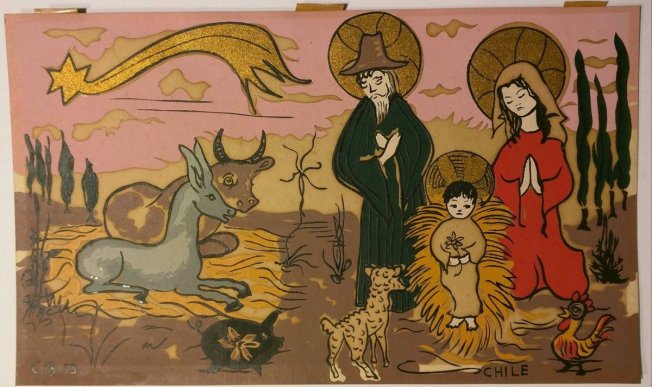
Chilean nativity scene, 1955.

John 1:1-4, 9-14 (1:14) – December 24, 2018

Christmas expectations can be wonderful. When we think of small—even middle-sized—children, they can be all wide-eyed and filled with amazement at the sense of wonder found in Christmas. That sense of wonder goes away somewhat as children get older, but then their expectations change, too. As people shift into adulthood, parenthood, and even grandparenthood, their Christmas expectations can shift even more.

What are your expectations of Christmas, this year?

I noted in one of my Advent sermons several weeks ago that December 9th was the 53rd anniversary of the first showing of the “Charlie Brown Christmas Special.” Over fifty years of this Christmas special has certainly affected how people in the United States view Christmas.

I wonder—how do we view Christmas? How are our expectations affected?

If we consider the people in and around Bethlehem on that first Christmas eve, there was a lot of hustle and bustle, a good deal of coming and going. The little town of Bethlehem was certainly a popular place, especially since the Roman law had been in effect for a while. Many descendants of King David needed to return to Bethlehem and register with the Roman government. We all know that Joseph was of the house and lineage of David, and that was why he was there.

We have heard about the shepherds, who were the first to receive God’s super-special birth announcement. They not only came to see the newborn King in a manger themselves, but they also alerted the whole town to the new birth, too. I suspect a goodly number of the people in Bethlehem had at least heard about the birth of a possible Messiah, by the time the shepherds were finished.

I wonder—what were their expectations, that first Christmas Eve?

We have the main players, Joseph himself, and Mary, his fiancée. The Holy Family. When the baby Jesus was born and the shepherds—and some others—showed up, I suspect Mary and Joseph were a bit perplexed at all the attention their Child was getting. What’s more, Dr. Luke records Mary treasuring up all these events in her heart, and reflecting upon them from time to time in the years to come.

I wonder—what were Joseph’s and Mary’s expectations from that first Christmas eve?

We shift from the common, ordinary smell of farm animals and the baby Jesus lying in a manger bed that Dr. Luke relates in the second chapter of his Gospel, to quite another scene. We shift to the first chapter of the Gospel of John. We shift from the warm, homey scene of a blessed Mother rocking her Baby to the time eternal before the heavens and earth began.

What kinds of expectations do we have from this particular retelling of the Gospel story, found in John, chapter 1? These verses, this retelling of the entrance into this world of the Messiah, goes like this: “In the beginning was the Word. The Word was with God. The Word was God. The light shines in the darkness and the darkness did not overcome it. To all who received Him, who believed in His name, He gave power to become children of God.”

Expectations of such cosmic significance! We go from the intimate, everyday retelling of Luke to the universal, cosmic retelling of John. Mind-blowing, to be sure. Most of the time, I cannot even begin to get my head around this eternal perspective.

The Apostle John was a mystic, a contemplative, and probably the least worldly of any of the disciples. It shows, in his writings. Yet, the beginning of John’s Gospel is a necessary part of the Nativity story. This cosmic retelling lets us know that Jesus broke into this world not only as a helpless Baby born in Bethlehem, but also as the pre-Incarnate Son, eternal from the time before the universe began, and eternal, to the time after the heavens and the worlds in the universe have all passed away.

One of my favorite expressions is “both/and.” I am uncomfortable with “either/or.” I do not like “black/white.” I much prefer “both/and.” Not either this, or that. Not either the Luke 2 Nativity, or the John 1 Prologue. But, both/and. Luke tells us of the very relate-able pregnant teenage mother, having her baby at a very inconvenient time. And at the same time, John tells us of the cosmic Christ, the Word, the One who spoke the universe into being at the beginning of all things. We have both. Often, too much for our puny human brains to grasp, but true, all the same.

What kind of expectations do we have from John’s cosmic retelling of the Nativity, in John chapter 1?

Let us draw closer in to the familiar Christmas story. Charlie Brown’s Christmas story. As with any cartoon, we need a villain. The villain in this cartoon special is no personification, no Abominable Snowman or Grinch, but instead the commercialization of Christmas. This is what is causing such angst and despair to Charlie Brown.

What does make Christmas? What kinds of expectations does Charlie Brown have?

Sometimes I feel like Charlie Brown at the Christmas pageant rehearsal. “Isn’t there anyone who knows what Christmas is all about?” I know Linus responds, “Sure, Charlie Brown. I can tell you what Christmas is all about.” He then recounts the Nativity narrative from Luke 2. Except—the blessed truth doesn’t penetrate into Charlie Brown’s head. Yet.

These whole four weeks of Advent we have been retelling the Nativity narrative from Luke, in anticipation of this very night. We have been singing the songs, and lighting the candles on the Advent wreath, all in preparation for this main event.

An Episcopal minister, the Rev. John Holton from Connecticut, uses this same Christmas special to relate the Nativity narrative. He says, “The good feeling, that warm fuzzy feeling I get watching A Charlie Brown Christmas is, at its core, a feeling of hope that even I could be loved.  The hope—the knowledge—that God who sees even our unloveliness loves us fully.  Loves us so much that God comes to be among us.  As one of us.  That God won’t let us go.” [1] Isn’t that the true meaning of Christmas? Isn’t that what Christmas is all about?

This is a gift that cuts through the commercialization of Christmas. Caring, compassion, and love for one another.

We can thank the Lord for God’s greatest gift, the gift to each of us of God’s Son, of God’s Love. And, we have the opportunity to bring glad tidings to all people right now, to people aching to hear of God’s love for them, for us, for all the world.

Won’t you share your expectation of Christmas with someone, tonight? Won’t you share God’s love with someone, today?

[1] http://www.christchurchnh.org/sermon/2017/12/28/thats-what-christmas-is-all-about-charlie-brown

@chaplaineliza

(Suggestion: visit me at my regular blog for 2018: matterofprayer: A Year of Everyday Prayers. #PursuePEACE – and my other blog,  A Year of Being Kind . Thanks!

Unknown's avatar

Shepherds Watched Their Flocks

“Shepherds Watched Their Flocks”

Shepherds, Annunciation, Oxford Bodlean Library

Luke 2:8-20 (2:8) – December 23, 2018

Birth announcements are often greeted with great excitement and joy. In the United States, they can be detailed and specific, with details like the time of delivery, the sex and the weight of the baby, and of course, the name of the new child. The new parents are so proud of their new bundle of joy, and the new grandparents often show everyone the latest photos of their new grandchild, sometimes before the baby is one hour old.

Nothing is new about babies being born. As long as humans have been on earth, babies have been born. As the old saying goes, “A baby is God’s opinion that the world should continue.” One particular, super-special birth announcement happened one night, two thousand years ago. Not with fancy paper, balloons, or glitter, but with something a lot more special.

We need to back up a bit. We all are familiar with the basic details of the Christmas story. Since the Roman Empire wanted to discover exactly how many people they had living in all the provinces and regions of their vast empire, a law was passed that said every adult male needed to go to their ancestral town to register, or report. So, Joseph, descendent of King David, needed to go to David’s home town, Bethlehem, to report in.

Except, Joseph and Mary find themselves on the road at an awkward time. Not only were there lots of other people traveling to their ancestral towns, but added to that, Mary was greatly pregnant. So pregnant, in fact, that soon after she arrived in Bethlehem she went into labor. Mary delivered a newborn boy, as Dr. Luke tells us in the verses previous to our reading.

There was something quite different about this birth. Several somethings, in fact.

In most birth announcements, one of the main things people want to know is the baby’s name. This newborn baby had a great name: Jesus, Yeshua, or Joshua, meaning “he saves.” We know—because one of the prophecies from the book of Isaiah told us so—that this Baby, this Child is also known as the Prince of Peace. Plus, the newborn baby is also of the house and lineage of King David. Added to which, the birth of this particular Baby was prophesied in the Hebrew Scriptures. Impressive bloodline and backstory, indeed.

After all this build-up, many people would expect a grand birth announcement, sent to the very best people. People like nobility, royalty, other V.I.P.s. But who is it who receives this birth announcement? Shepherds. Common, ordinary, lowly shepherds. As Dr. Luke records in his Gospel, “shepherds living out in the fields nearby, keeping watch over their flocks at night.” For the shepherds, it was an ordinary night. Nothing special, they were just minding their own business. And, if you have worked on a farm or with farm animals, you might know what herding animals smells like. Not very appealing, to modern minds—or noses.

Shepherds were not considered well-to-do, upright citizens. Quite the opposite! Dr. David Lose tells us “And the shepherds? These were the undesirables of the first century, the folks on the lowest of the low rungs of the socio-economic ladder.” [1] Today, we might look on people like these shepherds as street sweepers, or rag-pickers, people who emptied latrines, menial workers of the lowest variety. One step above indigent, homeless people.

Yet, these demeaned shepherds were the super-special chosen ones, the ones God favored with a super-special, divine birth announcement. Complete with a light display that lit up the whole sky, an angelic spokesperson, and angel chorus, God wanted the shepherds to know first of all. Not the rich people in town, or the president of the synagogue, or the elders on the ruling board. Not the King of Judah in his palace in Jerusalem, or the nobility who lived in fine houses with fancy clothes, or the Pharisees or members of the Sanhedrin. No, God wanted the lowest of the low to find out, first.

Isn’t it strange—or odd—or funny that God wanted these shepherds to be the first to know? Actually, no. Since God could choose absolutely anyone on earth to hear about the divine birth first, God must have had a really good reason for choosing these despised shepherds. And, God wants all people to know of the birth of the newborn King, the Prince of Peace.

“In spite of their poor reputation as a class of people, these shepherds seem to have been godly men, men who were looking for the coming of Israel’s Messiah. All the others of those who were directly informed of the birth of Messiah in Matthew and Luke were described as godly people, and so it would seem to be true of the shepherds as well.” [2]

Believe it or not, these despised shepherds were sometimes compared to God, in the Bible. God being the shepherd, and the people of Israel the sheep. As uncomplimentary as it may be, people are often compared to sheep in both the Hebrew and Christian scriptures.

As I have noticed before, the behavior of sheep and the behavior of human beings do have some similarities. Yet despite all of these negative attributes, the Jewish and Christian holy writings repeatedly talk about people being compared to sheep.

I found this lovely poem by William Blake (1757-1827). A poet and visionary, he was a committed Christian. He also was a creative writer and some called him even mystical.

As long as we are considering the shepherds coming to see the baby Jesus, I also wanted us to reflect upon the sheep—the flocks, shepherded by the workers on those cold, windswept hills around Bethlehem.


Meditation on the Lamb


Little Lamb, who made thee?

Dost thou know who made thee,

gave thee life, and bid thee feed

by the stream and o’er the mead;

gave thee clothing of delight,

softest clothing, woolly, bright;

gave thee such a tender voice,

making all the vales rejoice?


Little Lamb, who made thee?

Dost thou know who made thee?

Little Lamb, I’ll tell thee,

Little Lamb, I’ll tell thee:

He is called by thy name,

for he calls himself a Lamb.

He is meek, and he is mild;

He became a little child.

I a child, and thou a lamb,

we are called by his name.

Little Lamb, God bless thee!

Little Lamb, God bless thee!


Jesus is called a Lamb. We are called sheep. Not very flattering, is it?  The lowest of the low, the shepherds, heard of the birth of the Prince of Peace, the Lamb of God. However, it matters nothing to God about our position, or honor, or wealth, or influence.

God does care about our hearts, and how we receive God’s Son.

“In Christ we have the promise that God will not stop until each and all of us have been embraced and caught up in God’s tremendous love and have heard the good news [as proclaimed to the shepherds] that “unto you this day is born a savior, Christ the Lord.” [3]

Let us joyfully follow the shepherds’ example, “glorifying and praising God for all the things they had heard and seen.” Amen, alleluia.

[1] http://www.workingpreacher.org/craft.aspx?post=1612

“Something More,” David Lose, Dear Working Preacher, 2011.

[2] https://bible.org/seriespage/4-birth-messiah-luke-21-20

Robert L. (Bob)Deffinbaugh graduated from Dallas Theological Seminary with his Th.M. in 1971. Bob is a pastor/teacher and elder at Community Bible Chapel in Richardson, Texas.

[3] http://www.workingpreacher.org/craft.aspx?post=1612

“Something More,” David Lose, Dear Working Preacher, 2011.

@chaplaineliza

(Suggestion: visit me at my regular blog for 2018: matterofprayer: A Year of Everyday Prayers. #PursuePEACE – and my other blog,  A Year of Being Kind . Thanks!

Unknown's avatar

In A Manger

“In A Manger”

international Nativity

Luke 2:1-7 (2:6) – December 16, 2018

Nativity scenes are so sweet. You see them frequently at this time of year. Either lit up, like the one outside of our church, or carved in olive wood, similar to the figure I am holding up right now. They can be ceramic, plaster, or painted. Little, small enough to fit under a Christmas tree, or almost life-sized, like the one I saw outside of a big Catholic church in the suburbs.

I suspect we all could mention the cast of characters we might find in a nativity scene. Besides Mary, Joseph, and the baby Jesus, we find shepherds, animals, kings, and sometimes an angel. The nativity pictures look so gentle and perfect, just like a Christmas card.

Mary and Joseph did not have a picture-perfect time of it. As an adult male living under Roman occupation, Joseph was ordered to go to his ancestral town of Bethlehem and register, just as the Roman rulers said. Dr. Luke records it: “In those days Caesar Augustus issued a decree that a census should be taken of the entire Roman world. (This was the first census that took place while[a] Quirinius was governor of Syria.) And everyone went to their own town to register.”

There must have been a great deal of coming and going throughout Israel, as every adult went to their ancestral town. Complicating matters was Mary, Joseph’s betrothed, who was greatly pregnant. “So Joseph also went up from the town of Nazareth in Galilee to Judea, to Bethlehem the town of David, because he belonged to the house and line of David. He went there to register with Mary, who was pledged to be married to him and was expecting a child.”

I wonder how Joseph and Mary felt about being uprooted from their small town of Nazareth and forced to travel—that is, walk—dozens of miles through semi-arid, sometimes hilly country. I wonder what Mary and Joseph thought about coming to the very crowded town of Bethlehem, a near suburb of Jerusalem, chock full of extended relatives of King David. And, I have only an inkling of an idea of what Mary thought, being great with child, having to make the long, difficult journey. The forced timing of this whole trip must have been simply awful.

I want us to step back from Mary and Joseph for a moment. Let us leave them in Bethlehem. As one commentator mentioned, “We all see the Bible through an interpretive lens, and many Western Christians tend to read it through a European/American one. We often bypass the culture and customs that were prevalent during biblical times. We even interject our own bias and prejudice. This is a common error that causes misinterpretation to ensue.” [1]

But, isn’t that human nature? Each of us, all of us, relate to biblical narrative through the lenses of our own personal experiences, through our own separate upbringings. How else do we begin to understand some other person’s story, if not through familiar ideas, surroundings, characters, and narratives?

I was privileged to have the opportunity to get to know the Rev. Dr. Kenneth Bailey. I have attended the New Wilmington Mission Conference in western Pennsylvania the last week of July for almost twenty years, where Ken and his wife Mickey also attended. Except, they went to New Wilmington for some decades. The Baileys served as Presbyterian missionaries in the Middle East for decades, too, coming back to the United States each summer before returning to their work as teachers. Ken as a seminary professor, and his wife as a high school teacher.

Ken Bailey knew a vast amount about Middle Eastern culture and customs, both modern and ancient. He also knew a whole bunch of languages fluently, both modern and ancient. He was a man of great knowledge, stature, and influence, and yet also a humble and unassuming person. He wrote a number of biblical commentaries and scholarly discussions which included first-century Palestinian culture, and how it informs our reading of the Bible today.

I hesitate to break this to everyone, but according to current understandings of Palestinian customs and culture of the first century, Jesus was most probably not born in a stable. Where did this idea of a stable come from? It is difficult to tell. People elaborate, of course. You’ve all played “telephone” as young people, sitting in a big circle around a room, one person whispering in the ear of the next, each whispering what they heard in turn, and everyone laughing when the initial message ends up being all garbled at the end of the “telephone” chain.

We know the biblical text of the Gospel of Luke has remained constant, even through many translations over the centuries. However, as generations of people verbally relate the Nativity story, people tend to elaborate. It gets even more complicated when the message of the Gospel crosses the boundaries of different cultures, and crosses lines into different continents.

For example, considering the manger in a stable: “The mention of a ‘manger’ in Luke’s nativity story, suggesting animals, led mediaeval illustrators to depict the ox and the ass recognising the baby Jesus, so the natural setting was a stable—after all, isn’t that where animals are kept?” [2]  That stable is from a European point of view. But not necessarily, although Luke certainly mentions a manger.

Let’s go back to Mary and Joseph. We left this poor, exhausted couple on the outskirts of Bethlehem. The common modern understanding of an “inn” was another elaboration, since the Greek word kataluma is exactly the same word used to describe the upper room of the Passion Week. Its definition: “‘the spare or upper room in a private house or in a village […] where travelers received hospitality and where no payment was expected’ (ISBE 2004). A private lodging which is distinct from that in a public inn, i.e. caravanserai, or khan.” [3]

Mary and Joseph were probably bedded down in an upper room, dormitory-style, with a number of other extended relatives of the great King David. No private room, like they might have at an inn. As Luke said “she gave birth to her firstborn, a son. She wrapped him in cloths and placed him in a manger, because there was no guest room available for them.”

Not wonderful accommodations, but at least they were not freezing outside with no place to sleep. There was a communal area where the family’s animals were kept, at one end of the large open room, on the ground floor. I suspect there were animals, too—all watching the Holy Family, Mary, Joseph and the newborn baby Jesus. “Once Jesus was born, I envision the two of them tiredly improvising with a manger and some spare cloth, seeking the chance to rest before their newborn inevitably begins his new routine of squalling every 3 or 4 hours to be fed.” [4]

Where does that leave us, with our pretty nativity scenes under our Christmas trees, in front of our houses, and on our Christmas cards? What is the message we receive each Christmas? The holy God of all the universe became a human baby, born to an unmarried teenager, in uncomfortable, awkward circumstances. Not the best of beginnings from a human point of view, but certainly God-ordained beginnings.

What does all that mean for us? It means that we do not have to have neat, tidy lives, that our situations can be uncomfortable, awkward, sad, lonely, anxious, fearful, traumatic, with a whole host of other “negative” circumstances. None of that matters. What does matter is God is with us. Emmanuel, the God-become-human, God with us, is here in the middle of all those awkward, unfamiliar, even ugly situations. Have you lost a job? Jesus is with us. Have you lost a loved one? Jesus is with us. Have you lost a home, or changed neighborhoods, or are feeling lonely, depressed, or especially anxious? Jesus is still with us.

For to us a child is born, to us a son is given. Alleluia, amen.

[1] http://www.ashleyeaster.com/blog/yes-mary-knew

Guest post by: Pastor Gricel Medina, Leadership/Community Developer

[2] https://www.psephizo.com/biblical-studies/once-more-jesus-was-not-born-in-a-stable/

[3] Ibid.

[4] https://modernmetanoia.org/2016/12/09/756/

“Twas the Night Before Birthing”, Emily S. Kahm, Modern Metanoia, 2016.

@chaplaineliza

(Suggestion: visit me at my regular blog for 2018: matterofprayer: A Year of Everyday Prayers. #PursuePEACE – and my other blog,  A Year of Being Kind . Thanks!