Unknown's avatar

Star Light, Star Bright

“Star Light, Star Bright”

Matt 2-11 Epiphany star, Magi, angel, 12th century carving, Autun Cathedral

Matthew 2:1-12 (2:9) – January 5, 2020

When I was little, we always kept our Christmas tree up in our living room until Epiphany, January 6th. We did not always have this particular decoration, but sometimes, there would be a small star ornament my mother would place at the top of the tree. And, I can remember sitting in a darkened living room with my mom, filled with wonder. The only lights lit in the room would be the colored lights on the Christmas tree. What wondrous lights!

I wonder, were Christmas lights a big part of your Christmas celebration? They certainly were, where I grew up, on the northwest side of the Chicago. Christmas lights in the front yards of houses, and in the windows, as well as on the Christmas tree inside. And, I can remember hearing from a very young age that these bright, shiny Christmas lights all over were shining to remind everyone about the Christmas star, the Star of Bethlehem.

But, what about the original Star? Somehow, I suspect only a few people at the time of the birth of Jesus really understood the reason for the bright shining Star. That is, until it was shining over Bethlehem for a number of weeks.

Let’s look at what Matthew tells us, again: “After Jesus was born in Bethlehem in Judea, during the time of King Herod, Magi from the east came to Jerusalem and asked, “Where is the one who has been born king of the Jews? We saw his star when it rose and have come to worship him.” What do we know about these Magi, these scholars from the east?

Biblical commentators and historians tell us that these scholars were astronomers who spent their lives studying the stars and planetary movements, among other natural events. They were probably well-to-do, if not members of royal houses themselves. They most probably came from the general area of Persia—that is, in the area of modern-day Iraq, Syria and parts of Iran.  In their studies, consulting contemporary books and writings, these Magi had discovered that the appearance of a wondrous star meant that an important king—or ruler—had just been born. That Star—that Light—beckoned to these scholars. So, what did they decide to do? Go and visit that newborn king, of course!

While on their way, they needed directions. What to do? It only made sense for some well-born VIPs from another country to ask directions at the local palace.

We do know what happened when the Magi got to Jerusalem after following this Star for some weeks; Matthew tells us so. “When King Herod heard this he was disturbed, and all Jerusalem with him. When he had called together all the people’s chief priests and teachers of the law, he asked them where the Messiah was to be born. “In Bethlehem in Judea,” they replied.”

Do we see what a traumatic reaction these scholars had on many people in the area of Jerusalem? Lots of people were upset, especially King Herod! However, I do not know whether these scholars understood that Herod was a particularly nasty guy. At least, not at first.

Today, when you and I talk about Advent or Christmas services at our church, I wonder how people react to us when we talk about the Baby in Bethlehem? Have you recently invited people to our church for the holidays? Perhaps our acquaintances are just as cautious or bothered by our invitation as these people were, so long ago?

And, all this was happening because the Magi followed a Star. They had deciphered passages from books and manuscripts about something (or Someone) promised, whose birth was foretold in the skies. The Star was inviting them to follow, to journey into the unknown. These Magi must have been really excited at the prospect of seeing a prophecy come true.

After Herod directed the scholars to Bethlehem, down the road from Jerusalem, the Star moved again. As Matthew mentioned, “After they had heard the king, they went on their way, and the star they had seen when it rose went ahead of them until it stopped over the place where the child was. 10 When they saw the star, they were overjoyed. 11 On coming to the house, they saw the child with his mother Mary, and they bowed down and worshiped him.”

The Star—the Light from on high led them directly to the young King, where they bowed and worshiped. Can it lead us to draw near to our Lord Jesus? Is this Star, this Light a beacon of hope and joy for us, too?

All that was two thousand years ago, but Epiphany is still with us today. The word Epiphany means manifestation, or appearance. Epiphany is when Christ appears among us, offering hope and joy to all who might need it.

This brilliant Star encourages us to leave the darkness and despair behind and to come into the Light. God does, indeed put directional signals where we can see them. Sure, the sign of the Star of Bethlehem pointed the way to the Holy Child in Bethlehem two thousand years ago. But, doesn’t God use directional signals or signs to point to Jesus now, today? We can count on God’s love and presence with us, in Emmanuel, God-with-us.

Yes, Jesus appears when you or I need Him most. May He appear to each of us during this season of Epiphany, in spirit and in truth.

Alleluia, amen.


“During these weeks of Epiphany, dare to ask that Star some questions.

  • Where are we being led in this New Year?  Is the Star offering some course correction? Should we be like the magi and experiment with a “different road” that will lead us to new experiences?
  • What might we need to leave behind in order to start on this journey? What burdens or expectations can you and I set aside to lighten the load?
  • As the Light shines into our lives, what might we discover about ourselves? What do you and I value? What new parts of myself do I want to explore?
  • What does the Star—the Light reveal in our world? What needs or injustices are calling out for compassion and kindness?” [1]

(I would like to thank the Rev. Sue Foster for her Epiphany post “Into the Light!” For this sermon, I have borrowed several ideas and quotes from this devotional. Thanks so much!)

https://fosteringyourfaith.com/2019/12/30/into-the-light/ On December 30, 2019 By fosteringyourfaith In Epiphany

[1] https://fosteringyourfaith.com/2019/12/30/into-the-light/ On December 30, 2019 By fosteringyourfaith In Epiphany 

@chaplaineliza

(Suggestion: visit me at my regular blog for 2020: matterofprayer: A Year of Everyday Prayers. #PursuePEACE – and my other blog,  A Year of Being Kind . Thanks!

Unknown's avatar

Fleeing to Egypt

“Fleeing to Egypt”

Matthew 2:13-21 – December 29, 2019

Matt 2-12 Flucht_nach_Aegypten_Meuhlhausener_Altar_Bamberger_Dom

I have been puzzled by the week between Christmas and New Year for some years. Yes, it’s still the holiday season, and yes, lots of people are on reduced schedules, or even taking the whole week as a holiday. But, I realize some people need to keep working regular shifts, to do necessary things that keep the wheels of society rolling and things continuing to happen. As we all know, holidays do not last forever…or sometimes even for a few days.

Remember back to last Sunday? The fourth Sunday of Advent? I talked about the shepherds, and how they got ready to visit the Baby the Angel told them about. Only thing—the shepherds couldn’t afford to take a lot of time off to see the Baby. I doubt whether they could even take more than a few hours, at most a day, to go and see the Baby in Bethlehem. And, the angels in the angel chorus? The angels had gone back to heaven in an instant. They had already left before the shepherds even decided to check out this fantastic story.

Between last Sunday and today, Christmas happened. We sang “Away in a Manger,” “Silent Night” and lit our candles around the Advent wreath. But, what does our Scripture reading say happened? How on earth did we get from shepherds adoring the Baby at the manger to the horrible reading we had just now, from Matthew chapter 2?

Thank goodness for the Angel, again! Thank God the Angel came to Joseph—again—in a dream, and told him to flee to a different country, with Mary and the Baby. The Holy Family was fleeing for their lives; or, at least, for their Baby’s life.

Today, when young couples here in the United States have a new baby, even a toddler, usually the extended family, good friends, and often the church family members gather around in a fond shower of gifts, sometimes bringing dinner or other good things to eat. Somehow, I doubt whether Joseph, Mary and the Baby Jesus had much of a baby shower before Mary went into labor. Our reading from Matthew 2 tells us a whole lot more serious than just not having a baby shower. Matthew describes an evil, manipulative king who was extremely jealous and anxious. He worried about attacks against his power structure.

From all accounts of Herod and his life and reign, he was a tyrant. Looking at writings from contemporary authors of that period, Herod was cruel and bloodthirsty. He was also two-faced, as we can see from a few verses before our lectionary passage today, from his response to the Magi. He sent the Magi to Bethlehem, and requested that they come back after they find this “King of the Jews,” because Herod wished to “worship” this King as well.

I have a pretty good idea of exactly what Herod wished to do to the baby Jesus from what follows. What is even worse is King Herod has demanded that his soldiers go and slaughter all infant and toddler boys in and around Bethlehem. This reading of the slaughter of the innocents? Why this massive horror and carnage to happen? Why now? Isn’t it still the holidays? Didn’t we just celebrate Christmas? We just sang “O Little Child of Bethlehem” just a few days ago.

Sure, those soldiers were military men. I know those in the military have to do some really unpleasant things. But, ordered to kill babies and toddlers? Well. Just look who was giving that horrible order: the cruel, bloodthirsty King Herod.

We can see why the Holy Family left Judea. They fled. They became refugees.

As I have been thinking about this Scripture reading from Matthew 2 this past week, I wondered about the term “refugee.” I know many people use this term, not only in this country, but also internationally, and some of these people are misusing the term. What is the actual definition of the term “refugee?”

For this definition, I went to the United Nations website, where the UN describes and defines a great many words and terms that concern millions of people, worldwide. According to the migrant and refugee section of the official website, “Refugees are persons who are outside their country of origin for reasons of feared persecution, conflict, generalized violence, or other circumstances that have seriously disturbed public order and, as a result, require international protection.” [1] From everything described in Matthew chapter 2, that definition of refugees describes the Holy Family all too well. Sadly, too well.

As one of my favorite commentators Carolyn Brown said, “It would be nice if everyone had gone happily home and watched Jesus grow up safe and secure with angels watching over him and no problems for anyone.  But it didn’t work that way.  It doesn’t work out that way for any of us.  We all have all sorts of problems to worry about and work on.” [2]

Here in the United States, people are sometimes forced to relocate or are made homeless because of natural disasters or floods or fires – which certainly are on the UN’s list in their definition of the term “refugee.” We know about these refugees, or migrants.

A young man was shot on the Howard St. El platform just a few weeks ago. He had moved from the Englewood neighborhood on Chicago’s south side to Rogers Park, because he did not want to be actively recruited by gangs. And—he was shot in the back, execution-style, by a rival gang member. He tried to migrate. He tried to get away from feared persecution, conflict and violence by moving to the relatively safer area of Rogers Park.

This is not the sweet story of Christmas we heard on Christmas Eve. This wasn’t the gentle story of a young woman giving birth to a Baby, and angels giving a birth announcement to shepherds, including the words “Peace on earth, and good will to all!” Where—we heard about God breaking into the world, coming to be Emmanuel, God-with-us.

The narrative from Matthew 2, though jarring and heart-breaking, helps us know that God is truly with us. Just look at the state of the world, and the sad—even violent situations people encounter all over. Day in and day out, the days are dark more often than not. People like this young man from Englewood get shot, and stabbed. So many feeling separations of race and class and religion and so many other dividing lines.

Yet—nothing surprises God. Yes, the Holy Family did need to run away to escape from Herod the King. “So God understands when we and our families have scary problems.  God is with us and loves us not just when things are Christmas Eve wonderful but also when nothing is going right.  Right now, on the Sunday after Christmas, that is really good to know.  Christmas is over for this year.  But, soon it’s back to school [and work] and all the old problems and people we will struggle with.  It’s a good time to remember that God was with Jesus and His family in the peaceful stable AND on the scary road to Egypt.” [3]
            He is able to not only help us through our times of trouble, but also to be God with us. Jesus is there with us, even though homes are destroyed and children are slaughtered. Jesus is there with us through all the pain and suffering, through all the wailing and lamentation. We have His word on it. Jesus said “I will never leave you nor forsake you.” What a precious promise! What a wonderful Christmas gift! Jesus is our Emmanuel, God with us.

Alleluia, amen.

[1] https://refugeesmigrants.un.org/definitions

[2] http://worshipingwithchildren.blogspot.com/2013/11/year-first-sunday-after-christmas.html

Worshiping with Children, Christmas 1, Including children in the congregation’s worship, using the Revised Common Lectionary, Carolyn C. Brown, 2013.

[3] Ibid.

@chaplaineliza

(Suggestion: visit me at my regular blog for 2019: matterofprayer: A Year of Everyday Prayers. #PursuePEACE – and my other blog,  A Year of Being Kind . Thanks!

Unknown's avatar

Moved into the Neighborhood!

“Moved into the Neighborhood!”

John 1-14 word made flesh, circle

John 1:1-14 – December 24, 2019

A long time ago, in a galaxy close by—even, in this galaxy right here, the Word was first. The Word was present before anything else. What came into existence was Life, and the Life was Light to live by. The Life-Light blazed out of the darkness; the darkness couldn’t put it out.

All right, I have a confession to make. I saw the new Star Wars movie on Saturday. I love the original Star Wars trilogy. I did not love the prequel trilogy, however I really liked the last trilogy of movies. And, the last of the current trilogy, “The Rise of Skywalker,” was a satisfying end to the story—thus far.

What does Star Wars have to do with Christmas? Especially during the past week, I was intrigued by the juxtaposition of Light and Dark in the Star Wars universe; the two flip sides of the Force, that ultimate dyad of positive and negative energy, where Light is Good and Dark is Evil.  I saw a few differences to what we have highlighted this Advent season here at St. Luke’s Church—the Light and the Dark.

Except, different from the Star Wars universe, this galaxy’s kind of Light and Dark are both positive, both are needed. Both are made by the same ultimate Source, or Force, or heavenly Creator at the beginning of all things.

The beginning of the Gospel of John is modeled after the beginning of Genesis 1—except John goes much deeper, and gets theological right away. John chapter 1 tells us a lot about the Word—the Light—the Life—and then, brings those descriptions down to earth. The cosmic Light—the Word spoken before anything was created—that Word—or Light—or Life comes down to earth and gets up close and personal. How much more personal can you get than becoming flesh, becoming a tiny Baby?

I think everyone here is more familiar with the narrative of Luke 2, where we hear about Joseph, and Mary, and the census, and the awkward situation the young couple was in—being still fiancés, still pledged to each other, and not yet married. But wait, there’s more! We hear about the shepherds, angels and their heavenly birth announcement. The shepherds run to visit the newborn Baby, and afterwards go and tell everyone in that town of Bethlehem: “Alleluia! The Messiah is born!”

Somehow, the narrative told by Luke seems a lot more relatable than the first chapter of John. I mean, who can relate to the eternal Word spoken before anything was created? And, the cosmic Light that is also Life? Isn’t that a mixed metaphor, John? Couldn’t you get your metaphoric descriptions straightened out before you set it down as Gospel truth?

This Scripture reading from John 1 is the reading for Christmas Eve, where John tells us of the Eternal Word, part of the everlasting Trinity, becoming flesh. As Luke would say, Emmanuel, God with us, becoming a Baby born in Bethlehem.

Jesus was the name that Mary and Joseph gave to their Son, and John tells us He is “the Light of all people” coming into the world. After a month of Advent, of waiting and longing and talking about the miraculous birth, Jesus is now here! We have also been talking about how Light and Dark are both positive things, both created by God.

As we reflect on the two narratives, the familiar one in Luke 2 and our reading for tonight, John 1, both readings talk about the Light of the world come to earth. Yet, Jesus is both human and divine. “Those two things coexist in him, just like light and dark. John tells us darkness does not overcome the light. The darkness is there alongside the light as it shines. Darkness helps light stand out, just like the stars shining in the night sky.” [1]

We have already talked about how darkness can be warm and friendly. Just think of baby animals and their mothers. Puppies, kittens, calves, lambs, all kinds of animals resting with their mothers. And, think of human babies. They rest with their mothers in the warm, welcoming darkness of night. Not like the good versus evil, light/dark split of the Star Wars universe, but instead all creation created by God, and all is named good.

We can see how there is a natural bridge connecting John 1 (talking about the Eternal Word/Light/Life), and the narrative of Luke 2, telling about the common, every-day birth of a Baby—yet miraculous, too. Both are integral parts of the Greatest Story Ever Told.

“But note: when God decided to get personally involved, God came to tell us that we are loved, deeply, truly, and forever. God loves all of us, but especially wants those who don’t feel loved or lovable, those who regularly feel like they’re on the outside looking in, those who feel forgotten, and those who wonder what the point of life is, to hear the “good news of great joy” that God loves all of us.” [2]

Is it any wonder that our Scripture reading for this evening tells us, in the wonderful translation by Eugene Peterson, that this Wonderful Counselor, Almighty God, Prince of Peace, Word become flesh, “moved into the neighborhood.” Jesus became one of us, a human being.

That is the meaning of Christmas: Jesus has moved into our neighborhood, and become one of us. As the angel said, Jesus is born for you. For me. For each of us. That is the miracle, come to earth. Glory to God in the highest! Amen.


(I would like to thank illustratedministry.com for their Advent devotional “An Illustrated Advent for Families: In Light & Darkness.” For this sermon, I have borrowed several ideas and quotes from the Christmas Day devotional. Thanks so much!)

For further information, see info@illustratedministries.com

@chaplaineliza

(Suggestion: visit me at my regular blog for 2019: matterofprayer: A Year of Everyday Prayers. #PursuePEACE – and my other blog,  A Year of Being Kind . Thanks!

[1] Advent devotional “An Illustrated Advent for Families: In Light & Darkness.”

[2] http://www.davidlose.net/2015/12/christmas-eveday-c-keep-it-simple/

“Keep It Simple,” David Lose, …in the Meantime, 2015.


Unknown's avatar

While by My Sheep

“While by My Sheep”


Luke 2-10 angels, shepherds, Rembrandt 1635

Luke 2:15-20 – December 22, 2019

Christmas is a wonderful time of the year, with all of its opportunities to acquaint ourselves with our Lord Jesus once more. Whether in church on an Advent Sunday, or experiencing the wonder of preparation with an Advent calendar, we have many opportunities to prepare our hearts for the arrival of Christmas during the Advent season.

But, now is two thousand years after the first Christmas. We have developed a great many rituals and observances surrounding the birth of a Baby in Bethlehem. The liturgical year has been instituted, with the season of Advent celebrated for four weeks before Christmas even happens; Advent being the time of preparation and waiting before the birthday of the King.

The shepherds around the village of Bethlehem did not even know anything special was happening, that first Christmas night. They were simply going about their normal nightly activities with the sheep. When—suddenly, as Luke tells us, the whole night sky was lit up, as bright as noonday.

Do we remember what the social situation of the shepherds was, at the time Jesus was born? I mentioned it last week, in my sermon. I mentioned that shepherds were among the lowest of the low, as far as social class was concerned. Shepherds were on the outskirts of society, the same way they usually lived on the outskirts of a town or village. A shepherd was not highly regarded by common, decent Jews at that time, at all.

This narrative from Luke chapter 2 becomes all that much more valuable, that much more unusual, with the shepherds among the first to hear about the birthday of a newborn King.

We looked at the arrival of the angel of the Lord last week, delivering a heavenly birth announcement to these most unlikely recipients, the lowly shepherds. The shepherds were so astounded by the Good News of the angelic chorus that after the angels left they talked among themselves. After discussing the news, they determined to go check things out. Or, as Luke said, “When the angels had left them and gone into heaven, the shepherds said to one another, ‘Let’s go to Bethlehem and see this thing that has happened, which the Lord has told us about.’”

That is one thing our observance of Advent is supposed to heighten: just like small children, Christians are supposed to get more and more excited about the approach of Christmas. a whole month of Advent is supposed to make us look forward to the birth of the Baby in Bethlehem so much more.

Since we live in the northern hemisphere, the coming of Christmas means winter—cooler temperatures, shorter days and longer nights. This time of year is also known as the Winter Solstice; that is, the time of the shortest day and the longest night of the year. Do you think people were (and are) looking forward to the approach of more sunlight, of longer days and shorter nights? This is also an integral part of the Christmas celebration, a celebration of the return of sunlight and warmth, a harbinger of growth and green and all the things that light and life bring back into the world.

And, here we have the shepherds, stuck in the middle of all of this celebration, all this foretelling and forth-telling of God’s Good News. Isn’t that the message the angels brought to the shepherds? “Today in the town of David a Savior has been born to you; he is the Messiah, the Lord. 12 This will be a sign to you: You will find a baby wrapped in cloths and lying in a manger.” Good news, indeed!

Although the shepherds were not aware of the deeper meaning at the time, God’s angelic witness was first delivered to those of low station. These who were outcast, the lowest of the low by society’s standards formed for us a view of God’s redeeming love.

In the same way of His ancestor, the shepherd king David, our shepherd king Jesus would shepherd His people through the lineage of His earthly father Joseph and the Oneness with His heavenly Father. The lowly shepherds who were shunned by society, yet responsible for keeping the safety of temple’s sacrificial sheep in the area surrounding Jerusalem, were thus caused to be the first to see and hear God’s great Good News. [1]

As the shepherds excitedly discussed this angelic birth announcement, they did decide to go into Bethlehem and see this newborn Baby. And, as Luke tells us, “When they had seen him, they spread the word concerning what had been told them about this child, 18 and all who heard it were amazed at what the shepherds said to them.”

Tell me, does anyone here want to get on a street corner and tell others about God’s Good News? That was exactly what the shepherds wanted to do! The people on the outside, on the outskirts of the town of Bethlehem, the outcasts of society were so very excited by the Good News and by the miraculous sights they had seen.

Does that make you want to go and tell? Getting so excited about the miraculous, and yet every-day?  At once, wanting to bow in worship at the manger, and at the same time wanting to jump up and go and tell the blessed truth about Jesus?

Yes, our dear Lord Jesus is creator of al that is dark and all that is light. He is the Light of the world and the Lord of the day, and all that is green and growing. He is the Lord of darkness, too. Lord of all that is scary and fear-filled, yet also Lord of the night and nocturnal creatures, and the warm, welcoming darkness of nurture and strength.

Let us go and tell others about the blessed truth of Christmas, about how Jesus is so much more than just a Baby wrapped in swaddling clothes, laid in a manger. Our Lord Jesus is also Emmanuel, God with us.

Glory to God in the highest! Christ is born in Bethlehem. Our response? Go and tell!

Alleluia, amen.


(I would like to thank illustratedministry.com for their Advent devotional “An Illustrated Advent for Families: In Light & Darkness.” For this sermon, I have borrowed several ideas and quotes from Week 4 of this devotional. Thanks so much!)

For further information, see info@illustratedministries.com

@chaplaineliza

(Suggestion: visit me at my regular blog for 2019: matterofprayer: A Year of Everyday Prayers. #PursuePEACE – and my other blog,  A Year of Being Kind . Thanks!

[1] http://beambiblebounty.blogspot.com/2015/12/shepherds-joy.html

“Shepherds Joy!” Thomas Beam, 2015.

Unknown's avatar

Bringing Good News!

“Bringing Good News”

KONICA MINOLTA DIGITAL CAMERA

Luke 2:9-10 – December 15, 2019

Have you ever spent two hours in a dark movie theater, and come outside into the bright sunlight? When people are in the dark for some time, their eyes adjust and become used to the warm, friendly darkness. And, being in a movie theater can also transport people into a whole new world. Then, when the movie is over and they step into the real world, into sudden bright daylight, the stark difference in dark and light can be a shock to the system, can’t it?

That was a little what it was like for the shepherds, so long ago on the hills at night around Bethlehem. Not too far from Jerusalem, only eight or ten miles down the road. That was a much different time, and much different place. Electric light had never even been heard of! Sure, after night fell and the sun disappeared under the horizon, people had candles and oil lamps. Although, those were expensive. If people did not have much money to spare, they simply went to bed with the sun, and woke the next morning when the sun rose.

Our Gospel writer Luke tells us that “There were shepherds living out in the fields nearby, keeping watch over their flocks at night.”  I am certain the shepherds had some kind of night vision, especially if there was some moon shining and a clear night. I suspect they had grown comfortable with the darkness, keeping watch over their flocks by night.  

I wonder whether anyone here can remember back to a time when they were outside at night, far, far away from the city lights and civilization? Perhaps, far north in Wisconsin or Michigan? Or, maybe in the mountains of Colorado? Then, you might be familiar with that kind of night vision, being aware of all kinds of things happening around you in the dark.

Except – these shepherds had no understanding whatsoever about bright lights! I mean, like spotlights, flood lights, lighting up the whole sky! Suddenly, “An angel of the Lord appeared to them, and the glory of the Lord shone around them, and they were terrified.” What on earth – or, outside of the earth – was this sudden appearance of the angel?

Some people in the 21st century probably are so accustomed to the Christmas story that their idea of shepherds keeping watch over their flocks by night is somehow associated with Christmas cards. But, it was life as usual for these working people. An everyday way of life in Palestine. What’s more, being a shepherd was not a particularly high class job. The lowly vocation of shepherd was on the outskirts of society. A possible comparison today is to think of a person selling “Streetwise,” the paper sold for $2.00 outside of grocery stores, drug stores and coffee shops here around the Chicago area.

And suddenly, the angel of the Lord came to these shepherds—came to people in homeless shelters, people selling “Streetwise,” people down on their luck, people on the edge, on the outs of society. The angel of the Lord came to them with good news. Good news. Lighting up the sky in a way the shepherds had never seen before. We can see God breaking through, in an unexpected way, to an unexpected group of people.

The message of God’s Good News certainly did not come to the people we might expect. Are they influential members of the community? Rich movers and shakers? Leaders of the local synagogues and teachers of the Law of Moses? Those would be the kinds of people who I might expect to have an angel sent to them. But God doesn’t work that way. Again, God does the unexpected, and chooses the most unlikely people to receive a hand-delivered angelic message from the Lord of Hosts, the King of Kings.

One of my favorite commentators, Carolyn Brown, is a retired Children’s Ministry educator and writer. It is her confirmed opinion that children and families need “To hear the story read or told in an important way on the ‘night it happened’ – Children like hearing the story of their birth on their birthday and celebrating other big events on ‘the very day it happened.’  So, the story which may have been acted out in a pageant and discussed in church school and read at home, feels more ‘real’ when read [at Christmas time] in the sanctuary.” [1]

Last Friday, I was so pleased to be able to welcome the families of the preschoolers here for their holiday program. The highlight of the program was a visit from Santa. Since there are children from such a variety of faith traditions at the preschool, and since this is a preschool that gets help and funding from the state of Illinois, they need to be careful not to make it all about Jesus. It’s fun to think about Santa, but how do we here in the church deal with the tales and legends about Santa?

As Carolyn Brown reminds us, “If Santa is all there is to Christmas Eve once children learn ‘the truth’ [about Santa], Christmas is just a greedy gift grab.  But, if Christmas Eve has always circled around the story of Jesus told in the sanctuary, the truth about Santa can be fit into that context and the Christmas celebration gets richer.” [2]

We can tell our children, our grandchildren, about the bright light seen by the shepherds. We can tell how the angels came to bring the shepherds the Good News that the Baby born in Bethlehem is indeed Emmanuel, God with us. Jesus is the Light of the world, God born into this world as a Baby.

Alleluia, amen.


(I would like to thank illustratedministry.com for their Advent devotional “An Illustrated Advent for Families: In Light & Darkness.” For this sermon, I have borrowed several ideas and quotes from Week 2 of this devotional. Thanks so much!)

For further information, see info@illustratedministries.com

[1] http://worshipingwithchildren.blogspot.com/2013/12/why-children-need-to-get-to-church-on.html

Worshiping with Children, Christmas Eve/Day, Including children in the congregation’s worship, using the Revised Common Lectionary, Carolyn C. Brown, 2013. Why Children Need to Get To Church on Christmas Eve/Christmas Day.

[2] Ibid.

@chaplaineliza

(Suggestion: visit me at my regular blog for 2019: matterofprayer: A Year of Everyday Prayers. #PursuePEACE – and my other blog,  A Year of Being Kind . Thanks!

Unknown's avatar

God with Us!

“God with Us!”

Matt 1-23 Emmanuel Greek

Matt 1:18-24; Luke 1:26-38 – December 8, 2019

Have you ever had something unexpected happen? I mean, something huge. Something you never would have expected in a hundred years. Maybe, even a thousand. I know that, with statistics, we can figure out just what are the chances of having something happen. Like, a car accident, or a fall at home, or catching a rare disease. We can even figure out the statistical chances for getting hit by lightning—and a few people have even been hit by lightning twice, and lived to tell about it.

But—what about being visited by an angel? At night, when you are sleeping? Picture this—our Scripture reading from Matthew 1 tells us about Joseph receiving a visit from an angel of the Lord. Statistically, that angel probably would not even factor, because angels are not material, they are not able to be quantified by any earthly scale or system.

Regardless of whatever statistical system is used, I doubt very much whether Joseph would have been considered “the one most likely to see an angel.” And, especially when we consider what the angel had to say to him.

I wanted to focus on the sleeping part. The angel came to Joseph while he was asleep. That reminds me of someone creeping up on Joseph, trying to surprise him. Perhaps, even trying to scare him. I do not think the angel meant that at all, but the first words out of the angel’s mouth are “Don’t be afraid!”

We are considering light and dark this Advent season. Last week, we thought about different aspects about darkness that are warm, friendly, even inviting. We thought about nocturnal animals, gestating animals, and growing seeds underground. All in the warm, nurturing, friendly darkness. These examples give us a whole different view of darkness as opposed to light.

This week, we look at the angel of the Lord coming to Joseph in a dream. But, before we even start with the angel, what was the background to this Scripture reading?

We know Joseph and Mary are engaged—or, pledged to be married. I suspect that it was more than just an engagement thought up by the two young people themselves, with no one else involved. No, at that time, in that part of the world, a marriage was much more. A marriage was an alliance between two families, a merger, a joining of one extended family with another.

When two people got married, it was a long, drawn-out affair. First, both families needed to talk and negotiate. Most times, money or other kinds of valuables changed hands—some kind of dowry or bride price. The man and woman were seen to be engaged, promised to each other. But the actual, official marriage ceremony had not taken place yet. From what I see in the Scripture passage today, this is the point we are at. This is what is going on. Joseph’s family and Mary’s family have arranged the marriage; Joseph and Mary are engaged to be married.

This is where the story starts getting sad, or weird, or surprising—maybe all three. Mary tells Joseph privately, confidentially, that she is pregnant. And, this pregnancy is special. Super extra special! Mary told Joseph that God was the father of her baby.

Now, what did she say? Wait just a minute. What did Mary say? Joseph could not believe this tall tale Mary tried to tell him. And, this certainly seemed to be a whopper, in Joseph’s eyes.

What do you and I do when we have something happen that is statistically unlikely? Even, impossible? What would you or I do if we had someone tell us that they had heard from an angel, and they were pregnant. And, all this had to be kept confidential?

I suspect Joseph had really unsettled sleep for the next few nights. (Wouldn’t you?)

The Gospel reading tells us “Because Joseph her husband was faithful to the law, and yet did not want to expose her to public disgrace, he had in mind to divorce her quietly.” Seriously, if Mary were tried under the law of Moses, and found pregnant before she went through with the marriage ceremony with Joseph, she could be stoned for adultery. Serious, indeed.

This Scripture reading focuses on light and darkness, too. Sailors and other travelers used the light of stars at night to find their way. The stars, of course, were made of light, but the night—the darkness—enabled the sailors to see stars clearly enough to navigate their path. Light and dark worked together to illuminate the way.

It was during one of these nights of agitation and discomfort that the angel of the Lord came to him. In both Joseph’s and Mary’s cases, darkness plays a significant role. Night tells our bodies it’s time to sleep, and sometimes, we can even have dreams. Light and dark can work together in surprising ways.

Do you remember how I started this sermon, and talked about figuring out the statistical chances for getting hit by lightning—and a few people have even been hit by lightning twice, and lived to tell about it? What are the statistical chances of two engaged people each getting visited by an angel?   

I want to remind us all about the words of the Gospel of Luke, chapter 1. “The angel went to her and said, “Greetings, you who are highly favored! The Lord is with you.” 29 Mary was greatly troubled at his words and wondered what kind of greeting this might be. 30 But the angel said to her, “Do not be afraid, Mary; you have found favor with God. 31 You will conceive and give birth to a son, and you are to call him Jesus.”

Mary and Joseph, both received word from the angel of the Lord, both at home, and both were scared out of their wits. In both angelic visits, the angels say not to be afraid.  We begin with two people who both did not understand—both were in darkness, except the angel brought light and understanding to both people.

The angelic message offers peace, even as Mary and Joseph face an unexpected future. Like the night sky for ancient sailors, these holy visits to Mary and Joseph point the way when they don’t know what to do. And we know, of course, their message is very good news.

What about us, then, today? Would we receive this same news in the same way?

Each one of us is encouraged to ponder our selves, our lives. Let me suggest that in this pondering, we have the opportunity to offer our thoughts, feelings and emotions to God. Each of us can think of times of regret and sorrow, the deep feelings, the difficult memories. And, what about those times of anxiety and deep sadness? Of desperate loneliness and fear.

Like Mary, like Joseph, each of us today has the ability to ask God to take away the distress and anxiety from us. Just like in Mary’s situation, where she accepted the angel’s news with joy. Just like Joseph, who was persuaded to continue with the engagement by the words of the angel. The angels spread light and life wherever they went.

The angels delivered important messages to Mary and Joseph. Another word for angel is “messenger,” and we can all be messengers of hope, light and life. How can you or your family deliver a message of good news today? Take a moment to think of someone who could use a message of love and hope. Then write a note, send a photo by Facebook or Instagram, draw a picture, or send a text to that person or family.

God willing, we can all be messengers of God’s light, life and hope to others.

Alleluia, amen.

(I would like to thank illustratedministry.com for their Advent devotional “An Illustrated Advent for Families: In Light & Darkness.” For this sermon, I have borrowed several ideas and quotes from Week 2 of this devotional. Thanks so much!)

For further information, see info@illustratedministries.com

@chaplaineliza

(Suggestion: visit me at my regular blog for 2019: matterofprayer: A Year of Everyday Prayers. #PursuePEACE – and my other blog,  A Year of Being Kind . Thanks!

Unknown's avatar

The Light Will Shine!

“The Light Will Shine!”

John 1 1-14 word cloud

John 1:1-5 – December 1, 2019

Light versus dark. Good versus evil. The powers of the Light pitted against the powers of Darkness. And, think about the Good Witch, all shiny and light, in the Wizard of Oz, as opposed to her sister the Bad Witch, all black and dark. Think of movies, and television, and fairy tales, and folk tales. All of the stories we have ever heard tell us the same thing. Everyone knows the good guy wears a white hat, and the bad guy wears a black hat.

The Gospel Scripture reading this morning comes from the first chapter of John, John 1:5, where we are told “The light shines in the darkness, and the darkness has not overcome it.” But, what if we do not think of this contrast as a good versus evil set-up? What if we don’t think of this as a sharp duality, where light (or, white) is good, and dark (or, black) is bad? What then?

I know we have a number of people here in this congregation who are familiar with several languages. I suspect you are aware that sometimes it is a challenge to translate from one language to another with exactly the right words. Sometimes, the words and phrases of one language just do not quite fit the other language. So, you approximate. You give it your best effort, and try hard. But, translation is not an exact, word-for-word science. Sometimes, translation is more of an art.

That is the case with our verse from John 1, “The light shines in the darkness, and the darkness has not overcome it.” The Greek word translated “overcome” here in the New International Version of the Bible sometimes is translated as “did not comprehend.” As in the New American Standard Version of the Bible: “The Light shines in the darkness, and the darkness did not comprehend it.”

Remember, in the beginning? Way back, at the beginning of creation? John hearkens back to that beginning right here. He starts his Gospel with verse 1: “In the beginning was the Word, and the Word was with God, and the Word was God. He was with God in the beginning. Through him all things were made; without him nothing was made that has been made.”

God made everything that was made. All things! Yes, God made the light. Yes, God made the dark. And – this concept may blow our minds, but at the end of Genesis chapter 1, God called everything in creation very good. Everything! That includes light and dark!

John uses a comparison, a metaphor, comparing “the Light of all people” to the darkness, which could not comprehend the Light. I have heard this comparison lifted up by preachers and commentators many times in the past. Yes, it’s a vivid concept, that of Light and Dark. In fact, Jesus Himself uses this metaphor when He says “I am the Light of the world.” But, that is a whole different conversation, in a different place.

I want us to reflect about creation, and how God made all things in the beginning. God created Light and also Dark. What is more, God called them both very good!

But, wait a minute! What about all that stuff from movies, and from television, and fairy tales? What about all we have ever learned about light being good, and darkness bad?

People often thought that meant Jesus banishes the darkness. But actually, the darkness is still present. Jesus works in the midst of them both. Dark and light coexist together.

Let’s think more deeply about the dark; it is good for a lot of things. How about nocturnal creatures? Bats, opossums, cats, and owls all like the night. There are many creatures who have a thriving life in the hours between dusk and dawn. And, God made all of these creatures.

What about many baby mammals? Puppies, kittens, horses, elephants, mice, and dolphins. All of them are mammals, and all of them gestate in darkness. So often, mama animals go to a dark, quiet place to give birth. Think of a dog or cat looking for an enclosed closet or a cupboard where they can give birth to their puppies or kittens.

Darkness is not always frightening! Sometimes, the dark can be friendly and warm. As humans, we gestate in darkness, too. Comforting, calming, friendly darkness.

But, some people might still be puzzled. What did the prophet say in our Scripture reading this morning? From Isaiah 9:2, “The people walking in darkness have seen a great light; on those living in the land of deep darkness a light has dawned.” That sure sounds like light versus dark, good versus bad.

I would like to suggest that the prophet is using a similar metaphor, using light to express hope. Hope and goodness given by God.

What if people twist such verses, and cause them to mean painful and twisted things? Like, for instance, believing that darkness is always bad and evil—and dark or black. And sometimes, some people have the false belief, the mistaken assumption that people with lighter skin are better or more loved by God than those with darker skin. This false belief is untrue, and so damaging to so many people!

When I was a child in Sunday School, we learned the chorus “Jesus Loves the Little Children.” I wonder, do you know it, too? “Jesus loves the little children, all the children of the world, red and yellow, black and white, they are precious in His sight. Jesus loves the little children of the world.” Just reminding everyone: Jesus was Jewish, and a person of color, too.

I have a good friend, a fellow pastor. He does not live here in the Chicago area any more, but moved to Oregon about a year and a half ago. He was born with sight, but due to a progressive eye disease, he lost all of his sight shortly after he turned 30 years old. He’s now in his early 60’s. and has been completely blind for decades. Is my pastor friend somehow “bad” because he is blind? Or, because he is always in the dark? No, light is not necessary for my friend to live life to the full and to pastor a church and love his children and grandchildren.

God made all things. God made all people. Everything God created, both the bright light of day and the darkness of night, are called “very good.” We have God’s word on it, from Genesis 1:31. What is more, all people—each person—is equally beloved, equally created for good, and equally made in the image of God.

When we believe that black-and-white thinking that light is only good, and darkness is only evil, we miss so much in life. Nocturnal animals, gestating babies, seeds growing in the ground. All of these are living life in the warm, friendly, nurturing darkness. Think about the good gifts of God, giving us both bright, radiating light and comforting, friendly darkness.

John chapter 1 hearkens back to that first chapter of Genesis. Yes, in the beginning God did create everything, and every person, and God called it all very good. Including the light, and including the darkness.

We can look forward to the Light of the world, God coming to earth in the Baby Jesus. We can reflect on the growing Baby inside of Mary His mother, gestating in the warm, friendly darkness of her womb. And, we can praise God for the birth of that Baby in Bethlehem, God with us, Emmanuel.

Alleluia, amen!


(I would like to thank illustratedministry.com for their Advent devotional “An Illustrated Advent for Families: In Light & Darkness.” For this sermon, I have borrowed several ideas and quotes from Week 1 of this devotional. Thanks so much!)

For further information, see info@illustratedministries.com

@chaplaineliza

(Suggestion: visit me at my regular blog for 2019: matterofprayer: A Year of Everyday Prayers. #PursuePEACE – and my other blog,  A Year of Being Kind . Thanks!

Unknown's avatar

God Gives Us Good Things

“God Gives Us Good Things!”

Deut 26-1-11 words

Deuteronomy 26:1-11 (26:11) – November 24, 2019

This season we are in right now I call the thankful time of the year. We give thanks for the harvest just brought in to the barns across the country. We give thanks for fruits and vegetables harvested from our back gardens in cities and suburbs. And, we give thanks for God’s wonderful bounty of gifts poured out upon us all, regularly.

Our Scripture reading from the book of Deuteronomy lists a thanksgiving for the harvest for the Jewish people. It’s not only a thank-you to God, but chapter 26 lists a required offering of first fruits all Jews ought to bring to God. The first fruits—or harvest—of the season we bring to God, as an expression of gratitude and thankfulness.

What is more appropriate for our reading today than this Scripture reading, especially at this thankful, grateful time of the year?

Deuteronomy 26 begins with these words: “When you have entered the land the Lord your God is giving you as an inheritance and have taken possession of it and settled in it, take some of the firstfruits of all that you produce from the soil of the land the Lord your God is giving you and put them in a basket. Then go to the place the Lord your God will choose as a dwelling for his Name.”

Talk about making an actual, physical offering of the first fruits you have gathered from your farm, or orchard, or dairy, or hen house. Whatever we have the opportunity to gather from our harvest, that is what we are to present to the Lord

Yes, showing our gratitude and thankfulness to our God is truly important. But—does this Scripture passage say more than just a duty-bound thank-you operation? Our biblical commentator certainly thinks so. “God gave the unexpected and free gift of a new life to a group of stateless persons, making of them a people with a special relationship to him and giving them a ‘land of milk and honey’ to live in.” [1]

I can understand how this presentation of first fruits was so important for the Jewish people—finally with a land of their own after centuries of having no place to call their own. Wandering and landless. Just as Moses gave one of the biblical patriarchs as an example: this reading even mentions a “wandering Aramean.”

Moreover, the manner in which the Jews are to say “thank you” to God for material and spiritual gifts is important. That is what I hear when I listen to this chapter read: it has not only the instructions for presenting the first fruits of our harvest to God, but also the underlying reason why, in the first place.

“The members of the nation are invited to respond to this divine initiative by showing their gratefulness, and to do so by returning to God part of what God has given them. But how can we give a present to the invisible God? Here is where the institution of organized worship comes in, to enable human beings to make a symbolic offering to God and in this way to express their relationship to him.” [2]

So, we are not only to give God thanks individually, but we are instructed to do so in organized worship services. This is a way to gather together and to jointly—as a worshiping body—lift our voices to the Lord in gratitude and thanksgiving.

This is not just for adults. Families can give thanks. We ought to look for opportunities to get our children and grandchildren involved, too. An excellent bible commentator I often reference, Carolyn Brown, mentions how we might possibly get our children involved in the giving of thanks. “Involving children in community services is a good way to draw a crowd and to introduce children to their community’s religious base.”  She also suggests that we “provide paper and crayons or markers for children (and older worshipers) to write poems or draw pictures of where they see God all around them.” [3] These are imaginative and creative ways to celebrate God and give God our thanks.

There are many ways we can celebrate at a joint Thanksgiving service to God. One way is to sing hymns of thanksgiving and celebration and thank God for the wonderful harvest, as we are in this service today.

Can we think of a better way to have everyone in our community gather together to give thanks for all the blessings we enjoy? Just like on this coming Wednesday, when our wider Morton Grove community will gather here in this place to give thanks.

I know that several people here in this service have attended many of the past community Thanksgiving Eve services. I would like to remind everyone that the giving of thanks is a universal expression of gratitude. We have a tremendous opportunity for everyone to gather together and give thanks, despite our variety of backgrounds and despite our religious differences.

Just as we collect an offering at the close of each service on Sunday mornings, so we will gather an offering on Wednesday night. Not only are we making a symbolic gesture of our worship through the gathering of people from diverse faith traditions and various world cultures, but we all can lift thanksgiving and gratitude together as a community, no matter when each of us separately and regularly praise and worship God.

Is there a better and more praiseworthy way for us today to give thanks to God? What is more, is there a better way for us to show God how much we care for and love God? The Jewish people have gathered for millenia, in regular praise and worship of God, and especially in thanksgiving for all God has done for them in the past.

Deuteronomy 26 tells us that each individual citizen was told to rejoice with the priests (or, in this case, Levites) and foreigners. God wishes everyone to come before the Holy One with thanksgiving, including foreigners. Just saying, but God repeated informs Israel that they are to treat the foreigners who live with them exactly the same as any citizen of Israel. God makes no distinction, and tells the people of Israel those exact words.

How wonderful to have that continuity across the ages. From the Jews, wandering in the wilderness, through the time of the Temple and what formal worship happened there, up through the times of the foundation of the Church and more recent centuries—we have always had occasion to gather together to give praise and thanks to our God.

Everything, even life itself is a gift from God above, enabling us to give thanks to God in all things. Isn’t this what the apostle Paul told us in his letter to the Philippians?  “Do not be anxious about anything, but in every situation, by prayer and petition, with thanksgiving, present your requests to God.”

[1] http://www.taize.fr/en_article167.html?date=2014-10-01

“Giving back to God what God has given us,” Commented Bible Passages from Taizé, 2014.

[2] Ibid.

[3][3] http://worshipingwithchildren.blogspot.com/2013/09/year-c-thanksgiving-day-october-14-2013.html

Worshiping with Children, Thanksgiving Day, Including children in the congregation’s worship, using the Revised Common Lectionary, Carolyn C. Brown, 2013.

@chaplaineliza

(Suggestion: visit me at my regular blog for 2019: matterofprayer: A Year of Everyday Prayers. #PursuePEACE – and my other blog,  A Year of Being Kind . Thanks!

Unknown's avatar

We Know the Ending!

“We Know the Ending!”

Isa 65-17 new-heavens-new-earth

Isaiah 65:17-19 – November 17, 2019

Who likes to watch movies? I’m thinking in particular of scary movies. There’s the plucky heroine, the brave protagonist, the encouraging older character actor, the quirky supporting actor. I bet you recognize these typical parts of the horror movie formula. And, have you ever found yourself yelling at the screen, “Don’t go down in the creepy basement!” or “Don’t go up to the scary attic!” You and I could almost guess what was coming, couldn’t we? Many of them are so formulaic we already know the ending.

In the scripture reading from the end of Isaiah 65, we find out how things are going to end, at the end of all recorded time. It’s the end of the ultimate scary and suspenseful movie. Sure, there is a lot of scary stuff that happens in each of our lives, as well as really sad things and even some overwhelmingly traumatic happenings. But, there is no ultimate surprise ending to the overarching story. We already know the ending. God wins, and the whole world is re-created!

Let’s take a step back. What came before chapter 65 of Isaiah, in the original creation?

We all remember the blessed words of Genesis 1: “In the beginning, God created the heavens and the earth.” That was the time of the first creation. God created everything in this world, and God made it all very good. We have God’s word on it – it says so at the end of Genesis 1:31. “God saw all that He had made, and it was very good.”

The sad—even traumatic—events of Genesis 3 happened so soon afterwards, where the spotless creation was marred by sin, and the whole world was changed, turned topsy-turvy.

Just think—creation, blessed and sanctified by God in the beginning, was indelibly altered, leaving a huge upheaval in the whole order of all created beings and created places. We are still in that in-between time, dealing with the aftermath of Adam, Eve and the apple.

All this fall, I have done a part-time chaplain internship in a busy downtown hospital. There is nothing quite so intense as a critical care unit of a busy hospital to get across the sorrow, agony and mourning of the human experience.

Here at this church last week, we prayed for a senior who was scheduled for a delicate procedure the next day, last Monday. I have not checked up to see how that dear senior is doing now, but there are several serious continuing health issues in this dear one’s life and body. I do not know whether or not there are additional concerns in this situation. All I know is that I promised we would pray for this prayer request for four weeks. That is what I could do for this dear senior, to encourage and come alongside of this dear one.

But, we all are still in the time of the first creation. We all know about that time; still in the time of imperfection, of fallenness, of crying and suffering and sorrow.

I have mentioned Rev. Janet Hunt before. She is a Lutheran pastor in DeKalb. She is dealing with a real-life experience right now, where one of the families in her congregation is reeling from the unexpected news of cancer. This heart-breaking diagnosis affects not only the young person medically affected, but the whole extended family as well.

Rev. Hunt is correct when she says that this loving family has resources, both material and spiritual. They have adequate health insurance, and live near wonderful medical care and excellent hospitals. This youth’s particular medical diagnosis is the most common, and the most treatable form of that hated disease, cancer. And still—and still, Rev. Hunt’s heart breaks “to be living in a world where mothers weep, and dads stand stoic so as to emit a sense of much needed calm, and [young people] try to hold back tears of confusion and fear.” [1]

While here in this flawed world, we groan, and we struggle; we cry and we mourn. Why me, Lord? Why us? Why are there many children and young people in horrible circumstances, both in and out of the hospital? For that matter, why is anyone suffering? Why do bad, negative, even traumatic things happen to good, loving and compassionate people?

Why, Lord? Why, oh why? Please let me know. Please, please, dear Lord, act in all their troubled lives, relational difficulties, and medical situations

As we consider today’s Scripture reading from Isaiah 65, Rev. Hunt says, “I want the world the prophet promises now:

  • Where the sounds of weeping and distress are simply no more.
  • Where little ones (and children) never die and where life is still short when we live to be 100.
  • Where hard work is rewarded with adequate shelter and enough to eat for everyone.
  • Where sworn enemies —- the wolf and the lamb — eat together.

Oh, what a world that would be, will be where not one is hurt or destroyed on God’s holy mountain.” [2] This whole reading incorporates God’s wish for the entire world. When God describes Jerusalem, God means the whole world.

Remember how I started this sermon, talking about scary movies? We wanted to warn the characters of the dangers.  But, what if we have already seen that movie for the second, third, even fifth time when we knew the ending?  Once we knew the ending we sometimes might want to tell the hero not to worry during the scary parts and sometimes want to warn the heroine to be careful when everything is going well.

In our Gospel reading from Luke 21, the disciples ask, “Teacher, when will these [dire, horrible] things happen? And what will be the sign that they are about to take place?” The Hebrew Scripture readings for this week tell us God’s final ending.  The New Testament readings advise us on how to live until the ending comes. [3] Yes, we could concentrate on the disheartening Gospel reading, and look at all the bad, awful, and even worse things that are going to happen – and even happen right now. However, I wanted to look at God’s truly happily-ever-after ending. Let us all know and look forward to God’s ultimate, Good News ending.

Yes, creation is part of God’s continuing work today, and the continuing reality of the world today. Remember the prophet’s words in verse 65:19, that sorrow and crying will be taken away as God re-creates the world. Never fear – God will wipe away every tear from every eye. No more sorrow! In this reading, we see real celebration! Praise God, we will have joy in the morning on that day! In the words of that joyful gospel song, Soon and very soon!

Isn’t that God’s ultimate Good News? Alleluia, amen.

[1] http://dancingwiththeword.com/new-heavens-new-earth/

[2] http://dancingwiththeword.com/new-heavens-new-earth/

[3] http://worshipingwithchildren.blogspot.com/2016/10/year-c-proper-28-33rd-sunday-in.html

Worshiping with Children, Proper 28, Including children in the congregation’s worship, using the Revised Common Lectionary, Carolyn C. Brown, 2016.

@chaplaineliza

(Suggestion: visit me at my regular blog for 2019: matterofprayer: A Year of Everyday Prayers. #PursuePEACE – and my other blog,  A Year of Being Kind . Thanks!
 

Unknown's avatar

Our Redeemer Lives

“Our Redeemer Lives”

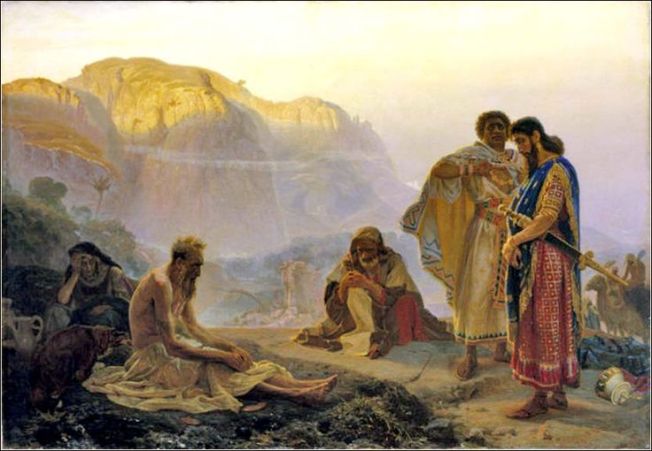
Job and his friends - Ilya Repin, 1869

Job 19:23-27 – November 10, 2019

Have you ever thought that God is just not fair? Look at the world today. With natural disasters, wildfires, hurricanes, earthquakes, torrential downpours, and flooding, some insurance policies still today list “acts of God” as a factor in their settlements.

Many people throughout the world live with debilitating illness or long-term disabilities. We may know several of them, personally. We may even be some of them, with illnesses like multiple dystrophy, polio, lupus, fibromyalgia, ALS, and complications from AIDS; not to mention the disabilities we see Jesus healing on a regular basis—people who are blind, lame and mute, to mention just a few.

Yes, there is a whole lot of bad and awful going on in the world. Many, many people think—and outright say—that God is just not fair. Do you ever feel that way? I know I have.

Job definitely felt that way; he expressed his feelings openly in the book named after him, in his discussions with his friends as well as his discussions with God. This book squarely brings up the question: is God fair? I ask again: is God fair? Job wanted to know. I think, so do we.

If people want comfort, they turn to the Psalms, or the Gospel of John, maybe parts of Isaiah, or the encouraging sections from the letters in the New Testament. Not the book of Job.

Perhaps you only know Job as a character in the Hebrew Scriptures who was very rich, and then through a horrific series of circumstances and through no fault of his own, had everything taken away. How many here know the basics about Job? And…that is about it? Oh, there is a sort of postscript to this book, where Job gets all of his wealth returned to him, plus additional children are born to him and his wife, but that does not come until the very ending of the story—a real happily-ever-after ending.

In the middle of Job’s disputing and arguing with his friends, the middle of his traumatic loss, paralyzing grief, and horrid debilitating physical condition, Job is really hard-pressed by his circumstances.

Plus, Job’s so-called friends are ostensibly there to try to comfort and help Job out. Talk about kicking a man when he’s down! Essentially, his friends wag their fingers in Job’s face and tell him to confess his secret sins. He is repeatedly, verbally beaten up by these three.

Poor Job slogs through his desperate life, one day at a time, one hour at a time. He goes through all manner of crap, from his circumstances, his health, and the people around him. Can we blame for saying, “God is not fair!”

Coming closer to home, we might consider the holiday tomorrow, Veteran’s Day. This day is set aside to remember veterans, and honor all veterans everywhere for their duty and sacrifice for our freedom. As we remember the horrors and deprivations of armed conflict throughout the world, what can you and I do about it? I feel powerless, puny and insignificant in the face of such things as conflicts and wars. Maybe you do, too. We also might say, “God is not fair!”

Seriously, I know I have thought God isn’t fair, sometimes. I suspect you have, too. Or, one of your loved ones has, or one of your close friends. If we assess the world today, it is enough to make even a sensible person throw up their hands and walk away, shaking their head.

Earlier in chapter 19, Job says that he repeatedly cries out to God, but God just doesn’t answer! The commentator James Limburg has the heartrending paragraph: “Job’s further complaints: and it is all God’s fault! Job says his life is miserable. He finds no support from family or friends (verses 13, 14, 19, 21). Even little children do not like him (18) and his wife finds him repulsive (17). Job is certain that God is behind all of this (13, 21, 22).” [1]

If we are looking for a poster child for miserable, suffering humanity, Job is definitely a finalist. But, wait. In the midst of all of Job’s cries for help and his complaints to his friends and to God, we have this shining jewel of verses in 19:25-26. What does Job say? I will read it again, so we can all savor the words: “I know that my redeemer lives, and that in the end he will stand on the earth. 26 And after my skin has been destroyed, yet in my flesh I will see God;“ I’m amazed at Job, having the gumption and the perseverance to make this proclamation. What a statement! James Limburg says about these words that this is “Job’s declaration of faith: I know that I have one who will rescue me from this mess!” [2]

We all agree that Job complains! He kvetches and complains to his friends and to God. Yet—Job does not quit. Some people we know may very well feel like quitting, and Job certainly was a candidate for throwing in the towel, yet—Job makes this shining declaration of faith.

In this unexpected verse he talks about a Redeemer. In Jewish usage, this term might be used for buying back a field or a person sold into slavery. Perhaps in modern terms we might “redeem” a musical instrument or piece of jewelry from a pawnshop. This same Hebrew word (go’el) is used in Exodus for God redeeming God’s people from slavery in Egypt, or in Psalms for God delivering an individual from death. God is the Redeemer! God will save Job! [3]

We might feel captive to our debilitating illness, or our desperate continuing situation, or shattering emotional state. It might seem like no one could ever reach down and help us out of the deep, dark pit we are in. Just like Job. Yet—God can reach down. God can save us. God is our Redeemer, just as God was Job’s Go’el, Job’s Redeemer.  

I would like to quickly add: Job was a realist. Job came right out and said he might die first, because he said his skin—his body—could very well be destroyed first before he was redeemed. Nevertheless, Job had the confidence to say “yet in my flesh I will see God.“ As James Limburg says, “Job expresses his conviction that there is One living who will eventually rescue him from the suffering and mess his life has become. As that One once rescued Israel, or the exiles, so the Redeemer will one day put Job’s life back together.” [4]

Does anyone doubt that this Redeemer can put our lives back together, too? In part three of the well-loved oratorio Messiah, the soprano soloist begins with Job’s words “I know that my Redeemer liveth.” I fully agree that the other Scripture passages Handel used in this part of the Messiah explain Job’s words so well.

For now is Christ risen from the dead, the first fruits of them that sleep.  
(I Corinthians 15: 20)  
Since by man came death, by man came also the resurrection of the dead. For as in Adam all die, even so in Christ shall all be made alive.  
(I Corinthians 15: 21-22)  
Behold, I tell you a mystery; we shall not all sleep, but we shall all be changed in a moment, in the twinkling of an eye, at the last trumpet.  
(I Corinthians 15: 51-52)  
The trumpet shall sound, and the dead shall be raised incorruptible, and we shall be changed. For this corruptible must put on incorruption and this mortal must put on immortality.  
(I Corinthians 15: 52-53)
But thanks be to God, who giveth us the victory through our Lord Jesus Christ.  
(I Corinthians 15: 57)  
If God be for us, who can be against us?  
(Romans 8: 31)  
Who shall lay anything to the charge of God’s elect? It is God that justifieth, who is he that condemneth? It is Christ that died, yea rather, that is risen again, who is at the right hand of God, who makes intercession for us.  
(Romans 8: 33-34)  

Where part three of the Messiah began with Job’s words “I know that my Redeemer liveth,” is there any way more fitting and more glorious to close this meditation on Job’s shining declaration of faith than the way Handel finished his oratorio? The words of Revelation 5:12-14:

Worthy is the Lamb that was slain, and hath redeemed us to God by His blood, to receive power, and riches, and wisdom,
and strength, and honour, and glory, and blessing.
Blessing and honour, glory and power, be unto Him that sitteth upon the throne, and unto the Lamb, for ever and ever.
Amen.
 
(Revelation 5: 12-14)  

[1] http://www.workingpreacher.org/preaching.aspx?commentary_id=735

Commentary, Job 19:23-27a, James Limburg, Pentecost 24C Preaching This Week, WorkingPreacher.org, 2010.

[2] Ibid

[3] Ibid

[4] Ibid.

(Many thanks to James Limburg, Professor Emeritus of Old Testament at Luther Seminary, Saint Paul, MN, for the use of his excellent commentary article on this passage from Job 19.)

@chaplaineliza

(Suggestion: visit me at my regular blog for 2019: matterofprayer: A Year of Everyday Prayers. #PursuePEACE – and my other blog,  A Year of Being Kind . Thanks!