Unknown's avatar

A Foreign Neighbor’s Faith

“A Foreign Neighbor’s Faith”

Matthew 15:21-28 (15:28) – July 27, 2025

When I worked as a hospital chaplain at Swedish Covenant Hospital (now called Swedish Hospital), more than 10 years ago, one of the points of working there highlighted was the multi-cultural setting of that hospital and that neighborhood. The ZIP code that Swedish is in is one of the most diverse in the country, in all kinds of ways. In terms of languages spoken, various countries of origin, differing faith traditions, and wide economic differences in that ZIP code alone make Swedish Hospital a unique place to work, of great cultural diversity.

In our Scripture reading today, the Rabbi Jesus traveled up north of the Sea of Galilee, on the border of Palestine. It was in an area called the Decapolis, the Ten Cities, which also was a multi-cultural crossing point. Perhaps not as widely diverse as the ZIP code around Swedish Hospital, but with a number of diverse cultures, faith traditions, and languages spoken.

Our Gospel writer Matthew was quite particular about how he presented the information in his Gospel, which was written specifically for a Jewish audience. Let us look at how Matthew begins this vignette in the life of the Rabbi Jesus. “Jesus withdrew to the region of Tyre and Sidon. 22 A Canaanite woman from that vicinity came to him, crying out, ‘Lord, Son of David, have mercy on me! My daughter is demon-possessed and suffering terribly.’”

We learn a lot from these two sentences! Matthew wants his readers to know where the Rabbi Jesus had gone – into the area of the Decapolis, on the border of Israel – and that this woman who came to Jesus for help is not Jewish, but instead is a Canaanite woman – what the Gospel writer Mark in his parallel account calls a Syro-Phoenician woman.

The Canaanites were hated by the Jews, and were among those the Jews termed “Gentiles,” since they were polytheists and prayed to various gods like Baal and Asherah.

Up until this point, Jesus had ministered to very few people who were not Jewish. So, here we are, in a cross-cultural situation. Here the spotlight shines on a woman who is not Jewish, asking Jesus for help. And, help not for her, but for her daughter, who is suffering terribly! This request is familiar territory for the Rabbi Jesus, certainly!  

I have mentioned the Rev. Janet Hunt before. She tells a heartfelt story, some of which I repeat here. “Mental illness carries all kinds of stigma today. I have known this since I was a child and we experienced it in our own family. Back then it was something whose name you whispered.  I’m not sure it is so very different now.  When I was young during that time during the prayers of the church where we stood in silence and remembered people in need, I would close my eyes shut tight and silently plead for Aunt Donna’s healing. It didn’t come.” [1]
            In the case of our Gospel narrative, we are not sure what is the matter with this daughter of the Canaanite woman. Certainly, it could well be mental illness! This was often seen as demon-possession in past centuries. Mental illness carried a huge stigma in the first century, just as now, in the twenty-first.

It is Jesus’s response that is surprising. Or rather, His non-response. “The disciples, obviously aggravated by her persistence, ask Jesus to deal with her request so that they can be on their way. Jesus then explains that his mission (under the authority of God) is to call out the faithful remnant of Israel. This doesn’t deny a future mission to the Gentiles, only that for the present, ‘salvation is from the Jews.’” [2]

The all-important point of this narrative comes from this mother, this neighbor from a different neighborhood. Our summer sermon series this summer is all about Fred Rogers. He met with a lot of different people from many, many different neighborhoods. Diverse cultures, and from foreign shores, or neighborhoods, too. As this Biblical narrative continues, the woman speaks to Jesus again. “The woman came and knelt before him. “Lord, help me!” she said.26 Jesus replied, “It is not right to take the children’s bread and toss it to the dogs.” 27 “Yes it is, Lord,” she said. “Even the dogs eat the crumbs that fall from their master’s table.”

28 Then Jesus said to her, “Woman, you have great faith! Your request is granted.” And her daughter was healed at that moment.

Did you hear? This woman from a different culture, from a different neighborhood, had great faith! Jesus acknowledges that, and her daughter is miraculously healed at that moment! It is marvelous that this faithful foreign woman – who knew that Jesus was the Chosen One of God, and called Jesus by the Messianic title “Son of David” – did indeed have great faith!

Except, where does that leave us today? What are we supposed to do with this narrative from Matthew’s Gospel? As commentator Karoline Lewis tells us, “A lot of how we talk about faith indeed ends up being about measurement. Life’s consequences are attributed to whether or not someone had enough faith, whatever the circumstance may be. “Just have faith!” Well, how much? It doesn’t seem like a little will do. And how do you get more? Are you stuck with what you have? Are we genetically disposed to a certain level of faith?” [3]

I sometimes wonder whether I would have had even half, even a quarter of the amount of faith this Canaanite woman had! I suspect that these are the kinds of issues about faith with which all of us struggle — and which we may likely hear in the Canaanite woman’s deep, heartbreaking request. “We wonder at the faith that is already working within her.  Even though she is a Gentile, somehow she sees Jesus as having come for her as well.[4]

At the same time, I do not want us to assume that because we do not have great faith that the Lord Jesus turns His back on us, or refuses to do anything for us at all. Which is what false teachers of the Gospel often tell their followers: “Oh, you did not receive that healing – or that answer to prayer – because you just didn’t have enough faith!”

No, Christianity is not a cheap marketplace, or a mercenary vending machine in the sky where we deposit our money and miracles and healings magically come forth. No, this Canaanite woman had faith in the Lord Jesus, the Messiah, the Son of David. She developed a relationship with Jesus. And, it all started with a mother’s willingness not only to speak, but to shout.  For the sake of love. For the sake of a much beloved daughter, desperately ill.

Our faith in God – your faith and mine – “lays claim on how you are in the world, how you choose to be, how [each of us] decide to live, in each specific moment of your life…. faith is not a fixed collection of beliefs but a state of being. Your faith is great, not because of what you do, but because of who you are.” [5]

Fred Rogers had a wide variety of diverse neighbors in Mister Rogers’ Neighborhood. These were both real neighbors in the real neighborhood, and the puppets and people of the Neighborhood of Make-Believe. They all interacted with one another with kindness and respect. Fred Rogers tells us, “As different as we are from one another, as unique as each one of us is, we are much more the same than we are different. That may be the most essential message of all, as we help our children grow toward being caring, compassionate, and charitable adults.” [6]

Yes, Jesus healed this daughter of a neighbor from a different neighborhood, a foreign neighborhood. As you and I travel through different neighborhoods in our lives, we can have the same openness, care and compassion that Jesus had. That Fred Rogers had.  

Be like Jesus. Be like Fred Rogers. Go into multicultural places with openness and respect, care and compassion. Go, do that.

(A big thank you to the online resources for Mr. Rogers Day – the Sunday nearest March 20th, Fred Rogers’ birthday. These resources come from the Presbyterian Church (USA). https://www.pcusastore.com/Content/Site119/Basics/13792MrRogersIG_00000154465.pdf )

@chaplaineliza

(Suggestion: visit me at my other blogs: matterofprayer: A Year of Everyday Prayers. #PursuePEACE – and  A Year of Being Kind . Thanks!


[1] http://words.dancingwiththeword.com/2014/08/a-mothers-cry.html

[2] https://www.lectionarystudies.com/studyg/sunday20ag.html

[3] https://www.workingpreacher.org/dear-working-preacher/getting-great-faith

[4] http://words.dancingwiththeword.com/2014/08/a-mothers-cry.html

[5] https://www.workingpreacher.org/dear-working-preacher/getting-great-faith

[6] https://www.misterrogers.org/articles/he-helped-us-with-our-relationships-with-others/ 

Unknown's avatar

A Neighbor and His Daughter

“A Neighbor and His Daughter”

Matthew 9:18-26 (9:25) – July 20, 2025

Welcome to the neighborhood! St. Luke’s Church neighborhood, that is.

I am continuing with our summer sermon series on Mister Rogers. You know, Fred Rogers, of Mister Rogers’ Neighborhood. I watched the television show with my small children – all four of them, at various times. I so appreciated Fred’s gentle, caring, loving way of speaking to everyone. Not only the children. He was the real deal. Fred was a genuine, caring, compassionate person, interested in everyone and everything. And, especially in children.

We are looking at a Scripture reading today that highlights a child, this week. Actually, it highlights both a girl child and a sick, unmarried woman, two people who were second-class citizens in the society of Jesus’s day. Women, especially unmarried women, were second-class, as were children. The only people who were of any worth in first-century society were males, and especially free males who owned property.  

But, let us leave this social class commentary for another day. I want us to concentrate on, first of all, the man who approaches the Rabbi Jesus, to ask if He could come and heal his daughter who is very sick. Actually, this narrative appears in three of the four Gospels: Matthew, Mark and Luke. There are slight differences in the telling of the narrative. In two accounts, the sick girl is still living, but at the point of death. In Matthew’s account, she has already died. In any of these narratives, it is a terrible tragedy for this father.

We understand that if two individuals are eye-witnesses to a car accident, but see it from the opposite sides of the street, we will have two different perspectives of the same accident. Just so here. Just so with the three writers of the Gospels. We see slightly different accounts of the same incident. With Matthew’s account, the father comes to Jesus, begging Him to come and heal his daughter – his dead daughter.

The father Jairus is the leader of the local synagogue. Not just a common attender or member, but the leader. He comes to the rabbi Jesus for help in a time of severe need. He must have been at the end of his rope, the end of all of his resources. Except – as the leader of his synagogue, leaders are trained to be competent and in control, and not supposed to be in desperate agony or heartbreaking fear of losing a much beloved family member. In fact, Jairus threw himself at Jesus’s feet, begging Him to come and raise his daughter from the dead. “He is desperate; his love for his daughter has left him utterly vulnerable.[1]

As the rabbi Jesus agrees and starts to go with the distraught father, we meet the second of these three people we are concerned with today. This unmarried woman has been sick for a long, long time. Twelve years. She has no standing in her community, and “apparently has no advocate to beseech this teacher on her behalf….Mark’s [account] doesn’t make a point of her impurity or isolation from the community, but because this was most likely vaginal bleeding it would have rendered her impure and, just as important, likely unable to bear children.” [2]

So, we have two desperate people. Two people at the end of their rope, vulnerable for different reasons. This unnamed woman was brave enough, desperate enough, to try to touch the cloak of this Rabbi. As she said to herself, “If I only touch his cloak, I will be healed.” Both of these people were seriously grieving, and were reaching out for help.

Both of these dear people – dear to our Lord Jesus – displayed tremendous vulnerability. Vulnerability was and is not a trait that is held up to be something that leaders of groups or CEOs of companies or corporations strive to emulate. Actually, Fred Rogers was vulnerable to lots of people, places and things. Willingly so. He considered vulnerability a strength, considering other people and their feelings and emotions. Just like Jesus did, too.  Fred Rogers saw the neighbor in people, just like Jesus, too.  

Mister Rogers said, “It takes strength to face our sadness and to grieve and to let our grief and our anger flow in tears when they need to. It takes strength to talk about our feelings and to reach out for help and comfort when we need it.” [3]

We are forgetting the third person in this narrative, though. The girl, terribly sick, at the point of death. It is easy to forget about her. She’s twelve years old, utterly helpless and passive, dependent on others, helpless to do anything about anything.

Here are three characters, three people that Jesus touches, heals in different ways. Life-changing ways. Which one do you identify with? “The leader who finds that all the usual advantages and experience that go with his office suddenly avail him nothing? The one who has endured much and isn’t sure she can bear any more? Or the one who is helpless, utterly dependent on others? Which one do you identify with?” [4]

It is only in our admitting our vulnerability that we are able to receive help, and only by admitting our desperation are we willing to try something, anything, that may give us hope. These admissions are not the end of the world! These admissions – these cries for help show that we are not rugged individualists, going it all alone, after all. We can show that we are part of a community, part of a neighborhood. This is a true way of showing courage, leaving behind the false culture of perfection, individualism and stiff upper lip.

This is what being a neighbor is all about, and what both Jesus and Fred Rogers advocate. Can we show mutual respect to others – all others? These three individuals are certainly from three widely different parts of society, and Jesus met them all where they needed Him most. Can we display inter-dependence freely, even call it what it is – the inter-dependence of the Kingdom of God that Jesus keeps preaching about?

Each of us has our own vulnerable, secret (or, not so secret) places inside that call for attention, call for healing and nurture and comfort. All of us have those places and spaces where we grieve and where we wish we could reach out. We all need a nurturing, healing neighborhood of trust, respect and caring.

 Can we – can you and I commit to being that caring community for others? That safe space where others who are hurting and need healing feel the trust and openness? Jesus definitely had that safe space and healing presence all around Him. Fred Rogers did, too. I strive to be that safe space and healing presence for others. See if you can be that for others, too. For all others, just like Jesus. Just like Fred Rogers, too.

And, the best part about this is that you and I do not need to have it all “together” and perfect to do this, to be that safe space. We just need to be open, willing and available to welcome all others into the neighborhood. What would Jesus do? What would Fred Rogers do? Go, do that.

(Thank you so much to David Lose and workingpreacher.org for the wonderful article on Jesus’ very busy day, https://www.workingpreacher.org/dear-working-preacher/come-as-you-are. Much appreciated!)

@chaplaineliza

(Suggestion: visit me at my other blogs: matterofprayer: A Year of Everyday Prayers. #PursuePEACE – and  A Year of Being Kind . Thanks!


[1] https://www.workingpreacher.org/dear-working-preacher/come-as-you-are

[2] Ibid.

[3] https://www.fredrogersinstitute.org/resources/reflections-on-fred-rogers-healing-power-of-presence

[4] https://www.workingpreacher.org/dear-working-preacher/come-as-you-are

Unknown's avatar

Loving Neighbors in the Strangest Places

“Loving Neighbors in the Strangest Places”

Luke 19:1-10 (19:5) – July 13, 2025

I have rubbed elbows with all kinds of people! I grew up in Chicago in a half-and-half, working-class and middle-class neighborhood. I lived in (and worshiped in) two racially mixed areas of Chicago for some years. I’ve had a number of jobs before I went to seminary at 40 years old, in diverse industries, including the ramp, a huge warehouse, and an order fulfillment center. So, when I hear the Rabbi Jesus getting some guff from the crowd for hanging out with the riff-raff and “sinners,” that surely gets my attention!   

I think today’s Scripture reading is particularly fascinating since it shows someone who was definitely not well liked in his neighborhood. In fact, no one wanted to call him “friend” or neighbor. Zaccheus was a chief tax-collector for the Roman occupation. Yes, he was Jewish, and yes, he was working for the hated occupying foreign forces. And as if that were not enough to get him disliked by his Jewish neighbors, Zaccheus was officially delegated by the Roman government to collect their taxes for them.

The Roman government was not very particular about how they got their tax money – as long as they got it. So, the local tax collectors could be as demanding or dishonest as they wanted to be, all for the purpose of getting money for the Romans. And, if these tax collectors squeezed a little extra money out of their fellow Jews, the Romans did not care. As long as enough money came into the Roman treasury. That was all the occupying force cared about.

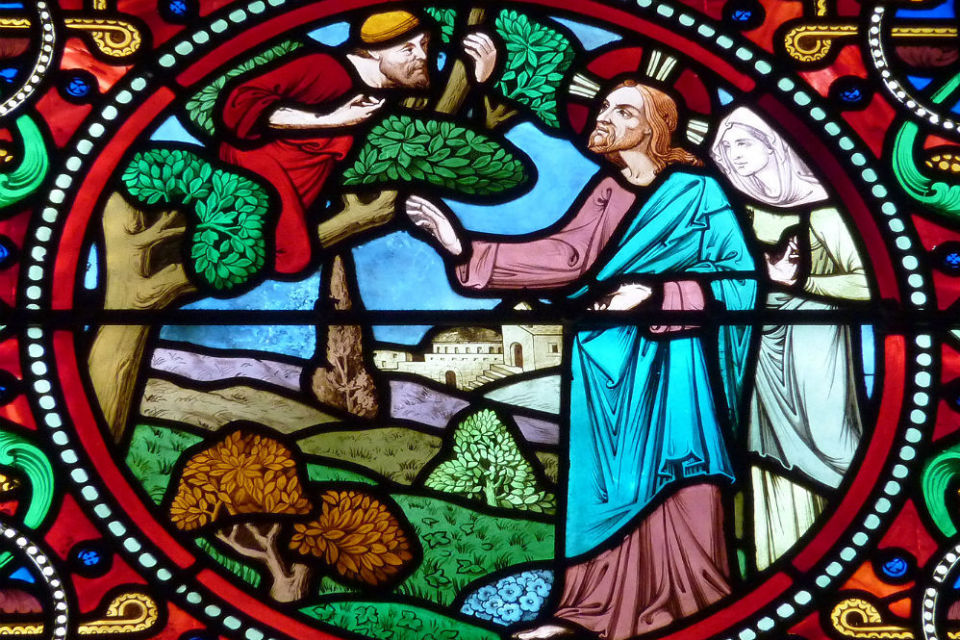
I would imagine that Zaccheus was a pretty lonely man. Until – the Rabbi Jesus came to town. This was several years after Jesus had started to preach, teach and do miracles, so I suspect by this time Jesus had quite a following, and quite the reputation! Let’s pick up right in the middle of the narrative: “3Zaccheus wanted to see who Jesus was, but because he was short he could not see over the crowd. So he ran ahead and climbed a sycamore-fig tree to see him, since Jesus was coming that way. When Jesus reached the spot, he looked up and said to him, “Zacchaeus, come down immediately. I must stay at your house today.” So he came down at once and welcomed him gladly.”

We read next that the crowd started to grumble, because the Rabbi Jesus saw and spoke with Zaccheus, truly engaged with him, and even said “I must stay at your house today.”  

Can you imagine, being the shortest guy in your high school! Plus, being one of the least popular persons in the town of Jericho! Both of those things must have been painful subjects for Zaccheus. I just imagine that he lived an isolated existence, wanting, hoping that someone would see him, notice him and validate him. This emotional response is only human!

We are currently observing a summer sermon series highlighting the person of Fred Rogers, of Mister Rogers’ Neighborhood. Have you ever thought of someone who is meek and gentle as being a strong individual? Someone who is so strong and confident themselves that they do not care what other people think? I think that is exactly the kind of person Fred Rogers was. Plus, Fred Rogers thought everyone was deserving of attention and respect, no matter what! And, that deep emotions were important things.

Of the many lessons Rogers gently gifted his audience, a chief one was that all emotions are valid, even the sad and angry ones. They need acceptance from friends and family and, often, expression – so long as it’s not violent. Sigmund Freud called this ‘sublimation,’ the channeling of destructive impulses into socially acceptable actions. It was a pillar of Rogers-ism, and [Rogers] often referred to dialogue about emotions and feelings as ‘important talk.’” [1]  

The Rabbi Jesus obviously thought that emotions were important – even the emotions of someone hated like Zaccheus. Sure, Zaccheus was seen as a hated tax collector by his Jewish neighbors! But, Zaccheus’s feelings were valid, too! Our Lord Jesus went out of His way to single Zaccheus out, see him, notice him, validate him. And, Jesus invited Himself over for dinner!

Salvation came to Zaccheus’s house that day. Jesus followed him home, and broke bread with him at a lonely table. Salvation comes to all of us when Jesus joins us, has fellowship with us. Even when people do not feel worthy, for whatever reason, to have Jesus join them – it doesn’t matter. Salvation is solidarity, hospitality, and yes, ministry.

Our commentator Karoline Lewis relates a modern (and true) narrative, taken from the column of David Brooks, long time New York Times columnist. Brooks tells the story of Kathy Fletcher and David Simpson. “They have a son named Santi, who went to Washington, D.C. public schools. Santi had a friend who sometimes went to school hungry. So, Santi invited him to occasionally eat and sleep at his house.”

“That friend had a friend and that friend had a friend, and now when you go to dinner at Kathy and David’s house on Thursday night there might be 15 to 20 teenagers crammed around the table, and later there will be groups of them crashing in the basement or in the few small bedrooms upstairs.”

The kids who show up at Kathy and David’s have endured the ordeals of modern poverty: homelessness, hunger, abuse, sexual assault. Almost all have seen death firsthand — to a sibling, friend or parent.”

“It’s anomalous for them to have a bed at home. One 21-year-old woman came to dinner last week and said this was the first time she’d been around a family table since she was 11… Poverty up close is so much more intricate and unpredictable than the picture of poverty you get from the grand national debates.”

“I started going to dinner there about two years ago,” writes Brooks, “hungry for something beyond food. Each meal we go around the table, and everybody has to say something nobody else knows about them. Each meal we demonstrate our commitment to care for one another. I took my daughter once and on the way out she said, ‘That’s the warmest place I can ever imagine.’”

The problems facing this country,” says Brooks, “are deeper than the labor participation rate and ISIS. It’s a crisis of solidarity, a crisis of segmentation, spiritual degradation, and [lack of] intimacy.”

“The kids call Kathy and David ‘Momma’ and ‘Dad,’ are unfailingly polite, clear the dishes, turn toward one another’s love like plants toward the sun and burst with big glowing personalities. The gift of Kathy and David is the gift of a complete intolerance of social distance,” insists Brooks. [2]

At church, we speak ‘salvation speech.’ This is speech that sees the other, that regards the overlooked. We speak speech that brings together, and unites across barriers and boundaries, classes and cultures. Speech that creates community and family for everyone. Speech that gives life and says that salvation is here and now, in this world as well as the next. [3]

Jesus said, “Today, salvation has come to this house.” It is salvation to a house, any house. It’s to a neighborhood, each and every neighborhood. This place where Zaccheus lives is where Fred Rogers would welcome, and be welcomed, too.

What would Jesus do? What would Fred Rogers do? Go. Do that.

(A big thank you to the online resources for Mr. Rogers Day – the Sunday nearest March 20th, Fred Rogers’ birthday. These resources come from the Presbyterian Church (USA). https://www.pcusastore.com/Content/Site119/Basics/13792MrRogersIG_00000154465.pdf )

@chaplaineliza

(Suggestion: visit me at my other blogs: matterofprayer: A Year of Everyday Prayers. #PursuePEACE – and  A Year of Being Kind . Thanks!


[1] https://www.cnn.com/2018/06/08/health/mister-rogers-go-ask-your-dad/index.html

[2] David Brooks, “The Power of a Dinner Table,” The New York Times, October, 18 2016, http://www.nytimes.com/2016/10/18/opinion/the-power-of-a-dinner-table.html

[3] https://www.workingpreacher.org/dear-working-preacher/salvation-today

Unknown's avatar

Approaching God in Community

(I am on vacation this week, or rather, a stay-cation. Enjoying stepping away from pastoral and preaching responsibilities. Here is a sermon from the beginning of July 2007, when I was co-interim pastor of a (sadly) now-closed little church, St. John’s United Church of Christ in Evanston, Illinois.)

Acts 2:42        July 1, 2007

“Approaching God in Community”

            Life here in America, even here in the Chicago area, in the 21st century can be lonely. People often live alone, drive alone, shop alone, even work alone. Many people do not talk about their lives, are never asked how their day is going, rarely experience a caring touch. Loneliness and a sense of isolation are part and parcel of many people’s daily lives. Unless people intentionally make an effort to interact with others today, whole days—even weeks can go by without meaningful encounters.

            There are lots of reasons for this. The rapid communication trend with ever increasing speed has distancing, impersonal effects on many. The nuclear family is fragmented, now more than ever. Technology will continue to develop, and businesses downsize, fragmenting society and driving people further apart. And then, of course, we need to consider the speed with which everything is going now, so much faster than fifteen or twenty years ago.

            A retired pastor friend of mine told me a while ago about some elderly people at a church he pastored, a number of years ago. Some of them lived alone, either in houses or apartments. My friend told me about the loneliness that drove several of them out to the grocery store every day, because if they did not have that interaction with the checker checking out their food, they would not have a personal encounter in the entire day. A few were so hungry for personal contact, they desperately wanted the physical touch that comes from an exchange of money at the cash register; so simple, so fleeting.

            Similarly, some people today are searching for an interaction with God. George Barna, the guru of surveys, statistics and demographics, found that 49 percent of people who do not attend church, in the 1990’s—less than ten years ago—wanted a close relationship with God. These are people who do not even darken a church door. The percentage is even larger when we consider the people who do attend church. There is a common desire among many to have an encounter with God. Saint Augustine referred to it as a God-shaped hole in our hearts.

            This longing for God, this desire for an encounter with God, I see as similar to longing for human contact. Both longings stem from a deep loneliness, a need for something internally, a kind of relationship. Many people are yearning for some kind of deep relationship in their lives, both horizontally—with other human beings, as well as vertically—with God.

However, there is a problem. This longing cannot be filled. The encounter—both vertically as well as horizontally—that many people want to have cannot happen. Something gets in humanity’s way. Something is in our lives and hearts, and acts as a block, a separation. You know it as well as I do, and this something is sin.  Sin is a separation; it comes between us and other people. Sin comes between us and God.

I won’t dwell on sin much, other than to say that it is a prideful, selfish, sometimes downright rebellious attitude. The “me, first!” attitude that comes between us and other people, and especially comes between us and God. And that deep-down attitude separates us, builds walls, and keeps humanity from developing relationships, from having meaningful, honest encounters.

But there is good news. God wants to break down that separation, and allow us to encounter Him. The Bible tells us that Jesus had willingly taken our sins on Himself to pay the “wages of sin” in our place!  And God the Father made it clear to everyone that He was completely satisfied with this payment by the fact that He raised Jesus His Son up from the dead!  And so, the way is now clear for us to have the relationship with God that we were meant to have! At last, the “hole in our souls” can be filled to our satisfaction, this deep-down longing for God can be filled.

So this is good news! This is very good news! But I haven’t even started to examine our scripture passage for this morning. I wanted to take a brief look at the second chapter of Acts.

Peter—you all remember Peter, don’t you? Peter was just finishing his sermon in Jerusalem, on the day of Pentecost. The book of Acts records one of the biggest altar calls ever. About three thousand people welcomed the gospel message of Peter into their hearts, and joined the brand new group of believers that day. Talk about a soul-winning campaign! God touched the hearts of thousands of people that day, and drew all these people to Himself. God had a close encounter with each one of these people that day.

One of the most amazing things we can learn from this passage is that God not only repaired the way for Him to have a relationship with each person, vertically-speaking, but this lifting of the sin-separation repairs the way for us as individuals to have a relationship, to have an encounter with each other. God causes the separation to disappear, both horizontally, as well as vertically.

Listen again to the passage, starting at Acts 2:41-42. “So those who welcomed his message were baptized, and that day about three thousand persons were added. They devoted themselves to the apostles’ teaching and fellowship, to the breaking of bread and the prayers.”

Welcoming the message of the good news is the first part I want to consider. God repaired the separation. About three thousand people came to faith in the message Peter preached. God drew these people to Himself, reached their hearts, and caused the separation of sin to disappear.

Do you hear? Do you understand? God wants to approach us just as much as we want to approach Him—more, even, since God’s love is higher than the highest heaven and deeper than the deepest sea. And God has made this possible by the death of His Son on the cross, reconciling us to Himself, breaking the separation that divides us from God.

But wait—that’s not all. Not by a long shot.

God not only wants to bring us into a close relationship with Him, God wants each of us to come into a relationship with each other. And what an awesome opportunity to do both at the same time. In worship, we have the opportunity to experience a close encounter with God and with other people worshiping with us.

We here at St. John’s Church call this congregation a church family. Well, that’s exactly what Dr. Luke had in mind as he wrote the book of Acts. He wanted to emphasize that separate, lonely, desperate individuals not only developed a relationship with God, but through their heartfelt belief, they developed a relationship with each other. And that relationship, that fellowship has the opportunity to be realized in worship, together.

In centuries past, congregations took the opportunity to worship actively together. Congregational singing, reciting creeds, celebrating communion, reading liturgy, passing the peace—all of these are expressions, activities that congregations used to do together. But, there’s more. Much, much more. God is pleased when we are creative, and what better way to be creative than in worship and praise of our God.

Now, especially in some churches, worship is becoming increasingly a passive activity. Just sit back, and watch the show up front. But this isn’t a way to have a relationship with God, or with our fellow church family! People cannot interact with God and with others if they don’t have anything to do on a Sunday morning in a worship service.

God wants a relationship with us. God wants to get in touch with us. And part of that interaction comes from our getting in touch with each other. As someone here in the congregation mentioned a couple of weeks ago, it is especially at times of deep emotion that a congregation can pull together and show love and concern for each other.

It would be silly to think that a relationship could be built simply on loving thoughts and nothing else. No, a relationship is built on regular interactions, close encounters on a regular basis. The book written to the Hebrews advises these believers not to neglect the assembling of themselves together. They were to assemble regularly for worship. I’d like to go even further, and suggest that we not neglect worship that is interactive—not only between the congregation and God, but between the members of the congregation.

God is offering you, offering me, the opportunity for a relationship with Him, as well as a relationship with our church family. The options are there in front of us—loneliness and separation, both vertically as well as horizontally, or relationship and fellowship, with God and with our church family.

What does this look like? I don’t know, exactly. It’s different for different congregations. God is a God of infinite variation, and I suspect He accepts worship of all different kinds, just as God accepts people of all different cultures and people-groups.

I invite you to start praying about worship, and talking about it with each other, too. Some here may feel rather skittish, or downright silly, entertaining different and new ideas about worship. Some may even feel like they’re “breaking the rules,” but that’s okay.  This interactive worship, both in a horizontal way as well as a vertical way, is truly biblical worship. It is truly a way for us to approach God, as well as each other. And in this day and age, that’s what humanity needs—a close encounter with God, as well as with each other.

Unknown's avatar

Welcome to the Neighborhood!

“Welcome to the Neighborhood!”

Mark 12:28-34 (12:33) – June 29, 2025

Welcome to the second in our summer sermon series on Fred Rogers, of the television show Mister Rogers’ Neighborhood, which aired on PBS for more than 30 years. As I said last week, I have great respect for Fred Rogers. I have even said a number of times (only partly humorously) that when I grow up, I want to be Mister Rogers.

When we consider our Scripture reading today, we might not at first be able to see clearly how the Rabbi Jesus instructing on the Greatest Commandment connects with Fred Rogers. We will explore that, but first, let’s take a closer look at today’s reading from Mark 12.  

            Starting with verse 28: 28 One of the teachers of the law came and heard them debating. Noticing that Jesus had given them a good answer, he asked him, “Of all the commandments, which is the most important?” 29 “The most important one,” answered Jesus, “is this: ‘Hear, O Israel: The Lord our God, the Lord is one. 30 Love the Lord your God with all your heart and with all your soul and with all your mind and with all your strength.’ 31 The second is this: ‘Love your neighbor as yourself.’ There is no commandment greater than these.”

            We need a little backstory here. The teachers of the Jewish Law (or the Law of Moses, from the Hebrew Scriptures) were quintessential rule-followers, often to the extreme! We can see that from the situation Jesus is dealing with, right here.  As one of our commentators said, “Throughout Mark’s Gospel, the scribes [and teachers] were always evaluating Jesus’ activities. They judged Jesus theologically.” [1] The Rabbi Jesus and some high-ranking teachers of the Law are having another in their series of continuing discussions. These teachers really enjoyed discussing the Law, and both the major as well as the minor points of Judaism. Some teachers would get all excited and rub their hands at the prospect of a good argument! I mean, discussion.

That’s where we pick up our thread of the narrative. Different rabbis or teachers had different opinions on what was the greatest of all commands. I am certain some of these teachers wanted to know what Jesus considered the “most important” of the 613 laws in the Mosaic Law code, which was (and still is) the official, orthodox Jewish rule book.

Our Lord Jesus said right here (and also in a parallel account in Matthew 22) that the Greatest Commandment has two parts. First part: Love the Lord your God with all your heart and with all your soul and with all your mind and with all your strength. Second part: Love your neighbor as yourself. The short way for us to think of this two-part command? Love God – vertically – and love neighbor – horizontally.

One common way of understanding this is that loving God first and foremost (which is a command, NOT a suggestion!) naturally leads us to loving neighbor. Our sermon today is called “Welcome to the Neighborhood,” because loving and caring about our neighbors is one of the foundational beliefs that was all-important to Fred Rogers.

For some additional understanding on what the Bible has to say about our neighbors, we can look at an unexpected place. Unexpected for Christians on a typical Sunday morning in the 21st century, that is. Let’s turn to Deuteronomy 10:17–19, where we see the Hebrew people after they have left slavery in Egypt and before they have entered the Promised Land.

Starting at verse 17: “For the Lord your God is God of gods and Lord of lords, the great God, mighty and awesome, who shows no partiality and accepts no bribes. 18 He defends the cause of the fatherless and the widow, and loves the foreigner residing among you, giving them food and clothing. 19 And you are to love those who are foreigners, for you yourselves were foreigners in Egypt.” Did we catch that last part? This is the Lord speaking. God shows no partiality and accepts no bribes. God tells us – and it is NOT just a suggestion – God commands all of the people of Israel and all of us (by extension) as the people of God, to love the foreigner residing among us, “for you yourselves were foreigners in Egypt.”

So, who IS our neighbor? Not just our relatives. Not just the people who go to our church, or our acquaintance from the garden club, or our friend from down the street. Instead, God commands us to defend the fatherless and the widow, and love the foreigner living in our neighborhood. Those foreigners – or our new neighbors, as Fred Rogers would say – are the ones who speak in a different language, or who come from a different country, or who dress in different clothes, or who worship at a different place than we do. Fred Rogers would be open, be curious, and most important, be caring and loving to everyone.  

Think about a time when you were new in a place. It could be a new home in a new location or a new school or workplace. It may be being new in an activity or class or team. How did it feel to be the “new one?” What would have made you feel welcome? Could you do that for someone else? Even a friendly smile or a greeting, like “good morning?”

            Fred Rogers would often ask people to do a short exercise. He would ask journalists to participate, or groups he’d speak to, and even the audience when he won the Emmy for Lifetime Achievement in 1997. Mr. Rogers would ask people to be silent for thirty seconds and think about people who have loved them into being. At the Emmy’s ceremony, Mr. Rogers marks the time. The camera pans the whole audience, with people deep in thought, and everything on the recording is absolutely silent during this time as well. [2]

Just like Fred Rogers, I would like to ask us to take 30 seconds to think about people who welcomed us and made us feel like neighbors. Who loved us, and welcomed us? Can you think of people who still warm your heart when you think of them? Take 30 seconds. ( … )  

I know I often ask in my sermons “what would Jesus do?” Who would Jesus love? We are supposed to, we are commanded to love God – vertically – and to love our neighbor – horizontally.

This week, I am going to change up my question, and ask “what would Fred Rogers do?” Who would Fred love? Who would Fred call his neighbor? I think, everyone. Each and every person. Go. Go, and do that.

Alleluia, amen.

(A big thank you to the online resources for Mr. Rogers Day – the Sunday nearest March 20th, Fred Rogers’ birthday. These resources come from the Presbyterian Church (USA). https://www.pcusastore.com/Content/Site119/Basics/13792MrRogersIG_00000154465.pdf )

@chaplaineliza

(Suggestion: visit me at my other blogs: matterofprayer: A Year of Everyday Prayers. #PursuePEACE – and  A Year of Being Kind . Thanks!


[1] https://www.workingpreacher.org/commentaries/revised-common-lectionary/ordinary-31-2/commentary-on-mark-1228-34-4

[2] https://www.pcusastore.com/Content/Site119/Basics/13792MrRogersIG_00000154465.pdf

Unknown's avatar

Came to Serve in the Neighborhood

“Came to Serve in the Neighborhood”

Mark 10:42-45 (10:43) – June 22, 2025

I’ve had a great respect and fondness for Fred Rogers, for many years. You know, Fred Rogers, of Mister Rogers’ Neighborhood. I watched the television show with my small children – all four of them, at various times. I so appreciated Fred’s gentle, caring, loving way of speaking to everyone. Not only the children. He was the real deal. Fred was a genuine, caring, compassionate person, interested in everyone and everything. And, especially in children.

Right now, with bombings and raids and rumors of war on the minds of many people worldwide, right now seems like a strategic time for us to be starting a summer sermon series on Fred Rogers. Today’s uncertain time in history is somewhat similar to the uncertain times in the area where the Rabbi Jesus grew up and was teaching and preaching. Occupied territory. I fear that your typical person on that first-century street in Israel did not have guarantees of security or comfort in their lives, either.  

Our reading is from Mark 10, just a few verses before the beginning of chapter 11, where Jesus enters Jerusalem on Palm Sunday for the final Passion week of His life. This is the very end of Rabbi Jesus’s three-year ministry. His disciples had been with Him, and learned from Him for three whole years. At this time just before the Passion week, Jesus calls all the disciples together to give them a short recap on the Gentiles—the Romans—the worldly way of dealing with pre-eminence, greatness, and authority.

I would like us to focus especially on a few verses from our Gospel reading today.  “whoever wants to become great among you must be your servant, 44 and whoever wants to be first must be servant of all. 45 For even the Son of Man did not come to be served, but to serve, and to give his life as a ransom for many.”

If we notice, Jesus did not want to be a big shot, strong-man, autocratic leader. Instead, we see the life of Jesus as offering unique insights and inspiration to all of us. Our Lord Jesus shows us how to live as a servant leader. In His life and teachings, Jesus consistently demonstrated the core principles of servant leadership. Our Lord Jesus embodied servant leadership in its purest form. [1]

People in the first century just did not understand. Not even when the Rabbi Jesus explained to the disciples that they needed to become completely of no account, like children, they still did not have any idea of what Jesus was talking about.

What is the overarching disconnect and problem here? “Power has been the perennial problem in human history. The reality of power is complex; its use and misuse in all human, social and political relations and interactions has been a question of utmost importance for all peoples.” [2]  

I strongly suspect that Fred Rogers would have objected to have his life compared to the earthly life of our Lord Jesus. However, I see some definite parallels. It is here that Fred Rogers shines. Yes, he totally understood and appreciated becoming like a child. He became vulnerable, totally open, on a daily basis. Fred Rogers turned the power dynamics of the popular world and of politicians and of world leaders on their head. Just exactly like Jesus did.

I’m going to tell you about a church I attended, years back, while I was still at seminary. Smaller church, here in the north suburbs of Chicago. The church was going to have a clean-up day in the nursery and small children’s area, after the morning worship service. The Sunday school and children’s ministry people had been planning it for a number of weeks. A number of people had dressed for church with their cleaning clothes on, blue jeans and t-shirts. The group even sent out for sandwiches for a quick lunch before they began to clean up.

            My husband Kevin approved of the clean-up; our children weren’t that far beyond that younger age group. We couldn’t stay after service that day, but said our good-byes to the cleaners. On our way out, we ran into the associate pastor. She had delivered the sermon that morning and worn her clerical robes in church. However, she had transformed; she had changed into blue jeans and a sweatshirt. She had a bucket and a spray bottle of cleanser in her hands, and cheerfully wished us well as my husband and I went off to the next event.

            My husband’s opinion of that associate pastor rose by leaps and bounds that day. He told me how impressed and pleased he was to see that she was willing to go to work without blowing her own horn. She was willing to get her hands dirty for the church, not just look pastoral and holy up front in the sanctuary. She was willing to be a servant, as well as a leader!

            I know I have mentioned this before, in my past sermons. I’ll mention it again. Fred Rogers was not only the star, puppet performer, writer and producer of Mister Rogers’ Neighborhood, he was also a Presbyterian minister in the PC(USA) denomination. He was ordained into the ministry of communication to families via the medium of television. “Fred Rogers committed his life to making television programs for the very young because he saw its potential as an instrument for good as a gift. He cared deeply about those on the other side of the screen – their needs, concerns, struggles and joys.” [3]

            Years ago, I sensed that deep caring through the television, as my small children watched Mister Rogers. I rejoice that my children – and countless others – had the opportunity and blessing to meet with this television neighbor, who strove to give his absolute best in a way that young children could readily understand.

That is exactly who and what Fred Rogers was, too. Each and every day. He said, “I’d like to be remembered for being a compassionate human being who happened to be fortunate enough to be born at a time when there was a fabulous thing called television that could allow me to use all the talents that I had been given.” [4]

I do not imagine that I have one quarter, even one tenth of the compassionate skills, talents and spiritual gifts that Fred Rogers was blessed with. But, I have the ability to be my honest, caring self in my ministry with others. God has given us all the opportunity and the blessing to be a blessing to others, each and every day.

How can you be a blessing to others, today? Tomorrow? Next month? We don’t need to be television personalities or leaders on the state or national level to follow in the way of Fred Rogers, and of other servant leaders. We can also be faithful in the little things, like clean-up day at the church. How can you and I serve God and serve others, today? We are all called to serve by Jesus. Let us serve in all honesty, caring, and love for others, in our neighborhood today.  

@chaplaineliza

(Suggestion: visit me at my other blogs: matterofprayer: A Year of Everyday Prayers. #PursuePEACE – and  A Year of Being Kind . Thanks!


[1] https://chieflings.com/examples-of-servant-leaders-in-the-bible/

[2] “Minjung and Power: A Biblical and Theological Perspective on Doularchy (Servanthood),” Kim Yong-Bock, at Religion OnLine.

[3] https://www.misterrogers.org/about-fred-rogers/

[4] https://www.misterrogers.org/about-fred-rogers/

Unknown's avatar

How Majestic!

“How Majestic!”

Psalm 8:1-9 (8:1) – June 15, 2025

            Have you ever been far from the city lights, at night? Have you ever looked up into the sky, and seen countless stars spread out, twinkling high above? When I went to the Upper Peninsula of Michigan, and again in rural central Indiana, the starry skies were absolutely breathtaking. Amazing. Majestic, as the psalmist King David said in our Psalm reading today.

            Listen again: “Lord, our Lord, how majestic is your name in all the earth! You have set your glory in the heavens.” I can just imagine King David sitting far away from the lights of the city of Jerusalem, perhaps contemplating the stars as he saw them in his youth, when he looked after his father’s sheep, or as a younger adult, a leader of men in the wilderness of Judah, David certainly had many opportunities to gaze up into the night skies and see the breathtaking stars.

            As we gaze up into the night and see the amazing sight of all the stars laid out above us, we marvel. Marvel just as countless people have done throughout the millenia. As we think about the vastness and sheer beauty of the heavens, other vast, even unanswerable questions may come to mind. Just as countless people have done, and have reflected upon. Questions like: What was God doing before God created the world? And, how can there never be a time before or after God? And, how can God pay attention to each person in the world all the time? [1]

            These kinds of big questions have puzzled people for millenia, too. You and I could get hung up on these kinds of questions, and totally lose sight of the sheer, magnificent, bottomless awesomeness of God. Or, are we simply to return to the first verse of today’s reading, and be totally in awe at God’s glorious majesty? “Lord, our Lord, how majestic is your name in all the earth! You have set your glory in the heavens.”

            My husband tells me when I am thinking about big ideas, I am sometimes too focused on individual trees, rather than looking at a whole forest. That is what comes to mind when I get sidetracked by wondering what God was doing before God created the world. Or, maybe, why did God create rattlesnakes and mosquitoes? Perhaps – it is okay just to contemplate the vastness of the heavens and the sheer beauty of all the stars, comets, moons and other creations in the universe! Just as Psalm 8 invites us to do.

“How majestic is your name.” That’s the line that stands out, maybe because the psalm begins and ends with those same words. “How majestic is your name.” That sounds wonderful, indeed! Our opening hymn was written by Michael W. Smith, and we sang these exact words at the beginning of our service. And, the words sung by the angels, the seraphs flying around the heavenly temple in Isaiah 6 – they kept singing, kept repeating “Holy, holy, holy is the Lord of hosts, the whole earth is full of God’s glory.”

            Over and over, the seraphs sang those words. And, it is sometimes in the singing and in the repetition that the majesty and awesomeness of God begins to make sense. I mean, as much as it can, to our puny, limited, human comprehension.

            The concept of the Trinity, one God, Three in One, is a difficult concept to start to believe, much less fully comprehend. For a small comparison, we can look at water. Water is liquid, at room temperature. Yet, when we freeze water, it turns hard. It becomes ice. Is it still water? Yes. And, when we heat up water, it turns into steam – becomes gaseous. Is it still water? Yes.

            This example of the three states of water is an imperfect way to talk about the Trinity. Yet, we can marvel at the awesome complexity of the doctrine of the Trinity just as we marvel at the glory and magnificence of our God and God’s creation, just as Psalm 8 leads us to do. Whether we sing about our awesome God, talk about the glory of God, or contemplate God and God’s magnificent creation, it’s all good. And, all these activities are exactly what we are led to do throughout the Bible, and especially here in Psalm 8.

            Looking to the skies and contemplating the glory of God may be a sincere way for people to begin to try to understand how huge God is. And, if we are coming at the theological concept of the Trinity – which is also a huge thought – perhaps it’s best for you and me to think about this huge thought from God’s end of things, from God’s point of view. Whether you and I “can fully grasp the nuanced theological understanding of what Trinity means, we can acknowledge that, in part, it means that God wants to be known and experienced by those who claim the majestic name of God as sovereign. We give thanks for an accessible God.” [2]

            I return to one of my tried and true ways of looking at biblical things, from a theological perspective. You all know that sometimes I view the topics or ideas from my sermons in a way that children see them, or in a way that young people more readily understand. Psalm 8 tells us about the wonders of God. Even little children can (and do) accept this as the truth of God! However, little children are definitely not interested in explaining how or why, or about lengthy sermons droning on about different theologians and their competing view on God and the Trinity.

            Very often, deep down, children understand that God made them and God loves them. This is a foundational truth! You and I can have – along with the children – a “simple” and “trusting” faith. We don’t need to use the “right” words in our prayers and creeds. Remember – God wants to be known by us, above all! And, our Lord wants to be experienced by all who claim the name of the majestic God. By those who praise God’s name.

            Yes, the theological understanding of the Trinity is also a deep theological truth. Yet – I can tell you right now that we as fallible, frail humans fall short of understanding God’s ways. I can also tell you that in the midst of everything, we can know we are loved. God wants each of us to know our Lord intimately! As my commentator the Rev. Dr. Derek Weber says, “We are being made more like the Christ we follow. Our love is being shaped by God’s love that is poured into us. We are God’s act of creation. That’s a part of the message of Trinity Sunday. The Creator works within us, choosing us to be a sign of God’s presence in the world.” [3]

            Yes, God’s message is quite simple. We can know we are loved by God. God wants each of us to know our Lord intimately! And, our awesome God works within each of us, choosing each of us to be a sign of God’s presence in the world. This is the best Good News we can bring to the world. Alleluia, amen!

@chaplaineliza

(Suggestion: visit me at my other blogs: matterofprayer: A Year of Everyday Prayers. #PursuePEACE – and  A Year of Being Kind . Thanks!


[1] https://worshipingwithchildren.blogspot.com/2016/04/year-c-trinity-sunday-may-22-2016.html

[2] https://www.umcdiscipleship.org/worship-planning/trinity-sunday-year-c-lectionary-planning-notes

[3] https://www.umcdiscipleship.org/worship-planning/trinity-sunday-year-c-lectionary-planning-notes/trinity-sunday-year-c-preaching-notes

Unknown's avatar

Spirit of Truth

“Spirit of Truth”

John 14:8-17 (14:16-17) – June 8, 2025

Have you ever been in a building during a power outage? A brown-out? Where something disrupted the electricity? Some years ago, I was at an evening meeting in a large building in Evanston, and that is exactly what happened. The electrical power was somehow shut off or interrupted, and everyone had to evacuate the building.

In situations like that, there can be a real feeling of helplessness. What happened? Where did the power go? When can we get it back? What do we do now? The disciples must have felt very much like this when the Rabbi Jesus made His statements about departure, at the dinner table on that Maundy Thursday night. Jesus told His disciples in no uncertain terms that He would leave them very soon. A distressing, disorienting situation, indeed! What is going on? Is our Rabbi really going to leave? What will we do? Where will we go now?

At dinner that night, our Lord Jesus reassures His disciples with the news that even if He does go away, the Heavenly Father will send another Helper or Advocate, the Holy Spirit. The Holy Spirit will help these new believers! As Jesus said, God our Father “will give you another Advocate, to be with you forever. 17 This is the Spirit of truth, whom the world cannot receive, because it neither sees him nor knows him. You know him, because he abides with you, and he will be in you.”

We can see how the disciples react to this news, given just before Jesus has His arrest, followed by the trials and then the crucifixion. Confusing events happening in short succession. This was compounded by the followers of Jesus scattering, running away, frightened by the very real, very legal, very official things happening to Jesus before and after His crucifixion.  Their leader and rabbi has gone. Several dozen disciples, huddled in an upper room, all together.  Wondering where their power is. Talk about a power disruption! Seems more like a power loss of epic proportions

And now what? As the disciples huddle in that Upper Room where Jesus and His disciples last met, The disciples still must have been frightened to death of the authorities, after the crucifixion. I suspect they needed to talk about the happenings of the past few weeks, too. Debriefed. Tried to figure things out, as best as they could.

We go forward several weeks to the day of Pentecost, another major feast day for the people of Israel. And where are the disciples? Back in Jerusalem, in the upper room, still hidden away from the authorities. Isn’t that a lot like today? No matter where people live in this world today, no matter what their situations are, no matter what they do for a living, a common desire among many people is that desire for reassurance, a wish for something to hope in, to believe in. A desire to know exactly where their power is coming from.

But that is where today’s story continues. You remember the scene? A little over one hundred followers of the risen Lord Jesus had gathered together in Jerusalem, in that very same second story of a building. The place that was the same Upper Room where the disciples had their Last Supper with their Rabbi. When, on that Harvest Festival morning, a noise like the rush of a mighty wind blew through that upper room. Apparently, it was loud enough—surprising enough—so that people on the street heard it, too!

The Holy Spirit came with full power, with heavenly flames over each head and with some kind of noise, music or something that caught everyone’s attention for some distance. After the energizing of the Holy Spirit, the followers of Jesus couldn’t help themselves. They spilled out into the street, and started speaking other languages, as the Holy Spirit gave them knowledge and utterance. Surprising? Amazing? Miraculous? Yes to all three!

But, let’s back up. Just before the Holy Spirit came upon the disciples. Regardless of people’s Power-Source, something was definitely missing in the lives of these followers of Jesus, and something is definitely missing in the lives of many people today. Some people—for various reasons—give up on a belief in a God, in a Higher Power.  They fall back on the vacuum of nothingness, or hopelessness, the feeling of nihilism, the concept that life ends at the point of death, and there is nothing whatsoever afterwards—life on this earth is all there is. Others raise up the substitution of some man-made idol (like the golden calf at the foot of Mount Sinai).

All kinds of things can function in our lives like a golden calf—something else like money, prosperity, position, huge house, great success, or comfort and lifestyle. Other people cling to the Higher Power of self-sufficiency, the substitution of self for God, the crazy idea that I run the show, I’m all that matters, I can be that Power-Source in my personal life.

We all know what a false hope that can be. The Higher Power of self-sufficiency, the substitution of “me, me, me!” for the power of the Holy Spirit. What was so different and so life-changing was that the powerful Holy Spirit moved mightily upon the disciples, and the very breath of the risen Jesus was felt by many—on that day of Pentecost, through the centuries, and to the present day.

The newly-energized disciples spread the Good News of Jesus and His Resurrection, and of God’s reconciliation. Boy, did the Good News travel! The authorities in and around Jerusalem got seriously worried, so upset that they eventually started to crack down on anyone who called themselves a follower of the risen Jesus. The disciples needed to move out from Jerusalem, and started taking the message of the Good News out to the ends of the earth.

God did a new thing at Pentecost, when the Holy Spirit came with power! I wonder if God is doing a new thing now, today? It’s possible that “God will use such a time as this to blow new life through and among and into and upon us. For our own sakes, yes. But even more so for the sake of those to whom we are sent.” [1]

Have you not known? Have you not heard? The everlasting Lord, the God of all creation is sending the Holy Spirit into each of our lives. Yes, the Holy Spirit is active and powerful, and living around the world. Yes, Pentecost happened, almost 2000 years ago, and Pentecost can happen again, right here and right now. Is the Holy Spirit speaking to you? Have you had the Holy Spirit turn on the power in your life?

We, the Church, are on assignment—out among the people God wants us to minister to. Feeding the hungry, comforting the afflicted, welcoming the stranger, taking care of the least of these. We can all tell people about the Good News—the wonderful news of God’s reconciliation and healing. Alleluia, amen!

@chaplaineliza

(Suggestion: visit me at my other blogs: matterofprayer: A Year of Everyday Prayers. #PursuePEACE – and  A Year of Being Kind . Thanks!


[1] http://dancingwiththeword.com/all-together-in-one-place/ 

Unknown's avatar

He Ascended!

“He Ascended!”

Acts 1:6-11 (1:8-9) – June 1, 2025

            I love butterflies! I love their different colors, their delicate wings, and how they are such a beautiful part of nature. I respect them so much for their help in pollinating flowers and flowering vegetables. All in all, butterflies are a marvelous part of God’s creation!

            Butterflies can help us think about our Scripture reading for today, too. We just heard the narrative from Acts chapter 1, where the resurrected Lord Jesus meets with His disciples for the very last time, and is taken up into heaven. Jesus rises, or ascends into heaven. Just as we proclaim in our Apostles Creed – “He (meaning Jesus) ascended into heaven.”

            But, wait. Before we get to this reading from Acts, let’s backtrack. We are still celebrating Eastertide. We are still thinking about the Resurrection, and how amazing that was! Like a butterfly bursting out of a cocoon, Jesus was resurrected from the dead.  This whole situation after Easter was totally unprecedented. The Rabbi Jesus, God’s Anointed, the Messiah, come back from the dead? Being resurrected, and brought back to life?  How can such a thing be? It was a blessed miracle of God, that’s how!  

            Many school children see when they watch caterpillars in their classrooms, the caterpillars eat all the time! This can be compared to the typical human concerns for food, shelter and taking care of our basic needs. Yet, what happens with a caterpillar and the metamorphosis? “The butterfly has long been a Christian symbol of the resurrection; it disappears into a cocoon and appears dead, but emerges later far more beautiful and powerful than before.” [1]

            We can compare this metamorphosis to what happened with our Lord Jesus. After the crucifixion, our Apostles Creed tells us “He died and was buried.” After His resurrection, the Risen Lord Jesus had now burst on the scene in a marvelous Resurrected body. As the disciple Thomas said to Jesus in the Upper Room, “My Lord, and my God!”

Jesus walked and talked for forty days with His disciples. We do not know for sure, but I suspect He gave them further information about why He had come down from heaven, setting aside His divinity, being born of the Virgin Mary as a human baby. From the Gospel reading from Luke chapter 24: “44 Jesus said to them, “This is what I told you while I was still with you: Everything must be fulfilled that is written about me in the Law of Moses, the Prophets and the Psalms.” 45 Then he opened their minds so they could understand the Scriptures.”

            Just imagine. What a marvelous gift that was for the disciples! They were given the gift of understanding all the Scriptures from the Hebrew Bible, that predict the coming of the Messiah Jesus. Whereas the Rabbi Jesus before His crucifixion and resurrection was walking and talking among them, as they thought, a very special man. But now?

Wouldn’t that be absolutely fantastic, to have the resurrected Jesus, the Word made flesh, interpreting Scripture so that we could more fully understand it? Talk about an in-depth bible study! Those would be some awesome conversations. I know I would be sitting at our Lord Jesus’s feet, like Mary of Bethany, hanging on His every word.

I also suspect our Lord Jesus significantly affected and touched His followers while He realized His time was becoming shorter and shorter. Don’t you think Jesus must have told them He would be going away—soon? We know how upset the disciples became when Jesus told them such things before His crucifixion. In John 16, at that Last Supper the night Jesus was betrayed, He spoke plainly about His departure. But, that was the last thing His followers wanted to hear about, or think about, either!

            If we reflect more deeply on that thought—the thought of Jesus going away—it’s similar to the idea of our loved ones dying and going away. Many people become deeply distressed at even the thought of it, much less the actuality. Even if we know our loved ones have died and gone to heaven, and we will eventually be reunited with them, it still can be distressing, even traumatizing for us to contemplate their departure from earth.  

            Often, we are in a quandary on how to help children understand the death of a dear loved one. A grandparent, or a parent, or another dear loved relative or close friend. One high school-aged Girl Scout wanted younger Sunday school and preschoolers at her church to see and understand the connection of a caterpillar transforming into a butterfly, and how it reminds Christians of Jesus Christ’s death and resurrection. So, she constructed a teaching tool for all ages to visit at her church, First Presbyterian Church of Virginia Beach.

            Emma Reed “completed the butterfly garden and accompanying instructional materials as part of her Girl Scout Gold Project Award. She said, ‘Allow me to pose this question: How often do you see kids wanting to run around the backyard or go on an outdoor adventure?’

            “In addition to constructing the butterfly garden, Reed’s project includes educational posters, felt board and drawing activities on the butterfly life cycle for Sunday school students as well as preschoolers at the church’s Beach Day School. ‘I sincerely hope that my project will spark interest in these kids to want to learn more about butterflies, gardens and anything about nature,’ Reed said. ‘As important as it is to get young kids involved in the outdoors, it is just as important to bring the whole community together in these endeavors.’”  [2]

            Yes, it is important for the whole community, the whole church to come together and to see the glorious truth of the Resurrection. And, if butterflies can help us in the telling of the Gospel truth, so much the better! Plus, the beauty and wonder of a butterfly garden is a marvelous way to spread God’s message!

We all are familiar with the words of the Apostles Creed. I quote again: Jesus Christ, “born of the Virgin Mary, suffered under Pontius Pilate, was crucified, dead, and buried; He descended into hell; the third day He rose again from the dead; He ascended into heaven, and sits on the right hand of God the Father Almighty.” These words are the very words I am preaching about here, today. They are not just stuffy old words found in some theological tome or some stilted book of creeds of the church. No! These words are faithful, true, and powerful.

            Jesus had the cosmic, heavenly view in mind. In other words, here in the first chapter of Acts, it is like the glorious, resurrected Jesus is telling His followers, “Forget that other stuff. Look, I am going now. I will send you all a Helper, an Advocate, to help you in the important work of being My witnesses. So, BE my witnesses!”

The followers of Jesus did not know what to expect. But, we know.  This ascension may be the end of Jesus’s time on earth, but no fear! We are going to celebrate the coming of the Holy Spirit next week, on Pentecost Sunday. Talk about coming attractions! Praise God, today we have the power and help of the Holy Spirit assisting us as we share the Good News of Jesus, reconciling us to God. That is something we can all celebrate! Alleluia, amen!

@chaplaineliza

(Suggestion: visit me at my other blogs: matterofprayer: A Year of Everyday Prayers. #PursuePEACE – and  A Year of Being Kind . Thanks!


[1] https://www.springbranchpres.org/how-is-a-butterfly-a-symbol-for-easter/

[2] https://pcusa.org/news-storytelling/news/2020/12/2/educational-green-space-teaches-about-butterflies-and-resurrection

Unknown's avatar

Peace – God’s Peace

“Peace – God’s Peace”

John 14:23-27 (14:27) – May 25, 2025

            I invite you to turn on the network news, read the news on your cellphone, listen to the news on a podcast, read a computer news website. Take the opportunity to sample any of these news sources. I’m sorry to say, but repeated over and over again are stories, articles, and photos of disquieting and upsetting events in this world.

            These familiar words of our Lord Jesus we have just read sound far away and distant. It seems that on the contrary, every day, we are surrounded by evidence of anger, upset, uproar, catastrophe, and outright fighting.

Peace. I’ll say it again—peace. When I think about the word “peace,” many disparate connections come to mind. Peace on earth. Interior peace. Peace be with you. Peace in the Middle East and in Ukraine. Peace in our time. Visualize world peace.

            Many today are searching for peace in an unpeaceful world. It doesn’t matter where you are located, what you do for a living, who your ancestors are. The drive for a peaceable life is a drive that is deep-seated and heartfelt in many people, a drive for living in a peaceful community, with a stable government, in a peace-filled environment.

There is a realistic, cynical part of me that wants to say, hold it! Come on. This isn’t paradise, you know. Wake up and smell the coffee. Come back to reality. Peace just won’t happen now, not on a worldwide scale. At least, not that kind of peace.

            Let’s go back to the situation of Jesus and His disciples. Jesus was living in what is now the country of Israel. During the first century of our common era, Israel was by no means an independent country. It was a Roman province, under the heel of Roman domination and oppression. In plain terms, Israel was under occupation! Remember the political situation Jesus was operating under! Everything was not hunky-dory in Jesus’ time. Certainly not.

            So, politically, the situation was not good. Personally, in the life of the Rabbi Jesus, this was not a peaceful time, either. Remember where Jesus and His disciples were, here in John 14. This was the Passion Week of our Lord. This chapter from John is part of the Upper Room Discourse, given earlier at the Passover dinner on the night Jesus was betrayed.

I ask again: was Jesus talking about external things? I think not. One big clue I have comes from our Lord Jesus’s phrase “I do not give to you as the world gives.”

            What does the world give? What is big, in the world’s eyes? What is worthwhile, as far as the world is concerned? Money, power, prestige. A big house, a big car, a big job. An attractive spouse, 2.5 well-behaved, cute children, Graduating from “appropriate” schools, living in “appropriate” places, knowing “appropriate” people. Fill in the blanks. These are all external, human attempts to try to get to peace. Many people try to achieve peace with themselves and with others through the world’s methods and by being steered into ways the world proposes.

So, some people turn around and concentrate on the inside! To be more specific, on their insides. The internal person. But, there’s a danger here, too.  If we’re not careful, worry and anxiety can sneak into the picture. Worry and anxiety can gnaw away at us on the insides, as well as our relationships with God and with others around us.

            Has anyone here had any experience with termites? I never have, thank God, but I understand that termites can go through large amounts wood over an extended period of time. If we allow worry and anxiety to eat away at our peace and relationship with God and with others, it’s like termites eating away at a wooden front porch. After a period of time, even though the porch looks stable, and seems like it can hold weight, it collapses.

            It’s the same way with us, when we allow worry and anxiety to get the better of us and take control of our insides. This refers to the second part of verse 14:27, “Do not let your hearts be troubled, and do not let them be afraid.” This is Jesus giving advice to us! He is telling us, just as He told the disciples so long ago. This is an exhortation, not a suggestion.

            What does all that have to do with you and me, today, anyway? Whether we’re talking about 2000 years ago, or whether we’re talking about today, life continues to happen. We can see that things, events, situations just don’t stop. Exterior upset, stress, catastrophic illness, fighting, calamity. All of these can happen, and probably will, at some point or other in our lives.

            Let’s think more about scary things, unpeaceful situations. When you and I are really scared, what happens? Do we have a safe space where we can run? Who do you run to? “We run to someone who loves us and will help us! Does that make us feel better? It does me! I don’t like to be scared and alone…I think that’s what Jesus means by giving us peace, Jesus reminds us that we have each other to help us remember that we are never truly alone.” [1]

It isn’t easy. Jesus didn’t say it was. This was the most event-filled night of our Lord Jesus’ life. He knew what was coming. Yet—He makes the statement, “Peace I leave with you, My peace I give to you.” He gave His disciples the gift of His peace.

            Jesus gives us the same gift, today, too. His peace. It isn’t peace like the world would expect. It isn’t always external peace (although it can very well be that, too!), but it is peace on the inside. Peace where it counts, as far as Jesus is concerned. We have His word on it. He promises to give us peace in our interior selves. Even though life happens, and trials and tribulations come into each one of our lives, we can claim our Lord’s promise and carry His peace with us, wherever we go. We can praise God for these gracious words of peace.

            How can you impart God’s peace to those around you? How can you communicate the good news of the gift of Jesus’ peace to others? My challenge to each one of you is to pray that God will not only encourage your hearts with Godly peace, but also provide opportunities for you to extend the peace of Christ to others.

            What a gift! What a promise! What an opportunity! Thank Jesus for His peace.

            Alleluia, amen.

@chaplaineliza

(Suggestion: visit me at my other blogs: matterofprayer: A Year of Everyday Prayers. #PursuePEACE – and  A Year of Being Kind . Thanks!


[1] https://faithformationjourneys.org/my-peace-i-give-to-you-john-14-23-29-may-1-2016-easter-5c/