Unknown's avatar

Attitude of Gratitude!

“Attitude of Gratitude!”

Psalm 100 – November 12, 2023

            Gratitude! Be grateful! Have an attitude of gratitude! But, how on earth do we do that? Great question!

With November, all of us here in the United States enter a time of thanksgiving, a season of gratitude. We can think of the Thanksgiving story, that thankful meal shared several centuries ago in New England. This was a means of showing gratitude for the harvest gathered in, and for the blessings of the bounty of nature God bestows upon those who farm the land.

I’ve lived in the Chicago area all my life. I’ve never lived in a small town, or a farming community, or had anything to do with gathering in crops. The most I’ve ever done is go to an apple orchard in the fall to pick apples – and that was just twice in my life. I know that whole communities rely on the harvest! Except – I have never been a direct part of that process.   

            What we all share, both city folks and country folks, is gratitude. Yes, we all can be thankful and grateful. Yes, we all can lift our hearts to the Holy One to say “thank you” for the bounty of nature, and we can come to God in praise for the interconnectedness of life.  

Autumn is, indeed, a thankful time of the year. But, how can each of us generate an attitude of gratitude? What does a life of gratitude look like? Or perhaps more importantly, what does a life of gratitude feel like?

            I want us to focus on our Scripture reading for today, and take special note of verse 4: “Enter God’s gates with thanksgiving and his courts with praise; give thanks to him and praise his name.” Psalm 100 is a praise psalm or song, the last in a small collection of special psalms of praise and worship. Do these verses get you in the mood of worship? Of praise? Could we see ourselves marching to our particular house of worship looking forward to meeting with God? To serve and praise and bless and be thankful to God? That is exactly what this Psalm is encouraging—no, even more strongly—is commanding us to do.

            The ancient superscription – or introduction – to this psalm simply says “a psalm of thanksgiving.” “On the one hand, there is the idea that thankfulness covers all of life; it is our way of approaching the world and the attitudes with which we choose to live. On the other hand, there is a clear indication that we are making a commitment to God in our choice to live a grateful life.” [1]

A number of verbs, or action words in this short psalm, are clear commands. In the first three verses, “Raise a shout!” “Serve!” “Come!” and “Know!” Verse four has “Enter!” “Be thankful!” and “Bless!” All of these verbs—and they are many of the chief action words in this Psalm—are instantly recognizable as an imperative, a command to anyone who spoke Hebrew!

This grateful commitment to God is quite serious if we follow these commands found in this psalm of praise. The grateful, thankful life shown to each of us in this short psalm is more than just a possibility. It becomes a blessed reality, if we follow through on the commands and promises highlighted by these few verses!

            We look to verse 4 again. We are commanded to “Enter the gates with thanksgiving!” “But what does that mean? Do we come to church with grateful hearts? Well, of course, we do. But more than that, we pass through every door with gratitude in our minds and hearts.” [2] Except, it’s more than that. Yes, we enter every door with thanksgiving and gratitude! And – plus – moreover – we can take the opportunity to incorporate this gratitude into each interaction we have throughout our day. When we enter our homes, we can be grateful for the family of which we are a part. When we go out and about, into the neighborhood or the community, we can be grateful for the abundance we all take for granted far too often. [3]

            And, what about those we encounter in our daily lives? Perhaps we haven’t even thought that far. Could it be that God would be pleased if we are grateful for each person we meet? Each one is a precious child of God, too – even the ones we sometimes struggle to get along with. Perhaps that attitude of gratitude is helpful for bridging the gap, for helping each of us be thankful for every interaction we have, every single day.

            I was so amazed to read about a senior’s daily practice in the preaching notes for this Sunday’s Scripture reading. Listen to this description: “Every morning, Amy Kawahara, ninety-four years old, opens her eyes and thanks God for another day to live. She knows she belongs to God. She reads devotion, prays, and seeks ways to share joy. She sings in the choir to make a joyful noise to the Lord. She leads a prayer group and senior exercise ministry. In every way, she worships the Lord with gladness.” [4]

            Isn’t the attitude of this senior Amy Kawahara a model attitude of gratitude to God?

            What are you thankful for, at this thankful time of year? What is each of us grateful for? There is something behind all this gratitude and thankfulness! We belong! We not only belong to God, but we belong to our church, to our fellowship of believers. “We are a part of something that is infinitely bigger than we can see. Of course, gratitude is the only proper response.” [5]

            This psalm ends with a powerful description: we have a the good God who loves each of us – all of us! Praise-filled, and thankful! May we all come into God’s loving, faithful presence with a joyful noise, giving thanks from the bottom of our hearts. Let us have an attitude of gratitude every day of the year, not only on Thanksgiving Day.    Alleluia, amen.

@chaplaineliza

(Suggestion: visit me at my other blogs: matterofprayer: A Year of Everyday Prayers. #PursuePEACE – and  A Year of Being Kind . Thanks!

(I would like to express my great appreciation for the observations and commentary from the web page www,umcdiscipleship.org for their brief series on gratitude. I used a number of quotes and ideas from their useful resources. Thanks so much!)


[1] https://www.umcdiscipleship.org/worship-planning/our-hymn-of-grateful-praise/twenty-fourth-sunday-after-pentecost-year-a-lectionary-planning-notes/twenty-fourth-sunday-after-pentecost-year-a-preaching-notes

[2] Ibid. 

[3] Ibid.

[4] https://www.umcdiscipleship.org/worship-planning/our-hymn-of-grateful-praise/twenty-fourth-sunday-after-pentecost-year-a-lectionary-planning-notes/twenty-fourth-sunday-after-pentecost-year-a-small-groups

[5] https://www.umcdiscipleship.org/worship-planning/our-hymn-of-grateful-praise/twenty-fourth-sunday-after-pentecost-year-a-lectionary-planning-notes/twenty-fourth-sunday-after-pentecost-year-a-preaching-notes

Unknown's avatar

Wipe Away Every Tear

“Wipe Away Every Tear”

Revelation 7:9-17 (7:17) – November 5, 2023

            Memory is a precious thing. People remember lots of things: birthdays of loved ones, victories of sports teams, anniversaries of weddings or graduations or even the dates of those who have died. Many, many people remember Pearl Harbor, or the day John F. Kennedy was shot, or that terrible day of September 11, 2001.

            Our Scripture reading today comes from the book of Revelation, the last book of the Bible. Revelation has much that is foreshadowing, and much that is cloudy. This book also has passages that are incredibly scary and sad, and some that are hope-filled and even absolutely awe-inspiring.

            This reading today is certainly a joy-filled reading that gives hope and promise to even the saddest and most despondent follower of Christ. The Revelation was written late in the 1st century by the elderly apostle John, in exile. He wanted to give some comfort and encouragement to his fellow believers, it is true! This reading today does exactly that – in the midst of great sadness and tribulation.

            Let us pause, and think about this day. This is a special Sunday, when we remember. That is why I want us to think hard about memory and remembering today, of all days. All Saints Sunday is the day when we not only remember those our church has lost in this past year, but all of our loved ones who are no longer here on this side of the River Jordan. We also remember that great cloud of witnesses, all the saints who are in the presence of the Lord.

In the many-part vision that John saw, he wrote this: “After this I looked, and there before me was a great multitude that no one could count, from every nation, tribe, people and language, standing before the throne and before the Lamb.”

            Many churches practice the tradition of honoring the members of congregations and families who have died during the past year on All Saints Sunday, each year. Many churches also remember all of their loved ones who have passed on throughout many years, that great cloud of witnesses, and truly have a corporate memorial time in the service.

            As the United Methodist minister Rev. Dr. Derek Weber says, “This observance is worth taking the time in worship to give thanks and honor the saints of the church. The founder of the Methodist movement, John Wesley, loved All Saints Day. So, we suggest you take this day and let it stand alone as a celebration of the church that was, the church that is, and the church that will be.[1] In all its diversity, with different looks, languages, cultures, and customs.

            I know from my end-of-life work with families and their loved ones in the hospital, in skilled nursing facilities, and in homes throughout Chicago, that many people grieve even before their loved one has died. So many factors, so many features of life slip away while we are journeying with loved ones. We see a stopping of familiar activities, decrease in mobility, downsized living space, and any one of many other poignant, heart-tugging losses. The person or the family can grieve each loss as it comes, and sometimes several at once.

            At the same time, there can be quiet contentment, sharpening awareness, or gentle expectation wrapped up in this journey alongside, on the prayerful way through aging or end-of-life. You and I can see our families, our loved ones who have passed on as part of this heavenly congregation that the apostle John talks about in Revelation.

            “Yes, there is grief in the recognition of death, but there is also joy in the promise of eternity and the gratitude for the legacy that remains. On this day, we proclaim that we are who we are because of those who have gone before. But we also give thanks for the saints who are still with us.” [2] Today, All Saints Sunday, is not only a memorial time for those in the great cloud of witnesses surrounding us here, but also a celebration of the life and ministry of the church today, here and now. As the apostle Paul tells us, we are all saints! Each one of us is, for real.

            As we reflect on this Scripture reading set in the heavens, the apostle John tells us “he who sits on the throne will shelter [the saints] with his presence. 16 ‘Never again will they hunger; never again will they thirst.” Yes, we might see the “saints” as those dressed in white, in the heavens, gathered into the church triumphant. But since you and I are also called saints, couldn’t we also be considered present, before the Lamb who sits on the throne?

            To all of those who are struggling to find hope or healing, or to find the strength to continue being a caregiver, or to go to that difficult job for one more day: Jesus Christ’s promise to “wipe away every tear” is a word that all of us may appreciate hearing, today! [3]
            I encourage each of us to reflect on an everyday saint, someone you know or who you remember as being an everyday person, yet a special child of God. How was that person special? What did they do or say that makes you think of them as a saint? Today is not only a memorial and remembrance, but also a celebration. What is your favorite memory of that everyday saint? How can you best honor that person?  I encourage all of us to think of those everyday saints, our loved ones, family or friends. Think of how we can honor them best, and then do that.

Remember, the apostle John “is describing a vision: there are countless people from all over the world with different looks, languages, cultures, and customs. And they’re all worshiping God! These are the ones who have gone home to God.” [4]  We know that God was with those saints, every step of the way, just as God is with us – and we are God’s saints, too.  

@chaplaineliza

(Suggestion: visit me at my other blogs: matterofprayer: A Year of Everyday Prayers. #PursuePEACE – and  A Year of Being Kind . Thanks!


[1] https://www.umcdiscipleship.org/worship-planning/from-every-tribe/all-saints-sunday-year-a-lectionary-planning-notes

[2] Ibid.

[3] https://www.davidlose.net/2014/10/all-saints-a/

[4] https://www.umcdiscipleship.org/worship-planning/from-every-tribe/all-saints-sunday-year-a-lectionary-planning-notes/all-saints-sunday-year-a-youth-lessons

Unknown's avatar

Our Refuge and Strength!

“Our Refuge and Strength!”

Psalm 46:1-7 – October 29, 2023

Here we are at Reformation Sunday, the week of the year when we remember Martin Luther posting his list of grievances against the church establishment of the Catholic Church, more than 500 years ago in 1517. These 95 grievances against the Church sparked a movement of protest that was felt around the world. And thus, the Protestant Church was born.

But, that was more than 500 years ago. Long ago history, to a lot of people today! And our Scripture reading Psalm 46? Written about 2000 years ago? That is really ancient times! How can these people and writings be relevant to us, today?

If you have any concept of what it means to “go viral,” Martin Luther’s 95 Theses did just that. For those who are not familiar with that term, “go viral” means a computer post that is popularly shared on email or social networking sites (Facebook, Instagram, etc.). The Urban Dictionary defines “going viral” as “an image, video, or web link that spreads rapidly through a population by being frequently shared with a number of individuals.” [1] That means that lots and lots of people forward posts or images to lots and lots of their online friends.

Martin Luther did not have an easy life,especially after the 95 Theses (or grievances against the Catholic Church) were published and popularized in large parts of Europe.

Seriously, when Martin Luther’s highly inflammatory writings were widely published, he gained a LOT of powerful enemies! And, he went on the run for a number of years, even secretly hiding out in a powerful ally’s castle for two years. But, what about the man?

Father Martin Luther – for he was a Catholic priest – was a sincere, devout follower of Jesus Christ. He thought long and hard about sin and confession, faith and grace. He also thought a lot about and valued God’s Word. Martin eventually translated the whole Bible – both the Hebrew Scriptures and the New Testament – into his dialect of German, the common tongue of his day and area of Germany.

The Catholic Church considered Martin Luther to be a very dangerous agitator and heretic. They sent armies to find and arrest Luther, and he stayed in hiding for several years.  Because he translated the Bible into German, the Catholic Church got even more mad, since they wanted the Bible to be available only in the specialized language of Latin. Martin disagreed!

Which brings us back to Psalm 46, a psalm of King David. This psalm written in a time of great need is reputed to be Martin Luther’s favorite psalm. Such a favorite, in fact, that Martin wrote the hymn “A Mighty Fortress is Our God” based on Psalm 46.

            Just imagine running for your life – which Martin was. Soldiers, even small armies were actively searching for him. The first verse of Psalm 46 proclaims “God is our refuge and strength, a very present help in trouble.” When he translated this psalm into his mother tongue, I suspect the words became very precious and real to Martin.

            Modern translators have done a great deal of study into the meaning of Biblical words. There is a footnote after the phrase “very present.” “Here the translators have indicated that the verse may also read: “God is our refuge and strength, a well-proved help in trouble.” If you go with “very present” you have a God who is right there with you, keeping you secure in your time of trouble. If you go with “well-proved,” you have a God who has been time-tested and, over and over again, can be trusted upon to keep you secure in your time of trouble. Either way – and in all times and circumstances – you have a God who has got you covered. That is what Psalm 46 declares. And that is what Luther wanted to proclaim in ‘A Mighty Fortress is Our God.’” [2]

            I have a special soft spot in my heart for Reformation Sunday. I was baptized and confirmed as a Lutheran in a church on the northwest side of Chicago (now sadly closed). I can remember very well those Sundays in Octobers past where churches had joyous organ preludes, Reformation celebrations, and brass accompaniment for the hymn “A Mighty Fortress.” I remember sermons where Martin Luther’s bold proclamation of “Here I stand, I can do no other” rang forth from the pulpit. And, I try to make certain our congregation understands how vitally important this date is, in the history of Christianity.

            Yet, I am also a hospice chaplain. I choose not to bring the intellectual ideas of Martin Luther and the Protestant Reformation to my patients and their families, nor should I. However, I can bring them the very real understanding that God is our refuge and strength, a very present help in times of trouble and need. For, who has more serious need of the Holy than a family dealing with the realities of significant physical decline and approaching end of life?

For that matter, we can embrace this psalm, too. God is always present, always at our sides. “Indeed, is this not as much a promise for a whole community of believers living in a time of uncertainty and anxiety as it is for the individual who is nearing the end of his life now?” [3]

Whether we are on the run – like King David from Saul’s armies, or Martin Luther from soldiers sent by the Catholic Church – or whether you, or I, or our families are going through difficult periods of serious illness, psychological upset, financial distress or political turmoil, God is indeed our refuge and strength.

Is anyone surprised that Martin Luther considered this comforting psalm his favorite? Even though everything is falling apart on all sides, Martin can stand safe and secure in his Lord’s care. And, so can we. That is good news for all of us! Alleluia, amen.

@chaplaineliza

(Suggestion: visit me at my other blogs: matterofprayer: A Year of Everyday Prayers. #PursuePEACE – and  A Year of Being Kind . Thanks!


[1] https://www.urbandictionary.com/define.php?term=go%20viral

[2] https://www.workingpreacher.org/commentaries/revised-common-lectionary/reformation-day/commentary-on-psalm-46-6

[3] https://dancingwiththeword.com/being-still-letting-go/

Unknown's avatar

Copy Cats!

“Copy Cats!”

1 Thessalonians 1:1-7 – October 22, 2023

            Do you remember copy cats? The easiest way for me to remember copy cats is to think of school days. Back in elementary school, one person copying another. Sometimes it was to irritate a person. Can’t you just hear the person being copied say to their teacher, “He’s copying me!” and “Make her stop!” But oftentimes, it was because that copy cat really wanted to emulate the person being copied!

            That is exactly what the apostle Paul is saying here! He praises his friends and former parishioners – “When we told you the good news, it was with the power and assurance that come from the Holy Spirit, and not simply with words. You knew what kind of people we were and how we helped you. So, when you accepted the message, you followed our example and the example of the Lord. You suffered, but the Holy Spirit made you glad.”

            Can you imagine that? Paul commends the Thessalonian believers for following his example, and moreover, for following the example of the Lord! For being copy cats! What is more, “Paul compliments the Thessalonians saying they are making a big difference in their town by living like Jesus every day.” [1] 

            When Paul and his friends came to Thessalonica, they found a pagan city. Although very religious, there was not a strong Jewish synagogue or presence of followers of the God of the Jews in that town. Yet, that did not stop Paul from preaching, and being faithful to spread the Good News of the Gospel. Lo and behold, the people in the newly formed gathering of believers began to follow Paul’s ways, and began to follow the Lord’s way, too. Paul lifts that up here at the beginning of this letter by calling his friends followers of the example of God.

“Paul could see the results in their lives: work stemming from faith; labor motivated by love; and steadfastness flowing from hope in the Lord Jesus Christ in spite of severe persecution. He goes on to mention how they had become imitators of himself and of the Lord and that the gospel was sounding forth from them all over the region. So their dramatically changed lives were evidence that God had chosen them for eternal life.” [2]

            Although you and I can follow Paul’s lead and try to follow in Jesus’s footsteps, many people really find it helpful to have a road map. This helps us understand and to read a step-by-step outline of instructions. We need to know how to live God’s way and walk in God’s path.

            Paul gives us three steps, or at least, three points to consider as you and I try to live God’s way. We find these pointers in verse 3: “We remember before our God and Father your work produced by faith, your labor prompted by love, and your endurance inspired by hope in our Lord Jesus Christ.”

            Some Christians have the mistaken belief that they can work their way to heaven. Paul highlights his friends’ work, yes! However, their Godly work is produced by faith – not the other way around. Yes, many Christians can quote the verses Ephesians 2:8-9, “For by grace you have been saved through faith; and that not of yourselves, it is the gift of God; not as a result of works, so that no one can boast.” I want to be perfectly clear. God does not love us simply because we do good things or live by “works righteousness,” or are blindly obedient to God.

No! God loved us first, before we ever did anything, even while we were yet sinners, God loved each of us. How many of us are familiar with newborn babies? How many of us just love holding a newborn, or a very young baby? The baby does not have to do anything, or be any particular way, and yet the sweet little baby is showered with love. It is the same way with humans and with God. Remember, God first loved us.

            One of my favorite verses from the New Testament is from 1 John 4, and it says “We love, because God first loved us.” Love is often referred to in the Bible, and here in 1 Thessalonians, Paul talks about the labor of love the Thessalonian believers show. This kind of love is evident in just about every believer’s life.

 “This labor motivated by love should be evident in our homes. We should display the qualities of love that Paul mentions.” [3] This kind of love is not cheap affection, or so-called “love” that does not get involved in the lives and situations of friends, relatives, even strangers. Plus, this labor – or work – is not effortless! It certainly can involve physical work, “such as helping an elderly person clean by their yard or house. It will cost your time and sometimes some money.” [4]

            The last pointer that Paul mentions here is endurance inspired by hope. The hope of the return of the risen and ascended Jesus in the clouds is truly a hope we all can share. This blessed hope can help us – enable each of us – to endure trials, difficulties, even persecution with joy. “That kind of steadfast joy under trials comes from hope in the coming of our Lord Jesus Christ, who will right every wrong and reward every good deed done in His name.” [5]

            You and I are not in complete control of our lives, no matter how much we may wish to be. But, there is good news: God is always with us. God always travels by our sides, and walks with us through the dark valleys.

Next week is Reformation Sunday, when we will remember and celebrate the Reformation, that time that started with Martin Luther and continued with many, many reformers over the centuries. Not only that, but you and I are always reforming our faith, reforming our church, reforming ourselves.

This reading today calls us to remake ourselves in the image of Jesus: to be copy cats of Paul, as he is of our Lord Jesus. We can follow Paul’s road map right here. This helps us understand a step-by-step outline of instructions. We are provided a step-by-step way to live God’s way and walk in God’s path.

Is the path easy? Frankly, not always. Is it simple? Straight forward? Yes. Follow the road map of faith, love and hope, and be copy cats. Follow Jesus. Alleluia, amen.

@chaplaineliza

(Suggestion: visit me at my other blogs: matterofprayer: A Year of Everyday Prayers. #PursuePEACE – and  A Year of Being Kind . Thanks!


[1] http://worshipingwithchildren.blogspot.com/2014/10/year-proper-24-28th-sunday-in-ordinary.html

[2] https://bible.org/seriespage/lesson-2-are-you-elect-1-thessalonians-12-4

[3] Ibid.

[4] Ibid.

[5] Ibid.

Unknown's avatar

Guard Your Hearts and Minds!

“Guard Your Hearts and Minds!”

Philippians 4:4-9 – October 15, 2023

            Anxiety is commonplace, today. Practically everyone is anxious about something! Whether it’s work or unemployment, school or health (yours or someone else’s) – anxiety is prevalent in this world today. Just like an automatic setting on your washer or dryer, we can even call anxiety an automatic emotional setting for many, many people.

            Being anxious is very real, very automatic for a whole lot of people. When we consider things like climate change, or gun violence, or the changes in weather, or inflation, or the state of politics today, any one of those things is enough to make anyone worried, at least a little.

            Add to that widespread wildfires, droughts in large areas of continents, catastrophic floods, earthquakes and the devastation that follows, plus wars and conflicts and political instability over large portions of the world today. If we consider all of these problems and calamities, even on our own continent, much less other continents, what on earth are we to do? How are we to feel? Just about anyone would be really worried and anxious, especially if loved ones were in serious danger or in harm’s way.

            The apostle Paul was very much in harm’s way. He was in prison when he wrote this letter to the Philippian believers, in Rome, the capital city of the Roman empire. He was chained to a Roman soldier constantly. That means all the time. Paul was in serious danger of being found guilty of sedition against the emperor, which crime had a penalty of death.

            And yet, Paul writes this joy-filled letter to his friends from his former church in Philippi. Instead of being fearful, glum, or downright depressed, Paul tells his friends to rejoice!

            As Paul says from his prison cell, do not be anxious! Instead, rejoice! And again, Paul says, rejoice! A double dose of rejoicing, so to speak. Paul was not a fool, and not a Pollyanna, not thinking of pie in the sky and wearing rose-colored glasses. No, he was very much a realist in many ways. Paul faced facts, and talked straight. And – he told his friends to rejoice! Twice!

              If you and I consider our personal situations, or those of our friends, or members of our families, I am sure we would come up with quite a list of things to concern ourselves with. We do not call these requests “prayer concerns” for nothing, you know!  

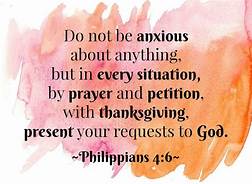
            After Paul’s strong injunction (and it is almost a command!) to rejoice twice, he goes on to say “Do not be anxious about anything, but in every situation, by prayer and petition, with thanksgiving, present your requests to God.”

            Paul does not make light of our very real prayer concerns. In fact, he urges us to bring those concerns – those worries! – before God! “Paul is not saying that there is nothing to worry about or that the things we worry about are unimportant. Rather he places our anxieties, fears, and concerns in the context of our relationship to God. We are invited to make ourselves known to God, and to ourselves, at our points of greatest vulnerability.” [1]

            God does understand when we have concerns – for ourselves or friends or for loved ones. And, we are invited numerous times in the Bible to bring those concerns, those worries, those anxieties, before our God.  

            What a relief and what a help to us and to our loved ones to know we can always come before the throne of grace and bring our cares and troubles to God.

            And, that is not all! This short reading from Paul’s letter is jam-packed with positive, joy-filled, impactful statements from this man in prison. Amazing to me is how positive Paul can be in this letter. Not only does Paul encourage prayer and thanksgiving in the midst of negative situations, sometimes even dire, ominous circumstances, but there’s more! He also emphasizes peace. The reality of a peace beyond human understanding. God’s peace.

            Yes, we certainly can expect trouble in this world. Our faith will be tested. Some may even suffer as Paul suffered. But, Paul reminds us all about Jesus Christ. We are urged to “think like Jesus who stood in solidarity with the oppressed by taking on the form of a slave. Yes, Jesus died on a cross. Yes, the powers killed him… But a far greater power exalted him and bestowed upon him the name which is above every name. [That at the name of Jesus every knee will bow and every tongue confess Jesus Christ.] This God did not abandon Jesus and will not abandon [us].” [2] Do you hear? Do you believe?

            This peace is not simply calmness or the absence of anxiety. A more literal or direct translation of the word is “having power over” or “being superior to.” In other words, “peace has power over, excels, and surpasses reasoning. It is superior to human understanding because peace comes from God.” [3]  Peace from God is truly a guard against fear, worry and anxiety.      

            How awesome is that? Yes, the world is powerful, but God has overcome the world. We have God on our side. Not to be a quick fix, or a magic incantation, or a Santa Claus in the sky. Prayer is not magic, not mumbo jumbo. Instead, Paul talks about developing a relationship with this God. An ongoing, deepening, intimate relationship with this God of peace. [4]

            This can be a blessed reality! And if you wish to know more about how to be in a close relationship like this with God, ask me! I’ll introduce you to our wonderful God.

In difficult times, in times of trial, and in the good times – at all times – we can draw near to this marvelous God of peace. God of love, and joy, and grace, and mercy, too!

The result will be that God’s peace stands guard over our hearts and minds in Christ Jesus our Lord. Believe this blessed truth! Alleluia, amen.

@chaplaineliza

(Suggestion: visit me at my other blogs: matterofprayer: A Year of Everyday Prayers. #PursuePEACE – and  A Year of Being Kind . Thanks!


[1] https://www.workingpreacher.org/commentaries/revised-common-lectionary/third-sunday-of-advent-3/commentary-on-philippians-44-7-4

[2] https://www.workingpreacher.org/commentaries/revised-common-lectionary/third-sunday-of-advent-3/commentary-on-philippians-44-7-5

[3] Ibid.

[4] https://bible.org/seriespage/lesson-24-answer-anxiety-philippians-46-7

Unknown's avatar

Keep On Keeping On!

“Keep On Keeping On!”

Philippians 3:7-14 – October 8, 2023

            I remember several wise sayings or proverbs, from when I was very young. I can’t recall where I heard them, or who brought them up, but they stick in my memory! Sayings like “A penny saved is a penny earned,” “slow but steady wins the race,” and “a stitch in time saves nine.” One wise saying that seems quite appropriate for today’s Scripture reading is “If at first you don’t succeed, try, try again.”

            Today’s reading from the apostle Paul in Philippians chapter 3 is filled with memorable remarks! But, when I read through this passage this time around, I focused on verses 13 and 14: “13 Brothers and sisters, I do not consider myself yet to have taken hold of it. But one thing I do: Forgetting what is behind and straining toward what is ahead, 14 I press on toward the goal to win the prize for which God has called me heavenward in Christ Jesus.”

            When Paul wrote to his friends in Philippi, he insisted that they keep on trying! Keep on the path, press on towards the goal. Paul uses a sports analogy here. Sports were huge in Roman society! And, Philippi was a colonized Roman city. It was several hundred miles from Rome, and not even on the Italian peninsula, but that made no difference. The people of that city were very much aware of their special status as Roman citizens, and many citizens of Philippi emulated the practices of Rome very much – including being big sports fans!

            Paul wrote this letter to the Philippians from prison in Rome. “His physical movements are severely limited. He is certainly not engaged in any chariot races. Yet this is the metaphor he chooses to inspire the Philippians to press on. It is an athletic, physical, and forward-moving metaphor.” [1] But, hold on, a minute! Before Paul says all this, he hits on something important!

            Let’s backtrack a few verses. Paul gives some autobiographical details. We already know Paul is highly educated, and a former member of the Sanhedrin, the ruling council of Israel. Here, he mentions his status and achievements as a Jew by birth – a “Hebrew of Hebrews.” Paul is ticking off these prestigious honors and points of status, one after the other. A Pharisee, a former persecutor of the Church, a blameless follower of the Law of Moses. A real blue blood, and he used to be particularly proud of all these status points on his resume!

            Just imagine a child or grandchild. Some parents would want them to get all the prestigious honors, high grades, and extra-curricular activities, playing a musical instrument, and going out for the team. All the things, as the young people say! Some parents really want their kids to have so many achievements on their resume or in their scholastic record! This is what Paul is saying, here. He was a huge overachiever, as far as his resume was concerned!      

            Yet, Paul now regards all of these prestigious honors and achievements to be nothing, less than nothing – even “dung” or in colloquial language, horse manure! Instead, the very most important thing to Paul was now doing exactly what God wanted him to do! And, being exactly who God wanted him to be!

            Which brings us back to where we started in our examination of this Scripture reading. “13 Brothers and sisters, I do not consider myself yet to have taken hold of it. But one thing I do: Forgetting what is behind and straining toward what is ahead, 14 I press on toward the goal to win the prize for which God has called me heavenward in Christ Jesus.” Paul returns to one of his favorite metaphors for the Christian life, a sports metaphor. At the end of a sports contest in the first century Roman empire, the winner would get the prize. A laurel crown, a bag of gold, some fame and repute. In other words, become a sports star! Paul is encouraging all of his readers to strive for the goal! To run the race, and win the prize!

But, this prize Paul talks about is not an earthly prize, like in the Olympics. It’s not some gold medal or silver coins, or some laurel crown that will decay and dry up. Instead, Paul encourages us all that we can never give up! We all need to press on. Not to persevere toward a sports medal, or public prestige, or a multi-million dollar contract! No! Paul wants us to persevere for our souls’ sake. Paul wants us to persevere in our walk with Christ! [2]

            Sure, we might fall down. Fall on our faces, and strive to get up again. This whole topic reminds me of a classic song and dance number from a Fred Astaire musical, where Fred sings “Pick myself up, dust myself off, and start all over again!”

            To use another (more modern) sports analogy, if in baseball a batter gets a base hit one out of four trips to the plate, he’s considered a pretty good hitter. A batting average of .250 is perfectly respectable! And, if the batter gets a base hit one out of three times at bat, he’s a really good hitter! A consistent batting average of .333 is great!

            Except – that means that two thirds or even three quarters of the time, the batter is going to strike out, fly out or ground out. That could get really disheartening! Imagine, only getting on base a quarter of the time. And yet, do baseball players get mad, or frustrated, or downright depressed just because they can’t bat 1.000 all the time? No! Sports players keep on going. They keep on keeping on. They persevere, and keep on swinging.

            Exactly what Paul would have said. He would have nodded in agreement and affirmation and said, ” this one thing I do: forgetting what lies behind and straining forward to what lies ahead, I press on toward the goal for the prize of the heavenly call of God in Christ Jesus”

            The old Spiritual expresses this sentiment of determination and perseverance well: “I have decided to follow Jesus. No turning back, no turning back.”

Remember the words of Paul, and remember to keep on keeping on, just like your favorite sports stars and sports personalities. And, remember to continue striving, and continue to serve God as best as you are able! Alleluia, Amen.

@chaplaineliza

(Suggestion: visit me at my other blogs: matterofprayer: A Year of Everyday Prayers. #PursuePEACE – and  A Year of Being Kind . Thanks!


[1] https://www.patheos.com/progressive-christian/keep-on-keepin-on-alyce-m-mckenzie-09-29-2014

[2] Ibid.

Unknown's avatar

Have the Same Mindset

“Have the Same Mindset”

Philippians 2:1-11 – October 1, 2023

            How many here have seen a Christmas pageant? How many here have ever participated in a Christmas pageant? It can be sweet, even awe-inspiring, seeing the story of the Nativity played out, sometimes with a large choir or even real animals. We can watch a Christmas pageant and be so proud of our children or grandchildren as they participate. Or, we could possibly be totally swept away as we consider what a grand, eternal narrative we are watching, as it was played out on a huge cosmic stage!            

            Today’s Scripture reading comes from the apostle Paul’s letter to the Philippian believers. I want us all to pay close attention as we connect this passage from Philippians theologically with the Incarnation, as God in Jesus came down on our level.” [1]

            We all know the story of Christmas Eve, and the cast of characters. The shepherds, the angels, the animals. Even the wise men (even though they really arrived some months later, according to the Gospel of Matthew). We see the Holy Family at the center of the Christmas pageant. Young Mary, exhausted shortly after the birth. Joseph, trying to protect his family. Then, we have the baby Jesus. A beautiful baby.

            But, what if we walk around backstage, behind the manger? That is what Paul is doing right here in Philippians 2! Paul is showing us what went on behind the scenes, before time began. Paul reminds his friends – his readers in Philippi – about the mind, the motivation and the character of God, in Jesus Christ. Then, Paul starts to relate the behind-the-scenes story of the Incarnation. Imagine only being vaguely aware of how Jesus came into the world. Paul lets us know how God the eternal Son humbled Himself! Became human – a tiny baby!

            Jesus fully joined the human race. He became one of us, and willingly left all of His Godhood behind. Far, far away in heaven. Just think of what a huge cosmic event that was, for the eternal God the Son to become a tiny, helpless human baby. And yet, becoming human was (and is) the best way to communicate with us humans, on our level. In our language, and in a way we could possibly begin to understand.

            When Paul wrote this letter to his Philippian friends, he was worried about their little church. He had heard about some church fights some of the believers were having. Paul calls these fights divisions in the body. (Remember, Paul refers to the church as the body of Christ in several places, in several places in the New Testament.)

            Paul had just finished talking about these divisions in the church when he says “make my joy complete by being like-minded, having the same love, being one in spirit and of one mind. Do nothing out of selfish ambition or vain conceit. Rather, in humility value others above yourselves, not looking to your own interests but each of you to the interests of the others.”

            Think back on your own history, and the history of this church, or other churches where you have been a member. Do you remember church fights? Where one or two members were bickering with each other? Perhaps others in the church started to join in? Even, maybe, it got to the point of a church split? Perhaps it was an argument between different members of the church board. Or a difference in worship styles. Or a showdown between the pastor and one or two elders in the church. Or even a disagreement about the style of the new church drapes.

            Let’s concentrate on what Paul said in our reading today, from Philippians. “Have this mind in you that was in Christ Jesus.” Our Lord Jesus is all about unity. His humility and love for everyone transcends division and fighting, squabbling and bickering. Even over serious, consequential things like worship bands and the color of the new church carpet.

            The Church Universal today is fractured and splintered into so many different pieces! We know that the quarrels, disagreements and selfish attitudes among church members are nothing new. Paul wrote to his friends about those same things, and it hasn’t changed one bit, all these centuries later. Whether it is conflicts between faith traditions (Catholics vs Protestants), between denominations (Baptists vs Methodists) or groups within denominations (conservative vs liberal), things have certainly not changed. [2]  

            Yet, the apostle Paul knows very well how the Gospel of Christ can change hearts and minds! Just look at how the various Philippian believers, from all strata of society, welcomed the stranger Paul into their midst. They welcomed him and the Gospel he preached into their hearts and homes! And, they continued to financially support Paul long-distance long afterwards, when he was in prison in Rome.

            As Paul says, we need to pattern our lives upon Jesus Christ and His humility. However, I caution us all because of powerful things, divisive things that are just waiting to pounce and to separate us as believers in Christ. We need to keep our eyes on Jesus, and not allow conflicts, quarrels and divisions to confuse and separate us as believers.

That is why World Communion Sunday exists. We all believe in our Lord Jesus Christ. We all – across faith traditions, across language differences and cultural divides, across earthly conflicts and reasons to fight – can agree on this important thing. We come together in our faith in Christ; we come together in our reverence for God and our celebration of the Lord’s Supper.

And one day, the world wide group of believers will acknowledge together that “God exalted Jesus to the highest place and gave him the name that is above every name, 10 that at the name of Jesus every knee should bow, in heaven and on earth and under the earth, 11 and every tongue acknowledge that Jesus Christ is Lord, to the glory of God the Father.”

So, come. The Lord has prepared THIS table. To that, we can all say “Maranatha! Come, Lord Jesus!” And we can also say, “Alleluia, amen!”

@chaplaineliza

(Suggestion: visit me at my other blogs: matterofprayer: A Year of Everyday Prayers. #PursuePEACE – and  A Year of Being Kind . Thanks!

(I would like to express my great appreciation for the observations and commentary from Alyce McKenzie, https://www.patheos.com/progressive-christian/level-with-me-alyce-mckenzie-09-19-2014.  And also, many thanks to Dennis Bratcher and his superb article at http://www.crivoice.org/kenosis.html.)


[1] https://www.patheos.com/progressive-christian/level-with-me-alyce-mckenzie-09-19-2014

[2] http://www.crivoice.org/kenosis.html – Dennis Bratcher

Unknown's avatar

Generosity – and Grace!

“Generosity – and Grace!”

Matthew 20:1-16 – September 24, 2023

            I often think of my four children. I sometimes remember them as younger children. I can remember very well those times when I went to school to help out in classrooms, or to chaperone on field trips. I especially remember the times when I overheard arguing and bickering in the classrooms, in the halls or on the playground between the school kids. “It’s not fair!” was one thing repeated over and over.

            Let’s see how the Rabbi Jesus begins this parable. Jesus is on His was to Jerusalem, and it will not be long before the Triumphal Entry on Palm Sunday and the Passion Week. It’s perhaps a few weeks before all those weighty events begin to happen. I am certain Jesus wanted to be certain to get some very important truths across to His disciples and to the crowds.  

            As is common with the Rabbi Jesus, when He wanted to teach some very important ideas and truths, He used parables. You and I know that using stories really helps to cement ideas into our heads! So it is with this story. That same complaint, “It’s not fair!” seems to come forth from some of the workers in this parable of Jesus. In our Gospel reading, “Jesus tells a story that reflects a completely different way of looking at things. It is a story about a vineyard owner who pays his workers on the principle of generosity, rather than on the principle of merit.” [1]

            In our parable today, Jesus tells what the kingdom of heaven is like. This is another parable in His series, in response to questions asking about what the kingdom, what heaven is like, for real! “Come on, Rabbi! Tell us! Enough with this confusing religious mumbo jumbo! Give us some straight talk about what we can expect from God!”

             Remember how the parable starts:

“Early one morning a man went out to hire some workers for his vineyard. After he had agreed to pay them the usual amount for a day’s work, he sent them off to his vineyard. About nine that morning, the man saw some other people standing in the market with nothing to do. He promised to pay them what was fair, if they would work in his vineyard. So they went. At noon and again about three in the afternoon he returned to the market. And each time he made the same agreement with others who were loafing around with nothing to do.”

            Remember, Jesus is answering a continuing question: what is the kingdom of heaven like? What will happen when we get there? In other words, another way to ask this same question is, what is God like? What can we expect from God when we get to heaven?

            I know this might be difficult, especially if you’ve been prudent with money all your life, but try and put yourself in the place of the workers who were chosen, who were sent to work at the end of the day. Imagine being a day laborer. There is no Social Security, no social safety net. Such a hard life! Imagine earning just enough to support you and your families for just one more day.

            “What we now call food insecurity is their norm, and so it’s easy to imagine their excitement when they finally get an invitation to work – they won’t earn a full day’s wage, but enough perhaps to scrape by. That excitement only multiplies when the manager unexpectedly and inexplicably pays them for a full day! I suspect that equal measures of relief, joy, and gratitude suddenly coursed through their veins as each received their payment.” [2]

            When people in the crowd or among His group of disciples continue to ask, the Rabbi Jesus is telling us that in the kingdom of heaven, God is generous! The loving, kind generosity of the owner of the vineyard is truly evident from this parable! Which brings us to the workers who were hired first, the ones who have seen all of the others, the workers hired later that day, already receive their wages for the day. Let’s hear Jesus describe the scene.

 “10 The workers who had been hired first thought they would be given more than the others. But when they were given the same, 11 they began complaining to the owner of the vineyard. 12 They said, “The ones who were hired last worked for only one hour. But you paid them the same that you did us. And we worked in the hot sun all day long!”

            Can’t you just hear these workers say, “It just isn’t fair!” Face it, their reaction ‘is almost exactly what most of us would have felt had we been in their shoes. Because what happens to them simply does not add up and so doesn’t seem fair. Never mind it’s what was contracted – if those who worked an hour received a day’s wage, then those who worked so much longer deserve more.[3] But – the owner of the vineyard is generous. Generous to everyone, no matter who, no matter what!

            Another word for this lavish, overabundant generosity is GRACE. Have you ever received grace for something you absolutely did not deserve? Many people read this parable, and say “That’s not fair!” That is exactly the point. If God were absolutely fair, none of us would be loved by God, none of us would be embraced by Jesus our Good Shepherd. No one. None. It is only by the Lord’s love, grace and mercy that any of us are welcomed into God’s family. It is all God’s grace and generosity. It is NOT about working in the vineyard, or working for salvation, at all.

                  We all have had grace extended to us here in the real world, haven’t we? – a grace period to turn in homework you did not finish or the work project you needed to finish last week. What about the landowner paying the last hired workers a whole day’s wage? And what about God forgiving us even when we don’t deserve it, or when we do things and say things that make God sad or even angry? That is grace. That is God’s generosity. God does not have to, is not obligated to forgive us and be gracious to us. But – that is exactly what God does.

      We don’t have to do more or be better in order to ensure that God loves us, because God loves each of us completely already. As Desmond Tutu puts it, “There is nothing we can do to make God love us more” and “there is nothing we can do to make God love us less.”  It is a strange kingdom indeed where there is nothing to earn.[4]

As Jesus said, this is what the kingdom of heaven is like. It’s fairness, God’s way. ”Everyone who is now last will be first, and everyone who is first will be last.” Abundant grace and generosity for all, no matter what. Thanks be to God! Alleluia, amen!

@chaplaineliza

(Suggestion: visit me at my other blogs: matterofprayer: A Year of Everyday Prayers. #PursuePEACE – and  A Year of Being Kind . Thanks!


[1] https://thewakingdreamer.blogspot.com/2011/09/nothing-to-earn-mt-201-16-1-i-have.html

[2] https://www.davidlose.net/2014/09/pentecost-15-a-love-or-justice/

[3] Ibid.

[4] https://thewakingdreamer.blogspot.com/2011/09/nothing-to-earn-mt-201-16-1-i-have.html

Unknown's avatar

How Many Times?

“How Many Times?”

Matthew 18:21-35 – September 17, 2023

            Do you remember someone doing something really awful? Maybe you had something you really loved, your grandma’s favorite dish or teapot or picture. And, someone broke it! Into a hundred pieces, so broken that you never could fix it! Or, perhaps it was your brand new cell phone that someone dropped in a deep puddle! Even though the person at the AT&T store said it might be able to be fixed, you knew that soggy cell phone was a hopeless case.

            And, every time you see that clumsy or thoughtless or idiotic person, you can’t help but remember again what happened! What was that person thinking? Or maybe that person just didn’t think! That was the problem!

Let’s take another look at how this parable was set up. The disciple Peter – you remember good ol’ brash, foot-in-mouth Peter, don’t you? – comes up to the Rabbi Jesus and asks him, “Lord, how many times shall I forgive my brother or sister who sins against me? Up to seven times?” 22 Jesus answered, “I tell you, not seven times, but seventy-seven times.”

            In Jewish practice of that time, forgiveness was not taken for granted. Forgiving someone three times was considered generous! So, for Peter to ask whether forgiving SEVEN times was sufficient, he must have thought he was going way above and beyond! Yet, how does Jesus respond? How many times does Jesus tell Peter to forgive? Seventy-seven times?

            If we consider the times we are living in, today, people are not very forgiving. People are really divided! If I am a Chicago Bears fan, and someone else is a Green Bay Packers fan, that can be a real deal-breaker as far as being friends is concerned. My daughter Rachel lived in St. Louis for six years, and occasionally went to Busch Stadium to watch the Chicago Cubs play the St. Louis Cardinals. She told me many St. Louis fans objected to her Chicago Cubs gear!

            Except, our Gospel reading today is a lot more serious than sports teams and rivalries. This parable of Jesus is about two servants of the King. The first servant owed that King a whole lot of money! Bags and bags of money! Maybe as much money as you or I would earn in five whole years, or more! When the first servant went down on his hands and knees and begged the King to be merciful, and to give him time to repay his loan, the King did.

            But, that is not the end of the parable! By no means! No sooner did the first servant leave the throne room of the King, when who should he meet but a second servant. This second servant owed the first a small sum of money. Perhaps two weeks’ wages, maybe a month’s wages. The second servant did exactly what the first had done with the King, got down on his hands and knees and begged the first servant to be merciful.

            Did the first servant remember how generous the King was to him? Did the first servant extend the same mercy, grace and forgiveness to his fellow servant? No! The first servant had his fellow servant collared by the police and thrown into jail for delinquent debt!  

Our Gospel reading today is difficult. That is, when you and I try to put it into practice. When we gather for worship and hear this parable “where Jesus tells Peter that we forgive 77 times, or 70 times 7, or in fact, we just keep forgiving, we smile and nod and clap our hands. “Of course,” we think, “we worship a forgiving God, and we know we need God’s forgiveness over and over again.” But then we realize that this means we also must be forgiving of those who offend us, again and again, perhaps. And then we wonder if that’s even possible.” [1]

Sometimes, it’s just so difficult! Especially with certain people! When they overstep the mark or put their foot into their mouth again, for the twentieth, or hundred and twentieth time, it can be so difficult to forgive them again and again! We all know we are not living in particularly forgiving times! People and groups are so divided, forgiveness seems like a real impossibility.

Except, this is not merely a suggestion from our Lord Jesus. He doesn’t ask, “pretty, pretty please?” No! Jesus is serious. He means what He says. We need to forgive others if we expect God our Heavenly Parent to forgive us. Not once in a while, but all the time.

Our Jewish friends are observing their New Year this weekend, with Rosh Hashanah and the High Holidays. This is a time for forgiving, for the Jewish tradition of apologizing and forgiving the day before the new year starts. Yes, there are easy things to forgive, like when someone bumps your car in the parking lot and makes a little dent on your bumper. But then, there are hard things to forgive, too. Forgiving is something we all need to do, no matter how young or old we are, no matter how serious or what the trespass or sin is. [2]

            You and I, every person, everywhere, we all make mistakes. We all need to be forgiven on a regular basis. Yet, how often do we go about our lives not paying attention? Or being oblivious to our missteps, or silly words, or angry actions? When we are divided into different camps, into “us” and “them,” on opposite sides of an issue, forgiveness and kindness rarely enter the conversation! [3]

            We all need this call from our Lord Jesus to repent, to forgive, and to be forgiven. In this particular congregation we say the Lord’s Prayer every week. One of the petitions in the Lord’s Prayer is “forgive us our debts—or sins—as we forgive those who sin against us.” Have you ever thought that if you and I do NOT forgive on a regular basis, we are going against this petition we regularly pray? Why should God forgive us if we are stubborn and refuse to forgive others?

            I repeat – our Gospel reading today is difficult. That is, when you and I try to put it into practice. Do we hear this call from our Lord Jesus to live counterculturally? Can we swim against this tide of anger and vengeance and hatred that is so prevalent in our world and our culture? Isn’t it risky, doing this forgiveness thing on a regular basis?

            Right now, I am giving an invitation to consider what a life of forgiveness, mercy and grace might look like, in our real-world living. Hear the call! Do what Jesus said. This is a crystal-clear time to consider: what would Jesus do? Do that. Forgive, as we are forgiven.

@chaplaineliza

(Suggestion: visit me at my other blogs: matterofprayer: A Year of Everyday Prayers. #PursuePEACE – and  A Year of Being Kind . Thanks!

(I would like to express my great appreciation for the superb observations and commentary from the Rev. Dr. Derek Weber, Director of Preaching Ministries with the United Methodist Church. I got several excellent ideas and quotes for this sermon from this excellent website, https://www.umcdiscipleship.org/worship-planning/the-journey-begins/sixteenth-sunday-after-pentecost-year-a-lectionary-planning-notes.)


[1] https://www.umcdiscipleship.org/worship-planning/the-journey-begins/sixteenth-sunday-after-pentecost-year-a-lectionary-planning-notes

[2] http://worshipingwithchildren.blogspot.com/2014/08/year-proper-19-24th-sunday-in-ordinary.html

[3] https://www.umcdiscipleship.org/worship-planning/the-journey-begins/sixteenth-sunday-after-pentecost-year-a-lectionary-planning-notes

Unknown's avatar

Reconciliation Amongst Believers

“Reconciliation Amongst Believers”

Matthew 18:15-20 – September 10, 2023

            I love reading children’s story books out loud. I read lots of them to my children when they were young, as I did for the preschoolers here in the full-day preschool. One that intrigues me is called Enemy Pie by Derek Munson. It’s told from a first-person perspective. A new boy, Jeremy, moves in next door to our narrator. Somehow, the boy next door becomes “enemy number one” on our narrator’s list.

            That scenario sounds so familiar! Doesn’t it? Someone on your block does something foolish that makes you SO mad, you can’t stand it! Or, someone at your work says something SO outrageous, you almost can’t work with them anymore! Or, someone at church acts SO … SO … “un-Christian” that you almost … well, you can finish that sentence, can’t you?

            Back to our book, Enemy Pie. Our narrator’s Dad has a recipe for enemy pie, and promises to make it. Our narrator needs to help his dad by providing one of the secret ingredients – he needs to play with Jeremy from next door for one entire day, treating him well. You all know what happens. Of course, while the two boys talk and play together, Jeremy morphs from an enemy into a friend. [1]

            I suspect we all are familiar with certain people who hold grudges, or family members who end up not talking with each other for years, sometimes even decades. These verses today from Matthew 18 speak about people in a church having disagreements, even feuds. Yes, Matthew uses the term “church,” which is only used twice in any of the Gospels. Is church supposed to be where we come on Sunday morning to worship God? And then, go home or about our business for the rest of the week? Or, is it someplace more? Much more?

            In Jesus’s time, in the Jewish community and culture, one thing that was very common was debate. Jesus’s world was socially combative. People debated with each other not only to score “points” against the other person, but also to build up one’s own reputation. Imagine, constantly being on your guard against having someone engage you – or a member of your family – in debate or argument, for the sake of scoring “points” against you! And reputation was everything! Not just causing offense or hurting the feelings of another person. [2]

            What’s more, this attitude was not only between individuals. “People used gossip, rumor, and slander in the same way. This conflicting spirit spilled over into family honor. One slight could escalate into a generations-long feud where both sides forgot the original incident.” [3]

            I want you to hear the Rabbi Jesus bringing up this topic of hurts, and sin, and dishonor, and slights of one person against another. These were fighting words! I am absolutely sure there were people listening to Jesus that day who had active feuds going on with neighbors, or extended family members, or people they had been avoiding for years in town.

            I remember back to when I was growing up, on my parents’ block in Chicago. Two families who lived next door to one another had a longtime feud going on. I don’t know what the feud was all about, but it was very bitter. One side had a mean old man who used to shake his fist and yell at any kid who accidentally set a foot on his neatly clipped front lawn.

            On the other side of the feud was a family who were friendly with all of the people on the block. The two daughters of the second family were friends with my older sisters, and went to school with them. Sometime during this feud, the sour old man actually set up a spite fence between the houses, twelve feet high. That fence stayed there for decades until the mean old man died, all alone in his house.

               Let’s hear again what our Lord Jesus said in this reading. “15 “If another believer hurts you, go and talk to him about it in private. If he really hears you and does something about it, he will become a true friend.” This is a phrase that has also been translated “you have won them over.” I much prefer “become a true friend!” These words of Jesus are truly about reconciliation and restoring relations between people. Turning enemies into friends!     

I wonder whether that sour old man on my block might have listened to Jesus and His message about sin, and restoration and reconciliation? I wonder whether the two families on my block could ever have made up and become friends?

            In a world full of disputes, fighting, disagreements, sin, hurts, and dishonor, the Rabbi Jesus came in as a breath of fresh air. New ideas, certainly! Jesus proclaimed the concept of reconciliation of people with God, in a vertical direction. That was what He repeated again and again, that each of us has the opportunity to become reconciled, and restored, and returned to a loving relationship with God our heavenly Parent.

            It is not only between humans and God – Jesus also wanted humans to be reconciled with one another. Right here in Matthew 18, Jesus gives a three-step process for reconciliation. Believers in Christ have the opportunity to have their friendship restored. And, Christian love serves to glue the community – the congregation – together, in the name of Christ.  

“Here in the Gospel of Matthew, ‘it is the function of the church to be a force for reconciliation. You could argue that, from a gospel perspective, it is the only function of the church. We are in the business of putting things together, of healing the breaches between people, of overcoming that which keeps us apart. It is about making sure that no one feels like an outsider.’” [4]

            What a concept, and what an opportunity! We, as followers of Christ, have the possibility to bring people together. Jesus tells us how to do it, right here. if even a handful of us would begin to do as Jesus did, the world’s culture would begin to shift. And then we practice it: how to talk to one another when we disagree, or are wounded, or are afraid. [5]

Just as Jesus brings each of us to His Heavenly Father, so each of us has the opportunity to bring each other together. Bring each other together in reconciliation and restoration, and especially bring each other together in forgiveness.

It is not easy! And, that’s an understatement! But, Jesus will be with us, every step of the way. As Jesus recommended, so let us do. Alleluia, amen.

@chaplaineliza

(Suggestion: visit me at my other blogs: matterofprayer: A Year of Everyday Prayers. #PursuePEACE – and  A Year of Being Kind . Thanks!


[1] http://worshipingwithchildren.blogspot.com/2014/08/year-proper-18-23rd-sunday-in-ordinary.html

[2] http://www.word-sunday.com/Files/a/23-a/A-23-a.html

[3] Ibid

[4] https://www.umcdiscipleship.org/worship-planning/the-journey-begins/fifteenth-sunday-after-pentecost-year-a-lectionary-planning-notes/fifteenth-sunday-after-pentecost-year-a-preaching-notes

[5] http://words.dancingwiththeword.com/2014/08/