Unknown's avatar

Amazed by Love!

“Amazed by Love!”

Luke 2:15-20 (2:18) – December 22, 2024

Merry Christmas! What a wonderful expression. People greeting each other on the street, in the stores, here at church. I know not everyone celebrates Christmas, but still. What a joyous time of the year. Today, we are here at the 4th Sunday of Advent! Many, many people can hardly wait for the arrival of Christmas Day! Especially for children, I bet some people are so excited that they hardly sleep a wink for the next few nights. (But that’s mostly for reasons of Santa and presents under the tree, not for the religious reasons I’m talking about this morning.)

Merry Christmas, many people say! But I want you to go back, two thousand years. Go back to a time when “Merry Christmas” was not even a phrase, a wish, not even an idea in people’s heads. Go back to the time Dr. Luke describes in his Gospel. Back to the time when Israel was an occupied country, and the Roman Empire was the occupying force. Back to the time when all people in Israel needed to be enrolled. The Roman government decided to have a census, so that they would be able to tax the people of Israel more accurately.

            We remember this census. The Holy Family, Joseph and his fiancée Mary, went to Bethlehem to enroll, because Joseph was a direct descendent of King David. I suspect there were many people on the roads. Today, traveling can be stressful and nerve-wracking. I am certain travel in the first century was much more difficult. Poor roads, with many people walking to get from one place to another. We might imagine that Joseph and Mary had a donkey, but nowhere in the Gospel is that mentioned. Travel conditions were challenging, at best.

Wait a minute. Do we really concentrate on the difficulties and trials of travel to Bethlehem, of the labor and birth of a baby without medication, or of any of the rest of this real-life narrative from Luke chapter 2? Or, do we imagine a nice, tidy, picture-perfect Christmas card? With Mary in a rich, bright blue robe, gazing lovingly at her radiant newborn baby, Joseph looking adoringly at both mother and child. Not to mention the cleaned-up shepherds gazing in wonder, their tidy, well-groomed sheep lying quietly in adoration, too.

That picture-perfect Christmas card was not what actually happened, not by a long shot. Mary felt the pains of labor begin. What a scary thing! To be far, far from home, in an unfamiliar place, and to have such a significant event happen. Significant, and potentially life-threatening, too. Plus, anyone who has worked with large animals (even many smaller animals) knows what a group of them smell like. That’s where Jesus was laid, in a manger among the animals. And, is anyone familiar with the hustle, bustle and smells associated with the labor and delivery room of a hospital? This refocused picture of the birth is not all gentle, meek and mild, to be sure.

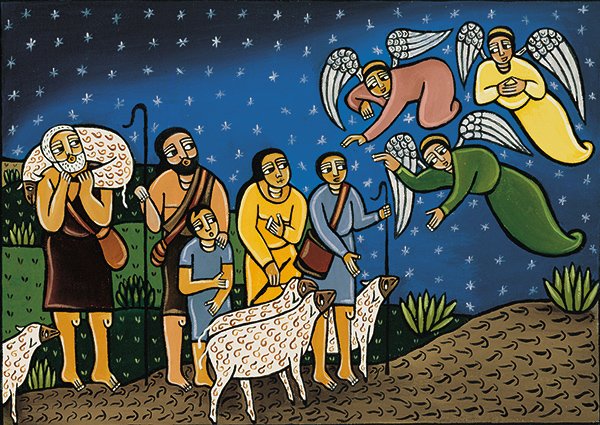
As Luke tells us, there were shepherds abiding in the fields, keeping watch over their flocks by night. When messengers personally come to deliver a special announcement, it is a big deal. These angels coming to the shepherds, well, that was a super big deal, to be sure!

            And the announcement? This isn’t the birth of a normal, ordinary baby. No! This baby is an extra special baby. The Messiah, who will save His people from their sins. Did you hear? This special baby, this Savior, Christ the Lord, is born to you—to me—to all of us, in the city of David, which is called Bethlehem.

            Did you hear? The Savior, the Christ, the promised Messiah, came into this world as a Baby. The Eternal Second Person of the Trinity, Creator of the whole universe, God the Son, emptied Himself of all God-ness. Took on humanity, and was born as a helpless Baby. That is not only good news, that is earth-shaking news. Good news of great joy for all the people. For you, for me, for all of us. How better to communicate to earth than to become one of the frail human beings God intended to reach?

            The Almighty God who made all of heaven and earth, the powerful God who can hold the incomprehensibly vast universe in the span of God’s fingers? Yes, that same God wanted to reach to earth—reach to each of us, to all of us, in love. With love. Through love. 

            That loving outreach is from God’s point of view. Yes, the Almighty God sent the Baby in Bethlehem to earth, in love. But, what if frightened, nervous humans did not in the least expect that? What if short-sighted humans closed their eyes and their hearts to the possibilities of God’s love breaking into the world in such a tender way?

            Mary could have been frightened half to death of the angel and closed her heart to the Divine possibilities that blessedly came about. But, Mary chose love. She chose openness and possibilities that transformed her heart and her life.

            When Mary’s baby was born, Jesus spoke quietly through the blood, sweat and tears of the labor pains of that young woman. Jesus cried softly as an infant, and allowed us all to see the unimaginable caring, the oh-so-tender love that Almighty God expressed, to each one of us. And, each of us is embraced in God’s everlasting arms of lovely love.

            One of my favorite Christmas carols talks about this very thing. This Christmas poem—before it was set to music—was written by Christina Rosetti in 1885. Here is the first verse:

Love came down at Christmas, Love all lovely, Love Divine,
Love was born at Christmas, Star and Angels gave the sign.

Love Divine was born at Christmas. Born for you, born for me. Praise God, our Lord and Savior Jesus was born as a Baby in Bethlehem. Yes, He would preach and heal and suffer and die. And, yes, He would rise again on that Easter morning years later.

Yet—right now, we rejoice in the blessed fact that Jesus was born.

Praise God, we, too, can stop by that manger in Bethlehem, and be caught up in the wonder of what happened that night, so long ago. We, too can welcome this lovely, Godly Love that has come into this broken, weary world, today.

Alleluia, amen.

@chaplaineliza

(Suggestion: visit me at my other blogs: matterofprayer: A Year of Everyday Prayers. #PursuePEACE – and  A Year of Being Kind . Thanks!
Unknown's avatar

Open Hearts to Joy!

“Open Hearts to Joy!”

Luke 2:8-20 (2:15) – December 15, 2024

So many houses and apartments are decorated for the season at this time of year. Colorful lights and holiday decorations indoors and out, shining Christmas trees, special dishes and fancy tablecloths. Plus, some families have a Nativity scene in a special place, whether under the Christmas tree or placed in an extra special location, even outside, all lit up at night.

As we consider our Scripture reading for this morning, we think about the familiar words from Luke chapter 2. We think of the very pregnant Mary and her husband Joseph, coming into the town of Bethlehem late one day, but they could not find any place to stay. So familiar it is today, but I suspect you all can think of the Nativity scene figures: a kneeling Mary, Joseph hovering over his wife, and the baby Jesus lying in a manger.

Where did this tradition of decorating with a Nativity scene come from? Yes, the Nativity scene is a familiar way of retelling this story of the birth of Jesus. But—how did Nativity scenes begin? It was in 1223. “According to St. Bonaventure’s biography, St. Francis of Assisi got permission from Pope Honorious III to set up a manger with hay and two live animals—an ox and an ass—in a cave in the Italian village of Greccio. He then invited the villagers to come gaze upon the scene while he preached about ‘the babe of Bethlehem.’ (Francis was supposedly so overcome by emotion that he couldn’t say ‘Jesus.’)” [1]

            That first Nativity was located in Italy, during the 1200’s. The practice of Nativity scenes, pictures and photos has certainly spread from there, all over the world. Do you remember acting in Christmas Nativity scenes, or perhaps Christmas pageants with a Nativity scene in them? You, or your children? Or grandchildren?

            The Nativity scenes I remember always had at least one shepherd visiting the baby Jesus, along with a sheep or two. Perhaps you remember when you or your children or grandchildren were in a Christmas pageant. Were there shepherds abiding in the fields, keeping watch over their flocks by night? And, sheep! I remember several Nativity scenes in Christmas pageants years ago, where the small children were dressed up as sheep.

            Let’s hear again from Dr. Luke the words the angel said to the shepherds, that Christmas night: “the angel said to them, ‘Do not be afraid; for see—I am bringing you good news of great joy for all the people.” Not just the people in Italy, where St. Francis was. Not just the people in Europe, or North America. Good news of great joy for all the people, all over the world.

This week in Advent, here at this church we are concentrating on the shepherds. As we read this familiar Christmas story, was there much in the shepherds’ daily life and experience to fill them with joy? I do not think they were particularly joy-filled, with their ordinary, workaday life and their low, social status. I wonder whether the shepherds felt like that, right before the angel chorus broke into this hum-drum, workaday world and appeared to them?

Remember the difficult situation the shepherds were in. The shepherds’ position on the social ladder in Palestine was pretty much the bottom rung. The Jewish religious leaders even considered shepherds ritually unclean, since their duties and their work of looking after sheep made it impossible for them to observe the Sabbath. Working as a shepherd was something that vagrants might pick up, or a job for ne’er-do-wells, or others who were very much down on their luck. Their society stereotyped shepherds as liars, degenerates, and thieves.

 Just imagine the reaction of these lowly shepherds as they heard this news from the angels! Good news of great joy, especially, particularly for them! And centuries later, imagine the reaction of these same shepherds to think that they are now an integral part of a Nativity scene, a central part of the Christmas story played out time and time again, year after year.  

When my children were small, one of the first Christmas decorations I’d take out of the box would be our little Nativity scene. The little figures were all children, and it was intended specifically for the young. I would tell and re-tell the Christmas story again and again. When they were small, all four of my children would love to play with the figures, spending a good long time with those inexpensive yet meaningful little figures.  

Different churches do different things to communicate this narrative of the birth of Jesus. I read that the Rev. Janet Hunt has a yearly practice she does in her Lutheran church in De Kalb. But, I will let her tell you herself. “It has been my practice for many years to ‘build the creche’ with the children during the children’s sermon during Advent.  One week we add the animals. The next week the angels join them. Pretty soon Mary and Joseph arrive and not long after the baby Jesus and shepherds and the three sages from the East arrive last of all. The order is not perfect, of course, but it is one way of bringing the story home.” [2]

My personal Nativity scene, the one my children played with, has white children, every one. I had not thought about this when I bought the set of figures, more than thirty years ago. Even though my children were part of a multi-ethnic, multi-cultural school system, we still had an all-white Nativity set. Were the people in that first Nativity people of color? Yes, they were.

            Let us return to these shepherds of the first century, on the hills surrounding Bethlehem. They were downhearted outsiders, all right! People of color, non-white, on the bottom rung of their society, for sure. “But God does not give up on us. God sends angels to people who have given up on God. How would you respond to God sending angels to you when you’d given up on God? Like the shepherds, I’d be terrified.” [3]     

Remember the words of the angel of the Lord: “Do not be afraid; for see—I am bringing you good news of great joy for all the people.” We can praise God! God did not send good news of great joy to just a few people in the world, or even some of the world’s people. Or, only people of a certain position in society. No, our God sent good news of great joy to all the people of the world.

The angel has come to all cultures, all ethnicities, all people, wherever their position on the social ladder. All people, everywhere. Even us. You and I can truly come to the manger in Bethlehem side by side with the lowly shepherds.

            That is not only GOOD news, that is GREAT news. Good news of great joy, for all the people of the world! Alleluia, amen.

@chaplaineliza

(Suggestion: visit me at my other blogs: matterofprayer: A Year of Everyday Prayers. #PursuePEACE – and  A Year of Being Kind . Thanks!

[1] http://www.smithsonianmag.com/smart-news/the-first-nativity-scene-was-created-in-1223-161485505/ 

[2] https://dancingwiththeword.com/re-telling-the-story/

[3] http://www.workingpreacher.org/preaching.aspx?commentary_id=1522

Unknown's avatar

Peace, from Generation to Generation

“Peace, from Generation to Generation”

Luke 1:44-56 (1:50) – December 8, 2024

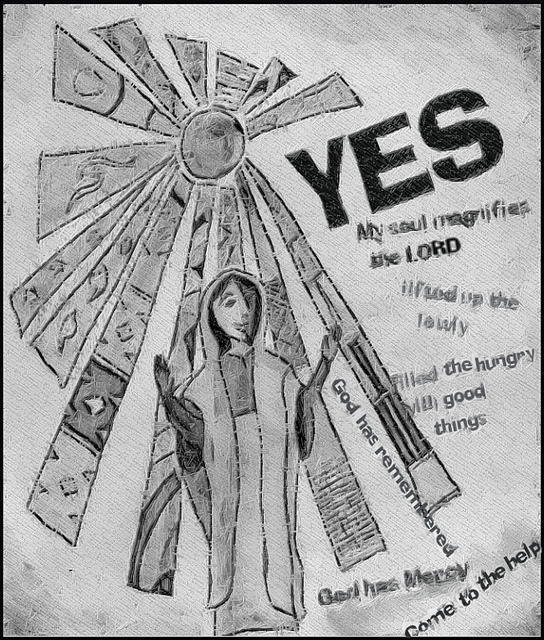
People have been writing songs about the Virgin Mary for centuries. Songs of praise, songs of worship, songs honoring God, and lifting up Mary for saying “yes” to God. Christmas carols might be the first thing that come to mind—but I am also thinking of music from centuries past. From the familiar first part of Handel’s Messiah, to the various settings of the Magnificat, with lyrics from the first chapter of Luke—our Gospel reading for this morning.

            Some Protestants might not be as familiar with the Virgin Mary as many Catholics and Orthodox Christians are. Mary is held in extremely high esteem in many denominations and faith traditions throughout the world, and for excellent reasons. I honor her greatly.

If we look at our modern world today, the situation here in our country, we have a great deal of uncertainty, and very little peace. Does our world today have some strong similarities to the world that Mary inhabited? I wonder, and I would say yes.

Mary sings about the mighty work of God. Yes, personally, in her life. But also in the lives of all the people in the world. “What will this work of God look like?  Something revolutionary is about to happen. God will turn the world upside down. The rich and the powerful will be brought low, and those living on the margins will be raised up. This isn’t a vision that fits very well with a Christian world that values success and power.[1]

For, that is definitely what a large portion of the so-called “Christian world” values today. At least, here in this country, and among a large number of people who claim to follow Christian values and practices religiously. Even if certain Christian denominations do not say it outright, the “Health, Wealth and Happiness Gospel” is a high priority in many people’s lives today.

Let us take a look at what Mary’s situation consisted of. Did you know that Mary—an unwed teenager from an oppressed people-group in an occupied country under crushing Roman rule—was also a radical? A subversive? Was plotting to overthrow the existing oppressive government and replace it with the rule of God?

            What surprising, even shocking things to say about the sweet, innocent Virgin Mary! Everyone associates her with travel to Bethlehem while nine months pregnant, and needing to deliver the infant Jesus in a stable, because there was no room for them in the inn.

That Mary? Radical? Subversive? Absolutely, yes.

Think about the modern Christmas season from another direction. Contrast Mary’s situation with today. Is there any place we can go where we are not bombarded with commercial messages shouting for us to “Buy, buy, buy!” and reminding us of big sales, and markdowns, and half-price! Not to mention all the pressure to be “merry and bright” all the time. Even when going to yet another event or concert or dinner or celebration is the last thing you want to do!

Let us reflect on the first chapter of Luke, on Mary’s song. The last thing on Mary’s mind was commercialism. “Mary’s song, often called the Magnificat, is a welcome contrast to the hyped-up speed of the commercialism that is too often the dominant theme in our culture during the Advent season. Her lyrics are an invitation to approach Christmas with a slower, more contemplative pace.” [2] Is it possible to slow down the frenetic pace of the holidays, to get off the commercial merry-go-round, and instead sit still and worship the coming Messiah?

Sure, the wonderful classical settings of the Magnificat were often sung in a foreign language, like Latin. Or, in text from the King James version of the Bible, full of “thee’s” and “thou’s” and all manner of archaic words. Listen to the first part of her Magnificat, as translated in the modern version by Eugene Peterson, “The Message.” 

“I’m bursting with God-news; I’m dancing the song of my Savior God. God took one good look at me, and look what happened—I’m the most fortunate woman on earth! What God has done for me will never be forgotten, the God whose very name is holy, set apart from all others. His mercy flows in wave after wave on those who are in awe before Him.”

 One well-known depiction of the Virgin Mary is one that is meek, docile, sweet, and not raising a fuss at all. But, wait a moment. Do we realize what Mary is going to sing next? How revolutionary were many of the statements in her song?

             “Even more importantly, Mary’s song is an overture to the Gospel of Luke as a whole. Mary’s lyrics set the tone for Jesus’s radical and controversial ministry that is to come:

You have shown strength with your arm;

You have scattered the proud in the thoughts of their hearts.

You have brought down the powerful from their thrones, and lifted up the lowly;

You have filled the hungry with good things, and sent the rich away empty.

“In contrast, the Christmas season leaves too many still hungry, and too many even further in debt.” [3]

            Do you hear what radical things Mary is saying? If these lyrics of her song were more well-known, would our understanding of Mary be changed? Here Mary is advocating social change, rescuing victims—neglected women, forgotten elders and children, abused strangers and refugees—from being trodden underfoot, even ground under the heel of bragging, bluffing tyrants and braggarts. Turning all society as it was in her day—and ours—upside down.

            What subversive idea is our revolutionary Mary advocating now? Feeding the starving? Giving the poor a banquet? Turning the unfeeling, callous rich people out into the cold? Yes, these radical words are the words found in Luke chapter 1, before we rush on to the narrative of the birth of the Baby in Bethlehem from Luke 2. 

Just looking at this Magnificat, we can see how subversive it was for the infant Messiah to be born to the Virgin Mary. And, we can begin to realize how radical it is for us to say, “O come, let us adore Him, Christ the Lord!” For Jesus truly will bring peace on earth, and He will truly turn the world upside down, just as Mary sang two thousand years ago.

But, this is still only the second Sunday of Advent. We still wait for the baby Jesus to be born in Bethlehem. We still hold our collective breath with all the rest of creation as we wait—and wait. And with Mary, we can rejoice in the promise of the coming Messiah.

Are we overwhelmed with the superficial, commercial glitz and bling of the holidays? Or, are we focused on what really matters – on the coming of our Messiah, our Lord, in God’s peace and wholeness? Let us focus on Jesus, today. Alleluia, amen.

@chaplaineliza

(Suggestion: visit me at my other blogs: matterofprayer: A Year of Everyday Prayers. #PursuePEACE – and  A Year of Being Kind . Thanks!


[1] http://www.bobcornwall.com/2015/12/blessed-are-you-among-women-lectionary.html

[2] http://www.patheos.com/blogs/carlgregg/2011/12/magnificat-learning-to-sing-mary%E2%80%99s-song-a-progressive-christian-lectionary-commentary-on-luke-146-55/

[3] http://www.patheos.com/blogs/carlgregg/2011/12/magnificat-learning-to-sing-mary%E2%80%99s-song-a-progressive-christian-lectionary-commentary-on-luke-146-55/

“Magnificat! Learning to Sing Mary’s Song,” Carl Gregg, Patheos, 2011.

Unknown's avatar

Uncertain? Hope!

“Uncertain? Hope!”

Luke 1:26-38 (1:37) – December 1, 2024

This week, we read one of the most familiar of the narratives in the New Testament, perhaps even of the whole Bible. From the first chapter of Luke, here is the first part of the reading:  “In the sixth month of Elizabeth’s pregnancy, God sent the angel Gabriel to Nazareth, a town in Galilee, to a virgin pledged to be married to a man named Joseph, a descendant of David. The virgin’s name was Mary. The angel went to her and said, “Greetings, you who are highly favored! The Lord is with you.”

            Let’s take a closer look at this situation. Imagine yourself as Mary, a teenaged girl. Perhaps doing housework, cooking in the kitchen, or folding laundry. When, out of nowhere, an angel appears. My goodness! Out of the clear blue sky, something completely supernatural happens! And not only that, but to be greeted by the angel with such words?

            Mary’s response is one of puzzlement: “Mary was greatly troubled at the angel’s words and wondered what kind of greeting this might be.” Let’s face it—Mary is perplexed! She is wondering at the angel’s words: “the Lord is with you.” What kind of a greeting is this, anyway?

            We can be fairly sure that Mary (or, as was probably her name, for a young Jewish woman, Miriam) Mary knew her Hebrew scriptures. The phrase “The Lord is with you” is repeated several times in the Hebrew scriptures, primarily expressing the Lord’s help or assistance. This would puzzle Mary even further—why on earth did she need the Lord’s help?

            We see Mary, probably in the middle of an ordinary day, with the angel Gabriel paying a surprise visit to her! What gives? What is going on?

           I know this is not exactly the same, but I would like to compare Mary’s surprise situation to ours, today. Specifically, to my friend Anita, some time ago now. Out of the clear blue sky, she found out that she needed surgery. Before the beginning of October, she was traveling along, blithely, no serious cares or concerns. After the first week in October? Her life was turned upside down, with a serious medical situation, quickly followed by major surgery.

            How often does something like that happen? Perhaps not a medical emergency in your life, or a loved one’s life, but some other serious situation out of a clear blue sky.

            But, let’s return to Mary. Or, more directly, to the angel Gabriel and what the next words out of the angel’s mouth are: “Do not be afraid, Mary; you have found favor with God.”

            I suspect, if I had the opportunity to see an angel, I probably would be afraid, too! Practically every time an angel visits someone in the Bible, “Do not be afraid!” is one of the first things out of their mouths! Gabriel continues: “You will conceive and give birth to a son, and you are to call him Jesus. He will be great and will be called the Son of the Most High.”

            Understandably, Mary is even more puzzled, hearing this! Her response—quite sensible, under the circumstances—“How will this be,” Mary asked the angel, ‘since I am a virgin?”

            I can see Mary’s point. The word from the angel? Surprise! Truth to tell, it’s hard to top a virgin birth! We can look at other places in the Scriptures, and see other miracles. We can look at the life and ministry of our Lord Jesus when He was an adult, and acknowledge the fact that He did miracles, regularly. But—here we have Mary, herself, wondering how on earth this miracle is going to happen to her?

            The angel has an answer for Mary, sure enough. “The angel answered, “The Holy Spirit will come upon you, and the power of the Most High will overshadow you. So the holy one to be born will be called the Son of God.” In brief, here we have the angel describing the divine plan for a miraculous conception. Mary expresses doubt and uncertainty, Gabriel explains God’s plan in greater detail, Mary consents, and the angel departs.

This whole narrative makes me want to ask Mary so many questions.

How soon did you tell your parents you were pregnant? Did you tell Joseph about the pregnancy yourself, or did the gossipmongers of Nazareth take care of that for you? Was there anyone in the village who believed your story? For that matter, after the angel Gabriel left, did you doubt his visitation to you? Did you think it was a dream? Question your sanity? And what about the townspeople’s response—did you fear for your life, since people probably thought you committed adultery?

The Gospel of Luke is silent on this matter. It leaves us with so many unanswered questions! All we know is what Mary said to the angel. “I am the Lord’s servant,” she answered. “May your word to me be fulfilled,” was her response.

I feel deeply for Mary. An unmarried girl who happened to be pregnant was not just looked down on but actively persecuted. Sure, she knows that she takes the risk of being rejected as a slut, as a tramp, as unworthy of polite company, as a result of this new openness to God’s surprise activity in her life.  I would not blame her one bit for being uncertain!

            Yet, we can see that Mary exemplifies the kind of response to God’s surprises that I would like in my own life. We can see from the Gospel that Mary afterwards goes to see her older cousin Elizabeth, who also is pregnant, miraculously. (I bet they have a good deal to say to each other, too!)

Though—out of a clear blue sky—God completely spun Mary’s life around, though Mary knew that her life would never be what she expected it to be before, she nevertheless said “yes” to God in faith. Yes, she worshiped God (especially in her prayer, which comes after our Scripture reading for today.) She models the heart of worship, the giving of ourselves to the one who has given everything to us.

Mary’s example challenges and encourages us to have the courage to say to the Lord: “Be it to me according to Your word!” This is blessed hope in God’s word!

Remember, Mary may have had thoughts about how this would affect the life she had planned out. However, she realizes there is something special about to happen, that God’s plan must take precedence over her own. She accepts the challenge with hope and faith as she realizes she will be carrying the Messiah her people have longed for.

            I’d like to remind all of us today that Mary—an ordinary Jewish teenager—was visited by an angel out of a clear blue sky. Mary was an ordinary person who was willing to say “yes” to God, to respond to God’s call willingly and with courage, and go forward in faith.

            It doesn’t matter what our situations are, today. God can come into any of our lives, seemingly out of nowhere. God can rush right in, abruptly, with no warning. We all—each one of us—are encouraged to respond to God in the same way as Mary did. To agree with God, to say “yes” to God, willingly, with hope, and go forward in faith.    

@chaplaineliza

(Suggestion: visit me at my other blogs: matterofprayer: A Year of Everyday Prayers. #PursuePEACE – and  A Year of Being Kind . Thanks!