Unknown's avatar

Be Prepared!

“Be Prepared!”

Ephesians 6:10-20 (6:10) – August 25, 2024

            I love to go to a baseball game! I do not go that often now, but in years past, I used to regularly go to Wrigley Field and watch the Cubs play. I don’t know if everyone is familiar with the equipment that baseball players need, but one player on a baseball team needs special equipment. The catcher is in a key spot on the team, and a very dangerous one! The pitcher regularly throws the ball at very high speeds. A catcher needs protection from those balls! A catcher’s mask, a chest protector, and shin guards, just to mention a few!

            This is similar to our Bible reading today. The Apostle Paul is finishing up his letter to his Ephesian friends. He warns them to be prepared, with a few practical, direct words for his long-time congregation. (I say long-time, because he spent about three years with this church, longer than with any other church he planted.)

Paul goes through a list of spiritual equipment that will protect his friends from attacks – the attacks of the Devil! Paul does not pull any punches. He is straight and up front with his former church members. He wants to warn them, prepare them for some really difficult times. These difficult times can often come into our lives today, too.

Let’s look more closely at what Paul says. “Finally, be strong in the Lord and in his mighty power. 11Put on the full armor of God, so that you can take your stand against the devil’s schemes. Therefore put on the full armor of God, so that when the day of evil comes, you may be able to stand your ground, and after you have done everything, to stand.”

            When I think of armor, my mind immediately goes to the military. Military service people definitely wear armor to protect themselves every day, in some duty stations, where some serve. Just as in baseball a catcher needs certain equipment to be prepared and safe while in a dangerous position, so do Christian people. Paul was in prison, in Rome, while writing this letter to the Ephesians. Paul was shackled to a Roman soldier inside of his cell, to make double sure he was going to stay put. Paul had the opportunity to become sadly familiar with the Roman soldier’s armor. Everyone, all believers in Christ need certain equipment (or pieces of armor) simply to be prepared!   

Let’s talk about baseball again, for a minute. What about the pieces of equipment the catcher wears? “The mask protects the catcher’s face from foul tips or pitches that might get past the glove. The glove protects the hand from balls. The chest protector protects the middle part of the body. Finally, the catcher wears shin guards to protect the knees and legs. No catcher would ever think of going into the game without this protective equipment.[1]

            Here in the letter to the Ephesians, at the very end of the practical portion of Paul’s letter, Paul details the protection you and I need in our lives, too. (And, this protection is so similar to what a baseball catcher wears!) We can see very well the kind of protection Paul is talking about if we think of a Roman soldier. Roman soldiers were commonplace, all over the Roman empire. Paul calls this protection the armor of God. He is thinking specifically of the armor the typical Roman soldier wears.

            We buckle the belt of truth around our waists. This is like putting on truthfulness. We are to tell the truth – at all times. Sometimes, it is not easy to be honest! In some situations, we are so tempted to bend the truth a little, or even a lot! But, the indwelling power of the Holy Spirit will help each of us with this important foundation of our faith.

            Next, each of us puts on the breastplate of righteousness. That’s a word we mention a lot in religious circles. Another way of thinking of it is putting on right behavior, putting on justice. Just like a catcher puts on a chest protector. Paul exhorts us to act rightly! This is certainly not easy! This thoughtful and prudent kind of action and behavior is often laughed at, by many people. Just think of rude or uncaring people, who may tease you or be mean to you for acting in a way that Jesus tells us to! (And, Jesus is our model for righteousness.)

            Which leads us to our shoes. Paul tells us to put on shoes that show we are speakers of peace. Not to argue and bicker, we are to go out of our way to bring peace to people!  

            These next two pieces of armor are clearly protective pieces. The shield of faith is our protection against those fiery darts that Satan can fire at us. And, not just physical darts! What about mean and nasty words that come our way, words that plant seeds of doubt in our hearts and minds? And, the helmet of salvation keeps the Evil One away. Thank God we have Jesus gifting each of us with salvation, because that is exactly what Paul talks about here.

            The last piece of armor is actually a weapon. The sword of the Spirit is the word of God. The letter to the Hebrews tells us that the Word of God is living, and active, and sharper than any two-edged sword. The Roman sword is a short sword, or weapon, used for combat at close quarters. This means that we are to actually engage the enemy, become active participants in battle! No sitting on the sidelines, as far as Paul’s fellow believers are concerned. As we continue to follow Jesus, we will continue to win the battle against Satan.

Whether inside or outside the church, however and wherever we serve our Lord, God intends for us to be prepared. That means being prepared by these words of caution and exhortation. Paul used these words in Ephesians to advise all of us to be ready to deal with challenging, even dangerous situations. We all need this prudent protection of God’s armor, in our everyday walk as believers.

Final words for today, quoting Paul? Be strong in the Lord! Stand ready, inside and out. And, do all this in prayer, always asking for God’s help. Are you prepared? Am I? With God’s help, yes – we are! Alleluia, amen! 

@chaplaineliza

(Suggestion: visit me at my other blogs: matterofprayer: A Year of Everyday Prayers. #PursuePEACE – and  A Year of Being Kind . Thanks!

(Thanks so much to link http://www.lectionarystudies.com/sunday21bae.html from the Rev. Bryan Findlayson of Pumpkin Cottage Ministry Resources, a lectionary resource I often quote from. Rev. Bryan gave me a lot of insight this week, and I used much of his material for describing the pieces of Godly armor!)


[1] https://sermons4kids.com/sermons/the-armor-of-god

Unknown's avatar

Don’t Be Good . . . Be Wise!

“Don’t Be Good . . . Be Wise!”

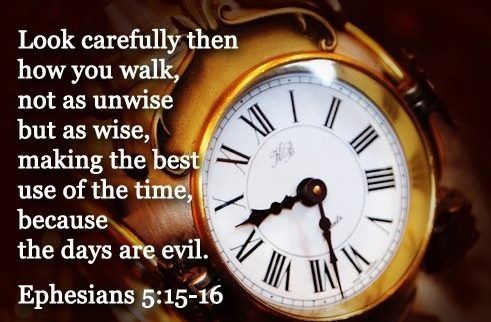
Ephesians 5:15-20 (5:15-16) – August 18, 2024

Can you picture this scenario? A tired mother, towing a whiny, unwilling child behind her in the grocery store, finally bursts out in an exasperated tone, “Will you please just be good?” How many times have you heard that cry? “Stop misbehaving!” or, “Please, be good, for once!” We may even have said it ourselves, to our children, grandchildren, nieces or nephews. Misbehavior is more than just a child’s issue. It’s bigger than that. It’s a larger issue . . . an issue of society in general, even a world issue.

The world situation today is not good. For confirmation, all anyone needs to do is look at a daily newspaper or listen to the nightly news. Misbehavior on a regional or national level. Wars and conflict overseas, violence in every large city in the United States, breakdown of society’s fabric in general, worldwide. I can quote the Apostle Paul from this passage in Ephesians 5 and say that these days are, indeed, evil.

This evil that Paul speaks of is not just generic, abstract evil. This evil is a specific kind of evil . . . in Greek, poneros—evil in active opposition to the good, pernicious. Insidious. Causing ruin. This is the situation that humanity is in without God. Left to our own devices, people will inevitably take the easier, softer way, cutting corners, with no moral compass.

If anyone here is familiar with the book The Lord of the Flies, this story is a prime example of how bad humanity can get. Briefly, the story concerns a group of British schoolboys who are wrecked on a tropical island without adult supervision, since the adults die in the plane wreck. It doesn’t take long before all kinds of evil behavior starts occurring as the boys engage in bullying, gang activity and before long, outright violence.

            Now, this book (later made into a movie) is a fictional account concerning schoolboys who do not have a moral compass. This kind of behavior is a worst case scenario, but it is happening more and more, as we see groups of people all over the world acting more and more amoral. Maybe we see it more and more because of better communications. And, with television and computers, news is beamed to the remotest corners of the world—news of these evil days.

“Though we cannot pretend that evil isn’t real (such a view would hardly be “wise”), this also cannot be the whole story of the world. We know that the world is God’s good creation, and that all days are God’s gifts” [1] – God’s gifts to God’s people!

            This is exactly the audience to whom Paul addresses this letter. The believers in Ephesus were Christians. They did believe in the claims of Jesus Christ. They were walking with God. One of the main themes of this letter is just that: keep walking with God. The Apostle Paul did not soften his words. He knew how difficult and challenging the Christian life can be.

            Paul’s strong words in Ephesians 5 are as much for us today as for believers centuries ago. “Take heed how you order your lives!” or, “Consider how you conduct yourselves!” The Christian life is not just a walk in the park, strewn with financial and material blessings, no matter what the tele-evangelists who promote a health, wealth and happiness gospel seem to say.

            Instead, and this is shown to us again and again in the Apostle Paul’s own life, the Christian life is not a spectator sport. No sitting in a comfy chair, eating bonbons. Life takes some doing. It takes rolling up our sleeves, and not being afraid to do something for God.

            Don’t get me wrong . . . I am NOT saying that we can work our way to heaven, because we CANNOT. No. We as human beings start off by our very nature separated from God, and cannot do anything about our own predicament. Yet, God’s wonderful grace sent God’s Son to redeem us from the evil things we have done, from the evil circumstances in which we find ourselves. And, when each of us believes in that gift of salvation and redemption, God helps us to be wise. God helps us to conduct ourselves in a manner pleasing to God!

            These days are evil, but with the Lord’s help, we can continue to walk in the way of God, not of evil. Yet, it is so easy to get off course. It’s like a ship on the ocean, steered by a rudder. Even if that rudder is off only a tiny amount, it doesn’t make a big difference at first. However, as the ship moves further and further across the ocean from New York City and continues on the wrong course uncorrected, instead of arriving in France, the ship might well end up in Africa! Aren’t we similar to that ship on the wrong course? Even though the course was only very slightly off in the beginning, as time went on and the journey continued, we might end up in a very different place from where we originally thought.

            This is one of the decision points of the letter to the Ephesians. We’re advised to live not as foolish people, but instead as wise people. I know very well how easy it is to become foolish. Sure enough, I do foolish things with great regularity. The Apostle Paul refers to this action as a continuing action.

Foolishness doesn’t just happen once or twice, and then stop. No, we need to keep close to God and keep coming to Him for help. God will help us understand how to be wise! God will help us to understand what God’s will is, too!

            This reminds me of my friend Mike, whose two children are about the ages of my two older daughters, in their late 30’s. Mike is a Presbyterian elder, a retired high school science teacher, and he gave me some words of wisdom some years ago regarding childrearing. He said because he wanted his children to exercise the excellent minds that God gave them, Mike would not tell his children to be good, but instead to be wise.

            Which is easier? Which is more difficult? Which takes more brain power? Being good, or being wise? Being wise takes some brain, some thoughtfulness, and some deliberation. Thank God that God loves us so much – God gave us excellent brains.

We can walk in a way pleasing to God, using the brains that God gave us to be God followers. “To be the awakened and wise people of God means that we can be good and honest stewards of time, so that opportunities to do justice, and to live boldly as God’s reconciled people during this time, are not missed.” [2]  And, the best part of all is that God will help us to be wise! God will give us wisdom, and will help us as we walk each day, one day at a time.

@chaplaineliza

(Suggestion: visit me at my other blogs: matterofprayer: A Year of Everyday Prayers. and  A Year of Being Kind . Thanks!


[1] https://www.workingpreacher.org/commentaries/revised-common-lectionary/ordinary-20-2/commentary-on-ephesians-515-20-4

[2] https://www.workingpreacher.org/commentaries/revised-common-lectionary/ordinary-20-2/commentary-on-ephesians-515-20-4

Unknown's avatar

In Prayer Before God

“In Prayer Before God”

2 Samuel 18: 5-17, 29-33 (18:33) – August 11, 2024

            The summary of a popular novel or a made-for-TV movie might be “An aging father grieves over the sudden death of his beloved son.” How often do we see this sort of sad headline broadcast by the media, or plastered on the covers of magazines in grocery stores? We can all feel for the affected family, or the grieving friends and relatives.    

            We all know grief. We all have experienced it, too. Some people are not even sure whether they ought to be grieving, but their insides say they very much ought to! “Grief is tremendous suffering and deep sadness. Grief could come after the death of a loved one. It could begin after the death of a pet. Grief could happen when our best friend moves to another city, and we have to say goodbye. We can’t get over grief – deep sadness- the way we get over a cold.” [1]

            This is what our Bible reading from 2 Samuel is all about today. The aging King David is grieving for his son – his most favorite son, Absalom. But, let’s back up a little, in this very sad tale. Absalom must have been a good-looking, charismatic guy, and a compelling leader, too. He thought very well of himself, and was itching to take over the kingdom from his father, King David. He certainly convinced a lot of people in Israel to get on his side, enough to mount a rebellion – an army to overthrow his father’s kingdom!

            This narrative is lengthy, and I don’t want to read it all to you. Let me give you the short-short version. Absalom was one of many children of King David. David had many wives, and they all were fruitful. David ended up with several dozen children from wives and concubines. Absalom was David’s favorite son. Sadly, and shocking to think – considering David was his father, Absalom was not a kind and virtuous person. By Biblical report, he was narcissistic, stuck up, and thought way too much of himself.

            David’s many children had a great deal of drama going on between them. You can read all about this unsavory drama yourselves, in 2 Samuel. Still, King David loved Absalom very much, even though Absalom raised an army to overthrow his father and become king of Israel himself. Sadly, things did not work out well for Absalom. “In this reading we see David issuing orders, trying to ensure that whatever happens in the upcoming battle between his supporters and the rebellion led by Absalom, that Absalom is to be spared. Ultimately, today’s passage ends with David learning that Absalom had been killed and the King is heartbroken.” [2]

            What do we do when we face such heartache over a loss that is not really a loss? What do we do when we have what is called ambiguous loss and grief? Certain kinds of loss and grief are frequently not even recognized as grief. Instead, it’s marked by uncertainty – the absence of closure, the murkiness surrounding what has been lost, or whether it’s truly gone.

Look at the awful situation with Absalom, who was treating his father King David so poorly. The young man was even leading a rebellion against his father! And, King David still loved his son very much, even when Absalom died. David loved and grieved so much!

            Some of these complicated and ambiguous situations are so difficult for the people and families to respond to. And, how should you and I respond to such pain, hurt and suffering? Our worship service each week gives us a road map on a caring way to respond even to ambiguous and puzzling situations. We can pray. We can come before God.

Our commentator reflects that “Few simple solutions exist to the complex problems that plague our lives, whether we’re talking about war among nations, conflicts within families, or battles being waged in individual hearts. And yet, no matter the enormity of the challenges we face, grace abounds again and again.” [3]

It is part of a loving and grace-filled response to lift our neighbors, our loved ones and their complicated situations to the Lord. A good place to begin is to acknowledge and validate the emotions surrounding the situation. There is real grieving going on! Even though the grief inside might not be acknowledged, or might be hidden or difficult to see, there are several responses possible. Let us choose the loving and caring response by praying for these friends without judgement. Let us cover the difficult or painful situation in prayer.

We realize that God knew David’s difficult situation, with Absalom and his total disrespect and rebellion of his father. We feel so deeply for King David, still loving his favorite son despite everything crashing down around his ears.

Even though our friends and loved ones may be in distress or even in despair, “The prayers of the people remind us that when we don’t know what to do or we are afraid to acknowledge the suffering around us, we begin with prayer; and not just individual prayer—corporate prayer. We don’t have to know the details of our neighbors’ struggles [and pain] to gather together and offer one another grace through prayer.” [4]

We can do that alone, in prayer before God, certainly! What is more, we can gather together as a congregation, as friends in Christ. Let us take the opportunity to lift up each other as we grieve, as we go through all kinds of losses. What a loving way to extend comfort and encouragement! And, we can bring all of these prayers before our loving, caring, compassionate God. What a balm for the heart and soul, as we know God cares for each one of us.

@chaplaineliza

(Suggestion: visit me at my other blogs: matterofprayer: A Year of Everyday Prayers. and  A Year of Being Kind . Thanks!


[1] https://www.umcdiscipleship.org/worship-planning/worship-with-rejoicing/twelfth-sunday-after-pentecost-year-b-lectionary-planning-notes/twelfth-sunday-after-pentecost-year-b-childrens-message

[2] https://www.churchofscotland.org.uk/worship/weekly-worship/monthly/2024-august/sunday-11-august-2024-twelfth-sunday-after-pentecost-year-b

[3] https://www.umcdiscipleship.org/worship-planning/worship-with-rejoicing/twelfth-sunday-after-pentecost-year-b-lectionary-planning-notes

[4] https://www.umcdiscipleship.org/worship-planning/worship-with-rejoicing/twelfth-sunday-after-pentecost-year-b-lectionary-planning-notes

Unknown's avatar

Whose Calling? God’s Calling!

“Whose Calling? God’s Calling!”

Ephesians 4:1-6, 13-16 (4:1-3) – August 4, 2024

            I love the Olympics! Yes, the Winter Olympics are wonderful! No doubt about it. However, I have always had a warm place in my heart for the Summer Olympics. Watching such marvelous athletes can be excellent for both the head as well as the heart.

Watching the nations of the world come together in friendship and friendly competition is wonderful, too. Sports and friendly competition can transcend national rivalry, ethnic differences and even bring about an end to conflict and wars – as temporary as the peace and truce every four years at the time of the Olympics is.

            Sadly, in Paul’s time, regions and countries were in regular conflict and war, one with another. The apostle Paul is quite deliberate here at the beginning of Ephesians chapter 4. He does entreat, in all seriousness! Paul knows how difficult it is for individuals to get along with each other, much less countries. It sounds much like today!  

            The letter to the Ephesian church is divided into two parts. Paul ended the first section with Ephesians 3, with a prayer for an outpouring of Christ’s love. Paul wished the Lord might grant strength and power to the Ephesian believers, prayed they might experience the full-ness of God, and closed with a spontaneous doxology to the immeasurable praise and glory of God. Here at the beginning of the second section of his letter, Paul gets practical.

I would like to read again these words from the apostle Paul. “live a life that measures up to the standard God set when he called you. Be always humble, gentle, and patient. Show your love by being tolerant with one another. Do your best to preserve the unity which the Spirit gives by means of the peace that binds you together. There is one body and one Spirit, just as there is one hope to which God has called you.”  

            When you think of someone who is humble, gentle, and patient, who comes to mind? Let me tell you who comes to mind for me. Mister Rogers. Yes, Fred Rogers from Mister Rogers Neighborhood is for me a star at being humble, gentle, and patient. Yet, look at our culture here in the United States.  These three attributes are not seen to be highly regarded or sought after. Look at television commercials, which deliver a hard no to humble, gentle, and patient.

            Especially as – and I am going to venture into the political realm for a moment, which I usually do not do – we consider the general tenor and divisive attitude of the whole nation, with our national election only three months away. Who among our political leaders and those running for office wants to showcase themselves as humble, gentle and patient? Yet, that is exactly what the apostle Paul tells us to be, as believers in Christ.

            Paul moves to the idea of being worthy of “the calling you have received.” That is, each of us is called. God has chosen us, as the Bible says in multiple places, to be God’s beloved children. The Lord has chosen each of us to be a part of God’s Church Universal. And, each in our congregation is a part of our local church here. St. Luke’s Christian Community Church.

            In the Olympic competition every four years, we can watch many, many different teams playing a variety of sports, from all over the world. I was very much struck by the USA women’s rugby team, who actually medalled, winning bronze. The first time a USA team has won a medal in rugby, since 1924. I heard Illona Maher, the earnest, sincere captain of the team interviewed, and several of her teammates also commented. They are so grateful they had the opportunity to practice and to compete together. There is a special bond between these women that will last a lifetime. May the bonds between each of us as fellow Christians lead us to such togetherness.

            Now, WHY should there be such togetherness? As Paul is urging believers in Ephesus to live lives worthy of this Godly calling, he also urges each of us to do the same. “Nothing we do can ever make us truly worthy of the gift of God’s grace, but God’s grace should make us want to live lives that align with who God has called us to be.” [1] Isn’t grace the whole point of living our lives as believers in Christ? Talk about being counter-cultural! This is it, right here.

 God not only freely gives each of us grace – which none of us has done anything to earn! – but we, the church, have been given unity! I know it doesn’t seem like we are unified some of the time. Even, most of the time, depending on which groups of people you and I are looking at! Paul reminds us: “Do your best to preserve the unity which the Spirit gives by means of the peace that binds you together.”

As we look at the spirit and goal of the Olympics, we can see another expression of unity. Unity in sport, in friendly competition. This year, athletes from more than 200 countries are living together under one roof, and are unified as ambassadors of peace, for these two weeks at least. What a marvelous expression, and how similar is this unity that the apostle Paul talks about here in our reading today! What better way to express this unity, as Paul says, than by stewarding this unity through you and me striving to be humble, gentle, patient and loving.

            I know sometimes there are fierce rivalries between sports teams, and between their devoted fans. But, not here! Not in God’s gifting. Just as on a sports team there are different gifts displayed by the various team members, so there is in every local church different people performing different functions. Even equipped with different but equal talents! “It is notable that God, desiring unity, didn’t make us all the same, but instead has given us the opportunity to encounter people who differ from us. Our goal as a Church is to learn to love all peoples ‘until we all reach unity in the faith and in the knowledge of the Son of God.’” [2]

            So, God is again doing the unexpected: giving us grace! And, calling us with the rich calling that is even more amazing than we could possibly ask for. Plus, the hallmarks of our calling as believers come as we all strive to be humble, gentle, patient and loving – to everyone! All people, from everywhere. Just like the Olympics. Just like the Church, all over the world.

Listen to Paul – be peacemakers to all people, and be unified. As God has gifted us to be. Alleluia, amen!

@chaplaineliza

(Suggestion: visit me at my other blogs: matterofprayer: A Year of Everyday Prayers. and  A Year of Being Kind . Thanks!


[1] https://www.churchofscotland.org.uk/worship/weekly-worship/monthly/2024-august/sunday-4-august-2024-eleventh-sunday-after-pentecost-year-b

[2] Ibid.