Unknown's avatar

Turning of the Year!

“Turning of the Year!”
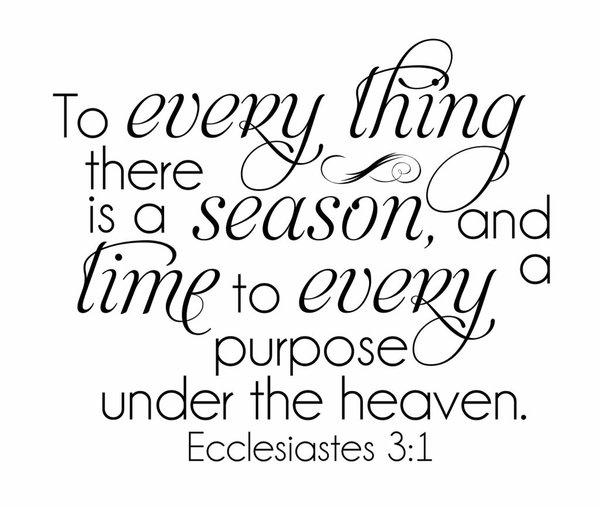
Ecclesiastes 3:1-8 (3:1) – December 31, 2023

            Time has a funny way of getting away from us, doesn’t it? Time can be rushing by while you and I are sitting, watching, on a treadmill or a big hamster wheel. Time is elastic, sometimes stretching out, tedious while we are waiting, other times jam-packed with events and decisions and happenings all on top of each other!

            Many people take stock at the end of the year, looking back, looking ahead. My husband Kevin noticed a local newspaper at a restaurant we went to for lunch yesterday. The sports page had a preview for 2024, showing some positive news: up-and-coming sports players to watch and look forward to! That is certainly one way of looking at the turning of the year!

            The Scripture reading for today (for tomorrow, really – for New Year’s Day) comes from the Hebrew Scriptures book called Ecclesiastes. Ecclesiastes does not have riveting stories like Genesis or 1 or 2 Samuel. It does not have uplifting or emotional songs like the book of Psalms, or stirring prophecy like Isaiah. What this book does have is a poignant, soul-stirring view on time, on life, on death, and on wisdom, right here in chapter 3.

            People can get bogged down with the basic message of Ecclesiastes. In short, an overview of the whole book has the Teacher (some call him the Preacher) telling his readers that life is short, everything passes away and goes back to God, and he gives the advice to live life to the fullest while you can. Grab all the gusto you can! Seize the day! Carpe diem!

            A secondary message found in this short book is to strive after wisdom. I can imagine young people hearing the first, overarching message of Ecclesiastes and doing exactly that – living life to the fullest while they can! Except, young people often do not consider wisdom. Sometimes older folks do not consider wisdom, either!

Wisdom is front and center here in chapter 3. We see life – and humanity – laid out for us, in all its nitty gritty manner, warts and all.

We can look at this reading from three different perspectives, This is helpful when interpreting this famous passage from Ecclesiastes 3. “In order to appreciate the wisdom of what “the Teacher” presents, we do well to see it from an outside location for a positive perspective, the inside for a negative perspective and up-above for an ultimate perspective.” [1]

            If we view this reading from the outside, just taking the words “as is,” everything looks pretty good, pretty safe. Remember the folk song from the 1960s by the Byrds? Turn, Turn, Turn. The words to the song read exactly like today’s Scripture reading. Yes, there are different times for different experiences in our lives. That plain truth is self-evident. The same fire that melts butter also boils a hard-boiled egg. The same wind that puts out a match will fan flames into a strong blaze. There is a time for everything, for every activity under heaven.

            Except – we are not to go through life blindly or carelessly. Just as the Teacher says to us, we “acknowledge the wisdom of these different times. We challenge the assumption that if we are spiritual enough, we ought to be happy all the time, realizing instead if we’ve lost someone—to divorce or Alzheimer’s or a miscarriage –it is the right time to weep.  We acknowledge there is a time to scatter stones (“Mr. Gorbachev, tear down this wall!”). And a time to hate (cancer, human trafficking, hypocrisy.)” [2]

            We need to consider the inside story next. That’s the negative part, isn’t it? Looking at these words from the inside, and considering the context, the “why” and the “how come?” We run right into sadness and pain, the core and substance of life. We all know that life is not always rosy! Life has negative aspects, depressing happenings, and sad situations.

Sometimes these situations come up again and again. This boils down to the conclusion that actor Jim Carrey gave in an interview: “I think everybody should get rich and famous and do everything they ever dreamed of so they can see that it’s not the answer.” [3]Does striving after the unreachable, beating the air, running as fast as you can with no chance of ever catching a break, sound familiar? “What do we gain from any of this? What profit?” At the end of the day, the Teacher calls every tick of our clock, every activity under the sun meaningless.            

            Sounds pretty hopeless, and the Teacher says humanity can do very little! But, do not despair! We come to the third view, the view from up above – God’s viewpoint! We read v. 10: “I have seen the burden God has laid on the human race. [And then this shining ray of hope] Yet God has made everything beautiful in its time. He has also set eternity in the human heart.”  

            God indeed has the last word. God can make a way through. God opens a window in the skies, in the everlasting cloudy day of sorrow the writer of Ecclesiastes paints for us. God does indeed make everything beautiful in its time! Everything is in God’s time.

            Which brings us back to where we started, with time. Our human concept of time. “We human beings are in time, we’re defined by its limits. But from the midst of time, we have a sense for eternity. We have inklings of something more. We hear echoes from a far country.” [4] I suspect even the writer of Ecclesiastes heard this inkling of eternity, too.

            With wisdom, we come to understand that time is not just what happens around us! “Time is something to which we pay wise attention so that we can know how to act in various seasons of life. Ecclesiastes 3 is not just about the passing of time or the “turn, turn, turn” of life’s cycles. It is also about wisdom, about a wise discerning of time and of how we are to react to the different occasions that come our way.” [5] Yes, there is a time for everything. And yes, there is an eternity for everyone – for you, for me, made beautiful in the human heart.

            The Teacher says, listen up! Be wise, and take heart. God is able, God is over all, and God loves us all. Whether in 2023, or 2024, and into eternity. Alleluia, amen.

@chaplaineliza

(Suggestion: visit me at my other blogs: matterofprayer: A Year of Everyday Prayers. #PursuePEACE – and  A Year of Being Kind . Thanks!


[1] https://cepreaching.org/commentary/lora-copley/ecclesiastes-31-11/

[2] Ibid.

[3]  Reader’s Digest, March 2006

[4] https://cepreaching.org/commentary/2014-12-15/ecclesiastes-31-13-2/

[5] Ibid.

Unknown's avatar

Love Amazes!

“Love Amazes!”

Luke 2:15-20 (2:18) – December 24, 2023

            Merry Christmas! What a wonderful expression. People greeting each other on the street, in the stores, here at church. This is also the fourth Sunday in Advent, the Sunday where we focus on Love. What a joyous time of the year, and what a celebration of love-come-to-earth. 

            But I want you to go back, two thousand years. Go back to a time when “Merry Christmas” was not even a phrase, a wish, an idea in people’s heads. Go back to the time that Dr. Luke describes in the second chapter of his Gospel. Back to the time when Israel was an occupied country, and the Roman Empire was the strong man. Back to the time when all people in Israel needed to be enrolled. The Roman government decided to have a census, so that they would be able to tax the people of Israel more accurately.

We heard this census described in our Gospel reading. Joseph and his fiancée Mary went to Bethlehem to enroll, because Joseph was a direct descendant of King David. I suspect there were many people on the roads. Today, traveling can be stressful and nerve-wracking. However, travel in the first century was much more difficult. Poor roads, with many people walking to get from one place to another. We might imagine that Joseph and Mary had a donkey, but nowhere in the Gospel is that mentioned. Travel conditions were challenging, at best.

There they are, in Bethlehem. A long way from their home in Nazareth. I suspect Joseph took care of the enrollment business first thing. But Mary felt the pains of labor begin. What a scary thing! To be far, far from home, in an unfamiliar place, and to have such a significant event happen. Significant, and potentially life-threatening, too.

            Yes, delivering a baby is a special day for anyone. But—even more so, for Mary and Joseph. Extra special because of the love surrounding them, this amazing love from God.

            As Dr. Luke tells us, there were shepherds abiding in the fields, keeping watch over their flocks by night. Remember, there is no radio or telephone, no Internet or telegraph. When messengers personally come to deliver a special announcement, it is a big deal. These angels coming to the shepherds, well, that was a super big deal, to be sure!

            And the announcement? This isn’t the birth of a normal, ordinary baby. No! This baby is an extra special baby. The Messiah, who will save His people from their sins. A special announcement of God’s love! This special baby, this Savior, Christ the Lord, is born to you—to me—to all of us, in the city of David, which is called Bethlehem.

            Did you hear? The Savior, the Christ, the promised Messiah, came into this world as a Baby in Bethlehem. The Eternal Second Person of the Trinity, Creator of the whole universe, God the Son, emptied Himself of all God-ness. Took on humanity, and was born as a helpless Baby. That is not only good news, that is earth-shaking news. Good news of great joy for all the people. For you, for me, for all of us.

            Yes, the promises of Christmas may sound familiar to us. The good news that the angels brought may be old news, to some. But those promises? They are so needed, today. What with uncertainty and fear, anxiety and hatred so common today. Peace and security seem way out of humanity’s reach. Don’t we need some good news right now? Don’t we need news of God’s amazing love for all of us, for each one of us?

This is good news, this Gospel the angels brought to the shepherds. And they, in turn, told everyone they could about the Child, which the Lord had made known to them. Just as Luke said, all who heard about the Child were amazed at what the shepherd told them.

When I take a step back from this narrative that is so familiar to all of us here in this church, I try to imagine this event brought up to date. “I do find myself wondering just where this might happen today. If Jesus were to come again in human form, would it be like the last time? Would it be in a country far away or would it be in our own back yard? Would it be in an unused room at a nursing home?  Or at a homeless shelter?  Or under a city bridge? I do wonder where Jesus would be born today, don’t you? I wonder how my wondering changes how I encounter those who are in those places now.” [1] It is very possible that those places are already made ‘holy’ – that babies born in unused rooms or homeless shelters or under bridges are holy, too. Even before the presence of the Christ Child makes them even more special.

After that special birth announcement from the angels, and the excited visits from the shepherds, we are left with Mary. Mary who was only a teenager, who had had nine months to consider this extraordinary pregnancy and upcoming birth. Mary must have been up to the task. Mary must have been an extraordinary, reflective young woman.

We know from verse 18 that Mary treasured all these words and pondered them in her heart. All of these words, these unfolding events. Another translation has this verse as “Mary was keeping together (the Greek verb sunetare) all these words, bringing them together (sumballos) in her heart.” Keeping together, sunetare, has the sense of integration. Bringing these events together, or sumballos! Mary was fitting all the puzzle pieces together, bit by bit.

Can we do the same? Can we fit all the pieces together? Can we slow down, just a little, and wonder at the miracle of that night? I invite us all to listen to the good news of the shepherds. The eternal God, Creator of the universe, come to earth as the Babe in Bethlehem.

God gives each of us an opportunity, an invitation to experience amazing love; an invitation to worship the newborn Savior. We, too, can stop by that manger in Bethlehem, and be caught up in the wonder of what happened that night, so long ago.  We, too, can say “O come, let us adore Him, Christ the Lord.” Alleluia, amen.

@chaplaineliza

(Suggestion: visit me at my other blogs: matterofprayer: A Year of Everyday Prayers. #PursuePEACE – and  A Year of Being Kind . Thanks!

(I would like to express my great appreciation for the observations and commentary from the Do Not Be Afraid Advent Devotional – © 2022 Illustrated Ministry, LLC.. I used several ideas from their useful resources. Thanks so much!)


[1] Dancing with the Word: Christmas in the Barn

Unknown's avatar

To Practice Joy!

“To Practice Joy!”

Luke 2:1-14 (2:10) – December 17, 2023

            Have you ever been so busy, so worried, or so focused, that you couldn’t be joyful? Sometimes it feels that way for me. Sometimes, with so much work for the hospice I work for, so many things to do for the small church I pastor – St. Luke’s Church – I feel stretched thin and working hard. Many people I know are head down, sitting in the computer chair, laptop on till late at night. It seems like I cannot find the time to be joyful – to practice joy!

            I wonder whether the shepherds on the hills surrounding Bethlehem felt anything like that? I wonder if their livelihood as shepherds – precarious at best – was also problematic, even hectic? I mean, you and I might connect shepherds with idyllic, pastoral scenes, with green pastures and quiet waters flowing gently under a sparkling blue sky. Let me tell you: life as a shepherd in Palestine was not idyllic, not by any means!

            Working as a shepherd was truly lurking on the outskirts of Palestinian society, in the first century. We just heard in our reading that the angels brought Good News. The shepherds needed some Good News, too. On those hilltops around Bethlehem, they were not exactly welcome in the general society of the town, either. Focusing on today’s Scripture reading, Dr. Luke tells us about the shepherds, abiding in the fields, keeping watch over their flocks by night. But, he does not mention anything about the low position they held in society.

            Let’s come at this miraculous birth announcement from another direction. Yes, the shepherds were keeping watch over their flocks by night, and yes, the divine messenger from heaven bursts upon them, lighting up the sky. The first words out of the angel’s mouth: “Do not be afraid!” I am certain the shepherds were terrified! And then, the angel shares the Good News: ““I bring you good news that will cause great joy for all the people. 11 Today in the town of David a Savior has been born to you; he is the Messiah, the Lord.” The angel’s marvelous news surely would cause great joy for everyone! Wouldn’t it?

            Then—before the shepherds have had a chance to digest this incredible announcement—the sky changes again. What had moments ago been silent and dark now roars with sound and flashes with light, a multitude of angels offering praise to God. [1] We can almost hear the angelic chorus in Handel’s Messiah: “Glory to God in the highest!”

            I wonder: are you and I ready to rejoice with the shepherds right now? Can we sing with the multitude of angels, praising God and lifting our voices to the skies? Or, would we be terrified, along with the shepherds, at the Good News of great joy that the angel brought?

            Let’s think some more about those shepherds. “By the time of Jesus, shepherding had become a profession most likely to be filled from the bottom rung of the social ladder, by persons who could not find what was regarded as decent work. Society stereotyped shepherds as liars, degenerates, and thieves. The testimony of shepherds was not admissible in court, and many towns had ordinances barring shepherds from their city limits.” [2]

Imagine the difference in class between the shepherds and the bulk of the townspeople of Bethlehem. Certain people live “on the wrong side of the tracks,” or “on the other side of town.” Perhaps they come from the “low-class hill country,” or “that sketchy place down by the river.”

Yet, God revealed the great Good News of the Messiah’s birth to these lowly, no-count shepherds! Imagine, angels – God’s heavenly messengers – came to these people on the bottom rung of the social ladder, not to the president of the biggest synagogue in Bethlehem, and not to the most respected Rabbi in town.    

The Gospel of Luke is a gospel centered on “a connection to the marginalized, the lowly, and the common and often unacceptable people of first century Judea that will be present throughout Jesus’ life and ministry. It reminds us that these are the very people who Jesus will invite to be part of the Kingdom of God.” [3] This stunning heavenly birth announcement came to the outsiders, people on the margins. In modern-day terms, God’s heavenly birth announcement comes to the homeless, people selling Streetwise or begging at street corners, migrants, people in tent camps, to lonely seniors, and children of teenaged mothers.  

            It truly does not matter – you and I can spread the Good News to everyone we meet, too.  

            The angels did not observe the class consciousness of society, or the language barriers or color barriers of so much of our world. No! The angels sent from God brought glad tidings of great joy to ALL the people. Not just some select few, not even to most of the earth’s population. No! This Good News came to ALL the people. It comes to all with an emotional, mental, or spiritual disconnect, too!       

            The angels came to the “fields of the isolated, the disenfranchised and the forgotten, or in our own painful places of spiritual wilderness, because God speaks the good news of Christ’s coming there. God brings great joy to those who need it most there.” [4]

            I realize that it can take a tremendous amount of emotional energy to navigate each day’s difficulties. Each day’s challenges can sap each one of us of strength to continue. So, “joy” can seem like a luxury, something that is almost unattainable. Yet, such joy is a gift. God brings joy to each of us, to lighten our hearts and brighten our souls. “We practice what we might have a knack for but want to get better at: drawing, soup-making, karate. We practice what we’re good at and know we’ll lose if we don’t keep at it: yoga, math, courage. Could joy fall into that category? Could we practice delighting in some piece of each new day, meeting each new person with wonder, treasuring each connection?” [5]

God wishes to draw ALL of us in to the Good News of the birth of God’s Son. Regardless of where we come from, or where we are right now, we receive great joy. Each one of us has the angel of the Lord bringing Good News to us—personally. Glad tidings of great joy, no matter what! Wonderful news, any time we need it! Alleluia, amen! m

@chaplaineliza

(Suggestion: visit me at my other blogs: matterofprayer: A Year of Everyday Prayers. #PursuePEACE – and  A Year of Being Kind . Thanks!

(I would like to express my great appreciation for the observations and commentary from the Do Not Be Afraid Advent Devotional – © 2022 Illustrated Ministry, LLC.. I used several quotes and ideas from their useful resources. Thanks so much!)


[1] The Do Not Be Afraid Advent Devotional – © 2022 Illustrated Ministry, LLC

[2] http://www.workingpreacher.org/preaching.aspx?commentary_id=1522

[3] https://www.workingpreacher.org/commentaries/revised-common-lectionary/christmas-eve-nativity-of-our-lord/commentary-on-luke-21-14-15-20-12

[4] http://www.workingpreacher.org/preaching.aspx?commentary_id=1522

[5] The Do Not Be Afraid Advent Devotional – © 2022 Illustrated Ministry, LLC

Unknown's avatar

God’s Radical Promises!

“God’s Radical Promises!”

Luke 1:46-55 (1:49) – December 10, 2023

            Who remembers going Christmas caroling? Going from house to house, singing the carols and hymns of the season, bringing hope, joy and peace to many at this season of the year. Such a wonderful memory! And, such wonderful carols and hymns and songs, too!

            Just think of where these songs of hope, joy and peace come from. All over the world, there have been songs of Advent and Christmas written throughout the centuries. These are by turns loud, joyous and bright music, or they could be soft, gentle, quiet lullabies. What holds all of these songs in common is their focus on God’s promises fulfilled.

            That sounds so much like our Gospel reading from Luke today. The pregnant teenager Mary sings a song where she remembers the promises of God. And, these promises are not just theoretical. These promises are actually happening to her, at the time she is singing.

            Her cousin Elizabeth is much older, and had given up any hope of having a baby until God miraculously intervened. Mary – well, we all know Mary’s story, how the angel Gabriel came to her and said God had highly favored her. And – Mary said yes to God, and became pregnant by the Holy Spirit. After several months, Mary and her cousin Elizabeth are together, at Elizabeth’s home. Mary, a thoughtful, contemplative teenager, began singing this marvelous song of God’s promises fulfilled in her life and in the time to come.

            At the beginning of this song – this Magnificat – Mary starts with giving praise to the Lord. Magnifiying God’s name! As the Jewish people had done long before Mary, she sings of the great things God has done. Except, for Mary, God is now doing these things for her, personally! Just imagine, Mary was from a small town in an obscure region of Palestine. A nobody from nowhere. Except, she is so similar to many young women throughout the centuries.

Just think, “living in a rural village in an occupied country. Everyone around her discounted her. But God did not. This gives everyone else who feels like a nobody the assurance that God values them too. God has work and a plan for them, too.” [1] What a bright hope this holds out for so many who otherwise would feel left out, downtrodden, and left behind!

Both Mary and Elizabeth felt joy, too. Both knew the joy of having a baby grow within their bodies, and they knew the joy of having God’s promises personally fulfilled in their own lives. Plus, Mary was joyful because she looked forward to seeing her son as the fulfillment of the world’s hope, the fulfillment of God’s promises foretold throughout the ages.

Mary is not a meek, mild and lowly person, no matter what certain carols may say. As we read Mary’s song of praise to God, we can clearly hear this song is a radical departure from the broken, the fallen, the least and the last. From the words of this song, I suspect that Mary is not only thoughtful, she is intelligent, even mature and freethinking.   

            Can you listen with open ears to Mary sing of God who “has brought down rulers from their thrones but has lifted up the humble,” and “has filled the hungry with good things but has sent the rich away empty.” This is a classic story (or song) about the “haves” and the “have-nots,” and we can guess who Mary associates herself with! The Jewish people are definitely downtrodden; the Roman empire certainly has them under their collective boot heel. Nevertheless, Mary’s notes of joy ring out for all to hear in the Magnificat!

            Remember, Mary’s song, giving glory, magnifying God, is also clearly a radical protest song. As she sings about the injustice not only in her hometown, but within the whole occupied Jewish nation, any peace but a forced “peace” was the furthest thing from the minds of the Roman occupiers. Yet, “the new world Mary sings about here isn’t elusive or unquantifiable at all. The hope she holds onto is one passed on to her from her ancestors: from Hannah, who sang this hymn of reversal and revolution in the Hebrew scriptures, to the Psalmist, who echoed praise to God for raising the poor from the dust and lifting the needy out of their desperation.” [2]      

            One commentator, Rolf Jacobson, tells about one of his colleagues at Luther Seminary. Dr. Lois Malcolm grew up as a missionary kid in the Philippines. “Growing up among that nation’s poor, Malcolm reported that when they heard Mary’s Psalm, it was the first time that anyone had told them the good news that God cares about them—the poor, the oppressed. Mary’s Psalm announces, “Christ has come to challenge the structures of sin, death, the devil, and oppression. Christ has come in the strength of the Lord to do what the Lord has always done: lift up the lowly, free the enslaved, feed the hungry, give justice to the widow, the orphan, and the sojourner. [3]

            In the words of a modern retelling of Mary’s song: “Though the nations rage from age to age, we remember who holds us fast: God’s mercy must deliver us from the conqueror’s crushing grasp. This saving word that our forebears heard is the promise which holds us bound, ‘til the spear and rod can be crushed by God, who is turning the world around.” [4]

Can you believe how radical, how revolutionary an idea this was (and is)? Especially to a large group of people who have been poor, downtrodden, and left on the outskirts for generations, perhaps for centuries? What good news – even marvelous news – this would be to such a group of people, to know that God not only loves them, but God cares about each of them, and is actively coming to their defense, to fill their stomachs and right their wrongs!

            This is, indeed, a counter-cultural Gospel reading, counter to the culture of the United States, surely. What better reason for us to lift up this message of resistance, to open our ears to Mary and her radical song. Here in this country, the commercial picture of the baby Jesus is “a cattle-lowing, no-crying-he-makes Jesus” with Silent Night and Away in a Manger. “But at least one Christmas carol would remind us of the ends to which the son of Mary was willing to go in order to cast the mighty down from their thrones and uplift the lowly:” [5]

Nails, spear shall pierce him through, / The cross he borne for me, for you;
Hail, hail the word made flesh, / The babe, the son of Mary!

May our hushed, reverent souls magnify our Lord, indeed. Amen, alleluia.

@chaplaineliza

(Suggestion: visit me at my other blogs: matterofprayer: A Year of Everyday Prayers. #PursuePEACE – and  A Year of Being Kind . Thanks!)

(I would like to express my great appreciation for the observations and commentary from the Do Not Be Afraid Advent Devotional – © 2022 Illustrated Ministry, LLC.. I used several quotes and ideas from their useful resources. Thanks so much!)


[1]Worshiping With Children: Year C – Fourth Sunday of Advent (December 20, 2015)

[2] The Do Not Be Afraid Advent Devotional – © 2022 Illustrated Ministry, LLC

[3]  Commentary on Luke 1:46b-55 – Working Preacher from Luther Seminary

[4] Cooney, Rory, “Canticle of the Turning,” (GIA Pulications, Inc. Chicago, IL: 1990)

[5] Commentary on Luke 1:46b-55 – Working Preacher from Luther Seminary

Unknown's avatar

Favor with God!

“Favor with God!”

Luke 1:26-45 (1:30) – December 3, 2023

            Stories are so important! Do you have family stories that you have told around the dining room table, or that your parents told you, about your family history? I have told my children stories about one grandfather who owned a pharmacy and drug store in Chicago through the Depression and afterwards. And, my other grandfather who emigrated from a shtetl in Eastern Europe early in the 1900’s, seeing the Statue of Liberty from the deck of the steamer.

            I imagine teenaged Mary, and the stories she was told in her family. Not only family stories about her parents and grandparents, but also stories of the Hebrew people – stories of Abraham and Sarah, of Jacob and his sons, of Moses, Miriam, King David, and especially of Hannah and Samuel. I’d imagine Mary thinking hard about Hannah, pregnant with her child of promise Samuel, and it would be difficult not to compare herself to Hannah!  

            I am wondering which such stories have shaped you and me, giving us direction and hope, understanding and wisdom in the midst of uncertain times. [1] Which stories – either our family stories or Bible stories – have helped us along, given us positivity and perseverance when we get discouraged or upset?

            Mary must have been a thoughtful teenager, possibly even mature beyond her years, when the angel Gabriel suddenly appeared to her! The angel greeted Mary with the typical words most recorded in Scripture when an angel makes a visitation: “Don’t be afraid!” Lo and behold, Mary enters into conversation with this heavenly visitor.

            Would you and I have been as thoughtful, or as quick on our feet if we were suddenly confronted with an angel? Even if the angel immediately said, “Don’t be afraid!?”

            Mary must have had some idea of what she was up against, both in her culture and in her traditional society structure. Here she was, a young, unmarried teenager – yes, of marriageable age, but not married yet. And, she willingly took on the task of bearing a child, the Son of God as the angel said. “You have found favor with God. 31 You will conceive and give birth to a son, and you are to call him Jesus.”

            I wonder perhaps if this is why Mary goes to her older cousin Elizabeth in the hill country, because of the societal pressure that was on her in her hometown. I wonder whether Mary was thinking she might receive social judgement from Elizabeth once she gets there? Yet, I also know that cousin Elizabeth had her own experience of being shamed and excluded. “In her culture a woman’s primary purpose in life was to bear children, so as an elderly infertile wife she had endured a lifetime of being treated as a failure. Her response to her miraculous pregnancy emphasizes that God’s grace has reversed her social status.” [2]   

            Just think about it! Both Mary and Elizabeth were in a position of social stigma and even dishonor. Yet, Elizabeth said “This is what the Lord has done for me when he looked favorably on me and took away the disgrace I have endured among my people” (Luke 1:25). Further, by greeting Mary with joy and with honor, the pregnant Elizabeth firmly overturns society’s frowns and shames and clucking of tongues.

            There’s a whole lot in front of Mary and Elizabeth that they do not know. “They do not know why they have been chosen for these roles. They don’t know who their babies will become, though they have some hints. They don’t know how their children will change the world or how the world will change their children.” [3]

            What about today, with migrants, immigrants, or people displaced from war-torn areas or as a result of natural disasters? People are outside of their society’s rules or their cultural expectations, and are regularly in precarious situations. Old people, seniors far from families who need assistance – even a wheelchair – and nothing is available. Children who go hungry because their displaced parents are unable to work because of their host country’s rules.

Pregnant women sometimes are stigmatized by their society, shame, and cultural dishonor. So like Mary and Elizabeth. Do any of these stories resonate inside of you? Which of these ancient stories passed on – even as they were to Mary – do you hold especially close to your heart, especially in December, in this season of Advent? Do one or two of these Biblical stories carry you in dark or uncertain times, and give you encouragement and comfort? [4] Either the story of Hannah and Samuel, or of Mary and Elizabeth? Or another Biblical story?

Sometimes, there are competing stories of hopelessness, or discouragement, or dishonor that come to people’s minds. I would like to tell you that those competing, pessimistic stories are not helpful to our hearts or minds! These stories are not positive or uplifting, and please, please do not let yourselves get bogged down listening to them, internalizing them!

This story of Mary and Elizabeth shows us the positive, nurturing attitude of God reaching down to the least and the lowly. We can be open to the ways that God chooses to act in our world, both two thousand years ago, and today, too! “What is God doing through unexpected people in our society today? Where is God at work through people whom our neighbors and fellow church members often exclude or treat as shameful? Will we listen to the Spirit’s prompting when the bearers of God’s new reality show up on our doorstep?” [5]

I invite us all to consider these positive, miraculous stories and invite the Lord to come alongside of us as we travel through Advent. And perhaps, these stories will help us all to make the world a different place, a more Godly place, where God overrules society’s structure, shame and cultural disapproval! A place where God has arms open wide to all children, all people.

Maranatha, come, Lord Jesus!  

@chaplaineliza

(Suggestion: visit me at my other blogs: matterofprayer: A Year of Everyday Prayers. #PursuePEACE – and  A Year of Being Kind . Thanks!

(I would like to express my great appreciation for the observations and commentary from the Do Not Be Afraid Advent Devotional – © 2022 Illustrated Ministry, LLC.. I used several quotes and ideas from their useful resources. Thanks so much!)


[1] https://dancingwiththeword.com/mary-and-hannah-and-a-woman-in-the-county-jail/

[2] https://www.workingpreacher.org/commentaries/revised-common-lectionary/fourth-sunday-of-advent-3/commentary-on-luke-139-45-46-55-3

[3] Do Not Be Afraid Advent Devotional – © 2022 Illustrated Ministry, LLC.

[4] https://dancingwiththeword.com/mary-and-hannah-and-a-woman-in-the-county-jail/

[5] https://www.workingpreacher.org/commentaries/revised-common-lectionary/fourth-sunday-of-advent-3/commentary-on-luke-139-45-46-55-3