Unknown's avatar

That You May Believe!

“That You May Believe!”

John 20:19-31 (20:31) – April 27, 2025

            Seeing is believing! Or . . . is it? I wonder what things come to mind when I mention the phrase, “Seeing is believing”? Or even, “I won’t believe it until I see it!” Sometimes, people can be really doubtful about things. I can just imagine several people I know folding their arms across their chests and saying, “Unless you show me . . . “

            In the gospel account we read today, from John 20, the disciple Thomas had just that reaction. After the resurrection, the first time Jesus came to the disciples, Thomas was not there. We’re not told why, simply that he wasn’t there. Maybe he was scared, maybe he was away, or out of town. Maybe he was sick. We just aren’t told why he wasn’t there.

            The ‘why’ is not the important part. The fact that Thomas wasn’t present is. Thomas had doubts. Sincere doubts. Truth to tell, the other disciples’ story was a little farfetched. I mean, how many people have you known who came back from the dead, and walked through walls into a locked room?

            I wonder. I wonder if Thomas’ reaction strikes a chord with anyone here today. How many of us today are like Thomas? Doubting that Jesus has risen indeed from the dead? Or, completely missing Jesus, and doubting that Jesus is even here at all, today?

            Let’s think some more about Thomas and his reaction. Thomas not only doubted, he wanted concrete proof. Tangible proof, proof he could touch and feel and handle. Thomas wanted to put his hands in the nail marks on Jesus’ hands. That’s pretty concrete.

            As I thought more about Thomas and his reaction and attitude toward Jesus and His first appearance to the disciples, the Gospel of John is not clear at this point. We as readers don’t know why Thomas had difficulty believing. But the gospel account says he did.

            How many of us today are like Thomas? Not sure? Not believing? Closed up behind the locked doors of feeble faith? Not believing that Jesus can make a difference in our lives today? Could Jesus come and reveal Himself to Thomas? Can He come and reveal Himself to those today who are fearful, doubting, and unbelieving? . . . Can He reveal Himself to me?

            Perhaps Thomas had difficulty finding something to believe in, since he had so recently seen his Master and Teacher arrested and crucified. Grief, fear, anger, dashed hopes, shattered dreams. I strongly suspect several, if not all of these, were operating in Thomas’ life at this time.

            These strong feelings and emotions inside are intense, and raw. From what is known today about the stages of grief, Thomas could have been feeling awful, and angry, and upset. Thomas could have felt his life was falling apart. But Jesus can break through all of that. Jesus could enter Thomas’ life with new hope, standing right in front of him. In the same way, Jesus Christ can enter through the closed doors of our hearts, meet us where we are, with open arms.

Just as Jesus did not leave Thomas high and dry, to figure things out on his own, so Jesus will not leave us. Our Lord came to Thomas in the upper room, despite his doubts and unbelief, and Jesus also comes to us in our doubts, and in our unbelief.  “The resurrection is among us, whether we see it or not. The resurrection is all around us, whether we recognize it or not. The resurrection is in the midst of us whether we are able to point to it or not.” [1]

            Now, Thomas didn’t actually see Jesus, at first. He had just heard from others who had seen Jesus. But then, a second time, the risen Lord appeared to the disciples. Again, in the locked room, and this time, Thomas was there. What were Jesus’ words to Thomas? “Put your finger here and see my hands. Reach out your hand and put it in my side. Do not doubt, but believe.”

            Thomas responded with that tremendous affirmation, “My Lord and my God!”  Praise God for the sincere, heartfelt response of Thomas.

            Jesus’ words to His doubting disciple serve as words of comfort and reassurance to me. I know I have doubts, sometimes. And just as Jesus did not leave Thomas doubting, so too, Jesus will not leave me doubting, either. He will welcome me with open arms, coming through the locked doors of my fear, anger, doubt and unbelief.

            Thomas saw Jesus. Seeing was believing, in Thomas’ case. And then, the risen Jesus continues with the statement, “Have you believed because you have seen me?” Here’s the best part of all. “Blessed are those who have not seen and yet have come to believe.”

            What was that Jesus just said? Did I read that correctly? “Blessed are those who have not seen and yet have come to believe.” So—the Gospel of John says here that all who have not actually seen the risen Lord and yet have come to believe are indeed blessed.

            That means Christians throughout the centuries are blessed, since they have come to believe in Jesus Christ and yet have not actually, physically seen Him as risen from the dead. That means you and I are blessed, since we have come to believe in Jesus Christ, too. How awesome is that? We are blessed because the Lord Jesus says so!

            Just in case we didn’t quite understand where the evangelist was coming from the first time, verses 30 and 31 of John 20 underline this concept. “Jesus did many other signs in the presence of His disciples, which are not written in this book. But these are written so that you may come to believe that Jesus is the Messiah, the Son of God, and that through believing you may have life in His name.”

            Just as Jesus helped Thomas to believe, so the Gospel of John helps us to believe, too. This Gospel was not only written to bear witness so long ago, in the first century, some years after Jesus was raised from the dead. This Gospel was also written for the many generations which have come to believe throughout the centuries. That includes us, too.

Plus, Jesus does not mean for us to hide this Good News and keep it for ourselves. We all are “to be involved and engaged with the communities around us, in which there are the lives of many who do not yet know the Gospel. We respond to them with loving service, walking alongside them and sharing Jesus with every step.” [2]

Even though we may have doubts, and unbelief, and wonder whether, and why, or even why not, Jesus comes to us in our doubts and unbelief. Our Lord comes to all of us with reassurance and open arms and says “Do not doubt, but believe!”

            Praise God that as we come to believe that Jesus is the Messiah, we can have life in His name. Jesus can come to us, at any point in our walk with the Lord, no matter what the circumstance happens to be, no matter where we are in our lives. Thank God that Jesus will be there for us and with us, no matter what. May we all be able to affirm, with Thomas, that the risen Jesus is our Lord and our God.

            Alleluia, amen.

@chaplaineliza

(Suggestion: visit me at my other blogs: matterofprayer: A Year of Everyday Prayers. #PursuePEACE – and  A Year of Being Kind . Thanks!


[1]  https://www.workingpreacher.org/dear-working-preacher/when-seeing-is-believing

[2] https://www.churchofscotland.org.uk/worship/weekly-worship/monthly/2025-april/sunday-27-april-2025-second-sunday-of-easter-year-c


Unknown's avatar

Are We Doubters, Too?

“Are We Doubters, Too?”

John 20:19-31 (20:29) – April 7, 2024

            Seeing is believing! Or . . . is it?

            I wonder what things come to mind when I mention the phrase, “Seeing is believing”? Or even, “I won’t believe it until I see it!” Sometimes, people can be really doubtful, even really skeptical about things. I can just imagine several people I know folding their arms across their chests and saying, “Unless you show me . . . “

            In the gospel account we read today, from John 20, the disciple Thomas had just that reaction. After the Resurrection, the first time Jesus came to the disciples, Thomas was not there. We’re not told why, simply that he wasn’t there. Maybe he was scared, maybe he was away for the day, or out of town. Maybe he was sick. We just aren’t told why he wasn’t there.

            The ‘why’ is not the important part. The fact that Thomas wasn’t present the first time is. Thomas had doubts. Sincere doubts. Truth to tell, the other disciples’ story was a little farfetched. I mean, how many people have you known who came back from the dead, and walked through walls into a locked room?

            I wonder. I wonder if Thomas’ reaction strikes a chord with anyone here today. How many of us today are like Thomas? Doubting that Jesus has risen indeed from the dead? Or, completely missing Jesus, and doubting that Jesus is even here at all, today?

            Let’s think some more about Thomas and his reaction. Thomas not only doubted, he wanted concrete proof. Tangible proof, proof he could touch and feel and handle. Thomas wanted to put his hands in the nail marks on Jesus’ hands. That’s pretty concrete. But – what about you and me? Do we want concrete proof that God is working in our lives right now? Do we want concrete proof that Jesus rose from the dead and is present with us, today?

            The second time the risen Jesus appeared to the disciples, it was also in a locked room. And, this time, Thomas was present. Let’s paint the picture. The disciples are huddled together in the Upper Room, still frightened of the Jewish leaders. It’s only been a little over a week since their Rabbi Jesus had died on the cross, after all! I’d imagine they would be shaking in their shoes! Then, the risen Jesus suddenly appears in the midst of them all, Thomas included. What do you think would be going through Thomas’s mind right about now? His Rabbi, his Lord, back from the dead, right in front of him!

            Let’s go further as we imagine Thomas’s face, and imagine what he is thinking and feeling as the risen Lord Jesus invites Thomas to touch Him. Then, we look around at the faces of the other disciples and try to figure out what they are thinking and feeling, too! The commentator Carolyn Brown says that she suspects the disciples “are glad Thomas asked his question because they really wanted to know the same thing but were afraid to ask.  It does take courage to ask some questions and Thomas had it.” [1]

            I think that “doubting Thomas” is not the most accurate nickname for this earnest disciple. Perhaps, maybe, just maybe, we ought to think of Thomas as courageous Thomas. Because, it takes real courage to ask out loud some of those questions Thomas wanted the answers to. After all, he was a real “show-me!” kind of guy, and not in a mean way, either. A healthy skepticism is just that – healthy and curious.

            I wonder whether our doubts and fears about Jesus and the Resurrection can be as easily taken care of, as Thomas’s? What if our problem is less doubt, and more fear? Fear of being misunderstood by others, fear of looking foolish, fear of falling flat on our face? Perhaps, some kind of nebulous fear that you and I do not even understand, but we know is deep down inside of us?

            Let us return to Thomas. When he sees our risen Lord Jesus in the flesh – the resurrected body – he suddenly believes that everything the disciples were telling him about the resurrected Jesus is true! And, “he makes the climactic confession of John’s Gospel, addressing Jesus as, ‘My Lord and my God!’” When Thomas saw Jesus with his own eyes, that was enough for him. Enough to make the declaration of divinity directly to our risen Lord! Remember the confession made in the first verse of John chapter 1: “In the beginning was the Word, and the Word was with God, and the Word was God.” [2]

            Sure, some healthy curiosity is just that – curiosity. And, some people are naturally skeptical. We know God can handle that! After all, that is the way God constructed many people. Our Lord Jesus is not surprised by any of this. He won’t get mad, or storm out, all upset. No! He was warm and accepting of Thomas and his “show-me” attitude, and even answered him right back! And, what did Thomas do? What did Thomas say to Jesus? “My Lord and my God!”

            As commentator David Lose tells us, Thomas offers those same readers a model for faithful response to an encounter with Jesus – belief, belief that leads to confession. All through the Gospel of John we see a variety of responses to Jesus. The confusion of Nicodemus the religious teacher, the trust of the Samaritan women, the stubborn fidelity of the man born blind, the disdain of Pilate, the denial of Peter. [3] John saves the best for last: he shows us the radical, bold confession of Thomas, sure and certain at last.

            Have there been long moments in your life where you have doubted God’s presence? Have you ever felt lost and alone, almost like the way the disciples felt right after the Crucifixion? We do not need to fear or be alone, because Jesus has promised never to leave us nor forsake us. We can embrace our flickering faith with the same words of Thomas: “My Lord and my God!”          

So, the Gospel of John helps us to believe, too. This Gospel was not only written to bear witness so long ago, in the first century, months and years after Jesus was raised from the dead. This Gospel was also written for the many generations which have come to believe in Jesus Christ throughout the centuries. That includes us, too.

Even though today we may have doubts, and fears, and unbelief, and wonder whether, and why, or even why not, Jesus comes to us in our doubts and fears and unbelief. Our Lord comes to us with reassurance and open arms and says “Do not doubt, but believe!” And our faithful, bold response to Jesus? “My Lord and my God!” Alleluia, amen!

@chaplaineliza

(Suggestion: visit me at my other blogs: matterofprayer: A Year of Everyday Prayers. and  A Year of Being Kind . Thanks!


[1] http://worshipingwithchildren.blogspot.com/2015/02/year-b-second-sunday-of-easter-april-12.html

[2] https://www.workingpreacher.org/dear-working-preacher/its-not-about-thomas  

[3] Ibid.

Unknown's avatar

Peace Be with All of Us

“Peace Be with All of Us”

peace be with you, formal

Luke 24:36-49 (24:36) – April 15, 2018

Sometimes I just feel like pulling the covers over my head and not getting up in the morning. Wars, rumors of wars, bombings, fires, gas attacks, and these were just in the past week. Seriously, with all of the scary and shocking things going on in the world, the world can be a downright scary place.

No matter whether we live today in the United States or two thousand years ago in occupied Israel, there can be a lot of scary and confusing stuff going on.

In the case of our Gospel reading today, the scary and confusing stuff was going on right in Jerusalem. It was the time of the Passover, during what we today call the Passion Week. As we have been considering for the past few weeks, the occupying Roman forces in Jerusalem are watching the festival and worship situation very closely.

Sure, there are a great number of visitors from all over the known world, in Jerusalem for that great festival, Passover. But, the Roman forces must have doubled down on the populace in the city. And, even more, since the Rabbi Jesus had just entered the city only a few days before. He made a huge commotion, too, what with riding in on a donkey (like King David) on Palm Sunday, debating in the Temple during the week with the scribes, Pharisees and Sanhedrin, and getting arrested in the Garden of Gethsemane late on Thursday night and accused being Messiah. And, the crucifixion on Friday? Quite a week, for the occupying Roman forces.

Yes, we know some things in general about the disciples. They scattered, running away. Hiding, afraid that since their leader and Rabbi was just executed by the Romans on Friday, they might be arrested and executed next. In fact, Peter even denied knowing Jesus while in the high priest’s courtyard. He must have been scared to death, too.

The upper room, a larger room on the second floor of a building in Jerusalem, was one place where the disciples felt at least half-way safe. They were huddled up there, in hiding, trying to keep a low profile. Luke tells us the male disciples had already dismissed what the women disciples had told them about their Rabbi, early that morning. Something about an empty tomb, and their dead Rabbi gone. Even though Peter and John had run to the tomb and checked things out for themselves, they still did not have a clear idea what was going on.

This year, the lectionary does not have us look at the post-Resurrection appearance of Jesus when He walks with the two disciples from Jerusalem to the town of Emmaus. In brief, our commentator Dr. Mark Vitalis Hoffman summarizes this section of Luke 24: “Two from the group of followers of Jesus were going to Emmaus when they encounter, but do not recognize, Jesus. They express their disappointed hope that Jesus would be the one to redeem Israel, but Jesus explains how everything that happened was necessary according to Scripture. The two invite Jesus to spend the night with them. During the meal, when Jesus blessed and broke the bread, their eyes were opened, and they recognized Jesus, but he vanished from their sight. They rush back to Jerusalem and report to the gathered believers what had happened.” [1]

It is later that day that our Gospel reading picks up. Later in the evening, many disciples (I am assuming both male and female) are in hiding in the upper room. Luke specifically has the two disciples from Emmaus telling the rest about their encounter with Jesus.

Yet, the rest of the disciples are having difficulty believing, understanding. Even though several of these same disciples had angels and Jesus Himself telling them of the Resurrection, what gives? I suspect many of them are still paralyzed with fear. Scared to death. Afraid of the Roman soldiers coming around and knocking on the door at any moment, ready to carry off some of the disciples to be crucified, too.

How often have we been really afraid? Almost scared to death? Terror can paralyze a person. Fear can cause us to disbelieve, to run away, to get angry and fly off the handle. Don’t you think the disciples needed Jesus right then? When He appeared miraculously in their midst, many of them were still unbelieving. Still scared to death.

I think the first thing out of Jesus’s mouth was the most needed of all: “Peace be with you!” Do you hear? Jesus went straight to the heart of the disciples’ fear, their anxiety, their unbelief, and said “Peace be with you!”

Yes, we could talk about what happened after that, when some disciples thought Jesus was a ghost, so He ate a piece of fish to show His friends that He really, actually, had come back to life. Yes, we could talk about Jesus opening the disciples’ minds to the truth of the Scriptures, and how they were to be witnesses of the Good News and the forgiveness of sins.

I would like to go back to the first thing Jesus said: “Peace be with you!” During the Children’s Time, I talked about peace. There are many greetings in different languages that mean “Peace.” “Aloha in Hawaiian means affection, peace, compassion and mercy. Shalom (Hebrew) and Salaam (Arabic) mean peace, complete-ness, and prosperity. Aloha, Shalom, and Salaam can be used on meeting or departing.” [2]

Jesus wished the disciples His peace several times, recorded in the Gospels, including right here. This word is not only wishing a person peace, but “peace, shalom, and salaam” can also be wishing a person God’s presence. The disciples really needed that, too!

In the New Testament reading today from 1 John chapter 3, the aged disciple John tells us that we are the children of God. I remember when I was a mom of young children, sometimes then would get afraid. Sometimes I would comfort them, and hold them on my lap or give them hugs. Don’t you think it’s the same way with God? When we get afraid, even scared to death, we can run into God’s everlasting arms of care and concern. Our Lord Jesus can send us His peace.

The disciples really needed peace, first of all! Perhaps, they needed it most of all. God can send peace into the world today, too. Including peace into conflict in the Middle East, peace in warring regions in Africa and Asia, peace into difficult places in Central and South America. God can send peace to the streets of the cities of our country.

Jesus offers us comfort and peace, just the same way that parents (and grandparents) do. Jesus sends closeness, caring and loving, in addition to His peace.

Can you and I reach out in peace, in shalom, in wholeness and with God’s love? That is the message on my heart from the Gospel reading today. Reach out with God’s peace. Offer God’s peace to those around you today, and every day.

We can praise God for God’s peace and wholeness. God’s peace is a sure antidote to fear, today, and every day.

Alleluia, amen.

[1] http://www.workingpreacher.org/preaching.aspx?commentary_id=3627

Mark G. Vitalis Hoffman Associate Professor of Biblical Studies Lutheran Theological Seminary at Gettysburg

[2] http://worshipingwithchildren.blogspot.com/2015/03/year-b-third-sunday-of-easter-april-19.html

Worshiping with Children, Easter 3, Including children in the congregation’s worship, using the Revised Common Lectionary, Carolyn C. Brown, 2015

Unknown's avatar

Seeing is Believing!

Seeing is Believing!

“Seeing is Believing”

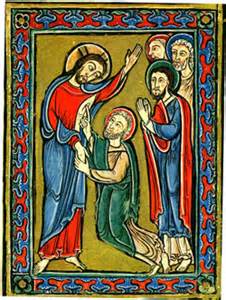
Jesus and Thomas illustration John 20-24

John 20:24-29 – April 12, 2015

Seeing is believing! Or . . . is it?

I wonder what things come to mind when I mention the phrase, “Seeing is believing”? Or even, “I won’t believe it until I see it!” Sometimes, people can be really doubtful about things. I can just imagine several people I know folding their arms across their chests and saying, “Unless you show me . . . “

In the gospel account we read today, from John 20, the disciple Thomas had just that reaction. After the resurrection, the first time Jesus came to the disciples, Thomas was not there. We’re not told why, simply that he wasn’t there. Maybe he was scared, maybe he was away, or out of town. Maybe he was sick. We just aren’t told why he wasn’t there.

The ‘why’ is not the important part. The fact that Thomas wasn’t present is. Thomas had doubts. Sincere doubts.

Truth to tell, the other disciples’ story was a little farfetched. I mean, how many people have you known who came back from the dead, and walked through walls into a locked room?

I wonder. I wonder if Thomas’ reaction strikes a chord with anyone here today. How many of us today are like Thomas? Doubting that Jesus has risen indeed from the dead? Or, completely missing Jesus, and doubting that Jesus is even here at all, today?

Let’s think some more about Thomas and his reaction. Thomas not only doubted, he also refused to believe! He not only doubted, he wanted concrete proof. Tangible proof, proof he could touch and feel and handle. Thomas wanted to put his hands in the nail marks on Jesus’ hands. That’s pretty concrete.

As I thought more about Thomas and his reaction and attitude toward Jesus and His first appearance to the disciples, I was reminded about my children. Generally, children have concrete thinking processes, especially smaller children. I have four children, and I’m accustomed to talking with them and communicating in more appropriate ways for their age groups. My children are just about grown up now. But when I used to explain something about God to my children, sometimes it was difficult for the younger ones to fully grasp the ideas I’m trying to explain. And they can ask some pretty hard questions. Gee, sometimes it’s difficult for me to know how to explain things about God to anyone who asks!

Maybe Thomas needed more concrete explanations, too. We just aren’t sure. The Gospel of John isn’t clear at this point. We as readers don’t know why Thomas had difficulty believing. But the gospel account says he did.

How many of us today are like Thomas? Not sure? Not believing? Closed up behind the locked doors of feeble faith? Not believing that Jesus can make a difference in our lives today? Could Jesus come and reveal Himself to Thomas? Can He come and reveal Himself to those today who are fearful, doubting, and unbelieving? . . . Can He reveal Himself to me?

Perhaps Thomas even had difficulty finding something to believe in, since he had so recently seen his Master and Teacher arrested and crucified. Grief, fear, anger, dashed hopes, shattered dreams. I strongly suspect several, if not all of these, were operating in Thomas’ life at this time.

These strong feelings and emotions inside are intense, and raw. From what is known today about the stages of grief, Thomas could very well have been feeling awful, angry, fearful and upset. Thomas could have felt like his life was falling apart. But Jesus can break through all of that. Jesus could enter Thomas’ life with new hope, standing right in front of him. In the same way, Jesus Christ can enter through the closed doors of our hearts, and meet us where we are, with open arms.

Just as Jesus did not leave Thomas high and dry, to figure things out on his own, so Jesus will not leave us. Our Lord came to Thomas in the upper room, despite his doubts and unbelief, and Jesus also comes to us in our doubts, and in our unbelief.

Now, Thomas didn’t actually see Jesus, at first. He had just heard from others who had seen Jesus. But then, a second time, the risen Lord appeared to the disciples. Again, in the locked room, and this time, Thomas was there.

What were Jesus’ words to Thomas? “Put your finger here and see my hands. Reach out your hand and put it in my side. Do not doubt, but believe.”

Thomas responded with that tremendous affirmation, “My Lord and my God!” Praise God for the sincere, heartfelt response of Thomas.

Jesus’ words to His doubting disciple serve as words of comfort and reassurance to me. I know I have doubts and fears, sometimes. And just as Jesus did not leave Thomas doubting, so too, Jesus will not leave me doubting, either. He will welcome me with open arms, coming through the locked doors of my fear, anger, doubt and unbelief.

Thomas saw Jesus. Seeing was believing, in Thomas’ case. Moreover, the risen Jesus continues with the statement, “Have you believed because you have seen me?” –here’s the best part of all. “Blessed are those who have not seen and yet have come to believe.”

What was that Jesus just said? Did I read that correctly? “Blessed are those who have not seen and yet have come to believe.” So–the Gospel of John says here that all who have not actually seen the risen Lord and yet have come to believe are indeed blessed.

That means Christians throughout the centuries are blessed, since they have come to believe in Jesus Christ and yet have not actually, physically seen Him as risen from the dead. That means you and I are blessed, since we have come to believe in Jesus Christ, too. How awesome is that? I am–you are–we all are blessed because the Lord Jesus says so!

Just as Jesus helped Thomas to believe, so the Gospel of John helps us to believe, too. This Gospel was not only written to bear witness so long ago, in the first century, some years after Jesus was raised from the dead. This Gospel was also written for the many generations which have come to believe throughout the centuries. And that includes us, too. Even though we may have doubts, and unbelief, and wonder whether, and why, or even why not, Jesus comes to us in our doubts and unbelief. Our Lord comes to us with reassurance and open arms and says “Do not doubt, but believe!”

Praise God that as we come to believe that Jesus is the Messiah, we can have life in His name. And Jesus can come to us, at any point in our walk with the Lord, no matter what the circumstance happens to be, no matter where we are in our lives. Thank God that Jesus will be there for us and with us, no matter what. May we all be able to affirm, with Thomas, that the risen Jesus is our Lord and our God.

Alleluia, amen.

@chaplaineliza

(Suggestion: visit me at my daily blog for 2015: matterofprayer: A Year of Everyday Prayers. and my other blog,  A Year of Being Kind .  Thanks!)