Unknown's avatar

A Neighbor and His Daughter

“A Neighbor and His Daughter”

Matthew 9:18-26 (9:25) – July 20, 2025

Welcome to the neighborhood! St. Luke’s Church neighborhood, that is.

I am continuing with our summer sermon series on Mister Rogers. You know, Fred Rogers, of Mister Rogers’ Neighborhood. I watched the television show with my small children – all four of them, at various times. I so appreciated Fred’s gentle, caring, loving way of speaking to everyone. Not only the children. He was the real deal. Fred was a genuine, caring, compassionate person, interested in everyone and everything. And, especially in children.

We are looking at a Scripture reading today that highlights a child, this week. Actually, it highlights both a girl child and a sick, unmarried woman, two people who were second-class citizens in the society of Jesus’s day. Women, especially unmarried women, were second-class, as were children. The only people who were of any worth in first-century society were males, and especially free males who owned property.  

But, let us leave this social class commentary for another day. I want us to concentrate on, first of all, the man who approaches the Rabbi Jesus, to ask if He could come and heal his daughter who is very sick. Actually, this narrative appears in three of the four Gospels: Matthew, Mark and Luke. There are slight differences in the telling of the narrative. In two accounts, the sick girl is still living, but at the point of death. In Matthew’s account, she has already died. In any of these narratives, it is a terrible tragedy for this father.

We understand that if two individuals are eye-witnesses to a car accident, but see it from the opposite sides of the street, we will have two different perspectives of the same accident. Just so here. Just so with the three writers of the Gospels. We see slightly different accounts of the same incident. With Matthew’s account, the father comes to Jesus, begging Him to come and heal his daughter – his dead daughter.

The father Jairus is the leader of the local synagogue. Not just a common attender or member, but the leader. He comes to the rabbi Jesus for help in a time of severe need. He must have been at the end of his rope, the end of all of his resources. Except – as the leader of his synagogue, leaders are trained to be competent and in control, and not supposed to be in desperate agony or heartbreaking fear of losing a much beloved family member. In fact, Jairus threw himself at Jesus’s feet, begging Him to come and raise his daughter from the dead. “He is desperate; his love for his daughter has left him utterly vulnerable.[1]

As the rabbi Jesus agrees and starts to go with the distraught father, we meet the second of these three people we are concerned with today. This unmarried woman has been sick for a long, long time. Twelve years. She has no standing in her community, and “apparently has no advocate to beseech this teacher on her behalf….Mark’s [account] doesn’t make a point of her impurity or isolation from the community, but because this was most likely vaginal bleeding it would have rendered her impure and, just as important, likely unable to bear children.” [2]

So, we have two desperate people. Two people at the end of their rope, vulnerable for different reasons. This unnamed woman was brave enough, desperate enough, to try to touch the cloak of this Rabbi. As she said to herself, “If I only touch his cloak, I will be healed.” Both of these people were seriously grieving, and were reaching out for help.

Both of these dear people – dear to our Lord Jesus – displayed tremendous vulnerability. Vulnerability was and is not a trait that is held up to be something that leaders of groups or CEOs of companies or corporations strive to emulate. Actually, Fred Rogers was vulnerable to lots of people, places and things. Willingly so. He considered vulnerability a strength, considering other people and their feelings and emotions. Just like Jesus did, too.  Fred Rogers saw the neighbor in people, just like Jesus, too.  

Mister Rogers said, “It takes strength to face our sadness and to grieve and to let our grief and our anger flow in tears when they need to. It takes strength to talk about our feelings and to reach out for help and comfort when we need it.” [3]

We are forgetting the third person in this narrative, though. The girl, terribly sick, at the point of death. It is easy to forget about her. She’s twelve years old, utterly helpless and passive, dependent on others, helpless to do anything about anything.

Here are three characters, three people that Jesus touches, heals in different ways. Life-changing ways. Which one do you identify with? “The leader who finds that all the usual advantages and experience that go with his office suddenly avail him nothing? The one who has endured much and isn’t sure she can bear any more? Or the one who is helpless, utterly dependent on others? Which one do you identify with?” [4]

It is only in our admitting our vulnerability that we are able to receive help, and only by admitting our desperation are we willing to try something, anything, that may give us hope. These admissions are not the end of the world! These admissions – these cries for help show that we are not rugged individualists, going it all alone, after all. We can show that we are part of a community, part of a neighborhood. This is a true way of showing courage, leaving behind the false culture of perfection, individualism and stiff upper lip.

This is what being a neighbor is all about, and what both Jesus and Fred Rogers advocate. Can we show mutual respect to others – all others? These three individuals are certainly from three widely different parts of society, and Jesus met them all where they needed Him most. Can we display inter-dependence freely, even call it what it is – the inter-dependence of the Kingdom of God that Jesus keeps preaching about?

Each of us has our own vulnerable, secret (or, not so secret) places inside that call for attention, call for healing and nurture and comfort. All of us have those places and spaces where we grieve and where we wish we could reach out. We all need a nurturing, healing neighborhood of trust, respect and caring.

 Can we – can you and I commit to being that caring community for others? That safe space where others who are hurting and need healing feel the trust and openness? Jesus definitely had that safe space and healing presence all around Him. Fred Rogers did, too. I strive to be that safe space and healing presence for others. See if you can be that for others, too. For all others, just like Jesus. Just like Fred Rogers, too.

And, the best part about this is that you and I do not need to have it all “together” and perfect to do this, to be that safe space. We just need to be open, willing and available to welcome all others into the neighborhood. What would Jesus do? What would Fred Rogers do? Go, do that.

(Thank you so much to David Lose and workingpreacher.org for the wonderful article on Jesus’ very busy day, https://www.workingpreacher.org/dear-working-preacher/come-as-you-are. Much appreciated!)

@chaplaineliza

(Suggestion: visit me at my other blogs: matterofprayer: A Year of Everyday Prayers. #PursuePEACE – and  A Year of Being Kind . Thanks!


[1] https://www.workingpreacher.org/dear-working-preacher/come-as-you-are

[2] Ibid.

[3] https://www.fredrogersinstitute.org/resources/reflections-on-fred-rogers-healing-power-of-presence

[4] https://www.workingpreacher.org/dear-working-preacher/come-as-you-are

Unknown's avatar

Fearfully and Wonderfully Made!

“Fearfully and Wonderfully Made!”

Psalm 139:13-18 (Psalm 139:14) – June 2, 2024

            As some of you know, I am a new grandma. My lovely twin grandchildren were born recently, much-awaited, and very welcome to their family and their parents. I was praying for the twins each day while my daughter was pregnant, and now that they are here, growing and maturing, and being their own wonderful selves, of course I continue to pray for them.

            I have always felt a real connection with Psalm 139, but never more so than when I – with their parents – was awaiting the birth of my lovely grandchildren. This psalm was written by King David, and shows his trust and confidence that God is indeed with him, all the time. And, indeed, with all of us.

            As Dr. Streaty-Wimberly says in her commentary on this psalm, the 139th Psalm reveals an account of what may be called “an encounter of the closest kind” with God. What a statement! And, what a word-picture David paints here.

“The psalm details an intimate conversation with God in which the psalmist is speaker and God is listener. The psalmist focuses quickly in verses1-2 on the word, “know(n).” This key reference points to the psalmist’s relating to God the experience of not simply being recognized and acknowledged by God, but of belonging inseparably to God.[1]

Along with the rest of my family, I eagerly awaited the arrival of my grandchildren! And, I find my wonder and amazement echoed by so many friends and acquaintances as they welcome newborns into their larger families, too.

One of the commentators I read has an extended example of her joy and wonder at welcoming her nephew. “My nephew was born on the day I started working on this commentary [about Psalm 139]. When the picture of Mason James arrived, my initial thoughts were, “There you are. What were you doing in there all of these months?” And then I read: For it was you who formed my inward parts;you knit me together in my mother’s womb (vs. 13).

“How did you go from a hoped-for dream of your parents to flesh and blood, bones, muscles and those long, skinny fingers and those cute ears?” I wondered. Then I read: My frame was not hidden from you, when I was being made in secret, intricately woven in the depths of the earth. Your eyes beheld my unformed substance (vs. 15).

“I wanted to shout, “Mason, you are perfect.” Yet this acclamation paled in comparison to his parents’ “You are perfect!” which pales in comparison to God’s “You are PERFECT!”

My hope for this little guy on his first day, his birth day, was that one day he would realize and pray with the psalmist, I praise you, for I am fearfully and wonderfully made (vs. 14). [2]

            What a marvelous addition to this commentary on such a rich, praise-worthy psalm! Dr. Hannan usually writes in a more academic style, but enriched and awed by the birth of her nephew, this particular commentary is unusually personal. And, her prayer is heartfelt.

            Sure, if we go to biology and look at the growth of a bunch of cells inside a female mammal, we can still be intellectually amazed by the intricacy of the growing being inside of the uterus. However, when we take into consideration the reference to “being ‘knit together’ in the mother’s womb, the psalmist seems to describe God as a weaver who engages on the highly intricate, and artistic, endeavor of creating a unique and wonderfully made living being.” [3]

            How marvelous that each of us – whether parents, grandparents, siblings, great-aunts and -uncles, or dear friends of the parents – can stand by and observe these miracles that come into the world each day. What a privilege to welcome one of these little ones, and nurture and help it grow!

            Now, we need to turn from beloved babies, entering life as very much wanted members of the family (and of God’s family), and consider another sad possibility. Sadly, there are many, many babies and children who have unhappy childhoods, are not valued members of a family, and even know that they are not welcome in their homes – from a young age. This is heart-breaking, and happens much more often in this world, for any number of sad reasons.

            Rabbi Sharon Brous talks about a commentary written in the ninth century that “declares that every person is accompanied, at all times, by a procession of angels crying out, “Make way, for an image of the Holy One is approaching!” Every person, like royalty… How do we keep missing all those angels, with their trumpets and proclamations, desperate to rouse us to the dignity of every human being?” [4]

            What an earth-shaking concept! This is true not only for cute, adorable newborn babies, but also for all children. For tweens and teenagers (even if we are irked or frustrated with them). This is true for each adult, whoever and wherever they may be on their journey through life. And, this is true as well for each sick person and each senior I may encounter as a chaplain in my day-to-day travels to skilled nursing facilities and extended care centers.

            Rabbi Brous continues to reflect that this attitude “heightens the amazing and magnificent artistry of God’s creation. Indeed, this recognition becomes reason for praising God and affirming the self’s ultimate worth in the sight of God (v. 14).” [5]

            Indeed, we are all – each of us, every person in the world – fearfully and wonderfully made! Each person is accompanied, at all times, by a procession of angels crying out, “Make way, for an image of the Holy One is approaching!” That means every single person, in beautiful diversity, regardless of color, creed, cultural difference, language or nation of origin.

            We are celebrating our graduates today! Let us celebrate each other, too. In the words of the lovely children’s hymn “All things bright and beautiful, all creatures great and small, All things wise and wonderful, the Lord God made them all.” [6] God made you, me, and every single person in the world – all fearfully and wonderfully made. Alleluia, amen!


[1] http://www.theafricanamericanlectionary.org/PopupLectionaryReading.asp?LRID=27

[2] https://www.workingpreacher.org/commentaries/revised-common-lectionary/second-sunday-after-epiphany-2/commentary-on-psalm-1391-6-13-18-3

[3] http://www.theafricanamericanlectionary.org/PopupLectionaryReading.asp?LRID=27

[4] Brous, Sharon, The Amen Effect: Ancient Wisdom to Mend Our Broken Hearts and World (New York: Avery, 2024), 53–54,

[5] Ibid.

[6] https://hymnary.org/text/each_little_flower_that_opens

@chaplaineliza

(Suggestion: visit me at my other blogs: matterofprayer: A Year of Everyday Prayers. and  A Year of Being Kind . Thanks!

Unknown's avatar

Don’t Worry—Rejoice!

“Don’t Worry—Rejoice!”

Philippians 4:4-7 (4:6) – September 13, 2020

            I love Bobby McFerrin. His way of recording acapella music is absolutely brilliant. No instruments, but just him, as he sings, whistles, and makes other kinds of sounds.

In 1988, a song was released that went straight to the top of the billboard charts. Not only in the United States, but worldwide. That quirky song “Don’t Worry, Be Happy” had no instruments, but just Bobby McFerrin singing, whistling and making other sounds with his body.  

            Today’s Scripture reading has almost exactly the same message. The apostle Paul tells his friends from Philippi, “Don’t worry—rejoice!”

            These verses from chapter 4 are where Paul gives his personal remarks and admonitions to a very special community of believers. Stand firm! Be of the same mind! Help each other! Rejoice! Be gentle! Don’t worry! And, pray!

            Of Pal’s words, what particularly strikes me at this time is “Don’t Worry—Rejoice!”  That is a tall order for anyone at any time. But, now? With all that is going on in the United States right now? Not only the COVID pandemic, but also the uncertainty, fear and anxiety with our country’s general condition. Plus, the racial tension, the problems with the weather and the wildfires, and the political uncertainty all add to the general anxiety of many in this country.

            Seriously, where does Paul get off, telling me NOT to worry? He doesn’t know what I am going through! Or, does he?

We have talked about Paul in prison, throughout this sermon series in Philippians. Imagine, awaiting his trial for a serious offence. Shackled at the wrist to a Roman soldier night and day, Paul had absolutely no privacy. What a miserable situation! Or, was it?  

            Let’s look more closely at Paul’s admonition. Or, if you like to think about it in this way, a part of Paul’s home improvement description.

Plus, some of these seem so difficult to accomplish. I can’t do this stuff that Paul tells me to! As Alyce McKenzie comments, “I would read [this admonition] and try to psyche myself up. “Let’s do this! No anxiety! Who needs it? I am a competent adult. I just need to breathe deeper, summon more faith, and I can achieve this anxiety-free life Paul talks about. Let’s do this!” [1]

            But, anxiety and fear continue to rise up and threaten to swallow us alive. Especially with so much uncertainty swirling around so many, few of us find it easy to do what Paul advises. So often, our attitude can be the exact opposite of that rejoicing and trust in God that Paul commands of us.

            Let’s think about the people Paul was writing to, in Philippi. Many of those people were probably unlikely to have comfortable lives. Most were poor, many were slaves or indentured servants. Few would have had any idea of what we know today as peace, joy and security. Yet, Paul encouraged all of them to rejoice in the Lord. [2]

            Let me tell you, Paul was hardly in the prime place to be a quality motivational speaker. From a worldly point of view, that is. Face it, we who live in comparative security, wealth and luxury today are so much more likely to be the most worried and anxious – especially with the sizeable fear and anxiety swirling around us for the past number of months.

            So, how on earth do we do it? How do we rejoice in the Lord always? And again, Paul says, rejoice!

A few years ago, commentator Alyce McKenzie went to a fitness class twice a week taught by an excellent instructor. As she says, “She is both fit and motivating. She is so pleasant that we don’t even hate her when she is making us do the tenth round of squats that are the reason getting up and down from my writing chair today is so painful.

“When we are flagging in energy in the middle of a round of chest presses or push-ups, she’ll call out “C’mon, people! You’ve got this!” I can’t deny that it has an energizing effect. Class members will call out things like “Yeah!” and “Woo-hoo!” I don’t call out anything. I’m busy trying to keep breathing, but I do feel a surge of internal confidence. “I’ve got this! I can do this!”

            Here is camaraderie, teamwork, and togetherness at work. And, the togetherness, the teamwork of the Christian life is what Paul recommends to us in verses 2 and 3. Remember? Be of the same mind! And, help each other!

            All of Paul’s commands dovetail into his urging to pray—with thanksgiving. “Do not be anxious about anything, but in every situation, by prayer and petition, with thanksgiving, present your requests to God.”   

            All too often, our prayers are just a ‘shopping list’ we bring to God, without thanksgiving and seasoned with anxiety and fear. We are urged to be grateful, to count our blessings. While the apostle Paul would express himself differently, I think Paul would appreciate the laid back, trusting attitude of Bobby McFerrin and his song “Don’t Worry, Be Happy.”   

Rejoice! Pray! Stand together in the faith!                                                                        Alleluia, amen.       


[1] https://www.patheos.com/progressive-christian/lets-do-this-alyce-mckenzie-10-06-2014.html

“Let’s Do This!” Alyce M McKenzie, Edgy Exegesis, 2014.

[2] Hooker, Morna D., “The Letter to the Philippians,” The New Interpreters Bible Commentary, Vol. XI (Abingdon, Nashville, TN: 2000), 540-41, 547.

@chaplaineliza

(Suggestion: visit me at my regular blog for 2020: matterofprayer: A Year of Everyday Prayers. #PursuePEACE – and my other blog,  A Year of Being Kind . Thanks!

Unknown's avatar

Faith, Birth from Above

John 3:1-17 – March 12, 2017

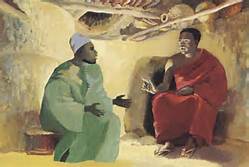
Jesus and Nicodemus, JesusMAFA

“Faith, Birth from Above”

Got faith? Really, do you have faith in anything? Perhaps, faith in electricity, to keep the lights and appliances working in our houses. What about faith in our doctors, or in the medical profession in general? Some people would say “yes” and others “not so much.” How about faith in the Chicago sports teams? That kind of faith is getting more and more difficult to keep up.

What about in our Scripture readings today? We have already heard about Abraham, and how he had faith in his God. In each reading, we have a person in our list of faith recipients. A person who tried to have faith and trust in someone or something outside of themselves.

Let’s take a closer look at Abraham’s situation. Reading from Genesis 12: “Now the LORD said to Abram, “Go from your country and your kindred and your father’s house to the land that I will show you.” Everything the Lord was saying sounded strange and unfamiliar. God did not even name the country where Abram was supposed to go.

Turning to John 3, Eileen and I acted out the encounter Nicodemus had with the Rabbi Jesus; let’s remind ourselves of that situation. “Now there was a Pharisee named Nicodemus, a leader of the Jews. He came to Jesus by night and said to him, “Rabbi, we know that you are a teacher who has come from God; for no one can do these signs that you do apart from the presence of God.”

Nicodemus was trying to have faith in someone or something, but faltering. That sounds a lot like us. Don’t we hesitate and falter sometimes, when trying to have faith?

“Jesus answered Nicodemus, “Very truly, I tell you, no one can see the kingdom of God without being born from above. Nicodemus said to him, “How can anyone be born after having grown old? Can one enter a second time into the mother’s womb and be born?”

This is a real puzzle for Nicodemus.  Added to that, Nicodemus had heard Jesus a number of times, thought He was right about a lot of things, but still was cautious.  Put yourself in Nicodemus’s situation. How would you like to be a big-shot teacher of Israel, well known not only among the common people, but also with his colleagues among the Pharisees? He brought his questions to Jesus at night when no one would see him and maybe make fun of him. [1]

Perhaps we are in a similar position, too, where some of us here are cautious or hesitant about finding out more about Jesus. For sure we are in the same boat as Abram: we don’t know quite where we are going, or where this new land really is.

This whole trusting-Jesus-business requires some faith.

Another way of looking at this is that we need to find a new perspective, too, like the Apostle Paul said about Abram in Romans, our New Testament reading today.

Leaving everything familiar to begin a new life? Going to an unknown land, you don’t even know where it is, or how far away? Look, Abram is not coming back. This is certainly no there-and-back-again journey. This is no pilgrimage, either.

I was fascinated to learn some things from one of the commentators. “On a pilgrimage, one sets out to a new place or a holy place to learn something and return where one came from with some new insight for living back home. Abram’s is to be a permanent relocation, something far more like the experience of the millions since Abram who have immigrated to other countries, including the vast majority of the population of the current United States or at least their ancestors.” [2]

I know some of you here are familiar with computers. You might even know how to “reset” or “restart” your computer with a CTRL-ALT-DEL move on a Microsoft Windows®-based computer. Maybe that was what Nicodemus really wanted to do. (It does get frustrating, being uncertain and unsure, not knowing where on earth we are going!) Let’s look at the situation from Jesus’s point of view. Jesus wanted to bring Nicodemus into a whole new world. He started talking about a new birth, or birth from above.

A sermon website I go to from time to time had a superb illustration. (I’m sorry, but I don’t know the name of the anonymous pastor.) “When I was a country pastor trying to get directions to a farm that I had never been to before, if the directions were complicated, the directions sometimes began with “you can’t get there from here.” It was their way of saying that starting from a different place would make the trip easier. Sometimes the best spiritual advice is like that — in order to get to life in the kingdom/reign of God, we have to start from a new place, a reborn place in our lives; and that we can’t get there (to the kingdom) from here (our life of sin apart from God). Nicodemus has trouble thinking that you can start from a new place, that you can’t take along all the history and baggage of the past — “how can these things be?” (vs. 9)” [3]

In computer terms, it is almost as if Jesus tells Nicodemus that he has to “reboot” — that he can’t run his program any more because there are too many error messages flashing in his life. We need, and God is ready to supply, an entirely different operating system.

Too true! Jesus offered the cautious Nicodemus more than a new perspective. It’s a new birth, and whole new world. And, how is he able to reach it? By faith, that’s how.

When God called Abraham, Abraham left everything he knew to move to a place that had not been named.  That is brave and bold.  That takes faith.

All that faith business is centuries in the past. Nicodemus lived when Jesus lived, and Abram lived a lot of centuries before that. What does all that have to do with today? With modern life, and with us here at St. Luke’s Church? Don’t we hesitate and falter sometimes, when trying to have faith? Today, Jesus would tell us the exact same thing.

Some people treat our relationship with God as something we earn by what we do, by “being good” or at least “not being bad” on the basis of some checklist of good or bad behavior. Have we reduced a life of discipleship to Jesus to morality and status instead of actual faithfulness to trust Him and follow where he leads every day? [4]

When we gather together our courage and go to see Jesus under the cover of darkness—like Nicodemus—He welcomes us. He enters into a relationship with us. We are in the same boat as Abram: we don’t know quite where we are going, or where this new land really is.

What about when we get to the end of that lifelong journey, and cross the River Jordan? There will be a welcoming party when we arrive in the Promised Land, for sure!

My original question at the beginning of the sermon: got faith? This whole trusting-Jesus-business requires some faith. The best part is that Jesus will help us. He understands our difficulties. He is patient, and will walk with us as we journey towards that new land. He’ll be right by our side in the valley of the shadow. Step by step, we strive to have faith in God.

What a Savior. What a Friend we have in Jesus. Amen.

[1] http://worshipingwithchildren.blogspot.com/2014/02/year-second-sunday-in-lent-march-16-2014.html 

[2] https://www.umcdiscipleship.org/worship/lectionary-calendar/second-sunday-in-lent4#bow

[3] http://desperatepreacher.com//bodyii.htmhttp://javacasa.com/resources/dps_form_results/jon3_1.htm

[4] https://www.umcdiscipleship.org/worship/lectionary-calendar/second-sunday-in-lent4#bow

@chaplaineliza

(Suggestion: visit me at my regular blog for 2017: matterofprayer: A Year of Everyday Prayers. #PursuePEACE – and my other blog,  A Year of Being Kind . Thanks!)

(Thanks so much to the good folks at UMC Discipleship.org! I am following their Lenten series. Their online Lenten sermon notes and worship helps are invaluable.)