Unknown's avatar

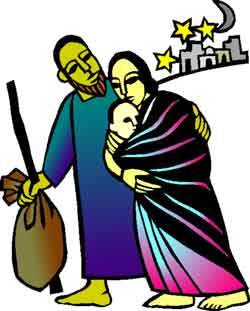
Flight into Egypt

“Flight into Egypt”

Matthew 2:13-23– December 28, 2025

            From time to time, I enjoy listening to radio serials. I suspect you all know the kind I’m thinking of. Old time radio shows like “Those Were the Days” broadcasts feature classic radio shows from the 1930’s, 40’s and 50’s. Periodically, I tune in to the show, and sometimes get caught up in an exciting, suspenseful adventure serial. Each installment usually ends with a cliffhanger, and the next installment of the serial begins: “When last we left our story . . . “

            Here, in our lectionary reading from the Gospel of Matthew, we have just such an installment. We come into the story right smack dab in the middle of things, with loose ends left hanging all over the place. It is not a pleasant story. The topic of this sermon is not pleasant, either—I’m telling you right now, up front.

            We are breaking into the Gospel account at one of the really gripping, gut-wrenching parts, but I’d like to zoom in on this particular scene. We look at Joseph, in Bethlehem, with his fiancée Mary and newborn baby Jesus. Joseph gets an emergency communique from an angel, in a dream. The angel says, “Get up, take the child and his mother and escape to Egypt. Stay there until I tell you, for Herod is going to search for the child to kill him.”

What would you do if you had to flee from danger, immediately? Be on the run at very short notice? Can you imagine you and your family traveling on an emergency basis, with the added complication of transporting a very young child?

            It may not be physical harm threatened against you or your family. However, there are many other traumatic or life-shattering things that can up-end our lives. “When you are plunged underwater by news you can scarcely comprehend, let alone respond to, how do you take your next breath? When all your visions of a joyous tomorrow are spoken out of existence by whispered words of tragedy or denial, how do you put one foot in front of another on your way into the void?” [1]

            I cannot even imagine what went through Joseph’s mind at that moment. From all accounts of King Herod and his life and reign, he was a tyrant. Looking at writings from contemporary authors of that period, Herod was cruel and bloodthirsty. He was also two-faced, as we can see from a few verses before our lectionary reading today, from his response to the Magi. He sent the Magi to Bethlehem, and requested that they come back after they find this “King of the Jews,” because Herod wished to “worship” this King as well. I have a pretty good idea of exactly what Herod wished to do to the baby Jesus from what follows.

            The Holy Family fled Bethlehem in a hurry. We know that. They fled across a distance, across boundaries, racial lines and cultural spaces. They encountered ethnic differences and language barriers, too, as they made their flight into Egypt.           

            Father James Martin wrote in a recent social media post, “It’s not surprising that in 1952, Pope Pius XII wrote: “The émigré Holy Family of Nazareth, fleeing into Egypt, is the archetype of every refugee family. Jesus, Mary and Joseph, living in exile in Egypt to escape the fury of an evil king, are, for all times and all places, the models and protectors of every migrant, alien and refugee of whatever kind who, whether compelled by fear of persecution or by want, is forced to leave his native land, his beloved parents and relatives, his close friends, to seek a foreign soil.” [2]

            I live in a suburb of Chicago, with the months-long Operation Midway Blitz occurring right here in Chicago and surrounding area. I have been praying with and for the clergy who go regularly to the federal facility in Broadview, on what has been named Faithful Fridays. I mourn with so many because of the injustice. Yes, I take the words of Jesus in Matthew 25 quite seriously. I regularly consider: what would Jesus do?

            Let us go back to the Holy Family fleeing to Egypt, in fear of King Herod and his military goons. But – I want to check in with you all as I am preaching. I know very well that these issues I am talking about are difficult for many people, traumatic for some, and even so upsetting that certain dear ones cannot even sit here and listen any longer. And – that is absolutely okay, to excuse yourself or leave the room or the sanctuary. Please, take this as an invitation for us all to tend to each other’s well-being.

            As we consider the Holy Family on the run, I would like to remind us all of countless families on the move for all kinds of reasons. Of course, some in danger for their lives! And, some on the move because of catastrophic natural disasters, or wars, or widespread extreme poverty. Sometimes, fleeing your safe, familiar town and place where you grew up is the only painful option left after heart breaking and gut-wrenching trials and traumas.

            I would like to highlight something important from Fr. Martin: “the Greek word that Matthew’s Gospel uses is a key: it’s ‘pheuge,’ to flee, one of the ancient roots of the word “refugee.” When we think of refugees, migrants and internally displaced peoples today, we are invited to remember the Holy Family, the ‘archetype,’ as Pope Pius XII said, of ‘every refugee family.’ And we should treat them accordingly.” [3]

            As we reflect upon the situation of the Holy Family as refugees, in the first century, we need to seriously consider the heartbreaking situations of so many refugees today. We are confronted with the serious question: what does God ask of us? If we look to the Bible, to both the clear commands from Micah 6:8 and from Matthew 25, consider these ringing words of Rev. Sharon Blezzard, Lutheran pastor, It does not matter whether we are considering refugees, strangers, aliens, migrants or immigrants. All are human beings, all created by God.

“We can be God’s presence to others in the midst of their suffering, and we can work to alleviate suffering, injustice, and pain in the world. Encourage [all of us] to find their voice and place of power to make a difference through small steps grounded in faithful community and fervent prayer.” [4]

            May it be so! Alleluia, amen.

@chaplaineliza

(Suggestion: visit me at my other blogs: matterofprayer: A Year of Everyday Prayers. #PursuePEACE – and  A Year of Being Kind . Thanks!


[1] https://www.umcdiscipleship.org/worship-planning/toda-la-tierra-espera/first-sunday-after-christmas-day-year-a-lectionary-planning-notes/first-sunday-after-christmas-day-year-a-preaching-notes

[2] https://x.com/JamesMartinSJ/status/2005287734017950134

[3] https://x.com/JamesMartinSJ/status/2005287734017950134

[4] https://www.stewardshipoflife.org/2013/12/refugees-all/

Unknown's avatar

Who Are You, Lord?

“Who Are You, Lord?”

Acts 9:1-9 (9:5) – May 4, 2025

            Sometimes, asking good questions is difficult.

In the 1400’s and 1500’s, the astronomers in Europe were discovering wonderful things about our solar system. It wasn’t until 1543 that astronomer Nicolaus Copernicus asked, “Could it be that the Earth orbits the Sun?” This was a dangerous question to ask, in his time. Common knowledge and expert opinion were in agreement, in the 1500’s: the Earth was the center of everything. However – Copernicus had the courage to ask this simple—and profound—question, which turned the scientific community on its heads, and changed the world.

            We turn to our Scripture reading for today. Acts chapter 9. Saul, a Pharisee of the Pharisees, was one of the chief persecutors of the early Church in the area of Jerusalem. He had been a witness to the stoning of Stephen, a short time before this reading today. Saul’s zeal in pursuing these “Jewish heretics,” these followers of “The Way” had become legendary. Let me read the Acts passage from an excellent translation by J.B. Phillips.

“1-2 But Saul, still breathing murderous threats against the disciples of the Lord, went to the High Priest and begged him for letters to the synagogues in Damascus, so that if he should find there any followers of the Way, whether men or women, he could bring them back to Jerusalem as prisoners.”

That was the situation. Saul was filled with religious zeal! It wasn’t enough that he had been instrumental in kicking out most of the believers and breaking up the Jerusalem church. He was going to round up these Jewish heretics in Damascus! These false believers! And, extradite them. Bring them back to face the Chief Priest and the Sanhedrin in Jerusalem.

Who was Saul, anyway? Born a Roman citizen in Asia Minor, he was one of the graduates of the equivalent of an Ivy League school—the University of Tarsus, one of the finest universities of the first century. As far as knowledge and book learning was concerned? Saul had it, in abundance! He was trained as a Pharisee, in every aspect of the Jewish religion. And, he was on fire to haul in every upstart Jewish heretic he could lay his hands on!

Just like the scientific establishment in the 1500’s, Saul knew he was right, and nothing could make him swerve from his desire, his zeal to see justice done. Let’s go back to our reading from Acts. “3-4 On his journey, as Saul neared Damascus, a light from Heaven suddenly blazed around him, and he fell to the ground. Then he heard a voice speaking to him, “Saul, Saul, why are you persecuting Me?””

Wait a minute! Saul is one of the top religious law-followers in Jerusalem. Bam! Here is a clear, Heavenly event happening to Saul. You might have heard about “a Damascus road experience,” meaning a sudden, dramatic conversion experience. This is it. Right here, right now. Paul’s—I mean, Saul’s dramatic conversion experience. This Greek word, an imperative verb in verse 3, is often omitted in translations. Literally, egeneto! One of Dr. Luke’s favorite words: “Then, it happens!” Another way of saying, “WHAM!” This word signals the surprising entry of God into ordinary, every-day events! We see a light flash around Saul.

The risen Lord Jesus also calls twice: “Saul, Saul!” I have a suspicion that Saul immediately “got it.” The mental puzzle pieces started falling into place. Saul finally asked a really good question:  “Who are you, Lord?

Isn’t that the way it is with you or with me, sometimes? Here we are, headed down Life Road, going about our business. When, boom! A huge event happens. Maybe not as serious as Paul’s Damascus Road encounter, but all the same, earth-shaking. It could be something that happens to our health, or our jobs, an accident, or some type of traumatic happening. Or, if it doesn’t happen to us, it happens to one of our loved ones, or our best friend. Even if it’s something really fantastic, it can still be earth-shaking. Just as much of a shift or change in life.

Similar to the dramatic shift in the scientific world after Copernicus proved that the Earth really did orbit the Sun. He turned the whole world’s attitudes and ideas on their heads and paved the way for a whole new way of thinking. New frames for good questions.

As Saul was lying there in the dust of the road, I am sure a few new thoughts broke into his mind. “Who are you, Lord?Saul’s really good question was that of a devout Jew who understands the significance of his experience from reading Scripture.

Let’s continue with our reading: “His companions on the journey stood there speechless, for they had heard the voice but could see no one.” Do you understand what’s going on? The others in this vigilante group can hear a voice, but have no idea Who is speaking. On top of that, Saul is suddenly struck blind. The companions don’t have a clue what is going on. They need to lead Saul into Damascus, blind and helpless. There he sit, and fasts, for three whole days.

            Sometimes, God chooses the most unlikely person for God’s purposes. Here is the Pharisee Saul, sitting and fasting in Damascus. Lord, what is going on here? In Acts chapter 9, Dr. Luke refers to Paul as God’s chosen vessel – a common, everyday domestic object. This is the same word that Paul uses himself in 2 Corinthians chapter 4: God’s treasure is found in “earthenware vessels.” In other words, Saul (soon to be renamed Paul) is the one chosen to be God’s vessel, or jar, or container. Paul is to carry the Good News, the truth of the Resurrection!

Paul calls himself a common, everyday jar or vessel, used for everyday tasks. With this important distinction: God has appointed Paul to carry the Good News! The same way God has appointed each of us to carry the truth of God’s message to everyone.

Paul was chosen to go to the nations, and not to just preach to Jews. The Lord has called each one of us. God has welcomed each of us into a heavenly embrace. I wonder. The nations are coming to us right here—to Morton Grove, to Glenview, to Niles, to Des Plaines, to Skokie, to Chicago. Is God calling us to be God’s vessels to carry Good News to our neighbors? To those we work with? To the person at the coffee shop or the clerk at the grocery store? 

I offer you the opportunity to hear God’s call! Chances are, it won’t be as dramatic as Saul’s conversion on the Damascus Road. But can you hear God’s call with gladness? You and I are welcomed into renewed relationship because of our encounter with the risen Christ – today!   Paul’s conversion narrative fires the imagination! May we find in its depths a call on every single one of us, for change and new possibility.

Alleluia, amen.

@chaplaineliza

(Suggestion: visit me at my other blogs: matterofprayer: A Year of Everyday Prayers. #PursuePEACE – and  A Year of Being Kind . Thanks!

Unknown's avatar

When God Shields Us

“When God Shields Us” – October 18, 2020

Exodus 33:12-23 (33:19-22)

Have you ever known someone who was really important? I mean, really, really a V.I.P.?

Moses was personally acquainted with the biggest V.I.P. in the whole world. Even, in the whole universe. Eileen just read today’s Scripture lesson from Exodus 33, and we heard what an awesome experience Moses had on top of that mountain. Just him and the Lord, they had personal one-on-one time.

Let’s take a closer look at this reading. An overview, so we can understand exactly what is at stake. We can simply take Exodus 33 as a striking word-picture of how awesome, mighty and all-powerful God is, and we would be absolutely correct. Our God is indeed an Awesome God. But, there is so much more involved here.   

Moses and the Lord talk about the presence of God. This is huge! The presence of God is a continuing theme in the book of Exodus, and right here is a particularly important exchange between our two protagonists.  

We could simply watch Moses and the Lord, almost like we are in the audience, or viewing on a television screen. Reading this story from Exodus, we might say “What does this story have to do with me?”  But, we can relate this to our personal situation – each one of us.

To come before the physical presence of God is truly rare – but it was something Moses greatly desired! What is more, he also wanted to be able to reassure the people of Israel with the reality of God’s presence. Is that something that reassures you, today?

Throughout the Hebrew Scriptures, again and again, we hear about how dangerous it is to approach the Lord. God’s presence is so fearsome that a number of people are immediately struck dead for daring to come in contact with the Lord. For much of Exodus, the Lord is not even sure whether Israel is even worthy enough to sit by and receive that Godly presence. Yet, Moses sees God’s presence and blessing as a beneficial thing, a good and necessary thing.

Have you ever been given the silent treatment? This could be by a parent or other grown-up when you were younger, or perhaps by a sibling or a friend? The silent treatment is particularly sad and jarring, especially when you really respect, even love the person giving you the silent treatment.

That is pretty close to what the Lord wanted to do to the whole nation of Israel by removing God’s presence and blessing from Israel. That would be horrible! Like, drinking water, and finding it was dry water. Or, going outside in the middle of the day, and finding there was an eclipse of the sun – permanently. What a traumatic, even cataclysmic event, having the Lord discuss permanently removing God’s presence and blessing from Israel. [1]

Yet – God said to Moses, ‘I know you by name and you have found favor with me.’ And, even further, “the Lord said to Moses, “I will do the very thing you have asked, because I am pleased with you and I know you by name.” That must be so heartwarming, hearing God say, “I know you by name and you have found favor with me.”

I remind you, looking on the face of God was fatal, for a number of those in the Hebrew Scriptures. I wonder: is it a fatal act to think that we see God’s glory, that we fully comprehend God, today? The hazard of thinking you’ve got it all figured out becomes a sign of our self-centered, self-involved problem. The idea that we’ve got it figured out, because once we figure that, WE become God to ourselves – our self-centered delusion is that WE are greater than God. This was certainly part of what was going on with the self-involved people of Israel, periodically thinking they were much more important than the presence of God.

If we step back from being self-centered and self-involved, we realize we are invited into a relationship – a relationship with the Lord. Moses knew that to become more aware of the presence of God, he needed to spend time with God. That is exactly what he and God were doing on top of that mountain. And, God and Moses had a number of one-on-one encounters that helped Moses get through his life’s journey.

Knowing that we are always in the presence of God will help us get through many difficult things. Though complicated questions and weighty issues overwhelm us on a regular basis, we can be certain that God walks beside each of us on our journey through life, too. [2]

Are you ready to have a relationship with the Lord? To have one-on-one conversations with God? Sure, our God IS a powerful, mighty, Awesome God. We are also freely invited into the generous, merciful presence of God.

Let us celebrate the presence of God, today. Amen, alleluia.


[1] Brueggemann, Walter, “Exodus,” The New Interpreters Bible Commentary, Vol. I (Abingdon, Nashville, TN: 1994), 938-39.

[2] https://www.umcdiscipleship.org/worship-planning/pressing-on/twentieth-sunday-after-pentecost-year-a-lectionary-planning-notes/twentieth-sunday-after-pentecost-year-a-preaching-notes

@chaplaineliza

(Suggestion: visit me at my regular blog for 2020: matterofprayer: A Year of Everyday Prayers. #PursuePEACE – and my other blog,  A Year of Being Kind . Thanks!