Unknown's avatar

We Are All Prodigals

“We Are All Prodigals”

Luke 15:11-32 (15:3) – March 30, 2025

We have the familiar parable of the Prodigal as our Gospel reading today. One of the best known of the parables, one that resonates with the heart and soul of many. It’s the story of two brothers and a father, the story of discontent and disgruntlement, the story of wandering in a far country, the story of return, and most of all, the story of forgiveness, reconciliation and redemption.

What is the setting for this parable? In verse 1 of chapter 15 we see Jesus sitting down to dinner with a bunch of social outcasts. As far as the scribes and Pharisees were concerned, that is—they were outright offended! How could Rabbi Jesus, a self-respecting, reputable rabbi, be associating with riff-raff, with undesirables, with people like that?

Tax collectors, outcasts and sinners. The upright, righteous Jewish leaders even had rules about associating with those people. They just didn’t. They were forbidden to have any dealings with them at all. But—Rabbi Jesus welcomed the tax collectors and sinners. Get this—He even ate dinner with them!

Except, Jesus wanted to stay in dialogue with these Jewish leaders, so He did was he often did – He told them parables. What a story! “And yet, the characters, the scenario, the family dynamics, are so familiar to us, it is real. And it is true in all the ways that matter, of course, for in one way or another we have lived this story. From one viewpoint or another, this experience is ours.” [1] It’s a story about brothers (or, siblings), about family, a loving father, repentance, and ultimately, about forgiveness.

This younger son was no prize, was he? He had been selfish and self-centered, for sure! Imagine, asking his father for his inheritance right then and there! (Which is kind of like saying that he wished his father had died already!) The nerve of that kid! However, his father went along with it, maybe cashed in some stocks or sold some property, and gave the younger son what he demanded. And, the ungrateful kid promptly goes out of the country to live it up.

One title this parable could have is “The Story of the Lost Son,” because the younger brother goes to a far country, spends all his money in riotous, profligate living, eventually doesn’t have a penny to his name, and is forced to herd pigs for a farmer just to scrape by and earn a pittance.

We heard the first half of this parable in our Scripture reading today. I continue now:

Remember, we left the younger son starving in the pigsty, with the pigs. ““When he came to his senses, he said, ‘How many of my father’s hired servants have food to spare, and here I am starving to death! 18 I will set out and go back to my father and say to him: Father, I have sinned against heaven and against you. 19 I am no longer worthy to be called your son; make me like one of your hired servants.’ 20 So he got up and went to his father.”

It’s so easy to point the finger at this younger son, isn’t it? He was selfish and self-centered, wasn’t he? He didn’t think of anyone else, except for himself. Especially when he lived it up in the far country with high living, wine, women and song. Yet – how often are you and I selfish? Thinking only of our own interests, not caring for anyone else? Sound familiar?

Let’s continue with the parable. “But while he was still a long way off, his father saw him and was filled with compassion for him; he ran to his son, threw his arms around him and kissed him. 21 “The son said to him, ‘Father, I have sinned against heaven and against you. I am no longer worthy to be called your son.’” 

My, goodness! What a turnaround this young guy has had! Sure enough, he has had a major change of heart and mind. We can see how much the father loved his younger son, can’t we? Imagine, a fine, upstanding middle-aged landowner comes running to meet his son, from far away down the road! The father must have had an eye out for his son for some time!

Yet, what about the older brother? What has he been doing all this time that the younger son has been partying it up in the far country? “Meanwhile, the older son was in the field. When he came near the house, he heard music and dancing. 26 So he called one of the servants and asked him what was going on. 27 ‘Your brother has come,’ he replied, ‘and your father has killed the fattened calf because he has him back safe and sound.’

28 “The older brother became angry and refused to go in. So his father went out and pleaded with him. 29 But he answered his father, ‘Look! All these years I’ve been slaving for you and never disobeyed your orders. Yet you never gave me even a young goat so I could celebrate with my friends. 30 But when this son of yours who has squandered your property with prostitutes comes home, you kill the fattened calf for him!’”

Think about it. You and I can easily see how “lost” this younger son was. But, what about the older son? On the surface, he’s the perfect son. Always obedient, always compliant.But underneath? Discontented, disgruntled, resentful, angry. Do we see anything selfish and self-centered about the older son? Even though he stayed at home, he was pretty “lost,” as well.  

We are in the middle of Lent, a season of reflection, contemplation, particularly on our human brokenness and our need for God’s redemption, God’s forgiveness.[2] If we are honest, Lent helps us see the “lostness” of all of us – just as much as both the younger and the older sons were “lost,” too.

Both sons need a change of heart, a repentant heart. And, both sons are equally loved and forgiven by their father. We are considering the part of the Lord’s Prayer this week where we say “Forgive us our sins as we forgive those who sin against us.” It doesn’t matter whether we say “sins” or “trespasses” or “debts.” What we are asking God to do is to forgive us! Except, we ask God to forgive us exactly in the same way we forgive others!

Just think about that. If you and I are unforgiving people, why on earth ought God forgive our sins? If I come to the Lord, praying the Lord’s Prayer and asking – petitioning – for God to forgive my sins, how can I – you – we – possibly think we are going to get away with regularly being mean, nasty, and especially unforgiving to others?

            Finally, we consider that Lent is the time when we are following Jesus on His journey towards the cross. “the cross is not a means of payment [for our sins] but rather shows us just how far our prodigal God will go to tell us of God’s immeasurable love. Period.” [3]

            Did you ever think of God being a prodigal? Our prodigal God, wandering in the wilderness, seeking each one of us as we sojourn in the far country. Just like the younger son. And, just like the older son – resentful and disgruntled, and especially unforgiving to others?

            In our parable, what is the father’s response? “‘My son,’ the father said, ‘you are always with me, and everything I have is yours. 32 But we had to celebrate and be glad, because this brother of yours was dead and is alive again; he was lost and is found.’”

If we had a title of this parable from the father’s point of view, it could very well be “The Story of the Forgiving Father.” Yes, he freely forgave the younger son for his extreme disrespect, for spending all his father’s hard-earned money, and for crawling back home in such a disreputable condition. Plus, the father was loving and welcoming to his older son, the one who seemed to be permanently disgruntled and resentful, with a huge chip on his shoulder.

Praise God, we know how far our Lord Jesus went to tell us about God’s immeasurable love. He went to the cross, for our redemption. For our forgiveness. And with this parable, Jesus wants us to see how much God loves each one of us, and how willing our loving, caring, nurturing God is to welcome us home. Even going so far as to run down the road to embrace us when we return in penitence and tears, or when we stay at home doing our duty in self-righteous disgruntlement and discontent.

Yes, God forgives! And yes, we are to do the same. As the petition of the Lord’s Prayer says, “forgive us our sins, as we forgive those who sin against us.”  God offers forgiveness to both prodigal sons, all wayward children, no matter what. Remember, what a loving, caring God we have. Always loving, caring and welcoming toward each one of us. Amen!

@chaplaineliza

(Suggestion: visit me at my other blogs: matterofprayer: A Year of Everyday Prayers. #PursuePEACE – and  A Year of Being Kind . Thanks!


[1] http://words.dancingwiththeword.com/2016/02/two-sons-how-will-story-end.html

[2] https://www.workingpreacher.org/dear-working-preacher/perspective-matters

[3] https://www.davidlose.net/2016/02/lent-4-c-the-prodigal-god/

Unknown's avatar

How Different are God’s Thoughts?

“How Different are God’s Thoughts?”

Isaiah 55:1-3, 6-9 (55:2) – March 23, 2025

            Sometimes, I get really, really busy. Involved. Even distracted. Doing a lot of things, sometimes attempting even more than I could possibly ever finish in one day. Sometimes, when I get really involved in things or activities, I don’t even think about God for whole stretches of time–for hours, sometimes even days at a time. Sometimes, I discover I don’t even look for the Lord. I don’t even concern myself with finding God. And every once in a while, I don’t even want to go looking for the Lord.

            I certainly admit it. I have been less than a perfect Christian. There have been numerous times when I’ve forgotten to pray, neglected to study the Bible, sidestepped communication with God. I definitely haven’t hit a bull’s eye in my personal Christian walk 100 percent of the time. I do freely admit it. I have a sneaking feeling that I’m not alone. If we were to admit it to ourselves (and even admit it to a few other people, too!), I suspect we would find a number of honest, repentant people, confessing where they have fallen short in their Christian lives.

            That’s bad news! What can we do about that??

            Looking at our scripture reading for today, I can find several things that may help us out when we consider a big problem like falling short in our lives before God.

            Let’s take a closer look at verses 6 and 7. “Seek the LORD while he may be found, call upon God while he is near;” Whoa! The Lord is closer than I thought! God’s right here, johnny-on-the-spot! I have a sneaking suspicion the Lord is right next to me, whenever I look for Him. And I have a feeling God will be right there, immediately, whenever I call.

            While I was writing this sermon, I was reminded of the times I played hide-and-seek with the neighborhood kids when I was young. I bet most of you have played hide-and-seek at one time or another, too. When I was seeking the other players, I knew the object of the game. Look for the other players. I understood what I was supposed to do.

            But, there’s a problem here in the scripture passage, in Isaiah 55:7. The prophet mentions the wicked, who pursue their own wicked ways. They are not following after the Lord. They are not even close to doing what the Lord wants them to do. These wicked people don’t even know what they’re missing. They don’t care about the object of the game. “Let the wicked forsake their way, and the unrighteous their thoughts.” These wicked people, these unrighteous guys are even thinking bad thoughts, thoughts that are not pleasing to the Lord!

            Again, that’s bad news! What can we do about that??

            I’ve been talking about some pretty negative people, and some pretty negative actions, where some people actively go out of their way to be disobedient and disruptive. Some people are like that. The Bible often talks about those kinds of actions and that particular kind of people

            Now, I’ll go off in a slightly different direction—still away from the Lord, but just different. Sometimes, other people get the “busy-sickness.” You know the type. Running around like chickens with their heads cut off.. In a dad-blamed hurry, frantic, running, rushing and dashing around, sometimes even without any clear direction. Sometimes their thought-life (our thought-life?) can be the same way—scattered, rushed, not able to concentrate.

            What’s more, in this culture of consumer abundance, we can become preoccupied with our belongings, with our “stuff.” This sneaky kind of mind-set can sneak into our brains! What we possess and what we think we “need” can be a source of control.[1] Sometimes it can really be difficult for me – for you – for us to figure out what we truly need. Sadly, it’s often something that redirects our minds away from God, which is never good!   

            Again, that’s bad news! What can we do about that? What do you think the Lord might say to those people? What do think the Lord might say to us, to you and me?

            I see the answer right here, in verses 7 and 8. The prophet tells us straight out. “Let them return to the LORD, that he may have mercy on them, and to our God, for he will abundantly pardon.” Mercy! Pardon! To me, that sounds an awful lot like GRACE. The Lord wants us to return to Him! The Lord IS gracious! The Lord WILL abundantly pardon! I don’t know about you, but I think that is exciting news.

            I had a general idea of what “pardon” meant, but I wanted to find out the exact meaning. According to Webster’s dictionary, pardon means “to excuse or forgive an offense or penalty.” Wow!! That means even if I do something wrong, or think something I shouldn’t, in God’s eyes, God will abundantly pardon me–God will forgive me!! And God will abundantly forgive you, as well! That’s truly good news!

            Here in Isaiah 55, as we say thank you to God for that marvelous pardon and forgiveness, we also see God providing good gifts for us. The phrase we highlight from the Lord’s Prayer is “Thy kingdom come, Thy will be done.” With as often as we pray the Lord’s Prayer, I suspect God would be really pleased if we took this part of the prayer seriously.

We know what many of the things that please God look like. We can even make a list! As we consider God’s good gifts, and God’s kingdom, there will be food for everyone, everyone feels loved and loves others, people find ways of settling problems other than war and fighting, and when people hurt each other, people forgive each other.

            We can praise God that – just as in verse 5 where God pours out on God’s people the blessings God promised to King David – the Lord will pour out those blessings on earth! Just as these blessings are true every day now in heaven, they will one day soon be true upon earth. Especially if we all work to make these blessings and love and caring for each other happen! [2]   

            God will be there for us when we need it! God will forgive, and have abundant grace and mercy and pardon for us, and we can count on that! We can have the assurance that as we come near to the Lord, the Lord will draw near to us! What a promise. What a God. Amen.

@chaplaineliza

(Suggestion: visit me at my other blogs: matterofprayer: A Year of Everyday Prayers. #PursuePEACE – and  A Year of Being Kind . Thanks!


[1] http://www.word-sunday.com/Files/a/18-a/FR-18-a.html

[2] https://worshipingwithchildren.blogspot.com/2016/01/year-c-third-sunday-in-lent-february-28.html

Unknown's avatar

The Coming King

“The Coming King”

Jesus Palm Sunday - Giotto di Bonde, Entry into Jerusalem 1304-06, Fresco, Cappella Scrovegni Arena Chapel, Padua

Luke 19:35-40 – April 14, 2019

The most powerful person in the world. Ever hear that expression? I suspect it is familiar to most of us from movies, from comic books, from historical fiction. With the release of super hero blockbusters every few months, we certainly have the opportunity to see the clash of titans on the big screen, and the super hero of the movie conquering the huge threat or the big bad guy—or big bad girl. The thing is…can we imagine Jesus as the most powerful person in the world?

Our Gospel reading today from Luke 19 tells us that a huge crowd of people thought the Rabbi Jesus was a really important person, a really powerful person. He was a Miracle Worker, He preached with authority, and just to be in His presence—wow! The crowd was hailing Him as the long-awaited King, the Anointed One of God, the Messiah.  

Jesus, Himself, had been telling His disciples that He had to go to Jerusalem for some time now. Even though His friends kept telling Him that the Jewish leaders and the Sanhedrin had it in for Him and wanted to kill Him, Jesus still “determined to go to Jerusalem,” as Luke tells us back in chapter 9.

Today’s story has all the makings of a great drama. (And, the narrative of the Passion Week has been recorded a number of times in motion pictures.) As commentator Alyce McKenzie tells us, “Good stories, screenwriters tell us, have a compelling protagonist, a believable supporting cast, a series of vivid scenes, and plenty of dramatic tension.” [1] Dr. Luke’s telling of the Palm Sunday story has all that, and more.

Here we are on Palm Sunday, and the weeks of Lent are almost over. That means that our series on the Lord’s Prayer is almost over, too. What sentence are we going to look at today, with our Scripture readings of Luke’s Triumphal Entry into Jerusalem, and the Apostle Paul’s hymn of Christ’s humility? We take a closer look at “for Thine is the kingdom, the power and the glory, forever and ever, amen.”  What more glorious Scripture readings to examine!

As we think of our great Divine drama, Jesus not only is a marvelous protagonist, but we can see He displays Divine foreknowledge. “Jesus knows ahead of time where the colt will be and what the response of the owner will be to being told, “The Lord needs it.” Luke shares with the other evangelists a portrait of Jesus as a true prophet whose prophecies are fulfilled and who has access to the secret knowledge of human hearts.” [2]

The second necessary feature of a great drama is a believable supporting cast. Look at the disciples—human, and distinctive. Listen again to Luke’s story: “Go to the village ahead of you, and as you enter it, you will find a colt tied there, which no one has ever ridden. Untie it and bring it here. 31 If anyone asks you, ‘Why are you untying it?’ say, ‘The Lord needs it.’” 32 Those who were sent ahead went and found it just as he had told them. 35 They brought it to Jesus, threw their cloaks on the colt and put Jesus on it “

We notice the rest of the supporting cast here, in the next verses. “As he went along, people spread their cloaks on the road. 37 When he came near the place where the road goes down the Mount of Olives, the whole crowd of disciples began joyfully to praise God in loud voices for all the miracles they had seen: 38 “Blessed is the king who comes in the name of the Lord!” “Peace in heaven and glory in the highest!”

From time to time we have talked about putting ourselves into a Scripture reading, and viewing it from the inside. Where would you be, in our Gospel reading from Luke? Are you an excited disciple or crowd member, waving your arms and picking up a palm to welcome the Messiah Jesus into the city of Jerusalem? Or, are you one of the skeptical ones on the road, holding back, with a wait-and-see attitude?

“The people were obviously weary of the Roman occupation. They had been hearing rumors of a great teacher from Nazareth who healed the sick, fed the hungry, and made the scriptures come alive. Some of them had seen miracles first hand and had heard parables straight from Jesus’ mouth. Now, they had a deliverer; their long-awaited Messiah and Savior, King Jesus, was with them.” [3]

The third necessary element in any great drama is dramatic tension. Boy, does the Triumphal Entry have that! Even down to the antagonistic Jewish leaders who come up against the Messiah Jesus, this has drama all over the place.

It is almost too difficult for me to put myself into the narrative, I know this story all too well. Yes, I am tempted to rush right through the Palm Sunday celebration, go once-over-lightly through the several events recorded in the other Gospels during Holy Week, and cry again because of the Crucifixion this Friday night. Or, was it two thousand years ago?

Switching to the New Testament reading from Philippians, the apostle Paul has a slightly different point of view. Paul is writing from the other side of the Crucifixion, the Resurrection and Jesus’ ascension into heaven—as we know from the Apostles Creed, Jesus has taken His seat at God’s right hand in heaven.

As we start this reading to the church in Philippi, Paul tells us of Jesus, before His incarnation and birth in Bethlehem. The eternal Christ humbled Himself, emptied Himself of all Godhood, all Godly prerogatives, and became a helpless human baby. Imagine the most powerful person in the whole world, in the whole universe, even. The eternal Christ put aside the kingdom of the universe, the ultimate power and the infinite glory, to become human.

Another way of looking at this is that Jesus put aside all of that kingdom, power and glory so He could communicate better with us, so He could come along side of us and be Emmanuel, God-with-us, as we have talked about at Christmas. But, that is not the end. Oh, no! Certainly not!

We see this progression: the preincarnate Christ, in all His kingdom, power and glory. Amen! “Christ emptied himself of inherent divinity, and for his supreme obedience unto crucified death, he was exalted by God for unending glory. Philippians 2:5-11 keeps the focus Christologically and theologically tight. On Passion Sunday [today, this Sunday], Paul keeps us grounded in what God, through Christ Jesus, is doing.” [4]

We do not look at the institution of Communion on Maundy Thursday and the Crucifixion of Good Friday. We are skipping the additional drama, trauma, anguish and grief today. Paul does mention those things briefly, but he looks to the amazing ending. “God exalted him to the highest place and gave him the name that is above every name, 10 that at the name of Jesus every knee should bow, in heaven and on earth and under the earth, 11 and every tongue acknowledge that Jesus Christ is Lord, to the glory of God the Father.”

If that is not a proclamation of the last line of the Lord’s Prayer, I don’t know what is. “For Thine is the kingdom, and the power, and the glory, forever and ever, amen.” Have you bowed the knee to our ascended and exalted Jesus the Messiah? Is your tongue acknowledging Him as Lord and Savior? Yes, Jesus was crucified on our account. It was for our sins He was crucified. His arms are open. His pierced hands are extended. Come to Jesus, today.

[1] https://www.patheos.com/Progressive-Christian/Palm-Sunday-Alyce-McKenzie-03-18-2013.html

Rewriting the Palm Sunday Story: Reflections on Luke 19:28-40, Alyce McKenzie, Edgy Exegesis, 2013.

[2] https://www.patheos.com/Progressive-Christian/Palm-Sunday-Alyce-McKenzie-03-18-2013.html

Rewriting the Palm Sunday Story: Reflections on Luke 19:28-40, Alyce McKenzie, Edgy Exegesis, 2013.

[3] http://www.theafricanamericanlectionary.org/PopupLectionaryReading.asp?LRID=15           

Commentary, Zechariah 9:9-13 / Luke 19:28-40, Rodney S. Sadler, Jr., The African American Lectionary, 2008.

[4] http://www.workingpreacher.org/preaching.aspx?commentary_id=284

Commentary, Philippians 2:5-11 (Passion Sunday), C. Clifton Black, Preaching This Week, WorkingPreacher.org, 2009.

@chaplaineliza

(Suggestion: visit me at my regular blog for 2019: matterofprayer: A Year of Everyday Prayers. #PursuePEACE – and my other blog,  A Year of Being Kind . Thanks!

Unknown's avatar

Patient, Forgiving and Welcoming

“Patient, Forgiving and Welcoming”

Luke 15 prodigal son sketch, Rembrandt

Luke 15:20 – March 31, 2019

What do you think of when I mention the black sheep of the family? The kid who went astray? A really rough customer? A person you would not trust an inch with any amount of money? Someone who you wouldn’t want any children hanging around?

This is the kind of person we are going to meet today in the parable of Jesus we read from Luke 15. Some people call the parable “The Prodigal Son.” Remember the Rabbi Jesus was having dinner with some people the good, righteous synagogue-going people did not approve of? They were sniffing and clucking and making a big stink about Jesus and His dinner companions. So, as a response, Jesus tells three parables in Luke chapter 15, the last of which is the parable of the Prodigal—or the Lost Son.

The parable begins: “Then Jesus said, “There was once a man who had two sons. The younger said to his father, ‘Father, I want right now what’s coming to me.’ So the father divided the property between them.”

This younger son was a brat. Or, worse, he was an ungrateful wretch. Do you know what he asked for? In that day, the son essentially told his father he wanted him to drop dead. That was the only way the younger son would have gotten his inheritance, in the normal order of things. What an ungrateful, selfish so-and-so! The father—amazingly—liquidates a third of his assets, giving the younger son his share of the father’s property. Perhaps you haven’t been as crass or unfeeling enough to walk up to one of your relatives and shout, “I wish you would drop dead!” and really mean it. But, that is exactly what Jesus begins this parable with.

Back to the parable: “It wasn’t long before the younger son packed his bags and left for a distant country. There, undisciplined and dissipated, he wasted everything he had. After he had gone through all his money, there was a bad famine all through that country and he began to hurt. He signed on with a citizen there who assigned him to his fields to slop the pigs. He was so hungry he would have eaten the corncobs in the pig slop, but no one would give him any.”

Going to a faraway, distant country. Sounds sort of romantic, doesn’t it? However, it does not take too long for this black sheep to run through all his money, lose all his fair-weather friends and end up on the streets as a homeless person. Plus, a famine struck the country he was living in. Consequences! What should he do now?

Let me step back from our parable for a moment—away from the younger son in the pigsty. I invite us to reflect on the church season we are presently in, Lent. Lent is a season where we are invited to reflect on our personal brokenness, and the need for God’s redemption.

This Lenten season we are also considering the different sentences of the Lord’s Prayer. This week, our sentence is “forgive us our debts (or, sins) as we forgive our debtors (or, those who sin against us).” I have a question: have you ever been so angry with someone that you have said (or thought) “I could never forgive him/her!” What is even worse is if you—or I—turn our backs, fold our arms across our chests and stubbornly insist, “I will never forgive her/him!”

What kind of unforgiving attitude is that? If we expect to be forgiven by God for all of the sins we commit daily, isn’t that unforgiving attitude a bit hypocritical? Rather a lot, really? What would God say about that ungodly attitude? What would you say about that attitude, now?

Back to the parable. “That brought him to his senses. The son said, ‘All those farmhands working for my father sit down to three meals a day, and here I am starving to death. I’m going back to my father. I’ll say to him, Father, I’ve sinned against God, I’ve sinned before you; I don’t deserve to be called your son. Take me on as a hired hand.’ He got right up and went home to his father.”

“The son’s repentance is implied, even if it is not clearly named by the ambiguous expression he came to himself (verse 17). After all, he hits rock bottom, longing to eat what unclean animals eat, once he is done in by a trio of calamities… As signs of contrition, he confesses sin and plans to ask his father to welcome him home as a slave instead of a son.” [1]

Now our parable shifts its point of view. We see the father: “When the son was still a long way off, his father saw him. His heart pounding, the father ran out, embraced him, and kissed him. The son started his speech: ‘Father, I’ve sinned against God, I’ve sinned before you; I don’t deserve to be called your son ever again.’

Remember, we are in the middle of Lent, a season when we are thinking of how much each of us sins against God and against others. We journey with Jesus towards the cross in Lent, but we also take the time to think about how much each of us need God’s forgiveness, grace and redeeming love.  What is more, “Lent helps us see when and how and where we think only of ourselves. Lent helps us see our true motivations for our actions and our true motivations for apology or repentance. Lent helps us see when we truly are in the depths of despair. Lent helps us see our deep longing for love.” [2]

Let’s look at the father’s response: “But the father wasn’t listening. He was calling to the servants, ‘Quick! Bring a clean set of clothes and dress him. Put the family ring on his finger and sandals on his feet. Then get a grain-fed heifer and roast it. We’re going to feast! We’re going to have a wonderful time! My son is here—given up for dead and now alive! Given up for lost and now found!’ And they began to have a wonderful time.”

Almost any parent knows the feeling that if your kid really screws up, no matter what, the father (or mother) has the same love towards him, regardless of sin and unforgiveness. One might say any parent knows the feeling that even if the child goes off the rails and repeatedly misses the mark, the father is especially joyous to see the son who returns. But—the parable does not end there. Oh, no! We see the further unforgiving attitude of the elder son.

“All this time his older son was out in the field. When the day’s work was done, he came in. As he approached the house, he heard the music and dancing. Calling over one of the servants, he asked what was going on. He told him, ‘Your brother came home. Your father has ordered a feast—barbecued beef!—because he has him home safe and sound.’

The older brother stalked off in an angry sulk and refused to join in. His father came out and tried to talk to him, but he wouldn’t listen. The son said, ‘Look how many years I’ve stayed here serving you, never giving you one moment of grief, but have you ever thrown a party for me and my friends? Then this son of yours who has thrown away your money on whores shows up and you go all out with a feast!’”

The elder son says “It’s not fair!” Well, guess what? The ways of God’s kingdom are NOT fair. True fairness leaves NO room for grace. Yes, God’s redeeming love for us is not fair. Would we really want it to be absolutely fair, all cold, legal rules with no grace and love at all?

The elder son is just as much as lost as his younger brother, isn’t he? Lost in his resentment, anger and alienation. “His father said, ‘Son, you don’t understand. You’re with me all the time, and everything that is mine is yours—but this is a wonderful time, and we had to celebrate. This brother of yours was dead, and he’s alive! He was lost, and he’s found!’”

Whoa! “No one bothered to call [the elder son] in to join the party! Accordingly, he does not enter the house. He does not address his father as “Father” and speaks to him about “this son of yours” instead of “my brother.” His refusal to celebrate stems from his deep resentment. Why is he resentful? He is taken for granted. No extravagance celebrates his reliable service. He accuses his father of showing preferential treatment.” [3] But, I ask again—do we really want God to be absolutely fair, in a cold, legalistic manner? With no grace or love at all?

Yes, “forgive as we wish to be forgiven” is a great lesson. But, I think the parable of the two Lost Sons has much more for us this week. Jesus told this parable to illustrate the boundless love of a parent for their children—the love of God the Father for His wayward sons and daughters. If you have really messed up, and you don’t think God could ever, ever forgive you, isn’t it wonderful to hear that the Prodigal’s father welcomed both His sons back home?

In this parable, Jesus tells us that God is patient, welcoming, and forgiving. God loves each one of us, forever and ever. Talk about good news! Isn’t this the best news in the world?

(Thanks to Eugene Peterson’s wonderful modern translation “The Message” for the use of this scripture reading. The parable of the two Lost Sons is from Luke 15:11-32.)

[1] http://www.workingpreacher.org/preaching.aspx?commentary_id=533

Matt Skinner  Professor of New Testament, Luther Seminary, St. Paul, Minn.

[2] http://www.workingpreacher.org/craft.aspx?post=4553

“Perspective Matters,” Karoline Lewis, Dear Working Preacher, 2016.

[3] http://www.workingpreacher.org/preaching.aspx?commentary_id=533

Matt Skinner  Professor of New Testament, Luther Seminary, St. Paul, Minn.

@chaplaineliza

(Suggestion: visit me at my regular blog for 2019: matterofprayer: A Year of Everyday Prayers. #PursuePEACE – and my other blog,  A Year of Being Kind . Thanks!

Unknown's avatar

God Is Working Things Out

“God Is Working Things Out”

Luke13-6 fig tree, medieval

Luke 13:1-9 – March 24, 2019

Mother Teresa is sometimes quoted as saying, “I know God won’t give me anything I can’t handle. I just wish He didn’t trust me so much.” Oh, I am often pleased and proud that God gives me such weighty things to be in charge of! But, I sometimes wish God would let someone else be so responsible!

Can you relate to Mother Teresa’s wry comment? I know I can, sometimes. Sometimes, life sneaks up on us and tackles us. Life can overwhelm us. Work gets beyond hectic; family problems can pile up. And, what about health? A friend of mine is in college, and her father had a sudden catastrophic health reversal earlier this week, and was rushed to ICU. As Katya Ouchakof said in her recent blog post, “The underlying idea is that life gets hard sometimes – almost to the point of being unbearable.” [1]

If we turn to our Gospel reading for today from Dr. Luke, we might scratch our heads, at first reading. We seem to have come into the conversation in the middle of things, and there is seemingly no continuity. Jesus bounces around from topic to topic. From the suffering Galileans, to the eighteen victims of a tower collapse, to a rather stern parable.

Wait a gosh darned minute, Jesus! I know our Lord’s sayings and parables can be deep and sometimes difficult to understand, but this section today is just plain random. Isn’t it? Is there anything that can tie these disparate segments together?

These topics Jesus brings up may seem random, it’s true. Just as random as life catching us unaware, and biting us on the tail. Say, a random downpour flooding your basement and ruining all the boxes—decades of photos and papers you have stored down there. Or, worse, a loved one falling on cement and seriously breaking a dozen bones. Or, worst of all, your favorite relative getting a terminal cancer diagnosis when they were previously the healthiest one in the whole family.

What gives? What on earth is going on? Why me? Why them? Why not someone else?  

Let’s look at the reading from Isaiah 55, verses 8 and 9. “For my thoughts are not your thoughts, neither are your ways my ways,” declares the Lord. “As the heavens are higher than the earth, so are my ways higher than your ways and my thoughts than your thoughts.”

At first glance, if we add these verses from Isaiah to the random stuff we read from Luke, we may come up with absolutely nothing. “Hey, God! You don’t make any sense! I can’t figure You out, no matter how hard I try!”

Jesus Himself said it. “Jesus answered, “Do you think that these Galileans were worse sinners than all the other Galileans because they suffered this way? I tell you, no!” Again, later in this reading: “Or those eighteen who died when the tower in Siloam fell on them—do you think they were more guilty than all the others living in Jerusalem? I tell you, no!”

I said it before, and I’ll say it again: Jesus Himself said it. God does not work in a quid pro quo fashion. It is absolutely not “if I do good stuff in my life, God simply has to give me good health, good family, lots of money, and long life.” Isn’t that the “Health, Wealth, and Happiness Gospel?” That is unscriptural, plain and simple. If we think and act this way, we make God a vending machine in the sky. God does not want to be expected to perform like some performing seal or dolphin! An immature understanding like that just will not work. When we do seven, or seventy-times-seven good deeds, God does not “have to” give us anything.

Compare the eighteen people killed by the collapsing tower in Jerusalem and the verses from Isaiah 55. At first glance, this does not seem like a very reassuring message. But, both of the passages are communicating to us that God’s ways are incomprehensible to us. God’s ways are so far beyond our ways, we cannot even comprehend the workings of the mind of God. Sometimes, we just do not understand why, or why not, and that is okay.

The sentence from the Lord’s Prayer we are highlighting this week is “Thy kingdom come, Thy will be done.” Or, as Eugene Peterson says in his modern translation The Message, “Do what’s best—as You do above, so do here below.”

We are to ask God for God’s kingdom to come—as Eugene Peterson puts it so well, we ask God to “do what’s best.” This is important! We don’t have to have our fingers in every little aspect of every little situation. We do not need to micromanage. I am not God, and I am very glad of that!

Reminder: the next thing we pray in the Lord’s Prayer: “Thy will be done.” In Peterson’s modern translation: “as You do above, so do here below.”

If you look at it another way, we do not HAVE to figure out why eighteen people were killed by the tower of Siloam falling on them. I love how commentator David Lose explains this: “in case they miss his meaning, [Jesus] adds his own story of recent calamity and repeats his point: tragedy is not a punishment for sin. Good news. Sort of.

“Because some calamity is a result of sin. What if the wall Jesus references was built by a fraudulent contractor (my guess is they had those back in the first century too)? There are all kinds of bad behaviors, in fact, that contribute to much of the misery in the world.”

“But notice that Jesus doesn’t sever the connection between sin and calamity. He severs the connection between calamity and punishment. “Do you think they were worse sinners than all the others? No. No worse than you.” [2]

Yes, some tragedies are intensely sad, sometimes incomprehensible. I think of things like shuddering earthquakes, massive floods, raging wildfires, and blinding blizzards. People are perpetually caught in the cycle of poverty. Children get terminal cancer. My friend Pastor Joe had a congenital eye disease, and now is completely blind. Jesus reminds us that people are not “punished” through these catastrophes. However, countless people mourn their losses and lament the passing of loved ones and strangers, alike.

Figuring out those catastrophic things is just not in our job description. It’s beyond our pay grade. We don’t need to worry about that kind of stuff. Worry and concern applies to many situations and problems in our lives. Or, rather, NOT being worried or concerned. Maybe it’s us recognizing what is beyond our control, and that is ultimately a beneficial thing.  

Remember the Serenity Prayer: “God, grant me the serenity to accept the things I cannot change, courage to change the things I can, and the wisdom to know the difference.”

Perhaps it is best for us to return to the sentence of the day from the Lord’s Prayer, “Thy will be done, on earth as it is in heaven.” Or, to be more understandable, from Eugene Peterson: “Do what’s best—as You do above, so do here below.”                                                                                                                                                                                                                                                                                                                                                                                                                                                                                                                                                                                                                                                                                                                                                                                                                                                                                                                                                                                                                                                                                                                                                                                                                                                                                                                                                                                                                                                                   Ultimately, even if we do not understand stuff, God has it handled. God is working everything out. Everything is in God’s hands, and that is the very best place to be—in this world, and the next.

[1] https://revgalblogpals.org/2019/03/19/revised-common-lectionary-beyond-understanding/

by Katya Ouchakof, March 19, 2019

[2] http://www.workingpreacher.org/craft.aspx?post=2461

“When Bad Things Happen,” David Lose, Working Preacher, 2013.

@chaplaineliza

(Suggestion: visit me at my regular blog for 2019: matterofprayer: A Year of Everyday Prayers. #PursuePEACE – and my other blog,  A Year of Being Kind . Thanks!

Unknown's avatar

God Delivers Us from Evil

“God Delivers Us from Evil”

Psa 27 1-3 afraid, fear

Psalm 27:1-3 – March 17, 2019

I often stay up late at night. My light is often burning way past midnight. (If you don’t believe me, ask Sunny. She can attest to the time stamp on many of my emails being past midnight, and some 1:00, even 2:00 am.) Imagine my huge shock and horror in the wee hours of Friday morning when I saw coming across the computer news feed that there had been a mass shooting in Christchurch, New Zealand. I was absolutely devastated. Talk about shocking me out of my security and complacency!

That is the portion of the Lord’s Prayer we are focusing on this week: deliver us from evil. Please, Lord! Right now!

So many faced such evil, such horror, and such sorrow in the town of Christchurch, and all New Zealand just two days ago. Imagine, if you will, two peaceful congregations, coming together for their midday time of prayer, abruptly torn apart by semi-automatic weapon fire. Is it any wonder many people around the world cannot even visualize such an attack? What on earth? Dear Lord! Deliver us from evil!

As soon as news of this horrific shooting started to come across my computer screen, you’d better believe I checked out my various favorite go-to news sites, including the BBC News. Yes, the news was even worse than I had heard or feared. And, the death toll was rising. So were my shock, dismay and horror at the rapidly developing story.

As we consider our Scripture reading from the Psalms this morning, we can flee to the assurance and strength of the first verse of Psalm 27: “The Lord is my light and my salvation; I will fear no one. The Lord protects me from all danger; I will never be afraid.”  I read these words and take heart. God is the source of my—our strength. God is our light, and we need no other light source. God is our protection and our protector. I—we—all of us need no one else.

But, wait, Lord! You didn’t mean that You would protect me from a domestic terrorist with a semi-automatic rifle!  Did You?

Even though the conception of a semi-automatic rifle was not even thought of at the time the psalm writer put pen to paper and wrote this psalm, that is the gist of verses 2 and 3: When evil people attack me and try to kill me, they stumble and fall. Even if a whole army surrounds me, I will not be afraid; even if enemies attack me, I will still trust God.”

King David is said to be the author of this Psalm, and I can believe it. David certainly knew quite a bit about having evil people try to attack him. Not only when he was young, before he even met Goliath on the field of battle, he was shepherd for his family’s flocks. He knew the many dangers a sheep or goat could face in the rocky, semi-arid pastures in the country of Israel. He was their shepherd, and he would need to rescue them when they got into trouble.

Then, when David was secretly anointed king and needed to run from the previous-but-still-on-the-throne King Saul, his fear and anxiety had the opportunity to shift into high gear. King Saul wanted to kill David. Literally. Seriously. Saul sent regular armed parties into the wilderness of Israel specifically to kill David. I am amazed that David could even write these words: “even if enemies attack me, I will still trust God.”

Dr. Beth Tanner, commentator on Psalm 27, writes “With all of the violence in our world, Christians are faced almost daily with a decision to live in fear, or despite their fear, to trust in God and God’s promises. To choose to remain true to God’s principles of hospitality feels frightening as well. Terrorists and Refugees come from the same places.” [1]

Gangs of fierce, armed men hunting you down, repeatedly? Frightening, indeed.

If we consider our problems today, whatever the specific problem is, we can draw some insight from this psalm. It’s clear that the person composing this prayer—King David—is afraid. “And yet, right in the middle of his expressions of fear, the Psalmist also declares his confident faith that God’s presence is like a light that keeps him safe.  So, he seeks God’s presence in the place where the people of Israel of his day believed God could be found: in the Temple.” [2] In the same way, we can seek the Lord where we know God is to be found: in the sanctuary, with other believers, and in meditation and prayer.

A number of these peaceful people at prayer on Friday were refugees from war-torn countries. They had fled their home countries of Somalia, Syria and Iraq—just to name a few—and had finally found sanctuary in the peaceful, beautiful town of Christchurch. New Zealand has truly gorgeous scenery, and a wonderful, equitable society of friendly people.

Not the kind of place one would expect for a domestic terror attack, certainly.

Yet, to run away, to leave almost everything you found dear and loved with all your heart, to come to a foreign land, no matter how pretty, Such heartache, and such desperation. And finally, to be getting back on your feet and finding a new home, just to have your place of worship abruptly, shockingly invaded. Get all shot up.

Dear God, deliver us from Evil, personified.

Dr. Tanner goes on to say: “Gun violence comes out of nowhere and even those places we considered safe are safe no longer. Fear threatens to defeat the gifts of trust and hospitality. The feeling of the psalm is the same.” [3]  It does not matter whether we ask to be delivered from evil things or evil people, from evil personified or evil within our own hearts. This psalm gives the message that we can depend on God as our light, our safety, our security, our salvation. And, if we depend on God, what more sure defender and protector do we need?

Jesus speaks to the city of Jerusalem rhetorically in the Gospel reading from Luke today: “Jerusalem, Jerusalem! You kill the prophets, you stone the messengers God has sent you! How many times I wanted to put my arms around all your people, just as a hen gathers her chicks under her wings, but you would not let me!” Jesus speaks of the image of a mother hen fluffing up her feathers and gathering her chicks to safety, under her wings. Such a wonderful maternal image! And, such an encouragement and comfort in times of trouble.

It doesn’t matter what evil approaches, what danger comes quickly. If we are gathered under the wings of Jesus as our mother hen, we will be safe and cared for—now, and wherever we go with our Lord.

May it be so, Lord. Amen.

[1] http://www.workingpreacher.org/preaching.aspx?commentary_id=2777

Commentary, Psalm 27 (Lent 2C), Beth L. Tanner, Preaching This Week, WorkingPreacher.org, 2016

[2] http://thewakingdreamer.blogspot.com/2014/01/what-do-we-have-to-fear.html

“What Do We Have To Fear?” Alan Brehm, The Waking Dreamer, 2016.

[3] http://www.workingpreacher.org/preaching.aspx?commentary_id=2777

Commentary, Psalm 27 (Lent 2C), Beth L. Tanner, Preaching This Week, WorkingPreacher.org, 2016

@chaplaineliza

(Suggestion: visit me at my regular blog for 2019: matterofprayer: A Year of Everyday Prayers. #PursuePEACE – and my other blog,  A Year of Being Kind . Thanks!


Unknown's avatar

Thy Kingdom Come

“Thy Kingdom Come”

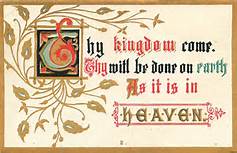
matt-6-10-thy-kingdom-come-illustrated

September 4, 2016 – Matthew 6:10

Here in the United States, most advertisers on Madison Avenue tell us every little girl wants to be a princess. We can see this in many cartoon movies made by Walt Disney. Princes, princesses, kings, queens. Living in a kingdom, with happily ever after figuring significantly in the ending of the stories.

When you mention “kingdom” to people, that is often the first thing they think of. But—what did Jesus mean when He talked about the term “kingdom?”

We have for our Scripture passage this morning a portion of the Lord’s Prayer from the Sermon on the Mount, Matthew 6.  This is one of the most familiar portions of the Bible. A huge multitude of Christians of a vast number of denominations and faith traditions know these words by heart. I ask again: what did our Lord Jesus mean when He said these words, “Thy kingdom come, thy will be done, on earth as it is in heaven.”

To be frank, this subject of the kingdom of God is something I have struggled with for decades. Yes, I now have some understanding of what Jesus meant here in the Gospel of Matthew. And yes, I will try to help us all to understand better what it was that Jesus was saying. And, why He wanted us to say—or pray—these words.

Jesus was considered a Rabbi, a teacher, by all who knew Him. He was learned in the Hebrew Scriptures, and must have been quite skilled in rabbinic discussion and debate. That’s why I think He knew all aspects of the Old Testament understandings of the Kingdom of God.

There are several aspects of the Kingdom of God. But, important: God created the world, and everything in it. (I think God took great joy in creation, too!) By default, everything and everyone is under God’s authority and power. So, yes. Everything is part of God’s kingdom.

However, something happened after God created everything. Sin happened. A cosmic rejection, rebellion and separation from God happened. As the Apostle Paul mentions in Romans 8, the whole creation has been groaning in agony ever since.

Let’s return to Madison Avenue, and advertising. Television commercials. I can see several young, smiling people, outside. Having fun. Maybe skiing, or hiking, or sailing. “Go for all the gusto you can!” says the voiceover, on a beer commercial. These young people are on the top of their game, not a care in the world. They are not even thinking of sin, rejection, rebellion and separation from God.

I want to tell you a secret. Well, not really a secret. The fallen world and the fallen people in this world do not want to acknowledge God at all. They are separated from any idea of following God’s life, light and love. From being a part of God’s kingdom.

This is a sad reality. Jesus knows it is. That is why Jesus tells us to pray this way. “Thy kingdom come.”  Yes, the whole world is separated from God. When we pray this prayer, Jesus wants us to commit to opening ourselves to God’s kingdom. We can help fulfill God’s kingdom in this world.

I found a fascinating bible study on the Lord’s Prayer online, released by the Salvation Army in Great Britain. When I examined this part of the study, it concentrated on another scripture passage from Luke 4. This section of Luke does not mention the Kingdom of God, but it might as well. This passage is where Jesus tells the people in the synagogue in His home town of Nazareth what His message is, in chapter 4. Jesus “found the place where it is written: 18 ‘The Spirit of the Lord is on me, because he has anointed me to proclaim good news to the poor. He has sent me to proclaim freedom for the prisoners and recovery of sight for the blind, to set the oppressed free, 19 to proclaim the year of the Lord’s favor.’”

This is Jesus’s Kingdom announcement! Remember, a few weeks ago, I spoke of where Jesus preaches His first sermon. It is quite a bit like political campaigns. The various candidates all try to have their position distilled down to a simple message. What they stand for. What they will strive to do. And, in both the Gospels of Matthew and of Luke, Jesus talks a lot about the Kingdom of God. What it means, and how Jesus expects to bring it. How Jesus wants His followers to bring the Kingdom themselves. Proclaim the Gospel. Share the Good News.

There are many, many commentaries, theological books, and bible studies written on this portion of Matthew, the Lord’s Prayer. The phrase we are looking at this week, “Thy kingdom come,” is considered to be a central phrase in this prayer. Some say the most important phrase. That would mean “the Kingdom announcement … is the focal point of Jesus’ entire ministry. This prayer, then, can only be understood in the light of how Jesus ‘lived the Kingdom’ while He was here on earth. Bringing the Kingdom of God to earth was Jesus’ great task.” [1]

Here is this message, this announcement of the Kingdom, again. Jesus teaches His followers to pray with a model prayer. The Lord’s Prayer. Just like Jesus does repeatedly in the Gospels when He preaches, Jesus proclaims the Kingdom in this model prayer—except He wants us to proclaim it, too! And, to do it. To bring the Kingdom in.

One thing I love about the Salvation Army: their emphasis on service, on proclaiming the Kingdom of God through concrete, hands-on means. Following their lead, we can “look at how Jesus lived His life, get involved in the things that He thought were important, and understand what Jesus meant by the term ‘Kingdom of God.’” [2] Bring relief to the poor. Visit those in jail. Heal those who are sick. Alleviate the suffering of those who are oppressed. That is what Jesus was saying in Luke 4.

With this week, we come to the end of our Summer Sermon Series from the United Church of Christ’s Statement of Mission. The last sentence of the statement: “Empowered by the Holy Spirit, we are called to discern and celebrate the present and coming reign of God.” (Or, the present and coming kingdom of God.)

God’s kingdom is here and now, and God’s kingdom is future tense. Like Jesus preached, God’s kingdom is among us, within us. We can share that kingdom with others, today. Plus, God’s kingdom is a future thing. At the end of all time, the fullness of God’s kingdom and glory will burst upon the whole world, the whole creation, in awesome majesty and glory.

What a series it has been! Each week, we have delved more deeply into each sentence of this mission statement. St. Luke’s Church was founded by this vital, missionary association of churches almost 70 years ago. Each week this summer, I hope we have discovered more about this wonderful denomination. It is my hope that we now see many connections where we can fit, and serve, and grow—as a local congregation, a fellowship of believers, and as a sister church in association with the great variety of churches in the Chicago Metropolitan Association.

God’s kingdom is here and now, and God’s kingdom is future tense, too. This is something to celebrate, like the Statement of Mission says! God is building God’s kingdom within each one of us now. It is our joy and privilege to share the Good News, to tell other people about Jesus and His love for each of us.

But, that is not all. By no means! The future part of God’s Kingdom is even better. I think most people here are familiar with George Frederick Handel and his oratorio Messiah.

The text for this chorus comes from our second reading today, from Revelation chapter 11. The Hallelujah Chorus from the end of the second part of the Handel’s oratorio Messiah says, “and He shall reign forever and ever. King of Kings, and Lord of Lords.” This is a joyous proclamation of the coming kingdom of our Lord.

Hallelujah! Hallelujah! Hallelujah!

[1]http://www.usc.salvationarmy.org/usc/prayer/24-7/24-7_UK_Bible_Studies..pdf

[2] Ibid.

@chaplaineliza

(Suggestion: visit me at my regular blog for 2016: matterofprayer: A Year of Everyday Prayers. #PursuePEACE – and my other blog,  A Year of Being Kind . Thanks!)