Unknown's avatar

The Spirit Intercedes for Us!

“The Spirit Intercedes for Us!”

Romans 8:22-27 (8:26) – May 19, 2024

            Have you ever been in a building with a power outage? A brown-out? Where something disrupted the electricity? A number of years ago, I was at an evening meeting in a large building here in Evanston, and that is exactly what happened. The electrical power was somehow shut off or interrupted, and everyone had to evacuate the building.

In situations like that, there can be a real feeling of helplessness. What happened? Where did the power go? When can we get it back? What do we do now?

            This is the situation at the beginning of Acts, chapter 2. We have a small band of disciples, followers of this Jewish Rabbi Jesus, who was crucified, raised from the dead on the third day after He died, and ascended into heaven several weeks after that. Jesus was not always perfectly clear in His communication or explanations, at least as far as His followers were concerned. Even after His resurrection and ascension, Jesus’ disciples still had problems understanding exactly what they were to do.

So, after His ascension into heaven (complete with some more, rather cryptic, remarks from Jesus, recorded in Acts 1), Jesus’ followers are in possession of this really far-out story; their miracle-worker of a teacher, rabbi and leader, died, buried, resurrected, and ascended to heaven. And, they are still on the run, or at least keeping a very low profile, in the eyes of both the Jewish and Roman authorities.

Let’s turn to one of our Scripture passages for today. Acts Chapter 2. All of a sudden, things have made a surprising turnaround! Listen to verses 1 and 2. “When the day of Pentecost had come, they were all together in one place. And suddenly from heaven there came a sound like the rush of a violent wind, and it filled the entire house where they were sitting.”

Something extraordinary happened. We now know it today as the coming of the Holy Spirit, the Day of Pentecost, the birthday of the Church. But, think of what it must have been like for these few dozen followers of Jesus—something extraordinary had happened!

            Let’s fast forward. No matter where people live in this world today, no matter what their situations are, no matter what they do for a living, a common desire among many people is that desire for reassurance, a wish for something to hope in, to believe in. A desire to know exactly where their power is coming from.

Some people—for various reasons—give up on a belief in a Higher Power, and fall back on the vacuum of nothingness, or hopelessness, the concept that life ends at the point of death, and there is nothing whatsoever afterwards—that is all there is. Others raise up the substitution of some man-made idol (like the golden calf). All kinds of things can function in our lives like a golden calf—something else like money, prosperity, position, success, or comfort. Other people cling to the Higher Power of self-sufficiency, the substitution of self for God, the crazy idea that I run the show, I’m all that matters, I can be that Power-Source in everyone’s life.

One huge surprise on that first Pentecost, “was that even though Jesus had died, been raised, and then gone to heaven, his disciples were not alone.  The Holy Spirit, the very power of God, was with them giving them the power to be the body of Christ in the world!  What was true for them on the day the church was born is also true for us today, [two thousand years later].” [1] 

            Which brings us to the Scripture we highlight today. Here in Romans, the apostle Paul tells his friends about the Holy Spirit – that same Holy Spirit that was heard and felt like a powerful rushing wind on the day of Pentecost! That same Holy Spirit helps us day by day. And, that same power enables us to do God’s work here on earth.

The apostle Paul gets specific, and lets us know that the blessed Holy Spirit will not leave us alone and forsaken. Instead, the Holy Spirit comes alongside of us, giving us heavenly power when we need it. The Spirit assists us as we journey our way through this day-to-day life.

As Paul says in Romans chapter 8, “the Spirit helps us in our weakness. We do not know what we ought to pray for, but the Spirit himself intercedes for us through wordless groans. 27 And he who searches our hearts knows the mind of the Spirit, because the Spirit intercedes for God’s people in accordance with the will of God.”

Just as the Holy Spirit empowered those first disciples on that Pentecost morning so long ago, God still intends for followers of Jesus to do powerful things for God! “God gives us power that enables us to do God’s work on earth. God inspires us, gives us gifts (talents), and works through us. God expects us to ‘do something in God’s name.’” [2] Yes, we all can pray, to further God’s work in the world! And yes, our Lord Jesus encourages each of us to touch people’s lives, speak to others in Christ’s name. We are encouraged to do acts and speak words of kindness and Godliness, each and every day. Each person, to their best ability.

Just think of it. On that first Pentecost morning, the Holy Spirit, the third Person of the Trinity, the Ruach ha Kodesh came down from heaven! The Spirit blew through these people’s lives, through their hearts, turned them inside out and upside down! The Holy Spirit is still blowing through the lives and hearts of the followers of Jesus today.

Yes, Pentecost happened, two thousand years ago, and Pentecost can happen again, right here and right now. Is the Holy Spirit speaking to you right now? God’s power can be scary, but remember, God will be with us, through whatever comes our way. Thank God for turning on the power in all of our lives, today! Alleluia, amen.

@chaplaineliza

(Suggestion: visit me at my other blogs: matterofprayer: A Year of Everyday Prayers. and  A Year of Being Kind . Thanks!


[1] http://worshipingwithchildren.blogspot.com/2015/04/year-b-day-of-pentecost-may-24-2015.html

[2] Ibid.
Unknown's avatar

God Created

“God Created”

Genesis 1:1-6, 26-28 – June 11, 2023

            With June, everything is blooming! All kinds of trees, plants, flowers and leaves are growing and blossoming, and it’s just like that song from the great American songbook, “June is Busting Out All Over!” We can easily see how much joy God took in creating the heavens and the earth, with how green and verdant all of nature appears, outside.

            And, God not only created the plants and growing things. The Lord created a whole lot more! As Genesis 1 tells us, God created all living things on the earth, sea and sky, and all the heavenly bodies in the universe, too. A mighty act of creation, for our mighty God! 

            This act of creation comes at the very beginning of things, in the very beginning of the Bible. Genesis chapter 1. “In the beginning God created the heavens and the earth. Now the earth was formless and empty, darkness was over the surface of the deep, and the Spirit of God was hovering over the waters.”

            We are starting our summer sermon series today, Re-imaging God. This series will highlight different ways of thinking about and naming attributes of our God. In this series, we will work on stretching ourselves! We will try to enlarge our image of our God.

            The words we use are important – not only the words we say, but the words we read on the printed page. The words of Scripture are all important, too. Let us take a closer look at how verses 1 and 2 describe our God. Verse 1 (the summary statement for this chapter) says that “God created.” God created the heavens up above and the earth beneath. Verse 2 describes the Spirit of God as “hovering over the waters.”

            This lean, spare description is marvelous! Can you see it? The dark heavens and the earth, formless, empty, just waiting for something to happen.

I don’t know whether you are aware, but different languages use different articles for nouns. In English, we all say “the cat” and “the dog,” and by the article “the,” they could be either male or female animals. However, many languages are structured differently.

In German or Italian, Spanish or Greek, different nouns are gendered. It’s a “male dog,” or a “female cat.” The article “the” in front of the noun changes with the word. Plus, the gender of the verbs must agree with the gender of the nouns! Any native English speaker who learns one of these languages in school struggles with the gender of the nouns and matching the proper articles and proper gender of verbs with the nouns!

It’s the same way with the Spirit of God. In the original language of the Hebrew Scriptures, “Spirit” is feminine. What’s more, the Spirit of God hovering or brooding over the waters is – according to the Hebrew language – a feminine Spirit. This verb “hovering” is also mentioned in Deuteronomy 32, where the mother eagle is protective towards her young in the nest. The “hovering” of the Spirit is a mothering activity! Here in Genesis, the Spirit of God, the Ruach ha Kodesh, is a protective, nurturing presence over the still formless waters. [1]

            Just so we do not get lost in the weeds of different languages, here’s the highlight I want us all to focus on. Whether Scripture is in Hebrew or Greek, “both masculine and feminine verbs are used for God, masculine for God, feminine for the Spirit. [And as we will see,] God’s human creation will reflect their creator as female and male.” [2]

               Seeing the nurturing, mothering nature of mammals, of dogs, cats, and humans – these mental images of puppies, kittens and babies can bring to mind gentle caring, loving encouragement, and supportive love. These are exactly the kinds of things that describe the activities of the Spirit of God! Plus, God the Father is caring, loving and supportive, too!

And what about the Good Shepherd? That’s Jesus, I want everyone to know. Remember how Jesus cares for His sheep, and how in several places in the Gospels Jesus is described as a loving, supportive Good Shepherd who guards, guides and protects His sheep.

            Isn’t it wonderful to see God as a mothering, nurturing God? Not only mighty and strong – a just, even stern, protector. Yes, God is all of those things. And, mothering and nurturing, caring and loving, too! Both/and – not either/or.

            Let us continue with verse 26: “Then God said, “Let us make humankind in our image, in our likeness, so that they may rule over the fish in the sea and the birds in the sky, over the livestock and all the wild animals, and over all the creatures that move along the ground.” God has created humans male and female. We, as humans, are created in the image of God! And, this whole chapter of Genesis 1 follows the same pattern, using pronouns of both genders.

            “We forget that Genesis 1 is a chapter brimming with goodness and blessing. In fact, God pronounces blessing on the created order three times. [God] calls creation “good” and “very good” seven times.” [3]

            We can see how the earth – the world – the universe was lovingly, joyfully created by God. And, whether we think of the feminine Spirit of God or the almighty Lord, or the Word that was in the beginning (from the Gospel of John), the preincarnate Son of God – however we consider the Triune God – all we can do is lift our hands in worship, thanksgiving and praise.

 What will you and I do with this fresh understanding of God? This understanding that transcends gender? “The creation story insists that God’s mark is imprinted on my very being. I might ignore or distort it, but the mark is always there. Whether I acknowledge it or not, I reflect something of God’s joy, God’s intentions, God’s love, and God’s beauty just by virtue of existing on the earth. I am His, and so He is mine.” [4]

            We can go out into the world, knowing that the Creator God made each of us, all of us, in the image of God. Male and female we are made, and each is in the image of God. Just as Psalm 139 tells us, “I praise you because I am fearfully and wonderfully made; your works are wonderful, I know that full well.”

            Our loving, caring, nurturing Creator God created the heavens and the earth; God created all humanity, and that includes you and me, too. Praise God! Alleluia, amen. 

@chaplaineliza

(Suggestion: visit me at my other blogs: matterofprayer: A Year of Everyday Prayers. #PursuePEACE – and  A Year of Being Kind . Thanks!


[1] van Wijk-Bos, Johanna, W.H., “Reimagining God” (Westminster John Knox Press: Louisville, KY, 1995), 72.73.

[2] Gafney, Wilda, “A Women’s Lectionary for the Whole Church” (Church Publishing, New York, NY, 2021), 142.

[3] https://www.journeywithjesus.net/Essays/20140609JJ.shtml

[4] Ibid.

Unknown's avatar

Useful Gifts

“Useful Gifts”

1 Corinthians 12:10-17 (12:13) – January 23, 2022

            Who remembers Mr. Potato Head? That wonderful children’s toy provided hours of pleasure and play for my children, to be sure! They would laugh when they put the feet where the eyes ought to be, or the ears where the arms fit in the potato body. And, how much laughter and silliness would happen when my children made a Potato Head person with all eyes, or all ears, or all hands – and nothing else!  

            That is exactly what comes to mind when I read these verses from 1 Corinthians 12. A Mr. or Mrs. Potato Head, and all of their representative plastic parts. The Apostle Paul reminds the Corinthian believers “All these gifts have a common origin, but are handed out one by one by the one Spirit of God. [The Spirit] decides who gets what, and when.”

As we heard last week, God continues to give gifts to each believer. How generous of God! Our scripture reading says “God’s various gifts are handed out everywhere; but they all originate in God’s Spirit.”

We never can hear this enough! All of us as believers in Jesus Christ have been given some very special gifts from God! It’s possible you were not aware, or once knew and had forgotten, but it is true. Each Christian has a unique, God-given gift (or unique bundle of gifts!).

            Today’s sermon is the second part of a sermon series on spiritual gifts. Last week, we focused on the whole Church and the God-honoring service we could give to each other, individually. This week, we will highlight our service to the whole Body of Christ. Paul gives us such great examples! Each of us matters. It’s not only a current, popular message of today – Paul wrote it right here two thousand years ago in this letter to the Corinthians, too!

            Let’s take a closer look at what exactly Paul did say. I am using Eugene Peterson’s marvelous modern translation The Message. “A body isn’t just a single part blown up into something huge. It’s all the different-but-similar parts arranged and functioning together. If Foot said, “I’m not elegant like Hand, embellished with rings; I guess I don’t belong to this body,” would that make it so? If Ear said, “I’m not beautiful like Eye, transparent and expressive; I don’t deserve a place on the head,” would you want to remove it from the body?”

            Paul’s emphasis here: “you matter because the body [of Christ] won’t be the body without you, without the gift that you bring, without the person that you are.” [1] I realize that some church members and some believers in Christ feel inferior, regarding their spiritual gifts. They might throw up their hands and say something like this: “My contribution doesn’t mean much. It isn’t worth much at all. I can’t measure up to what important Christians are able to do.”

            Some years ago, I happened to know an elderly Christian woman who felt exactly this way. She had tremendous spiritual gifts of helps and mercy, but because she had been taken advantage of numerous times by a church (long since closed) in Chicago, she was so sad and dispirited that she had given up. Her amazing spiritual gifts were simply lying unused. She even had given up going to church. Her once-abundant gifts of helping and showing mercy were sitting on a shelf, sadly gathering dust.

            Isn’t it so true that God directs different gifts to go to different people? Each one is given something fashioned exactly for that particular individual, but ALL these various gifts and people (or, parts of the Body) come together to make one Body of Christ, one Church. The Church would be pretty silly if everyone was an eye, or everyone was an ear, wouldn’t it?

That is why the Church has all different members – or limbs – or parts to do lots of different functions. And, some of these functions in the Body of Christ are unseen from the outside. It’s like with an ordinary human body. Lots of a body’s functioning is – necessarily – sight unseen. Yet, we would look silly if we saw all of our arteries and veins on the exterior, or our digestive system on the outside of our skin.

This is where our responsibility comes in. God challenges us to recognize which of these spiritual gifts have been given to the service of our local family of faith. We are called to use these gifts for the larger Body of Christ, the Church Universal. As Paul says, it is the same God that causes these gifts to work in and through us. “God himself is behind it all. Each person is given something to do that shows who God is: Everyone gets in on it, everyone benefits.”       

One of my favorite commentators is Carolyn Brown, retired director of Children’s Ministries in the Presbyterian Church. She gave an excellent example of the whole local church contributing to ministry: “Since my church is hosting the community winter overnight shelter for men for whom there is no space in the permanent shelters, I’d [like to talk about] people who are cooking meals, playing games during the evening, decorating the room and tables to welcome our guests, etc.  Together we are like a body taking care of our guests.” [2]  What a wonderful way to work together as a healthy Body of Christ! A great reminder to the rest of us, for sure.

Some good questions to ask: “What staff people are often neglected in the thank-you moments in the life of the church? Which volunteers are plugging away unremarked sometimes for years without proper recognition?” [3] Helping people find their worth is a valuable and necessary effort. And, it’s blessed by God! Whatever you do, in thought, word, or deed, do it all to the glory of God – and for the benefit of your family of faith, too! Amen!


Thanks so much to Rev. Dr. Derek Weber, Director of Preaching Ministries for www.umcdiscipleship.com and his excellent preaching notes for this week’s worship service and sermon. I used several ideas from these notes for the sermon today

@chaplaineliza

(Suggestion: visit me at my other blogs: matterofprayer: A Year of Everyday Prayers. #PursuePEACE – and  A Year of Being Kind . Thanks!


[1] https://www.umcdiscipleship.org/worship-planning/love-never-ends-being-the-body-of-christ/third-sunday-after-the-epiphany-year-c-lectionary-planning-notes/third-sunday-after-the-epiphany-year-c-preaching-notes

[2] http://worshipingwithchildren.blogspot.com/2015/12/year-c-third-sunday-after-epiphany.html

[3] Ibid, www.umc.discipleship.org  

Unknown's avatar

Life on God’s Terms

“Life on God’s Terms” – July 12, 2020

Rom 8_11 Spirit of God

Romans 8:1-11 (8:10)

Does anyone know what this is? [motioning towards the garbage can] You’re right. This is a garbage can. Good for being a container for all the garbage – refuse – junk – from our homes, workplaces, and communities. All kinds of worthless garbage that is not needed or wanted goes right in here. The apostle Paul talks about all kinds of garbage in our lives, on our insides, here in the letter to the church in Rome.

Imagine, if you will, all the internal junk in a person’s life, and mind, and heart. All of that meanness, and selfishness, gossip and swearing, bullying and arguing. And, what about the times people cheat? Or, blow off assignments or obligations? Or, stretch the truth just a little – or, perhaps a lot? Oh, it’s not much. But, do you think God keeps track of each and every time?

Just think of a person’s life. Perhaps, your life, or mine. If all the years and decades of those junky, selfish, stubborn, or mean thoughts, words or deeds were piled in this garbage can, I’d imagine it would be pretty full. Even, perhaps, full to overflowing.

Life on the inside, our internal selves without God can be pretty hopeless. Worthless. Just like garbage – refuse – junk that goes into this garbage can. Another word that Paul uses for all the stuff in these garbage cans is sin. I suspect many of us here can quote Romans 3:23, where Paul says “For all have sinned and fall short of the glory of God.” Paul does not say, “For some have sinned,” or even “For many have sinned.” No, we all have our internal selves filled up with meanness, selfishness, gossip, swearing, bullying, arguing. And, then some.

God does have laws. Many of these laws are common sense, and others are in keeping with moral codes that many civilizations have held for millenia. We know the big 10, the Ten Commandments, and many of the other laws of Moses that are found in the Hebrew Scriptures. Right before Paul writes these marvelous words in Romans 8, he talks about the huge problem with law and sin. We know about that. Sin and the law of God do not get along.

What do I do now? I know a lot of these laws of God, sure. But I still fall into sin, even though I know the rules. Another way of looking at sin is separation from God. When you—I—when all of us sin, we are separated from God. What’s more than that, sometimes people don’t even think of the Lord. God does not even enter their minds. Can you imagine? Ignoring God? Yet, so many people do just that.

So many people today are running on that treadmill of self will run riot, of selfish, mean, resentful living. I have seen a number of these kinds of persons, and they keep running, running, running on that treadmill of separation from God.

I have one particular person in mind. An acquaintance, from some years ago. To all outward appearances, she was very successful. She had designer clothes, a successful job, a luxury car, a fancy house. But, on the inside? All kinds of resentment, anger, greed, envy, gossiping and backbiting. She cut corners on her integrity and honesty, and just did not have a moral compass. Do you know someone like that? I have a feeling we all might have more in common with this unhappy lady than any of us might like to admit.

I’d like all of you to think of a sin in your life. I suspect you have thought of a sin that is really obvious to you, right now. the one thing you feel worst about. The one regret or misdeed or misfortune that you wear like a snail does its shell. The one part of your life that forever threatens sin and condemnation. Could you write it down? Or, if you don’t have a pen and paper, could you think really hard of that particular sin right now?

Paul does not leave us in that horrible place. Yes, all of Romans chapter 7 is talking about sin, and separation from God, and how much difficulty all of us have with these sinful thoughts, words and deeds. We might think that we are stuck at the bottom of one of these smelly, stinky, filthy garbage cans, with no way out. Who will rescue me from this body of sin and death? How can I – can we – get in a place where we can possibly have access to God?

Paul has good news for us. In fact, it’s great news! We do not have to stay in this garbage dump for the rest of our lives. No, Jesus reaches down from heaven and rescues us from sin and death. Jesus takes each of us out of that separated, filthy garbage can and brings us into the glorious presence of God!

Here is the best part of all. God’s Holy Spirit helps us to stay free from the power of sin and death. We no longer need to reflect on what we have done – or said – or thought that was wrong. No! Jesus Christ delivers us from sin and the Law.

I want to invite all of us to—virtually—toss that sin we wrote down into the garbage can right here. Jesus can clean us up from the inside, and help us to sin less and less. Amen!

One last thing. I invite each of you to take another piece of paper, and write what you are free to do now that you do not have that condemnation in your life and inside your very self. What challenge will God bring into your life, now that you know you are beloved by God and filled with God’s Spirit? What kindness or generosity will you attempt? What will you do with all the love and grace God can give you? [1]

God promises to be with us, yes! And, even more, God promises to use each of us for the sake of the people and the world God loves so much. Go out into the world for God, today.

[1] http://www.workingpreacher.org/craft.aspx?post=1571

“What Willl You Do…?” David Lose, Dear Working Preacher, 2011.

@chaplaineliza

(Suggestion: visit me at my regular blog for 2020: matterofprayer: A Year of Everyday Prayers. #PursuePEACE – and my other blog,  A Year of Being Kind . Thanks!


Unknown's avatar

Baptized, Beloved

“Baptized, Beloved”

luke-3-21-baptismchrist2

Matthew 3:13-17 (3:16) – January 8, 2017

Water. Water is used for a great many things. For washing and cleaning, certainly! Washing clothes and dishes, washing hands before dinner, washing cars in the summertime. Cleaning things, too, like brushing teeth before bed, and cleaning instruments and tools. Water is used for a special, cleansing purpose in the Christian church, too. Water is for cleansing of people, and washing of souls, of body and spirit.

The Gospel of Matthew begins our Scripture passage today with Jesus at the very beginning of His ministry. He comes to the River Jordan, to see His cousin John the Baptist. And what is John doing at the Jordan? Baptizing people, cleansing them while they confess their sins, washing their souls, inside and out.

Let’s back up a bit, and take a look at the passage from Isaiah, from the Hebrew scriptures. Here we have a prophetic suggestion of what is to come; the prophet tells us here in the book of Isaiah about the Sent One of God.

Did you know that God deeply cares about the Sent One? The prophet says so! Listen again to verse 42:6—“I am the Lord, I have called you in righteousness, I have taken you by the hand and kept you;” We see that God is faithful to God’s promises, and will care for those whom God loves. In fact, God is within the Servant the prophet speaks of, And, God means for this Servant to transform and cleanse the mess the world has been in. [1]

This is awesome news! The mixed-up world will finally be washed and cleansed. Except, Jesus does something completely unexpected. Jesus does not come to cleanse the world, at first. No, Jesus comes to John to be obedient and go through the waters of baptism Himself.

We can see from the Gospel passage that John is really hesitant to baptize Jesus. He says, “No way, Jesus! I oughta be baptized by You! And here You are, coming to me to be baptized?”

I want to remind everyone that Jesus had no sin. He was both God and man at the same time. Yet, Jesus came to be baptized by John. Jesus wanted to identify with sinful humanity in every way. Plus, Jesus wanted to fix the mess the world was in.

Look at verses 6 and 7 of the passage from Isaiah: “I have given you as a covenant to the people, a light to the nations, to open the eyes that are blind, to bring out the prisoners from the dungeon, from the prison those who sit in darkness.” That sounds like washing and cleansing this fallen, mixed-up world. That sounds like the mission Jesus had in His ministry here on earth.

But, Jesus is not there yet, at the beginning of Matthew 3. Jesus needs to be baptized, to fulfill all righteousness. And, what is righteousness? “Compassionate justice and care for those who are poor and/or marginalized, humility and faithfulness that always point to God as the One who is at work in this transformation, and the hope—the promise—of new things that will dazzle us and rattle the foundations of our safe little worlds. When read, and heard, together, the texts from Isaiah and Matthew dramatically illustrate God’s own deep faithfulness and care.” [2]

We can see from the Gospel of Matthew how God has deep faithfulness and care for Jesus, God’s Son. After Jesus convinces John to baptize Him, the heavens open, the Spirit of God as a heavenly dove descends, and God the Father says, “This is my Beloved!”

Let us imagine ourselves in that crowd on the banks of the river, watching the baptisms, as people are cleansed from sin. John is washing their souls, inside and out. Hear the sound of the rushing water. You and I, all of us are crowded together, jostling each other. We watch John the Baptizer, with that new rabbi Jesus, in the water. Suddenly, the heavens break apart! Everyone, all of us in the crowd know the Spirit of God is present, in the likeness of a dove coming down from the sky.

What do you think of when you hear the voice of God saying, “This is my Beloved!” What goes through your head? What kinds of feelings are going through you? Are you scared? Excited? Puzzled? Confused? Or, all of the above?

Think of baptisms we have seen, even participated in. Do you think baptisms are just an excuse for gifts and a party? Or, does baptism mean much more? Consider your own baptism in light of this Gospel reading. Now, think of the others in this congregation, too. Close your eyes. Think of God saying to you—yes, to you in particular—“You are my Beloved!”

            God is saying that to each one of you. Really and truly.

I found this story on a pastor’s sermon board, online. It was written a number of years ago by a Pastor Del in Iowa. He tells the story of his grandmother’s death, and his subsequent desire to find out more about his grandparents’ families.

“I began to ask questions about my genealogy… about my great grandfather (whose last name was Fahling) whom I remember well from my childhood.

“As I questioned my mother about the family history on my father’s side, she indicated to me that my great grandfather’s real last name is unknown. It seems that he left the old country and came to the New World as a boy, his journey paid for by a farmer with the name of Fahling. Upon crossing the waters of the Atlantic, my great grandfather took up residency with this farmer, labored on his land and took upon himself his sponsor’s name and identity and became part of the Fahling family. He even receiving a share in the inheritance of the family farm.

“At first I was disappointed with the loss of a history, but then I realized that in many respects this is the meaning of our baptisms. Crossing the waters, we take on different residency, ordained labors, and new identities and begin a new history. We become an integral part of the family of God through sharing in the baptism of Christ who sponsors and pays for our journey.”[3]

We have several different ways to come to an understanding of baptism. Yes, we have been washed and cleansed from our sins. We have crossed the water. Yes, each of us has been adopted by God. Yes, each of us has a new identity. And, yes, each of us is Beloved, much loved by God, our heavenly Parent.

Consider this last understanding of baptism, about each person, child or adult, in our congregation. And then about each baptized person you know. God considers each one God’s Beloved. Do we consider each one Beloved? Do we treat each person as God’s Beloved? How would that understanding change the way we treat each other?

Not that baptism magically changes us and—presto, change-o—causes us to become Beloved in some magical way. No! We are Beloved because God says we are. Just as God called Jesus Beloved, God refers to each of us in the very same way.

Praise God! I know I am God’s Beloved, the same way you are, too. What a marvelous name. What a fantastic feeling. What a wonderful God we serve.


(Thanks to Kathryn Matthews and the United Church of Christ’s Worship Ways for several ideas used in this sermon.)

[1] http://www.ucc.org/worship_samuel_sermon_seeds_january_8_2017   by Kathryn Matthews

[2] http://www.ucc.org/worship_samuel_sermon_seeds_january_8_2017   by Kathryn Matthews

[3] http://desperatepreacher.com//bodyii.htm

@chaplaineliza

(Suggestion: visit me at my regular blog for 2017: matterofprayer: A Year of Everyday Prayers. #PursuePEACE – and my other blog,  A Year of Being Kind . Thanks!)

Unknown's avatar

From Fearful to Fearless

“From Fearful to Fearless”

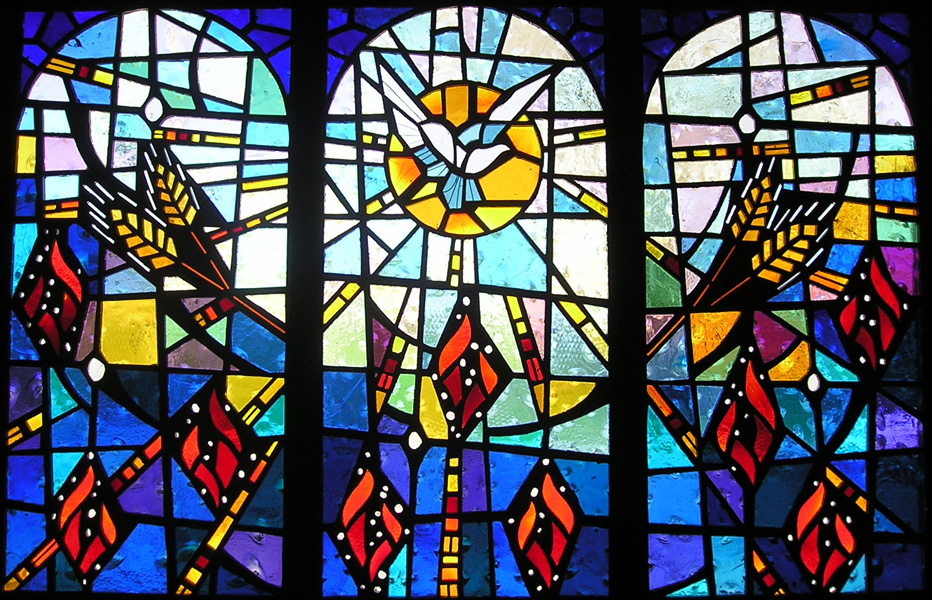
Pentecost stained glass - Boone Tabernacle Church of God in Christ

Pentecost stained glass – Boone Tabernacle Church of God in Christ

Acts 2:1-18 – May 24, 2015

Everyone feels afraid, some time. I know I usually do not make sweeping statements like that, but I feel safe in making that particular one: everyone is afraid, sometime. Being fearful; it goes with being human.

If we look at the disciples, gathered in that upper room—the same upper room where their leader and Rabbi Jesus had them gather together to eat the Passover dinner on Thursday in Holy Week—we can see several good, valid reasons for them to be afraid.

Confusing events happening in short succession. This was compounded by the followers of Jesus scattering, running away, frightened by the very real, very legal, very official things happening to Jesus just before His crucifixion.

     Let’s fast-forward past Easter Sunday, past the weeks when the risen Jesus was occasionally present with the disciples. Past the time of the Ascension. The disciples still must have been frightened to death of the authorities. But, I suspect they needed to talk about the happenings of the past few weeks, too. Debriefed. Tried to figure things out, as best as they could. We go to the day of Pentecost, another major feast day for the people of Israel. And where are the disciples? Back in Jerusalem, in the upper room, hidden away from the authorities.

Let’s begin to read our scripture passage for today, starting at Acts chapter 2, verse 1: “When the day of Pentecost came, they were all together in one place. Suddenly a sound like the blowing of a violent wind came from heaven and filled the whole house where they were sitting. They saw what seemed to be tongues of fire that separated and came to rest on each of them. All of them were filled with the Holy Spirit and began to speak in other tongues/languages as the Spirit enabled them.”

If we were watching this scene as it happened on television, or in a movie, the special effects would be awe-inspiring! Can you see it now? Except, this was long centuries before the time of anything approaching motion pictures, even electricity. Imagine what it was like for these few dozen people, gathered together to pray in the upper room.

The biblical record refers to the coming of the Holy Spirit as being similar to the blowing of a violent wind. I’m sure this was an eye witness report. That must have been what it really felt like! Buffeted about by the sheer power of a strong wind—except—they were all inside the house, with all the doors shut tight! Let’s continue with the next verses:

Now there were staying in Jerusalem God-fearing Jews from every nation under heaven. When they heard this sound, a crowd came together in bewilderment, because each one heard their own language being spoken. Utterly amazed, they asked: “Aren’t all these who are speaking Galileans? Then how is it that each of us hears them in our native language? Parthians, Medes and Elamites; residents of Mesopotamia, Judea and Cappadocia, Pontus and Asia, 10 Phrygia and Pamphylia, Egypt and the parts of Libya near Cyrene; visitors from Rome 11 (both Jews and converts to Judaism); Cretans and Arabs—we hear them declaring the wonders of God in our own tongues/languages!” 12 Amazed and perplexed, they asked one another, “What does this mean?”

Here in these verses, we take a tour of Asia Minor, and parts of Africa and some of Europe. That’s how far the Jewish people had dispersed, in the past few hundred years. Observant, practicing Jews had settled in these far-flung places many years before. Their present-day descendants were fully enculturated, and spoke the local languages and dialects as their own. However, some still came back to Jerusalem on a pilgrimage, to worship at the Temple. As I mentioned, Pentecost was a big festival in the Jewish religious calendar.

Moreover, these dispersed Jews from far-flung provinces were amazed that home-grown Jews from Galilee, the boondocks of Israel, were able to speak many regional languages and dialects so fluently! Wonder upon wonder!

These Galilean Jews had gone out on the street, rubbing shoulders with all and sundry outside. They all had gotten a big shot of courage from somewhere, and were communicating the good news—to everyone. To all of these visitors to Jerusalem, who in turn could take the good news of the Gospel with them, to all parts of the Roman Empire when they returned home.

True, I could preach about the erasing of the Tower of Babel’s barrier, the division of separate languages, and the ease of communication that took place here on Pentecost. I could talk about the birthday of the church, and how the church began its great mission of spreading the good news. But—I wanted to focus on the disciples. How they went from fearful to fearless.

Let’s turn back to our scripture passage: “13 Some, however, made fun of them and said, “They have had too much wine.” 14 Then Peter stood up with the Eleven, raised his voice and addressed the crowd: “Fellow Jews and all of you who live in Jerusalem, let me explain this to you; listen carefully to what I say. 15 These people are not drunk, as you suppose. It’s only nine in the morning! 16 No, this is what was spoken by the prophet Joel: 17 “‘In the last days, God says, I will pour out my Spirit on all people. Your sons and daughters will prophesy, your young men will see visions, your old men will dream dreams. 18 Even on my servants, both men and women, I will pour out my Spirit in those days, and they will prophesy.”

Did you hear what Peter said? It’s because of the Holy Spirit. Everything is because of the Holy Spirit! That is exactly why the disciples poured out into the street after their fiery experience in the upper room! After the wind of the Holy Spirit swept through that room, their hearts, and their very lives. It didn’t matter—men, women, whoever was there. Each one in that room had the Spirit energize their hearts and their minds. The Spirit came with fire!

What is more, we see from the prophet Joel that the Spirit was prophesied to be poured upon all people. Sons, daughters, young men, old men, even men and women servants. I think that is everyone. We are all going to get power from the Spirit of God. The ruach ha kodesh, the Holy Spirit. What’s more all of us have the possibility of going from fearful to fearless!

Here is the last of today’s reading from Acts: “20 The sun will be turned to darkness  and the moon to blood before the coming of the great and glorious day of the Lord. 21 And everyone who calls on the name of the Lord will be saved.’”

Pentecost was not just a one-time-only event. Sure, Dr. Luke put this account down on paper so we all could remember, so we all could see the power of God as it happened so long ago, in Jerusalem. But—we can see the power of the Spirit of God now, each and every day. We can tell others about what the Lord has done and is doing in our lives—how the Spirit of the Lord blows through our lives on a regular basis–today.

The important thing about the arrival of the Spirit of God was not the wind or the flames. That’s just the exterior way we all knew that the Holy Spirit had arrived! But the disciples knew, from experience, that God was now with them in power and in might. The same way the Spirit is with us, today. That knowledge changed the disciples from fearful to fearless, and that knowledge can do the same thing for each of us, today.

Is there a Pentecost in our lives today? Is the Holy Spirit living, breathing, active in our lives, today? Please God, yes. God can enable us to go forth from here in the Spirit’s power, to share what God has done for each of us. And the response? As Peter quoted from the prophet Joel, “everyone who calls on the name of the Lord shall be saved.” Amen, and amen!

@chaplaineliza

(Suggestion: visit me at my daily blog for 2015: matterofprayer: A Year of Everyday Prayers. and my other blog,  A Year of Being Kind .  Thanks!)