Unknown's avatar

That You May Believe!

“That You May Believe!”

John 20:19-31 (20:31) – April 27, 2025

            Seeing is believing! Or . . . is it? I wonder what things come to mind when I mention the phrase, “Seeing is believing”? Or even, “I won’t believe it until I see it!” Sometimes, people can be really doubtful about things. I can just imagine several people I know folding their arms across their chests and saying, “Unless you show me . . . “

            In the gospel account we read today, from John 20, the disciple Thomas had just that reaction. After the resurrection, the first time Jesus came to the disciples, Thomas was not there. We’re not told why, simply that he wasn’t there. Maybe he was scared, maybe he was away, or out of town. Maybe he was sick. We just aren’t told why he wasn’t there.

            The ‘why’ is not the important part. The fact that Thomas wasn’t present is. Thomas had doubts. Sincere doubts. Truth to tell, the other disciples’ story was a little farfetched. I mean, how many people have you known who came back from the dead, and walked through walls into a locked room?

            I wonder. I wonder if Thomas’ reaction strikes a chord with anyone here today. How many of us today are like Thomas? Doubting that Jesus has risen indeed from the dead? Or, completely missing Jesus, and doubting that Jesus is even here at all, today?

            Let’s think some more about Thomas and his reaction. Thomas not only doubted, he wanted concrete proof. Tangible proof, proof he could touch and feel and handle. Thomas wanted to put his hands in the nail marks on Jesus’ hands. That’s pretty concrete.

            As I thought more about Thomas and his reaction and attitude toward Jesus and His first appearance to the disciples, the Gospel of John is not clear at this point. We as readers don’t know why Thomas had difficulty believing. But the gospel account says he did.

            How many of us today are like Thomas? Not sure? Not believing? Closed up behind the locked doors of feeble faith? Not believing that Jesus can make a difference in our lives today? Could Jesus come and reveal Himself to Thomas? Can He come and reveal Himself to those today who are fearful, doubting, and unbelieving? . . . Can He reveal Himself to me?

            Perhaps Thomas had difficulty finding something to believe in, since he had so recently seen his Master and Teacher arrested and crucified. Grief, fear, anger, dashed hopes, shattered dreams. I strongly suspect several, if not all of these, were operating in Thomas’ life at this time.

            These strong feelings and emotions inside are intense, and raw. From what is known today about the stages of grief, Thomas could have been feeling awful, and angry, and upset. Thomas could have felt his life was falling apart. But Jesus can break through all of that. Jesus could enter Thomas’ life with new hope, standing right in front of him. In the same way, Jesus Christ can enter through the closed doors of our hearts, meet us where we are, with open arms.

Just as Jesus did not leave Thomas high and dry, to figure things out on his own, so Jesus will not leave us. Our Lord came to Thomas in the upper room, despite his doubts and unbelief, and Jesus also comes to us in our doubts, and in our unbelief.  “The resurrection is among us, whether we see it or not. The resurrection is all around us, whether we recognize it or not. The resurrection is in the midst of us whether we are able to point to it or not.” [1]

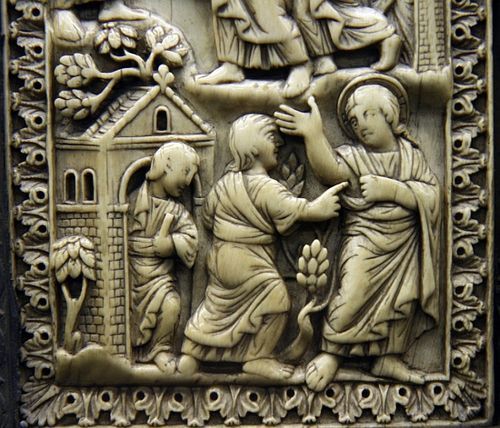
            Now, Thomas didn’t actually see Jesus, at first. He had just heard from others who had seen Jesus. But then, a second time, the risen Lord appeared to the disciples. Again, in the locked room, and this time, Thomas was there. What were Jesus’ words to Thomas? “Put your finger here and see my hands. Reach out your hand and put it in my side. Do not doubt, but believe.”

            Thomas responded with that tremendous affirmation, “My Lord and my God!”  Praise God for the sincere, heartfelt response of Thomas.

            Jesus’ words to His doubting disciple serve as words of comfort and reassurance to me. I know I have doubts, sometimes. And just as Jesus did not leave Thomas doubting, so too, Jesus will not leave me doubting, either. He will welcome me with open arms, coming through the locked doors of my fear, anger, doubt and unbelief.

            Thomas saw Jesus. Seeing was believing, in Thomas’ case. And then, the risen Jesus continues with the statement, “Have you believed because you have seen me?” Here’s the best part of all. “Blessed are those who have not seen and yet have come to believe.”

            What was that Jesus just said? Did I read that correctly? “Blessed are those who have not seen and yet have come to believe.” So—the Gospel of John says here that all who have not actually seen the risen Lord and yet have come to believe are indeed blessed.

            That means Christians throughout the centuries are blessed, since they have come to believe in Jesus Christ and yet have not actually, physically seen Him as risen from the dead. That means you and I are blessed, since we have come to believe in Jesus Christ, too. How awesome is that? We are blessed because the Lord Jesus says so!

            Just in case we didn’t quite understand where the evangelist was coming from the first time, verses 30 and 31 of John 20 underline this concept. “Jesus did many other signs in the presence of His disciples, which are not written in this book. But these are written so that you may come to believe that Jesus is the Messiah, the Son of God, and that through believing you may have life in His name.”

            Just as Jesus helped Thomas to believe, so the Gospel of John helps us to believe, too. This Gospel was not only written to bear witness so long ago, in the first century, some years after Jesus was raised from the dead. This Gospel was also written for the many generations which have come to believe throughout the centuries. That includes us, too.

Plus, Jesus does not mean for us to hide this Good News and keep it for ourselves. We all are “to be involved and engaged with the communities around us, in which there are the lives of many who do not yet know the Gospel. We respond to them with loving service, walking alongside them and sharing Jesus with every step.” [2]

Even though we may have doubts, and unbelief, and wonder whether, and why, or even why not, Jesus comes to us in our doubts and unbelief. Our Lord comes to all of us with reassurance and open arms and says “Do not doubt, but believe!”

            Praise God that as we come to believe that Jesus is the Messiah, we can have life in His name. Jesus can come to us, at any point in our walk with the Lord, no matter what the circumstance happens to be, no matter where we are in our lives. Thank God that Jesus will be there for us and with us, no matter what. May we all be able to affirm, with Thomas, that the risen Jesus is our Lord and our God.

            Alleluia, amen.

@chaplaineliza

(Suggestion: visit me at my other blogs: matterofprayer: A Year of Everyday Prayers. #PursuePEACE – and  A Year of Being Kind . Thanks!


[1]  https://www.workingpreacher.org/dear-working-preacher/when-seeing-is-believing

[2] https://www.churchofscotland.org.uk/worship/weekly-worship/monthly/2025-april/sunday-27-april-2025-second-sunday-of-easter-year-c

Unknown's avatar

Uncertain? Hope!

“Uncertain? Hope!”

Luke 1:26-38 (1:37) – December 1, 2024

This week, we read one of the most familiar of the narratives in the New Testament, perhaps even of the whole Bible. From the first chapter of Luke, here is the first part of the reading:  “In the sixth month of Elizabeth’s pregnancy, God sent the angel Gabriel to Nazareth, a town in Galilee, to a virgin pledged to be married to a man named Joseph, a descendant of David. The virgin’s name was Mary. The angel went to her and said, “Greetings, you who are highly favored! The Lord is with you.”

            Let’s take a closer look at this situation. Imagine yourself as Mary, a teenaged girl. Perhaps doing housework, cooking in the kitchen, or folding laundry. When, out of nowhere, an angel appears. My goodness! Out of the clear blue sky, something completely supernatural happens! And not only that, but to be greeted by the angel with such words?

            Mary’s response is one of puzzlement: “Mary was greatly troubled at the angel’s words and wondered what kind of greeting this might be.” Let’s face it—Mary is perplexed! She is wondering at the angel’s words: “the Lord is with you.” What kind of a greeting is this, anyway?

            We can be fairly sure that Mary (or, as was probably her name, for a young Jewish woman, Miriam) Mary knew her Hebrew scriptures. The phrase “The Lord is with you” is repeated several times in the Hebrew scriptures, primarily expressing the Lord’s help or assistance. This would puzzle Mary even further—why on earth did she need the Lord’s help?

            We see Mary, probably in the middle of an ordinary day, with the angel Gabriel paying a surprise visit to her! What gives? What is going on?

           I know this is not exactly the same, but I would like to compare Mary’s surprise situation to ours, today. Specifically, to my friend Anita, some time ago now. Out of the clear blue sky, she found out that she needed surgery. Before the beginning of October, she was traveling along, blithely, no serious cares or concerns. After the first week in October? Her life was turned upside down, with a serious medical situation, quickly followed by major surgery.

            How often does something like that happen? Perhaps not a medical emergency in your life, or a loved one’s life, but some other serious situation out of a clear blue sky.

            But, let’s return to Mary. Or, more directly, to the angel Gabriel and what the next words out of the angel’s mouth are: “Do not be afraid, Mary; you have found favor with God.”

            I suspect, if I had the opportunity to see an angel, I probably would be afraid, too! Practically every time an angel visits someone in the Bible, “Do not be afraid!” is one of the first things out of their mouths! Gabriel continues: “You will conceive and give birth to a son, and you are to call him Jesus. He will be great and will be called the Son of the Most High.”

            Understandably, Mary is even more puzzled, hearing this! Her response—quite sensible, under the circumstances—“How will this be,” Mary asked the angel, ‘since I am a virgin?”

            I can see Mary’s point. The word from the angel? Surprise! Truth to tell, it’s hard to top a virgin birth! We can look at other places in the Scriptures, and see other miracles. We can look at the life and ministry of our Lord Jesus when He was an adult, and acknowledge the fact that He did miracles, regularly. But—here we have Mary, herself, wondering how on earth this miracle is going to happen to her?

            The angel has an answer for Mary, sure enough. “The angel answered, “The Holy Spirit will come upon you, and the power of the Most High will overshadow you. So the holy one to be born will be called the Son of God.” In brief, here we have the angel describing the divine plan for a miraculous conception. Mary expresses doubt and uncertainty, Gabriel explains God’s plan in greater detail, Mary consents, and the angel departs.

This whole narrative makes me want to ask Mary so many questions.

How soon did you tell your parents you were pregnant? Did you tell Joseph about the pregnancy yourself, or did the gossipmongers of Nazareth take care of that for you? Was there anyone in the village who believed your story? For that matter, after the angel Gabriel left, did you doubt his visitation to you? Did you think it was a dream? Question your sanity? And what about the townspeople’s response—did you fear for your life, since people probably thought you committed adultery?

The Gospel of Luke is silent on this matter. It leaves us with so many unanswered questions! All we know is what Mary said to the angel. “I am the Lord’s servant,” she answered. “May your word to me be fulfilled,” was her response.

I feel deeply for Mary. An unmarried girl who happened to be pregnant was not just looked down on but actively persecuted. Sure, she knows that she takes the risk of being rejected as a slut, as a tramp, as unworthy of polite company, as a result of this new openness to God’s surprise activity in her life.  I would not blame her one bit for being uncertain!

            Yet, we can see that Mary exemplifies the kind of response to God’s surprises that I would like in my own life. We can see from the Gospel that Mary afterwards goes to see her older cousin Elizabeth, who also is pregnant, miraculously. (I bet they have a good deal to say to each other, too!)

Though—out of a clear blue sky—God completely spun Mary’s life around, though Mary knew that her life would never be what she expected it to be before, she nevertheless said “yes” to God in faith. Yes, she worshiped God (especially in her prayer, which comes after our Scripture reading for today.) She models the heart of worship, the giving of ourselves to the one who has given everything to us.

Mary’s example challenges and encourages us to have the courage to say to the Lord: “Be it to me according to Your word!” This is blessed hope in God’s word!

Remember, Mary may have had thoughts about how this would affect the life she had planned out. However, she realizes there is something special about to happen, that God’s plan must take precedence over her own. She accepts the challenge with hope and faith as she realizes she will be carrying the Messiah her people have longed for.

            I’d like to remind all of us today that Mary—an ordinary Jewish teenager—was visited by an angel out of a clear blue sky. Mary was an ordinary person who was willing to say “yes” to God, to respond to God’s call willingly and with courage, and go forward in faith.

            It doesn’t matter what our situations are, today. God can come into any of our lives, seemingly out of nowhere. God can rush right in, abruptly, with no warning. We all—each one of us—are encouraged to respond to God in the same way as Mary did. To agree with God, to say “yes” to God, willingly, with hope, and go forward in faith.    

@chaplaineliza

(Suggestion: visit me at my other blogs: matterofprayer: A Year of Everyday Prayers. #PursuePEACE – and  A Year of Being Kind . Thanks!

Unknown's avatar

Favor with God!

“Favor with God!”

Luke 1:26-45 (1:30) – December 3, 2023

            Stories are so important! Do you have family stories that you have told around the dining room table, or that your parents told you, about your family history? I have told my children stories about one grandfather who owned a pharmacy and drug store in Chicago through the Depression and afterwards. And, my other grandfather who emigrated from a shtetl in Eastern Europe early in the 1900’s, seeing the Statue of Liberty from the deck of the steamer.

            I imagine teenaged Mary, and the stories she was told in her family. Not only family stories about her parents and grandparents, but also stories of the Hebrew people – stories of Abraham and Sarah, of Jacob and his sons, of Moses, Miriam, King David, and especially of Hannah and Samuel. I’d imagine Mary thinking hard about Hannah, pregnant with her child of promise Samuel, and it would be difficult not to compare herself to Hannah!  

            I am wondering which such stories have shaped you and me, giving us direction and hope, understanding and wisdom in the midst of uncertain times. [1] Which stories – either our family stories or Bible stories – have helped us along, given us positivity and perseverance when we get discouraged or upset?

            Mary must have been a thoughtful teenager, possibly even mature beyond her years, when the angel Gabriel suddenly appeared to her! The angel greeted Mary with the typical words most recorded in Scripture when an angel makes a visitation: “Don’t be afraid!” Lo and behold, Mary enters into conversation with this heavenly visitor.

            Would you and I have been as thoughtful, or as quick on our feet if we were suddenly confronted with an angel? Even if the angel immediately said, “Don’t be afraid!?”

            Mary must have had some idea of what she was up against, both in her culture and in her traditional society structure. Here she was, a young, unmarried teenager – yes, of marriageable age, but not married yet. And, she willingly took on the task of bearing a child, the Son of God as the angel said. “You have found favor with God. 31 You will conceive and give birth to a son, and you are to call him Jesus.”

            I wonder perhaps if this is why Mary goes to her older cousin Elizabeth in the hill country, because of the societal pressure that was on her in her hometown. I wonder whether Mary was thinking she might receive social judgement from Elizabeth once she gets there? Yet, I also know that cousin Elizabeth had her own experience of being shamed and excluded. “In her culture a woman’s primary purpose in life was to bear children, so as an elderly infertile wife she had endured a lifetime of being treated as a failure. Her response to her miraculous pregnancy emphasizes that God’s grace has reversed her social status.” [2]   

            Just think about it! Both Mary and Elizabeth were in a position of social stigma and even dishonor. Yet, Elizabeth said “This is what the Lord has done for me when he looked favorably on me and took away the disgrace I have endured among my people” (Luke 1:25). Further, by greeting Mary with joy and with honor, the pregnant Elizabeth firmly overturns society’s frowns and shames and clucking of tongues.

            There’s a whole lot in front of Mary and Elizabeth that they do not know. “They do not know why they have been chosen for these roles. They don’t know who their babies will become, though they have some hints. They don’t know how their children will change the world or how the world will change their children.” [3]

            What about today, with migrants, immigrants, or people displaced from war-torn areas or as a result of natural disasters? People are outside of their society’s rules or their cultural expectations, and are regularly in precarious situations. Old people, seniors far from families who need assistance – even a wheelchair – and nothing is available. Children who go hungry because their displaced parents are unable to work because of their host country’s rules.

Pregnant women sometimes are stigmatized by their society, shame, and cultural dishonor. So like Mary and Elizabeth. Do any of these stories resonate inside of you? Which of these ancient stories passed on – even as they were to Mary – do you hold especially close to your heart, especially in December, in this season of Advent? Do one or two of these Biblical stories carry you in dark or uncertain times, and give you encouragement and comfort? [4] Either the story of Hannah and Samuel, or of Mary and Elizabeth? Or another Biblical story?

Sometimes, there are competing stories of hopelessness, or discouragement, or dishonor that come to people’s minds. I would like to tell you that those competing, pessimistic stories are not helpful to our hearts or minds! These stories are not positive or uplifting, and please, please do not let yourselves get bogged down listening to them, internalizing them!

This story of Mary and Elizabeth shows us the positive, nurturing attitude of God reaching down to the least and the lowly. We can be open to the ways that God chooses to act in our world, both two thousand years ago, and today, too! “What is God doing through unexpected people in our society today? Where is God at work through people whom our neighbors and fellow church members often exclude or treat as shameful? Will we listen to the Spirit’s prompting when the bearers of God’s new reality show up on our doorstep?” [5]

I invite us all to consider these positive, miraculous stories and invite the Lord to come alongside of us as we travel through Advent. And perhaps, these stories will help us all to make the world a different place, a more Godly place, where God overrules society’s structure, shame and cultural disapproval! A place where God has arms open wide to all children, all people.

Maranatha, come, Lord Jesus!  

@chaplaineliza

(Suggestion: visit me at my other blogs: matterofprayer: A Year of Everyday Prayers. #PursuePEACE – and  A Year of Being Kind . Thanks!

(I would like to express my great appreciation for the observations and commentary from the Do Not Be Afraid Advent Devotional – © 2022 Illustrated Ministry, LLC.. I used several quotes and ideas from their useful resources. Thanks so much!)


[1] https://dancingwiththeword.com/mary-and-hannah-and-a-woman-in-the-county-jail/

[2] https://www.workingpreacher.org/commentaries/revised-common-lectionary/fourth-sunday-of-advent-3/commentary-on-luke-139-45-46-55-3

[3] Do Not Be Afraid Advent Devotional – © 2022 Illustrated Ministry, LLC.

[4] https://dancingwiththeword.com/mary-and-hannah-and-a-woman-in-the-county-jail/

[5] https://www.workingpreacher.org/commentaries/revised-common-lectionary/fourth-sunday-of-advent-3/commentary-on-luke-139-45-46-55-3

Unknown's avatar

That You May Believe

“That You May Believe”

John 20:19-20, 24-31 (20:30-31) – April 24, 2022

            Have you ever missed a really exciting event? Perhaps a big game or sports playoff? You had tickets, but at the last minute you got sick – or couldn’t go? And then, something really exciting happened at the game? Just recall what it felt like to miss out on something big like that! Frustrating, perhaps sad-making? Maybe you were even upset and angry? How do you think the disciple Thomas felt, missing out on the risen Jesus and His surprise first appearance?

            Let’s consider today’s narrative. John tells us in his Gospel: “Now Thomas (also known as Didymus, or “the Twin”), one of the Twelve, was not with the disciples when Jesus came. 25 So the other disciples told him, “We have seen the Lord!” But Thomas said to them, “Unless I see the nail marks in his hands and put my finger where the nails were, and put my hand into his side, I will not believe.” I suspect Thomas was gently ridiculed by his friends for not believing. But, Jesus did not return to His disciples for a full week, either.

            I don’t blame Thomas one bit for wanting some verifiable evidence, evidence he could see with his own eyes. I mean, this story the other disciples told him – it was a wild story, to be sure! Wouldn’t you want to see proof of such a thing for yourself before you swallowed the story, hook, line and sinker?   

            Thomas has gotten a bad rap for centuries. Imagine, having the nickname “Doubting Thomas” hung around your neck! Whenever anyone brings up your name, everyone always goes back to that single instance in your life. We can change that up, and look at Thomas as someone who really wonders. Someone who is curious and honest! What else can we say about Thomas?

            If we remember, Thomas was the disciple who cared enough – who was passionate enough about what Jesus was saying – to interrupt Jesus! In John chapter 14, Thomas did not understand, and he stopped Jesus in the middle of a statement. Jesus welcomed Thomas’s question! And, I am certain that that was not the only time Thomas asked his Rabbi a question. Thomas was a sincere seeker, and he truly wanted to know. To understand. And, to have proof. This is a good reminder for all of us: There is no honest question God cannot handle.

            It is important for everyone to keep wondering, and to continue to ask honest, sincere questions! Do you remember how your children, grandchildren, nieces or nephews went through a time in their lives when they asked constant questions? “Why is the sky blue?” “How does the grass grow?” and “What kind of music does God like?”

Do you have questions for God? Is there a burning question you wish to ask Jesus, that you very much want to have answered? Perhaps a question about the whole Easter narrative, what we have been looking at during this Easter season? Remember, God has given us good minds and sensibilities, to help us figure things out in life. Even Godly things. God wants us to use our brains and celebrate our intelligence! Just like Thomas.

In the Upper Room, it’s like Jesus said, “Thomas, I know you don’t understand what is happening, But, whatever happens, I will be with you. You’ve got me.” It isn’t necessary to have a reasoned argument in every case – but we do need a faithful, loving presence, all the time. In Jesus, we have that!

            But, sometimes, people are scared to approach Jesus. Shy of pestering God. Are we straight forward? I mean, in terms of God? Thomas was! By the time Jesus raised Lazarus from the dead, the Jewish authorities very much wanted to arrest the Rabbi Jesus. Thomas actually voiced the statement that going to Jerusalem was now a reckless, even foolish act. Thomas was a realist, and was not afraid to say what he meant, even when Jesus insisted He was going to Jerusalem anyway. Thomas finished that interaction with the bold, faithful statement, “Let us go and die with him.” Whatever else we say about Thomas, we can see how brave and loyal he was.

            Which brings us back to today’s reading from the Gospel of John. 26 A week later his disciples were in the house again, and Thomas was with them. Though the doors were locked, Jesus came and stood among them and said, “Peace be with you!” 27 Then he said to Thomas, “Put your finger here; see my hands. Reach out your hand and put it into my side. Stop doubting and believe.” 28 Thomas said to him, “My Lord and my God!”

Thomas needed to see for himself. He needed concrete evidence. (as some people do!) After Jesus returned and invited Thomas to place his fingers in the scars, Thomas made the most stirring confession of faith in the New Testament: “My Lord and my God!” His skepticism – his realistic questioning – was turned to certain, true belief. That was Thomas’s statement of faith! Thomas the realist. Loyal, bold, brave Thomas.

            Let’s move from Thomas, who has been known as a doubter. (Even though he probably was not, as we can see from the Gospel record!) Let’s think about doubting, in general. Which of us has never, ever doubted in our lives? I suspect all of us have had a whole wilderness of doubts and uncertainties in our lives! What do we doubt? Are we ever unsure about Jesus and His claims? About Jesus and His presence right next to us? About God’s faithful love for us?  

            Perhaps Thomas’s confession cancels out his previous question in the Upper Room, “Lord, we do not know where you are going. How can we know the way?” Perhaps that is why John finishes chapter 20 with the words “30 Jesus performed many other signs in the presence of his disciples, which are not recorded in this book. 31 But these are written that you may believe that Jesus is the Messiah, the Son of God, and that by believing you may have life in his name.”

            We can rejoice in the Resurrection! And, we can rejoice by believing in Jesus, the Resurrected One, and have life in His name – eternal life! Alleluia, amen!            

@chaplaineliza

(Suggestion: visit me at my other blogs: matterofprayer: A Year of Everyday Prayers. #PursuePEACE – and  A Year of Being Kind . Thanks!

(Thanks to Carolyn C. Brown and her excellent article Worshiping with Children, Easter 2C, Including children in the congregation’s worship, using the Revised Common Lectionary, Carolyn C. Brown, 2016. For this sermon, I took a number of ideas from her suggestions for the Gospel reading. Wonderful commentary, too!)

Unknown's avatar

When There Is No Peace

“When There Is No Peace”

Luke 1:46-55 (1:52) – December 5, 2021

            What do you remember most from Christmas celebrations? Holiday laughter? The joy of giving? The family gatherings? What about Christmas carols? Hearing and singing of Christmas music is so memorable, and so meaningful for so many people.

            Our Scripture reading this morning contains the lyrics to a song. Shortly after the angel Gabriel came to Mary and told her the news that she was going to be the mother of the Messiah, the Son of God, Mary burst into song. She had to express her emotion in some way – and what a way to express these deep-down, amazingly rich feelings. Amazement, yes! We find abundant joy, awareness, questioning, curiosity, and excitement here, too.   

            But, let’s take a step back. Perhaps several steps back. When many people today consider Mary, the mother of Jesus, some probably see her through the lenses of the modern-day. Some perhaps see Mary dressed in rich robes of blue, with fair skin and blond hair, as many paintings and depictions through the centuries show. What do we know about Mary?

            Mary was a teenager, and we know she came from a Jewish family of the lineage of King David. Her family was probably not well-to-do. Yet, Mary was biblically literate. I suspect she could read and write. She certainly was familiar with Hannah’s song from 1 Samuel. And, she had maturity beyond her years – certainly, beyond most teens of today.  

            How many teenagers do you know who could sing such a revolutionary song? Because, that is exactly what Mary did, about the moral, social, and economic turning upside down of the world with the coming of the baby she would bear.

            What kinds of songs do we sing today about the Baby born in Bethlehem? So often, these gentle songs, hymns and carols talk about the coming of peace. Just think of these lyrics: “Peace on earth and mercy mild,” “All is calm, all is bright,” “Peace on earth, good will to all.” Listening to these modern carols, we might think that the coming of the Christ Child was neat and tidy, picture perfect, like a lovely Christmas card. Can’t you see the shiny glitter glued on the outside to make it extra pretty?

            This is the second Sunday of Advent. The second candle of the Advent wreath is the candle of peace. So many people look at the birth of the Christ Child as so peaceful – and it was. So many people gathered together, as they hold hands and sing to praise God.

            However, I believe Mary had the right idea, when she talked about the overturning of everything the greater society held dear. She lived in a time of foreign occupation. Israel was occupied by a foreign power, the Roman army, with Roman governors and administrators in charge. I think Mary was on to something profound when she saw with unusual maturity that God can bring peace when there is no peace.    

            Sure, the first century had little peace, and Mary sang a revolutionary song about the coming of peace, crashing through, into the weary world. What about today? What does it look like to explore the idea of peace in a chaotic and uncertain time, like right now?

My friend Rev. April Fiet reminds us that “both the Greek and Hebrew words for peace (eirene and shalom) have more to do with wholeness than with quiet or rest. Eirene comes from the verb that means “to join together” or “to tie into a whole.” Shalom is about wholeness and goodness in the relationship between things.” [1]

Oh, to have wholeness in this world, right now! Everything seems so fragile, so broken, so disjointed, disrupted, and just plain falling apart. Things are so divided, in terms of the fragmented relationships between individuals, groups, nations, and the uncertain state of humanity and the world. Mary certainly had to deal with a great deal of grit and difficulty in her personal life, as an unwed teenaged mother. Her social situation was not easy, by any means, even with the support of Joseph, her betrothed. Yet, she was able to sing a revolutionary song telling of the turning of the world.

Are things today much different than they were for Mary, so long ago? She was able to sing joyously, and look forward with clear eyes, wide open – even though her world was anything but peaceful and peaceable, Mary still had an inner sense of peace within her very being that was a wellspring of God’s peace for her. Yes, and God-given hope and joy, too!  

In modern-day terms, “Perhaps, our calling in a world without peace isn’t to strive for days off, or quiet hours, or interruption-free days (though those things are blessings, too), but to participate in the work of tying things back together. In peace-less days, we are called to be peacemakers, with all of the grit and difficulty that will entail.” [2]

In the words of a modern retelling of Mary’s song: “Though the nations rage from age to age, we remember who holds us fast: God’s mercy must deliver us from the conqueror’s crushing grasp. This saving word that our forebears heard is the promise which holds us bound, ‘til the spear and rod can be crushed by God, who is turning the world around.” [3]

            No matter what storms and distress rock each of us or batter our lives, our hearts can still sing to God. Even when we are too weary or too uncertain, God does indeed hold us fast. We can see, as Mary joyfully saw so long ago, that God brings wondrous things to those who wait. We can all take refuge in God. Yes, we can find God’s peace where there is seemingly no peace, because we have faith in our mighty, powerful God, who can turn the world upside down.

@chaplaineliza

(Suggestion: visit me at my other blogs: www.pastorpreacherprayer.com, matterofprayer: A Year of Everyday Prayers. and  A Year of Being Kind . Thanks!


[1] https://aprilfiet.com/my-thoughts/advent-for-uncertain-hearts-week-2-when-there-is-no-peace?fbclid=IwAR3xUZFElo2UtTUuD5qYh_cPIEQ7Txbrvcq28sDZCmTHAmQYQJme1eYn_0w

[2] Ibid.

[3] Cooney, Rory, “Canticle of the Turning,” (GIA Pulications, Inc. Chicago, IL: 1990)

Unknown's avatar

Listen Up!

“Listen Up!”

Mark 9:2-9 – February 14, 2021

            When I was in elementary school, on rainy days we would play games in our classroom instead of going outside for recess. One of these games was “Telephone.” The whole class would line up single file, in a big circle around the classroom. The teacher would quietly whisper a sentence into the first child’s ear. By turns, one by one, each child would communicate the sentence exactly as they heard it to the next person. And—imagine the giggles when the sentence got to the end of the line and ended up all garbled!

            We can imagine the way the disciples sometimes received information from Jesus. We can just tell from listening to this reading from Mark. Let’s set the scene. We have Jesus with His disciples, and some other followers. Women, too! Usually unnamed, but also there. In several important instances, Jesus had an inner circle. Three special, or key disciples, who would be the ones he wanted to tell special things. Important things, as in the Gospel reading for today.

            Jesus had been preaching God’s word, healing people and doing other miracles for some time. If we think about it, by this time the Rabbi Jesus was really in demand. Think of any popular person, or famous celebrity. Often mobbed by people when He stopped to preach in a synagogue, or if He stayed overnight at someone’s home.

            A week before the happenings in our passage today, Jesus fed more than four thousand men, plus women and children. Immediately afterwards, He heals another blind man. Jesus was even more in demand than ever, after that display of power and might! Remember, that’s one of the main emphases for Mark. Showing the power and might of the Son of God!  

            As much as Jesus taught and preached and performed miracles, He needed time to Himself, too. He withdrew to have time with his Heavenly Father, all alone, in prayer. Here at the beginning of today’s reading, Jesus took three of his disciples with Him to pray. I suspect they took off early in the morning to go up to a high mountain, nearby.

            I want you all to take note! Jesus actively looked for time to get alone with His Father. To pray as well as to listen and concentrate on what the Lord was saying to Him. Sure, Jesus said amazing things and did astounding miracles, on a regular basis. He rubbed shoulders with crowds and taught large groups of people. But He also knew He needed to separate and recharge. To have down time, personal time, family time with His Heavenly Father.

            Sure, it’s great to be in crowds, fun to be with people sometimes! But it’s also good to be alone. Restful to take some time away, time to pray and take stock. Recharging time! As one of my daughters says, alone-time can be wonderful, too.

            But this time is a little different. Jesus brings Peter, James and John with Him to the top of the mountain. And then, He prays—as it says in the parallel Transfiguration account in Luke. While all four of them are there, lifted up, apart from the ordinary everyday life down at the bottom of the mountain, something happens. Something completely unexpected, and marvelous.

            Or, was it? The disciples had already seen their Rabbi and leader Jesus do miraculous things on a regular basis! Feeding thousands of people, performing a number of miraculous healings, and ejecting unclean spirits—and we’re just talking about during the past few weeks!

            While Jesus is in prayer at the top of the mountain, His clothes become dazzling white. Whiter than any laundry could possibly make them. Plus, Moses and Elijah show up in the same bright white clothes, and start talking with Jesus. (I am not sure exactly how Peter, James and John could tell the other two were Moses and Elijah, but somehow, they knew.) Mark even tells us what the reaction of the three disciples was to all of this—they were scared to death!

            Let me ask—do you know someone who tends to dither? When they are scared, or nervous, or excited, do they just start talking? Just a reflex action? I think that’s exactly what Peter is doing here. And Mark tells us Peter didn’t even know what he was saying.

            Can you just see these three grown men, clutching at each other? Scared to death at these miraculous, out-of-this-world happenings? “Um—Lord! Um—let’s build three altars here! One for You, and—um—one for the other two guys, too!” Or, something like that. Do you think Peter and the other two disciples were receptive to what God was saying at this point? I suspect not.     

But wait—there’s more! As if that wasn’t enough, with Jesus, Moses and Elijah showing up in dazzling white, a cloud covered them all. And a voice came out of the cloud.

            Can you remember when a supernatural cloud appeared before? Remember, the LORD appeared as a cloud to the nation of Israel, in Exodus 13. Again, in Exodus 19, the LORD’s voice came out of the cloud in thunder. And so it is, again. God’s voice came out of this cloud that surrounded the disciples and Jesus, Moses and Elijah. The voice said, “This is my Son, whom I love. Listen to Him!”

            It isn’t every day that the Lord God Almighty talks to you! The Lord even gave specific instructions to the three disciples. “Listen to Jesus!” This is a command, NOT a suggestion! The verb tense is present imperative! Here God not only commands the disciples to listen, but by extension, God commands the whole world to listen—to Jesus!

            Jesus healed deaf people, so they could really hear. What’s more, Jesus came to heal the spiritually deaf to His words! Jesus opens all our ears so we can hear the truth in His words!

Just as we closely listen to a doctor when he or she is talking to us about our cancer, or heart attack, or broken leg, just as we ask our spouses or family members to accompany us so that we have another set of ears to listen accurately to the doctor, so also you and I are to listen carefully and attentively to the words of Jesus. The voice from the cloud, from heaven declared Jesus to be none other than the Son of God. Then, the voice commanded us to listen to Him.

The message of this Gospel reading today is clear. To hear, we need to listen carefully. To experience, we need to open our minds and hearts to the possibility of God’s voice. Look at the Son. Listen to His words. Open your mind and heart to His presence. We don’t need to be on the top of a mountain to experience God’s presence and fullness. Just shake off the routine, the same-old same-old. And, God will be there. We can celebrate the fullness of the Lord’s presence! The possibility of God’s power and grace! Alleluia, amen.

Take a few moments to reread the gospel. Imagine you’re before the Lord Jesus as He speaks to you in His glory. What is His word to you? We start the journey of Lent this week with Ash Wednesday. How will that word of Jesus help you this week as you begin your Lenten journey?

@chaplaineliza

(Suggestion: visit me at my other blogs: matterofprayer: A Year of Everyday Prayers. #PursuePEACE – and  A Year of Being Kind . Thanks!

Unknown's avatar

God’s Birth Announcement

Luke 2:1-7 – December 13, 2020

Welcoming babies into the world is such a joyous occasion. One of the first things most people do is spread the news about the new baby. When and where the baby was born, how big it was, whether it was a girl or a boy, and what the parents decided to name the baby are all details that are joyously spread, as soon as possible.

             I wonder . . . what would God’s birth announcement look like?

            In the fullness of time, God’s Son came into the world. Prophesied in many passages from the Hebrew Scriptures, foretold for centuries before His coming. Looking at the Hebrew Scripture passage for today, Isaiah 9, the prophet tells his readers about the Wonderful Counselor, Mighty God, Everlasting Father, and Prince of Peace, who is the coming Messiah.

            Throughout the Advent season, we prepare for the coming of this Messiah. Soon we will celebrate the earthly birthday of the Babe of Bethlehem, the Savior of the World, the only begotten Son. Our Lord Jesus Christ, our savior and redeemer came into this fallen world as a baby. Emptying Himself of all His vast, eternal God-ness, and being born as a human baby.

            I wonder: what would God’s birth announcement look like?

            I think we have a pretty good idea, if we take a look at the second chapter of Luke. Doctor Luke gives a full accounting of what went on in those days. What an unexpected sort of announcement!

            Let’s look at the parents of the Baby, first of all. The mother, Mary of Nazareth, is not even married yet. Sure, she’s engaged to this carpenter, Joseph, but they haven’t yet been fully joined in marriage. Marriage in those days, in the Jewish culture, was a several-step process.

            We read in chapter 1 of Luke that the Holy Spirit came upon Mary, and she conceived. Is Joseph the father of this Baby? No. Joseph could not believe this part, until assisted by some heavenly help. An angel came and reassured Joseph that Mary was on the up and up, and that the baby inside of Mary was really the Messiah, the Savior of the world.

            The circumstances of the birth are not quite the typical birth scenario, either. Imagine the birth of a baby today. Chances are that the baby would be born in a hospital, with the latest medical technology available, just in case. Not so for Mary, the mother of Jesus. Not only did she have the baby Jesus in less than optimum circumstances, in terms of hygiene and medical needs, but she was also far from her home as well.

            Mary and Joseph were both far away from familiar people, places and things. They were travelers, like many people in the town of Bethlehem at that time. Luke 2 tells us that there wasn’t any place for them to stay—anywhere. Because of the census ordered by Caesar Augustus, the town of Bethlehem was mobbed.

            Since Bethlehem was the ancestral home of King David, that meant there were quite a lot of people who had to be counted who were descended from David. We can see, from the offering that Mary and Joseph offered to the Lord shortly after the birth of the baby Jesus, that they did not have very much money.            

            Bethlehem must have been very crowded indeed, if a woman about to give birth couldn’t find even a room to have her baby in. We could even take it a step further, and draw some definite similarities between Mary and Joseph and some other young, homeless couple going to have a new baby, searching for a place to spend the night.

            I remember a suburban church I attended a number of years ago. One of the smaller trees near the front door to the sanctuary was practically covered with blue ribbons. A sign was posted next to the tree, saying “While celebrating One homeless Family, these ribbons ask us to remember the homeless with us today.” I had never thought about the Holy Family in that way before. Again, it’s God’s unexpected way of announcing the birth of God’s Son.

            While we’re thinking about where Mary had her baby, what about that manger, anyway? Jesus was a descendant of King David, through both His mother Mary and His adopted father, Joseph. A manger is an unexpected place to find a king. I don’t know about you, but I’d expect royalty to be born in a palace, or at least in a nice house.

            And who are the people who first receive this birth announcement? Are they influential members of the community? Leaders of the local synagogues and teachers of the Law of Moses? Those would be the kinds of people who I might expect to have a birth announcement sent to them. But God doesn’t work that way. God does the unexpected, and chooses the most unlikely people to receive a hand-delivered message from the Lord of Hosts.

            God sends a birth announcement in unexpected ways to unexpected people, in many situations, all over the world. When and where the Baby was born, the news that it was a boy, and that the parents decided to name this Baby Jesus—for He would save people from their sins—are all details that the shepherds joyously spread, as soon as possible.

            Again, it’s God’s unexpected way of announcing the birth of His Son. Can you think of someone who hasn’t heard about this birth announcement? We today have the opportunity to spread the news about this Baby born in Bethlehem. And, we can joyously praise God, for Jesus is the savior and redeemer of the world, as was proclaimed so long ago.

@chaplaineliza

(Suggestion: visit me at my regular blog for 2020: matterofprayer: A Year of Everyday Prayers. #PursuePEACE – and my other blog,  A Year of Being Kind . Thanks!

Unknown's avatar

My Soul Magnifies the Lord!

“My Soul Magnifies the Lord!”

Luke 1-46 Mary Magnificat, colors

Luke 1:46-55 (1:46) – December 24, 2017

People have been writing songs about the Virgin Mary for centuries. Songs of praise, songs of worship, songs honoring God, and lifting up Mary for saying “yes” to God. Christmas carols might be the first thing that come to mind—but I am also thinking of music from centuries past. From the familiar first part of Handel’s Messiah, to the various settings of the Magnificat, with lyrics from the first chapter of Luke—our Gospel reading for this morning.

Some Protestants might not be as familiar with the Virgin Mary as many Catholics and Orthodox Christians. Mary is held in extremely high esteem in many denominations and faith traditions throughout the world, and for excellent reasons. I honor her greatly.

Did you know that Mary—an unwed teenager from an oppressed people-group in an occupied country under crushing Roman rule—was also a radical? A subversive? Was plotting to overthrow the existing oppressive government and replace it with the rule of God?

What surprising, even shocking things to say about the sweet, innocent Virgin Mary! Everyone associates her with travel to Bethlehem while nine months pregnant, and needing to deliver the infant Jesus in a stable, because there was no room for them in the inn.

That Mary? Radical? Subversive? Yes.

Let’s back up. Go back to last week’s sermon, where the angel Gabriel surprises Mary and tells her God would like for her to be the mother of the Messiah.

But, what about Mary’s opinion? For a teenager, Mary must have been mature and sensible. She acknowledges the angel’s statement and God’s will. Mary says “Yes, I see it all now: I’m the Lord’s maid, ready to serve. Let it be with me just as you say.”

Sure, the wonderful classical settings of the Magnificat were often sung in a foreign language, like Latin. Or, in text from the King James version of the Bible, full of “thee’s” and “thou’s” and all manner of archaic words. Listen to the first part of her Magnificat, as translated in the modern version by Eugene Peterson, “The Message.”

“I’m bursting with God-news; I’m dancing the song of my Savior God. God took one good look at me, and look what happened—I’m the most fortunate woman on earth! What God has done for me will never be forgotten, the God whose very name is holy, set apart from all others. His mercy flows in wave after wave on those who are in awe before Him.”

One well-known depiction of the Virgin Mary is one that is meek, docile, sweet, and not raising a fuss at all. But, wait a moment. Do we realize what Mary is going to sing next? How revolutionary were many of the statements in her song?

“Even more importantly, Mary’s song is an overture to the Gospel of Luke as a whole. Mary’s lyrics set the tone for Jesus’s radical and controversial ministry that is to come:

You have shown strength with your arm;

You have scattered the proud in the thoughts of their hearts.

You have brought down the powerful from their thrones, and lifted up the lowly;

You have filled the hungry with good things, and sent the rich away empty.

“In contrast, the Christmas season leaves too many still hungry, and too many even further in debt.” [1]

Do you hear what radical things Mary is saying? If these lyrics of her song were more well-known, would our understanding of Mary be changed? Here Mary is advocating social change, rescuing victims—neglected women, forgotten elders and children, abused strangers and refugees—from being trodden underfoot, even ground under the heel of bragging, bluffing tyrants and braggarts. Turning all society as it was in her day—and ours—upside down.

What subversive idea is our revolutionary Mary advocating now? Feeding the starving? Giving the poor a banquet? Turning the unfeeling, callous rich people out into the cold? Yes, these radical words are the words found in Luke chapter 1, before we rush on to the narrative of the birth of the Baby in Bethlehem from Luke 2.

Mary was singing two thousand years ago. But, things haven’t changed much. Political leaders are still calling one another names while people starve. “Refugees struggle to find a home in a world with increasingly closed doors. The poor sleep under bridges while the rich build homes with rooms they will never need. And Abraham’s descendants—Jews, Christians, and Muslims—continue to fight over the lands where God’s messengers first spoke to all humanity.”[2]

As the Rev. Dr. Carl Gregg stated in his article on the radical nature of Mary’s Magnificat, “The Christmas story has, over time, too frequently come to have a sense of ‘preciousness,’ of saccharine sentimentality, of almost sickening sweetness as if you had eaten all the candy in your stocking all at once on Christmas morning. When this super-sweetening of the story happens, we can miss the radicality of the claim that God is found, not as the royal child of a queen in a palace, but as the son of an unwed teenager, born in a stable in a religiously-conservative small town.” [3]

Sure, we can see this saccharine sweetness of Luke chapter 2, once it is pointed out to us. But, in reality, life was not so pretty for teenaged Mary, pregnant without the benefit of marriage.

We are still in the season of Advent, the season of waiting. Today is the fourth Sunday of Advent. We still watch as Joseph and his greatly pregnant wife Mary walk one hundred miles to the town of Joseph’s ancestors (and Mary’s, too).

We still wait for the baby Jesus to be born in Bethlehem. We still hold our collective breath with all the rest of creation as we wait—and wait.

Luke, the writer of our Gospel, has a different take on things. Yes, he waits, too. But he waits with songs. Mary’s song—Mary’s Magnificat is a great example.

As Dr. David Lose says in his commentary, “Have you ever noticed how often Luke employs songs in the first several chapters of his story about Jesus? Mary sings when she is greeted by her cousin Elizabeth. Zechariah sings when his son John is born and his tongue is finally loosened. The angels sing of peace and goodwill when they share their “good news of great joy” with the shepherds. And Simeon sings his song of farewell once he has seen God’s promises to Israel kept in the Christ child.” [4]

These songs are deep expressions of the heart and soul to God and to the listeners—including us. These songs are hymns, psalms, songs of praise and exaltation, and even songs of resistance. Mary combined all of these into her song.

I’d like to close with a portion of a modern song written to Mary, asking her if she knew her infant son would truly be the Messiah, the Son of God. This song was written by Mark Lowry, and asks: “Mary, did you know that your baby boy is Lord of all creation? Mary, did you know that your baby boy would one day rule the nations?
Did you know that your baby boy is heaven’s perfect Lamb?
This sleeping child you’re holding is the great I am!

Mary, did you know? Mary, did you know?”  [5]

We are still waiting…


[1] http://www.patheos.com/blogs/carlgregg/2011/12/magnificat-learning-to-sing-mary%E2%80%99s-song-a-progressive-christian-lectionary-commentary-on-luke-146-55/

“Magnificat! Learning to Sing Mary’s Song,” Carl Gregg, Patheos, 2011.

[2] From An Advent Journey: Devotional Guide, Week Four. This curriculum comes from Illustrated Children’s Ministry.

[3] http://www.patheos.com/blogs/carlgregg/2011/12/magnificat-learning-to-sing-mary%E2%80%99s-song-a-progressive-christian-lectionary-commentary-on-luke-146-55/

“Magnificat! Learning to Sing Mary’s Song,” Carl Gregg, Patheos, 2011.

[4] http://www.davidlose.net/2015/12/advent-4-c-singing-as-an-act-of-resistance/

“Singing as an Act of Resistance,” David Lose, …in the Meantime, 2015.

[5] http://www.lyricsmode.com/lyrics/m/mark_lowry/mary_did_you_know.html

Mary Did You Know lyrics

(A heartfelt thank you to An Advent Journey: Devotional Guide. Some of these sermon ideas and thoughts came directly from this guide.  I appreciate this intergenerational curriculum, which is the basis for my Advent sermon series. This curriculum comes from Illustrated Children’s Ministry. Thanks so much for such great ideas!)

@chaplaineliza

(Suggestion: visit me at my regular blog for 2017: matterofprayer: A Year of Everyday Prayers. #PursuePEACE – and my other blog,  A Year of Being Kind . Thanks!)

Unknown's avatar

He Is Not Here!

Matthew 28:1-10 (28:6) – April 16, 2017

Matt 28-6 He is not here, cursive

“He Is Not Here!”

Birds. butterflies, and flowers all have something in common: they are all surprises! You might not expect a brightly colored cardinal or peacock to hatch from a plain old egg, but, it does! You might not expect a lovely Monarch butterfly to come out of a drab cocoon, but, it does! You might not expect a colorful tulip or sweet-smelling hyacinth to grow from the lumpy bulb you planted last fall, but, it does!

Birds, butterflies and flowers are very common things. We have become used to their small surprises, every time they emerge from the dull former things to the bright, new life. What kind of surprise do we have, at Easter time? What great big thing has changed?

Let’s go back three days, from Easter Sunday to Good Friday. The priests and religious leaders finally thought they beat Jesus. That upstart Rabbi, false Messiah, calling Himself the Son of God—the religious leaders finally got that Galilean troublemaker arrested. About time, some might say! That Jesus was just a rabble-rouser, speaking against the Romans, stirring up trouble, and protesting against the established order of things. Serves Him right. (Or, so some people said.)

We know the Passion narrative, how our Lord Jesus was arrested by Roman soldiers, tried, beaten, jeered at, spat upon, and finally brought before Pilate for the sentence of execution to be delivered by the ruling governor.

We know the Way of the Cross, how our Lord Jesus walked the Via Dolorosa, the way of sorrows, carrying that cruel cross on His back through Jerusalem. And, the many women and others in the crowd, watching Jesus walk that road out of the city.

We know the Crucifixion, how our Lord Jesus was nailed to that cross, hoisted up, and hung there for hours that Good Friday morning and afternoon. Until, at last, He died on that cross amidst the thunder and earthquake.

What some do not know is that our Lord Jesus was taken down from that cross later Friday afternoon and laid in a new tomb. Quickly, quickly, before night fell on that Friday evening, and the Jewish Sabbath began. A time of God-ordained rest when no work could be done, not even to bury a dearly loved one.

Friday night passed. All day Saturday—the Jewish Sabbath—passed. Saturday night, and nothing could be done. No work, certainly. It was dark, after all!

On Sunday morning, the first day of the week, the two Marys came to the new tomb. I’d imagine they came early, early in the morning, creeping—coming on tiptoe toward the tomb. I’d also imagine that they might have been frightened to come into a graveyard.

We don’t know much about the other Mary (other than her name, which was a very common name for that time), but we do know several things about Mary Magdalene. When Jesus met her, a year or two before, she had a number of demons residing in her. Jesus, the Messiah, the Son of God, cast the demons out of her! The old, horrible existence she had been living was—gone. Everything had become new. The demons were gone, Mary was healed and free to live the abundant life. The very life she lived was proof of God’s abundant power in her life. [1]

I don’t know about you, but if Jesus had done something that awesomely powerful in my life, I may have followed Him, too, no matter what!

Both Marys were going to the tomb to perform a solemn, loving ritual for their Rabbi, teacher and leader, a ritual of anointing with precious oils and expensive spices. They had not had time to do this loving anointing when they so hurriedly placed Him in the tomb late Friday afternoon.

I suspect the women were also concerned about how to roll away the stone. Possibly, they meant to ask the Roman soldiers. The last thing the two Marys were expecting was an Easter surprise!

As Matthew tells us in his Gospel, an Angel of the Lord had rolled away the stone, and sat upon it. “[The Angel’s] appearance was like lightning, and his clothes were white as snow. The guards were so afraid of him that they shook and became like dead men.”

What about the two Marys? The Angel said to them, first thing, “Do not be afraid!”

Do you notice that? Almost every single time that angels appear in the Bible, they first have to caution people: “Do not be afraid!” Angels must really be fearsome creatures, since they always are saying, “Do not be afraid!”

Let’s go a few verses further. The risen Jesus greets the two women with the same words: “Do not be afraid!” Here, I am certain the women were scared half to death when they encountered Jesus!

Talk about an Easter surprise! No one expected their Rabbi Jesus to be alive again.

What on earth does this mean for us, today? “For children, this simply means ‘don’t be afraid of anything.  I am stronger than the worst evil there is.  And, no matter what happens I will be with you always.’” And for us big people, it can mean exactly the same thing. Jesus tells all of us, “Don’t be afraid!” This is a message we can tell each other again and again. This is a message that we can unpack repeatedly.  “On Easter for children it begins with knowing that no one could kill Jesus forever” and, it’s a celebration of God’s cosmic, unbeatable power. [2] On Easter for us big people it means that Jesus has conquered death once and for all, and lives forever.

We go back to birds, butterflies and flowers, these very common things. God has created them to hatch, to burst forth, to bloom. We have become used to their small surprises, every time they emerge from the dull former things to their bright, new lives.

“Tradition has it that Christ was raised from death to life in the springtime, when the ground and the trees are waking up from the dead of winter and showing the unmistakable signs of rebirth that come every year. But the new life that is in Christ is not really like the new life in nature in spring.” [3] New life in Christ is not only a physical matter, but a spiritual matter.

On Easter, we have a great big surprise, a huge surprise: a dead body coming out a tomb, alive again. Jesus has overcome death. God has done the biggest miracle in the world—in the universe. Our Lord Jesus is alive again. This is the greatest Good News of all!

Alleluia! He is risen! Alleluia!

[1] https://www.umcdiscipleship.org/worship/lectionary-calendar/easter-sunday-festival-of-gods-creation

Worship Planning Helps (Easter): Worship & Preaching Notes, Hymn Suggestions and Worship Resources from the United Methodist Church General Board of Discipleship.

[2] http://worshipingwithchildren.blogspot.com/2014/03/year-easter-sunday-april-21-2014.html

Worshiping with Children, Easter Sunday, Including children in the congregation’s worship, using the Revised Common Lectionary, Carolyn C. Brown, 2014.

[3] https://www.umcdiscipleship.org/worship/lectionary-calendar/easter-sunday-festival-of-gods-creation

Worship Planning Helps (Easter): Worship & Preaching Notes, Hymn Suggestions and Worship Resources from the United Methodist Church General Board of Discipleship.

@chaplaineliza

(Suggestion: visit me at my regular blog for 2017: matterofprayer: A Year of Everyday Prayers. #PursuePEACE – and my other blog,  A Year of Being Kind . Thanks!)

Unknown's avatar

Jesus Wept, Too

John 11:1-44 (11:35) – April 2, 2017

John 11-35 Jesus wept, bible

“Jesus Wept, Too”

In hospitals and care centers throughout the country, chaplains are called to the bedsides of dying patients. The families of patients are grief-stricken, and need comfort, and spiritual and emotional care. Imagine the loved ones of the patient, recently deceased, rushing to the hospital from some distance to be with their loved one, one last time. Alas, the deceased patient has, sadly, already been moved from the room.

When I worked as a chaplain, from time to time this would happen. Can you imagine such a sad visit to the hospital? I would walk with the few relatives down to the morgue in the basement of the hospital with the nursing supervisor and we would bring them to see their loved one. Always—always the loved ones would be deeply moved. Sometimes with tears, sometimes with emotion. Their relative had died. I witnessed such raw feelings of deep grief, heartbreak, sometimes anger, and even despair—just as in our reading today from the Gospel of John.

Our Gospel reading today comes from John, chapter 11. I will read most of the chapter. This is about our Lord Jesus in the town of Bethany. I’ll let John fill us in on the details.

11 1-3 A man was sick, Lazarus of Bethany, the brother of Mary and her sister Martha. This was the same Mary who massaged the Lord’s feet with aromatic oils and then wiped them with her hair. So the sisters sent word to Jesus, “Master, the one you love so very much is sick.”

When Jesus got the message, he said, “This sickness is not fatal. It will become an occasion to show God’s glory by glorifying God’s Son.”

From what John says here, we can see how much Jesus cares for Lazarus and Mary and Martha. We may wonder at the cryptic response Jesus gives in response to the urgent message from the sisters, almost an SOS for help. Jesus healed others, Certainly He will heal our brother!

“After two days, Jesus said to his disciples, “Let’s go back to Judea.” They said, “Rabbi, you can’t do that. The Jews are out to kill you, and you’re going back?”

9-10 Jesus replied, “Our friend Lazarus has fallen asleep. I’m going to wake him up.” Jesus was talking about death, while his disciples thought he was talking about taking a nap. 14-15 Then Jesus became explicit: “Lazarus died. And I am glad for your sakes that I wasn’t there. You’re about to be given new grounds for believing. Now let’s go to him.”

This is a complication, to be sure! Bethany is just down the road from Jerusalem. The Jewish leaders were already threatening to kill Rabbi Jesus, and He proposes to walk right into their backyard? Moreover, Jesus knows that His friend Lazarus is dead. But, He goes anyway. And, His disciples go with Him.

17-20 When Jesus finally got there, he found Lazarus already four days dead. Bethany was near Jerusalem, only a couple of miles away, and many of their friends were visiting Martha and Mary. Martha heard Jesus was coming and went out to meet him. Mary remained in the house.

21-22 Martha said, “Master, if you’d been here, my brother wouldn’t have died. Even now, I know that whatever you ask God he will give you.” 23 Jesus said, “Your brother will be raised up.” 24 Martha replied, “I know that he will be raised up in the resurrection at the end of time.”

25-26 “You don’t have to wait for the End. Right now, I am Resurrection and Life. The one who believes in me, even though he or she dies, will live. And everyone who lives believing in me does not ultimately die at all. Do you believe this?” 27 “Yes, Master. All along I have believed that you are the Messiah, the Son of God who comes into the world.”

We see more of this family, and more of their grief. Many of the sisters’ friends and acquaintances are mourning with them at their home. Mary remains in the house while Martha goes out to see her friend Jesus. Martha makes the heartfelt statement that Lazarus will be raised at the end of time. And, Jesus follows that with one of the most striking “I am” statements from the Gospel of John here! I am Resurrection and Life! Jesus not only has power over the present time, but He has power over the future, as well. Martha’s response? It is in the formal language of a confession of faith. In the midst of her grief, she affirms—she confesses—that Jesus is, indeed, Messiah, the Son of God.

28  She went to her sister Mary and whispered in her ear, “The Teacher is here and is asking for you.” 29-32 The moment Mary heard that, she jumped up and ran out to him. Mary came to where Jesus was waiting and fell at his feet, saying, “Master, if only you had been here, my brother would not have died.”

33-34 When Jesus saw her sobbing and the Jews with her sobbing, he was troubled and a deep anger welled up within him. He said, “Where did you all put him?” 34-35 “Master, come and see,” they said. Now Jesus wept.

Some people think Jesus is God. Only God. Not human at all. Yet, we can clearly see here that Jesus had emotions. He was troubled and deeply angry. He was sorrowful and He wept. These are deep feelings, and almost everyone has experienced them sometime in life. Jesus experienced them, too. Yes, He was fully God, and yes, He was fully human, like each of us, all of us. Jesus wept, too. He felt the loss of His friend’s death deeply, and mourned.

36 The Jews said, “Look how deeply he loved him.” 37 Others among them said, “Well, if he loved him so much, why didn’t he do something to keep him from dying? After all, he opened the eyes of a blind man.” 38-39 Then Jesus, the anger again welling up within him, arrived at the tomb. It was a simple cave in the hillside with a slab of stone laid against it. Jesus said, “Remove the stone.” Martha, said, “Master, by this time there’s a stench. He’s been dead four days!”

40 Jesus looked her in the eye. “Didn’t I tell you that if you believed, you would see the glory of God?” 41-42 Then, to the others, “Go ahead, take away the stone.” They removed the stone. Jesus raised his eyes to heaven and prayed, “Father, I’m grateful that you have listened to me. I know you always do listen, but on account of this crowd standing here I’ve spoken so that they might believe that you sent me.”

Everyone dies. Yes, it is incredibly sad. As soon as a baby is born into the world, we all know for certain that that baby will die. Yes, sometimes we say “She died too soon.” Or, “Died in his prime. What a shame!” Yet, death happens to everyone, with no exceptions. As a Rabbi acquaintance of mine said several years ago, “We all have an expiration date.” It just depends on whether it is sooner or later in our lives. Each of us must come to terms with our mortality. [1]

43-44 Then Jesus shouted, “Lazarus, come out!” And Lazarus came out, a cadaver, wrapped from head to toe, and with a kerchief over his face. Jesus told them, “Unwrap him and let him loose.” 45-48 That was a turnaround for many of the Jews who were with Mary. They saw what Jesus did, and believed in him.

            God can come alongside of all of us, whether we are grieving the death of a loved one, the shock of a sudden medical diagnosis, or the loss of a needed job. Jesus weeps with us as we go through all of these experiences. He walks with us through the valley of the shadow.

But, that is not all—oh, no! We see from today’s bible reading that Jesus is much more than just a companion in time of need. John tells us that Jesus brought Lazarus back from the dead. How can that be? How can it be that Jesus brought back to life a man who was dead?” [2] We can affirm that Jesus is not only Lord of creation, but also Life-giver of the living. Not only in the first century, but also today.


How this resurrection can possibly happen is not to be understood with our minds. But we can understand it by faith, with our hearts. Because it is by faith that you and I, like Martha, confess that Jesus is uniquely connected to God. It is by faith that we, like Martha, confess that Jesus is Messiah, the Christ, God incarnate. [3]

This is another blessed aspect of our Gospel message. As I say each Sunday after our confession of sins, “Believe the Good News of the Gospel!” Jesus tells us all today, “Believe My Good News!” Just as Jesus had the power to raise Lazarus, so He will raise us all. Jesus is the Resurrection and the Life. By faith we believe, praise God. Amen.


(The Gospel reading is from the modern translation The Message, by Eugene Peterson. With gratitude, I appreciate Rev. Peterson’s translation and use his words in my sermon today.)

[1] https://www.umcdiscipleship.org/worship/lectionary-calendar/fifth-sunday-in-lent7#preaching

[2] Ibid.

[3] Ibid.

@chaplaineliza

(Suggestion: visit me at my regular blog for 2017: matterofprayer: A Year of Everyday Prayers. #PursuePEACE – and my other blog,  A Year of Being Kind . Thanks!)