Unknown's avatar

Sacrifice of Praise

“Sacrifice of Praise”
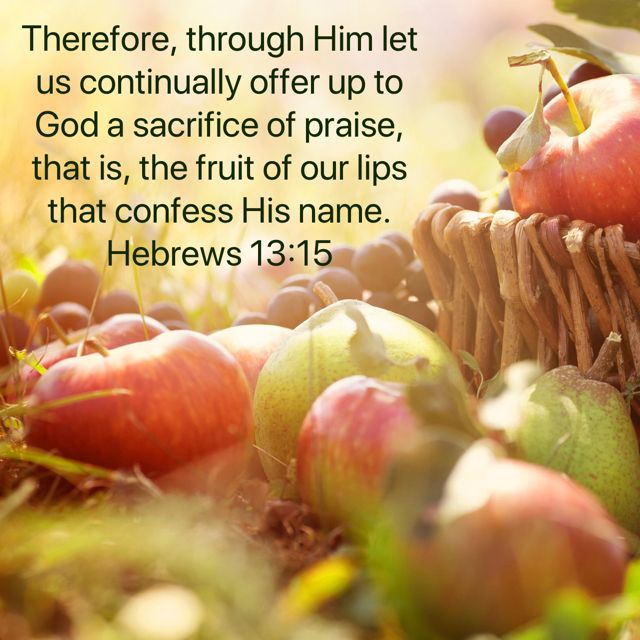
Hebrews 13:5-8, 15-16 (13:15) – August 31, 2025

            Have you ever known anyone who was really proper? Always every hair in place, always did the socially acceptable thing, and never put a toe out of line? Imagine a stern teacher, keeping order in the classroom by a mere look and a slow stare. Someone with high standards. Thinking about satisfying this kind of person makes me anxious, and nervous. I always need to be on my best behavior, minding my p’s and q’s. Just being around someone like this puts me on edge.

            But, what about putting God into the conversation? I know we are probably stretching our imaginations, but it is hard to imagine God wearing a wrinkled shirt, or with a sloppy haircut, or having a dirty face. For that matter, isn’t God perfect? Isn’t God prim and proper, always doing the right thing, never stepping out of line? Doesn’t God have incredibly high standards? Don’t we need to be on our best behavior with God, minding our p’s and q’s? Doesn’t that sum up many people’s conception of God?

Our Scripture reading today can sound like a list of rules. Do this! And, do that! And, don’t do this other thing! I can just imagine several stern Heavenly angels frowning, shaking their fingers at me if I step out of line!

However, the letter to the Hebrews was written to a bunch of scattered Jews who believed in Jesus as their Messiah, scattered in small groups throughout Asia Minor. What we know as Turkey, today. They had been chased out of Palestine by the Jewish and Roman authorities. Many of these scattered Hebrews were refugees. Migrants. People chased out of the land of their birth by an oppressive government that was out to imprison them, if not kill them, because they claimed Jesus as Lord and Messiah. So similar to migrants throughout history who come to other countries seeking asylum, because the place where they were born is very dangerous.

That is the background of the small congregations receiving this letter. This letter was copied and sent from place to place, a breath of fresh air, sound biblical teaching coming to these small groups of believers in Jesus.

Let us turn to our reading today, from Hebrews 13. At the beginning of the reading, the writer of this letter talked about sacrifice—the sacrifice for sin, which was one major way the Jews came before God in worship. In the time of the Jewish temple, it was common for Jews to bring animal offerings to God to make up for sins, to cover their sins and the sins of their loved ones, under the old covenant. One first-century Jewish idea of God was distant, angry, and even vengeful. God had incredibly high standards. God was someone to be placated. Even today, many people have that kind of view of God—a scary view. Not the view of God as loving, caring, and kind, at all.

However, we are going to flip that idea of a distant, angry, scary God. Many, many people are in fear for their religious beliefs. Governments throughout history have been cruel, indeed. Is the fear, anger and disturbance of the powerful governments today much different from the fear, anger and disturbance of the powerful people of Jesus’ day? I think not.

If we consider the wider picture today, around the world, countless followers of Christ are being actively and bitterly persecuted. It’s happening right now, in dozens of countries, officially sanctioned by their governments. Just as it was in the first century, for the small scattered congregations of Jesus followers.  

True, these scattered Hebrews in small groups have good reason to be afraid! On edge! Ready to run again. However, at the heart of this letter is a Kingdom ethic that turns worldly values upside down. Much like my summer sermon series of three years ago, when I preached on the Beatitudes, the first section of our Lord Jesus’s Sermon on the Mount from Matthew 5. That summer we looked at the Topsy Turvy Teachings of Jesus, talking about our service to others, loving mercy and kindness, and even being glad when we are persecuted, for Christ’s sake

Here, today, we can see the practical teachings in Hebrews chapter 13 as teachings of God’s Kingdom, a topsy turvy teaching which tells us that “greatness is revealed through serving others, worship is expressed in doing good, and righteousness is rooted in trusting God and acting with love. This radical re-ordering of values calls believers to live in a way that reflects the grace, justice and compassion of Christ.” [1] Truly, a topsy turvy way of living, then and now.

Instead of “pie in the sky” theological platitudes, this reading today talks about practical ways of living – and acting. These are practical ways to love others, just as Jesus told us to do. When Meier’s Bakery was donating many baked goods to our church, up until just a few years ago, we would donate those baked goods in turn to a local YMCA, for their men’s residence, which had many low-income residents. And then when we needed to stop that during the COVID shutdown, I quickly found another mission that was very grateful to receive those baked goods.

I’ve spoken about this worthy mission outreach before. A Just Harvest, which is located a block from the Howard Street El station, serves a hot meal to 200 to 250 low-income people every day, 365 days a year. This Christian group with their radical hospitality has boots on the ground. They truly welcome the stranger and reach out. They truly experience Christ’s constancy and amazing grace on a regular basis. In their daily ministry and outreach, they also rely on the Lord, as do the people in poverty they serve.[2]

            As we imitate these friends in welcoming the stranger, can there be a better way for any of us to be freed from fear, and become free to serve and praise and really live for God?

            And finally, as our instructions from Hebrews tell us, we can expand our vision of worship. Not just worship at 10:00 on Sunday morning! No, “True worship, the writer says, includes not just praise on our lips, but generosity and good works. I remind everyone: we are not doing these good works to get on God’s good side! No, the point of our good works is in response to what Jesus has done for us. Just as the whole book of Hebrews tells us!

Our freely given good works, generosity and radical welcome to all are “sacrifices pleasing to God.” It’s a complete picture of faith—one that blends word and deed, praise and practice, belief and behaviour.” [3]

            Yes, we truly bring God our sacrifice of praise! And, with boots on the ground, we can truly welcome the stranger and reach out in radical hospitality. And, we truly experience Christ’s constancy and amazing grace on a regular basis. What a way to live, the Jesus way.

Alleluia, amen.

@chaplaineliza

(Suggestion: visit me at my other blogs: matterofprayer: A Year of Everyday Prayers. #PursuePEACE – and  A Year of Being Kind . Thanks!


[1] https://www.churchofscotland.org.uk/worship/weekly-worship/weekly-worship-2025-august/31-august-twelfth-sunday-after-pentecost-year-c

[2] https://www.stewardshipoflife.org/2016/08/to-be-continued/

[3] https://www.churchofscotland.org.uk/worship/weekly-worship/weekly-worship-2025-august/31-august-twelfth-sunday-after-pentecost-year-c

Unknown's avatar

Came to Serve in the Neighborhood

“Came to Serve in the Neighborhood”

Mark 10:42-45 (10:43) – June 22, 2025

I’ve had a great respect and fondness for Fred Rogers, for many years. You know, Fred Rogers, of Mister Rogers’ Neighborhood. I watched the television show with my small children – all four of them, at various times. I so appreciated Fred’s gentle, caring, loving way of speaking to everyone. Not only the children. He was the real deal. Fred was a genuine, caring, compassionate person, interested in everyone and everything. And, especially in children.

Right now, with bombings and raids and rumors of war on the minds of many people worldwide, right now seems like a strategic time for us to be starting a summer sermon series on Fred Rogers. Today’s uncertain time in history is somewhat similar to the uncertain times in the area where the Rabbi Jesus grew up and was teaching and preaching. Occupied territory. I fear that your typical person on that first-century street in Israel did not have guarantees of security or comfort in their lives, either.  

Our reading is from Mark 10, just a few verses before the beginning of chapter 11, where Jesus enters Jerusalem on Palm Sunday for the final Passion week of His life. This is the very end of Rabbi Jesus’s three-year ministry. His disciples had been with Him, and learned from Him for three whole years. At this time just before the Passion week, Jesus calls all the disciples together to give them a short recap on the Gentiles—the Romans—the worldly way of dealing with pre-eminence, greatness, and authority.

I would like us to focus especially on a few verses from our Gospel reading today.  “whoever wants to become great among you must be your servant, 44 and whoever wants to be first must be servant of all. 45 For even the Son of Man did not come to be served, but to serve, and to give his life as a ransom for many.”

If we notice, Jesus did not want to be a big shot, strong-man, autocratic leader. Instead, we see the life of Jesus as offering unique insights and inspiration to all of us. Our Lord Jesus shows us how to live as a servant leader. In His life and teachings, Jesus consistently demonstrated the core principles of servant leadership. Our Lord Jesus embodied servant leadership in its purest form. [1]

People in the first century just did not understand. Not even when the Rabbi Jesus explained to the disciples that they needed to become completely of no account, like children, they still did not have any idea of what Jesus was talking about.

What is the overarching disconnect and problem here? “Power has been the perennial problem in human history. The reality of power is complex; its use and misuse in all human, social and political relations and interactions has been a question of utmost importance for all peoples.” [2]  

I strongly suspect that Fred Rogers would have objected to have his life compared to the earthly life of our Lord Jesus. However, I see some definite parallels. It is here that Fred Rogers shines. Yes, he totally understood and appreciated becoming like a child. He became vulnerable, totally open, on a daily basis. Fred Rogers turned the power dynamics of the popular world and of politicians and of world leaders on their head. Just exactly like Jesus did.

I’m going to tell you about a church I attended, years back, while I was still at seminary. Smaller church, here in the north suburbs of Chicago. The church was going to have a clean-up day in the nursery and small children’s area, after the morning worship service. The Sunday school and children’s ministry people had been planning it for a number of weeks. A number of people had dressed for church with their cleaning clothes on, blue jeans and t-shirts. The group even sent out for sandwiches for a quick lunch before they began to clean up.

            My husband Kevin approved of the clean-up; our children weren’t that far beyond that younger age group. We couldn’t stay after service that day, but said our good-byes to the cleaners. On our way out, we ran into the associate pastor. She had delivered the sermon that morning and worn her clerical robes in church. However, she had transformed; she had changed into blue jeans and a sweatshirt. She had a bucket and a spray bottle of cleanser in her hands, and cheerfully wished us well as my husband and I went off to the next event.

            My husband’s opinion of that associate pastor rose by leaps and bounds that day. He told me how impressed and pleased he was to see that she was willing to go to work without blowing her own horn. She was willing to get her hands dirty for the church, not just look pastoral and holy up front in the sanctuary. She was willing to be a servant, as well as a leader!

            I know I have mentioned this before, in my past sermons. I’ll mention it again. Fred Rogers was not only the star, puppet performer, writer and producer of Mister Rogers’ Neighborhood, he was also a Presbyterian minister in the PC(USA) denomination. He was ordained into the ministry of communication to families via the medium of television. “Fred Rogers committed his life to making television programs for the very young because he saw its potential as an instrument for good as a gift. He cared deeply about those on the other side of the screen – their needs, concerns, struggles and joys.” [3]

            Years ago, I sensed that deep caring through the television, as my small children watched Mister Rogers. I rejoice that my children – and countless others – had the opportunity and blessing to meet with this television neighbor, who strove to give his absolute best in a way that young children could readily understand.

That is exactly who and what Fred Rogers was, too. Each and every day. He said, “I’d like to be remembered for being a compassionate human being who happened to be fortunate enough to be born at a time when there was a fabulous thing called television that could allow me to use all the talents that I had been given.” [4]

I do not imagine that I have one quarter, even one tenth of the compassionate skills, talents and spiritual gifts that Fred Rogers was blessed with. But, I have the ability to be my honest, caring self in my ministry with others. God has given us all the opportunity and the blessing to be a blessing to others, each and every day.

How can you be a blessing to others, today? Tomorrow? Next month? We don’t need to be television personalities or leaders on the state or national level to follow in the way of Fred Rogers, and of other servant leaders. We can also be faithful in the little things, like clean-up day at the church. How can you and I serve God and serve others, today? We are all called to serve by Jesus. Let us serve in all honesty, caring, and love for others, in our neighborhood today.  

@chaplaineliza

(Suggestion: visit me at my other blogs: matterofprayer: A Year of Everyday Prayers. #PursuePEACE – and  A Year of Being Kind . Thanks!


[1] https://chieflings.com/examples-of-servant-leaders-in-the-bible/

[2] “Minjung and Power: A Biblical and Theological Perspective on Doularchy (Servanthood),” Kim Yong-Bock, at Religion OnLine.

[3] https://www.misterrogers.org/about-fred-rogers/

[4] https://www.misterrogers.org/about-fred-rogers/

Unknown's avatar

Gifts for Service

“Gifts for Service”

1 Corinthians 12:1-11 (12:4) – January 16, 2022

            Christmas was not that long ago. Less than a month ago! Remember the gift-giving? And, how much you wanted to see whether a close family member really liked your gift? Sometimes gift-giving can be stressful, especially when we exchange gifts with people who do not have a generous spirit. You know the kind, people who are so focused on themselves that they – or perhaps, we forget what Christmas is all about – receiving God’s greatest gift of all.

In this after-Christmas, post-gift-giving season, is there any wonder that many people are still up to their ears in the after-holiday bustle of gift returns or gift acknowledgements, and some even disappointment from all the gift-giving?

            God did not finish giving gifts when the Baby in Bethlehem was born in a manger two thousand years ago. By no means! God continues to give gifts to each believer, just as Eileen read to us. How generous of God! Our scripture reading says “God’s various gifts are handed out everywhere; but they all originate in God’s Spirit. God’s various ministries are carried out everywhere; but they all originate in God’s Spirit.”

Perhaps, we might paraphrase Paul: “Since you have already received gifts from God, what are you doing with them – lately?” But, perhaps I am getting too far ahead of myself. All of us as believers in Jesus Christ have been given some very special gifts from God! Perhaps you were not aware, or once knew and had forgotten, but it is true. Every Christian has a unique, God-given gift (or unique bundle of gifts!).

Oh, no, some say. I can just hear them. “Not me! I don’t have any special gifts from God! How could that be? I can’t do anything super special. I’m just a run-of-the-mill person.” Our commentator Karoline Lewis would strongly object! Lewis says we all need to recognize “that the gifts we receive are the very grace-acts of God. The term that Paul uses for “gift” has the same root as the word for “grace.” [1] These grace-filled gifts are charismaton in Greek, which is where we get the word “charismatic.” And, each believer receives these gifts!

            What a marvelous thought: each of us is a charismatic Christian, in other words! That is exactly what the apostle Paul says, right here.

Here in 1 Corinthians is not the only place where the New Testament gives a list of spiritual gifts. It talks about them in Ephesians 4, 1 Peter 4, and Romans 12, too. Plus, modern lists of spiritual gifts draw from all over the Bible. We can see that each believer has a unique, God-given gift (or unique bundle of gifts!). Individualized, and personalized!

So, what do we do, now that we know we all have spiritual gifts? Good question!

Just knowing about our spiritual gifts is only a small portion of actually having them and acknowledging them. The gifts of the Holy Spirit are an excellent way for each of us to serve God, in our own individual way. Do you know someone in the church who is a really helpful person? I can think of several. I think God may have given them the spiritual gift of helps. How about someone who is particularly encouraging to others? That person might indeed have the gift of encouragement.

What about the gift of administration, to organize and figure out what goes where? The gift of healing is seen physically, true, but it’s also used for mental, emotional or spiritual sickness or distress. And, the gift of leadership, of delegating tasks and gathering people together is another important spiritual gift.

            This is where our responsibility comes in. We don’t just sit on our hands and do nothing, now that we know about our personal spiritual gifts. God challenges us to recognize which of these spiritual gifts have been given to us individually and then to use them to the glory of God in our lives at home, at school, at work, and in the community. [2] As Paul says, it is the same God that causes these gifts to work in and through us. “God himself is behind it all. Each person is given something to do that shows who God is: Everyone gets in on it, everyone benefits.”

            Now, what about service to others? Specifically, I am thinking about the federal holiday that will be celebrated tomorrow. Yes, it is Martin Luther King Jr.’s birthday anniversary. Moreover, this holiday has been recognized as a Day of Service, nationwide.    

            The whole idea behind this service fits hand in glove with the United Church of Christ’s concept of the Beloved Community. Service is a hallmark for certain churches, especially in the UCC. The Rev. John Mingus describes the many-year journey of renewal his church took, Pilgrim UCC in Chattanooga, Tennessee, in a recent article on church renewal.

Rev. Mingus finishes his story with this moving summary: “the word is out about this church. Visitors come and stay. New folks go out and invite others. All kinds of folk see us as a safe place. We care for the homeless. We feed the hungry. We work for peace and public education. We have children and programming. We are a church in mission and when we gather it is as a beloved community. We are black and white, gay and straight, young and old, and much more. In our radical hospitality and at prayer people know that they are loved.” [3]

            Serving with spiritual gifts? Or providing a Day of Service? Or is it showing our neighbors we are indeed a Beloved Community? However you explain it, God will be so pleased that God’s people are given something to do that shows all people who God is.

God is indeed behind these marvelous expressions of Beloved Community, in exercising our spiritual gifts. Alleluia, amen.

@chaplaineliza

(Suggestion: visit me at my other blogs: matterofprayer: A Year of Everyday Prayers. #PursuePEACE – and  A Year of Being Kind . Thanks!


[1] https://www.workingpreacher.org/commentaries/revised-common-lectionary/second-sunday-after-epiphany-3/commentary-on-1-corinthians-121-11-2

[2] http://www.sundayschoollessons.com/gift.htm

[3] http://d3n8a8pro7vhmx.cloudfront.net/unitedchurchofchrist/legacy_url/11073/10JourneyTowardBelovedCommunity.pdf?1418436796

Unknown's avatar

Jesus Calling!

“Jesus Calling!”

Mark 1:14-20 (1:17) – January 24, 2021

            Have you ever heard someone calling, and responded right away? I am sure you have. Whether it is a call out to the back yard or the garage to come in for dinner, or a call to join in on a project or job, have you felt eager to respond? Excited? Like you can’t wait to begin?

            I wonder whether the disciples felt that way when they responded to Jesus?

            Last week, we took a closer look in the Hebrew Scriptures at the Lord’s call of the young Samuel when he was serving along with the high priest Eli in the Tabernacle. Today, our Scripture reading talks about Jesus calling four of His disciples.

            But, wait a moment. The four fishermen were actively involved in their secular jobs when Jesus came up to them and called. Simon and Andrew owned one boat at least, perhaps more than one. James and John were the sons of Zebedee, and we do know that Zebedee had a fishing business with at least several boats on the Sea of Galilee. So, we are talking about some serious fishermen seriously involved up to their elbows in fishy business.  

            I am sure our Lord Jesus talked with loads of people each week. Except – I don’t think He called all of those people to be His disciples, His followers. Do you wonder about these four fishermen, in particular? Does something about this reading today bother you? How could Simon, Andrew, James and John up and leave everything right away? How could they walk away from their nets and respond to Jesus’s call – immediately?  

            Let’s consider a different translation of this reading, from The Message. Verses 16-18: “Passing along the beach of Lake Galilee, he saw Simon and his brother Andrew net-fishing. Fishing was their regular work. Jesus said to them, “Come with me. I’ll make a new kind of fisherman out of you.” I’ll show you how to catch men and women instead of perch and bass.”

“They didn’t ask questions. They dropped their nets and followed.”

            Perhaps you might not believe this narrative. Does anyone actually DO that anymore? I mean, dropping everything and just following Jesus when He calls. Maybe, in Bible times, people did things like that. But, today? Does anyone answer God’s call like that anymore?

            Let’s be honest. I cannot imagine doing what these four fishermen did. True, we do not have many professional fishermen in the Chicago area. But, can you imagine leaving your full-time job – or, if you don’t work full-time, leaving whatever takes much of your time and attention each day. “Most of us, truth be told, would find it very hard to leave work and family and friends and all the rest to venture into such an uncertain future. Does that mean we’re more or less failures as Christians? Or at least that we are less faithful than Andrew and Peter, James and John?” [1]

            I started off looking at Jesus calling four disciples. He chose them and called them, knowing them better than they knew themselves. Why don’t we flip this around and look at this scenario from the fishermen’s point of view. These four guys had Jesus call, to follow Him.

We read that they got up without hesitation, leaving their nets and boats and catches of fish behind. Immediately! Did they feel eager to respond? Excited? Like they couldn’t wait to begin to follow this unconventional Rabbi?

“We are called, perhaps not so much to follow, but to take Mark’s ‘immediately’ seriously. This is not, “wait a few minutes. Let me pack my bag. I have a few more arrangements to make.” No preparation. No packing list. No recommendations of what to take, what to do.” [2]

When I first felt a call to serve God, I was in high school. I did not listen for a long time. At least, I don’t think I heard clearly. Sure, I heard something of a message from God for some time, but it was muffled, or garbled. I did work as an eager church leader, as a faithful church worker for years and years before I had the opportunity to go to seminary when I was forty years old. But – isn’t being a faithful church worker following the call of God, too?

As commentator David Lose says, “We follow [Jesus] in particular and distinct ways that may or may not be like the first disciples. And that, I think, is the point. Perhaps we follow by becoming a teacher. Perhaps we follow by volunteering at the senior center. Perhaps we follow by looking out for those in our schools who always seem on the outside and invite them in.

“Perhaps we follow by doing a job we love as best we can to help others. Perhaps we follow by doing a job we hate but contributes to supporting our family and helping others. Perhaps we follow by being generous with our wealth and with our time. Perhaps we follow by listening to those around us and responding with encouragement and care. Perhaps we follow by caring for an aging parent, or special needs child, or someone else who needs our care. Perhaps we follow by….” [3] Well, you get the idea.

Jesus calls us all to follow Him, in any number of ways. That means us knowing that Jesus is for real – He is the real thing, the real deal, the genuine article.  

 When we are called to follow Him, that means He calls us to turn our backs on something else in our lives. Is it possible that sometimes we get altogether too comfortable, too unwilling to risk, too unable to step out in faith? My challenge to all of us: be willing to step out, and follow the calling of Jesus, whenever and wherever He wishes us to go.

Please God, I’ll go.


[1] http://www.davidlose.net/2015/01/epiphany-3-b-following-jesus-today/

“Following Jesus Today,” David Lose, …in the meantime… 2015.

[2] https://www.workingpreacher.org/dear-working-preacher/the-immediately-of-epiphany

“The Immediately of Epiphany,” Karoline Lewis, Working Preacher, 2015.

[3] http://www.davidlose.net/2015/01/epiphany-3-b-following-jesus-today/

“Following Jesus Today,” David Lose, …in the meantime… 2015.

@chaplaineliza

(Suggestion: visit me at my other blogs: matterofprayer: A Year of Everyday Prayers. #PursuePEACE – and  A Year of Being Kind . Thanks!

Unknown's avatar

Come, Holy Spirit!

“Come, Holy Spirit!”

Acts 2-3 pentecost

Acts 2:1-4 (2:4) – May 31, 2020

My parents grew up in the 1920’s and 1930’s. That was the golden age of radio. When I was young, my mother used to tell me about radio serials she used to follow. Serials like the Lone Ranger, Little Orphan Annie, Buck Rogers, and the Cinnamon Bear. I know many people all across the country followed these programs closely every week, and listened to even more.

I think of our friends, the followers of Jesus on that hilltop. Like in the radio serials, when last we left our intrepid heroes, we saw them with heads toward the sky. They watched the risen Lord Jesus ascend into heaven. Fast forward to this week. Thank you, Levi, for reading our Scripture from chapter 2 of Acts.

Only a few days have passed since that miraculous happening. Jesus disappeared into heaven. Yes, Jesus gave His followers their orders. Marching orders! But—where are the disciples now? What are they doing? Are they fearlessly marching out into Jerusalem, Judea, Samaria, and to the ends of the world? Come on, guys! What gives? What’s the matter? The followers of Jesus—both men and women—are waiting for something; something that Jesus foretold, something big that had not happened yet. Everyone was together in one place—waiting.

At least they all were in Jerusalem. After all, another religious festival was right around the corner. Fifty days after the Feast of Unleavened Bread (or Passover) the Festival of First Fruits, or First Harvest was celebrated. This festive day was also a glad ceremony in the Temple, and many Jews from hundreds of miles around were in Jerusalem to celebrate.

At least the Jews did not have a pandemic to worry about. No, Jerusalem and the surrounding area were packed with visitors ready to celebrate at the special worship services at the Temple, ex-pat Jews from all across the known world at that time.

And, where were the followers of Jesus? Up in that upper room, presumedly the same room where Jesus and the disciples had celebrated that Passover dinner the night before Jesus was crucified. They were there, but yes, they were shut away. Presumedly behind locked doors, for fear of what the authorities might do to them, even weeks after the crucifixion of their leader, the Rabbi Jesus. Or, is that the Messiah Jesus? Or, the risen, ascended Jesus?

The disciples of Jesus were all gathered together in one place. When, on that Harvest Festival morning, a noise like the rush of a mighty wind blew through that upper room. Apparently, it was loud enough—surprising enough—so that people on the street heard it, too!

The Holy Spirit came with full sound effects, with heavenly flames over each head and I suspect with some kind of noise, music or something that caught everyone’s attention for some distance. After the energizing of the Holy Spirit, the followers of Jesus couldn’t help themselves. They spilled out into the street, and started speaking other languages, as the Holy Spirit gave them knowledge and utterance. Surprising? Amazing? Miraculous? Yes to all three!

I think the Holy Spirit moved mightily upon the disciples, and the very breath of the risen Jesus was felt by many—on that day of Pentecost, through the centuries, and to the present day.

The disciples of Jesus were all gathered together in one place. I envy them.

Because of the pandemic and the shelter-in-place order I have not been able to gather together with a number of other believers for almost three months. And, neither have you.

Sure, we have had online worship, Zoom bible studies and prayer meetings, and telephone conversations. Perhaps individual Christians have met each other in the neighborhood, taking their dogs for a walk or running into each other at the grocery store. We remain socially-distant, to be safe and caring for others who are elderly or in fragile health—but it is not the same as in-person worship, IRL. Not the same, at all.

However—do we depend on a structure, a building, a tall steeple to witness to the Resurrection? Or, is the Church something more, something much bigger than this building?

The COVID-19 pandemic did not surprise God. I am not here to tell you this is a judgement of God upon the earth, or upon one group of people or another. I do not believe a good, gracious, loving God works that way. But—I want to suggest something else. Is it possible that we, as followers of Jesus, can also serve God by being separate, socially-distant, apart and still caring for one another? Can we follow the final instructions of our Lord that He gave just before He ascended, to go to Jerusalem, Judea and Samaria, and even to the ends of the earth?

The newly-energized disciples spread the Good News of Jesus and His Resurrection, and of God’s reconciliation. Boy, did the Good News travel! The authorities in and around Jerusalem got seriously worried, so upset that they eventually started to crack down on anyone who called themselves a follower of the risen Jesus. The disciples needed to move out from Jerusalem, and started taking the message of the Good News out to the ends of the earth.

God did a new thing at Pentecost, when the Holy Spirit came with power! I wonder if God is doing a new thing now, today? It’s possible that “God will use such a time as this to blow new life through and among and into and upon us. For our own sakes, yes. But even more so for the sake of those to whom we are sent.” [1]

We, the Church, are on assignment—out among the people God wants us to minister to. Feeding the hungry, comforting the afflicted, welcoming the stranger, taking care of the least of these. We can all tell people about the Good News—the wonderful news of God’s reconciliation and healing. Alleluia, amen!

[1] http://dancingwiththeword.com/all-together-in-one-place/

@chaplaineliza

(Suggestion: visit me at my regular blog for 2020: matterofprayer: A Year of Everyday Prayers. #PursuePEACE – and my other blog,  A Year of Being Kind . Thanks!

Unknown's avatar

Baptism: A Gift of God

“Baptism: A Gift of God”

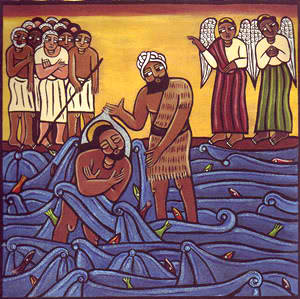
luke 3-21 african depiction baptism

Luke 3:21-22 – January 13, 2019

When I was a small child, I remember being so excited about gifts. Christmas gifts, birthday gifts, it did not matter. I remember how wonderful it was for me to receive gifts. I also remember when I was in middle school, when I first bought my mother a birthday present, a little vase from a gift store. I believe it was the first birthday present I had ever bought and given to anyone. I really hoped she would like it.

I also remember when I was a little older, being so excited to share my newly-opened gifts with one of my best friends. I would bring over to her house the sweater or special socks or wonderful book I had received, and be so happy when she rejoiced with me over my awesome gift. Can you think of any wonderful gifts that you wanted to share? Perhaps a brand new bicycle, or an engagement ring, or some extra-special news from far away. The wonderful joy of receiving the gift was made even more special by sharing the joy.  

One very special gift-giver is God. God gives wonderful gifts to God’s people. We can hear about that gift in our Gospel reading from Luke 3. “When all the people were being baptized, Jesus was baptized too.” When John the Baptist urged people to come forward and be baptized, Luke’s Gospel says all the people were baptized. That means all of them. All who heard John’s message and invitation came forward to receive God’s wonderful gift of grace through baptism.  

Who among us is perfect, here? Who never sins? Who never does anything wrong or never says mean or angry things, or never steps out of line? Not me. I know I fall short of where God wants me to be. I am hesitant to accept this free gift of God’s grace, at times. I know I sin, I know I miss the mark of God’s righteousness that is set for me in the Bible.

This is the case with you, and with everyone in the world, whether they admit it or not. Romans 3:23 tells us “For all have sinned and fallen short of the glory of God.” This is a heavy burden to lay on anyone. Yet, what does the Apostle Paul tell us in Romans 6:23? Yes, the wages of sin—our payment for sinning—is death. Yet, the free gift of God is eternal life through Jesus Christ our Lord.

As we watch in the baptism service, some may wonder. As we see, in Luke 3, some wondered there, too. Luke tells us they were questioning in their hearts whether John the Baptist might possibly be the Messiah. John redirected their questioning and their gaze by pointing to one who would come after him. John pointed to Jesus.

The Rev. Jeff Campbell relates, “A loving God is constantly reaching out, wanting to be at the center of our lives. And although we might still have questions, we are directed to Jesus, just as John directed those gathered who were seeking a Messiah.” [1]

Baptism is a sign of this marvelous, free gift of God. God’s rich and abundant grace is poured out. As we can see from our reading today in Luke, all the people present received this marvelous gift. Jesus was an extra-special case, since He already had an intimate relationship with His Heavenly Father. Looking at today’s reading, we can see what happened, from Luke’s account: “And as [Jesus] was praying, heaven was opened 22 and the Holy Spirit descended on him in bodily form like a dove. And a voice came from heaven: “You are my Son, whom I love; with you I am well pleased.”

Jesus showed, in part, that by being baptized He was dedicating His whole life to following His Heavenly Father. The Holy Spirit descending on Jesus was a visual sign of the gift of grace freely given that descends upon each one who is baptized. What a marvelous visual sign for all of us to treasure!

Then, as a sign of love and response, we strive to love and to serve God in Christian fellowship and service, all the days of our lives. Freely and without obligation.

I want to caution everyone here. Baptism is not something we do on our own, not some rung of the ladder we are building to get into God’s heaven. No, us building a ladder of good works will never work. God’s grace covers everything, and the free gift of God is given on our account. It’s not us at all. It is all God. God’s amazing love and indescribable gift.

When a baby is baptized, the parents tell God and the church, “Our child belongs to the Lord.” When an adult is baptized, he or she tells God, “I belong to you. I trust you with my whole life.” At Jesus’s baptism, God’s voice said aloud that Jesus is God’s beloved Son. Jesus is God’s well-loved Child. It pleases God that Jesus trusts and obeys God. That makes God glad beyond measure. [2]

Rev. Janet Hunt, ELCA pastor from DeKalb, relates the following: “Jesus’s life did not measure up to much by those standards you and I often hold dear. He never married or had a family. From all we can tell he owned no property, had no wealth to pass on once he died. The results of his work were awfully hard to measure: unless you kept track of the numbers healed and taught and fed. A whole lot of the time the crowd he hung around with was not the sort that could help him ‘get ahead.’ In fact, they were those most respectable folks then and now might mostly avoid. In the end, Jesus died a painful, shameful death, abandoned by his closest followers….being claimed and loved by God brings power and purpose — to Jesus, yes, but also to each and every one of us who have heard even a whisper of the promise Jesus hears today: “You are my Child, the beloved…” But that power and purpose are not only for this life alone. Oh, these must be promises which extend far beyond the physical and must carry us not only through this life but into life eternal, don’t you think? And isn’t it ours to begin and end each day wondering at the meaning of having been called by name… and belonging to God.” [3]

What wonderful gifts, to all of us. What an indescribable gift of grace, given freely in baptism, to us all!  

As the Holy Spirit descends like a dove from heaven, we all can hear the voice of God, whispering to each of us, “You are my son. You are my daughter. My beloved one. With you I am well pleased.”

Each of us can say, “I am God’s beloved.” Remember our baptismal vows, and rejoice!

[1] https://www.umcdiscipleship.org/worship/season-after-epiphany-2019-part-1-worship-planning-series/january-13-baptism-of-the-lord-sunday-year-c/baptism-of-the-lord-2019-year-c-preaching-notes

[2] https://www.umcdiscipleship.org/worship/season-after-epiphany-2019-part-1-worship-planning-series/january-13-baptism-of-the-lord-sunday-year-c/baptism-of-the-lord-2019-year-c-preaching-notes

[3] God’s Claim, God’s Protection…

http://dancingwiththeword.com/gods-claim-gods-protection/  January 6, 2019

Water Drop Words – Star Words

Marci Auld Glass is the pastor of Southminster Presbyterian Church in Boise, Idaho. She wrote a post several years ago in her blog Glass Overflowing where she said, “The premise is this: the magi followed the star to find baby Jesus, bringing their gifts. We are also seeking Jesus, trusting God can/does use many signs [or gifts] to guide us closer to the Divine presence.”

Marci says, “People are invited to take a star in worship. On each of the stars is a word. I invite people to trust the word that selects them, but we do not police the star choosing, so if people need to trade out a word, they are free to do so. When we first started doing this, people weren’t sure they wanted to trust the words they drew. Now it has become an important part of our congregation’s liturgical year.”

Here at St. Luke’s Church in Morton Grove, for the past few years we have been celebrating a Reaffirmation of Our Baptism on the second Sunday of January, the Sunday after Epiphany. Instead of star words, some churches have used water drops, and passed out water drop words to their congregations. That is what we are doing today.

The water drop gifts are passed around to the congregation using the same offering plates that we use later on in worship to gather up the tithes and offerings. As people help themselves to a water drop word (without looking—just reach in and grab!), the significance is not lost. In this moment, people are not asked to give; they are invited to receive. It reminds us that this is always the order of things in God’s kingdom—God always gives first, and then we are invited to respond with our gifts and ourselves.

As the Holy Spirit descends like a dove from heaven, we all can hear the voice of God, whispering to each of us, “You are my beloved one. With you I am well pleased.”

Each of us can say, “I am God’s beloved.” Remember our baptismal vows, and rejoice!


@chaplaineliza

(Suggestion: visit me at my regular blog for 2019: matterofprayer: A Year of Everyday Prayers. #PursuePEACE – and my other blog,  A Year of Being Kind . Thanks!


Unknown's avatar

All the Saints

“All the Saints”

Rev 7 multitude white-robes

Revelation 9:7-28 (9:7) – November 5, 2017

Today, we commemorate All Saints Sunday. The first Sunday of November, that day we remember all the saints who are now in heaven, worshiping God in that great cloud of witnesses. We also remember familiar people, relatives and friends known to us, dear to us, who died since last All Saints Day last year. What is it about these formal occasions of remembrance? Often, we remember those who have sacrificed much, displayed tremendous bravery, or were persecuted—even died—at tremendous risk to themselves.

What is it that causes you and me to be listed in among a great multitude of saints like these? Or, aren’t we even to be worthy to be listed on the same page as these rarefied superstar saints? These women and men who followed after God, no matter what?

One of our Scripture readings today comes from the book of Revelation, starting at verse 9: “After this I looked, and there before me was a great multitude that no one could count, from every nation, tribe, people and language, standing before the throne and before the Lamb.”

We break into the narrative as the elderly John has another vision, this time a scene of heaven. And, instead of seeing a predominance of Jews and only a sprinkling of other tribes and people groups, John sees a great multitude of all colors, all ethnicities, all languages and dialects, from every place on the globe.

I am blown away by that vision, the more I think about it. I am in awe, because the great multitude is of every possible description, every possible people group under the sun. Not just me and my family, not just me and the people from the neighborhood where I grew up. Not just people from one region, or one country, or one ethnicity. But, people from everywhere.       These people of the vision are called “saints,” and many people today have only one specific idea of what a “saint” is. St. Francis of Assisi, or St. John of the Cross, or St. Martha—the patron saint of our neighbor Catholic church, or the newly beatified saint, Mother Teresa.

Robert Louis Stevenson, writer of Kidnapped and Treasure Island, has a different definition of “saints.” “The saints are the sinners who keep on going.” And, both apostles Paul and Peter call their friends “saints” in the greetings, to all of the people who receive their letters.

But, we know very well that life often does not go smoothly. Not for us, not for our friends and families, and certainly not for the multitudes who lived in centuries past. Interesting, that “because we sinners are made holy by God’s grace, and not by our own actions, we are able to keep on going as Stevenson says.  Our keeping on in life often involves suffering.” [1] And, if we know anything about history, we know that believers in Christ often had to deal with grief, pain, suffering, and even persecution.

When John received this grand series of visions that he wrote down in the book of Revelation, he was often puzzled. He had to ask the people or elders or angels around him what it was he was seeing. As is the case here: “Then one of the elders asked me, “These in white robes—who are they, and where did they come from?” 14 I answered, “Sir, you know.”

Leading question, you may say! John persuades the elder to answer the question himself. ““they are before the throne of God and serve God day and night in His temple; and He who sits on the throne will shelter them with His presence. 16 ‘Never again will they hunger; never again will they thirst. The sun will not beat down on them, nor any scorching heat.”

It sounds like to me that these people in heaven, who are identified as “saints” in other places in the book, no longer have to go through that valley of the shadow here on the earth, where God walks right by their side as they are in difficulty. They no longer need to face challenges of health reversals or job loss or crushing poverty or horrible accidents, or various calamities of one sort or another. They are at God’s side in heaven, and never have to experience those trials, losses, hunger and anguish any more.

But we are still left on this side of the veil. On this side, on a troubled world where suffering and loss and fear and anxiety rear their heads all too often. Especially grief, where we mourn the loss of loved ones, friends and relatives who left us too soon.

Rev. Janet Hunt talks about a sad situation like this: “And yet, for all of those for whom I light a candle and remember each All Saints Sunday, there is still really just the one I carry closest of all. One whose dying has me yearning most deeply for the promises of this day.

“It came to me again last week when a beloved cousin came to visit. He had stopped to see his folks the night before he flew out and as he sat with them he told his dad he was going to see Kathleen. “You remember Kathleen, don’t you dad? She was Tommy’s wife.” (Kathleen is my mother.)

“Now in these recent years my dad’s brother does not remember as he once did. For a moment last week, though, there was clarity as he remembered his only brother and as he registered all over again the fact that he had died and with that remembering, his face fell along with his tears. And mine did, too, to hear of his remembering.” [2]

Grief, sorrow and loss are like that, sometimes. We can be fine, content, living our lives. Then, out of nowhere it seems, the thought of that special loved one, that dear friend who is no longer with us in this world, comes to mind.

And then, Janet Hunt reminds us, “nothing makes us more grateful than the gift of that time and place so vividly described in today’s words from Revelation. A time and place:

  • where the whole world will gather and join together in song and where we will be washed clean,
  • where hunger and thirst will no longer hold sway,
  • where there will be shelter from all that would harm,
  • where the very water of life will sustain us,
  • and where God Himself will bend low to wipe away our tears.” [3]

Is such a place even possible? In those times when you or I are grieving anew, remembering with sorrow or longing in our hearts, the apostle John assures us that “Salvation belongs to our God, who sits on the throne, and to the Lamb.” And, ““Amen! Praise and glory and wisdom and thanks and honor and power and strength be to our God for ever and ever. Amen!”

In plainer words, from his first letter to the scattered believers in Christ, John gives us further assurance: “Dear friends, now we are children of God, and what we will be has not yet been made known. But we know that when Christ appears, we shall be like Him, for we shall see Him as He is.”

Today, we have a foretaste of heaven from both Scripture readings. Revelation tells us of the wonderful worship service in heaven, where everyone is praising God. And 1 John lets us know that when our Lord Jesus appears to each of us, we shall be like Him in glory.

“So with all of you, I will light the candles this All Saints Day. In memory and in powerful hope we will light the candles. Standing confident in the very promises of God we will light them.[4]

Amen. May it be so. Amen.

[1] https://preachingtip.com/archives-year-a/pentecost-year-a/all-saints-day-all-saints-sunday/

[2] http://dancingwiththeword.com/all-saints-day-in-memory-and-in-hope/

[3] Ibid.

[4] Ibid.

@chaplaineliza

(Suggestion: visit me at my regular blog for 2017: matterofprayer: A Year of Everyday Prayers. #PursuePEACE – and my other blog,  A Year of Being Kind . Thanks!)