

“A Foreign Neighbor’s Thankfulness”
Luke 17:11-19 (17:19) – August 10, 2025
One thing I have noticed that is really sad is when someone is left all alone – on purpose! Not necessarily picked on and jeered at, although that can be horrible, too! But, sometimes a person can just be left alone, left out, isolated, even shunned.
In our Scripture reading today, we have exactly that happening. Except, the Jewish community was required to do this, to ignore or turn their backs on someone! This was a serious matter. Skin diseases were not anything anyone wanted to fool around with. Because medicine and treatment centuries ago was rudimentary and simple, there were not many things doctors and medical providers had that was in any way effective.
Plus, the Law of Moses specifically instructed the Jewish people to keep their distance from anyone with a skin disease, and not allow them to mingle with people who did not have skin diseases. All of these people with skin diseases were referred to as “lepers,” and they had to cry out, “Leper! Unclean!” so everyone else would get a warning not to get anywhere near. These people were outside of their society, forever out of reach. Forever away from their families, their friends, their community, and their synagogue.
Just so everyone here knows what the situation was, for these ten people, as we consider our Scripture reading today, this severe, shunning treatment was what happened wherever these poor people with skin diseases went.
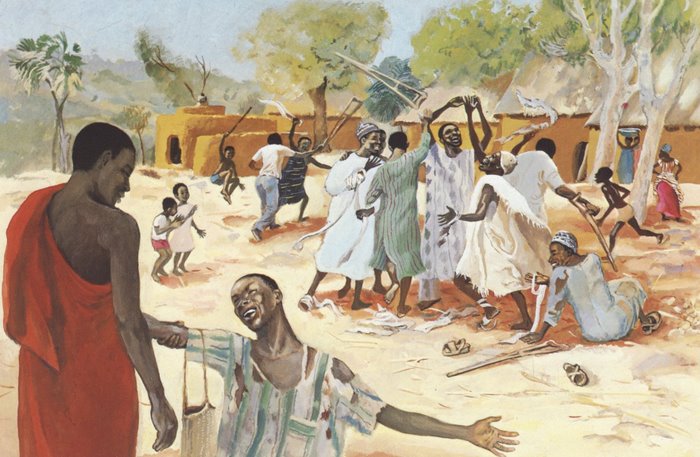
Let us listen again to these words from Dr. Luke, chapter 17: “Now on his way to Jerusalem, Jesus traveled along the border between Samaria and Galilee. 12 As he was going into a village, ten men who had leprosy met him. They stood at a distance 13 and called out in a loud voice, ‘Jesus, Master, have pity on us!’”
Here is the situation, the set-up. We have ten men who have banded together, as a group of lepers. They obviously have heard of this Jesus of Nazareth, and are actively seeking healing! The Rabbi Jesus hears them cry out, and responds immediately. Jesus offered immediate and profound healing to all ten men!
This kind of immediate healing is sometimes difficult for us to wrap our heads around. From time to time, I have faithful believers who come to me as a hospice chaplain and tell me, trustingly, “I have faith to believe God, and believe that my loved one in hospice will get well.” Or, “I believe in miracles, and I know that God will hearken to our voice.”
Yes, I believe in God, I believe in miraculous healing, and I believe that God heals in many different ways. Perhaps God wants to have the patient receive ultimate healing, to leave this world and enter God’s presence? Perhaps God wants to see that person face to face? And yes, we all have an expiration date.
Whatever the reason, nine of the ten men did not return to the Rabbi Jesus to thank Him for their immediate healing. Except – one man did. “The others are too busy getting back into their proper societal position. And who could blame them? After all, they were just following Jesus’ instructions, right? The one who returns is a real outsider – a Samaritan – who took a chance, who followed his heart and gave thanks to the one who really mattered.” [1]
This man, this Samaritan was in a precarious position. Not only was he rejected by the Jewish community because of his ethnicity, he was also ostracized because of his health condition. If you all remember, I have been preaching a summer sermon series on Fred Rogers. Many of these sermons have also been about outsiders, about people rejected by their communities, rejected from their neighborhoods.
No one enjoys being shut out of their community, and ignored by their neighbors! Not in the first century, and not in the twenty-first, either.
This is the last week in our summer sermon series on Fred Rogers, of the television show Mister Rogers’ Neighborhood, which aired on PBS for more than 30 years. As I’ve said in weeks past, I have great respect for Fred Rogers. I have even said a number of times (only partly humorously) that when I grow up, I want to be Mister Rogers.
Fred Rogers was revolutionary in his treatment of people, especially children. He considered children to be very significant individuals, worthy of respect and caring and love. “The most controversial thing Fred Rogers ever did is tell children that they are special. That their lives have value simply because they exist. That they don’t have to do anything sensational to be deserving of love.” [2] The same could be said of these people with skin diseases, and the same could be said of each and every person in the whole wide world.
These ten lepers were shunned, were passed over, were not even considered “people” by most of those at a distance from them. But, none of that mattered to Jesus. He considered each one a valued, special person, a creation of God. No matter what their health condition, no matter what their ethnicity.
“Jesus offered a gift of profound healing to the ten who approached him that day. I wonder how you and I might be agents of such healing in our world today. Indeed, in a world too often marked by fear and division, might healing just be ours to offer (and in turn, receive) if we simply reached out with a word of kindness, curiosity, or affirmation even to someone we have never seen before who we may never see again? Or to one who we have passed by a thousand times (as those ten lepers must have been passed by a thousand, thousand times) without even noticing before?” [3]
I know I often ask in my sermons “what would Jesus do?” Who would Jesus heal? Who would Jesus love?”
This week, again, I am going to change up my question, and ask “what would Fred Rogers do?” Who would Fred love? Who would Fred call his neighbor? I think, everyone. Each and every person. Go. Go, and do that.
Alleluia, amen.
(A big thank you to the online resources for Mr. Rogers Day – the Sunday nearest March 20th, Fred Rogers’ birthday. These resources come from the Presbyterian Church (USA). https://www.pcusastore.com/Content/Site119/Basics/13792MrRogersIG_00000154465.pdf )
(Suggestion: visit me at my other blogs: matterofprayer: A Year of Everyday Prayers. #PursuePEACE – and A Year of Being Kind . Thanks!
[1] https://www.stewardshipoflife.org/2013/10/first-and-always-give-thanks/
[2] https://www.thedailybeast.com/we-need-mr-rogers-now-more-than-ever-but-do-we-deserve-him/
[3] http://words.dancingwiththeword.com/2016/10/the-tenth-leper-and-how-god-is-already.html

 Pastor, Preacher, Pray-er