Unknown's avatar

The Light of the Lord

“The Light of the Lord”

isa-2-5-teach-me-to-walk-in-the-light

Isaiah 2:1-5 (2:5) – November 27, 2016

At this holiday and homecoming time of the year, some people’s thoughts turn to those who are traveling. Those who will be coming to a gathering, a party, a meal. Have you been waiting for someone to arrive at a gathering? A meal, perhaps? At this time of year, the sun sets early. People often put the porch light on to welcome the traveler, in hope and expectation. That is the situation we have here, in our scripture passage from the prophet Isaiah.

And, what a grand porch light it is! Let’s read from Isaiah 2, verse 2: “In days to come the mountain of the Lord’s house shall be established as the highest of the mountains, and shall be raised above the hills; all the nations shall stream to it.”
But, what of Isaiah’s audience? What about them? Times in the nation of Judah were uncertain, to say the least. Spirits were low. The Israelites were in fear for their lives. The Assyrian armies were closing in. The nation of Assyria was a major world power in that time, conquering nations, kings, and vast areas of land right and left. (This was several centuries before Jesus Christ was even born in Bethlehem.) What about today? We can look at our times, too. A great deal of uncertainty, everywhere we look. Uncertain times here, locally, in the immediate community. On a nation-wide scale, as well. What about internationally? However—Isaiah brings a word of hope to people of his day, and hope to people of ours, too.

The prophet gives a prophetic announcement in these verses. It isn’t a hymn of praise, but instead words to let people know that God is not absent or unable to help, but instead a very present help. A hope, in times of uncertainty and need. The very promise of salvation, to not only the people of Israel, but to anyone who hears these words. We can see that from the mention of “all nations” streaming to the mountain of the Lord.

Many people in Isaiah’s time frankly doubted God’s power and faithfulness, with the Assyrians breathing down their necks. These were uncertain times, indeed. Can you imagine, a huge army right on our border, and not very much in between? Imagine the fear, anxiety, and conflict for those people of Judah! Even though, today, we here in the United States are not in such dire straits as little, puny Israel, we face uncertainty and times of conflict, too.

What does the prophet have to say about that fear, that anxiety? He brings words of hope and expectation to his listeners. Listen to verse 3: “Many peoples shall come and say, “Come, let us go up to the mountain of the Lord, to the house of the God of Jacob; that God may teach us His ways and that we may walk in God’s paths.” So, God will begin a time of learning, a time of pilgrimage! “A purposeful journey to a holy place.” [1]

Again, we see that the prophet tells us many, many people will come to God’s house! Remember, this proclamation refers to all nations, all peoples, and addresses all who have open ears to hear.

All this will occur “in days to come.” Sure, the prophet is not specific; this is an indefinite time, but there also will be a radical transformation! Listen to verse 4: “[God] shall judge between the nations, and shall arbitrate for many peoples; they shall beat their swords into plowshares, and their spears into pruning hooks; nation shall not lift up sword against nation, neither shall they learn war any more.”

Can anyone read these verses and not long for peace? And not have keen hope and expectation for this coming time of peace and concord? The Lord God will sit as a judge or arbiter for many, many people. And—this is fascinating—the nations, themselves, shall willingly lay down their weapons. Many nations shall cause their weapons—their swords—to be turned into something radically different. To rephrase, “God promises that there will be a time when everyone gets along.  It will be so peaceful that people won’t need swords and other weapons anymore.  So, they will turn them into garden tools.” [2]

It does not take a brilliant student of current events to tell us that this prophecy is not here, yet. We regularly hear about wars and rumors of war today. We see for ourselves that nations are at each others’ throats, bickering, sometimes fighting, and even committing acts of mass destruction and death. What is to be done?

The prophet brings these words of hope and expectation to a fearful and anxious people, at an uncertain time centuries ago. Is the situation much different, today? Our time is filled with conflict. Fearful, anxious, and uncertain, too.

The prophet’s message holds out hope and expectation, true. But hope would be empty if we did not have a situation where we needed God’s help. We have to see our desperate need first, in order for us to realize that we are sunk without God. This whole mindset of conflict, fighting and resistance to any kind of peace certainly registers as a time of great need. The prophet was calling to the nation of Israelites just as much as he is calling to us.

“God is taking us somewhere we cannot go on our own, not because of our righteousness, but because of God’s goodness. The coming peace is God’s, but it is promised to us. And thus, like Israel, Isaiah calls us to act in the meantime as though the promise is ours.” [3]

Today is the first Sunday in Advent. We have the reminder of our hope set before us, in this Advent wreath. Today, Carl and Irene lit our first candle, the candle of hope. Yes, both scripture readings this morning spoke of expectation in the Lord’s working, in different ways. Yet, how does this work show itself?

Practically everyone here is familiar with the need for light. If we have a dark closet or a dark basement corner, bright light is so useful and needful to shine in and reveal our needs.  What about dark news? Dark times need light, too. The prophet talks about hope and expectation of nations turning tools of destruction and war into tools that will help us to grow food, and to provide nurture and healthfulness. Isn’t this a promise of light? And wonderful things to come?

Can we “compare lighting the Advent candles to putting a candle in the window?  [This is a way] of saying we are ready, you are welcome, come in. Often we turn these lights on while we are setting the table, sweeping the floor, and cooking dinner.” [4] Isn’t this a way to use common, everyday things to work with God to bring God’s light into the world?

In Christ’s kingdom, we have the opportunity to tend with everyday garden tools to cultivate and grow the peaceful, loving ways of God rather than using swords and spears—and bombs, tanks and guns—to cultivate wayward humanity’s own ways of conflict, fighting and war. Truly, may we all be faithful, anticipate God’s light and expect it in God’s peaceful ways, and not our own. Come, Lord Jesus!


[Thanks for several ideas to Gene M. Tucker and the The New Interpreter’s Bible Commentary (Vol. 6, The Book of Isaiah, Chapters 1-39), (Nashville, TN: Abingdon Press, 2000)]

[1] Gene M. Tucker and the The New Interpreter’s Bible Commentary (Vol. 6, The Book of Isaiah, Chapters 1-39), (Nashville, TN: Abingdon Press, 2000).

[2] http://worshipingwithchildren.blogspot.com/2013/08/year-first-sunday-of-advent-also-sunday.html ; Carolyn C. Brown, Year A – First Sunday of Advent, Also the Sunday after Thanksgiving in the USA.

[3]  http://www.workingpreacher.org/preaching.aspx?commentary_id=7

[4] http://worshipingwithchildren.blogspot.com/2013/08/year-first-sunday-of-advent-also-sunday.html ; Carolyn C. Brown, Year A – First Sunday of Advent, Also the Sunday after Thanksgiving in the USA.
 

Unknown's avatar

Our Stronghold, Our Peace

“Our Stronghold, Our Peace”

God, stronghold for the oppressed

March 9, 2016 – Psalm 37:39-40

Most everyone is afraid, at one time or another. And, there are some really powerful things in this world to be afraid of! Worry, anxiety, fear. Those are all things that threaten to take away any peace and serenity in our lives.

One of the enemy’s most powerful weapons that he uses against us?  Worry, anxiety, fear can overwhelm us with a thick shadow of darkness, threatening our every move and decision. Not only the huge things, but also the little things. The personal things. I know we, here at St. Luke’s Church, have a good deal to be concerned about. Things just happen.

Just when I think I’m going in a definite direction, with a specific goal in mind, things can happen. These things can just be accidental, minor bumps along the way. Or, sometimes the situations or accidents can be catastrophic, life-changing. Maybe even life-ending.

Take our psalm for the evening. A psalm of King David, David wrote about evildoers, and about the evil people seem to routinely do. Yes, there’s lots to worry about! Yes, there’s lots for us to be anxious about! Look at all the evil in the world!

No matter what kinds of things happen in our lives—and good things happen as well as bad!! —the psalm we read today is talking about the evil things that happen. Evil things complicate our lives. Make our lives messy, even confront us with dangers. Things to worry about, endlessly.

What can we do when we get into an anxious predicament like this? What if the evil, worrisome things complicate our lives beyond all imagination? It is then that we feel separate from others. What’s more, we can feel separated from God, too. Any peace we had is hopelessly gone. Worry, anxiety and fear take its place.

I have known people who do not face evil, trials, and tribulations very well. I usually didn’t ask at the time, but I think one of the reasons might have been because they were not sure whether God was really in their lives. I know for a fact that several of my acquaintances do not really care about God, and don’t want much to do with Him at all. They are totally separated from God.

There are several ways to face evil; this way is not the wisest way, to my way of thinking.

The psalmist, King David, certainly had cause to be anxious. He had been up against real evil, many times. He had been in a real mess over and over, and he had come through it repeatedly. What’s more, David knew God had been at his side all the way. And, David knew that the evildoers would get their comeuppance, sooner or later.

Remember what David said in the first two verses of this psalm: “Do not fret because of those who are evil or be envious of those who do wrong; for like the grass they will soon wither, like green plants they will soon die away.” This theme runs through this psalm, all the way through. David tells us not to worry! Yes, the evildoers might be prospering right now. Yes, the evildoers might have lots of money, and property, and power, and control. The evildoers might be doing awful things to people. But, that is not the end of the story!

Some scoffers might say, what about things that are even worse than we can imagine? Things like violence, war, rape, bombing. Why do godless people seem to get away with all these horrendous acts?

Marjorie Nelson, a Quaker nurse served with a Friends medical team in Vietnam in the late 1960’s. She is a pacifist. This is part of her story. “Our project was located six miles from My Lai [the site of a massacre by U.S. military forces]. We treated at least one survivor from that massacre. Vietnamese friends told me not only of that event but of five similar incidents perpetrated by American or Korean troops in our province alone. I saw children injured by NLF rockets which exploded near their orphanage. I treated patients in our rehabilitation center who had extremities blown off by land mines planted by both sides in that conflict. Do I under-estimate the power and influence of evil? I think not.” [1]

Some scoffers consider Christians to be naïve and easily manipulated. I don’t think so. I don’t think Marjorie, that Quaker nurse and pacifist, was naïve. Yes, we are aware of the evil that people do. Sometimes, horrible things, so awful we cannot even imagine how horrific. But we are not naïve. We have sin within ourselves, too. Plus, God’s message is to love our enemies, and be kind to them. Even when we are our own worst enemies.

David finishes the psalm with the verse “The salvation of the righteous comes from the Lord; God is their stronghold in time of trouble.”

A stronghold is not only a refuge, a place of safety, but a stronghold is also for our salvation, for offensive purposes, too! We can see that God is not only a safe place for us to hide, but also God is also a strong place to keep us free. No matter the situation, God is there for us.

God is our salvation–and we can come to the Lord at any time. We have not only the ability to come to God, but we have the privilege, too! What an opportunity. And what a thing to celebrate–we can echo the psalmist’s words, “Trust in the Lord and do good; dwell in the land and enjoy safe pasture. Take delight in the Lord, and God will give you the desires of your heart.”


[I’d like to thank Catherine Whitmire and her excellent collection of thoughts on peace found in Practicing Peace (Sorin Books: United States of America, 2007). ]

[1] Whitmire, Catherine, Practicing Peace (Sorin Books: United States of America, 2007), 126.

@chaplaineliza

Suggestion: visit me at my daily blog: matterofprayer: A Year of Everyday Prayers– where I am doing a Lenten journey.  #PursuePEACE – And my other blog,  A Year of Being Kind -Thanks!


Unknown's avatar

By Grace through Faith

“By Grace through Faith”

grace = by grace through faith Lutheran

Romans 3:24 – October 25, 2015

I have a confession to make. I was raised a Lutheran. Baptized and confirmed in a Lutheran church on the northwest side of Chicago, I loved everything about that church. When I was in grammar school and high school, I learned all I could about my church, about being a Lutheran, and even about Martin Luther. I studied Luther’s Small Catechism during my two years of confirmation classes in seventh and eighth grades. So, you could say I know a thing or two about Martin Luther and about the church that to this day bears his name.

This Saturday, October 31st, is the 498th anniversary of the day Martin Luther tacked up the 95 Theses, his 95 points of disagreement he had with the Catholic Church. In 1517, the priest and doctor of theology Martin Luther posted his 95 Theses on the chapel door in Wittenberg, Germany, at the university where he served as professor. Thanks to the printing press, these 95 points of disagreement spread like wildfire. Not only in Germany, but throughout Europe. The Reformation began in earnest.

Why was Martin so upset? To understand that, we need to take a closer look at Martin’s beginnings. When he was a very young man, Martin Luther felt unworthy of God’s love. He felt lower than a worm sometimes, and tried his hardest to get into God’s good graces! He would go to confession several times a week, do penance after penance, and he made several pilgrimages. All of these things and more to stop feeling unworthy and sinful.

Taking a quick look at the letter the Apostle Paul wrote to the Roman church, you and I might get that same message, too. From chapter three, “There is no difference between Jew and Gentile, 23 for all have sinned and fall short of the glory of God.” Martin felt that so deeply! All have sinned! All fall short of God’s glory! All means everyone. All of us.

Romans 3:23 is not good news! This verse is pretty bad news. Rotten news. Really hopeless news, if you ask me. And, that is the news Martin Luther faced, the more and more he read and studied the Bible, meditated, and prayed.

Martin was right. According to the Law of Moses, given to the nation of Israel in the Old Testament, there is no one who can follow the Law one hundred percent. Not the Old Testament Jews, not Jews in Jesus’s day, not Martin Luther, five hundred years ago. And, not you and me, today, either. There is no way anyone can keep every single one of God’s commands! (Even though the Pharisees of Jesus’s day—and the Pharisees of today—try their very hardest.)

Martin Luther regularly reflected on his life and his thoughts, and how far short he fell, compared to where he knew that God wanted him to be. That was what I felt, when I was a teenager, too. I knew I couldn’t keep all of God’s rules, even if I tried really, really hard. Remember Romans 3:23? “For all have sinned and fall short of the glory of God.”

When I was a teenager, I was a particularly studious teen. I would read books on the Bible and on theology when I was in high school. I prayed regularly, and tried my hardest to get closer to God. I had low self-esteem. I felt sinful, unlovely and unlovable a good deal of the time.

Martin Luther tried even harder to get close to God! He did a ton of good works. He got a university degree in theology, and started teaching from the Old and New Testament at the university in Wittenberg. He studied even more about God, and preached regularly in a church in town. And yet—he still felt sinful and far from God! He still felt unlovable!

Can anyone relate to Martin? Are there times when you—when I—feel unlovable?
I remember hearing the story of a woman, horribly burned in a fire. Her husband came to see her in the hospital and was disgusted and horrified by what he saw. “You are not the woman I married,” he said, and promptly divorced her. Are we so unlovable? Is that what we are afraid God might do to us?

Martin felt sinful and unlovable, too. What’s more, even after lots and lots of good works and all these years of reading and study, he still felt so inadequate. He felt God could not possibly love or forgive him. That is—until he was reading the letter to the Romans, chapter 1, verse 17: “ For in the gospel the righteousness of God is revealed—a righteousness that is by faith from first to last, just as it is written: ‘The righteous will live by faith.’”

Do you hear? Do you understand? It wasn’t about Martin. It wasn’t about how sinful or unlovable he was. Or, how hard he tried to do good things, or tried to get on God’s good side, or tried to live by good works. God’s righteousness comes by faith. Faith alone! Faith in God!

Remember Romans 3:23? “For all have sinned and fall short of the glory of God.” Yes. Yes! That is true. But—that isn’t the whole story! Reading, starting from 3:21: “21 But now apart from the law the righteousness of God has been made known, to which the Law and the Prophets testify. 22 This righteousness is given through faith in Jesus Christ to all who believe. There is no difference between Jew and Gentile, 23 for all have sinned and fall short of the glory of God, 24 and all are justified freely by His grace through the redemption that came by Christ Jesus.”

I can almost see Martin falling off his chair, once he realizes how huge this is. Our sin is taken away through the redeeming that came through Jesus. We are made lovable through God’s grace. Our low self-worth and low self-esteem is now viewed by God through Jesus. God looks at all of us, each one of us, through Jesus-tinted lenses.

We are now brothers and sisters of Jesus, God’s beloved children! We are now redeemed freely. By His grace, through faith, through the redemption that came by and through Christ Jesus. The best part of this gift? It’s a free, undeserved gift, so that no one can pridefully boast about it.

Another way to look at this gift from God comes from a sermon study board online I follow. I recently read this, written a few years ago by a preacher named Erik in Wisconsin.

“This Sunday we celebrate confirmation. As a part of their confirmation requirements, students have to meet with me for a brief discussion/interview. I ask them about faith, life, God, etc. – see if they learned anything during confirmation. One question I always ask is “How will you get into heaven? How are you saved?” Most often I get the answers – “Pray. Go to church. Do good deeds.” And I shake my head and ask myself “Didn’t I emphasize grace enough?”

“Finally, I said to the class, “Listen, you are saved purely by God’s grace as a gift. I will ask you how you are saved in your confirmation interview. If you don’t remember anything else I’ve taught during these two years, remember this: “You are saved by God’s grace!” Why is it so hard to remember? Probably because we’ve been taught not to trust anything we might get for free, even if it is from God.”

Martin Luther found out that we are saved by faith alone, through grace alone. No good works! No trying and trying really, really hard, and not making it after all that! Salvation is all from God and God’s grace! Romans 3:24 says,” and all are justified freely by His grace through the redemption that came by Christ Jesus.”

As Martin Luther studied scripture, he finally discovered he was saved by grace, not because of anything he did or deserved. The Rev. David Hansen tells us, “He discovered a God who would send the only Son—not for the perfect people, but for the sinners. He discovered, above all else, a God and a Savior that will NEVER abandon us, that will stand by our side no matter how often we fail or how short we fall.”

Is that good news? Jesus died for our sins. Jesus showed us radical, God-sized grace, and radical, God-sized love.

As I proclaim each week after the Confession of Sin during the Assurance of Pardon, “Believe the Good News of the Gospel: in Jesus Christ, we are forgiven!”

Alleluia, amen!

Thanks to Rev. David L. Hansen and Pastor Erik from Wisconsin for their assistance in the formulation of this sermon!

@chaplaineliza

Suggestion: visit me at my daily blog for 2015: matterofprayer: A Year of Everyday Prayers. and my other blog,  A Year of Being Kind .  Thanks!

Unknown's avatar

To the Ends of the Earth!

To the Ends of the Earth!

Acts 13-47 go into all the world

Acts 13:47 – August 16, 2015

Every month, St. Luke’s Church has a Church Council meeting to deal with the everyday business of running the church. We are going to have our August meeting this coming Friday. This being a congregational church, any member is more than welcome at our council meetings.

Let me ask: what would you think if someone from the Church Council were to get up in front of the congregation next Sunday morning, and say something like, “This past Friday at the Council meeting, the Holy Spirit told us to send two of our church leaders—two Council members—off to the mission field full time. We prayed over them, and we sent them off. They’re gone, and we’re not really sure where they’ll end up”? What would your reaction be to such a statement?

That’s just what happened. That’s just the situation, here at the beginning of Acts chapter 13. Except, I suspect the whole congregation gathered around Paul and Barnabas, as well as several others who intended to travel with them. Dr. Luke doesn’t specifically say, but I think the whole congregation prayed over them before they sent them out.

Paul and Barnabas were chosen by the Holy Spirit to go out. To tell others about the Good News of the risen Jesus. They, and several of their friends, left for parts unknown.

It’s a wonderful thing, to be noticed, recognized. Chosen as a messenger, a missionary for God. In the several churches I have attended over the years, I have seen dozens of people go on both short- and long-term mission trips, just like Paul and Barnabas. I’ve been involved with mission committees, and led prayer teams and prayer efforts in support of many of those same missionaries. However, I—myself—have never gone anywhere on a mission trip. Nope. Not even a short-term one.

How many of us, here, can say the same thing? I am not asking for anyone to raise hands or otherwise identify themselves. But, in your hearts, how many of us know that we have never gone to the mission field? Either overseas, or in this country?

Let’s define terms. What is a mission field, anyhow? What does it mean to be a missionary?

A simple definition? A mission field is somewhere on the other side of a boundary or barrier. I know seminary professors and people who study the history of missions might quibble with the specifics of this definition. However, I think most everyone would agree that a mission field involves crossing some sort of a boundary. That can be a boundary or barrier of race, nationality, language or culture. Those are the easiest to see and recognize! But a mission field can also be on the other side of an economic boundary, or a societal barrier.

Take my friends, Jim and Amy. Both trained as doctors, they both worked here in the Chicago area for a long time. But, they were mission-minded. They intentionally went to the South side of Chicago regularly, for years, to work at a Christian medical clinic. An inner city mission, right here in Chicago. They are now in sub-Saharan Africa, working as missionary doctors. Still with that mission mindset. But, it was only recently that they went to Africa.

For years, before that, they were using the training they had to work for God—as medical doctors. To communicate the Good News that God loves everyone. Here in Chicago, but in a radically different community, with a different culture. Were they missionaries then, in Chicago? Are they missionaries now, in Africa? I say, in both cases, yes!

Let’s consider our scripture passage for today. Pretty new idea, for these early believers to preach the Good News to a multi-cultural audience! Take a look at the list of prophets and teachers from the beginning of Acts chapter 13. “1-2 Now there were in the Church at Antioch both prophets and teachers—Barnabas, Simeon surnamed Niger, Lucius the Cyrenian, Manaen the foster-brother of the governor Herod, and Saul.”

Just looking at this list, off the top of my head, I might not notice anything particularly different. But, let’s dig a little deeper. My research tells me that this assembly of believers in Antioch was the first truly multi-ethnic local church. This church had Jews and Gentiles together in one local congregation, according to Acts 11:19–22.

            We have Barnabas, a Jewish man, a Levite from the priestly class, born in Cyprus. Next, Simeon—he’s also called Niger. That’s a black man, from Africa. Then, Lucius, the North African from a large town called Cyrene. Then, there is the upper-class Manaen, the foster-brother of Herod—raised in the palace of the ruler Herod Antipas. And finally, we have Saul (or Paul), one of the most pre-eminent Pharisees of his day, born a Roman citizen in Asia Minor, and educated in the equivalent of an Ivy League school.

            We have some heavy hitters. Men of spiritual substance, described by Dr. Luke as both prophets and teachers of the church in Antioch. And, they are VIP’s. Very Important People, from many different regions and cultural backgrounds! It was these church leaders—the Church Council of the church in Antioch—who commissioned Paul and Barnabas and their friends. These missionaries left a multi-cultural local congregation to go to the multi-cultural world.

            As we read further in the chapter, Paul, Barnabas and their friends traveled further. “13-15  They continued their journey through Perga to [another] town called Antioch. They went to the synagogue on the Sabbath day and took their seats. After the reading of the Law and Prophets, the leaders of the synagogue sent to them with a message, “Men and brothers, if you have any message of encouragement for the people, by all means speak.”

We can see Paul goes first to the congregation at a synagogue. Dressed as a Pharisee (because they did wear distinctive clothing), the synagogue leaders knew he was learned in the Law and the Prophets. Paul gets up to speak. He gives them the Gospel, in a way they could understand.

Using the Hebrew Scriptures, he spoke about the coming Messiah, and about the death and resurrection of the risen Jesus. He spoke in a clear way that Jewish people could easily relate to. And, many of them came to faith in the risen Jesus, the Messiah.

However, Paul did not stop there! He spoke of the risen Jesus to God-fearing people who were not Jewish! He spoke of the resurrection to Gentiles, to Romans, to people without regard of their ethnic origin, or of the color of their skin.

Listen as chapter 13 continues: “44-47 On the next Sabbath almost the entire population of the city assembled to hear the message of God, but when the Jews saw the crowds they were filled with jealousy and contradicted what Paul was saying, covering him with abuse. At this Paul and Barnabas did not mince their words but said, “We felt it our duty to speak the message of God to you first, but since you spurn it and evidently do not think yourselves fit for eternal life, watch us now as we turn to the Gentiles! Indeed the Lord has commanded us to do so with the words: ‘I have set you to be a light to the Gentiles, that you should be for salvation to the ends of the earth.’”

“48-50 When the Gentiles heard this they were delighted and thanked God for God’s message. All those who were destined for eternal life believed, and the Word of the Lord spread over the whole country.”

Did you hear? The Gentiles were delighted when they heard that they were welcomed by God, too! The Gentiles were—are as much God’s beloved children as are the Jews. All people are welcome to be saved. Salvation is for anyone, to the ends of the earth!

            What about the rest of the church, where Paul and Barnabas came from? Were they just sitting at home, twiddling their thumbs, or hiding their heads in the sand like ostriches?

I think the other believers in the church at Antioch had an important job to do, too. True, they may not have been sent out, called by the Holy Spirit to be missionaries. To go far away, like Paul and Barnabas, to suffer hardship and travel and preach the Good News in a different town every few weeks. However, God called these believers who stayed in Antioch to follow God, too. The Lord wanted each of them to share their story to the people around them, to share the Good News of the risen Jesus, too.

And, what about us, today? Do we have to be sent out as missionaries to Africa, like my friends, Jim and Amy? Or, can we share our stories, here? Can we show others the Good News of the risen Jesus? Tell them what Jesus has done for us, lately? Or, show them God’s love? Or what God has done in the lives of people we know?

What can you say about what God has done for you, or for a loved one? People almost always listen to stories. So, tell a true story. Tell how God has worked in your life.

How can you share about God, today?

I’d like for everyone to think of one person you might talk to. And, think of something that God has done in your life. And, prayerfully, go and tell! Here in multi-cultural Morton Grove—and Niles, and Des Plaines, and Skokie, and Chicago—most people we meet are from different ethnic groups or various cultural backgrounds. Just like the church in Antioch, the first truly multi-ethnic local church. So, go forth! Go and tell! That’s our challenge today.

Alleluia, amen!


(The scripture readings of Acts 13 were taken from the excellent translation by J.B.Phillips; ; J. B. Phillips, “The New Testament in Modern English”, 1962 edition by HarperCollins.”  And, thanks to the wonderful people who prepared the bible studies on Acts at http://www.intervarsity.org/bible-studies – The study on Acts 13 was quite helpful, and gave me some great jumping-off places from which to preach!)

@chaplaineliza

Suggestion: visit me at my daily blog for 2015: matterofprayer: A Year of Everyday Prayers. and my other blog,  A Year of Being Kind .  Thanks!

Unknown's avatar

Jesus is Lord of All!

Jesus is Lord of All!

Acts 10 Peter's Vision bas relief

Acts 10:45 – August 9, 2015

Here in the church, we sometimes talk about missionaries going to far-flung places in distant parts of the earth. They navigate visible and invisible borders and boundaries. But not me! I’ve always lived here in the Chicago area. One big similarity? I served in three multi-cultural hospitals. For almost ten years, in several hospitals and extended care centers around Chicago, I worked as a chaplain. I dealt with patients, their loved ones, and health care staff—on a regular basis. Instead of going to the world, I had the world come to me, in the hospital.

What in the world does this have to do with our sermon today? I’ll tell you, in a story-telling kind of way. We start off in Caesarea, a Roman city on the coast of the Mediterranean Sea, the Roman capital of the Roman province of Judaea. Thoroughly Roman in every way, from its pagan temples, amphitheater and other architecture to the brand new deep harbor, thanks to superior Roman engineering skills.

Here we meet Cornelius, a Roman centurion, in charge of one hundred soldiers. (He’s a Gentile, by the way.) Let me tell you what Dr. Luke has to say in Acts chapter 10. I’m reading again from the excellent version translated by J.B. Phillips. “1-3 There was a man in Caesarea by the name of Cornelius, a centurion in what was called the Italian Regiment. He was a deeply religious man who reverenced God, as did all his household. He made many charitable gifts to the people and was a real man of prayer.”

Did you all catch that? Cornelius reverenced/revered God! The God who made heaven and earth. The God of the Jews. But, he was a . . . Gentile! Not a drop of Jewish blood in him.

What happens next? “About three o’clock one afternoon he saw perfectly clearly in a dream an angel of God coming into his room, saying, “Cornelius!” 4a He stared at the angel in terror, and said, “What is it, Lord?” 4b-6 The angel replied, “Your prayers and your deeds of charity have gone up to Heaven and are remembered before God. Now send men to Joppa for a man called Simon, who is also known as Peter.”

The town of Joppa was not just a mile or two down the road. No, the soldier Cornelius needed to send his servants between thirty and forty miles away in order to fetch this Simon Peter guy. Which, Cornelius did, right then and there.

Meanwhile, in Joppa—I imagine a split-screen sort of a deal here. On this side, here is the city of Caesarea. A large, Roman-style house. The camera zooms in on the centurion Cornelius, just having dispatched his men to go fetch Peter. And—on the other side of the screen, we have the camera: starting out in a long shot. We see the street scene on an afternoon in Joppa. The camera pans in, coming closer and closer to a particular building. A smaller house. Simon Peter is sitting up on the flat roof, catching some breeze off the ocean in that coastal town.

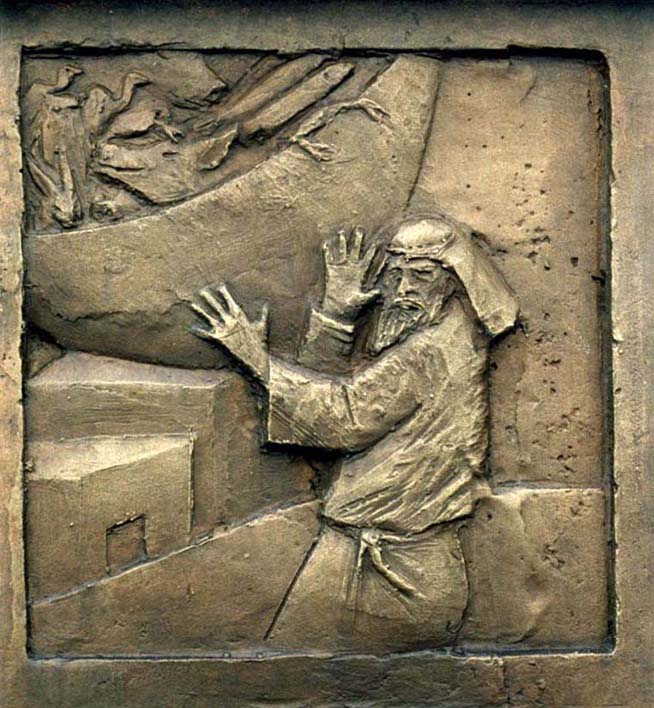
Dr. Luke continues: “9-13 Next day, while these men were still on their journey and approaching the city, Peter went up about mid-day on to the flat roof of the house to pray. He became very hungry and longed for something to eat. But while the meal was being prepared he fell into a trance and saw the heavens open and something like a great sheet descending upon the earth, let down by its four corners. In it were all kinds of animals, reptiles and birds. Then came a voice which said to him, “Get up, Peter, kill and eat!” “

In the Mosaic Law, recorded in the books of Exodus, Leviticus and Deuteronomy, the Law code has definite restrictions on what any good, kosher-keeping Jew is and is not allowed to eat. A few well-known forbidden foods are no pigs—no pork. No shrimp or other shellfish. Also, no rabbits or snakes, and no owls or birds of prey. These are just a few of the kinds of animals, fish and birds that are forbidden, for various reasons. So, let’s see what happens next!

14 Peter said, “Never, Lord! For not once in my life have I ever eaten anything common or unclean.” 15 Then the voice spoke to him a second time, “You must not call what God has cleansed common.” 16 This happened three times, and then the thing was gone, taken back into heaven.”

Wow! Amazing vision that Peter had! Talk about totally blowing Peter away. Peter had always—all of his life—kept kosher. Eaten only the things that the Mosaic Law code said he could eat. Now, out of a clear blue sky, this vision is telling him that God calls all things clean!

I want to take a little detour. Tell you a bit about my two chaplain internships, after graduating seminary. I dug right into learning about various faith traditions. I learned about widely different cultural traditions, too. This was a natural progression for me, learning more of how to accompany diverse people in crisis, critical care, trauma and end of life. It sounds rather odd, talking about my years of intensive learning and stressful internship in this way, but I very much appreciated every intense, multicultural experience I had: both in the classroom, as well as on the floors and units of the hospitals and care centers.

Let’s come back to Acts, chapter 10. “17-20 While Peter was still puzzling about the meaning of the vision which he had just seen, the men sent by Cornelius had arrived asking for the house of Simon. They were standing at the very doorway of the house calling out to enquire if Simon, surnamed Peter, were lodging there. Peter was still thinking deeply about the vision when the Spirit said to him, “Three men are here looking for you. Get up and go downstairs. Go with them without any misgivings, for I myself have sent them.”

“23b-26 On the next day Peter got up and set out with them, accompanied by some of the believers from Joppa, arriving at Caesarea on the day after that. Cornelius was expecting them and had invited together all his relations and intimate friends. As Peter entered the house Cornelius met him by falling on his knees before him and worshiping him. But Peter roused him with the words, “Stand up, I am a human being too!”

I need to interrupt, to let you know—Peter and his Jewish friends from Joppa, being good observant Jews, were forbidden by the Jewish Law code to enter the house of a Gentile. Yet—that is exactly what Peter intended to do! Let’s continue.

27-29 Then Peter went right into the house in deep conversation with Cornelius and found that a large number of people had assembled. Then he spoke to them, “You all know that it is forbidden for a man who is a Jew to associate with, or even visit, a man of another nation. But God has shown me plainly that no man must be called ‘common’ or ‘unclean’. That is why I came here when I was sent for without raising any objection.”

As for me? All three of the hospitals where I served were in the middle of multicultural areas, a crossroad of the multicultural communities of Chicago and the surrounding area. One of these hospitals has the distinction of sitting in one of the most diverse ZIP codes in the country. (The U.S. Census Bureau says so.) I never knew who was going to be in that next room I entered, or what situation I was going to encounter next.

34-43 Then Peter began to speak, “In solemn truth I can see now that God is no respecter of persons, but that in every nation the one who reverences Him and does what is right is acceptable to Him! God has sent His message to the children of Israel by giving us the good news of peace through Jesus Christ—He is the Lord of us all.” Ahh. We can see that slowly, very slowly, Peter is taking baby steps towards being open to more than just Jews.

When I served as a chaplain, I didn’t just serve Protestant Christians. I remember a Buddhist Asian family in critical care, as their loved one died just as I came in—complete silence and intense sadness greeted me as I joined them in the room. Another time, I entered the packed ICU cubicle—wall to wall with a Pentecostal Latino family, who wanted me to pray their brother (and uncle) across the River Jordan. (The crashing, palpable waves of grief struck me again and again…I vividly remember.) It wasn’t all end of life. I remember being asked to pray the Rosary with a Filipino family around their ill auntie, lying in the hospital bed. There was the situation with an older Muslim patient, and the 20-something relative wearing black hijab and very conservative dress, sitting next to the bed; she earnestly asked me to pray. Of course I did!

In fact, Peter goes on to say: “We are those witnesses, we who ate and drank with Him after he had risen from the dead! Moreover, we are the people whom He commanded to preach and bear fearless witness to the fact that He is the one appointed by God to be the judge of both the living and the dead.”

This sermon Peter preached—for it was a sermon!—had its effect. The Gentile audience heard Peter, and what happened? “44-46a While Peter was still speaking these words, the Holy Spirit fell upon all who were listening to his message. The Jewish believers who had come with Peter were absolutely amazed that the gift of the Holy Spirit was being poured out on Gentiles also; for they heard them speaking in foreign tongues and glorifying God.”

Did you hear what happened? Praise God! These Gentiles believed, and the same thing happened to them that had happened to the Jewish believers in Acts chapter 2! The gift of the Holy Spirit came upon the Gentiles, too.

Remember what Peter told his Jewish audience, at Pentecost? Acts chapter 2? Joel’s prophecy regarding the outpouring of the Holy Spirit had been fulfilled. All who call upon the name of the Lord will be saved (Joel 2:32a). At first, Peter and the rest of Jesus’ followers thought that all only meant Jews. And then, Samaritans were added.

I have Good News for you. I have Good News for us all. Jesus is the Lord of all (10:36b). All Jews and all Gentiles who believe in Him receive forgiveness of sins through His name (10:43). As the commentator Richard Carlson said, the Apostle Paul had it exactly right, “In Christ there is neither Jew nor Gentile, slave nor free, male nor female” (Galatians 3:28). In Christ, there is neither Republican nor Democrat, citizen nor undocumented visitor, gay nor straight, for all are one in Christ Jesus.

In God’s salvation plan, all now really means all.

Alleluia, amen!

@chaplaineliza

Suggestion: visit me at my daily blog for 2015: matterofprayer: A Year of Everyday Prayers. and my other blog,  A Year of Being Kind .  Thanks!

Unknown's avatar

We Cannot Keep from Speaking!

“We Cannot Keep from Speaking!”

Peter - cannot stop Acts-4-20_2

Acts 4:1-20 – June 21, 2015

Ever had this situation happen to you? Just when you thought you had taken care of some pesky problem, here it comes, all over again! Sort of like the carnival game Whack-a-Mole. Just when you whack at all the moles, and think that they are all gone—that your problems are all solved—here they come again! Popping up all over the place.

I suspect the ruling council in Jerusalem felt this way just about now. Here they had rid themselves of that troublesome Rabbi Yeshua, or Jesus, some weeks ago. They had even gone to their Roman governor, Pontius Pilate, to get his permission to put this upstart Rabbi to death. They got some people to accuse Jesus of insurrection and treason, so He would be killed by crucifixion. That was it! Done! One great, big, pesky problem taken care of!

True, there were some rumors about Jesus coming back to life a few days later, but that was just a rumor. Resurrection? Hah! Sounds pretty far-fetched to me. It was far-fetched to the ruling council, to the Sanhedrin, too.

They didn’t figure on Peter, John, and the rest of the disciples. They didn’t figure on the blowing of the Holy Spirit at Pentecost, or the energy of the new believers in the Risen Jesus.

Our summer sermon series, Postcards from the Early Church, reminds me a bit of a radio serial. You might remember those! “When last we left our intrepid heroes . . . “ Last week, we saw Peter and John about to enter the Temple in Jerusalem for daily afternoon prayers. A long-time beggar, lame from birth, asked Peter and John for alms—for money. Peter made that extraordinary statement to the lame beggar: “Silver and gold I have none, but what I have I give to you. In the name of Jesus of Nazareth, stand up and walk!”

As I mentioned in my sermon last week, Peter suits the words to his action. He leans forward, grasps the lame man’s right hand, and raises him to his feet.

What happens next? “Immediately his feet and ankles were made strong.” Whatever congenital defect there was in his feet and ankles was immediately, miraculously healed. The ex-lame-beggar could walk. And not only totter around, but leap in the air! He praised God right there inside the Temple, giving immediate public testimony to God’s mighty power!

This was a big problem for the Jewish leaders in Jerusalem, believe me! Just when they thought that pesky Rabbi Jesus was all gone, permanently taken care of, they have even more miracle-workers on their hands. The disciples, the friends who had been with Jesus.

The Sanhedrin—the Jewish leaders—quickly grabbed Peter and John, and threw them into prison. Right after this marvelous miracle! I am sure the bystanders were asking, “What gives? These men did a miracle! Why are you arresting them?”

But—are we surprised? Looking at the Hebrew Scriptures, many of the miracle-working prophets were misunderstood, mistreated, imprisoned. Exiled, and even put to death, sometimes.

The Jewish leaders needed to get on this miracle stuff right away. Try to hush it up. See whether they could sweep the whole business under the rug. But—there was a problem. This was a very public miracle, done in downtown Jerusalem, at the height of rush hour. Or, the equivalent. Afternoon prayer time at the Temple in the city center.

We see from this reading today that the leaders had Peter and John thrown into prison overnight. For working a miracle! For doing what God had called them to do!

This makes me think of the Civil Rights movement and marches of the 1950’s and 1960’s. A friend of mine, Ken, (a recently retired seminary professor) marched alongside of African-American activists. A good friend of this church, Pastor Gordon, attended several marches in the South during the 1960’s. It was a tense, even dangerous time. Both my friends were jailed in the aftermath of the marches. Both are proud to say that they were imprisoned for standing up for a Godly cause.

Back in Jerusalem, the day after the miracle occurred, Peter and John were hauled out of prison and brought in front of the Sanhedrin. The ex-lame-beggar was there, too! The Jewish leaders could not deny that this man—who everyone knew as lame from birth—now had full use of his fully-restored feet and ankles. The news of the miracle was traveling around Jerusalem like wildfire! The leaders knew they had to let Peter and John go free.

But Peter wasn’t done yet! Just like the carnival game Whack-a-Mole, where the Sanhedrin desperately wanted to make all those pesky miracle-working moles go away, Peter kept on popping up. And, he spoke to the learned Jewish leaders and teachers, too.

Peter quoted from Psalm 118 in his defense of the miracle he and John had done. He said to the Sanhedrin, “by the name of Jesus Christ the Nazarene, whom you crucified, whom God raised from the dead—by this name this man stands here before you in good health. 11 He is the stone which was rejected by you, the builders, but which became the chief corner stone. 12 And there is salvation in no one else; for there is no other name under heaven that has been given among men by which we must be saved.”

Talk about in your face! Peter had a lot of guts, speaking to the ruling leaders of his country like that!

As commentator Scott Hoezee brings out, “the Spirit led them to a lowly little textual nugget embedded deep inside one of the lesser known of all the psalms and prompted Peter to use that little verse as the perfect summary of what God’s ways are all about.” This idea is something that Peter repeats again and again. The stone which the builders rejected has become the cornerstone of the building. The most important part of the whole structure. “That’s my Rabbi, Jesus of Nazareth. Oh, and by the way? You Jewish leaders crucified Him!” (That’s guts.)

By Peter quoting this psalm, he reminded these leaders of an unpleasant confrontation between Jesus and the Jewish leaders, shortly before His death. I appreciate another commentator’s words: “It was to say, in effect, “Jesus told you so.” How this citation must have stung in the ears of the Sanhedrin. The One they thought they had rid themselves of was still speaking to them, through the apostles.” The Jewish leaders didn’t have just one pesky problem any longer. The problem had multiplied.

Oh, my goodness. The Sanhedrin tries to tell Peter and John and the rest to shut up. To keep quiet about this Jesus person!

But it does just as much good as attempting to hold back the wild waves of the ocean. In other words, it doesn’t work at all. There is far too much power, far too much momentum behind that crashing ocean wave of testimony.

Despite the stern orders to “pipe down! Sit down and shut up!” Peter and John refuse. Their response? “Whether it is right in the sight of God to give heed to you rather than to God, you be the judge; 20 for we cannot stop speaking about what we have seen and heard.”

What about us? Are we eager to tell people about what we have seen or heard? What about the mighty deeds we have experienced? Or, perhaps you haven’t had God do anything extraordinary in your life lately. Can you tell people about how God has been faithful? God has continued to walk with you, each and every day. I encourage you to tell someone! Amen!

Praise God, each of us can talk about something God has done—for each of us. God has given each of us a new day, each and every day. Praise God! That is truly something to praise and thank God about. Can we all say Amen? Amen! And again! Amen!

@chaplaineliza

(Suggestion: visit me at my daily blog for 2015: matterofprayer: A Year of Everyday Prayers. and my other blog,  A Year of Being Kind .  Thanks!)