Unknown's avatar

A Foreign Neighbor’s Thankfulness

“A Foreign Neighbor’s Thankfulness”

The Healing of the Ten Lepers – Luke 17:11-19

Luke 17:11-19 (17:19) – August 10, 2025

One thing I have noticed that is really sad is when someone is left all alone – on purpose! Not necessarily picked on and jeered at, although that can be horrible, too! But, sometimes a person can just be left alone, left out, isolated, even shunned.

In our Scripture reading today, we have exactly that happening. Except, the Jewish community was required to do this, to ignore or turn their backs on someone! This was a serious matter. Skin diseases were not anything anyone wanted to fool around with. Because medicine and treatment centuries ago was rudimentary and simple, there were not many things doctors and medical providers had that was in any way effective.

Plus, the Law of Moses specifically instructed the Jewish people to keep their distance from anyone with a skin disease, and not allow them to mingle with people who did not have skin diseases. All of these people with skin diseases were referred to as “lepers,” and they had to cry out, “Leper! Unclean!” so everyone else would get a warning not to get anywhere near. These people were outside of their society, forever out of reach. Forever away from their families, their friends, their community, and their synagogue.

Just so everyone here knows what the situation was, for these ten people, as we consider our Scripture reading today, this severe, shunning treatment was what happened wherever these poor people with skin diseases went.

Let us listen again to these words from Dr. Luke, chapter 17: “Now on his way to Jerusalem, Jesus traveled along the border between Samaria and Galilee. 12 As he was going into a village, ten men who had leprosy met him. They stood at a distance 13 and called out in a loud voice, ‘Jesus, Master, have pity on us!’”

Here is the situation, the set-up. We have ten men who have banded together, as a group of lepers. They obviously have heard of this Jesus of Nazareth, and are actively seeking healing! The Rabbi Jesus hears them cry out, and responds immediately. Jesus offered immediate and profound healing to all ten men!

This kind of immediate healing is sometimes difficult for us to wrap our heads around. From time to time, I have faithful believers who come to me as a hospice chaplain and tell me, trustingly, “I have faith to believe God, and believe that my loved one in hospice will get well.” Or, “I believe in miracles, and I know that God will hearken to our voice.”

Yes, I believe in God, I believe in miraculous healing, and I believe that God heals in many different ways. Perhaps God wants to have the patient receive ultimate healing, to leave this world and enter God’s presence? Perhaps God wants to see that person face to face? And yes, we all have an expiration date.  

Whatever the reason, nine of the ten men did not return to the Rabbi Jesus to thank Him for their immediate healing. Except – one man did. “The others are too busy getting back into their proper societal position. And who could blame them? After all, they were just following Jesus’ instructions, right? The one who returns is a real outsider – a Samaritan – who took a chance, who followed his heart and gave thanks to the one who really mattered.” [1]

This man, this Samaritan was in a precarious position. Not only was he rejected by the Jewish community because of his ethnicity, he was also ostracized because of his health condition. If you all remember, I have been preaching a summer sermon series on Fred Rogers. Many of these sermons have also been about outsiders, about people rejected by their communities, rejected from their neighborhoods.  

No one enjoys being shut out of their community, and ignored by their neighbors! Not in the first century, and not in the twenty-first, either.

This is the last week in our summer sermon series on Fred Rogers, of the television show Mister Rogers’ Neighborhood, which aired on PBS for more than 30 years. As I’ve said in weeks past, I have great respect for Fred Rogers. I have even said a number of times (only partly humorously) that when I grow up, I want to be Mister Rogers.

 Fred Rogers was revolutionary in his treatment of people, especially children. He considered children to be very significant individuals, worthy of respect and caring and love. “The most controversial thing Fred Rogers ever did is tell children that they are special. That their lives have value simply because they exist. That they don’t have to do anything sensational to be deserving of love.” [2] The same could be said of these people with skin diseases, and the same could be said of each and every person in the whole wide world.

These ten lepers were shunned, were passed over, were not even considered “people” by most of those at a distance from them. But, none of that mattered to Jesus. He considered each one a valued, special person, a creation of God. No matter what their health condition, no matter what their ethnicity.

Jesus offered a gift of profound healing to the ten who approached him that day. I wonder how you and I might be agents of such healing in our world today. Indeed, in a world too often marked by fear and division, might healing just be ours to offer (and in turn, receive) if we simply reached out with a word of kindness, curiosity, or affirmation even to someone we have never seen before who we may never see again? Or to one who we have passed by a thousand times (as those ten lepers must have been passed by a thousand, thousand times) without even noticing before?” [3]

I know I often ask in my sermons “what would Jesus do?” Who would Jesus heal? Who would Jesus love?”

This week, again, I am going to change up my question, and ask “what would Fred Rogers do?” Who would Fred love? Who would Fred call his neighbor? I think, everyone. Each and every person. Go. Go, and do that.

Alleluia, amen.

(A big thank you to the online resources for Mr. Rogers Day – the Sunday nearest March 20th, Fred Rogers’ birthday. These resources come from the Presbyterian Church (USA). https://www.pcusastore.com/Content/Site119/Basics/13792MrRogersIG_00000154465.pdf )

@chaplaineliza

(Suggestion: visit me at my other blogs: matterofprayer: A Year of Everyday Prayers. #PursuePEACE – and  A Year of Being Kind . Thanks!


[1] https://www.stewardshipoflife.org/2013/10/first-and-always-give-thanks/

[2] https://www.thedailybeast.com/we-need-mr-rogers-now-more-than-ever-but-do-we-deserve-him/

[3] http://words.dancingwiththeword.com/2016/10/the-tenth-leper-and-how-god-is-already.html

Unknown's avatar

A Foreign Neighbor’s Faith

“A Foreign Neighbor’s Faith”

Matthew 15:21-28 (15:28) – July 27, 2025

When I worked as a hospital chaplain at Swedish Covenant Hospital (now called Swedish Hospital), more than 10 years ago, one of the points of working there highlighted was the multi-cultural setting of that hospital and that neighborhood. The ZIP code that Swedish is in is one of the most diverse in the country, in all kinds of ways. In terms of languages spoken, various countries of origin, differing faith traditions, and wide economic differences in that ZIP code alone make Swedish Hospital a unique place to work, of great cultural diversity.

In our Scripture reading today, the Rabbi Jesus traveled up north of the Sea of Galilee, on the border of Palestine. It was in an area called the Decapolis, the Ten Cities, which also was a multi-cultural crossing point. Perhaps not as widely diverse as the ZIP code around Swedish Hospital, but with a number of diverse cultures, faith traditions, and languages spoken.

Our Gospel writer Matthew was quite particular about how he presented the information in his Gospel, which was written specifically for a Jewish audience. Let us look at how Matthew begins this vignette in the life of the Rabbi Jesus. “Jesus withdrew to the region of Tyre and Sidon. 22 A Canaanite woman from that vicinity came to him, crying out, ‘Lord, Son of David, have mercy on me! My daughter is demon-possessed and suffering terribly.’”

We learn a lot from these two sentences! Matthew wants his readers to know where the Rabbi Jesus had gone – into the area of the Decapolis, on the border of Israel – and that this woman who came to Jesus for help is not Jewish, but instead is a Canaanite woman – what the Gospel writer Mark in his parallel account calls a Syro-Phoenician woman.

The Canaanites were hated by the Jews, and were among those the Jews termed “Gentiles,” since they were polytheists and prayed to various gods like Baal and Asherah.

Up until this point, Jesus had ministered to very few people who were not Jewish. So, here we are, in a cross-cultural situation. Here the spotlight shines on a woman who is not Jewish, asking Jesus for help. And, help not for her, but for her daughter, who is suffering terribly! This request is familiar territory for the Rabbi Jesus, certainly!  

I have mentioned the Rev. Janet Hunt before. She tells a heartfelt story, some of which I repeat here. “Mental illness carries all kinds of stigma today. I have known this since I was a child and we experienced it in our own family. Back then it was something whose name you whispered.  I’m not sure it is so very different now.  When I was young during that time during the prayers of the church where we stood in silence and remembered people in need, I would close my eyes shut tight and silently plead for Aunt Donna’s healing. It didn’t come.” [1]
            In the case of our Gospel narrative, we are not sure what is the matter with this daughter of the Canaanite woman. Certainly, it could well be mental illness! This was often seen as demon-possession in past centuries. Mental illness carried a huge stigma in the first century, just as now, in the twenty-first.

It is Jesus’s response that is surprising. Or rather, His non-response. “The disciples, obviously aggravated by her persistence, ask Jesus to deal with her request so that they can be on their way. Jesus then explains that his mission (under the authority of God) is to call out the faithful remnant of Israel. This doesn’t deny a future mission to the Gentiles, only that for the present, ‘salvation is from the Jews.’” [2]

The all-important point of this narrative comes from this mother, this neighbor from a different neighborhood. Our summer sermon series this summer is all about Fred Rogers. He met with a lot of different people from many, many different neighborhoods. Diverse cultures, and from foreign shores, or neighborhoods, too. As this Biblical narrative continues, the woman speaks to Jesus again. “The woman came and knelt before him. “Lord, help me!” she said.26 Jesus replied, “It is not right to take the children’s bread and toss it to the dogs.” 27 “Yes it is, Lord,” she said. “Even the dogs eat the crumbs that fall from their master’s table.”

28 Then Jesus said to her, “Woman, you have great faith! Your request is granted.” And her daughter was healed at that moment.

Did you hear? This woman from a different culture, from a different neighborhood, had great faith! Jesus acknowledges that, and her daughter is miraculously healed at that moment! It is marvelous that this faithful foreign woman – who knew that Jesus was the Chosen One of God, and called Jesus by the Messianic title “Son of David” – did indeed have great faith!

Except, where does that leave us today? What are we supposed to do with this narrative from Matthew’s Gospel? As commentator Karoline Lewis tells us, “A lot of how we talk about faith indeed ends up being about measurement. Life’s consequences are attributed to whether or not someone had enough faith, whatever the circumstance may be. “Just have faith!” Well, how much? It doesn’t seem like a little will do. And how do you get more? Are you stuck with what you have? Are we genetically disposed to a certain level of faith?” [3]

I sometimes wonder whether I would have had even half, even a quarter of the amount of faith this Canaanite woman had! I suspect that these are the kinds of issues about faith with which all of us struggle — and which we may likely hear in the Canaanite woman’s deep, heartbreaking request. “We wonder at the faith that is already working within her.  Even though she is a Gentile, somehow she sees Jesus as having come for her as well.[4]

At the same time, I do not want us to assume that because we do not have great faith that the Lord Jesus turns His back on us, or refuses to do anything for us at all. Which is what false teachers of the Gospel often tell their followers: “Oh, you did not receive that healing – or that answer to prayer – because you just didn’t have enough faith!”

No, Christianity is not a cheap marketplace, or a mercenary vending machine in the sky where we deposit our money and miracles and healings magically come forth. No, this Canaanite woman had faith in the Lord Jesus, the Messiah, the Son of David. She developed a relationship with Jesus. And, it all started with a mother’s willingness not only to speak, but to shout.  For the sake of love. For the sake of a much beloved daughter, desperately ill.

Our faith in God – your faith and mine – “lays claim on how you are in the world, how you choose to be, how [each of us] decide to live, in each specific moment of your life…. faith is not a fixed collection of beliefs but a state of being. Your faith is great, not because of what you do, but because of who you are.” [5]

Fred Rogers had a wide variety of diverse neighbors in Mister Rogers’ Neighborhood. These were both real neighbors in the real neighborhood, and the puppets and people of the Neighborhood of Make-Believe. They all interacted with one another with kindness and respect. Fred Rogers tells us, “As different as we are from one another, as unique as each one of us is, we are much more the same than we are different. That may be the most essential message of all, as we help our children grow toward being caring, compassionate, and charitable adults.” [6]

Yes, Jesus healed this daughter of a neighbor from a different neighborhood, a foreign neighborhood. As you and I travel through different neighborhoods in our lives, we can have the same openness, care and compassion that Jesus had. That Fred Rogers had.  

Be like Jesus. Be like Fred Rogers. Go into multicultural places with openness and respect, care and compassion. Go, do that.

(A big thank you to the online resources for Mr. Rogers Day – the Sunday nearest March 20th, Fred Rogers’ birthday. These resources come from the Presbyterian Church (USA). https://www.pcusastore.com/Content/Site119/Basics/13792MrRogersIG_00000154465.pdf )

@chaplaineliza

(Suggestion: visit me at my other blogs: matterofprayer: A Year of Everyday Prayers. #PursuePEACE – and  A Year of Being Kind . Thanks!


[1] http://words.dancingwiththeword.com/2014/08/a-mothers-cry.html

[2] https://www.lectionarystudies.com/studyg/sunday20ag.html

[3] https://www.workingpreacher.org/dear-working-preacher/getting-great-faith

[4] http://words.dancingwiththeword.com/2014/08/a-mothers-cry.html

[5] https://www.workingpreacher.org/dear-working-preacher/getting-great-faith

[6] https://www.misterrogers.org/articles/he-helped-us-with-our-relationships-with-others/ 

Unknown's avatar

Loving Neighbors in the Strangest Places

“Loving Neighbors in the Strangest Places”

Luke 19:1-10 (19:5) – July 13, 2025

I have rubbed elbows with all kinds of people! I grew up in Chicago in a half-and-half, working-class and middle-class neighborhood. I lived in (and worshiped in) two racially mixed areas of Chicago for some years. I’ve had a number of jobs before I went to seminary at 40 years old, in diverse industries, including the ramp, a huge warehouse, and an order fulfillment center. So, when I hear the Rabbi Jesus getting some guff from the crowd for hanging out with the riff-raff and “sinners,” that surely gets my attention!   

I think today’s Scripture reading is particularly fascinating since it shows someone who was definitely not well liked in his neighborhood. In fact, no one wanted to call him “friend” or neighbor. Zaccheus was a chief tax-collector for the Roman occupation. Yes, he was Jewish, and yes, he was working for the hated occupying foreign forces. And as if that were not enough to get him disliked by his Jewish neighbors, Zaccheus was officially delegated by the Roman government to collect their taxes for them.

The Roman government was not very particular about how they got their tax money – as long as they got it. So, the local tax collectors could be as demanding or dishonest as they wanted to be, all for the purpose of getting money for the Romans. And, if these tax collectors squeezed a little extra money out of their fellow Jews, the Romans did not care. As long as enough money came into the Roman treasury. That was all the occupying force cared about.

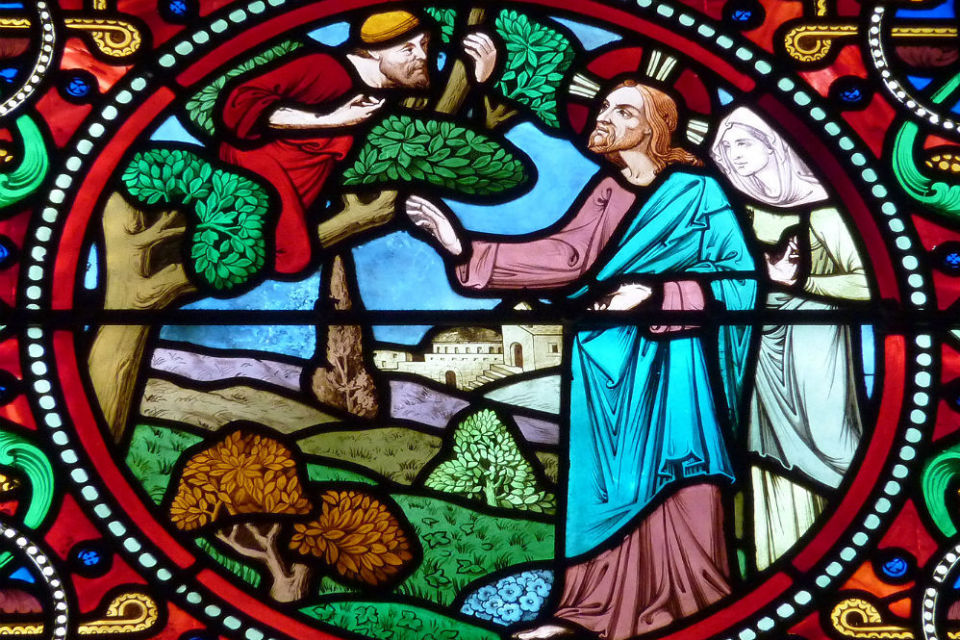
I would imagine that Zaccheus was a pretty lonely man. Until – the Rabbi Jesus came to town. This was several years after Jesus had started to preach, teach and do miracles, so I suspect by this time Jesus had quite a following, and quite the reputation! Let’s pick up right in the middle of the narrative: “3Zaccheus wanted to see who Jesus was, but because he was short he could not see over the crowd. So he ran ahead and climbed a sycamore-fig tree to see him, since Jesus was coming that way. When Jesus reached the spot, he looked up and said to him, “Zacchaeus, come down immediately. I must stay at your house today.” So he came down at once and welcomed him gladly.”

We read next that the crowd started to grumble, because the Rabbi Jesus saw and spoke with Zaccheus, truly engaged with him, and even said “I must stay at your house today.”  

Can you imagine, being the shortest guy in your high school! Plus, being one of the least popular persons in the town of Jericho! Both of those things must have been painful subjects for Zaccheus. I just imagine that he lived an isolated existence, wanting, hoping that someone would see him, notice him and validate him. This emotional response is only human!

We are currently observing a summer sermon series highlighting the person of Fred Rogers, of Mister Rogers’ Neighborhood. Have you ever thought of someone who is meek and gentle as being a strong individual? Someone who is so strong and confident themselves that they do not care what other people think? I think that is exactly the kind of person Fred Rogers was. Plus, Fred Rogers thought everyone was deserving of attention and respect, no matter what! And, that deep emotions were important things.

Of the many lessons Rogers gently gifted his audience, a chief one was that all emotions are valid, even the sad and angry ones. They need acceptance from friends and family and, often, expression – so long as it’s not violent. Sigmund Freud called this ‘sublimation,’ the channeling of destructive impulses into socially acceptable actions. It was a pillar of Rogers-ism, and [Rogers] often referred to dialogue about emotions and feelings as ‘important talk.’” [1]  

The Rabbi Jesus obviously thought that emotions were important – even the emotions of someone hated like Zaccheus. Sure, Zaccheus was seen as a hated tax collector by his Jewish neighbors! But, Zaccheus’s feelings were valid, too! Our Lord Jesus went out of His way to single Zaccheus out, see him, notice him, validate him. And, Jesus invited Himself over for dinner!

Salvation came to Zaccheus’s house that day. Jesus followed him home, and broke bread with him at a lonely table. Salvation comes to all of us when Jesus joins us, has fellowship with us. Even when people do not feel worthy, for whatever reason, to have Jesus join them – it doesn’t matter. Salvation is solidarity, hospitality, and yes, ministry.

Our commentator Karoline Lewis relates a modern (and true) narrative, taken from the column of David Brooks, long time New York Times columnist. Brooks tells the story of Kathy Fletcher and David Simpson. “They have a son named Santi, who went to Washington, D.C. public schools. Santi had a friend who sometimes went to school hungry. So, Santi invited him to occasionally eat and sleep at his house.”

“That friend had a friend and that friend had a friend, and now when you go to dinner at Kathy and David’s house on Thursday night there might be 15 to 20 teenagers crammed around the table, and later there will be groups of them crashing in the basement or in the few small bedrooms upstairs.”

The kids who show up at Kathy and David’s have endured the ordeals of modern poverty: homelessness, hunger, abuse, sexual assault. Almost all have seen death firsthand — to a sibling, friend or parent.”

“It’s anomalous for them to have a bed at home. One 21-year-old woman came to dinner last week and said this was the first time she’d been around a family table since she was 11… Poverty up close is so much more intricate and unpredictable than the picture of poverty you get from the grand national debates.”

“I started going to dinner there about two years ago,” writes Brooks, “hungry for something beyond food. Each meal we go around the table, and everybody has to say something nobody else knows about them. Each meal we demonstrate our commitment to care for one another. I took my daughter once and on the way out she said, ‘That’s the warmest place I can ever imagine.’”

The problems facing this country,” says Brooks, “are deeper than the labor participation rate and ISIS. It’s a crisis of solidarity, a crisis of segmentation, spiritual degradation, and [lack of] intimacy.”

“The kids call Kathy and David ‘Momma’ and ‘Dad,’ are unfailingly polite, clear the dishes, turn toward one another’s love like plants toward the sun and burst with big glowing personalities. The gift of Kathy and David is the gift of a complete intolerance of social distance,” insists Brooks. [2]

At church, we speak ‘salvation speech.’ This is speech that sees the other, that regards the overlooked. We speak speech that brings together, and unites across barriers and boundaries, classes and cultures. Speech that creates community and family for everyone. Speech that gives life and says that salvation is here and now, in this world as well as the next. [3]

Jesus said, “Today, salvation has come to this house.” It is salvation to a house, any house. It’s to a neighborhood, each and every neighborhood. This place where Zaccheus lives is where Fred Rogers would welcome, and be welcomed, too.

What would Jesus do? What would Fred Rogers do? Go. Do that.

(A big thank you to the online resources for Mr. Rogers Day – the Sunday nearest March 20th, Fred Rogers’ birthday. These resources come from the Presbyterian Church (USA). https://www.pcusastore.com/Content/Site119/Basics/13792MrRogersIG_00000154465.pdf )

@chaplaineliza

(Suggestion: visit me at my other blogs: matterofprayer: A Year of Everyday Prayers. #PursuePEACE – and  A Year of Being Kind . Thanks!


[1] https://www.cnn.com/2018/06/08/health/mister-rogers-go-ask-your-dad/index.html

[2] David Brooks, “The Power of a Dinner Table,” The New York Times, October, 18 2016, http://www.nytimes.com/2016/10/18/opinion/the-power-of-a-dinner-table.html

[3] https://www.workingpreacher.org/dear-working-preacher/salvation-today

Unknown's avatar

Playing Favorites!

“Playing Favorites!”

James 2:1-10, 14-17 (2:17) – September 8, 2024

            Sometimes, my husband and I step back and observe our fellow human beings. For example, when we are at a coffee shop, or walking through a park. My husband calls it “people watching.” And sometimes, we catch snatches of conversation, too. Some of these bits of conversations are quite revealing! Sometimes, we can even hear about relationships between these people, and their family or friends. These relationships are not always the most healthy.

            Who has all really healthy, happy relationships in their family? Or, friend groups, and acquaintances? Do you – do I – have friends or family members who are mean sometimes? Or who gossip? What about family who have bad habits, like rooting for the wrong sports teams? Or to be more serious, what about friends or family members who play favorites? Who prefer certain people because of their fancy clothes, or their popularity, or how much money they have?

            That is exactly what James is talking about here in chapter 2. This letter from James is so practical! Yes, he does refer to theological concepts now and then, but James wants to give us a manual of Christian living: living the way we as believers are called to live! The description in this reading today is a pertinent, hard-hitting example. 

            James says, “Suppose a rich man wearing a gold ring and fine clothes comes to your meeting, and a poor man in ragged clothes also comes. If you show more respect to the well-dressed man and say to him, “Have this best seat here,” but say to the poor man, “Stand over there, or sit here on the floor by my feet,” then you are guilty of creating distinctions among yourselves and of making judgments based on evil motives.”

            One of my biblical commentators says, “The problem is ‘status serving’ – favoritism. Playing favorites! We are easily attracted toward the successful, wealthy and beautiful people. Yet for James, such partiality is something quite evil.” [1] Playing favorites is definitely not a way for anyone to please God, or to live the way we as believers are called to live. 

            The Gospel reading from the Revised Common Lectionary today also has some difficult, hard-hitting points. Jesus and the disciples are in the racially-mixed area of the Decapolis, near the Sea of Galilee in the far north of Israel. A Gentile woman approaches the Rabbi Jesus while He is at dinner, and asks Him to please heal her daughter. Jesus says some challenging words to her about being a Gentile. She convinces Jesus to help her and heal her daughter, which He does.

            This Gospel reading deals with favoritism and being partial to one group while excluding another group. Who would Jesus exclude? Would He exclude me and my family? Would favoritism include you? How about your children, or grandchildren? 

            These are difficult issues raised by both the apostle James and the Gospel writer Mark.

            Favoritism is all over the place! At work, in the school room, on sports teams, at home. Even – perhaps, especially, as James says – in our local churches. “To seek out the ‘beautiful’ people in our congregation and give them honour because of wealth, status in society, looks, youthfulness, race, education, breeding, success….. is a most ugly way to develop a Christian fellowship. Favoritism is rife in society, let it not exist in our church.” [2]

            Preferring one person over another or one group of people over another is a very worldly way of approaching life. James tells us point blank that we are not to behave this way. Period.  If we take the bare bones approach and look at what the apostle Paul tells us, that we are all one in Christ, and that we are to all love one another, as both Paul and John remind us, some might say we can all simply join hands in a big circle around a campfire and sing “Kum-by-yah” feel all warm and fuzzy inside, and that would be more than enough for the Christian life.

            If that simplistic attitude and short-sighted way of behavior was the only thing we had to do to live the Christian life, then the Christian life would be an insular, warm-and-fuzzy thing indeed. But, as James tells us throughout this letter, there is much more to the Christian life. In this letter, he gives us a how-to manual. A manual for living the way believers are called to live.   

            If we take the example that James gives us, one quick solution would be to simply buy the poor person a new outfit. See? Now the two people coming into church look the same! But, that is only a shallow, simplistic quick-fix for the situation. Instead, James “is asking them to treat the [poor] man with the same respect they would offer a well-dressed man.  Learning to do that in a culture that separates and creates fear between the richer and the poorer requires practice.” [3] This problem goes deep down in people’s attitudes, and is much more serious – even insidious. James says plainly, “Don’t be snobs! Don’t play favorites!”

            I can remember a church I attended some years ago was part of a group of houses of worship that hosted midday meals for the homeless once a week, as well as hosting a warming center during the winter months for five hours in the afternoon and early evening, allowing the homeless to gather inside in a safe space that was warm and welcoming. My husband volunteered at the warming center, and some of those friends who attended regularly mentioned how grateful they were for the church opening their doors freely.

            Yes, make sure our internal attitudes line up with the way that is pleasing to God. Remember, practical, matter-of-fact James shows us a manual for Christian living. Does God choose favorites? What if you are one of those excluded homeless people, or left-out high school kids, sitting at the loser lunch table, with no way to even get close to God? Shut out from God’s loving, caring, nurturing presence?

            Thank God we are always God’s beloved children! We are always the favorites – all of us! Here is a quote by Max Lucado. See if it resonates with you. “If God had a refrigerator, your picture would be on it. If God had a wallet, your photo would be in it. God sends you flowers every spring and a sunrise every morning Face it, friend – God is crazy about you!“

            Does God choose favorites? No! That is the way God feels about each one of us! Please, remember that as you go into the world. Treat every single person you meet as a very beloved child of God – because, they are! No matter what, no matter who!

@chaplaineliza

(Suggestion: visit me at my other blogs: matterofprayer: A Year of Everyday Prayers. #PursuePEACE – and  A Year of Being Kind . Thanks!


[1] http://www.lectionarystudies.com/sunday23be.html

[2] Ibid.

[3] http://worshipingwithchildren.blogspot.com/2012/08/year-b-proper-18-23rd-sunday-in.html

Unknown's avatar

Solemn Warnings!

“Solemn Warnings!”

Luke 16:19-31 (16:28) – September 25, 2022

Have you seen homeless people begging for money? Every so often I encounter them, along busy street corners, next to off ramps from expressways, along bustling downtown sidewalks. Often, they hold hand-printed signs with heartbreaking requests for money. So often, the passersby rush right past. I must confess that I often drive or walk right past them, too.

Today’s Gospel reading about the poor man Lazarus and the uncaring rich man is meant to make us a little uncomfortable. Even, a lot uncomfortable. Jesus spoke more about money than about faith and prayer combined! Jesus was so concerned with people’s attitude toward money, possessions and finances – and we ought to be, too!

I also want to point out the close connection today’s reading has with a reading we associate with Christmastime. Or, more correctly, Advent. This second reading from Luke chapter 1 is Mary’s song, the Magnificat. This reading also makes us feel uncomfortable.  

Both of these Scripture readings reference rich and poor, reversed. Both of these powerful readings turn things upside down. Talk about Topsy-Turvy Teachings!

Let’s look first at the rich man and Lazarus. This parable of Jesus is different, because it names one of the major characters. Plus, this parable makes the rich man anonymous. He, or, in today’s egalitarian view, she, could be anyone. “He could be the one Jesus was accusing of loving money. He could be those who have when they are surrounded by those who have not.” [1] One of the big points Jesus makes in this parable concerns the gulf that exists between the haves and the have-nots. This parable shows us how huge that gulf can be!

Let’s think more about that name: naming the character with a real name, not just “such-and-such” or even “John Doe.” Does giving him a name cause us to relate to the poor man better? Just think about the concept of knowing and using a person’s name. Names can communicate respect. Not just some faceless, nameless, anonymous one.

Doesn’t using their name also show we recognize their worth as a person? What’s more, their name shows that we give them dignity! And, doesn’t every human creation of God deserve some dignity? [2]

In my work, I often go into skilled nursing facilities. Some of the patients in the facilities are very sick, very sad, and have very little in the way of money. We can view these dear human beings as being extensions of the poor man mentioned here in this parable. Sometimes these poor and indigent patients receive very little in the way of visitation and attention, too.

I am friends with someone who is on Social Security disability. He lived in a studio apartment in Rogers Park. Yes, he had a mental illness diagnosis, and yes, it was controlled with medication, so he was able to live a somewhat normal life. But, he was on the edge of poverty, and was almost like the poor man Lazarus from today’s parable. I lost track of him around last Christmas. He just stopped answering his cell phone, and I did not know where he had gone.

Imagine my surprise when I just happened to come across my friend several months ago in one of the skilled nursing facilities I regularly visit, in Rogers Park. I was really relieved to find him, but really sad to see him there, an indigent patient with no money and no resources. And recently, he has disappeared again. I hope and pray his sister in Crystal Lake brought him to live in a skilled nursing facility out near her house. I can hope and pray for him and his situation.

Let’s switch gears, and turn to Mary’s song from Luke chapter 1, the Magnificat. Talk about reversals! Listen to several verses from this song that Mary sang after the angel came to her and told her that she would be the mother of the long-foretold Messiah: 50 God’s mercy extends to those who fear him, from generation to generation. 51 He has performed mighty deeds with his arm; he has scattered those who are proud in their inmost thoughts. 52 He has brought down rulers from their thrones but has lifted up the humble. 53 He has filled the hungry with good things but has sent the rich away empty.

Mary tells us through her song that “The poor are filled with good things, and the rich are sent away hungry;[she clearly states that] brought down the powerful and lifted up the lowly. Here it is acted out in the parable Jesus told to those who were ridiculing him because they loved money more than God’s kingdom.” [3]

I suspect you all can understand that this message did not go over too well. The Rabbi Jesus was not popular at all with the rich people and religious leaders of His day And, I doubt that Mary would have been very popular either, given the reactionary nature of most of the Magnificat. Talk about topsy-turvy!

One of the main problems in both of these readings from Luke is the gulf between rich and poor. This gulf is not only an actual one, in terms of money. (which is serious enough!) “the gulf doesn’t seem fixable in that life. This means that it can only be crossed or closed in this one. Jesus is calling all his listeners to pay attention to the gulfs that exist in our world. How do we close the gulfs between the haves and the have nots? How do we close the gulfs between those who hold power and those who live on the margins? How do we close the gulfs . . . or how do we cross them?” [4]

Does this church build bridges to cross that gulf? Not only with the financially poor, but what about those with mental illnesses? (which sometimes can be in similar situations!) Does our church include both the folks with financial stability as well as those who are not, and who go to the Niles or Maine Township food pantries? Does our church include the people with mental health diagnoses, who often are also on the edge of poverty? Do we have ministries at our church for those who are struggling? These are serious questions, and ones we all need to grapple with.

Where are you in this parable today? Where am I? This is a serious question, and one that I am seriously considering.

Thank God our Lord Jesus is willing to help us! Willing to give us a hand when we ask, willing to assist when we start new ministries. God bless all those we encounter in our daily journeys, wherever they may be on the financial spectrum or the mental health spectrum. God be with us, every one!

@chaplaineliza

(Suggestion: visit me at my other blogs: matterofprayer: A Year of Everyday Prayers. #PursuePEACE – and  A Year of Being Kind . Thanks!

(Thanks to umcdiscipleship.org for their excellent notes and commentary on this week’s Gospel reading. Another reading in the Topsy-Turvy Teachings of Jesus!)


[1] https://www.umcdiscipleship.org/worship-planning/having-words-with-jesus/sixteenth-sunday-after-pentecost-year-c-lectionary-planning-notes/sixteenth-sunday-after-pentecost-year-c-preaching-notes

[2] https://www.umcdiscipleship.org/worship-planning/having-words-with-jesus/sixteenth-sunday-after-pentecost-year-c-lectionary-planning-notes/sixteenth-sunday-after-pentecost-year-c-youth-lessons

[3] https://www.umcdiscipleship.org/worship-planning/having-words-with-jesus/sixteenth-sunday-after-pentecost-year-c-lectionary-planning-notes

[4] https://www.umcdiscipleship.org/worship-planning/having-words-with-jesus/sixteenth-sunday-after-pentecost-year-c-lectionary-planning-notes/sixteenth-sunday-after-pentecost-year-c-preaching-notes

Unknown's avatar

Friends, Not Servants.

John 15:9-15 – May 10, 2015

handshake drawing

“Friends, Not Servants”

How would you like to have no friends? None, at all? According to several recent surveys, a significant number of American adults say that they have no friends. Today, in this fast-paced world with so many people rushing to and fro, and so many things filling our lives, who has the time for real friendship? Who has the commitment? How do we meet friendly people? How do we make room in our lives for genuine, honest relationships?

Another name for having no friends is being disconnected, or cut off. This idea of being cut off, with no friendships or relationships, to my mind, is like living without love. It is exactly what condition I am in without God.

Without God in my life, without a vertical relationship with my loving Heavenly Parent, I am lost. I am hard-pressed to find any joy in my life. This makes it very difficult for me to connect with other people in a horizontal way, in any meaningful way.

Let’s turn to our gospel reading for today. One of the important points He makes when He is talking to His disciples, our Lord Jesus mentions servants. As the Greek word doulos is translated, slave. Jesus describes His disciples being called servants, or slaves.

That image struck me. I know something about slavery at the time of the 1st century of this common era, when our Lord Jesus was here on this earth. I know about the imagery that the Apostle John brings up here in chapter 15 of his gospel: the image of slavery. Bondage. This image was very familiar to the people of the first century; ancient society was built on slavery. This image is less familiar, even distasteful for us, here in 21st century America, but John uses it several times in his gospel, including here.

If I consider a similar passage about believers being servants—slaves in Romans 6, where the Apostle Paul also talks about being a servant, a slave, I find out some interesting things. Slaves became slaves through a number of different ways: through economic hardship, by becoming prisoners of war, or by being children of slaves. Slaves were utterly dependent on their masters, and were looked upon with scorn in the world of the first century. Slaves have no rights, no voice, nothing at all except to do the will of their master. The Apostle Paul says sin is our master. So sin claims our allegiance and service.

Except—Jesus through His death on the cross has transferred us from being slaves, or servants of sin to servants of God. To me, that is good news indeed!

But wait, there’s more. Much, much more.

Jesus talks with His disciples for the last time here in the room where they ate the Passover dinner, just a few hours before He is arrested and tried. He tells them all kinds of really important things, like how to be close to Him, how to treat each other, and even commands them to love each other. Here, in this reading today, our Lord Jesus makes a tremendous statement: “I do not call you servants any longer, because the servant does not know what the master is doing; but I have called you friends.” That’s friends! Of our Lord Jesus!

When I was doing some study last week and preparing this sermon, I happened upon a biblical reflection about this particular passage from John 15. A pastor named Melissa Bane Sevier made the following observation.

A few months ago this pastor was eating pizza with some of her church’s youth on a Sunday night at youth group. She asked them what it means to be a friend. She wrote down all the definitions, because they were better than any she could come up with. “A friend is someone who is herself.” “A friend cares about you, listens to your problems, and helps you.” “A friend thinks about you before he thinks about himself.” “A friend cares about other people’s opinions and beliefs, and respects them.” Astute descriptions coming from these teenagers. They are showing wisdom beyond their years.

Just imagine: that’s what these teens thought were the attributes of a good friend. Here, in this passage from John 15, Jesus is offering us friendship, a relationship, intimacy with God! I repeat Jesus’ words: “I do not call you servants any longer, because the servant does not know what the master is doing; but I have called you friends.”

The Greek verb in this verse is significant, too. The Greek word for “called” is the verb “ereo.” This verb means “to declare,” or “to promise.” So, our Lord Jesus is not only calling or mentioning we are friends, He is declaring, or promising that we are now friends. This change in our status did not happen because of anything that we did or said. No. This change in status was totally up to Jesus. It’s all Him. He decided, He declared that we are now the friends of God!

This was rare in the Hebrew Scriptures. “The Lord used to speak to Moses face to face, as a man speaks to a friend,” the book of Exodus says (33:11). Absolutely, the Lord extends His friendship and favor to Moses. In the book of Isaiah it is God and God only who says the same thing of Abraham. “Abraham, my friend,” God says of him (41:8). It is a staggering thought. Think about it! The friendship of God?

During the time of the first century, there was a special designation for certain, very special people. They were called Friends of the Emperor, or Friends of the King. They had the privilege to have access to him at any time, day or night. The Friends of the King had the closest and most intimate connection with him of anyone.

I have news for you—we are friends of the King. The King of Kings. We have the ability to talk to our Lord Jesus at any time, night or day. That is a tremendous opportunity, a wonderful privilege. You and I no longer have to stand afar off like servants, with our eyes lowered and faces to the ground, like servants who have no right to enter into the presence of the master. No! Jesus gave us this intimacy with God, so that God can be our best friend, our heavenly Friend!

We can see from our Lord’s words that God wishes to reveal Godself to us. Jesus tells us that He has revealed the things of God to us. That is what a friend does. How many people can you go to, can you reveal deep troubles to, or share wonderful joys?

Jesus wants to be friends with us! Good friends, the best there is!

And Jesus not only is friends with us, but He wants us to be friends with each other, to love one another. We know from experience what kind of friend Jesus is to us.  His command to us is to be that kind of friend to others. “Love one another,” He says.

And friendship is a two way street. Relationships go both ways, otherwise they are not much of a relationship. I urge you to think about yourself, about your friendship with Jesus. What kind of a friend are you to Jesus? And consider: what kind of friend is Jesus to you?

What an opportunity to have the relationship of our lives!

Praise God that God has sought us out, and offers us the opportunity to be friends with God. Good friends, the best friends there is. We can tell the Lord anything—absolutely anything at all, and we will receive understanding, help and encouragement from a loving, caring God.

What a tremendous gift! And what a tremendous God.

Alleluia, amen.

@chaplaineliza

(Suggestion: visit me at my daily blog for 2015: matterofprayer: A Year of Everyday Prayers. and my other blog,  A Year of Being Kind .  Thanks!)