Unknown's avatar

A Hometown Reaction?

“A Hometown Reaction?”

Mark 6:1-7 (6:5) – July 7, 2024

            I have not rubbed shoulders with many VIPs – Very Important People – in my life. All of those VIPs grew up somewhere. All of those high-profile people started out as kids, and teenagers, and some grew up in small towns before they hit it big. When they went back to the old neighborhood where they grew up, how were they received? Were the older people from the neighborhood filled with awe or pride? Or, did these VIPs get disrespected?

            From what our reading tells us, the people from the old neighborhood in Nazareth did not think very much of the newly-minted Rabbi Jesus. Starting at verse 2, “On the Sabbath Jesus began to teach in the synagogue. Many people were there; and when they heard him, they were all amazed. “Where did he get all this?” they asked. “What wisdom is this that has been given him? How does he perform miracles? Isn’t he the carpenter, the son of Mary, and the brother of James, Joseph, Judas, and Simon? Aren’t his sisters living here?” And so they rejected him.”

            The folks from the old neighborhood – from where Jesus grew up – would not see Jesus as He had become. They insisted on seeing Him as the young boy who had grown up down the block, where His extended family still lived. Nothing more. Talk about disrespect! “There is an undertone of ‘who does he think he is’ in this passage. Not the warm welcome you might expect your home crowd to give you. And yet is it not often the case that when people know you, really know you, that they can be quick to believe the gossipmongers?” [1]

            When our Lord Jesus went home, things did not go well for Him, as we see here. How many of us wish to “go home,” wherever “home” is for you?

            Of course, a great deal depends on our family of origin and the situation of our growing up, the neighborhood where we were born, even how long we lived there. Did our family move from place to place several times during the time we were children? What about the place were we were born – was it in a large town, or a little village, or on the wrong side of the tracks?

            And, what about where you were in the birth order in your family? Some families have definite birth orders, while other family structures are more lackadaisical and some even haphazard. How many of us do not get respect from brothers or sisters or family elders simply because of place in our family “pecking order?” Certainly, Jesus got this kind of attitude when he went home and preached in Nazareth. [2]

Mark’s Gospel clearly says that a number of townsfolk took offense at Jesus. Some commentaries particularly mention this word. In Greek, it is “skandalon,” from which we get the word “scandal.” Can you imagine being scandalized by a young man from your hometown or neighborhood actually preaching, teaching, and even doing miracles? I cannot imagine it. It’s a little beyond me, but Mark says it’s so, right here in chapter 6.           

            Jesus said to them, “Prophets are respected everywhere except in their own hometown and by their relatives and their family.” He was not able to perform any miracles there, except that he placed his hands on a few sick people and healed them. Jesus was greatly surprised, because the people did not have faith.

            Jesus realizes that His teaching, preaching and miracles would not always be well-received. But, this is still the beginning of His ministry. Jesus is still building His team and training them for the work He knows they will have to do. Jesus knows that it will not be easy and the teaching and preaching of the disciples will not always be well-received or even welcome – although even Jesus is amazed at how hostile the crowd in Nazareth are. [3]

But, what if we took the sad situation in Nazareth – or wherever our small town or old neighborhood is – and flipped it upside down? What kinds of things might happen? Instead of some hometown boy or girl coming back and being disrespected, what might happen?

            What if you and I are more alert and more attuned to what God can do in our world than Jesus’s neighbors in Nazareth were? Can we watch for God at work in our world? How about on our block or down the street? Does God work here, today, and not just in Bible times? A pastor friend of mine (another Pastor Joe) calls these “God sightings.”

What about an older brother or sister leaving friends to take care of a younger sibling? What about some young people working on and repairing an elderly church member’s house? What about a son or daughter (or grandson or granddaughter) getting a first job at a local mission agency or food pantry, like A Great Harvest hear the Howard Street El station? I used to take the baked goods from Maier’s Bakery there for a number of months. What about a church member bringing a dinner or some take-out to a shut-in or someone recently returned from the hospital? Aren’t these all “God sightings?”  God working through ordinary people – like us?

            We can see from our Gospel reading today that the Rabbi Jesus came home, but He wasn’t “at home.” How were His friends and disciples His new “found family,” or “family of choice?” Are you – am I more comfortable with a “family of choice?” And, does God support us when we find family in unexpected places? Each of us – all of us can find family and can find “God sightings” each and every day!

            I encourage all of us to open our eyes and look for these everyday ways that God works in our lives, our homes, and our neighborhoods each day. We all have the opportunity to support “God sightings!” Plus, we all have regular opportunities to find places where you and I can get active and perform one of these “God sightings” ourselves!

Today, this week, whenever we can.

            Don’t be like the people in Nazareth, hostile and scandalized at Jesus and His ways of doing God’s work. Instead, celebrate – support – and get involved in any of the places where God is at work in our neighborhoods, today! Alleluia, amen!

@chaplaineliza

(Suggestion: visit me at my other blogs: matterofprayer: A Year of Everyday Prayers. and  A Year of Being Kind . Thanks!


[1] https://www.churchofscotland.org.uk/worship/weekly-worship/monthly/2024-july/sunday-7-july-2024-seventh-sunday-after-pentecost-year-b

[2] http://www.word-sunday.com/Files/b/14-b/A-14-b.html

“Going Home,” Ordinary 14B, Larry Broding’s Word-Sunday.Com: A Catholic Resource for This Sunday’s Gospel

[3] https://www.churchofscotland.org.uk/worship/weekly-worship/monthly/2024-july/sunday-7-july-2024-seventh-sunday-after-pentecost-year-b
Unknown's avatar

Reminders from God

“Reminders from God”

Mark 8:31-39 (8:34) – February 28, 2021

When my teenage children reminded me about something, I certainly heard about it. They were never shy. They came right out and told me. This brings to my mind our scripture reading this morning. We hear Someone who reminded His disciples about something important, and wasn’t afraid to talk about it.

            Here is our Lord Jesus, acting as He often did in those years He traveled through Palestine, teaching His disciples, preaching, and healing. He was an itinerant Rabbi and teacher, traveling from place to place, setting up open-air classrooms, and doing theological seminars. Arguing scriptural points with other religious leaders. His followers tried to learn as much as they could from Jesus. They had an opportunity to observe Him closely, for three years.

            Just before today’s passage in the Gospel of Mark, our Lord Jesus asked the disciples “Who do people say that I am?” We can see from their responses that the disciples were starting to have some idea of their Rabbi’s purpose here on this earth.

            But now, our Lord Jesus began to systematically teach His followers that He was going to suffer, be rejected and killed, and then rise again. Moreover, Jesus did not just say this in private, but He said it openly, repeatedly.

            But, just a minute . . . the disciple Peter just made the declaration that Jesus was God’s Anointed. The Messiah. Then—immediately afterwards—Jesus reminds His followers of His passion and purpose here on earth.

            Whose priorities come first? What was Peter’s idea of the Messiah, God’s Anointed? Was Peter even ready to listen to Jesus? What is our idea of the Messiah, God’s Anointed? Do we listen to Jesus when He tells us who He is?

            A common, first-century idea of the Messiah, God’s Anointed, was that of a powerful, earthly Savior of His people, who leads them to worldly victory, and sets up a mighty earthly kingdom. Peter may very well have absorbed some of this idea of a worldly Messiah. The concept of Jesus being rejected and killed may have been completely out of the question for Peter. It was out of the question for many other people, too—in Jesus’s time, and our time today.

            Intellectually, we are familiar with the idea of Jesus being a suffering Savior. But how often, deep down, do we prefer a safe, comfortable idea of Jesus as a cheerful, safe, sensible fellow? A meek and mild Heavenly Friend? In other words, can you—can I—accept the idea of Jesus undergoing great suffering, being rejected, killed, and after three days rising again?

            I suspect Peter was unwilling to accept Jesus’s explanation of His passion and purpose. I think he refused to believe that Jesus was proclaiming Himself a meek, mild, Suffering Servant, ready to endure the Cross. From Mark’s description, Peter took Jesus aside and rebuked Him! I suspect Peter was putting his own priorities first!

            Do we put our own priorities first, as well? After all, in this modern day and age, the idea of dying on a cross is an extreme thing. Radical, in fact. It’s so much easier for us to believe in a moderate, neat, tidy, sensible religion.    

            Jesus does not mince words with Peter. Let’s read from Mark 8:33: “He rebuked Peter and said, “Get behind me, Satan? For you are setting your mind not on divine things but on human things.” Those are harsh words! Especially since Peter made such a marvelous declaration a short time before, that Jesus was God’s Anointed, the Messiah!

            But, isn’t it so typical of Peter, wanting things his own way, and not God’s way? Did he even listen to Jesus, and hear what his Lord was saying?

            Isn’t it so typical of us, to want things to be easy, cheerful, and sensible? Isn’t it simpler for us to shut out any concept of suffering and sacrifice? Or the pain of overcoming evil and temptation? We can see how Jesus reminds us, again, of God’s priorities. Jesus talks about how His followers need to think and act.

            Taking up His cross—for Jesus—was showing God’s love in the ultimate way. Jesus says that His followers are invited to take up their crosses, too. This isn’t shouldering a calamity, or enduring pain like a Stoic for your whole life. Taking up our cross is putting ourselves at the service of Christ, preparing a way for the Kingdom of God, whatever the cost.

            How can we follow Jesus’s example? The first thing I think of is putting God first. My insistent ego is a pesky thing, with its preoccupation with “me first!” and “I want some!” and “where’s mine?” A good suggestion is to think of God first, others second, and myself last. It’s a simple as wishing someone a good morning, and meaning it, or asking how someone is doing, and actually being interested in the answer. Thinking of others, and thinking of God – first.

            Being all focused on my own thoughts and activities can be one sure way to get my priorities messed up. Then, I lose sight of God’s priorities, and lose sight of Jesus and what He would encourage me to do, and to think.

            Thank God that Jesus gives us a clear idea of how we are to follow God’s priorities. Thank God for His reminders. We don’t need to forget the Cross, or avoid the Cross, but take up the Cross. We are encouraged to put ourselves at the service of our Lord Jesus. To think of others, and especially to think of God. That’s how to follow God’s priorities.

@chaplaineliza

(Suggestion: visit me at my other blogs: matterofprayer: A Year of Everyday Prayers. #PursuePEACE – and  A Year of Being Kind . Thanks!

Unknown's avatar

Godly Seeing

“Godly Seeing”


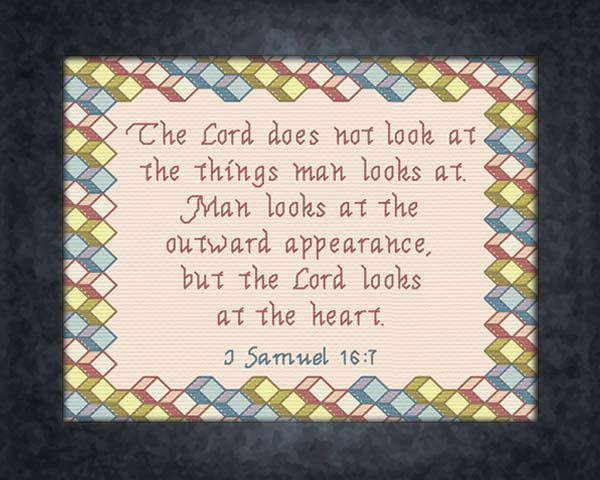
1 Sam 16-7 The Lord Looks at the Heart

1 Samuel 16:1-13 – March 22, 2020

What does a hero look like? Can we describe them? Are they good-looking? Strong or attractive? How much does their image and appearance affect us? How much does what someone looks like cause us to judge that person—positively or negatively? These are all great questions, and questions I’d like us to explore today.

Let’s get right to our Scripture reading. We look at King Saul. Saul had done some really unwise things.  We see the prophet Samuel directed by God to anoint a new king of Israel. Samuel is hesitant…because Saul is still king! However, Samuel is instructed to go to the town of Bethlehem under cover of deception, to the house of Jesse, supposedly to make an animal sacrifice to God.  That is the background of the story thus far.

But what about the deeper meaning of this narrative from the Hebrew Scriptures? For that, we need to go back a few chapters in 1 Samuel. At first, Samuel and the people of Israel were very glad that Saul was their king. He was tall and broad-shouldered, and pleasing in appearance. Saul looked like a king! He was the very image of what people thought a king ought to be. Everyone said so!

But, after some time, Saul’s true nature—on the inside—became evident. He was not all he appeared to be on the outside. He made some very unwise choices, acted foolishly, and God finally rejected him as the king of Israel.

When Samuel met with Jesse and his sons, Samuel looked them up and down. He thought he knew which one God had chosen. The one who appeared big, and tall, broad-shouldered and good-looking. That was the one the Lord wanted, wasn’t it? Or—was it? Did Samuel have discerning eyes? Could he see what God sees?

The writer of 1 Samuel particularly highlights the words “see” and “appearance.” “In the Hebrew, the verb ‘to see’ occurs three times in v. 7 while the noun ‘appearance’ is related to the verb ‘see’. The focus is on how one sees when choosing leaders, and especially on how the Lord ‘sees’ as compared to how humans see. The Lord ‘sees the heart.’[1]

It was just as true when King Saul was chosen as it is today. Just think of the superhero movies—and television shows, and comic books—that are so popular in recent years. We just do not see any skinny, scrawny runts as superheroes. No, it’s all about the outward appearance. That is the all-important factor for human beings today. Plus, add some handsome or beautiful attributes, and we have a definite winner.

What is important to God? What kinds of attitudes and ways of thinking are pleasing to the Lord? Are we “looking” but not really “seeing” as God sees?

All of Jesse’s older sons were presented to the prophet Samuel, but God was silent. Samuel needed to ask whether Jesse had any more sons. “Yes, I do. But, he’s the youngest. He’s out watching the sheep,” said Jesse. Sure enough, God chose David, the youngest of eight brothers. God sees differently from human beings.

We settle for the outward appearance, for what we think the “image” of a king ought to be. However, the Lord looks on the heart. The heart has to do with our will, our attributes, and our internal character. God chose David because David had shown he was a person after God’s own heart. God chose David because David had bright possibilities even when others could not see them.

This bible reading from 1 Samuel is a great source of encouragement for children and young people, who feel left out and left behind by the big and powerful. We see that God finds possibilities in the most unexpected places and through the most unlikely persons. We see the Lord lift up Jesse’s youngest son David to be the anointed king of Israel. In a similar way, God can lift up the marginalized, the downtrodden and the rejected ones today to a place of prominence. God can, and God does just that.

Many people are still fooled by appearances. What kinds of possibilities are there in your life and heart today? Are you a person after God’s own heart? Be comforted and encouraged that God does not see us as the world sees, but God sees past all that. God sees our very hearts.  

It’s amazing to know that the Lord sees inside each of us, down to the “real person” inside. Let us pray that our hearts become like God’s heart, more and more, each day.


(I would like to thank Dr. Bruce Birch. For this sermon, I have borrowed several extended ideas from his commentary on 1 Samuel 16:1-13 from The New Interpreter’s Bible Commentary, Vol 2. Abingdon Press, Nashville, 1998.)

@chaplaineliza

(Suggestion: visit me at my regular blog for 2020: matterofprayer: A Year of Everyday Prayers. #PursuePEACE – and my other blog,  A Year of Being Kind . Thanks!

[1] http://hwallace.unitingchurch.org.au/WebOTcomments/LentA/Lent4A1Sam16.html

The Old Testament Readings: Weekly Comments on the Revised Common Lectionary, Theological Hall of the Uniting Church, Melbourne, Australia.