Unknown's avatar

Peace, from Generation to Generation

“Peace, from Generation to Generation”
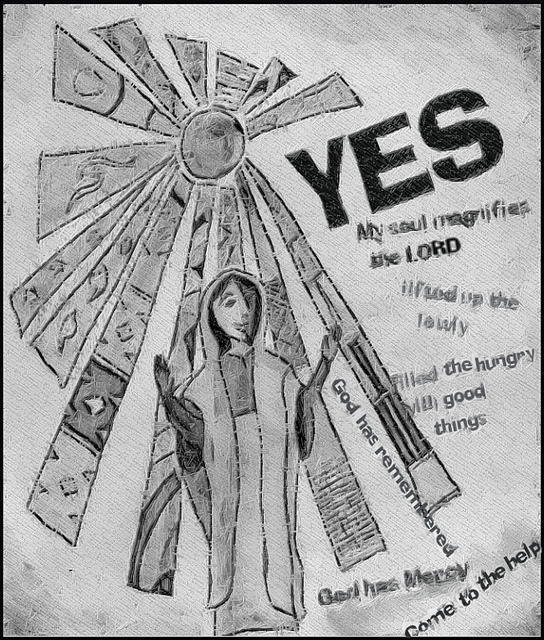
Luke 1:44-56 (1:50) – December 8, 2024

People have been writing songs about the Virgin Mary for centuries. Songs of praise, songs of worship, songs honoring God, and lifting up Mary for saying “yes” to God. Christmas carols might be the first thing that come to mind—but I am also thinking of music from centuries past. From the familiar first part of Handel’s Messiah, to the various settings of the Magnificat, with lyrics from the first chapter of Luke—our Gospel reading for this morning.

            Some Protestants might not be as familiar with the Virgin Mary as many Catholics and Orthodox Christians are. Mary is held in extremely high esteem in many denominations and faith traditions throughout the world, and for excellent reasons. I honor her greatly.

If we look at our modern world today, the situation here in our country, we have a great deal of uncertainty, and very little peace. Does our world today have some strong similarities to the world that Mary inhabited? I wonder, and I would say yes.

Mary sings about the mighty work of God. Yes, personally, in her life. But also in the lives of all the people in the world. “What will this work of God look like?  Something revolutionary is about to happen. God will turn the world upside down. The rich and the powerful will be brought low, and those living on the margins will be raised up. This isn’t a vision that fits very well with a Christian world that values success and power.[1]

For, that is definitely what a large portion of the so-called “Christian world” values today. At least, here in this country, and among a large number of people who claim to follow Christian values and practices religiously. Even if certain Christian denominations do not say it outright, the “Health, Wealth and Happiness Gospel” is a high priority in many people’s lives today.

Let us take a look at what Mary’s situation consisted of. Did you know that Mary—an unwed teenager from an oppressed people-group in an occupied country under crushing Roman rule—was also a radical? A subversive? Was plotting to overthrow the existing oppressive government and replace it with the rule of God?

            What surprising, even shocking things to say about the sweet, innocent Virgin Mary! Everyone associates her with travel to Bethlehem while nine months pregnant, and needing to deliver the infant Jesus in a stable, because there was no room for them in the inn.

That Mary? Radical? Subversive? Absolutely, yes.

Think about the modern Christmas season from another direction. Contrast Mary’s situation with today. Is there any place we can go where we are not bombarded with commercial messages shouting for us to “Buy, buy, buy!” and reminding us of big sales, and markdowns, and half-price! Not to mention all the pressure to be “merry and bright” all the time. Even when going to yet another event or concert or dinner or celebration is the last thing you want to do!

Let us reflect on the first chapter of Luke, on Mary’s song. The last thing on Mary’s mind was commercialism. “Mary’s song, often called the Magnificat, is a welcome contrast to the hyped-up speed of the commercialism that is too often the dominant theme in our culture during the Advent season. Her lyrics are an invitation to approach Christmas with a slower, more contemplative pace.” [2] Is it possible to slow down the frenetic pace of the holidays, to get off the commercial merry-go-round, and instead sit still and worship the coming Messiah?

Sure, the wonderful classical settings of the Magnificat were often sung in a foreign language, like Latin. Or, in text from the King James version of the Bible, full of “thee’s” and “thou’s” and all manner of archaic words. Listen to the first part of her Magnificat, as translated in the modern version by Eugene Peterson, “The Message.” 

“I’m bursting with God-news; I’m dancing the song of my Savior God. God took one good look at me, and look what happened—I’m the most fortunate woman on earth! What God has done for me will never be forgotten, the God whose very name is holy, set apart from all others. His mercy flows in wave after wave on those who are in awe before Him.”

 One well-known depiction of the Virgin Mary is one that is meek, docile, sweet, and not raising a fuss at all. But, wait a moment. Do we realize what Mary is going to sing next? How revolutionary were many of the statements in her song?

             “Even more importantly, Mary’s song is an overture to the Gospel of Luke as a whole. Mary’s lyrics set the tone for Jesus’s radical and controversial ministry that is to come:

You have shown strength with your arm;

You have scattered the proud in the thoughts of their hearts.

You have brought down the powerful from their thrones, and lifted up the lowly;

You have filled the hungry with good things, and sent the rich away empty.

“In contrast, the Christmas season leaves too many still hungry, and too many even further in debt.” [3]

            Do you hear what radical things Mary is saying? If these lyrics of her song were more well-known, would our understanding of Mary be changed? Here Mary is advocating social change, rescuing victims—neglected women, forgotten elders and children, abused strangers and refugees—from being trodden underfoot, even ground under the heel of bragging, bluffing tyrants and braggarts. Turning all society as it was in her day—and ours—upside down.

            What subversive idea is our revolutionary Mary advocating now? Feeding the starving? Giving the poor a banquet? Turning the unfeeling, callous rich people out into the cold? Yes, these radical words are the words found in Luke chapter 1, before we rush on to the narrative of the birth of the Baby in Bethlehem from Luke 2. 

Just looking at this Magnificat, we can see how subversive it was for the infant Messiah to be born to the Virgin Mary. And, we can begin to realize how radical it is for us to say, “O come, let us adore Him, Christ the Lord!” For Jesus truly will bring peace on earth, and He will truly turn the world upside down, just as Mary sang two thousand years ago.

But, this is still only the second Sunday of Advent. We still wait for the baby Jesus to be born in Bethlehem. We still hold our collective breath with all the rest of creation as we wait—and wait. And with Mary, we can rejoice in the promise of the coming Messiah.

Are we overwhelmed with the superficial, commercial glitz and bling of the holidays? Or, are we focused on what really matters – on the coming of our Messiah, our Lord, in God’s peace and wholeness? Let us focus on Jesus, today. Alleluia, amen.

@chaplaineliza

(Suggestion: visit me at my other blogs: matterofprayer: A Year of Everyday Prayers. #PursuePEACE – and  A Year of Being Kind . Thanks!


[1] http://www.bobcornwall.com/2015/12/blessed-are-you-among-women-lectionary.html

[2] http://www.patheos.com/blogs/carlgregg/2011/12/magnificat-learning-to-sing-mary%E2%80%99s-song-a-progressive-christian-lectionary-commentary-on-luke-146-55/

[3] http://www.patheos.com/blogs/carlgregg/2011/12/magnificat-learning-to-sing-mary%E2%80%99s-song-a-progressive-christian-lectionary-commentary-on-luke-146-55/

“Magnificat! Learning to Sing Mary’s Song,” Carl Gregg, Patheos, 2011.

Unknown's avatar

Jesus Is Calling!

“Jesus Is Calling!”

Mark 1:14-20 (1:20) – January 21, 2024

            What would make you change your whole life? I know some people radically change, but what would push you to change everything about your life? For some, it’s a marriage proposal, a chance on true love. For others, it’s a wonderful job offer. Still others, a chance to do something amazing in another part of the country, even another part of the world.

            Now, what did the rabbi Jesus offer? Just think – Jesus was a former carpenter, now a rabbi and itinerant preacher. He came preaching and teaching, offering God’s good news, about God’s kingdom come near. These four career fishermen put down their nets and took off with this radical rabbi for something completely different! [1]

Again, I ask what offers, what commitments convince us that they are worth living for? Changing everything for?

            Let’s look at our Scripture passage for today. We have Mark beginning his gospel with “the Good News of Jesus the Christ, the Son of God.” This is the very start of Jesus’ ministry, I want everyone to understand. Jesus suddenly breaks onto the scene! The urgency, the immediacy is palpable! Can’t you just feel it?

 Only a few verses into the first chapter of the Gospel, the rabbi Jesus takes a purposeful walk. “As Jesus walked beside the Sea of Galilee, he saw Simon and his brother Andrew casting a net into the lake, for they were fishermen.”  

            Jesus was brilliant in His approach to these fishermen, Peter, Andrew, James and John. These were career fishermen, and they knew fishing backwards and forwards. Jesus came asking them to let down their metaphorical nets with an offer of God’s Good News. He said, 17 “Come, follow me, and I will send you out to fish for people.” Although, they probably did wonder, at least a little, what on earth they were doing. Leaving it all behind! Boats, nets, livelihood, everything!

Do you think this was the absolute first time these four men had ever seen Jesus? I suspect not. I would imagine the brothers might have seen Jesus preaching and teaching when they went into town, stood among the crowd and listened. Perhaps the brothers had discussed what Jesus had said while they were working on the job, in their boats, or mending their nets.

            Notice what Jesus did not say to these men! He did not say, “I have a theological system which I would like you to investigate.” No! Jesus did not say, “I have certain theories I would like you to think over.” Certainly not! They followed Jesus because they believed what He said about God’s Good News, about commitment. Reorienting. Reframing their whole lives.

            Let me tell you a bit about reframing. When the wood frame around a window is water damaged, carpenters pull out the wood frame and do what is called a reframing of the window. Straightening out the frame so the window will set plumb and straight up and down. It’s similar to going a new way, a new direction. These four fishermen put down their old lives and set their lives in a totally new direction. Reframing their lives, following Jesus and His call.

The commentator Gary Burge tells us “All we can say about the call is that “the kingdom of God” has broken into their lives in the immediacy of Jesus’ call. There are also two other fishermen on the shore mending their nets, James and John, sons of their father Zebedee. The call of Jesus to them is the same and their response is the same. They leave their livelihood and their father and “immediately” follow this stranger (1:20).” [2]

Friends, as Mark’s Gospel reminds us, God has broken into our world. Jesus proclaimed the Good News, but His whole point is not, “Have an opinion about the Good News.” Or, “This Good News is nice and inoffensive.” Rather, Jesus is calling for a radical, total, unqualified basing of one’s life on this Good News. Just as following this radical Rabbi is a radical idea, a radical reframing of these fishermen’s lives, so is His offer, His calling to us.  

As Lutheran pastor Janet Hunt reminds us, “I wonder now what it is that Jesus is calling us away from and what Jesus is calling us to, don’t you?  I wonder how our worlds would change if we just ‘left our nets behind’ and stepped into the new life before us. I wonder how the world itself would change if we just did this, too.” [3]

As commentator David Lose says, “We follow [Jesus] in particular and distinct ways that may or may not be like the first disciples. And that, I think, is the point. Perhaps we follow by becoming a teacher. Perhaps we follow by volunteering at the senior center. Perhaps we follow by looking out for those in our schools [or workplaces] who always seem on the outside and invite them in. Perhaps we follow by being generous with our wealth and with our time. Perhaps we follow by listening to those around us and responding with encouragement and care. Perhaps we follow by caring for an aging parent, or special needs child, or someone else who needs our care. Perhaps we follow by….” [4] Well, you get the idea.

There is a song I would like to bring to your attention. It’s a recently-written hymn called “The Summons,” written by John Bell, a member of the Iona Community, an ecumenical Christian community in Scotland. The first four verses of the hymn are questions from Jesus. He is asking these questions of us. The last verse is a first-person response to these questions. I would like to read the first and last verses of this hymn. 

Will you come and follow me if I but call your name?
Will you go where you don’t know and never be the same?
Will you let my love be shown? Will you let my name be known,
will you let my life be grown in you and you in me?

Lord, your summons echoes true when you but call my name.
Let me turn and follow you and never be the same.
In Your company I’ll go where Your love and footsteps show.
Thus I’ll move and live and grow in you and you in me. [5]

            Friends, Jesus is calling. Jesus says, “Come, follow Me.” Just as He called those four fisherman by the Sea of Galilee. He calls to each of us, today. Can you see Him? He has His hand extended. Jesus is calling. “Come, follow Me.”

            God willing, with Your help, Lord Jesus, I will follow. Will you?  

@chaplaineliza

(Suggestion: visit me at my other blogs: matterofprayer: A Year of Everyday Prayers. and  A Year of Being Kind . Thanks!


[1] https://www.workingpreacher.org/dear-working-preacher/the-call-of-the-disciples-and-the-decline-of-the-church

[2] https://www.workingpreacher.org/commentaries/revised-common-lectionary/third-sunday-after-epiphany-2/commentary-on-mark-114-20

[3] https://dancingwiththeword.com/gone-fishing/

[4] https://www.workingpreacher.org/dear-working-preacher/the-call-of-the-disciples-and-the-decline-of-the-church

[5] Words © 1987 John Bell, The Iona Community, administered by GIA Publications, Inc.

Unknown's avatar

Believe the Message!

“Believe the Message!”

Mark 1-17 fishers of people

Mark 1:14-20 (1:15) – January 21, 2018

What is news? There are lots of different kinds of news. National news, local news. Partisan news, news that is slanted one way or another. What’s more, we hear so much about “fake news” today. News fit to scare the pants off of some people, and news meant to get some people really upset. News brings about all kinds of reactions. What kind of news can we possibly trust? How do we know which kind of news to believe?   

If we take a closer look at our Gospel reading for today, the Gospel writer Mark talks about news, too. Good News. God’s news—God’s wonderful message of Good News, brought by the greatest newsman, the greatest news announcer of all time, our Lord Jesus Himself.

Mark doesn’t waste any time with genealogies (like Matthew) or with long backstories of how Jesus came into the world (like Luke and John). No, Mark starts right off with a bang, with the baptism of Jesus. Then, shortly after He is baptized, Jesus starts to travel about saying, “Time’s up! God’s kingdom is here. Change your life and believe the Message.”

I love the relevance, the immediacy of Eugene Peterson’s modern translation. How appropriate that this translation of the Bible is called “The Message.” The whole Bible is God’s Good News to humanity, and most especially right here, in the Gospel of Mark.

Here we are, right at the beginning of Jesus’s ministry. John the Baptist (the cousin of Jesus) was already on the scene. A sort of a warm-up act for the main event, for some time John had already been proclaiming “Repent! And, believe God’s Good News!” First Jesus came to John to be baptized, and now was the time for Him to begin His own ministry, His own preaching of God’s Good News.

What do we hear first thing in our Gospel reading today? John the Baptist has been arrested. Next thing, Jesus begins to gather a group of disciples around Himself. Mark tells us that the way Jesus does this is by proclaiming God’s Good News. The Kingdom of God has come to us. Or, as Eugene Peterson translates it, “Believe God’s Message!”

One sure way to know when the writers of the Bible really want readers to pay attention is when a word or phrase is repeated. “The emphasis of Mark’s gospel is that Jesus’ coming is the gospel, the “good news,” a term that in the first fifteen verses of the gospel occurs three times.” [1]  Today’s text continues the story from last Sunday, that is, the beginning of Jesus’ ministry as He tells God’s Good News to His first disciples. In today’s reading Jesus calls four fishermen at the Sea of Galilee — Simon Peter, Andrew, James and John.

Our Gospel reading last week was from John chapter 1, and there are some differences between John’s account and Mark’s account from today’s scripture reading. In that sermon, I also mentioned how Jesus called several of His first disciples—this time it was John and James first, and then Simon Peter and Andrew. Some people have said, “I don’t understand. Which story is true, the Gospel of John or the Gospel of Mark?” Great question.

When a car accident happens in the middle of a busy intersection, that is a real tragedy. I understand when the accident is serious enough, the police sometimes get involved to find out exactly what happened. Imagine the surprise and even consternation when eyewitnesses on different street corners have different perspectives and impressions of the same event!

In the case of the car accident, the different people all saw the same vehicles collide, but from opposite angles and varying positions. Different things may have made a strong impression on one witness, more than another.

It’s no wonder that their eyewitness accounts are somewhat different from each other. And, in the case of the four different Gospel accounts, that adds to the richness and depth of the separate narratives. Each Gospel writer had a separate emphasis and perspective, and different things he wanted to highlight and point out.

However, we need to drill down to what is common between these readings. Jesus calls His first disciples, and Jesus tells them all, “God’s kingdom is here. Change your life and believe the Message.” What is the definition of God’s Good News, anyway? In Greek, the word is euaggelion, or Gospel. God’s Message of Good News to all humanity.

As we trace this Good News through the four Gospels and the rest of the New Testament, we get some more information. God’s Good News is truth. With the coming of the man Jesus here on the earth, humanity has the opportunity to see and touch and experience what God is like. A key feature of this Good News is hope. The fallen world is pretty hopeless and dark, but Jesus brings hope to the hopeless heart. And, last, God’s Good News means salvation. Salvation is not just being saved from the negative aspects of escape from sin and death. No! Salvation is eternal life, and the power to live life victoriously. [2]

God’s Good News is something new to many; something different, even radical. Why on earth should anyone want to adopt this strange, new life from Jesus? Maybe, this way of being and living is even a bit frightening? Many people may well be afraid of taking such a big step.

As Dallas Willard writes, “when he was a boy, rural electrification was just happening and power lines were being strung throughout the countryside.  But suppose even after the lines were up and running you ran across a house where the weary family still used only candles and kerosene lanterns for light, used scrub boards, ice chests, and rug beaters.  A better life was waiting for them right outside their door if only they would let themselves be hooked into the power lines.  “My friends,” you could proclaim, “electricity is at hand!”  But suppose they just didn’t trust it, thought it was too much of a hassle, and anyway didn’t believe the promises that things might be easier with this newfangled juice running into their house.  “If it’s all the same to you, we’ll stick with the old ways.” [3]

You see the difficulty? How some people are afraid of change? Or, prefer not to change their lives? How some don’t want to accept this Good News from God because it’s different, or new, or out of their experience? Can you hear Jesus saying, “My friends, God’s Kingdom is at hand! God’s Good News of eternal life is right here, waiting for you!”

Jesus still offers this gift of God in our world today, proclaiming His Message of God’s Good News, His Message of God’s truth, hope and salvation.

God’s Good News actually makes our job simple. We need to widely and clearly communicate the Message of God. “What mustn’t be lost on us is the urgency of its communication, for the day of judgement is at hand. We point to the hope of eternal life in Christ and call on everyone everywhere to turn and put their trust in Jesus.” [4]

Have you responded as the disciples did, by dropping everything and embracing the Good News? Jesus is calling, waiting for you and for me. Jesus says, “Believe the Message! Come, follow Me.”

[1] http://www.workingpreacher.org/preaching.aspx?commentary_id=2315

Commentary, Mark 1:14-20, Michael Rogness, Preaching This Week, WorkingPreacher.org, 2015.

[2] Barkley, William, The Gospel of Mark (Westminster Press: Philadelphia, 1975), 25-26.

[3] http://cep.calvinseminary.edu/sermon-starters/epiphany-3b-2/?type=the_lectionary_gospel

Commentary and illustration idea, Mark 1:14-20, Scott Hoezee, Center for Excellence in Preaching, 2015.

[4] http://www.lectionarystudies.com/studyg/sunday3bg.html   “Repent and Believe in the Good News,” Rev. Bryan Findlayson, Lectionary Bible Studies and Sermons, Pumpkin Cottage Ministry Resources.  

@chaplaineliza

(Suggestion: visit me at my regular blog for 2018: matterofprayer: A Year of Everyday Prayers. #PursuePEACE – and my other blog,  A Year of Being Kind . Thanks!)

Unknown's avatar

My Soul Magnifies the Lord!

“My Soul Magnifies the Lord!”

Luke 1-46 Mary Magnificat, colors

Luke 1:46-55 (1:46) – December 24, 2017

People have been writing songs about the Virgin Mary for centuries. Songs of praise, songs of worship, songs honoring God, and lifting up Mary for saying “yes” to God. Christmas carols might be the first thing that come to mind—but I am also thinking of music from centuries past. From the familiar first part of Handel’s Messiah, to the various settings of the Magnificat, with lyrics from the first chapter of Luke—our Gospel reading for this morning.

Some Protestants might not be as familiar with the Virgin Mary as many Catholics and Orthodox Christians. Mary is held in extremely high esteem in many denominations and faith traditions throughout the world, and for excellent reasons. I honor her greatly.

Did you know that Mary—an unwed teenager from an oppressed people-group in an occupied country under crushing Roman rule—was also a radical? A subversive? Was plotting to overthrow the existing oppressive government and replace it with the rule of God?

What surprising, even shocking things to say about the sweet, innocent Virgin Mary! Everyone associates her with travel to Bethlehem while nine months pregnant, and needing to deliver the infant Jesus in a stable, because there was no room for them in the inn.

That Mary? Radical? Subversive? Yes.

Let’s back up. Go back to last week’s sermon, where the angel Gabriel surprises Mary and tells her God would like for her to be the mother of the Messiah.

But, what about Mary’s opinion? For a teenager, Mary must have been mature and sensible. She acknowledges the angel’s statement and God’s will. Mary says “Yes, I see it all now: I’m the Lord’s maid, ready to serve. Let it be with me just as you say.”

Sure, the wonderful classical settings of the Magnificat were often sung in a foreign language, like Latin. Or, in text from the King James version of the Bible, full of “thee’s” and “thou’s” and all manner of archaic words. Listen to the first part of her Magnificat, as translated in the modern version by Eugene Peterson, “The Message.”

“I’m bursting with God-news; I’m dancing the song of my Savior God. God took one good look at me, and look what happened—I’m the most fortunate woman on earth! What God has done for me will never be forgotten, the God whose very name is holy, set apart from all others. His mercy flows in wave after wave on those who are in awe before Him.”

One well-known depiction of the Virgin Mary is one that is meek, docile, sweet, and not raising a fuss at all. But, wait a moment. Do we realize what Mary is going to sing next? How revolutionary were many of the statements in her song?

“Even more importantly, Mary’s song is an overture to the Gospel of Luke as a whole. Mary’s lyrics set the tone for Jesus’s radical and controversial ministry that is to come:

You have shown strength with your arm;

You have scattered the proud in the thoughts of their hearts.

You have brought down the powerful from their thrones, and lifted up the lowly;

You have filled the hungry with good things, and sent the rich away empty.

“In contrast, the Christmas season leaves too many still hungry, and too many even further in debt.” [1]

Do you hear what radical things Mary is saying? If these lyrics of her song were more well-known, would our understanding of Mary be changed? Here Mary is advocating social change, rescuing victims—neglected women, forgotten elders and children, abused strangers and refugees—from being trodden underfoot, even ground under the heel of bragging, bluffing tyrants and braggarts. Turning all society as it was in her day—and ours—upside down.

What subversive idea is our revolutionary Mary advocating now? Feeding the starving? Giving the poor a banquet? Turning the unfeeling, callous rich people out into the cold? Yes, these radical words are the words found in Luke chapter 1, before we rush on to the narrative of the birth of the Baby in Bethlehem from Luke 2.

Mary was singing two thousand years ago. But, things haven’t changed much. Political leaders are still calling one another names while people starve. “Refugees struggle to find a home in a world with increasingly closed doors. The poor sleep under bridges while the rich build homes with rooms they will never need. And Abraham’s descendants—Jews, Christians, and Muslims—continue to fight over the lands where God’s messengers first spoke to all humanity.”[2]

As the Rev. Dr. Carl Gregg stated in his article on the radical nature of Mary’s Magnificat, “The Christmas story has, over time, too frequently come to have a sense of ‘preciousness,’ of saccharine sentimentality, of almost sickening sweetness as if you had eaten all the candy in your stocking all at once on Christmas morning. When this super-sweetening of the story happens, we can miss the radicality of the claim that God is found, not as the royal child of a queen in a palace, but as the son of an unwed teenager, born in a stable in a religiously-conservative small town.” [3]

Sure, we can see this saccharine sweetness of Luke chapter 2, once it is pointed out to us. But, in reality, life was not so pretty for teenaged Mary, pregnant without the benefit of marriage.

We are still in the season of Advent, the season of waiting. Today is the fourth Sunday of Advent. We still watch as Joseph and his greatly pregnant wife Mary walk one hundred miles to the town of Joseph’s ancestors (and Mary’s, too).

We still wait for the baby Jesus to be born in Bethlehem. We still hold our collective breath with all the rest of creation as we wait—and wait.

Luke, the writer of our Gospel, has a different take on things. Yes, he waits, too. But he waits with songs. Mary’s song—Mary’s Magnificat is a great example.

As Dr. David Lose says in his commentary, “Have you ever noticed how often Luke employs songs in the first several chapters of his story about Jesus? Mary sings when she is greeted by her cousin Elizabeth. Zechariah sings when his son John is born and his tongue is finally loosened. The angels sing of peace and goodwill when they share their “good news of great joy” with the shepherds. And Simeon sings his song of farewell once he has seen God’s promises to Israel kept in the Christ child.” [4]

These songs are deep expressions of the heart and soul to God and to the listeners—including us. These songs are hymns, psalms, songs of praise and exaltation, and even songs of resistance. Mary combined all of these into her song.

I’d like to close with a portion of a modern song written to Mary, asking her if she knew her infant son would truly be the Messiah, the Son of God. This song was written by Mark Lowry, and asks: “Mary, did you know that your baby boy is Lord of all creation? Mary, did you know that your baby boy would one day rule the nations?
Did you know that your baby boy is heaven’s perfect Lamb?
This sleeping child you’re holding is the great I am!

Mary, did you know? Mary, did you know?”  [5]

We are still waiting…


[1] http://www.patheos.com/blogs/carlgregg/2011/12/magnificat-learning-to-sing-mary%E2%80%99s-song-a-progressive-christian-lectionary-commentary-on-luke-146-55/

“Magnificat! Learning to Sing Mary’s Song,” Carl Gregg, Patheos, 2011.

[2] From An Advent Journey: Devotional Guide, Week Four. This curriculum comes from Illustrated Children’s Ministry.

[3] http://www.patheos.com/blogs/carlgregg/2011/12/magnificat-learning-to-sing-mary%E2%80%99s-song-a-progressive-christian-lectionary-commentary-on-luke-146-55/

“Magnificat! Learning to Sing Mary’s Song,” Carl Gregg, Patheos, 2011.

[4] http://www.davidlose.net/2015/12/advent-4-c-singing-as-an-act-of-resistance/

“Singing as an Act of Resistance,” David Lose, …in the Meantime, 2015.

[5] http://www.lyricsmode.com/lyrics/m/mark_lowry/mary_did_you_know.html

Mary Did You Know lyrics

(A heartfelt thank you to An Advent Journey: Devotional Guide. Some of these sermon ideas and thoughts came directly from this guide.  I appreciate this intergenerational curriculum, which is the basis for my Advent sermon series. This curriculum comes from Illustrated Children’s Ministry. Thanks so much for such great ideas!)

@chaplaineliza

(Suggestion: visit me at my regular blog for 2017: matterofprayer: A Year of Everyday Prayers. #PursuePEACE – and my other blog,  A Year of Being Kind . Thanks!)