Unknown's avatar

Be Prepared!

“Be Prepared!”

Ephesians 6:10-20 (6:10) – August 25, 2024

            I love to go to a baseball game! I do not go that often now, but in years past, I used to regularly go to Wrigley Field and watch the Cubs play. I don’t know if everyone is familiar with the equipment that baseball players need, but one player on a baseball team needs special equipment. The catcher is in a key spot on the team, and a very dangerous one! The pitcher regularly throws the ball at very high speeds. A catcher needs protection from those balls! A catcher’s mask, a chest protector, and shin guards, just to mention a few!

            This is similar to our Bible reading today. The Apostle Paul is finishing up his letter to his Ephesian friends. He warns them to be prepared, with a few practical, direct words for his long-time congregation. (I say long-time, because he spent about three years with this church, longer than with any other church he planted.)

Paul goes through a list of spiritual equipment that will protect his friends from attacks – the attacks of the Devil! Paul does not pull any punches. He is straight and up front with his former church members. He wants to warn them, prepare them for some really difficult times. These difficult times can often come into our lives today, too.

Let’s look more closely at what Paul says. “Finally, be strong in the Lord and in his mighty power. 11Put on the full armor of God, so that you can take your stand against the devil’s schemes. Therefore put on the full armor of God, so that when the day of evil comes, you may be able to stand your ground, and after you have done everything, to stand.”

            When I think of armor, my mind immediately goes to the military. Military service people definitely wear armor to protect themselves every day, in some duty stations, where some serve. Just as in baseball a catcher needs certain equipment to be prepared and safe while in a dangerous position, so do Christian people. Paul was in prison, in Rome, while writing this letter to the Ephesians. Paul was shackled to a Roman soldier inside of his cell, to make double sure he was going to stay put. Paul had the opportunity to become sadly familiar with the Roman soldier’s armor. Everyone, all believers in Christ need certain equipment (or pieces of armor) simply to be prepared!   

Let’s talk about baseball again, for a minute. What about the pieces of equipment the catcher wears? “The mask protects the catcher’s face from foul tips or pitches that might get past the glove. The glove protects the hand from balls. The chest protector protects the middle part of the body. Finally, the catcher wears shin guards to protect the knees and legs. No catcher would ever think of going into the game without this protective equipment.[1]

            Here in the letter to the Ephesians, at the very end of the practical portion of Paul’s letter, Paul details the protection you and I need in our lives, too. (And, this protection is so similar to what a baseball catcher wears!) We can see very well the kind of protection Paul is talking about if we think of a Roman soldier. Roman soldiers were commonplace, all over the Roman empire. Paul calls this protection the armor of God. He is thinking specifically of the armor the typical Roman soldier wears.

            We buckle the belt of truth around our waists. This is like putting on truthfulness. We are to tell the truth – at all times. Sometimes, it is not easy to be honest! In some situations, we are so tempted to bend the truth a little, or even a lot! But, the indwelling power of the Holy Spirit will help each of us with this important foundation of our faith.

            Next, each of us puts on the breastplate of righteousness. That’s a word we mention a lot in religious circles. Another way of thinking of it is putting on right behavior, putting on justice. Just like a catcher puts on a chest protector. Paul exhorts us to act rightly! This is certainly not easy! This thoughtful and prudent kind of action and behavior is often laughed at, by many people. Just think of rude or uncaring people, who may tease you or be mean to you for acting in a way that Jesus tells us to! (And, Jesus is our model for righteousness.)

            Which leads us to our shoes. Paul tells us to put on shoes that show we are speakers of peace. Not to argue and bicker, we are to go out of our way to bring peace to people!  

            These next two pieces of armor are clearly protective pieces. The shield of faith is our protection against those fiery darts that Satan can fire at us. And, not just physical darts! What about mean and nasty words that come our way, words that plant seeds of doubt in our hearts and minds? And, the helmet of salvation keeps the Evil One away. Thank God we have Jesus gifting each of us with salvation, because that is exactly what Paul talks about here.

            The last piece of armor is actually a weapon. The sword of the Spirit is the word of God. The letter to the Hebrews tells us that the Word of God is living, and active, and sharper than any two-edged sword. The Roman sword is a short sword, or weapon, used for combat at close quarters. This means that we are to actually engage the enemy, become active participants in battle! No sitting on the sidelines, as far as Paul’s fellow believers are concerned. As we continue to follow Jesus, we will continue to win the battle against Satan.

Whether inside or outside the church, however and wherever we serve our Lord, God intends for us to be prepared. That means being prepared by these words of caution and exhortation. Paul used these words in Ephesians to advise all of us to be ready to deal with challenging, even dangerous situations. We all need this prudent protection of God’s armor, in our everyday walk as believers.

Final words for today, quoting Paul? Be strong in the Lord! Stand ready, inside and out. And, do all this in prayer, always asking for God’s help. Are you prepared? Am I? With God’s help, yes – we are! Alleluia, amen! 

@chaplaineliza

(Suggestion: visit me at my other blogs: matterofprayer: A Year of Everyday Prayers. #PursuePEACE – and  A Year of Being Kind . Thanks!

(Thanks so much to link http://www.lectionarystudies.com/sunday21bae.html from the Rev. Bryan Findlayson of Pumpkin Cottage Ministry Resources, a lectionary resource I often quote from. Rev. Bryan gave me a lot of insight this week, and I used much of his material for describing the pieces of Godly armor!)


[1] https://sermons4kids.com/sermons/the-armor-of-god

Unknown's avatar

Caring for You!

“Caring for You!”

1 Thessalonians 2:6-10 – August 27, 2023

            Anyone here familiar with any religious leaders who are puffed up? Proud beyond measure? Strutting their stuff? I mean, lording it over their congregations and everyone else? Some preachers and evangelists can be like that. Don’t bother the extra special holy person!

It doesn’t seem like those puffed-up preachers or evangelists care about anyone! Not any common, ordinary folk from their congregations, anyway.

That kind of self-centered, self-satisfied attitude is the problem with certain people, and this is not exclusive to preachers or evangelists. Lots of people can have really skewed priorities and end up ignoring people who hurt, or those who are sad or depressed, or people who grieve all manner of losses. Or even worse, these blinded, entitled people are aware of those who cry out for help, but simply shut the door in their faces.

            I’d like us to focus on several verses from this reading today. They come from the apostle Paul’s letter to the believers in Thessalonica. Starting at verse 6: “We were not looking for praise from people, not from you or anyone else, even though as apostles of Christ we could have asserted our authority. Instead, we were like young children among you. Just as a nursing mother cares for her children, so we cared for you. Because we loved you so much, we were delighted to share with you not only the gospel of God but our lives as well.”

            What does Paul make a point of saying here? Paul and his friends did not want to be treated like something super special! They were not hungry for praise, or seeking strokes and adulation from their fellow believers in town. Certainly, Paul and his friends were in what is known today as a teacher or mentor position among their friends, but not high on a pedestal. And especially not puffed up.

Paul points out, “We proved to be gentle among you.” Like young children!

 “This is another example of positive and gracious leadership. Paul was not a like a dictator to the Thessalonians. Instead, he chooses one of the most tender images in all of nature, a nursing mother. Some of us here may be inclined toward “tough love.” We might say, ‘my way or the highway.’” [1] But, not Paul! He purposely meant to come alongside his Thessalonian friends gently, and he demonstrated that his co-workers were, too.

            This nurturing, maternal reading is not common within the apostle Paul’s letters, since he was more likely to use strong, masculine word-pictures or metaphors. However, using these words of maternal love and affection here show us the loving heart of Paul, and how much he cared for these believers. And not only that, Paul and his friends were ready and eager to share all that they had with the Thessalonians.

Commentator F.F. Bruce makes the connection that “No other attitude would befit the preachers of a gospel which proclaimed as Lord and Savior one who ‘emptied himself’ (Phil 2:7) for the enrichment of others.” [2]  We can see our Lord Jesus showing the ultimate in loving, caring affection in Philippians 2, as He emptied Himself of all Godly prerogatives and attitudes, and set all his Godhood aside. Our Lord Jesus became a human being so He could communicate on the same level, and more easily and directly with us fellow human beings.

            Similar to what Paul just said in this letter to the Thessalonians, Jesus did not throw His weight around! No, Jesus was not on a pedestal or puffing up His chest because He was so high and mighty. Can you possibly imagine Jesus doing things like that? Absolutely not!

            Just so, Paul imitates his Lord Jesus by showing that he and his companions are not hungry for praise, or seeking strokes and adulation from their fellow believers in Thessalonica.

Paul specifically says he and his friends tenderly care for their Thessalonian friends in the church. The Greek word he uses here is thalpo, “to warm, cherish, nourish.” How nurturing is that! This is the same word used in the Greek translation of the Hebrew Scriptures for a Scripture reading we examined earlier this summer: Deuteronomy 22:6, where mother birds cover her young or her eggs with their feathers. 

That is not all! This Greek word thalpo, “to warm, cherish, nourish,” is used again by the apostle Paul in Ephesians 5:29. Here he describes our risen Lord Jesus Christ and His care for the church universal. How wonderful that the Lord Jesus Christ continues the same caring, nurturing activity He regularly displayed during His time here on Earth as a human being. Commentator F.F. Bruce adds, Paul’s words “’For her own children’ would stress the personal involvement and concern. A mother who is nursing her children does not and cannot turn the care of her child over to someone else. She feeds, loves, and protects her child.” [3]

Helping people to grow in the Lord, as with growing children, takes time and requires patience, just as much today as 2000 years ago. Sometimes it causes pain and grief, and priorities need to be set in our relationships. We don’t raise children overnight, You and I can’t raise them without growing pains for both parent and child alike. [4]

            If we recognize our deep need for nurture, protection and caring from all that would harm us, we can also watch out for one another! Jesus urges us to nurture, protect, and care for one another, too. As our loving, caring Lord Jesus always does for us. Without fail.

            Praise God, God has been loving, caring and full of nurture for us all. God is our nurturing Parent, and that’s a blessed fact. Alleluia, amen. 

@chaplaineliza

(Suggestion: visit me at my other blogs: matterofprayer: A Year of Everyday Prayers. #PursuePEACE – and  A Year of Being Kind . Thanks!

(I would like to thank the website www.bible.org for their commentary and bible study on today’s New Testament reading, https://bible.org/seriespage/4-compelling-example-ministry-1-thess-21-12. I got several excellent ideas and quotes for this sermon from this excellent article.)


[1] https://studyandobey.com/inductive-bible-study/thessalonians-studies/1thessalonians2-1-9/

[2] https://bible.org/seriespage/4-compelling-example-ministry-1-thess-21-12

[3] Ibid.

[4] Ibid.

Unknown's avatar

Gathered under God’s Wings!

“Gathered under God’s Wings!”

Matthew 23:37-39 – August 13, 2023

            Growing up in Chicago, I never had the opportunity to see chickens. I mean, live chickens, in a barnyard or roosting in a henhouse. Lately, I still have never gotten up close and personal with a chicken. I may have read the story of “The Little Red Hen” to my young children, years ago, but haven’t had too much more contact with chickens than that.  

            I am certain that this image of a hen and her chicks was much more familiar to the people the Rabbi Jesus spoke to. It was much more common to have chickens in your yard, or at least down the street, in the first century. Remember the reading? Here’s the verse we are focusing on, where Jesus refers to Jerusalem: “I have often wanted to gather your people, as a hen gathers her chicks under her wings. But you wouldn’t let me.”

Our Lord Jesus made this serious and sad statement, when He was warning Jerusalem and the people of Israel. This lovely word-picture is so touching and tender! A mother hen fluffs herself up and gathers her chicks under her wings, keeping them safe and warm. Protecting them from harm, too. Jesus often used familiar images and common metaphors in His teaching and preaching. Except – one thing stood out about this particular image Jesus used.

“Jesus, let us note, employs a feminine image for himself and, to the degree that we confess Jesus reveals the essential character and disposition of the One who sent him, also for God.” [1] Those were not my words. Instead, they are the words of a well-respected Bible commentator, Dr. David Lose. (One of my favorite commentators, I may add!) It is not often that the Bible uses feminine or maternal images to describe God, but here is one of them!

I know I have been preaching this summer sermon series about Re-Imaging God for two months now. Many of the examples and Scripture references I’ve been using come from the Hebrew Scriptures. Yet, right here we have an important one, used by our Lord Jesus! At a critical time in His ministry, too. Jesus was in Jerusalem, during the Passion Week, face to face with the Jewish leaders and members of the Sanhedrin. And, what does He do here? Jesus compares Himself to a mother hen, wanting to gather her chicks protectively under her wings.

Just as I have done during this sermon series, David Lose makes the very good point that “if Jesus can describe himself and God as a mother hen, can we not also employ a variety of images to describe God? Scripture, after all, is replete with a variety of images for God, both male and female.” [2] I must say, that most of the images and metaphors used for God in the Bible are masculine and male. However, this week we highlight this important maternal image, given by our Lord Jesus at a critical time of His work here on earth. Shortly before the Passion and Crucifixion.

Which brings us to the following question: who was Jesus talking to? Yes, the Jewish leaders were listening to Him, but in this reading, Jesus addresses Jerusalem. That’s the historic capital of the land of Israel. We see Jesus saying that He has been reaching out to Jerusalem, and the Jewish people, and they have not listened. They have not heard the invitation of Jesus.

We turn to the next question: where do you and I come in? Sure, it breaks my heart to see Jesus offering His powerful, protective love to those He was sent to serve and to save. Yes, that is the people of Israel, but couldn’t it be us, too? Jesus has His arms open wide to us. Are we not hearing? Not listening to Jesus? Or even worse, just like the Jewish people, are we rejecting His love and caring, where He offers to be like a protective mother hen with her chicks?

As the Rev. Janet Hunt says, we are, indeed, “that brood of chicks who are scattered, distracted, unable, somehow, to comprehend the very real danger which is threatening. Jesus’ lament over Jerusalem is also over you and me and this world which all too often still refuses the gifts Jesus would so freely give.” [3] 

This loving image, this metaphor for Jesus is so perfect for all of us, today. Can you see how Jesus as a mother hen would comfort the one who grieves? What about the weary ones who are fearful or anxious? What about protecting the safety for those in the care of Jesus? What about those gathered under His protective love, today?

Today’s Gospel reading does not give instruction, or commands. It does not prescribe something for the followers of Jesus to do or to say. Instead, this reading is descriptive. This description of the loving, caring mother hen – Jesus! – has His wings open wide to us all!

As Pastor Janet says, “we do not hear directly that we are to be or do anything as a result of Jesus’ words today. And yet, how might the world be changed if all of us” stopped to think of the consequences, both for those who wage war and those who suffer as a result. Or, for those who struggle to contain or direct our frustration, our anger and take it out on innocent ones. [4]

            Yes, these words were written almost 2000 years ago, but they resonate so deeply within. I don’t know about other people’s understanding, but these words and this image of the Lord Jesus speaks directly to the heart. Going to some deep, elemental place within, inviting you and me to turn to the One who would draw us close, our Lord Jesus.

If we recognize our deep need for nurture, protection and caring from all that would harm us, we can also watch out for one another! Jesus urges us to nurture, protect, and care for one another, too. As our loving, caring Lord Jesus always does for us. Without fail.

Join me in bringing thanks to our Lord for the loving, everlasting care and nurture of Jesus.  Praise God! Alleluia, amen.

@chaplaineliza

(Suggestion: visit me at my other blogs: matterofprayer: A Year of Everyday Prayers. #PursuePEACE – and  A Year of Being Kind . Thanks!

(I would like to thank the Rev. Janet Hunt for her commentary on today’s Gospel reading, https://dancingwiththeword.com/mining-the-metaphor-jesus-as-a-mother-hen/. I got several excellent ideas and phrases for this sermon from this excellent article.)


[1] https://www.workingpreacher.org/dear-working-preacher/re-imagining-god

[2] Ibid.

[3] https://dancingwiththeword.com/mining-the-metaphor-jesus-as-a-mother-hen/

[4] Ibid.

Unknown's avatar

Green Pastures, Quiet Waters

Psalm 23:2, John 10:4 – May 7, 2017

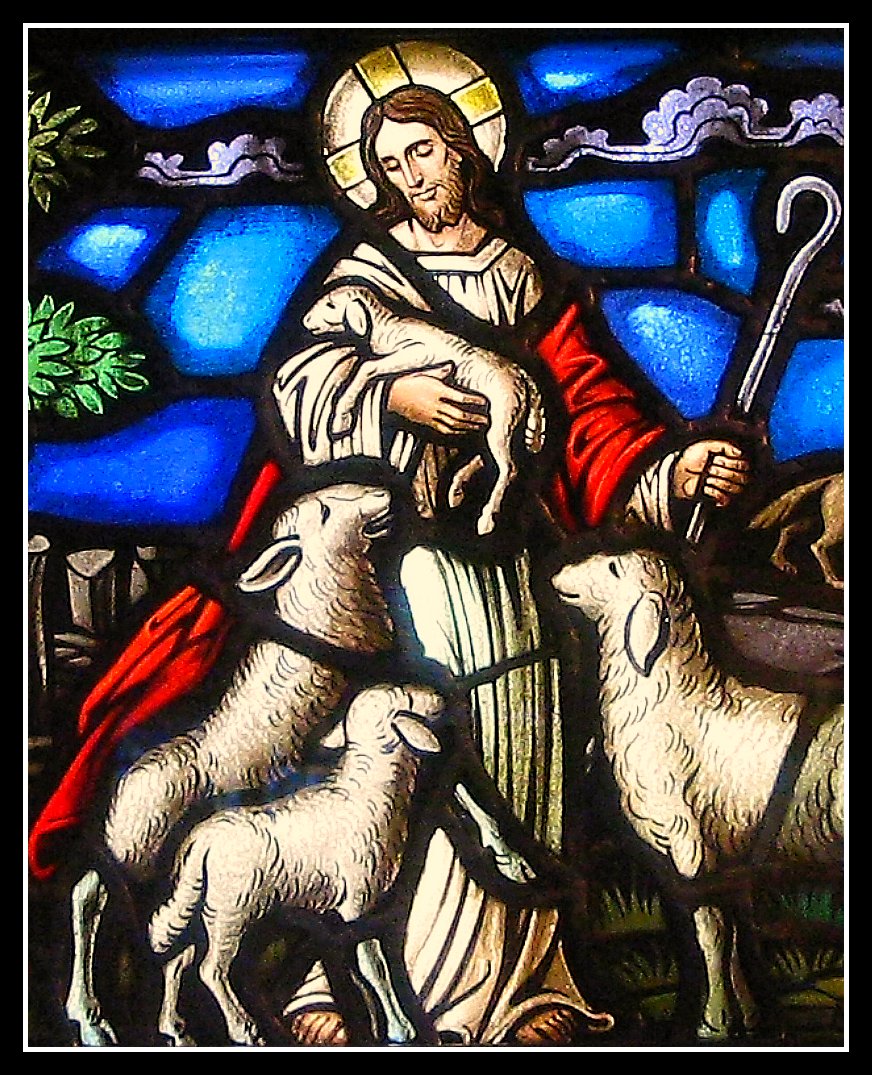
John 14 Good Shepherd, stained glass

“Green Pastures, Quiet Waters”

If I mention images of sheep and green pastures, what comes to your mind, on that video screen in your head? For some people, it might be something on the Nature channel on cable television, with verdant, green grass and gently rolling hills, dotted with fluffy white sheep. For others, it’s a painting at an art museum, with lush green meadows under brilliant blue skies. Again, dotted with sheep feeding on that green grass.

In Psalm 23, our psalm writer is King David. He is writing about his youth as a shepherd for his father’s sheep, long before he ever became king. That time as a shepherd must have been vivid in his mind, because David’s poetic description of sheep and shepherd remains one of the most striking, beloved, and relatable passages in the Bible, in either the Hebrew Scriptures or the New Testament.

Here is another way of saying the first verse of Psalm 23: Because the Lord is my Shepherd, I have everything that I need.

Wait, that makes me a sheep, and sheep are not particularly intelligent. Now, I am okay with that. As I have said in the past, this is a common analogy in the Bible. The nation of Israel is referred to as sheep several times in the Hebrew Scriptures. Different biblical writers refer to people who believe in God as sheep. Several times in the Gospels—as in our Gospel passage from John 10, today—Jesus talks about Himself as Shepherd, and His followers as sheep.

I figure God must know a few things about people, being the Creator of the Universe, and all. Since God uses this common analogy of sheep and shepherd so many times in the Bible, and since sheep have been known to be stubborn and timid and sometimes even foolish, I guess I might have a few things in common with sheep. Maybe you do, too.

Sheep need stuff. They need grass, water, nurture, and protection against enemies. They depend on their Shepherd to provide all of these things for them. But, what if there is no Shepherd? What if there is no one to provide all of this good stuff for us—I mean, for sheep?

Sometimes bible study leaders and bible teachers have their students do an exercise. They write a reverse psalm. That is, writing the reverse of what the verses say. One of the bible commentators I read used this process. She said, “I’ve been led in this process, and led my Bible Study in it. At first you might ask, ‘Why do it this way?’ But, especially when in a group, reading back all the hopeless examples of our life without God, we see the power of this psalm more clearly.” [1]

I’m going to read just the first few verses of Psalm 23, written in reverse. It was written by a then-15 year old named Anna Thompson.

“I have no shepherd, I need a shepherd./I am caught in the desert.
I am thirsty/and no one is telling me where to go.
I am lost and no one cares./I am scared of evil, because I am alone.”  [2]

This is truly a hopeless example of our life without God! What would happen to a few little sheep, huddling in the wilderness or the desert, with no one to guide them, take care of them, or to shepherd them? I don’t think they would last very long. Some predator might come along and have some lamb and mutton for dinner. That’s what probably would happen. This is a far cry from the green pastures and the quiet waters the psalm describes for us, and quite different from the Good Shepherd who supplies our wants and needs.

Jesus takes this image of sheep and a Shepherd from Psalm 23, and enlarges on it.

Notice what is not mentioned in either Psalm 23 or John 10. Is there any mention of the sheep needing all the stuff we see on television? I must have this new outfit or latest electronic gadget or trendy pair of shoes. I absolutely need to be healthy, beautiful, entertained, wealthy and successful. No, neither of these bible readings have anything of the kind.

Psalm 23 has a basic set of wants that “the shepherd provides for his sheep. That list includes food, drink, tranquility, rescue when lost, freedom from the fear of evil and death, a sense of being surrounded by the grace of the Lord, and a permanent dwelling place in the house of God. An ever-rising mountain of material possessions is not on the list.” [3]

.           Let’s think about the reverse psalm again. I have no shepherd. I am caught in the desert. I am thirsty. I am lost. I am all alone.

Doesn’t that hit you right in the gut? Hopeless, helpless, life without God. Where are You, God? I’m all alone out here, and I am lost and scared!

One of my favorite commentators is Carolyn Brown, a Christian educator who’s worked with children for decades. She writes about the Bible and our worship being filled with metaphors. We try to help children understand them “when we carefully explore the details of a few key ones, expecting them to become familiar with the concrete part of the metaphor and some of the spiritual realities it embodies, but not fully making the connection until later [when they are older].  The Good Shepherd is definitely one of those key metaphors. [Doctor and educator] Maria Montessori reports that while working in a children’s hospital she found that when she told sick children stories about the Good Shepherd using small wooden figures, they almost all grabbed the figure and held onto it ‘for keeps.’” [4]

It doesn’t matter if we are talking about the Shepherd of Psalm 23, or the Good Shepherd of John 10. The Shepherd helps the sheep to feel safe, to feel protected and full, able to rest and feel content. Not to feel hungry, thirsty, frightened, lost and alone.

In our Gospel reading this morning, Jesus adds something to the picture of the Good Shepherd that is not in the 23rd Psalm. Jesus talks about the sheep knowing the Shepherd’s voice. That means whether sheep are in green pastures or brown ones, in the desert or high in the hills, the sheep will recognize the shepherd’s voice and call. As Jesus said, “When he has brought out all his own, he goes on ahead of them, and his sheep follow him because they know his voice. But they will never follow a stranger; in fact, they will run away from him because they do not recognize a stranger’s voice.”

In Palestine, in the mid 1930’s, a village near Haifa had some internal conflict. The occupying British soldiers confiscated all the villagers’ animals and put them in a central pen, mixing them all up. The animals’ owners were permitted to redeem their animals, if they could identify them. An orphan shepherd boy whose only possessions were six sheep and goats came to the officer in charge, and asked for his animals. The officer ridiculed the idea that the shepherd boy could possibly pick out his “little flock” from among the hundreds of animals in the pen. The shepherd boy had his pipe and gave his own “call”—his unique call for his animals. “His own” separated from all the others and trotted out around him. [5]

The sheep know the Shepherd. They follow the Good Shepherd’s voice, and willingly go with Him to green pastures, and by the quiet waters. Jesus is the Good Shepherd, and He will be with us in green pastures as well as desert places, by quiet waters as well as in thirsty times. And, Jesus will walk with us through those dark and scary valleys of the shadow, too.

Even when we walk though the valley of the shadow more than we like, praise God, our Good Shepherd will always be there beside us, to help, nourish, protect and nurture us.

Yes, I am a sheep. I freely admit that.

I know if the Good Shepherd is my Shepherd, surely His goodness and love will follow me all the days of my life, and I will dwell in the house of the Lord forever.

[1] http://bethquick.blogspot.de/2011/05/lectionary-notes-for-fourth-sunday-of.html

[2] Psalm 23: “I Have No Shepherd” https://re-worship.blogspot.com/2011/05/psalm-23-i-have-no-shepherd.html

[3] Bailey, Kenneth E., The Good Shepherd (Downers Grove: IVP Academic, 2014), 39.

[4] http://worshipingwithchildren.blogspot.com/2014/03/year-fourth-sunday-of-easter-may-11-2014.html

Worshiping with Children, Easter 4A, Including children in the congregation’s worship, using the Revised Common Lectionary, Carolyn C. Brown, 2014. 2011.

[5] Bishop, Eric F. F., Jesus of Palestine (London: Lutterworth, 1955), 297-98. Quoted by Kenneth E. Bailey in The Good Shepherd, 42.


@chaplaineliza

(Suggestion: visit me at my regular blog for 2017: matterofprayer: A Year of Everyday Prayers. #PursuePEACE – and my other blog,  A Year of Being Kind . Thanks!)

Unknown's avatar

One Who Brings Peace

“One Who Brings Peace”

Micah 5-5 He will be our peace

Micah 5:5 – December 20, 2015

Peace. Peace is the subject today. Today we light the Advent candle of peace. Here, inside the church, it seems like peace is a realize-able actuality. But—not on the outside. Not out in the cold, cruel world. Peace, peace, is the cry! Here in the 21st century, we have wars and the rumors of war. Fighting, skirmishes, various attacks of various kinds. Will anyone hear our cry for peace? Will anyone—anywhere—heed our cry?

In biblical times, there was always some tribe or country beating up on another tribe or country. Always somebody marching off to war. To enlarge territory, or to gain political advantage, or to right some wrong. So seldom did the nation of Israel have true peace! Much of this book of the prophet Micah deals with war, conflict and fighting. Except for right here.

Our Gospel reading from Luke tells of the pregnant Virgin Mary going to visit her older cousin Elizabeth, who prophecies that Mary has within her the baby Jesus, the Son of God. Usually, the Scripture readings are chosen with great care. Chosen with an eye to common themes. So, what is in common, here? The prophecy of a strong leader to come, from our Old Testament text, and the prophecy of the birth of the Messiah, from our Gospel reading.

Here we are at the fourth Sunday of Advent. We have had Advent for a long time. Since the last week of November. I can just hear the children saying, “When is Christmas finally going to get here?” Some schools have already gotten out for the winter holidays. I know some local churches are featuring a Christmas cantata today, or a Christmas pageant in worship.

Yet here we all are. The last Sunday of Advent. Isn’t Christmas here yet? Isn’t it time for angels and shepherds, Mary and Joseph and the Baby in a manger? Can’t we hurry things along?

As we look at the prophecy in Micah, we can see that the prophet is certainly not thinking about warm and fuzzy Christmas carols. Not about the lion lying down with the lamb, about God reaching down and bringing peace on earth, good will towards all people. Or, is he? What is Micah saying in our reading today?

Yes, a strong leader will rise up. Who do you think Micah’s contemporaries thought the prophet was talking about? I was fascinated to read in one commentary that most people would connect this strong leader to King David. But, wait! David had been dead for two hundred years, by the time that Micah wrote his prophecy. How could the Jewish people think “David” when they heard prophetic words like this?

Because—because of the prophecy of David’s prophet Nathan from 2 Samuel 7. A direct descendant of David would be king. God had promised King David that exact thing. So, who else could this strong leader be but a direct descendant of the great King David?

All well and good! Except, it gets more complicated, fast. Micah mentions “out of you [Bethlehem] will come one who will be ruler over Israel, whose origins are from of old, from ancient times.”

Now, I can understand a strong leader. A ruler, a mighty King. A descendant of King David. I can even understand the prophecy of a baby, from Luke, chapter one. The descendant of David needs to be born. Elizabeth prophecying and praising God that the mother of the Messiah to come was coming to see her. Okay, I’ve got that.

I am so indebted to John C. Holbert’s article on this Scripture reading. [1] I was aware of some of this material from the book of Micah, but by no means all. And never in so much depth!

Micah’s prophecy foretells a strong leader, yes. A descendant of David is presumed. (Micah doesn’t specifically say so.) Adding two and two and two together, from the prophecies of the Hebrew Scriptures, people have ascertained that this prophecy also refers to the Messiah. And then—Micah adds the part about the ruler “whose origins are from of old, from ancient times.” This part definitely needs more explanation.

These phrases are a challenge to translate from Hebrew. The best that anyone can figure is that there are several meanings for these words. “Origins” can also be translated “coming forth” of old! Dr. Holbert says that God put this word ‘olam, or “ancient times,” “into human minds in such a way that they may know a bit of what has happened in the past, and a tiny portion of what may come, but just enough to teach them that they in fact know precious little about either past or future in the end. There the word appears to mean something like a very long time or deep in the past and far into the future, not quite eternity but as much as any puny human mind may conceive.”

Talk about not being able to understand Scripture. These couple of phrases blow me away. I feel small when I read this. Really young, like a preschooler. I realize I do not know very much about God or about the Bible, at all. Period. God surely can flatten me, humble me with a phrase from the prophet Micah.

But, wait! There is more! Let’s unpack this reading, further.

Holbert continues: “Who then does Micah have in mind? This is no simple heir of David; here is someone primordial, someone from the most ancient of times yet also uniquely prepared to act decisively in the present.” In other words, Micah is talking about Someone more than human. Looking forward to the future, talking about Someone who not only is the promised Messiah to come, the promised descendant of David, but also looking back to the far distant past. To the beginning of time, even beyond the beginning.

Then, in Micah 5:3, the prophet brings up the image of a woman in labor. What is our Gospel reading from Luke for today? It’s about two pregnant women. Elizabeth prophecying about the Child Mary is carrying. The Child is the Lord. The Son of God. The next verse, Micah 5:4 speaks of the promised one who will be a shepherd. Just like King David! A powerful and godly shepherd who keeps the flock safely; “and they will live securely, for then his greatness will reach to the ends of the earth.” Again, this is Messiah language, and more!

Who is this Messiah, anyway? Descendant of David, check. Born in Bethlehem, which is David’s ancestral home. Check. But, Micah says from ancient of days? Luke calls Him the Son of God? The Lord God Almighty?

This great Shepherd will not only be concerned with the flock of Israel, but also the flock of the entire world. And—this is the most important part to me, right now. This strong leader, this Shepherd will be our peace.

This Messiah will not just be peaceful for Israel’s sake. No! Our Messiah, our Christ, from ancient of days, will act peacefully for the safety and well-being of the whole world!

Do you hear the Good News from the prophet Micah today? This Messiah was not going to act in the way that so many other Middle Eastern potentates did. Or, for that matter, like any other earthly ruler ever has. Instead, we are told in our Scripture passage today that He will feed His flock. The Messiah’s flock will have the opportunity of living secure, safe, and peacefully under Messiah’s mighty protection. I thank God that I am one of the worldwide flock.

God extends that opportunity to everyone, so that we all can have the security and care of the Messiah, the Good Shepherd, the Babe of Bethlehem, the ruling King. Praise God for God’s wonderful gift of protection and care.

[1] http://www.patheos.com/Progressive-Christian/Who-Is-This-Peaceful-One-John-C-Holbert-12-11-2015

(Many thanks and much appreciation to Dr. Holbert! Wonderful article on Micah.)

@chaplaineliza

Suggestion: visit me at my daily blog for 2015: matterofprayer: A Year of Everyday Prayers. and my other blog,  A Year of Being Kind .  Thanks!

Unknown's avatar

Jesus Sends Us Forth!

John 17:11-19 – May 17, 2015

Sent into the world - John 17-18

“Jesus Sends Us Forth!”

Most everyone I know like to receive packages. Have you ever received something extremely fragile in the U.S. mail, or from Federal Express or UPS? Can you just visualize the package? Unpacking something like this is a multi-step process! Opening the box, taking out the protective foam pellets, unwrapping the layers of encasing bubble wrap, taking off the newspaper cushioning the fragile piece. And, then—there it is. Finally, unwrapped.

We didn’t want to allow the fragile piece of glassware—or pottery—to get chipped or broken. Heavens, no! So, we take extra-special care. We wrap it, protect it, and swathe it, even immobilize it, in order to make extra sure that it’s safe and won’t get hurt or broken.

Except—as we consider our gospel passage today, we aren’t talking about fragile glassware or delicate pottery. Here, our Lord Jesus is praying to His Heavenly Father about the disciples. Asking some things for them, specifically.

Let’s set the scene. It’s a familiar scene. The Upper Room, after the Passover dinner with His disciples. Jesus has just finished His last words to His friends, and now in John 17, He prays. It’s an intimate time, with Jesus addressing God His Father in the most intimate way.

God sent His Son into the world—special delivery. Into a battered, fallen, sinful, hate-filled world. Did you know that? Did you realize that? From time to time we may say that, in an Affirmation of Faith, or some such statement of belief. I try to make it a central point in my sermons, when the Scripture passage mentions it.

Yes! Jesus, the Son, was sent into the world in order to proclaim the gospel, as well as to give everyone a picture, an actual physical representation of God in heaven. Here, on earth. One of the names of Jesus is Emmanuel, God with us.

Question: when God sent Jesus into the world—special delivery, what was the situation?

Where was He sent, in the first place, according to the Christmas narrative in the Gospel of Luke, chapter 2? We remember! Jesus—the eternal Son, laid down all of His heavenly Godly-ness, all of His awesome power and might, and was born as a helpless infant to an unmarried girl. In an occupied state, from a marginalized people. Here on this earth in amongst fallen, messy, dirty people who often make mistakes. Lose their tempers. Are unkind and rude—and even worse—to others. Where sin and disease and unemployment and accidents happen, on a regular basis. Imagine that!

God the Heavenly Father could have wrapped the man Jesus securely in bubble wrap. Or, in case Jesus even moved, God could have made sure He was packed in protective foam pellets, so Jesus wouldn’t get injured or harmed. But—that sounds silly! Maybe that idea works for shipping fragile items or glasswear, but not for people!

Let’s take a closer look at verse 18 of this intimate prayer. Jesus says, “As you sent me into the world, I have sent them into the world.” So—Jesus is talking about sending the disciples out into the world. Do you get the picture? The past three years were a training program. An internship, if you will, to get the disciples prepared for ministry.

Being sent out. Getting down to the business of letting others know about God. The disciples are getting ready to be launched into the world. In order to proclaim the gospel, the Good News, as well as to give everyone a picture, a representation of God in heaven. Here, on earth.

Wait a second, Jesus. That’s scary!

The thought of the disciples going forth, being sent out. Who knows where they might end up? Here on this earth in amongst fallen, messy, dirty people who often make mistakes. Lose their tempers. Are unkind and rude—and even worse—to others. Where sin and disease and unemployment and accidents happen, on a regular basis. Imagine that!

These words in this intimate prayer to God are words that entrust the future to God. These words do not leave the disciples as orphans (as Jesus said), nor do they set the disciples adrift, completely on their own. These words do prepare the disciples for His departure, and for their work and lives in ministry after His death and resurrection.

In short, Jesus is asking God to take care of His friends, after He leaves. How caring! How considerate! How awesome! But, Jesus did not ask for God to pack the disciples in protective foam pellets or encase them in bubble wrap.

In preparing this message, one of the resources I used is one I occasionally turn to. An online website where clergy discuss the lectionary passages of the week. In one of the discussions on this gospel passage, a pastor from North Dakota gave the following reflection and then, illustration.

“The thing that strikes me this year about this text – this prayer – is that Jesus prays for protection. He doesn’t pray for removal – removal from the world – removal from evil. It seems to me that we are expected to be in the world (not of it) and with that comes dealing with sin and evil. And Jesus prays for protection. I also think there is a difference between protection and shielding.

“Here in North Dakota (not in May, mind you!) an image that works for me is that we dress our kids in snowsuits and hats and mittens and boots and then we send them out into the cold. We don’t just hide out in the house with the nice warm furnace and hot chocolate and we don’t shield our children from the weather. We protect them, yes, but, still, they are sent out into the wind and cold. I think God is like that with us as well. God doesn’t help us to hide from the world and all its ‘stuff.’ God gives us what we need as protection … the Word, faith, a conscience … you get the idea.”

You get the idea—God protected our Lord Jesus while Jesus was here on the earth, even though I’m sure Jesus and His friends had to put up with being itinerant and homeless all the time they were traveling around Israel, with all the accompanying discomforts and getting dirty and sometimes going hungry. God protected the disciples, the followers of Jesus—and they were still sent out into the wind and the cold. Into the world where sin and disease and unemployment and accidents happen, on a regular basis.

The part of this passage that hits home the most, for me, is that Jesus prays for His friends. Not only the disciples, but we can also see His prayer broadened to include all those who follow Him. That includes you and me! Us. All those who receive Jesus’ good news, His Gospel of the revelation of God.

Just as Jesus prays for us in this prayer in John 17, so we share in this mission. We, too, are being sent! We, too, have the awesome direction from our Lord Jesus to go forth, let others know about God. We are launched into the world. In order to proclaim the gospel, the Good News, as well as to give everyone a picture, a representation of God in heaven. Here, on earth.

The best part is that Jesus has prayed for us, already! He has covered us with prayer, with protection, so that we are suited up to go out into the world. Just as we don’t shield our children from the weather; we protect them, yes, but, still, they are sent out into the wind and the weather and cold. I think God is like that with us as well.

We are sent out into the world, to spread the Good News about Jesus. God is right by our sides, too. God gives us what we need, too. We can have that assurance. For sure, and certain. Alleluia, amen!

@chaplaineliza

(Suggestion: visit me at my daily blog for 2015: matterofprayer: A Year of Everyday Prayers. and my other blog,  A Year of Being Kind .  Thanks!)