Unknown's avatar

How Different are God’s Thoughts?

“How Different are God’s Thoughts?”

Isaiah 55:1-3, 6-9 (55:2) – March 23, 2025

            Sometimes, I get really, really busy. Involved. Even distracted. Doing a lot of things, sometimes attempting even more than I could possibly ever finish in one day. Sometimes, when I get really involved in things or activities, I don’t even think about God for whole stretches of time–for hours, sometimes even days at a time. Sometimes, I discover I don’t even look for the Lord. I don’t even concern myself with finding God. And every once in a while, I don’t even want to go looking for the Lord.

            I certainly admit it. I have been less than a perfect Christian. There have been numerous times when I’ve forgotten to pray, neglected to study the Bible, sidestepped communication with God. I definitely haven’t hit a bull’s eye in my personal Christian walk 100 percent of the time. I do freely admit it. I have a sneaking feeling that I’m not alone. If we were to admit it to ourselves (and even admit it to a few other people, too!), I suspect we would find a number of honest, repentant people, confessing where they have fallen short in their Christian lives.

            That’s bad news! What can we do about that??

            Looking at our scripture reading for today, I can find several things that may help us out when we consider a big problem like falling short in our lives before God.

            Let’s take a closer look at verses 6 and 7. “Seek the LORD while he may be found, call upon God while he is near;” Whoa! The Lord is closer than I thought! God’s right here, johnny-on-the-spot! I have a sneaking suspicion the Lord is right next to me, whenever I look for Him. And I have a feeling God will be right there, immediately, whenever I call.

            While I was writing this sermon, I was reminded of the times I played hide-and-seek with the neighborhood kids when I was young. I bet most of you have played hide-and-seek at one time or another, too. When I was seeking the other players, I knew the object of the game. Look for the other players. I understood what I was supposed to do.

            But, there’s a problem here in the scripture passage, in Isaiah 55:7. The prophet mentions the wicked, who pursue their own wicked ways. They are not following after the Lord. They are not even close to doing what the Lord wants them to do. These wicked people don’t even know what they’re missing. They don’t care about the object of the game. “Let the wicked forsake their way, and the unrighteous their thoughts.” These wicked people, these unrighteous guys are even thinking bad thoughts, thoughts that are not pleasing to the Lord!

            Again, that’s bad news! What can we do about that??

            I’ve been talking about some pretty negative people, and some pretty negative actions, where some people actively go out of their way to be disobedient and disruptive. Some people are like that. The Bible often talks about those kinds of actions and that particular kind of people

            Now, I’ll go off in a slightly different direction—still away from the Lord, but just different. Sometimes, other people get the “busy-sickness.” You know the type. Running around like chickens with their heads cut off.. In a dad-blamed hurry, frantic, running, rushing and dashing around, sometimes even without any clear direction. Sometimes their thought-life (our thought-life?) can be the same way—scattered, rushed, not able to concentrate.

            What’s more, in this culture of consumer abundance, we can become preoccupied with our belongings, with our “stuff.” This sneaky kind of mind-set can sneak into our brains! What we possess and what we think we “need” can be a source of control.[1] Sometimes it can really be difficult for me – for you – for us to figure out what we truly need. Sadly, it’s often something that redirects our minds away from God, which is never good!   

            Again, that’s bad news! What can we do about that? What do you think the Lord might say to those people? What do think the Lord might say to us, to you and me?

            I see the answer right here, in verses 7 and 8. The prophet tells us straight out. “Let them return to the LORD, that he may have mercy on them, and to our God, for he will abundantly pardon.” Mercy! Pardon! To me, that sounds an awful lot like GRACE. The Lord wants us to return to Him! The Lord IS gracious! The Lord WILL abundantly pardon! I don’t know about you, but I think that is exciting news.

            I had a general idea of what “pardon” meant, but I wanted to find out the exact meaning. According to Webster’s dictionary, pardon means “to excuse or forgive an offense or penalty.” Wow!! That means even if I do something wrong, or think something I shouldn’t, in God’s eyes, God will abundantly pardon me–God will forgive me!! And God will abundantly forgive you, as well! That’s truly good news!

            Here in Isaiah 55, as we say thank you to God for that marvelous pardon and forgiveness, we also see God providing good gifts for us. The phrase we highlight from the Lord’s Prayer is “Thy kingdom come, Thy will be done.” With as often as we pray the Lord’s Prayer, I suspect God would be really pleased if we took this part of the prayer seriously.

We know what many of the things that please God look like. We can even make a list! As we consider God’s good gifts, and God’s kingdom, there will be food for everyone, everyone feels loved and loves others, people find ways of settling problems other than war and fighting, and when people hurt each other, people forgive each other.

            We can praise God that – just as in verse 5 where God pours out on God’s people the blessings God promised to King David – the Lord will pour out those blessings on earth! Just as these blessings are true every day now in heaven, they will one day soon be true upon earth. Especially if we all work to make these blessings and love and caring for each other happen! [2]   

            God will be there for us when we need it! God will forgive, and have abundant grace and mercy and pardon for us, and we can count on that! We can have the assurance that as we come near to the Lord, the Lord will draw near to us! What a promise. What a God. Amen.

@chaplaineliza

(Suggestion: visit me at my other blogs: matterofprayer: A Year of Everyday Prayers. #PursuePEACE – and  A Year of Being Kind . Thanks!


[1] http://www.word-sunday.com/Files/a/18-a/FR-18-a.html

[2] https://worshipingwithchildren.blogspot.com/2016/01/year-c-third-sunday-in-lent-february-28.html
Unknown's avatar

What about the Tongue?

“What about the Tongue?”

James 3:1-12 (3:1-12) – September 15, 2024

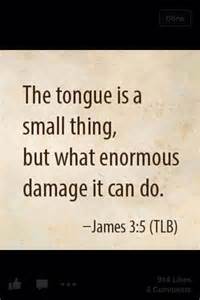
How many of us can remember that old playground saying, “Sticks and stones may break my bones, but names can never hurt me!” children and young people may put on a brave face when they are teased, hurt and picked on. Children and young people can be particularly mean, teasing each other, with left-handed compliments, and even downright insults. But, what insight does this Bible reading from James give us about this very problem?

Let’s hear again these serious words from James. “Just think how large a forest can be set on fire by a tiny flame! And the tongue is like a fire. It is a world of wrong, occupying its place in our bodies and spreading evil through our whole being. It sets on fire the entire course of our existence with the fire that comes to it from hell itself. We humans are able to tame and have tamed all other creatures—wild animals and birds, reptiles and fish. But no one has ever been able to tame the tongue. It is evil and uncontrollable, full of deadly poison.”

Such a little part of the body – the tongue! And yet, despite the playground saying, the tongue can really hurt. “When people are called nasty, dirty names they know what the name caller thinks of them – and that hurts. Those people can be strong, not believe the name caller, and work to prove they are better than the name caller claims. But, it still hurts.” [1]

Names can cause pain, internally. The hurt feelings can smart and fester for a long time. And sometimes, people remember mean words, nasty words or harsh words years after they heard them. Sometimes even decades later. Words can come back to haunt us – either words we have said, or words we have heard. Internalized. Taken to heart.         

Who hasn’t been on the receiving end of a nasty argument, or mean, angry words? Sometimes, words can even change the way we think about ourselves.

Our letter-writer James would whole-heartedly agree. Remember, in this letter the apostle James writes a manual of Christian living. A how-to book on how to live a life pleasing to God.

The big problem with mean, hasty or thoughtless words is that they cannot be unsaid. Once the words have been said out loud – or, sometimes worse, printed electronically in social media – the mean or hasty or thoughtless words are out there in public, whether texts, or tweets or TikTok. These various kinds of words cannot be taken back. And, James cautions all of us on the danger of a tongue that just flaps in the wind! Or, as James says, burns like a forest fire or is fast acting as deadly poison!

Commentator Rev. Dr. Derek Weber thinks further about mean, nasty name-calling and the destructive nature of words. “In our normal catalog of sins, gossip is somewhere far down the list. We are much more concerned about other kinds of misbehavior. James would have us reconsider our hierarchy [of sins] and raise our awareness of the power of words to bring harm to the body of Christ.” [2]  

In Yiddish folklore, there is a story about a woman who would gossip and make false accusations about her neighbors. She never understood the implications of her words until the wise rabbi of her village decided to demonstrate it to her. He told her to get a feather pillow, cut the top off, and run around town with it. As she did that, the feathers flew away and fluttered all around the town. The wise rabbi then told her to collect all of the feathers that flew away and put them back in the pillow. She just couldn’t. It was an impossible task, she told him. “Maybe now you will understand,” he explained, “for you see, your words are like those feathers. Once they get out, it’s impossible to put them all back in.”

Our letter-writer James would so much agree! “As God’s children we are to be careful how we use the power of words. We are called to bless rather than harm, to seek justice and peace for all rather than revenge or harm.” [3] And, I do not want any of us to think that God is just a frowning or disapproving Supreme Being in the sky, ready to hurl thunder bolts at anyone who sins and lets their tongue run on and is a name caller and a gossip.

No, God is serious about sin, that is true! However, we can think of God our Heavenly Parent sort of like a well-loved elder who you and I love and cherish so much, who we do not want to disappoint, who we very much want to do our very best for!

Let’s flip this around, and look at our words from a positive light. Recall how you felt when someone said good, positive things to you or about you. How did you feel, deep down inside? Just think hard about the positive, beneficial impact of these words! James tells us we can certainly bless one another, just as much as we let slip mean or hateful words!

How can we build up each other with our words? What kind of effect would positive affirmations, sincere compliments and just plain being kind have on our daily interactions? I mean all of our interactions, it doesn’t matter with who. Family, friends, acquaintances, even people you meet on the street. Even people who don’t look like us, or speak our language, or wear familiar clothes. Maybe, especially different folks!

I offer the following challenge: find ways of blessing others through kind words, affirmations, and positive reinforcement. Look for everyday opportunities! Try it for the next week, and then the week after that. This is as much a challenge for me as it is for you! Please, find ways of blessing others. [4]  Remember, in this letter the apostle James writes a manual of Christian living. A how-to book on how to live a life pleasing to God. James encourages us to bless each other.

Please, consider turning to your neighbor, to the person in the next pew, and saying, “God bless you!” “God be with you!” Do it, right now. Please. That’s the way to live pleasing to God.

Finally, how would Jesus speak? Would Jesus say kind, helpful, encouraging, positive words? Would Jesus bless people? Do that. And, God will be so pleased!

@chaplaineliza

(Suggestion: visit me at my other blogs: matterofprayer: A Year of Everyday Prayers. #PursuePEACE – and  A Year of Being Kind . Thanks!


[1] http://worshipingwithchildren.blogspot.com/2012/08/year-b-proper-19-24th-sunday-in.html

[2] https://www.umcdiscipleship.org/worship-planning/doers-of-the-word/sixteenth-sunday-after-pentecost-year-b-lectionary-planning-notes/sixteenth-sunday-after-pentecost-year-b-preaching-notes

[3] https://www.stewardshipoflife.org/2012/09/the-gratitude-attitude/

[4] Ibid.

Unknown's avatar

Playing Favorites!

“Playing Favorites!”

James 2:1-10, 14-17 (2:17) – September 8, 2024

            Sometimes, my husband and I step back and observe our fellow human beings. For example, when we are at a coffee shop, or walking through a park. My husband calls it “people watching.” And sometimes, we catch snatches of conversation, too. Some of these bits of conversations are quite revealing! Sometimes, we can even hear about relationships between these people, and their family or friends. These relationships are not always the most healthy.

            Who has all really healthy, happy relationships in their family? Or, friend groups, and acquaintances? Do you – do I – have friends or family members who are mean sometimes? Or who gossip? What about family who have bad habits, like rooting for the wrong sports teams? Or to be more serious, what about friends or family members who play favorites? Who prefer certain people because of their fancy clothes, or their popularity, or how much money they have?

            That is exactly what James is talking about here in chapter 2. This letter from James is so practical! Yes, he does refer to theological concepts now and then, but James wants to give us a manual of Christian living: living the way we as believers are called to live! The description in this reading today is a pertinent, hard-hitting example. 

            James says, “Suppose a rich man wearing a gold ring and fine clothes comes to your meeting, and a poor man in ragged clothes also comes. If you show more respect to the well-dressed man and say to him, “Have this best seat here,” but say to the poor man, “Stand over there, or sit here on the floor by my feet,” then you are guilty of creating distinctions among yourselves and of making judgments based on evil motives.”

            One of my biblical commentators says, “The problem is ‘status serving’ – favoritism. Playing favorites! We are easily attracted toward the successful, wealthy and beautiful people. Yet for James, such partiality is something quite evil.” [1] Playing favorites is definitely not a way for anyone to please God, or to live the way we as believers are called to live. 

            The Gospel reading from the Revised Common Lectionary today also has some difficult, hard-hitting points. Jesus and the disciples are in the racially-mixed area of the Decapolis, near the Sea of Galilee in the far north of Israel. A Gentile woman approaches the Rabbi Jesus while He is at dinner, and asks Him to please heal her daughter. Jesus says some challenging words to her about being a Gentile. She convinces Jesus to help her and heal her daughter, which He does.

            This Gospel reading deals with favoritism and being partial to one group while excluding another group. Who would Jesus exclude? Would He exclude me and my family? Would favoritism include you? How about your children, or grandchildren? 

            These are difficult issues raised by both the apostle James and the Gospel writer Mark.

            Favoritism is all over the place! At work, in the school room, on sports teams, at home. Even – perhaps, especially, as James says – in our local churches. “To seek out the ‘beautiful’ people in our congregation and give them honour because of wealth, status in society, looks, youthfulness, race, education, breeding, success….. is a most ugly way to develop a Christian fellowship. Favoritism is rife in society, let it not exist in our church.” [2]

            Preferring one person over another or one group of people over another is a very worldly way of approaching life. James tells us point blank that we are not to behave this way. Period.  If we take the bare bones approach and look at what the apostle Paul tells us, that we are all one in Christ, and that we are to all love one another, as both Paul and John remind us, some might say we can all simply join hands in a big circle around a campfire and sing “Kum-by-yah” feel all warm and fuzzy inside, and that would be more than enough for the Christian life.

            If that simplistic attitude and short-sighted way of behavior was the only thing we had to do to live the Christian life, then the Christian life would be an insular, warm-and-fuzzy thing indeed. But, as James tells us throughout this letter, there is much more to the Christian life. In this letter, he gives us a how-to manual. A manual for living the way believers are called to live.   

            If we take the example that James gives us, one quick solution would be to simply buy the poor person a new outfit. See? Now the two people coming into church look the same! But, that is only a shallow, simplistic quick-fix for the situation. Instead, James “is asking them to treat the [poor] man with the same respect they would offer a well-dressed man.  Learning to do that in a culture that separates and creates fear between the richer and the poorer requires practice.” [3] This problem goes deep down in people’s attitudes, and is much more serious – even insidious. James says plainly, “Don’t be snobs! Don’t play favorites!”

            I can remember a church I attended some years ago was part of a group of houses of worship that hosted midday meals for the homeless once a week, as well as hosting a warming center during the winter months for five hours in the afternoon and early evening, allowing the homeless to gather inside in a safe space that was warm and welcoming. My husband volunteered at the warming center, and some of those friends who attended regularly mentioned how grateful they were for the church opening their doors freely.

            Yes, make sure our internal attitudes line up with the way that is pleasing to God. Remember, practical, matter-of-fact James shows us a manual for Christian living. Does God choose favorites? What if you are one of those excluded homeless people, or left-out high school kids, sitting at the loser lunch table, with no way to even get close to God? Shut out from God’s loving, caring, nurturing presence?

            Thank God we are always God’s beloved children! We are always the favorites – all of us! Here is a quote by Max Lucado. See if it resonates with you. “If God had a refrigerator, your picture would be on it. If God had a wallet, your photo would be in it. God sends you flowers every spring and a sunrise every morning Face it, friend – God is crazy about you!“

            Does God choose favorites? No! That is the way God feels about each one of us! Please, remember that as you go into the world. Treat every single person you meet as a very beloved child of God – because, they are! No matter what, no matter who!

@chaplaineliza

(Suggestion: visit me at my other blogs: matterofprayer: A Year of Everyday Prayers. #PursuePEACE – and  A Year of Being Kind . Thanks!


[1] http://www.lectionarystudies.com/sunday23be.html

[2] Ibid.

[3] http://worshipingwithchildren.blogspot.com/2012/08/year-b-proper-18-23rd-sunday-in.html

Unknown's avatar

Compassion = Just, Kind, Humble

“Compassion = Just, Kind, Humble”

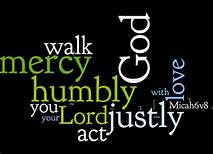
Micah 6-8 word cloud

Micah 6:6-8 – August 27, 2017

Familiar things, familiar words. Even familiar bible verses. When we see or hear familiar things—like a familiar family member, a familiar couch or chair, a familiar saying or expression our best friend says—what goes through our minds? Do we take it in? Do we pay attention? Do we understand that what we are seeing or hearing is important? Or, do we just dismiss it?

Do we dismiss a loved one who just happens to live with us because she or he is always underfoot? Do we even hear an expression from a friend because he or she says it all the time? Or, does familiarity encourage us to ignore the loved one, the sayings, or expressions?

Can this happen to familiar bible verses, too? I am thinking now of John 3:16. Can that beloved verse become so familiar, so same-old, same-old, that it has absolutely no power in our lives or hearts? What about some other super-familiar Scripture verses, too? What about them? What happens to our sensibilities now, now that I have highlighted this important point?

Let’s take a closer look. When we hear the same old thing (even in a bible verse) repeated over and over, week after week, our ears can stop hearing it. It might make some people sick and tired, or bored to tears. We can say, “yeah, yeah,” and ignore it. Go on our merry way. As bible commentator Tyler Mayfield said, “There is a danger to familiarity. The familiar can be overlooked or neglected.” [1]

We have for our Scripture passage today one of the most familiar commands from the Lord, ever. Micah 6:6-8. I will read it in the straight-forward modern translation for all ages provided for us by the Illustrated Children’s Ministry. Starting at verse 6: “How can I even begin to approach God? How can I honor who God is? What gift could I bring, what sacrifice could I make? Would God like it if I made offerings like those made in the past—rams, oil, or whatever is most precious? Does God want me to give up what means the world to me?”

That translation puts a new, different twist on things, doesn’t it?

In this chapter of Micah, the people of Israel pose several questions, and this one is a biggie. How can we even begin to approach the awesome God who made heaven and earth? Isn’t God huger than huge, more righteous and holy than anything else in the entire universe? How can you or I possibly bring anything to God that would please this Holy One?

As Dr. Mayfield says, the central issue with all of these questions concerns the gift, the sacrifice. “What is it, O God, that you want from us? What do you require? Just tell us your favorite offering, and we will surely sacrifice it—even if it is a rather extreme request.” [2]

This is a rhetorical question, of sorts. Micah follows it up with God’s response, in this very familiar verse, Micah 6:8. Is it “same old, same old,” or do you think we ought to sit up and pay attention? After all, this is a verse that lets us know God’s own requirements of how to come to God, this Holy One who made heaven and earth. Listen to this very familiar verse.

The prophet says: “No, listen, people, we already know the answer to this one.  God has told us, this is what counts; this is the compassionate life God wants for us: that we would do justice, and love kindness, and walk humbly, together with God.

Let’s turn to the playground and the schoolroom. What do you think children value? What are ways they like to be treated when they are together? Do you think children want things to be fair and equal in the classroom? Do they want people to be kind to them when they are in line at the store, or at the restaurant, or at home? And what about showing respect to other people? Do children want others to show them respect and courtesy on the playground, school, in the mall, or on the sidewalk? What about at home, too? These are important questions, since they not only apply to children, these questions apply to each of us. Every day.

“That’s not fair! He got more! She cut in line! They shoved me! That’s not fair!” Sound familiar? Does it sound like children bickering at home? This is exactly what the prophet Micah mentions, right off the bat. He tells us that God wants us—all of us—to act justly. And, to remind all of us, justice means fairness. Making things right. Got integrity? Do you act in an upright manner? That is exactly what God wants us—all of us—to do.

But, wait a moment! I know we have been through this before, but I thought the people of Israel were eager to know what kinds of stuff they could offer to God.

I can hear the conversations now: “Just tell me, I’m ready to bring the special animal offerings! I’ll bring really expensive stuff, Lord. Just tell me what it is that You want me to bring!” The problem is, the Lord may not give the answer the people expect. In fact, it is not the answer they seek. They have focused on expensive animals and special oils and fine wine offerings—small and large. The people of Israel have over-emphasized super-special sacrifices, and showy gifts in worship; they have ignored justice and kindness to others. [3]

Do you think children want other people to be kind to them? What about us? Do we want others to show care and consideration toward us? Let’s go even further. Being humble is a difficult concept for children to understand. (Gee, sometimes it’s difficult for me to understand!) However, being respectful is simpler to understand. Do I want others to be respectful to me? Just as important, am I—are you—respectful and courteous to others, no matter what? No matter who they are, and no matter where they come from, which side of the tracks they live on, or what they smell like, or who they vote for?

As we can see, Micah “turns the questions asked in verses 6-7 away from their focus on the types of offerings and toward a focus on the type of person. God does not want a specific type of offering. God wants a specific type of person.” [4]

Are you that type of person, the type God wants? Someone who regularly does just things with integrity? Someone who loves kindness and mercy and does kind and merciful things for others, regularly? What about someone who walks humbly, and is respectful and courteous to others, no matter what?

I think the prophet Micah would say that this is a truly compassionate life.

I wonder what this kind of life looks like, in our setting, here in the Chicago suburbs? How do you imagine this kind of life looks in our world today?

The prophet says our life is a journey, and we walk with the Lord, each day. We walk with integrity, in kindness, and we walk humbly. Imagine God is asking you to do one thing this week that would bring more compassion to those around you.

What would our lives look like if we lived like this? Would other people stop short in their tracks and say, “That person definitely is kind!” “That person goes out of her way to help people!” “That person certainly values the newcomer.” “That person displays genuine integrity, for sure!” I challenge all of us: choose one (or more) of these attributes each day for a week, and live it out.

Act justly—with integrity. Do kindness and mercy. Walk humbly with our God, showing compassion to all we meet. And, guess what? This is the way to truly please God.

Let those with ears to hear, let them hear. Amen.

[1] http://www.workingpreacher.org/preaching.aspx?commentary_id=3152 ; Dr. Tyler Mayfield, Assistant Professor of Hebrew Bible/Old Testament, Louisville Presbyterian Theological Seminary, Louisville, Ky.

[2] http://www.workingpreacher.org/preaching.aspx?commentary_id=3152

[3] http://www.workingpreacher.org/preaching.aspx?commentary_id=3152

[4] http://www.workingpreacher.org/preaching.aspx?commentary_id=3152

(A heartfelt thank you to An Illustrated Compassion: Learning to Love Like God. Many of these sermon ideas and thoughts came directly from this series.  I appreciate this intergenerational curriculum, which is the basis for my summer sermon series on compassion. This curriculum comes from Illustrated Children’s Ministry. Thanks so much for such great ideas!)

@chaplaineliza

(Suggestion: visit me at my regular blog for 2017: matterofprayer: A Year of Everyday Prayers. #PursuePEACE – and my other blog,  A Year of Being Kind . Thanks!)