Unknown's avatar

The Light of the Lord

“The Light of the Lord”

isa-2-5-teach-me-to-walk-in-the-light

Isaiah 2:1-5 (2:5) – November 27, 2016

At this holiday and homecoming time of the year, some people’s thoughts turn to those who are traveling. Those who will be coming to a gathering, a party, a meal. Have you been waiting for someone to arrive at a gathering? A meal, perhaps? At this time of year, the sun sets early. People often put the porch light on to welcome the traveler, in hope and expectation. That is the situation we have here, in our scripture passage from the prophet Isaiah.

And, what a grand porch light it is! Let’s read from Isaiah 2, verse 2: “In days to come the mountain of the Lord’s house shall be established as the highest of the mountains, and shall be raised above the hills; all the nations shall stream to it.”
But, what of Isaiah’s audience? What about them? Times in the nation of Judah were uncertain, to say the least. Spirits were low. The Israelites were in fear for their lives. The Assyrian armies were closing in. The nation of Assyria was a major world power in that time, conquering nations, kings, and vast areas of land right and left. (This was several centuries before Jesus Christ was even born in Bethlehem.) What about today? We can look at our times, too. A great deal of uncertainty, everywhere we look. Uncertain times here, locally, in the immediate community. On a nation-wide scale, as well. What about internationally? However—Isaiah brings a word of hope to people of his day, and hope to people of ours, too.

The prophet gives a prophetic announcement in these verses. It isn’t a hymn of praise, but instead words to let people know that God is not absent or unable to help, but instead a very present help. A hope, in times of uncertainty and need. The very promise of salvation, to not only the people of Israel, but to anyone who hears these words. We can see that from the mention of “all nations” streaming to the mountain of the Lord.

Many people in Isaiah’s time frankly doubted God’s power and faithfulness, with the Assyrians breathing down their necks. These were uncertain times, indeed. Can you imagine, a huge army right on our border, and not very much in between? Imagine the fear, anxiety, and conflict for those people of Judah! Even though, today, we here in the United States are not in such dire straits as little, puny Israel, we face uncertainty and times of conflict, too.

What does the prophet have to say about that fear, that anxiety? He brings words of hope and expectation to his listeners. Listen to verse 3: “Many peoples shall come and say, “Come, let us go up to the mountain of the Lord, to the house of the God of Jacob; that God may teach us His ways and that we may walk in God’s paths.” So, God will begin a time of learning, a time of pilgrimage! “A purposeful journey to a holy place.” [1]

Again, we see that the prophet tells us many, many people will come to God’s house! Remember, this proclamation refers to all nations, all peoples, and addresses all who have open ears to hear.

All this will occur “in days to come.” Sure, the prophet is not specific; this is an indefinite time, but there also will be a radical transformation! Listen to verse 4: “[God] shall judge between the nations, and shall arbitrate for many peoples; they shall beat their swords into plowshares, and their spears into pruning hooks; nation shall not lift up sword against nation, neither shall they learn war any more.”

Can anyone read these verses and not long for peace? And not have keen hope and expectation for this coming time of peace and concord? The Lord God will sit as a judge or arbiter for many, many people. And—this is fascinating—the nations, themselves, shall willingly lay down their weapons. Many nations shall cause their weapons—their swords—to be turned into something radically different. To rephrase, “God promises that there will be a time when everyone gets along.  It will be so peaceful that people won’t need swords and other weapons anymore.  So, they will turn them into garden tools.” [2]

It does not take a brilliant student of current events to tell us that this prophecy is not here, yet. We regularly hear about wars and rumors of war today. We see for ourselves that nations are at each others’ throats, bickering, sometimes fighting, and even committing acts of mass destruction and death. What is to be done?

The prophet brings these words of hope and expectation to a fearful and anxious people, at an uncertain time centuries ago. Is the situation much different, today? Our time is filled with conflict. Fearful, anxious, and uncertain, too.

The prophet’s message holds out hope and expectation, true. But hope would be empty if we did not have a situation where we needed God’s help. We have to see our desperate need first, in order for us to realize that we are sunk without God. This whole mindset of conflict, fighting and resistance to any kind of peace certainly registers as a time of great need. The prophet was calling to the nation of Israelites just as much as he is calling to us.

“God is taking us somewhere we cannot go on our own, not because of our righteousness, but because of God’s goodness. The coming peace is God’s, but it is promised to us. And thus, like Israel, Isaiah calls us to act in the meantime as though the promise is ours.” [3]

Today is the first Sunday in Advent. We have the reminder of our hope set before us, in this Advent wreath. Today, Carl and Irene lit our first candle, the candle of hope. Yes, both scripture readings this morning spoke of expectation in the Lord’s working, in different ways. Yet, how does this work show itself?

Practically everyone here is familiar with the need for light. If we have a dark closet or a dark basement corner, bright light is so useful and needful to shine in and reveal our needs.  What about dark news? Dark times need light, too. The prophet talks about hope and expectation of nations turning tools of destruction and war into tools that will help us to grow food, and to provide nurture and healthfulness. Isn’t this a promise of light? And wonderful things to come?

Can we “compare lighting the Advent candles to putting a candle in the window?  [This is a way] of saying we are ready, you are welcome, come in. Often we turn these lights on while we are setting the table, sweeping the floor, and cooking dinner.” [4] Isn’t this a way to use common, everyday things to work with God to bring God’s light into the world?

In Christ’s kingdom, we have the opportunity to tend with everyday garden tools to cultivate and grow the peaceful, loving ways of God rather than using swords and spears—and bombs, tanks and guns—to cultivate wayward humanity’s own ways of conflict, fighting and war. Truly, may we all be faithful, anticipate God’s light and expect it in God’s peaceful ways, and not our own. Come, Lord Jesus!


[Thanks for several ideas to Gene M. Tucker and the The New Interpreter’s Bible Commentary (Vol. 6, The Book of Isaiah, Chapters 1-39), (Nashville, TN: Abingdon Press, 2000)]

[1] Gene M. Tucker and the The New Interpreter’s Bible Commentary (Vol. 6, The Book of Isaiah, Chapters 1-39), (Nashville, TN: Abingdon Press, 2000).

[2] http://worshipingwithchildren.blogspot.com/2013/08/year-first-sunday-of-advent-also-sunday.html ; Carolyn C. Brown, Year A – First Sunday of Advent, Also the Sunday after Thanksgiving in the USA.
[3]  http://www.workingpreacher.org/preaching.aspx?commentary_id=7

[4] http://worshipingwithchildren.blogspot.com/2013/08/year-first-sunday-of-advent-also-sunday.html ; Carolyn C. Brown, Year A – First Sunday of Advent, Also the Sunday after Thanksgiving in the USA.


Unknown's avatar

Peaceful and Quiet Lives

“Peaceful and Quiet Lives”

1-tim-2-2-pray-message

1 Timothy 2:1-8 – September 18, 2016

It’s good to be in the habit of doing certain things. Say, going to the gym. Exercise is a beneficial thing, and if I go to the gym on a regular basis, like three times a week, I will be healthier for it. Same for other things—like practicing the piano, or practicing football or baseball—it’s beneficial to get into the habit of regular repetition, week in, and week out.

Worship and prayer are regular, comfortable things, things many churches do the same way, week in and week out. Here in our scripture passage today, Paul gives his younger friend Timothy some words of wisdom. Recommendations, if you will, of some things Timothy’s church can do in worship and prayer that will be beneficial to them all.

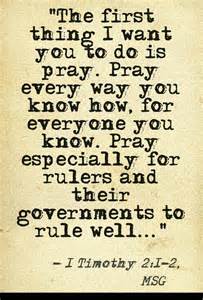
Reading again from 1 Timothy 2, “I urge, then, first of all, that petitions, prayers, intercession and thanksgiving be made for all people— for kings and all those in authority, that we may live peaceful and quiet lives in all godliness and holiness. This is good, and pleases God our Savior.”

I’ll stop right there. Not because the rest of the reading is unimportant. No! But, because Paul has so many ideas that are bursting out of him one on top of the other, I am afraid we might be overloaded if I read them all.

Paul begins the chapter by encouraging Timothy to offer prayers for all members of the human family during church services. He mentions prayer in the terms of: petitions (humble, general requests to God), intercessions (requests, pleading for those in need), supplications (requests for ourselves, especially when faced with a crisis) and thanksgivings (expressing gratitude for blessings we receive). [1] All people need to be held up to God in prayer. All. That is, everyone. Not just one particular neighborhood, not just one particular ethnicity, not just one particular denomination. Paul tells Timothy—Paul tells us—pray for all people.

Yes, this is a wonderful passage that gives us the basics of prayer and worship, and lets us know more about Paul’s ideas concerning this important aspect of our lives. However, I was drawn to one particular phrase in this passage that went beyond the basics of worship: that we may live peaceful and quiet lives in all godliness and holiness.” I pursued it all week.

I was fascinated to dig into this passage of scripture. I have not read the Pastoral Letters as often as the rest of the New Testament. So, this week was a good excuse for me to dust off those seldom-opened commentaries and brush up on what was going on in this highly charged situation. For, highly charged it certainly was!

There was a complication, in the case of these house churches. Let’s take a look at the historical context. In the first century, small house churches like the ones where Timothy and Paul worshipped were in a precarious situation. They were constantly involved in “the struggle to secure and maintain a foothold within a hostile environment, where political authorities would always tend to be suspicious of the little house groups whose legal status was at best ambiguous and be ready to act against them at short notice with little excuse.” [2] Many of these small groups of emerging Christians desperately wanted to gain basic respect. Not even respectability, but hoping for just a bit of respect from the authorities.

These groups, or house churches, are identical to house churches meeting all over the world today, in fear for their leaders, if not the group members’ very lives. House churches in parts of Vietnam and Thailand, China, Pakistan, Nepal, and large parts of the Middle East. These groups are—today, here and now—struggling to survive in precarious political situations.

Is it any wonder that these small house churches wanted to pray for those in authority over them, so that they might have some peace and quiet? Quiet and tranquil lives?

Good habits—beneficial, certainly! Habits like prayer and worship are something that Paul would tell Timothy that his house church ought to follow, each time they gather.

How does this prayer and worship counteract the complication of overbearing and even unjust authorities that hold sway over these little groups of believers?

Both Paul and Peter tell their friends that the Godly thing to do is to pray for the authorities. I read from Romans 13:1: “Let everyone be subject to the governing authorities, for there is no authority except that which God has established.” And 1 Peter 2:17: “Show proper respect to everyone, love the family of believers, fear God, honor the emperor.” The New Testament tells us so, in several places, including this letter from Paul to Timothy.

We can see Timothy and his church are prompted to pray for the government. As Rev. Findlayson comments, “We are encouraged to pray for the political process such that it provides an environment where ‘we may live peaceful and quiet lives in all godliness and holiness’ (verse 2:2). This verse actually contains a clue to the content of our prayer for government. We are to pray for “peace”, but what kind of peace? Is it peace in the sense of freedom from war, social and industrial strife and revolution?” [3]

Ah. We have arrived at the topic of the day. The theme of our service today. What kind of peace do we pray for, indeed?

I have been talking about peace ever since February, the beginning of Lent. Remember, I went to a number of different churches, church groups, and schools to ask individuals what their personal definition of peace was. What is peace to you?                I got many fascinating definitions and expressions. Everything ranging from “Peace is serenity” to “Peace is Jesus Christ in my heart” to “Peace is quiet and calm” and “Peace is no war and no fighting.” And, a whole lot of other things, besides.

This kind of peace Paul describes is not just personal peace, and individual peace. This kind of peace Paul talks about is peace in the larger sense. Peace among regions, between people groups, and even between countries. We can see the progression in Paul’s thought. The spread of truth and of the Good News of Jesus Christ is facilitated when peace exists among the nations. In Paul’s day, the Roman Empire, the Roman transportation system and the Pax Romana made the spread of the Gospel easier. Then as today, peaceful interaction between countries and regions opens doors for the Good News.

See what Paul says in verse 4. God “wants all people to be saved and to come to a knowledge of the truth.” So then, when we pray for government and for the authorities, we can confidently pray that there be peace for the maximizing of the spread of the Good News.

Paul gives us the basics of prayer and worship. Remember what I often say? Prayer time is one of my favorite times in the worship service. Paul tells us we are to pray for all people; and we are to follow Paul’s lead in supplications, prayers, intercessions and thanksgivings. The intention of such prayers is so that we Christians in society will be able to live tranquil and quiet lives. This isn’t me saying it. It’s the apostle Paul!

Regardless of whether there is peace in our church, peace in our neighborhood, or peace in our country, prayer is always a good idea. A close relationship with our Lord and Savior Jesus Christ is the reason we are here. Praise God! Thank You, Jesus. Alleluia, amen.

If anyone would like to know more about how to come to know God in a closer, more intimate way, I would be glad to tell you.

[1]  http://www.lectionarystudies.com/sunday25ce.html Rev. Bryan Findlayson, Lectionary Bible Studies and Sermons, Pumpkin Cottage Ministry Resources.

[2] New Interpreter’s Bible Commentary on 1 Timothy, James D.G. Dunn, (Nashville, TN: Abingdon Press, 1994)

[3] http://www.lectionarystudies.com/sunday25ce.html Rev. Bryan Findlayson, Lectionary Bible Studies and Sermons, Pumpkin Cottage Ministry Resources.

@chaplaineliza

(Suggestion: visit me at my regular blog for 2016: matterofprayer: A Year of Everyday Prayers. #PursuePEACE – and my other blog,  A Year of Being Kind . Thanks!)


Unknown's avatar

A Great Multitude

“A Great Multitude”

Rev 7 multitude white-robes

Revelation 7:9-17 – April 17, 2016

This past Friday, April 15, 2016, I convened a Peace Breakfast at Kappy’s Restaurant, here in Morton Grove. We had a diverse group assembled! Not quite as diverse as this great multitude that John talked about in Revelation 7, but still, diverse. Culturally, ethnically, and religiously different from one another.

Let’s step back, and think about the book of Revelation. This is not your typical bible passage to read on a Sunday morning. Not your usual sermon text, either. The book of Revelation is a series of interconnected visions alerting believers to the last days of the church.

Chapter 7 comes towards the beginning of John’s visions.

I’d like everyone to think of an old-fashioned radio or television serial, in multiple parts, or episodes. Here we have yet another fantastic episode of this amazing book.

For centuries, many preachers, teachers, and bible interpreters have read Revelation, and completely pick it apart. Find all types of supposed references to actual people, places and things. Use it as a guidebook for the End Times. It sounds like the political hype we lament but can’t quite seem to escape. (Let me say—bible interpreters have been “identifying” people, places and things in Revelation for centuries. Different anti-Christs, different identifications for the Four Horsemen of the Apocalypse, and all the rest—every century, every era, every place.)

If John wrote this book to bring hope to his readers, how in the world can this passage of Revelation provide a different, more life-giving vision to us, today?

Our bible passage today opens with a great multitude. It’s like John has a huge video screen in front of him. He’s watching this fantastic vision play out in front of him.

I encourage you all to get into the spirit of this passage. Shut your eyes, and imagine yourself seated in a heavenly theater (an iMax theater, if that helps you). John is seated right next to you, and suddenly, you see a great multitude on this massive screen in front of you. Every racial group, every ethnicity, every language spoken. All of them! All the things, as the young people say today.

Yes, in the larger picture, all of these people in the great multitude are going to go through a time of great trial. However—I would like to focus on this multi-racial, multi-ethnic, multi-lingual multitude of people.

We are all aware of other separations and designations for groups of people. Upper class, working class. City folk, country folk, North side, South side. With all of this fantastic stuff going on in the book of Revelation, on that huge theater screen in front of us, who has time to think about these divisions? Who would be concerned—in heaven? Standing before the throne of God Almighty, in the full sight of God.

Yet—here in this world, here in the United States, in the Chicago area, those things do matter. As a pastor, I talk to a number of people many times in a week. Some of these people share about their fears and hopes for the future. More and more, I notice a shift in the mindsets of people—a shift towards deeper feelings of uncertainty and general anxiety.

I am distressed and dismayed at the overt anger, undisguised racism, and blatant xenophobia that is increasingly happening in this country. The shouting, yelling, name-calling, and general mud-slinging in this political primary process, just for an example. Note: I am not taking sides, but I am truly dismayed by the marked increase in such attitudes due to people’s ethnicity, culture, or religion. That is what I see as a big problem today.

Perhaps I am an idealist, but I would like to believe that we as a nation are truly a melting pot. This country is one of the most like this image, this part of the vision that John saw. That is such a strength of the United States! Yay! Go, us!!

We are going to switch gears. Let us look at the beginnings of the church.

In Acts, shortly after the day of Pentecost, a disagreement came up in the church. As Rev. Findlayson mentions, “The Jewish world was divided between Aramaic-speaking Jews from Palestine [Hebrews—home grown], and Greek-speaking Jews from the dispersion [or Hellenists—who had grown up outside Palestine]. Racial tension, often focused on religious purity, existed in the wider Jewish community and found its way into the New Testament church. [The tension] revealed itself in a dispute over the care of widows. The [Greek-speaking Jews] claimed that their widows were not getting a fair share of the church’s welfare budget.”

Do you hear the problem? Two separate groups of people in the early Church—all Jews, and one group—a minority group, no less—claimed they were being overlooked. Discriminated against. Now, multiply that 100 times. No, 1000 times. And, you begin to see the problems we all have today with rampant, widespread hatred, racism, fear, and xenophobia.

I guess I was one of those people who wanted to believe that we as a country and maybe even as a human race were becoming more open, integrated, and generous. I wanted to believe that humans were moving past this kind of hatred, fear, and violence. I thought we were on the way towards making it as difficult as possible for anyone to intimidate or harm others simply because they are of a certain religion, or racial background, or culture.

What can conquer such deep set feelings?

John 3:16 is a wonderful verse. So much promise, so much love, so much grace. And—so much power!

Let us consider John 3:16. I suspect many of you can say it with me. We are just going to quote the beginning of the verse: “For God so loved the world that He gave His only begotten Son.” I wondered: let’s unpack this verse. God loves? With a God-sized love. We all agree. God gave His Son—God’s ultimate Gift. Again, we all agree.  

The last phrase of this sentence? God so loved—the world.

Who is not part of the world that God loved? Let us consider racist feelings. Does God love the racist person? Yes. How about the person who is racially profiled? Yes.

Let’s consider xenophobic fears. Does God love the person who is so afraid of people who look different from them, or speak another language, or come from another part of the world? Yes, God does. God loves everyone. No matter what.

That is the hope we can gather from this passage in Revelation 7 today. God loves you. God loves me. Even though we may be flawed, and make mistakes, and do or say bad things. God still loves us.

The Peace Breakfast was a beginning, a chance to continue the conversation. We all live and work together, in community. Let’s promote positivity and friendship, not distrust and alienation. Here, in Niles and Morton Grove—and in Des Plaines, Glenview, Skokie—all over the Chicago area—we have such a multitude of diverse people! And it’s an opportunity to shine forth as a light of the Gospel, right here on this corner of Shermer and Harlem.

Finally, we can all praise God along with the great multitude from Revelation, and say, “Amen! Praise and glory and wisdom and thanks and honor and power and strength be to our God for ever and ever. Amen!”

@chaplaineliza

(Suggestion: visit me at my daily blog for 2015: matterofprayer: A Year of Everyday Prayers. and my other blog,  A Year of Being Kind .  Thanks!)

Unknown's avatar

As Far As Possible—Peace

“As Far As Possible—Peace”


March 2, 2016 – Romans 12:18

Living at peace with others can be difficult sometimes.

Peace in families. Peace between friends and in relationships. Peace between groups of people, whether in terms of sports teams, religions, music preference, the racial context, food choices, even thinking about the pets some people choose to have!

People have disagreements about all of these areas—and then some!

What does the Bible say about disagreements? Conflict?

Let’s take a closer look at the Apostle Paul’s book of Romans, 12:16-21. This is two paragraphs in a larger section. There is a lot here, in terms of pointers for conflict resolution!

These are a series of good pieces of advice from Paul. A laundry list of valuable ways of acting. Plus, these are pieces of advice that Paul gives to the whole congregation. We can tell from the verbs—all plural, for the group of believers. A group pep talk!

How does Paul recommend the Roman congregation to act? “By living in such a way that fosters peace.” Commentator Elizabeth Shively says, “Verses 17 and 21 act like bookends, ‘Do not repay anyone evil for evil … Do not be overcome by evil’” As she tells us, these ideas are connected. We are truly overcome by evil when we allow spite to infect us. [1]

Aren’t evil, spite and resentment like a disease? Like a particularly nasty, insidious virus, that sneaks into our bloodstream. Gets under our skin, and burrows down deep inside. Evil, spite and resentment are particularly difficult to get out of our hearts and lives.

Yes, we can think about different people in a congregation. Our church, or any church. Yes, there are serious matters that come up. Divisive issues, and sometimes matters that are particularly difficult to resolve. The Apostle Paul was no stranger to this kind of serious conflict! He gives us some words of advice that may be useful in just such a contentious situation. More than that, he gives words of advice that are useful in many situations—squabbles between friends or family, and arguments between church folk and those outside the church.

This can be a complication! Paul comes right out and tells the believers in Rome that they are not to repay evil for evil. Instead, show love. Paul does not say so here, in this paragraph, but he does several times in other places, in this letter.

It is the Christian’s job to show love! Paul tells us expressly how we are to show love, too.

How are we to show love? Verse 17: “Do not repay anyone evil for evil. Be careful to do what is right in the eyes of everyone.” And further, verse 20 quotes from Proverbs 21, “’If your enemy is hungry, feed him; if he is thirsty, give him something to drink.’”
Let me give an illustration. Corrie Ten Boom in the book, Reflections of God’s Glory (page 69), wrote, “In Africa a man came to a meeting with bandaged hands. I asked him how he had been injured. He said, “My neighbor’s straw roof was on fire; I helped him to put it out and that’s how my hands were burned.

“Later I heard the whole story. The neighbor hated him and had set his roof on fire while his wife and children were asleep in the hut. They were in great danger. Fortunately, he was able to put out the fire in his house on time. But sparks flew over to the roof of the man who had set the house on fire and his house started to burn. There was no hate in the heart of this Christian; there was love for his enemy and he did everything he could to put out the fire in his neighbor’s house. That is how his own hands were burned.”

This African man showed love to his enemy. He did everything he could to put out that fire in his neighbor’s house. He lived out God’s love towards his enemy, just as Paul urges us to do, here.

God shows us abundant love! God shows us plentiful mercy! And, we do not deserve it. That’s why Paul urges us to do the same for those who do evil to us, and for those who are our enemies.

Since the believers in Rome were shown God’s love and mercy, Paul recommends tending to enemies in the same way they—we—would tend to the material needs of families, and friends. As our commentator Elizabeth Shively says, Paul’s audience “are to do more than refrain from repaying evil; they are to initiate doing good to opponents. This is much harder. But in doing so, Christians overcome evil with good, showing that they “cling to what is good,” expressing the definition of true love.” [2]

How difficult is that? Really difficult! How hard to express true love. How hard to live at peace with everyone. Yet, that is what we are called to do as followers of Christ.

Yes, the idea of living at peace with everyone is a wonderful thing. Living it out is a challenging thing. Sometimes, even an almost impossible thing. Remember, it’s the Christ-like way to live.

What would Jesus do? How would Jesus act?

17 Do not repay anyone evil for evil. Be careful to do what is right in the eyes of everyone. 18 If it is possible, as far as it depends on you, live at peace with everyone.”

We are called to act in practical and physical ways. Show love. Express mercy.

That, I think, is how Jesus would act.

[1] Commentary, Romans 12:9-21, Elizabeth Shively, Preaching This Week, WorkingPreacher.org, 2014.

[2] Ibid.

@chaplaineliza

Suggestion: visit me at my sometimes-blog: matterofprayer: A Year of Everyday Prayers– where I am doing a Lenten journey.  #PursuePEACE – And my other blog,  A Year of Being Kind -Thanks!


Unknown's avatar

PEACE is Helping Keep My Spouse Happy

Matterofprayer: A Year of Everyday Prayers – Saturday, February 20, 2016

IMG_0157.JPG

PEACE is Helping Keep My Spouse Happy

When I considered today’s definition, the first thing I thought of was the old saying, “Happy wife, happy life.”

Today’s definition of PEACE comes from Carl Hanson, who said “PEACE is helping keep my spouse happy.”

Carl and his spouse Irene are members of St. Luke’s Christian Community Church in Morton Grove. They are a loving, caring couple, deeply devoted to one another and to their two dogs (both from rescue).

One telling comment Carl made to me? “If my spouse is happy, our home is happy.” To cap that off, he wrote it out on a piece of paper, and added a smiley face at the bottom of the sheet.

I reflected deeply on both the definition that Carl gave, as well as his comment, above. How do I apply that in my life? My life with my husband? What do I do for my husband, anyhow? Do I make him happy? How? Can I make certain he is content and serene? All good questions.

What I can do each day? Since I am not the most diligent housekeeper, I can make sure I pick up several items in the apartment, each day. I can try to be certain that the kitchen sink is clear of dishes at the end of the day…

Dear Lord, thank You for Carl’s reminder to me, and to many, about the benefits of keeping our spouses happy. I ask You to draw Carl and Irene closer together, and give them peace, happiness, and contentment. Thank You for loving us and wishing to make a big difference in each life You touch. Amen.

@chaplaineliza

Like what you read? Disagree? Share your thoughts with your loved ones and continue the conversation.

Why not visit my sister blogs, “the best of” A Year of Being Kind.   @chaplaineliza And, read my sermons from Pastor, Preacher Pray-er

Unknown's avatar

An Instrument of Peace

“An Instrument of Peace”

instrument of Your peace, round

John 14:27 – February 17, 2016

This evening, we are going to consider pursuing peace within ourselves. Tonight we consider two things: a verse and a prayer. Both have a great deal to say about peace. And both are examples for us and our daily lives.

First, the verse. Giving you some context, this verse comes from the final night our Lord Jesus spent on earth. Jesus was at a Passover dinner, or seder, with His friends. The Gospel of John gives us an extended look at this evening, and devotes several chapters to this time. Jesus discusses some things and gives His disciples some last instructions.

Now, the verse, John 14:27. “27 Peace I leave with you; my peace I give you. I do not give to you as the world gives. Do not let your hearts be troubled and do not be afraid.”

These familiar words of Jesus we’ve just read can sound far away and distant. Perhaps we remember this verse from a funeral, or quoted by a chaplain at a hospital or care center. It seems that almost every week we are surrounded by evidence of upset, catastrophe, and trauma. Many people today are searching for peace in an anxious, unpeaceful world.

Remember the political situation Jesus was operating under! Israel was an occupied country. Politically, the situation was not good. Personally, in the life of Jesus, this was not a peaceful time, either. Remember where Jesus was, here in John 14. This was the Passion Week of our Lord, hours before His arrest. Imagine what Jesus was preparing Himself to go through, in the next hours. Yet, we hear Jesus talk about peace. His peace. He wants to share His peace with all those who are listening. Amazing. Astounding. Almost inconceivable.

Suppose we catch on, and suppose a light bulb goes off in our heads, and we say to ourselves, “Maybe what I’ve been hearing in church on Sundays and in services on Wednesdays is worthwhile, after all! Maybe God really does want to give me peace. Maybe God wants me to focus on peace on the inside. Internally.”

So, some people turn around and concentrate on the inside! To be more specific, on their insides. The internal person. But there’s a danger here, too. If we’re not careful, worry and anxiety can sneak into the picture. Worry and anxiety can push away peace. Worry and anxiety can gnaw away on the insides, as well as our relationships with God and with others around us.

Has anyone here had any experience with termites? I never have, thank God, but I understand that termites can go through large amounts wood over an extended period of time. If we allow worry and anxiety to eat away at our peace with God and with others, it’s like termites eating away at a wooden front porch. After a period of time, even though the porch looks stable, and seems like it can hold weight, it collapses.

It’s the same way with us, when we lose peace. When we allow worry and anxiety to get the better of us and take control of our insides. This refers to the second part of verse 14:27, “Do not let your hearts be troubled, and do not let them be afraid.” This is Jesus giving advice to us! He is helping us hang onto the peace He’s just given us, just as He told the disciples so long ago. This is an exhortation, not a suggestion.

The second half of this meditation tonight lifts up a prayer. It is a really good prayer: arguably the most famous prayer attributed to St. Francis of Assisi. There is no direct link to St. Francis, but one of his companions, the Blessed Giles of Assisi, wrote a short synopsis of this prayer. The prayer could very well have been enlarged and written from those words.

The first line of this prayer runs as follows: “Lord, make me an instrument of Your peace.” I am assuming we all want the peace that Jesus so freely gives away. Jesus gives it away to anyone. I mean, anyone. Step right up, and Jesus will lovingly give you peace. His peace.

This wonderful prayer lets us know some of the outgrowths of the peace of Christ. For example, using God’s peace, we can sow love, pardon, faith, hope, light, and joy.

St. Francis and St. Giles knew very well that they were both imperfect people. Yet, this meaningful prayer was an expression of everything they strove to do and everything they tried to live by. We, too, are imperfect people. Anxious, fearful, sometimes even angry and sinful people. Yet, we can be instruments of God’s peace, too.

This night was the most event-filled night of our Lord Jesus’ life. He knew what was coming. Yet—He makes the statement, “Peace I leave with you, My peace I give to you.” He gave His disciples the gift of His peace.

Jesus gives us the same gift, today, too. His peace. It isn’t peace like the world would expect. It isn’t always external peace (although it can very well be that, too!), but it is peace on the inside. Peace where it counts, as far as Jesus is concerned. We have His word on it. He promises to give us peace in our interior selves. So that, imperfect as we all are, we can be instruments of God’s peace to our brothers and sisters, and to the world.

Amen.

Unknown's avatar

One Who Brings Peace

“One Who Brings Peace”

Micah 5-5 He will be our peace

Micah 5:5 – December 20, 2015

Peace. Peace is the subject today. Today we light the Advent candle of peace. Here, inside the church, it seems like peace is a realize-able actuality. But—not on the outside. Not out in the cold, cruel world. Peace, peace, is the cry! Here in the 21st century, we have wars and the rumors of war. Fighting, skirmishes, various attacks of various kinds. Will anyone hear our cry for peace? Will anyone—anywhere—heed our cry?

In biblical times, there was always some tribe or country beating up on another tribe or country. Always somebody marching off to war. To enlarge territory, or to gain political advantage, or to right some wrong. So seldom did the nation of Israel have true peace! Much of this book of the prophet Micah deals with war, conflict and fighting. Except for right here.

Our Gospel reading from Luke tells of the pregnant Virgin Mary going to visit her older cousin Elizabeth, who prophecies that Mary has within her the baby Jesus, the Son of God. Usually, the Scripture readings are chosen with great care. Chosen with an eye to common themes. So, what is in common, here? The prophecy of a strong leader to come, from our Old Testament text, and the prophecy of the birth of the Messiah, from our Gospel reading.

Here we are at the fourth Sunday of Advent. We have had Advent for a long time. Since the last week of November. I can just hear the children saying, “When is Christmas finally going to get here?” Some schools have already gotten out for the winter holidays. I know some local churches are featuring a Christmas cantata today, or a Christmas pageant in worship.

Yet here we all are. The last Sunday of Advent. Isn’t Christmas here yet? Isn’t it time for angels and shepherds, Mary and Joseph and the Baby in a manger? Can’t we hurry things along?

As we look at the prophecy in Micah, we can see that the prophet is certainly not thinking about warm and fuzzy Christmas carols. Not about the lion lying down with the lamb, about God reaching down and bringing peace on earth, good will towards all people. Or, is he? What is Micah saying in our reading today?

Yes, a strong leader will rise up. Who do you think Micah’s contemporaries thought the prophet was talking about? I was fascinated to read in one commentary that most people would connect this strong leader to King David. But, wait! David had been dead for two hundred years, by the time that Micah wrote his prophecy. How could the Jewish people think “David” when they heard prophetic words like this?

Because—because of the prophecy of David’s prophet Nathan from 2 Samuel 7. A direct descendant of David would be king. God had promised King David that exact thing. So, who else could this strong leader be but a direct descendant of the great King David?

All well and good! Except, it gets more complicated, fast. Micah mentions “out of you [Bethlehem] will come one who will be ruler over Israel, whose origins are from of old, from ancient times.”

Now, I can understand a strong leader. A ruler, a mighty King. A descendant of King David. I can even understand the prophecy of a baby, from Luke, chapter one. The descendant of David needs to be born. Elizabeth prophecying and praising God that the mother of the Messiah to come was coming to see her. Okay, I’ve got that.

I am so indebted to John C. Holbert’s article on this Scripture reading. [1] I was aware of some of this material from the book of Micah, but by no means all. And never in so much depth!

Micah’s prophecy foretells a strong leader, yes. A descendant of David is presumed. (Micah doesn’t specifically say so.) Adding two and two and two together, from the prophecies of the Hebrew Scriptures, people have ascertained that this prophecy also refers to the Messiah. And then—Micah adds the part about the ruler “whose origins are from of old, from ancient times.” This part definitely needs more explanation.

These phrases are a challenge to translate from Hebrew. The best that anyone can figure is that there are several meanings for these words. “Origins” can also be translated “coming forth” of old! Dr. Holbert says that God put this word ‘olam, or “ancient times,” “into human minds in such a way that they may know a bit of what has happened in the past, and a tiny portion of what may come, but just enough to teach them that they in fact know precious little about either past or future in the end. There the word appears to mean something like a very long time or deep in the past and far into the future, not quite eternity but as much as any puny human mind may conceive.”

Talk about not being able to understand Scripture. These couple of phrases blow me away. I feel small when I read this. Really young, like a preschooler. I realize I do not know very much about God or about the Bible, at all. Period. God surely can flatten me, humble me with a phrase from the prophet Micah.

But, wait! There is more! Let’s unpack this reading, further.

Holbert continues: “Who then does Micah have in mind? This is no simple heir of David; here is someone primordial, someone from the most ancient of times yet also uniquely prepared to act decisively in the present.” In other words, Micah is talking about Someone more than human. Looking forward to the future, talking about Someone who not only is the promised Messiah to come, the promised descendant of David, but also looking back to the far distant past. To the beginning of time, even beyond the beginning.

Then, in Micah 5:3, the prophet brings up the image of a woman in labor. What is our Gospel reading from Luke for today? It’s about two pregnant women. Elizabeth prophecying about the Child Mary is carrying. The Child is the Lord. The Son of God. The next verse, Micah 5:4 speaks of the promised one who will be a shepherd. Just like King David! A powerful and godly shepherd who keeps the flock safely; “and they will live securely, for then his greatness will reach to the ends of the earth.” Again, this is Messiah language, and more!

Who is this Messiah, anyway? Descendant of David, check. Born in Bethlehem, which is David’s ancestral home. Check. But, Micah says from ancient of days? Luke calls Him the Son of God? The Lord God Almighty?

This great Shepherd will not only be concerned with the flock of Israel, but also the flock of the entire world. And—this is the most important part to me, right now. This strong leader, this Shepherd will be our peace.

This Messiah will not just be peaceful for Israel’s sake. No! Our Messiah, our Christ, from ancient of days, will act peacefully for the safety and well-being of the whole world!

Do you hear the Good News from the prophet Micah today? This Messiah was not going to act in the way that so many other Middle Eastern potentates did. Or, for that matter, like any other earthly ruler ever has. Instead, we are told in our Scripture passage today that He will feed His flock. The Messiah’s flock will have the opportunity of living secure, safe, and peacefully under Messiah’s mighty protection. I thank God that I am one of the worldwide flock.

God extends that opportunity to everyone, so that we all can have the security and care of the Messiah, the Good Shepherd, the Babe of Bethlehem, the ruling King. Praise God for God’s wonderful gift of protection and care.

[1] http://www.patheos.com/Progressive-Christian/Who-Is-This-Peaceful-One-John-C-Holbert-12-11-2015

(Many thanks and much appreciation to Dr. Holbert! Wonderful article on Micah.)

@chaplaineliza

Suggestion: visit me at my daily blog for 2015: matterofprayer: A Year of Everyday Prayers. and my other blog,  A Year of Being Kind .  Thanks!