Unknown's avatar

Under His Wings

“Under His Wings”

Luke 13:31-35 (13:34) – March 16, 2025

During this season of Lent, our focus is on love.

When we think of the animal kingdom—and let’s broaden that to all birds and beasts, all creatures great and small—how does love fit into the picture? Picture this. A mama cat or dog, licking and cleaning her little ones. A mama horse or elephant or dolphin, feeding her baby. A mother hen on her nest, spreading out her feathers, her wings, to keep her chicks warm and safe at night. All loving and caring pictures. All maternal. Motherly. 

When we think about God and God’s actions, maternal and motherly images are not necessarily the first things that pop into a person’s mind.  

This little, short Scripture reading from Dr. Luke today really packs a lot into it! Just four verses, and, my! We start with some Pharisees, coming to warn the Rabbi Jesus. Many Pharisees were part of the Jewish leadership, which generally did not look very kindly upon Jesus. However, these particular Pharisees warned the Rabbi Jesus that King Herod was out to get Him, and there is definitely trouble ahead!

This is one of the times that Jesus is reported calling someone a name, and probably (knowing what we know about Jesus) His words were ironic. Jesus says, “Go and tell that fox: ‘I am driving out demons and performing cures today and tomorrow, and on the third day I shall finish my work.’” The appellation “that fox” most probably meant “that wily, scheming person!” All of which was true, concerning King Herod!

Except, we are not going to focus primarily on foxes for our sermon today. No, we are going to continue on in our reading, and examine more closely what Jesus says and does next. But, just one mention first – Herod was someone who did a lot of evil things!

I said last week that we will look at a phrase (or petition) of the Lord’s Prayer each week in Lent. This week we think of “Deliver us from evil.” As we consider nasty King Herod and his evil clutches, being delivered from Herod certainly qualifies as being delivered from evil! But, that is this particular situation, with the Rabbi Jesus. There are plenty of other evil things and evil people in the world, more than enough to go around!

A clear, simple definition of evil is “bad stuff.” When we think of all the bad stuff we need to be saved from, we can come up with quite a list! Bullies, diseases, war, unemployment, natural disasters, anger and bitterness, being greedy. And that is hardly scratching the surface of all the evils that can happen! One of the best, straight forward translations of this part of the Lord’s Prayer is “Lord, save us from all the bad stuff that happens.” [1]

As our commentator on Psalm 27, Beth Tanner, says, “With all of the violence in our world, Christians are faced almost daily with a decision to live in fear, or despite their fear, to trust in God and God’s promises.“ [2]  “Deliver us from evil” is a powerful prayer! A prayer of trust and assurance in God’s provision, in God’s ability to keep us safe, whatever our situation.

Which brings us to the other image Jesus brings up in this short Gospel reading. Jesus says, “Jerusalem, Jerusalem! You kill the prophets, you stone the messengers God has sent you! How many times I wanted to put my arms around all your people, just as a hen gathers her chicks under her wings, but you would not let me!”

In my imagination, I can just see our Lord Jesus, on a hill looking down on a large portion of the city of Jerusalem. His heart is broken, and He says these very sad, very heart-breaking things about the city – and about the residents of the city. And by extension, about the Jewish people. Here is a very maternal, motherly image, “just as a hen gathers her chicks under her wings.” Jesus sees Himself as the loving, caring, nurturing mother hen!

When many people think of our Lord Jesus, often the images that come to mind are strong and mighty. The Lion of the tribe of Judah. The Messiah, the King. The Son of God, the Miracle Worker, the Lord Jesus Christ. All strong, powerful images!  

One of our commentators, Karoline Lewis, reflects that women are made in the image of God just as much as men are. She goes on to say, “if you rarely, if ever, hear about God’s femininity, female images for God, or female characteristics of God, then even that biblical truth will be hard to believe. And, if God is mostly assumed to be male, referred to with male pronouns, and described as male, then it will be more difficult and take more energy to imagine God in female categories — and to believe that you have a place in the kingdom of God.” [3]

I am reminded of the summer sermon series I preached in 2023, where I featured many of the maternal, motherly images of God in both the Hebrew Scriptures and the New Testament. This mothering image used by our Lord Jesus in Luke 13 reminded me of a newer hymn, found in several newer hymnals. The lyrics for hymns are often theological, moving and stirring, emotionally and intellectually. Here is the first verse of a hymn called “Mothering God.”\

Mothering God, you gave me birth / in the bright morning of this world.

Creator, source of ev’ry breath, / you are my rain, my wind, my sun. [4]

Of course God has male attributes and characteristics. God also has female attributes and characteristics, as we can see from this motherly word picture that Jesus uses!

            Jesus welcomes us into His embrace, into His community of love and caring. Just as a lost little chick who finally finds the way home into the nest, into his or her mother hen’s warm feathery embrace, so we can find our way into a community of caring, love, nourishing and belonging. I hope our church community extends that caring and loving welcome to everyone. Jesus wants us to know that we are welcome with Him, always.  

            Are you still searching for that community of belonging? That warm, caring place? I pray that we all may find it. Not only here, in this community, but especially in the embrace of Jesus.

            Amen, amen.

@chaplaineliza

(Suggestion: visit me at my other blogs: matterofprayer: A Year of Everyday Prayers. #PursuePEACE – and  A Year of Being Kind . Thanks!


[1] http://worshipingwithchildren.blogspot.com/2016/01/year-c-second-sunday-in-lent-february.html

[2]  https://www.workingpreacher.org/commentaries/revised-common-lectionary/second-sunday-in-lent-3/commentary-on-psalm-27-3

[3]  https://www.workingpreacher.org/dear-working-preacher/love-and-belonging

[4] “Mothering God, you gave me birth,” Evangelical Lutheran Worship, hymn #735,

Unknown's avatar

Caring for You!

“Caring for You!”

1 Thessalonians 2:6-10 – August 27, 2023

            Anyone here familiar with any religious leaders who are puffed up? Proud beyond measure? Strutting their stuff? I mean, lording it over their congregations and everyone else? Some preachers and evangelists can be like that. Don’t bother the extra special holy person!

It doesn’t seem like those puffed-up preachers or evangelists care about anyone! Not any common, ordinary folk from their congregations, anyway.

That kind of self-centered, self-satisfied attitude is the problem with certain people, and this is not exclusive to preachers or evangelists. Lots of people can have really skewed priorities and end up ignoring people who hurt, or those who are sad or depressed, or people who grieve all manner of losses. Or even worse, these blinded, entitled people are aware of those who cry out for help, but simply shut the door in their faces.

            I’d like us to focus on several verses from this reading today. They come from the apostle Paul’s letter to the believers in Thessalonica. Starting at verse 6: “We were not looking for praise from people, not from you or anyone else, even though as apostles of Christ we could have asserted our authority. Instead, we were like young children among you. Just as a nursing mother cares for her children, so we cared for you. Because we loved you so much, we were delighted to share with you not only the gospel of God but our lives as well.”

            What does Paul make a point of saying here? Paul and his friends did not want to be treated like something super special! They were not hungry for praise, or seeking strokes and adulation from their fellow believers in town. Certainly, Paul and his friends were in what is known today as a teacher or mentor position among their friends, but not high on a pedestal. And especially not puffed up.

Paul points out, “We proved to be gentle among you.” Like young children!

 “This is another example of positive and gracious leadership. Paul was not a like a dictator to the Thessalonians. Instead, he chooses one of the most tender images in all of nature, a nursing mother. Some of us here may be inclined toward “tough love.” We might say, ‘my way or the highway.’” [1] But, not Paul! He purposely meant to come alongside his Thessalonian friends gently, and he demonstrated that his co-workers were, too.

            This nurturing, maternal reading is not common within the apostle Paul’s letters, since he was more likely to use strong, masculine word-pictures or metaphors. However, using these words of maternal love and affection here show us the loving heart of Paul, and how much he cared for these believers. And not only that, Paul and his friends were ready and eager to share all that they had with the Thessalonians.

Commentator F.F. Bruce makes the connection that “No other attitude would befit the preachers of a gospel which proclaimed as Lord and Savior one who ‘emptied himself’ (Phil 2:7) for the enrichment of others.” [2]  We can see our Lord Jesus showing the ultimate in loving, caring affection in Philippians 2, as He emptied Himself of all Godly prerogatives and attitudes, and set all his Godhood aside. Our Lord Jesus became a human being so He could communicate on the same level, and more easily and directly with us fellow human beings.

            Similar to what Paul just said in this letter to the Thessalonians, Jesus did not throw His weight around! No, Jesus was not on a pedestal or puffing up His chest because He was so high and mighty. Can you possibly imagine Jesus doing things like that? Absolutely not!

            Just so, Paul imitates his Lord Jesus by showing that he and his companions are not hungry for praise, or seeking strokes and adulation from their fellow believers in Thessalonica.

Paul specifically says he and his friends tenderly care for their Thessalonian friends in the church. The Greek word he uses here is thalpo, “to warm, cherish, nourish.” How nurturing is that! This is the same word used in the Greek translation of the Hebrew Scriptures for a Scripture reading we examined earlier this summer: Deuteronomy 22:6, where mother birds cover her young or her eggs with their feathers. 

That is not all! This Greek word thalpo, “to warm, cherish, nourish,” is used again by the apostle Paul in Ephesians 5:29. Here he describes our risen Lord Jesus Christ and His care for the church universal. How wonderful that the Lord Jesus Christ continues the same caring, nurturing activity He regularly displayed during His time here on Earth as a human being. Commentator F.F. Bruce adds, Paul’s words “’For her own children’ would stress the personal involvement and concern. A mother who is nursing her children does not and cannot turn the care of her child over to someone else. She feeds, loves, and protects her child.” [3]

Helping people to grow in the Lord, as with growing children, takes time and requires patience, just as much today as 2000 years ago. Sometimes it causes pain and grief, and priorities need to be set in our relationships. We don’t raise children overnight, You and I can’t raise them without growing pains for both parent and child alike. [4]

            If we recognize our deep need for nurture, protection and caring from all that would harm us, we can also watch out for one another! Jesus urges us to nurture, protect, and care for one another, too. As our loving, caring Lord Jesus always does for us. Without fail.

            Praise God, God has been loving, caring and full of nurture for us all. God is our nurturing Parent, and that’s a blessed fact. Alleluia, amen. 

@chaplaineliza

(Suggestion: visit me at my other blogs: matterofprayer: A Year of Everyday Prayers. #PursuePEACE – and  A Year of Being Kind . Thanks!

(I would like to thank the website www.bible.org for their commentary and bible study on today’s New Testament reading, https://bible.org/seriespage/4-compelling-example-ministry-1-thess-21-12. I got several excellent ideas and quotes for this sermon from this excellent article.)


[1] https://studyandobey.com/inductive-bible-study/thessalonians-studies/1thessalonians2-1-9/

[2] https://bible.org/seriespage/4-compelling-example-ministry-1-thess-21-12

[3] Ibid.

[4] Ibid.

Unknown's avatar

God Comforts Us!

“God Comforts Us!”

Isaiah 66:12-14 – July 16, 2023

            Many people I’ve talked with are interested when I talk about puppies. Or, kittens. Or young bunnies, or chicks or ducklings. When we see them at a pet store, or at the zoo, or on television or documentaries, a common reaction is, “Awww!” and “How darling!” Can you imagine watching a mama cat or dog, washing her little ones, or making sure that they are safe and warm, cuddled up and safe next to their mama.

            So similar to what the prophet says about the nation of Israel, here in Isaiah 66! Listen again to these verses: “12 For this is what the Lord says: “I will extend peace to her like a river, and the wealth of nations like a flooding stream; you will nurse and be carried on her arm and dandled on her knees. 13 As a mother comforts her child, so will I comfort you; and you will be comforted over Jerusalem.”

            The prophet Isaiah wrote at a time of great upheaval in both the kingdom of Israel and the sister kingdom of Judah. The kingdom of Israel had been conquered by the Assyrians a few decades before, in 722 BCE. Isaiah was a prophet in and around the city of Jerusalem, in Judah. I am certain that the political situation was precarious for many years following the conquering of the northern kingdom, the domination of that part of Palestine by the Assyrian army.

            Sure, Isaiah was a prophet of the Lord, and as such had many words of warning and judgment for the nation of Judah and the city of Jerusalem. Yet, Isaiah is also one of the most hopeful and positive of the prophets in the Hebrew Scriptures.

            Here in chapter 66, the last chapter of the book, the prophet writes about the future. Coming attractions, for the Jewish people. “Rejoice with Jerusalem! Be glad! Rejoice!” Such calls are common in this section of the book of Isaiah following chapter 40, where hearers are called to rejoice, take joy, exult, sing and shout out.” [1] The commentator Kristin Wendland makes special note of the personification – the metaphor of the nursing mother, here in Isaiah 66! In these verses we see the future, restored Jewish community made whole again. We see children and toddlers born, nurtured, nursing at the breast and dandled on the knees.

            What is more, the prophet is hearkening back to a time two or three generations before, when the city of Jerusalem was under siege for an extended period of time. There was great starvation within the city, and mothers could not feed their babies and children. Many today can remember times of recent want and deprivation in their families and loved ones’ histories, just within the past century. I am sure this reference struck a chord with the prophet’s readers!

            Can you imagine our almighty, all-powerful Lord, who made heaven and earth, extending comfort, care and nurture, just like this image of the nursing mother? That is exactly the point! Here we have the highly respected prophet Isaiah saying exactly that.  

            Again, I come back to what the Rev. April Yamasaki has to say about differing views of God. She has preached on Scripture using “masculine, gender-neutral, and feminine imagery to talk about God. God is the father waiting for his prodigal son. God is the mother who comforts us. God is the Rock that never changes.” And, April hits the nail exactly on the head. She continues, “Like it or not, all of these and more are in the Bible.  Humanly speaking, there is enough in Scripture to challenge all of us.” [2]

            You and I might be anxious or downright afraid of a different kind of image or picture of God. You or I may be totally unused to maternal or nurturing Godly images. “But instead of mentally crossing out anything that disturbs us, we need to allow the different images of God in Scripture to challenge us, to correct us, to shape and expand our relationship with God,” says Kristina LaCelle-Peterson. [3]

God’s Divine nature is too immense to be captured by only one image. Moreover, our disparate, all-over-the-board life situations are definitely too varied – too multi-colored! – to be considered by only one Divine reference or metaphor.

            I am re-reading a marvelous book on prayer by the equally marvelous Christian and devotional writer Richard Foster. He suggests that we access this kind of Divine metaphor with our imaginations. Using the prayer mode of Ignatian prayer, we can see these mothering, nurturing aspects of God with our mind’s eye, to see, to hear, to touch what is right here in the biblical narrative.

            Richard Foster tells us “We must not despise this simpler, more humble route into God’s presence. Jesus himself taught in this manner, making constant appeals to the imagination in his parables. Many of the [Christian] devotional masters encourage us in this way.” [4] In this simple, straight-forward way, we are urged to enter into a close, intimate relationship with our Lord. What a way to come home to God!

Who doesn’t want to have a fresh relationship with God? Who doesn’t desire close communication with our Lord? Right here, right now, we are invited and urged to use these vivid mothering metaphors and climb into God’s lap ourselves. Can you decide to welcome such a caring and loving God into your Daily Prayer?  

            God is surely a source of comfort and nurture, for all! Not only for those in Isaiah’s time, but for all of us, all those under God’s loving protection and care. What a promise! What a Divine presence that spells “home” and comfort for us all. Alleluia, amen.          

@chaplaineliza

(Suggestion: visit me at my other blogs: matterofprayer: A Year of Everyday Prayers. #PursuePEACE – and  A Year of Being Kind . Thanks!


[1] https://www.workingpreacher.org/commentaries/revised-common-lectionary/ordinary-14-3/commentary-on-isaiah-6610-14-4

[2] https://aprilyamasaki.com/2015/05/11/mothers-day-revisited-and-how-god-is-like-your-mom/

[3] Ibid.

[4] Foster, Richard, Prayer: Finding the Heart’s True Home (HarperCollins: New York NY, 1992), 147.

Unknown's avatar

Like a Small Child

“Like a Small Child”

Psalm 131:1-3 – July 2, 2023

            The news of a happy, healthy birth and new addition to the family is something to be celebrated! I just got the joyful news that a healthy baby boy was delivered to one of the young people at a Presbyterian church out of state, who participated in our trip to Egypt back in March. All of us here in this congregation are so happy when we hear of babies being born! I know some people are less than excited about babies, but not here.  

            The Psalms are no different, as far as containing expressions of families’ emotions. We can find the full range of emotions in our book of Psalms, including joy, celebration and contentment with families and with children, and with babies, too.

            Our Scripture reading for today from Psalm 131 is so appropriate for our Summer Sermon series. We are re-imaging God. Seeing God from a different point of view. We will focus on verse 2, in particular. I will read it again: “I am not concerned with great matters or with subjects too difficult for me. Instead, I am content and at peace. As a child lies quietly in its mother’s arms, so my heart is quiet within me.”

            Have you – or your children, or grandchildren – had experience with a school subject that was really difficult? I know our Psalm writer was probably not thinking of school or of learning concepts that are really challenging. However, this is a way for me to zero in on the psalm writer’s meaning!

            I know I had a real block in my head when it came to certain concepts in high school physics. I had an excellent teacher! But, there were certain concepts that just couldn’t penetrate my understanding, no matter how much coaching I got from my father or extra tips from my teacher. I know I got a really poor grade that quarter in Physics.

 I felt like I was hitting my head against a brick wall. Have you ever felt like that? Most children and young people have experience with subjects at school that are really difficult. As adults, I suspect we can relate! We all have had sad or frustrating experiences where we cope with issues or subjects that are just too hard, too complicated, or too emotionally charged.

With this comforting psalm, it’s like we have the opportunity, even the permission to enter into the holy sanctuary. To come into the gentle presence of God.

We know that little babies – as adorable as they can be – are also totally dependent on their mother’s care. In Biblical times, babies would be breastfed, and a nursing infant would always have his or her mother nearby. Yet, this expression in Psalm 131 refers to a little older child, one who has been weaned. Not solely dependent on its mother for all food and drink.

I suspect most of us here, if not all of us, have memories of toddlers and small children. They were (and are!) endlessly curious about the wide world! Those same toddlers and small children get tired, and hungry, and want to rest. Where do they come at times like these? They return to the safe sanctuary of their parent’s embrace. As Psalm 131:2 says, “I am content and at peace. As a child lies quietly in its mother’s arms, so my heart is quiet within me.”

As I have said in past weeks, in both the Hebrew Scriptures as well as the New Testament, the depiction of God is so often as a Mighty Defender or Deliverer, strong and powerful, The Lord is described many times in the Hebrew Scriptures as a Rock, or a Fortress. That can be helpful, especially when we are in need of Someone strong to help us fight our battles, or when we need a safe, divine Shelter to hide inside – but quite impersonal.

But, what about when some of us (yes, I include all of us here!) need our God to be something other than distant, cold, and scary? When we really need Someone warm, caring, and compassionate? Like right here, where a small child crawls up trustingly into the lap of a loving God! A loving, caring, welcoming maternal presence. That is exactly what we have right here! As the psalmist says about God’s warm nurture and care, “I am content and at peace. As a child lies quietly in its mother’s arms, so my heart is quiet within me.”

Yes, the Lord is strong, and mighty, and a powerful Deliverer. And yes, the Lord is loving, caring, compassionate, and has a wonderful maternal aspect, too.

I love the way that Carolyn Brown, retired Children’s Ministry Director and Bible commentator leads us through the first verse of the hymn “Be Still, My Soul.” She describes this very psalm, and uses the words of this wonderful hymn to give us further understanding. Could you turn to hymn #455 and read along with me, as I go line by line through the first verse?

Be still my soul; the Lord is on your side.

God loves you and is on your side.

Bear patiently the cross of grief or pain.

Having God on your side doesn’t mean that everything will always go the way you want it to; but you can get through the bad times knowing that even in them God is on your side.

Leave to your God to order and provide.

Remember that God is in charge.

In every change God faithful will remain.

God will be with you in all the scary and unknown changes.  For children those changes include a new school, moving, the arrival of a sibling, parents divorcing, having to learn something new and hard, going away to camp or to live with relatives….

Be still my soul, your best, your heavenly friend through thorny ways leads to a joyful end.

Recall the thorny part of the crucifixion that led to Jesus’ joyful resurrection and note that Jesus is with us all the way through both our joyful and thorny times.[1]

As we reflect upon this gentle psalm, seeking what the long-ago words of the psalmist have for us, today, we come to our God like trusting children. We also seek the food and drink of Holy Communion, which we celebrate today. Praise God that we have the opportunity to lean into the loving embrace of our caring, compassionate God today and every day! Praise God whenever we are hungry, tired, lonely or scared, we can come into God’s gentle, still center.

What a wonderful gift! What a loving God. Alleluia, amen.

@chaplaineliza

(Suggestion: visit me at my other blogs: matterofprayer: A Year of Everyday Prayers. #PursuePEACE – and  A Year of Being Kind . Thanks!


[1] http://worshipingwithchildren.blogspot.com/2011/01/year-eighth-sunday-in-epiphany-eighth.html

Unknown's avatar

His Followers—Including Us, Too

“His Followers—Including Us, Too”

John 17-9 Jesus prays for us

John 17:6-19 (17:9) – May 13, 2018

Throughout the centuries since Jesus’s death and resurrection, believers have followed their Lord Jesus and prayed for others. I suspect we all can picture Jesus and His friends during that last week before His crucifixion. And, Jesus was a person of deep prayer. This profound image is quite precious to me, and I suspect for you, too.

In our Gospel reading today, Jesus prays for His followers. Not just any old prayer, but a significant prayer, at a profound time of Jesus’s life. The night before His crucifixion, when He must have had a thousand and one things on His mind, Jesus takes the time to think of and to pray for His followers; His friends and disciples.

Today is Mother’s Day. Today is a day to take the time to think of beloved mothers (and, those who have acted as mothers). Some more devout people even pray for their mothers. And grandmothers, and daughters and sisters. All those who act as mothers, too.

In many, many cases throughout this country—and beyond, around the world—many caring, loving and nurturing women have mothered those under their care. In cases of religious nurture, caring mothers, grandmothers, aunties, sisters—and others who have stood in the place of these maternal figures—have prayed for their friends, relatives and loved ones, too.

Whether nearby or far away, prayer makes that intimate connection, that bond between friends, relatives, and loved ones. It does not matter whether the pray-er and the ones prayed for are next door, in the next town, or separated by miles, mountains or oceans.

Jesus was making that connection, too, through His prayer.

As we have noted before in weeks past, the disciples were anxious, worried, even scared to death. And, Jesus knew that very well. Remember His words of comfort from just a short while before this? In John 14:27, where Jesus says “Peace I leave with you, My peace I give to you; not as the world gives do I give to you.”

Of course, Jesus knew how serious this all was! He knew He was going to be beaten, jeered at, crucified, and die. He knew it was all going to happen in less than twenty-four hours. Yet, Jesus still had the amazing love, nurture and caring for His friends and disciples that He would say such things as these. Jesus did not allow the horror and anguish of what was to come take away from the love, caring and connection He had with His friends.

In today’s passage from John 17, Jesus expresses His deepest yearning for His closest followers. But, there is much more. Commentator Janet Hunt says “[Jesus] speaks to them all together at length ‘one last time’ as he sits with his disciples at table that Thursday night. … For instance, we get a sense of Jesus’ profound connection to the one to Whom he prays. And we are told that those who followed Jesus had learned of the truth of this as well.” [1]

How often do we hear of a faithful, devout mother or grandmother or auntie or dear friend praying for her loved one, asking God to take care of this dear one, whether nearby or far away? And, even when things become depressingly sad, or that diagnosis turns into a hospice admit, or the divorce finally happens, God is still able to be there and be present with the one prayed for. And their family.

As we can see from today’s scripture reading, Jesus prayed for His closest followers and friends. I love the way Dr. David Lose puts it: Jesus “senses their anxiety, confusion, and fear, and so he prays for them. He knows they can bear no more, and so he prays for them. He knows he will soon leave them, and so he prays for them. And as he does, and whether or not they understand everything he says, he tells them that they do not have to do everything or even understand everything.” [2]

Jesus was a master at making connections, just as relatives do in a close family, just as dear friends make intimate connections with each other. Sure, this climactic point in the Passion Week, this night in which Jesus was betrayed, had all the disciples’ emotions and feelings at a breaking point. Sadness, anxiety, fear, anger, horror. And, we know Jesus was there with His friends in the middle of all of those tumultuous feelings.

What about those in countless congregations today, and those who did not go to a house of worship this weekend, who had (or are still having) difficulty with the relationship with their mom? What about those whose mothers are somehow unwilling or unable to care for their children? What about those who have given children up for adoption? Mother’s Day is certainly difficult for these hurting people.

What about the mothers who have had miscarriages, or stillbirths, or abortions? What about those mothers who have lost a young—or not-so-young child? What about those who have never been mothers—for a whole host of different reasons? Yet, these women often care for and nurture others, whether theirs by natural means, or through choice. And even more important, Jesus is certainly able to love, nurture and care for all of these loved caregivers, all of these called children of God.

As we look at John 17, we can be sure that Jesus used His masterful way of connecting to show love, care and nurture. Pastor Tim Yee had the following illustration: “Jedd Medefind and Erik Lokkesmoe’s book, The Revolutionary Communicator, stresses seeking connection as an important communication tool that Jesus modeled, as he engaged people… This story [the authors] share of a little boy visiting a grieving elderly widower illustrates the power of seeking connection: The mother noticed the little boy crossing into the neighbor’s yard and climbing up into the old man’s lap. He remained there for some time, sitting quietly. When the boy returned home, his mother met him with her hands on her hips. “I told you not to bother him!” she scolded. “What were you doing?” “I wasn’t doing anything,” the little fellow answered. “I was just helping him cry.” (p. 23) [3]

Yes, Jesus prayed for the disciples, and “not only on behalf of these, but also on behalf of those who will believe in me through their word…” That includes us! Just as a devout mother or grandma prays for her loved ones, just as Jesus seeks a intimate and loving connection with His friends and followers, so we can seek to have that deep connection with one another.

Dr. David Lose invites all of us to hear these words of Jesus addressed to each of us today. To imagine – really, to know – that Jesus was praying for us all those years ago and continues to care for us, support us, and love and connect with us today. Please take a moment to think about where we need to be more whole, to have more peace in our lives. And then, imagine that Jesus is actively, intimately praying for each of you. And, indeed, for all of us. [4]

Jesus is caring for us, you know. Jesus loves each of us that much.

Alleluia, amen.

[1] http://dancingwiththeword.com/last-words/  “Last Words,” Janet H Hunt, Dancing with the Word, 2018.

[2] http://www.workingpreacher.org/craft.aspx?post=2566  David Lose The Power of Being Prayed For

[3] Revolutionary Communicator: Seeking Connection

https://lifeforleaders.depree.org/revolutionary-communicator-seeking-connection/?utm_source=Life%20for%20Leaders&utm_campaign=6da0a06843-EMAIL_CAMPAIGN_2018_05_12&utm_medium=email&utm_term=0_daeb77a376-6da0a06843-85700765&mc_cid=6da0a06843&mc_eid=6effffadbb

[4] http://www.workingpreacher.org/craft.aspx?post=2566  David Lose The Power of Being Prayed For

@chaplaineliza

(Suggestion: visit me at my regular blog for 2018: matterofprayer: A Year of Everyday Prayers. #PursuePEACE – and my other blog,  A Year of Being Kind . Thanks!)

Unknown's avatar

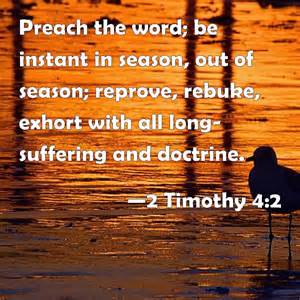
Preach the Word!

“Preach the Word!”

2-tim-4-2-preach-the-word-water

2 Timothy 4:2 – October 16, 2016

For those who have had a mentor relationship—either as a mentor or a ment-ee—this kind of relationship can be so rewarding. This is the kind of relationship I had with Pastor Gordon, when we worked together years ago for almost a year at another UCC church. He was the mentor, I was the ment-ee. Paul and Timothy had this kind of relationship. Close, nurturing, and a blessing to both parties. In their case, this relationship was especially close. Paul even called Timothy “my true son in the faith.”

We get glimpses of the deep, nurturing relationship between Paul and Timothy in several of the New Testament letters. However, perhaps the deepest, most personal window into their relationship comes from this letter, the second letter to Timothy recorded in the New Testament.

Some backstory. Paul is in prison in Rome. This is nothing new for Paul. He had been imprisoned multiple times throughout his time as a follower of Jesus Christ. What is the most urgent thing on Paul’s mind? His direct command, his charge to his son in the faith: “Preach the Word! In season and out of season.” (In other words, all the time.)

Yes, Timothy was a pastor, and a preacher. We can take this command as something that Paul only meant for Timothy. Or, expand it a little further, and consider it a command for any pastor, for any preacher.

I would like to let everyone here know that I always—always—start with the Word of God. When I start preparing my sermons, I pray over the text. I ask God what the message is that God wants me to deliver to the congregation. I research the pertinent passage, and sometimes other, related passages from the Bible. Sometimes I take a closer look at the original languages, and at the nuances and the shades of meaning in the translations. Then, after all that, I write the sermon. And, I hope and pray I may faithfully proclaim God’s Word to the congregation. Always.

That is what I—personally—do as I bring the Word of God to you, each week. But, I believe Paul is talking to more than just his son in the faith. I believe Paul’s message can be taken to heart by all believers. Not only by me, or Pastor Gordon, or Pastor Kevin from Epiphany UCC, or Pastor Vertie Powers from the Chicago Metropolitan Association. But, Paul’s message is for all of us. Each of us, individually. At this church, and any every church.

As is so often the case with the Apostle Paul, he crammed a ton of ideas into a very small space. Let’s read his directions to Timothy, again, starting at 3:14: “But as for you, continue in what you have learned and have become convinced of, because you know those from whom you learned it.” Paul had already praised Timothy for his careful learning from his grandmother and mother, Lois and Eunice, at the beginning of this letter. Here, he expands this idea.

Here, Paul ”refers to the people from whom Timothy has learned. (And it is ’people,’ more than Paul alone, but a collection of people, since the ‘whom’ in 3:14 is plural.)” [1] We know that Timothy learned from his mother and grandmother, because Paul said so. Perhaps Timothy also went to Hebrew school, or Torah classes, or studied with some rabbinic scholar as a teen. But, Paul said Timothy learned from a number of people. Mentors. Teachers. Coaches. Elders in the faith, people who had thorough, lived-or-demonstrated faith. Their faithfulness, which made Timothy who he was as an adult.

Go back in your mind and memory. Can you remember one or two special people who instructed you in the faith? People who lived out their Christian faith each day, every day?

I can remember one dear woman when I was in elementary school on the northwest side of Chicago at the Lutheran church. I vividly remember a senior, Mrs. Pabst (who died many years ago). She was faithful. She was kind. She had the spiritual gifts of helps and mercy and service to others in abundance. She was unfailingly loving and giving to others. Each day. Every day. She lived out the Christian life in front of me. I learned practical theology from Mrs. Pabst: how to make theology part of everyday life and apply it to the nuts and bolts of everyday living. She demonstrated the Christian faith as part of who she was.

That’s what Paul is talking about here. He praises Timothy for having absorbed practical theology from mentors, teachers, coaches. The Christian faith was part of who Timothy was.

Who have we learned from? Who showed us how to make practical theology part of our everyday lives? Great question! I’ll let us all ponder that for today.

Let’s get back to talking about the Word. Yes, Paul commanded Timothy to preach the Word. What else does Paul say about the Word? About Scripture? These verses are rich with meaning. Paul says that Timothy learned Scripture from the time he was very small. From his infancy Timothy had been exposed to God’s Word, which was—which is able to make all of us wise for salvation through faith in Christ Jesus.

How about for us, today? Does that mean learning about Scripture in Sunday school? Memorizing verses in Confirmation classes? Sharing at bible study or at prayer time? Yes, yes, and yes. All of those, and so much more. What about decorating the sanctuary for Christmas? What about getting the fellowship hall ready for the Spaghetti Dinner or the Not-So-Lent Fish Fry? What about working at the Car Wash? Or praying for others with the email Prayer Chain?

Can those be times when we learn from each other how to be of service, and how to live Godly lives in a cheerful, faithful way? How to DO practical theology?

Just letting you all know: this final letter is bittersweet. More than sad. Paul is coming to the end of the road; he knows it. This time, he knew he had very little time left before he was executed. Beheaded. He has lost the final appeal, before the Emperor in Rome. Time is short—Paul desperately needs to give Timothy a final charge: “Preach the Word!”

We can all point to preachers on street corners or on television, or on the Internet. Preachers who give us lessons in how NOT to preach the Word. Preachers who use a boom box or a bullhorn, using guilt and shame as weapons to browbeat passersby into their “churches.” False preachers like these have no regard for those hearing the message. They do not deliver the Good News of forgiveness in Jesus Christ. God’s Word that transforms the life of every person who truly believes.

Communicating the transforming Word of God is the ministry of the Church. The main job of each and every believer. Just as Paul praised Timothy for having absorbed practical theology from mentors, teachers, coaches, just as Paul recognized that the Christian faith was part of who Timothy was, so each of us can live out the Christian faith each day. Every day. We can make theology part of our everyday lives, too.

We can have confidence and faith in Jesus Christ as our Lord, our Savior. We all can live lives that let everyone know we are Christians because we have love for one another. We can strive to be unfailingly loving and giving to others. Many others. Each day. Every day. And when we finally stand before Jesus Christ in glory, we will hear the words, “Well done, good and faithful servant.”

St. Francis of Assisi made theology part of his everyday life, making the Christian faith part of who he was. He reminded us, “Preach the Gospel at all times. And when necessary, use words.” Let those with ears to hear, let them hear. Amen.


[1] http://www.workingpreacher.org/preaching.aspx?commentary_id=1836 ; Commentary, 2 Timothy 3:14-4:5, Matt Skinner, Preaching This Week, WorkingPreacher.org, 2013.

@chaplaineliza

(Suggestion: visit me at my regular blog for 2016: matterofprayer: A Year of Everyday Prayers. #PursuePEACE – and my other blog,  A Year of Being Kind . Thanks!)