Unknown's avatar

Peace for Those Who Wait

“Peace for Those Who Wait”

            Waiting. I can remember waiting while being pregnant. Waiting for the weeks to pass. Waiting for another prenatal visit. Especially waiting during that last month. And, waiting for the labor pains finally to kick in and to get going, for the baby to finally be born. (Each of my pregnancies involved long labors.)

            I can relate to our Gospel reading from Luke chapter 1 today! Waiting! Waiting for something huge to happen. Waiting for babies to be born.

Except, Mary found herself in the early months of pregnancy without the protection of a husband or partner. I have a feeling she and Joseph were having continuing dialogue about her being pregnant, and not by Joseph. That must have been awkward, to say the least! We find that Mary traveled and went to her older cousin Elizabeth’s house, some distance away, for several months. Elizabeth’s home must have been a sanctuary in an unpeaceful time for Mary, while she was in a time of waiting.

Let us look at the current day, and focus on the United States. Things today, situations here and now are certainly not peaceful. We are looking at the second Sunday in Advent, and the second candle on the Advent wreath signifies the candle of Peace. Can you and I possibly find peace in an unpeaceful world?

Is there a way to look for God’s peace in a turbulent and tumultuous time?

As I said last week, we are well used to seeing Mary as a sweet, calm, quiet, almost docile follower of God’s will for her life. Last week, I brought up the fact that Mary, our Mary that Dr. Luke tells us about, was also a prophet! As a prophet, she brought hope to the world. Was it possible that Mary also brought peace to an unpeaceful world?  

This prophetic role, this insight is a new way of looking at Mary for me. New for me, and I hope enlightening to you, too. As we consider the call of the prophets in the Hebrew Scriptures, and consider the call of Mary by the angel Gabriel, we see all the familiar, classic steps: we see God’s initial call to Mary, God’s task, Mary the prophet’s objection, God’s reassurance, and Mary the prophet’s acceptance of call. [1]

All of these are found in Mary’s conversation with the angel Gabriel in the account of the Annunciation, found in Luke chapter 1. I was struck by – you might say, gobsmacked by – the clarity of all those classic steps of the prophet’s call displayed, and I had never seen it before. Sure, I had approached this insight in years past, even preaching about how Mary was a radical by singing about such radical ideas.

Even though I have been well acquainted with the first chapter of Luke for decades, the further concept of Mary as God’s chosen prophet never fully clicked with me. Until now.

As we go on to look at the Canticle that Mary sings, I want to bring before us the earth-shattering idea that “Luke portrays her in a startling role: one that shakes up the way we’ve been brought up to think of her and invites us to stop observing her and start imitating her.” [2]

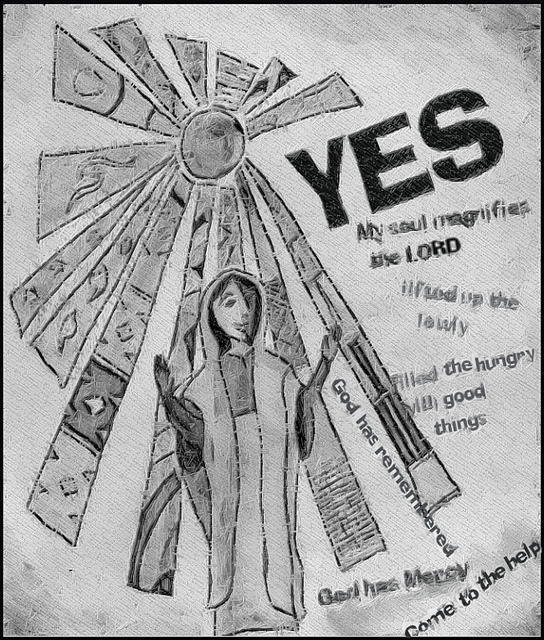
Can you listen with open ears to Mary sing of God who “has brought down rulers from their thrones but has lifted up the humble,” and “has filled the hungry with good things but has sent the rich away empty.” This is a classic story (or song) about the “haves” and the “have-nots,” and we can guess who Mary associates herself with! The Jewish people are definitely downtrodden; the Roman empire certainly has them under their collective boot heel. Nevertheless, Mary’s prophetic notes of joy ring out for all to hear in the Magnificat!

Remember, Mary’s song, giving glory, magnifying God, is also clearly a radical protest song. As she sings about the injustice not only in her hometown, but within the whole occupied Jewish nation, any peace but a forced “peace” was the furthest thing from the minds of the Roman occupiers. Yet, “the new world Mary sings about here isn’t elusive or unquantifiable at all. The hope she holds onto is one passed on to her from her ancestors: from Hannah, who sang this hymn of reversal and revolution in the Hebrew scriptures, to the Psalmist, who echoed praise to God for raising the poor from the dust and lifting the needy out of their desperation.” [3]

One of my favorite interpretations of the Canticle Mary sings, the Magnificat, is a newer song written by artist Rory Cooney, set to a traditional Irish tune called “Star of the County Down.” It is presented as a story-song with refrain: “Though the nations rage from age to age, we remember who holds us fast: God’s mercy must deliver us from the conqueror’s crushing grasp. This saving word that our forebears heard is the promise which holds us bound, ‘til the spear and rod can be crushed by God, who is turning the world around.” [4]

Can you believe how radical, how revolutionary an idea this was (and is)? Especially to a large group of people who have been poor, downtrodden, and left on the outskirts for generations, perhaps for centuries? What good news – even marvelous news – this would be to such a group of people, to know that God not only loves them, but God cares about each of them, and is actively coming to their defense, to fill their stomachs and right their wrongs!

Here in the United States, right now, we have a large segment of the population becoming fearful and anxious. Not only about the economic situation for individuals and families, but also the current political situation. The roaming of ICE agents and Department of Homeland Security walking freely, touchy and eager to display their confounding and overwhelming strength, their power over.

How striking and similar is this to the occupying Roman army in first century Palestine? Some striking and sadly similar parallels between the first and twenty-first centuries. In both cases, God’s love was and is displayed, overcoming worldly power.

As the Canticle of the Turning says in the last verse, “Though the nations rage from age to age, we remember who holds us fast: God’s mercy must deliver us from the conqueror’s crushing grasp. This saving word that our forbears heard is the promise that holds us bound, ‘Til the spear and rod be crushed by God, who is turning the world around.” [5]

  Let those with ears to hear, hear the words of the prophet Mary. Alleluia, amen.

@chaplaineliza

(Suggestion: visit me at my other blogs: matterofprayer: A Year of Everyday Prayers. #PursuePEACE – and  A Year of Being Kind . Thanks!)


[1] http://www.patheos.com/progressive-christian/mary-reluctant-prophet-alyce-mckenzie-12-17-2012.html

[2] Ibid.

[3] The Do Not Be Afraid Advent Devotional – © 2022 Illustrated Ministry, LLC

[4] Cooney, Rory, “Canticle of the Turning,” (GIA Pulications, Inc. Chicago, IL: 1990)

[5] Ibid.

Unknown's avatar

Hope, for Mary and for Us

“Hope, for Mary and for Us”

Luke 1:26-45 (1:38) – November 30, 2025

            I have a secret confession to make. I am greatly thankful that I have never had to take a job in retail. As I said to my husband this past weekend, I would have quit after the first day, simply because of the constant, cheesy, sometimes saccharin-sweet Christmas music that is piped in over the PA system at every retail store I go into. This is done for about two months before Christmas. And, that’s a long, long time to hear Christmas carols and songs, non-stop.

            And yet – and yet, as we consider this alternative Advent Bible reading from Luke chapter 1 today, I invite you to come with me back in time, to a time before there even was a Christmas. We are not only going to time-travel, but we are going to ocean-hop, too. Let us go to the modest home of a teenager named Mary, living with her parents in Palestine, around the beginning of the first century of the Common (or, Christian) Era.

            This teenaged girl – really, young woman, as she was in that time and place – had an angel visitation. We even find out the Angel’s name, Gabriel. The few times that the angel Gabriel appears in the Bible (that we know of), are times of great importance. Especially this appearance, when Gabriel heralds the birth of the coming Messiah! But, we haven’t gotten there yet. Mary is in her parents’ home when the angel suddenly arrives, about to upend everything concerning Mary and her life as she knows it.  

            Another very important fact: the country where Mary is living, and her people, the Jews, are under Roman rule. Palestine is an occupied country, like so many other regions and nations under the boot of Rome and the powerful Roman army. Palestine doesn’t sound much like a “Silent Night, Holy Night,” where “all is calm, all is bright.” Does it?

            Our mighty God does not wait until everything is perfect, or everything is calm and placid, to work wonders and miracles. God sent the angel Gabriel to a teenager in a modest house, in a country under military occupation. Not to the ruling classes, not to the king’s family in his luxurious palace, but to an unlikely young woman in a backwater town.

            Let us shift gears and move our focus to the modern day. Here in the United States, we have a great deal of internal struggle! Things today are certainly not perfect, or calm or placid. As we mark the first Sunday in Advent, the first candle on the Advent wreath is called the candle of Hope. Can you and I possibly find hope in an atmosphere of anxiety? Of uncertainty? Overwhelmed by pervasive negativity, with the American people’s attitudes filled with division, derision and defensiveness?

            Let’s return to Mary and the angel. How does Gabriel lead off in this conversation from Luke chapter 1? 28 The angel went to her and said, “Greetings, you who are highly favored! The Lord is with you.” Admittedly, Mary wonders what on earth is going on! Dr. Luke tells us, Mary “was greatly troubled at his words and wondered what kind of greeting this might be.” I dare say you and I would be greatly troubled, too, if we were to encounter an angel!

            Sure enough, Gabriel announces to Mary that she is highly favored, and that “you will conceive and give birth to a son, and you are to call him Jesus. 32 He will be great and will be called the Son of the Most High. The Lord God will give him the throne of his father David, 33 and he will reign over Jacob’s descendants forever; his kingdom will never end.”

Mary probably knew her place in society of her time, as a female, as a second-class citizen. Mary “is common, ordinary, of little account in her world and definitely not the stuff of legends…and she knows it. Only after expressing her wonder and dismay, and then hearing again Gabriel’s affirmation and promise, does she manage to summon the courage to believe that God has indeed favoring her by working in her and through her for the health of the world.” [1] What was Mary’s response to the angel? 38 “I am the Lord’s servant,” Mary answered. “May your word to me be fulfilled.”

We all know very well that our teenaged Mary became pregnant by the Holy Spirit, and gave birth to the baby Jesus in Bethlehem. We are well used to seeing Mary as a sweet, calm, quiet, almost docile follower of God’s will for her life. However, I would like to suggest that Mary was also a prophet! As a prophet, she would also be a bringer of hope to the world!

This prophetic role, this insight is a new way of looking at Mary for me. New for me, and I hope enlightening to you, too. As we consider the call of the prophets in the Hebrew Scriptures, and consider the call of Mary by the angel Gabriel, we see all the familiar, classic steps: we see God’s initial call, God’s task, the prophet’s objection, God’s reassurance, and the prophet’s acceptance of call. [2]

 I will say more about this next week, when we take a look at the Canticle that Mary sings, but I want to bring before us the earth-shattering idea that “Luke portrays her in a startling role: one that shakes up the way we’ve been brought up to think of her and invites us to stop observing her and start imitating her.” [3]

 I know that the Christmas carol “Once in Royal David’s City” calls mother Mary “mild,” and the typical portrayal of her on Christmas cards is calm, placid and docile. But, how can this mild depiction of Mary cause our hearts to be hopeful, today? Especially when it seems that the whole world is uncertain, the current political situation is contentious, and our society in the United States is fractured and broken?

            While Mary’s specific task is specific to her, the prophetic call remains open to everyone. God can call each one of us to a prophetic role, especially at this time of Advent, at this grateful and expectant time of year when people are looking up, looking outward, looking for hope. We can all be like Mary, the prophet, bearing good news to everyone.

            Alleluia, amen.

@chaplaineliza

(Suggestion: visit me at my other blogs: matterofprayer: A Year of Everyday Prayers. #PursuePEACE – and  A Year of Being Kind . Thanks!


[1] https://www.workingpreacher.org/dear-working-preacher/favored-ones

[2] http://www.patheos.com/progressive-christian/mary-reluctant-prophet-alyce-mckenzie-12-17-2012.html

[3] Ibid.

Unknown's avatar

Peace, from Generation to Generation

“Peace, from Generation to Generation”

Luke 1:44-56 (1:50) – December 8, 2024

People have been writing songs about the Virgin Mary for centuries. Songs of praise, songs of worship, songs honoring God, and lifting up Mary for saying “yes” to God. Christmas carols might be the first thing that come to mind—but I am also thinking of music from centuries past. From the familiar first part of Handel’s Messiah, to the various settings of the Magnificat, with lyrics from the first chapter of Luke—our Gospel reading for this morning.

            Some Protestants might not be as familiar with the Virgin Mary as many Catholics and Orthodox Christians are. Mary is held in extremely high esteem in many denominations and faith traditions throughout the world, and for excellent reasons. I honor her greatly.

If we look at our modern world today, the situation here in our country, we have a great deal of uncertainty, and very little peace. Does our world today have some strong similarities to the world that Mary inhabited? I wonder, and I would say yes.

Mary sings about the mighty work of God. Yes, personally, in her life. But also in the lives of all the people in the world. “What will this work of God look like?  Something revolutionary is about to happen. God will turn the world upside down. The rich and the powerful will be brought low, and those living on the margins will be raised up. This isn’t a vision that fits very well with a Christian world that values success and power.[1]

For, that is definitely what a large portion of the so-called “Christian world” values today. At least, here in this country, and among a large number of people who claim to follow Christian values and practices religiously. Even if certain Christian denominations do not say it outright, the “Health, Wealth and Happiness Gospel” is a high priority in many people’s lives today.

Let us take a look at what Mary’s situation consisted of. Did you know that Mary—an unwed teenager from an oppressed people-group in an occupied country under crushing Roman rule—was also a radical? A subversive? Was plotting to overthrow the existing oppressive government and replace it with the rule of God?

            What surprising, even shocking things to say about the sweet, innocent Virgin Mary! Everyone associates her with travel to Bethlehem while nine months pregnant, and needing to deliver the infant Jesus in a stable, because there was no room for them in the inn.

That Mary? Radical? Subversive? Absolutely, yes.

Think about the modern Christmas season from another direction. Contrast Mary’s situation with today. Is there any place we can go where we are not bombarded with commercial messages shouting for us to “Buy, buy, buy!” and reminding us of big sales, and markdowns, and half-price! Not to mention all the pressure to be “merry and bright” all the time. Even when going to yet another event or concert or dinner or celebration is the last thing you want to do!

Let us reflect on the first chapter of Luke, on Mary’s song. The last thing on Mary’s mind was commercialism. “Mary’s song, often called the Magnificat, is a welcome contrast to the hyped-up speed of the commercialism that is too often the dominant theme in our culture during the Advent season. Her lyrics are an invitation to approach Christmas with a slower, more contemplative pace.” [2] Is it possible to slow down the frenetic pace of the holidays, to get off the commercial merry-go-round, and instead sit still and worship the coming Messiah?

Sure, the wonderful classical settings of the Magnificat were often sung in a foreign language, like Latin. Or, in text from the King James version of the Bible, full of “thee’s” and “thou’s” and all manner of archaic words. Listen to the first part of her Magnificat, as translated in the modern version by Eugene Peterson, “The Message.” 

“I’m bursting with God-news; I’m dancing the song of my Savior God. God took one good look at me, and look what happened—I’m the most fortunate woman on earth! What God has done for me will never be forgotten, the God whose very name is holy, set apart from all others. His mercy flows in wave after wave on those who are in awe before Him.”

 One well-known depiction of the Virgin Mary is one that is meek, docile, sweet, and not raising a fuss at all. But, wait a moment. Do we realize what Mary is going to sing next? How revolutionary were many of the statements in her song?

             “Even more importantly, Mary’s song is an overture to the Gospel of Luke as a whole. Mary’s lyrics set the tone for Jesus’s radical and controversial ministry that is to come:

You have shown strength with your arm;

You have scattered the proud in the thoughts of their hearts.

You have brought down the powerful from their thrones, and lifted up the lowly;

You have filled the hungry with good things, and sent the rich away empty.

“In contrast, the Christmas season leaves too many still hungry, and too many even further in debt.” [3]

            Do you hear what radical things Mary is saying? If these lyrics of her song were more well-known, would our understanding of Mary be changed? Here Mary is advocating social change, rescuing victims—neglected women, forgotten elders and children, abused strangers and refugees—from being trodden underfoot, even ground under the heel of bragging, bluffing tyrants and braggarts. Turning all society as it was in her day—and ours—upside down.

            What subversive idea is our revolutionary Mary advocating now? Feeding the starving? Giving the poor a banquet? Turning the unfeeling, callous rich people out into the cold? Yes, these radical words are the words found in Luke chapter 1, before we rush on to the narrative of the birth of the Baby in Bethlehem from Luke 2. 

Just looking at this Magnificat, we can see how subversive it was for the infant Messiah to be born to the Virgin Mary. And, we can begin to realize how radical it is for us to say, “O come, let us adore Him, Christ the Lord!” For Jesus truly will bring peace on earth, and He will truly turn the world upside down, just as Mary sang two thousand years ago.

But, this is still only the second Sunday of Advent. We still wait for the baby Jesus to be born in Bethlehem. We still hold our collective breath with all the rest of creation as we wait—and wait. And with Mary, we can rejoice in the promise of the coming Messiah.

Are we overwhelmed with the superficial, commercial glitz and bling of the holidays? Or, are we focused on what really matters – on the coming of our Messiah, our Lord, in God’s peace and wholeness? Let us focus on Jesus, today. Alleluia, amen.

@chaplaineliza

(Suggestion: visit me at my other blogs: matterofprayer: A Year of Everyday Prayers. #PursuePEACE – and  A Year of Being Kind . Thanks!


[1] http://www.bobcornwall.com/2015/12/blessed-are-you-among-women-lectionary.html

[2] http://www.patheos.com/blogs/carlgregg/2011/12/magnificat-learning-to-sing-mary%E2%80%99s-song-a-progressive-christian-lectionary-commentary-on-luke-146-55/

[3] http://www.patheos.com/blogs/carlgregg/2011/12/magnificat-learning-to-sing-mary%E2%80%99s-song-a-progressive-christian-lectionary-commentary-on-luke-146-55/

“Magnificat! Learning to Sing Mary’s Song,” Carl Gregg, Patheos, 2011.

Unknown's avatar

Uncertain? Hope!

“Uncertain? Hope!”

Luke 1:26-38 (1:37) – December 1, 2024

This week, we read one of the most familiar of the narratives in the New Testament, perhaps even of the whole Bible. From the first chapter of Luke, here is the first part of the reading:  “In the sixth month of Elizabeth’s pregnancy, God sent the angel Gabriel to Nazareth, a town in Galilee, to a virgin pledged to be married to a man named Joseph, a descendant of David. The virgin’s name was Mary. The angel went to her and said, “Greetings, you who are highly favored! The Lord is with you.”

            Let’s take a closer look at this situation. Imagine yourself as Mary, a teenaged girl. Perhaps doing housework, cooking in the kitchen, or folding laundry. When, out of nowhere, an angel appears. My goodness! Out of the clear blue sky, something completely supernatural happens! And not only that, but to be greeted by the angel with such words?

            Mary’s response is one of puzzlement: “Mary was greatly troubled at the angel’s words and wondered what kind of greeting this might be.” Let’s face it—Mary is perplexed! She is wondering at the angel’s words: “the Lord is with you.” What kind of a greeting is this, anyway?

            We can be fairly sure that Mary (or, as was probably her name, for a young Jewish woman, Miriam) Mary knew her Hebrew scriptures. The phrase “The Lord is with you” is repeated several times in the Hebrew scriptures, primarily expressing the Lord’s help or assistance. This would puzzle Mary even further—why on earth did she need the Lord’s help?

            We see Mary, probably in the middle of an ordinary day, with the angel Gabriel paying a surprise visit to her! What gives? What is going on?

           I know this is not exactly the same, but I would like to compare Mary’s surprise situation to ours, today. Specifically, to my friend Anita, some time ago now. Out of the clear blue sky, she found out that she needed surgery. Before the beginning of October, she was traveling along, blithely, no serious cares or concerns. After the first week in October? Her life was turned upside down, with a serious medical situation, quickly followed by major surgery.

            How often does something like that happen? Perhaps not a medical emergency in your life, or a loved one’s life, but some other serious situation out of a clear blue sky.

            But, let’s return to Mary. Or, more directly, to the angel Gabriel and what the next words out of the angel’s mouth are: “Do not be afraid, Mary; you have found favor with God.”

            I suspect, if I had the opportunity to see an angel, I probably would be afraid, too! Practically every time an angel visits someone in the Bible, “Do not be afraid!” is one of the first things out of their mouths! Gabriel continues: “You will conceive and give birth to a son, and you are to call him Jesus. He will be great and will be called the Son of the Most High.”

            Understandably, Mary is even more puzzled, hearing this! Her response—quite sensible, under the circumstances—“How will this be,” Mary asked the angel, ‘since I am a virgin?”

            I can see Mary’s point. The word from the angel? Surprise! Truth to tell, it’s hard to top a virgin birth! We can look at other places in the Scriptures, and see other miracles. We can look at the life and ministry of our Lord Jesus when He was an adult, and acknowledge the fact that He did miracles, regularly. But—here we have Mary, herself, wondering how on earth this miracle is going to happen to her?

            The angel has an answer for Mary, sure enough. “The angel answered, “The Holy Spirit will come upon you, and the power of the Most High will overshadow you. So the holy one to be born will be called the Son of God.” In brief, here we have the angel describing the divine plan for a miraculous conception. Mary expresses doubt and uncertainty, Gabriel explains God’s plan in greater detail, Mary consents, and the angel departs.

This whole narrative makes me want to ask Mary so many questions.

How soon did you tell your parents you were pregnant? Did you tell Joseph about the pregnancy yourself, or did the gossipmongers of Nazareth take care of that for you? Was there anyone in the village who believed your story? For that matter, after the angel Gabriel left, did you doubt his visitation to you? Did you think it was a dream? Question your sanity? And what about the townspeople’s response—did you fear for your life, since people probably thought you committed adultery?

The Gospel of Luke is silent on this matter. It leaves us with so many unanswered questions! All we know is what Mary said to the angel. “I am the Lord’s servant,” she answered. “May your word to me be fulfilled,” was her response.

I feel deeply for Mary. An unmarried girl who happened to be pregnant was not just looked down on but actively persecuted. Sure, she knows that she takes the risk of being rejected as a slut, as a tramp, as unworthy of polite company, as a result of this new openness to God’s surprise activity in her life.  I would not blame her one bit for being uncertain!

            Yet, we can see that Mary exemplifies the kind of response to God’s surprises that I would like in my own life. We can see from the Gospel that Mary afterwards goes to see her older cousin Elizabeth, who also is pregnant, miraculously. (I bet they have a good deal to say to each other, too!)

Though—out of a clear blue sky—God completely spun Mary’s life around, though Mary knew that her life would never be what she expected it to be before, she nevertheless said “yes” to God in faith. Yes, she worshiped God (especially in her prayer, which comes after our Scripture reading for today.) She models the heart of worship, the giving of ourselves to the one who has given everything to us.

Mary’s example challenges and encourages us to have the courage to say to the Lord: “Be it to me according to Your word!” This is blessed hope in God’s word!

Remember, Mary may have had thoughts about how this would affect the life she had planned out. However, she realizes there is something special about to happen, that God’s plan must take precedence over her own. She accepts the challenge with hope and faith as she realizes she will be carrying the Messiah her people have longed for.

            I’d like to remind all of us today that Mary—an ordinary Jewish teenager—was visited by an angel out of a clear blue sky. Mary was an ordinary person who was willing to say “yes” to God, to respond to God’s call willingly and with courage, and go forward in faith.

            It doesn’t matter what our situations are, today. God can come into any of our lives, seemingly out of nowhere. God can rush right in, abruptly, with no warning. We all—each one of us—are encouraged to respond to God in the same way as Mary did. To agree with God, to say “yes” to God, willingly, with hope, and go forward in faith.    

@chaplaineliza

(Suggestion: visit me at my other blogs: matterofprayer: A Year of Everyday Prayers. #PursuePEACE – and  A Year of Being Kind . Thanks!

Unknown's avatar

God’s Radical Promises!

“God’s Radical Promises!”

Luke 1:46-55 (1:49) – December 10, 2023

            Who remembers going Christmas caroling? Going from house to house, singing the carols and hymns of the season, bringing hope, joy and peace to many at this season of the year. Such a wonderful memory! And, such wonderful carols and hymns and songs, too!

            Just think of where these songs of hope, joy and peace come from. All over the world, there have been songs of Advent and Christmas written throughout the centuries. These are by turns loud, joyous and bright music, or they could be soft, gentle, quiet lullabies. What holds all of these songs in common is their focus on God’s promises fulfilled.

            That sounds so much like our Gospel reading from Luke today. The pregnant teenager Mary sings a song where she remembers the promises of God. And, these promises are not just theoretical. These promises are actually happening to her, at the time she is singing.

            Her cousin Elizabeth is much older, and had given up any hope of having a baby until God miraculously intervened. Mary – well, we all know Mary’s story, how the angel Gabriel came to her and said God had highly favored her. And – Mary said yes to God, and became pregnant by the Holy Spirit. After several months, Mary and her cousin Elizabeth are together, at Elizabeth’s home. Mary, a thoughtful, contemplative teenager, began singing this marvelous song of God’s promises fulfilled in her life and in the time to come.

            At the beginning of this song – this Magnificat – Mary starts with giving praise to the Lord. Magnifiying God’s name! As the Jewish people had done long before Mary, she sings of the great things God has done. Except, for Mary, God is now doing these things for her, personally! Just imagine, Mary was from a small town in an obscure region of Palestine. A nobody from nowhere. Except, she is so similar to many young women throughout the centuries.

Just think, “living in a rural village in an occupied country. Everyone around her discounted her. But God did not. This gives everyone else who feels like a nobody the assurance that God values them too. God has work and a plan for them, too.” [1] What a bright hope this holds out for so many who otherwise would feel left out, downtrodden, and left behind!

Both Mary and Elizabeth felt joy, too. Both knew the joy of having a baby grow within their bodies, and they knew the joy of having God’s promises personally fulfilled in their own lives. Plus, Mary was joyful because she looked forward to seeing her son as the fulfillment of the world’s hope, the fulfillment of God’s promises foretold throughout the ages.

Mary is not a meek, mild and lowly person, no matter what certain carols may say. As we read Mary’s song of praise to God, we can clearly hear this song is a radical departure from the broken, the fallen, the least and the last. From the words of this song, I suspect that Mary is not only thoughtful, she is intelligent, even mature and freethinking.   

            Can you listen with open ears to Mary sing of God who “has brought down rulers from their thrones but has lifted up the humble,” and “has filled the hungry with good things but has sent the rich away empty.” This is a classic story (or song) about the “haves” and the “have-nots,” and we can guess who Mary associates herself with! The Jewish people are definitely downtrodden; the Roman empire certainly has them under their collective boot heel. Nevertheless, Mary’s notes of joy ring out for all to hear in the Magnificat!

            Remember, Mary’s song, giving glory, magnifying God, is also clearly a radical protest song. As she sings about the injustice not only in her hometown, but within the whole occupied Jewish nation, any peace but a forced “peace” was the furthest thing from the minds of the Roman occupiers. Yet, “the new world Mary sings about here isn’t elusive or unquantifiable at all. The hope she holds onto is one passed on to her from her ancestors: from Hannah, who sang this hymn of reversal and revolution in the Hebrew scriptures, to the Psalmist, who echoed praise to God for raising the poor from the dust and lifting the needy out of their desperation.” [2]      

            One commentator, Rolf Jacobson, tells about one of his colleagues at Luther Seminary. Dr. Lois Malcolm grew up as a missionary kid in the Philippines. “Growing up among that nation’s poor, Malcolm reported that when they heard Mary’s Psalm, it was the first time that anyone had told them the good news that God cares about them—the poor, the oppressed. Mary’s Psalm announces, “Christ has come to challenge the structures of sin, death, the devil, and oppression. Christ has come in the strength of the Lord to do what the Lord has always done: lift up the lowly, free the enslaved, feed the hungry, give justice to the widow, the orphan, and the sojourner. [3]

            In the words of a modern retelling of Mary’s song: “Though the nations rage from age to age, we remember who holds us fast: God’s mercy must deliver us from the conqueror’s crushing grasp. This saving word that our forebears heard is the promise which holds us bound, ‘til the spear and rod can be crushed by God, who is turning the world around.” [4]

Can you believe how radical, how revolutionary an idea this was (and is)? Especially to a large group of people who have been poor, downtrodden, and left on the outskirts for generations, perhaps for centuries? What good news – even marvelous news – this would be to such a group of people, to know that God not only loves them, but God cares about each of them, and is actively coming to their defense, to fill their stomachs and right their wrongs!

            This is, indeed, a counter-cultural Gospel reading, counter to the culture of the United States, surely. What better reason for us to lift up this message of resistance, to open our ears to Mary and her radical song. Here in this country, the commercial picture of the baby Jesus is “a cattle-lowing, no-crying-he-makes Jesus” with Silent Night and Away in a Manger. “But at least one Christmas carol would remind us of the ends to which the son of Mary was willing to go in order to cast the mighty down from their thrones and uplift the lowly:” [5]

Nails, spear shall pierce him through, / The cross he borne for me, for you;
Hail, hail the word made flesh, / The babe, the son of Mary!

May our hushed, reverent souls magnify our Lord, indeed. Amen, alleluia.

@chaplaineliza

(Suggestion: visit me at my other blogs: matterofprayer: A Year of Everyday Prayers. #PursuePEACE – and  A Year of Being Kind . Thanks!)

(I would like to express my great appreciation for the observations and commentary from the Do Not Be Afraid Advent Devotional – © 2022 Illustrated Ministry, LLC.. I used several quotes and ideas from their useful resources. Thanks so much!)


[1]Worshiping With Children: Year C – Fourth Sunday of Advent (December 20, 2015)

[2] The Do Not Be Afraid Advent Devotional – © 2022 Illustrated Ministry, LLC

[3]  Commentary on Luke 1:46b-55 – Working Preacher from Luther Seminary

[4] Cooney, Rory, “Canticle of the Turning,” (GIA Pulications, Inc. Chicago, IL: 1990)

[5] Commentary on Luke 1:46b-55 – Working Preacher from Luther Seminary

Unknown's avatar

Hope for Uncertain Hearts

“Hope for Uncertain Hearts”

Luke 1:26-45 (1:30) – November 28, 2021

            I want to ask a simple question. Do you believe God is active in the world today? I know we can read about Bible times, thousands of years ago. The Bible says that God was active, mighty and powerful, back then. God did amazing things in people’s lives – long, long ago. But, what about today? Is God active in your life – in my life – today?

            “Few of our people imagine God to be an active character in the story of their lives.” And I suspect commentator Walter Brueggemann is right. It’s not that people today don’t believe in God. It’s more that, day in and day out, God seems to most of them (and perhaps to us, too) as fairly passive. If God is doing anything, it’s pretty much hanging out in the background, watching, waiting, merely being supportive. Not vital, and not active. [1]

Here we are, on the first Sunday in Advent. God may seem far away right now. Merely watching and waiting. Not playing a vital, active role in the story of our lives today. Perhaps it is difficult to think of the Lord as a mighty, powerful actor in our lives right now. But, wasn’t that exactly what God was, in our Scripture reading today?  

            I suspect Mary was shocked down to her sandals when the angel came to her that day, two thousand years ago. The angel said, “Greetings, you who are highly favored! The Lord is with you.” We can read that “29 Mary was greatly troubled at his words and wondered what kind of greeting this might be. 30 But the angel said to her, “Do not be afraid, Mary; you have found favor with God.” If that isn’t God taking an active role in Mary’s life, I don’t know what is.

            Is it possible that you and I might have that same kind of expectation today, that hopeful looking-forward-to God acting in our lives, too?

            I am afraid that I am not very hopeful right now. Neither is my friend, Rev. April Fiet. The fear, the anxiety, the uncertainty of the past eighteen months of pandemic have taken their toll on many, many people across our country. Across our world. Is it even possible to hope? Or, is that feeling a big uncertainty, too?

            Pastor April says “I have tried to hope even when better days seemed impossible. I tried to take things one day at a time, not get too far ahead of myself, and look at the good things I had rather than the things I was losing out on.” [2] I can relate to this honesty. Like Pastor April, I became afraid to hope, too. Every time I got a little bit of hope in my heart, some positivity inside, something would happen. COVID cases would spike, or hospitals and morgues would be overwhelmed, or more recently, the supply chain would have severe interruptions. Not to mention interruptions or disasters in my work life here, or my personal life at home.

            Yet, as we mark the first Sunday in Advent, the first candle on the Advent wreath is called the candle of Hope. Can you and I possibly find hope in such an atmosphere of anxiety? Of uncertainty? Overwhelmed by pervasive negativity?

            Pastor April’s words ring so true in my heart. She says, “I’m uncertain about Advent. I’m uncertain I can hope. I’m uncertain about what’s possible for me. The only thing I’m certain about is that I don’t want to go through Advent with this heaviness on my heart. I want to find a way to release [this feeling] so that healing can begin to happen. I want to exchange uncertainty for hope.” [3] Oh, that would be such a blessing to my heart, to even begin to hope!

            I suspect if you and I had an encounter with a heavenly messenger, like Mary did in our Scripture reading, things might be very different for us. I’m asking, again: what about today? Is God active in your life – in my life – today? Can God actively encourage our hearts to hope?

            Sometime after Mary and the angel had their encounter and Mary became pregnant with the infant Jesus, Mary went to her older cousin Elizabeth’s house. Elizabeth had had a wonderful intervention happen in her life, too. Mary and Elizabeth both had a most joyous reason to hope. Yes, I suspect both women were anxious and fearful sometimes, especially as this was the first pregnancy for both women.

I’m wondering: isn’t it possible to feel afraid and to hope at the same time? The Holy Spirit helped Mary and Elizabeth to hold great hope in their hearts. They held on to hope even in all the uncertainty and caution of their lives.

Sometimes, we may feel overwhelmed, even afraid to hold on to hope. But, we do not need to face challenges all alone. God has promised to be with us. Plus, you and I can join together. We can come alongside of each other, too, if someone is feeling especially down and hopeless. [4] We can thank God for each other! Thank God for God’s mighty power, too.

So, what do you think? We know about Bible times long ago, and what the biblical record has to say. What about today? Is God active in your life – in my life – today? Can God actively encourage our hearts to hope? We can trust that God is still active, and is still doing all kinds of things in the world today – even in each of our lives! Look around at the people around you, in your family, in your congregation. God actively encourages each one of them, and each of us, too. [5]

God can do marvelous things through all our lives, too. Think how many marvelous things God wants to accomplish through each of us, today. On our insides and on our outsides. God IS mighty, active, and inspiring hope for sure, even through these uncertain times.

Alleluia, amen.

@chaplaineliza

(Suggestion: visit me at my other blogs: matterofprayer: A Year of Everyday Prayers. #PursuePEACE – and  A Year of Being Kind . Thanks!

And, thanks to Rev. April Fiet for her excellent series “An Advent for Uncertain Hearts.” I appreciate Illustrated Ministry’s Do Not Be Afraid selections for Advent, too.


[1] https://www.workingpreacher.org/dear-working-preacher/favored-ones

[2] https://aprilfiet.com/my-thoughts/advent-for-uncertain-hearts-week-1-when-it-is-hard-to-hope

[3] Ibid.

[4] Illustrated Ministry – Do Not Be Afraid, Advent 2021

[5] https://www.workingpreacher.org/dear-working-preacher/favored-ones

Unknown's avatar

Magnify the Lord with Me!

“Magnify the Lord with Me!”

Luke 1:38-56 (1:46) – December 6, 2020

            Do you know any teenage girls? Any girls with the maturity and balance that teenaged Mary shows to us here? This kind of maturity and balance in one so young is not very plentiful among teens, believe me.

            Socially and culturally, Mary was in an awkward situation. Even, a tight spot. A young woman (for, that was what Mary was considered, in the culture of her day), pledged to be married, who turns up pregnant. Scandalous! I am sure the old biddies in Nazareth were clucking about Mary’s situation—and character—and a whole lot more.

            While we, today, may read this narrative and think, “what a nice bible story!” this reading today is much more than that. Mary decides to go and visit her older cousin Elizabeth, in the hills of Judah. Elizabeth has miraculously gotten pregnant several months earlier. (The angel Gabriel told Mary so!) Two miraculous pregnancies, two women blessed by God. Plus, Elizabeth was an older, wiser woman, able to be a companion and mentor to the teenage Mary.  

            Yes, Mary’s extended visit to Elizabeth probably was comforting and encouraging to Mary. However, my attention is drawn to Mary’s song. The Magnificat is a tremendous counter-cultural song, turning everything in the political and cultural order upside down and topsy-turvy.

            Do you have any experience with an extended situation turning our world today upside down and topsy-turvy? Any disease or pandemic that is causing nationwide—even worldwide disruption and confusion? These two instances do not have a direct one-to-one correspondence, but there are many similarities here! The political and cultural upheaval Mary sings about in the Magnificat will greatly upend the established order of things. And, in many ways today, so will the COVID pandemic and its surrounding upheaval.

            I am reminded of a fellow professor friend of one of my Bible commentators. She grew up as a missionary kid in a poverty-stricken area in the Philippines. “Growing up among that nation’s poor, Professor Malcolm has reported that when they heard Mary’s Psalm, it was the first time that anyone had told them the good news that God cares about them — the poor, the oppressed.” [1] Some people in poverty have never heard this Good News! “Christ has come to challenge the structures of sin, death, the devil, and oppression. Christ has come in the strength of the Lord to do what the Lord has always done: lift up the lowly, free the enslaved, feed the hungry, give justice to the widow, the orphan, and the sojourner.” [2]

            Imagine Mary, having the maturity and the balance to sing such a radical, counter-cultural song! Is there some secret that Mary knew about, helping her to stay balanced and level-headed during all the upset and disruption of her unexpected pregnancy and the surrounding gossip and backbiting and sometimes outright nastiness of her fellow townspeople? Did Elizabeth aid her in finding this hope and balance, this calmness and serenity?

            Knowing what we do about the marvelous words of the Magnificat, and its similarity to Hannah’s song from 1 Samuel 2, we can learn from Mary. Her strength was in her trust in the Lord. Her faith was in God’s mighty power to overthrow society’s structures and the cultural norms of her day. Although our continuing situation is not exactly similar to Mary’s, we can still rely on God, too. Our strength can be our trust in the Lord. Our faith can be in God’s mighty power to overcome society and cultural norms.

            I’d like to think that Mary had a pleasant voice. Not operatic quality, although I do enjoy the voices of people who have studied and trained their voices into wonderful instruments! I can see how Mary knowingly turned for help to the One who would never leave her nor forsake her. Singing is one deep-seated way to come to God in prayer, in sadness, in hope and in joy.

            As commentator David Lose says, “songs are powerful. Laments express our grief and fear so as to honor these deep and difficult emotions and simultaneously strip them of their power to incapacitate us. Songs of praise and thanksgiving unite us with the One to whom we lift our voices. And canticles of courage and promise not only name our hopes but also contribute to bringing them into being.” [3]

            As we come before God in these next days and weeks ahead, perhaps we may come with trust and faith. Trust and faith in the God who is always with us, even through dark valleys, even through sickness, depression, despair and death.

            And may we, like Mary, lift up Mary’s radical song of resistance. Even though there is so much oppression and evil, and so much disease and despair in the world, God has brought light and hope into the world with the birth of God’s Messiah.

            I pray that you, like Mary, find joy even in the darkness of this particular Advent season of 2020. I also pray that the songs of Advent and Christmas bring light and hope to you as you draw closer to God each day. Alleluia, amen!


[1] https://www.workingpreacher.org/commentaries/revised-common-lectionary/fourth-sunday-of-advent-2/commentary-on-luke-146b-55

Commentary, Luke 1:39-45, (46-55), Rolf Jacobson, Preaching This Week, WorkingPreacher.org, 2014.

[2] Ibid.

[3] https://www.workingpreacher.org/dear-working-preacher/a-promise-that-changes-the-world

“A Promise That Changes the World,” David Lose, WorkingPreacher, 2012.

@chaplaineliza

(Suggestion: visit me at my regular blog for 2020: matterofprayer: A Year of Everyday Prayers. #PursuePEACE – and my other blog,  A Year of Being Kind . Thanks!

Unknown's avatar

O Come, Emmanuel

“O Come, Emmanuel”

O come Emmanuel

Luke 1:26-38 (1:31) – December 2, 2018

Have you noticed when you saw or heard your first Christmas commercial this year? On television, or on the radio? Or, perhaps it’s the first piped-in Christmas music at the store or at the coffee shop. Do you remember where you were? This expectation we go through every year; we pause, we watch the commercials, we hear in the music, we see in the displays of holiday lights and lighted figures outside of our neighbors’ houses.

These four weeks of Advent are weeks of preparation, of anticipation, of expectation. All these things are announcements of an impending arrival. Little reminders of the anticipation of the narrative from the first chapter in Luke. Ours is a fraction of the expectation that Mary had, beginning with the announcement from the angel. The teenage Mary had the angel Gabriel burst in on her, unannounced, giving her the very first Christmas commercial.

The anticipation we feel today is only a shadow of that we find in the Bible. I suspect, the teenage Mary was surprised out of her sandals by this unexpected visitor. Mary is told to expect the birth of the Son of the Most High.

If we go back several centuries, to the time of the prophet Isaiah, we notice the prophet writing about a young woman bearing a child, too.  In the Septuagint, the Greek translation of the Hebrew Scriptures, Isaiah 7:14 reads “a virgin will conceive and give birth to a son.” The Gospel of Luke shows this prophecy being fulfilled. But—not quite yet. Mary needs to go through a nine-month waiting period, a period of anticipation, expectation, and preparation.

As one commentator says, “Let’s be honest. Perplexity is exactly our response when the Lord shows up. To me? Why me? Why now? I think we underestimate the impact of what it means to know that God is actually around. Here. With us. Doesn’t God have better things to do? Bigger things to take care of? More major issues to maintain besides me?” [1]

Mary has a problem. She is not only a virgin (which the angel tells her not to worry about). However, she thinks she is merely a common, ordinary, every-day-type young woman. There is nothing special or extraordinary about her! It is “only after expressing her wonder and dismay, and then hearing again Gabriel’s affirmation and promise, does she manage to summon the courage to believe that God is indeed favoring Mary by working in her and through her for the health of the world.” [2]

This week is the first week of Advent, and we are going to focus on songs during these weeks. The Advent and Christmas seasons have marvelous carols, hymns and songs written during a number of centuries. This week, appropriately, we highlight the Advent carol “O Come, O Come, Emmanuel.” An excerpt from a fine article on this carol is found in your bulletin.

If you look at the article, notice several things. This is one of the oldest carols we have in our hymnals today. Christians have been singing it for over 1000 years. Originally written in Latin, it was translated into English by the scholar and priest John Mason Neale in the 1800’s. The translation of this hymn lets us know how much theology was written into the original lyrics. Each verse mentions a number of biblical and theological references.

You know what this ancient Latin hymn reminds me of? Young Mary. Eileen did not read Mary’s song from the first chapter of Luke, the Magnificat, but Mary does exactly that—after the angel leaves her, she breaks into song, and praises God. Not only that, she must have been biblically knowledgeable, because her song is chock full of biblical and theological references.

We know Mary was an introspective young woman, thoughtful and contemplative, since Dr. Luke tells us so in chapters 1 and 2. Does it surprise us that she knew a great deal about the Hebrew Scriptures, as we can tell from reading her song, her response to God?

Quoting from this wonderful song, the Magnificat:

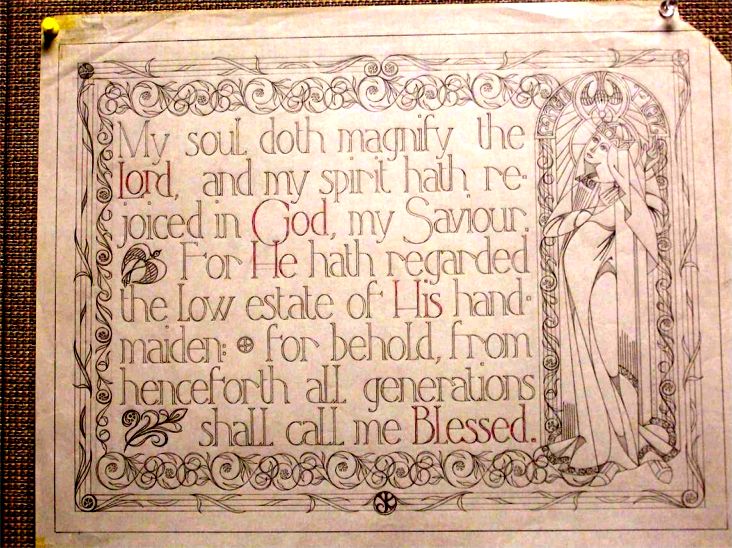
“My soul glorifies the Lord  47 and my spirit rejoices in God my Savior,
48 for he has been mindful of the humble state of his servant.
From now on all generations will call me blessed,
49 for the Mighty One has done great things for me—holy is his name.
50 His mercy extends to those who fear him, from generation to generation.
51 He has performed mighty deeds with his arm; he has scattered those who are proud in their inmost thoughts. 52 He has brought down rulers from their thrones but has lifted up the humble.
53 He has filled the hungry with good things but has sent the rich away empty.
54 He has helped his servant Israel, remembering to be merciful
55 to Abraham and his descendants forever, just as he promised our ancestors.”

A modern setting of this song of Mary is the Canticle of the Turning, by Rory Cooney. I keep reminding myself not to get political in my weekly sermons—except when the words of the Scripture we read from the Lectionary are clearly lifting up some direct calling from God. Through Mary’s words, we are called to stand up in this neighborhood, this country, this world, and stand with the humble, the hungry, with those who fear God. We are called to stand against the proud, the rich, and the rulers.

In the Canticle of the Turning, this new retelling of Mary’s song is, indeed, about the birth of a baby. It also talks about how this birth turns a family upside down. Yet, this whole event—the birth of the Son of the Most High—is about God turning the world around. It is through God’s Son, Jesus, God welcomes us all. Not just welcoming the rich and privileged, but everyone, male, female, rich, poor, slave, free, whatever difference one person has from another. All means Jesus welcomes everyone. No matter what, no matter who.

Perhaps God did an extraordinary thing through Mary—just as the angel said—to show the world that through God all things are possible. Just as it was for the prophets, so it was with Mary, and so it is with us. May we all respond like Mary—“Here am I, the servant of the Lord; let it be with me according to Your word.”

[1] http://www.workingpreacher.org/craft.aspx?post=3462

Advent as a Way of Life, Karoline Lewis, Working Preacher, 2014

[2] http://www.workingpreacher.org/craft.aspx?post=1611

“Favored Ones,” David Lose, Dear Working Preacher, 2011.

@chaplaineliza

(Suggestion: visit me at my regular blog for 2018: matterofprayer: A Year of Everyday Prayers. #PursuePEACE – and my other blog,  A Year of Being Kind . Thanks!

Unknown's avatar

Generous with Our Faith

“Generous with Our Faith” – March 29, 2015

Jesus raising Lazarus John 11

John 11:25-27

Some people strive to be punctual. Even, early. My grandfather was like that. If he wasn’t fifteen minutes early for an appointment, he would consider himself late! Then, some people have a more fluid idea of time. They see a more relaxed framework of the spectrum of late- versus-early. These come down at different points on this spectrum. And then, we have Jesus.

Our Gospel reading is quite long today, from the 11th chapter of the Gospel of John. I wanted to read this whole passage in the context of this sermon. At the beginning of the reading, we have Jesus and His disciples, some distance from the town of Bethany, where His friends Mary, Martha and Lazarus lived. Let me set the scene. I will be using the awesome, modern version of the Gospel, translated by Eugene Peterson, called The Message.

1-3 A man was sick, Lazarus of Bethany, the town of Mary and her sister Martha. This was the same Mary who massaged the Lord’s feet with aromatic oils and then wiped them with her hair. It was her brother Lazarus who was sick. So the sisters sent word to Jesus, “Master, the one you love so very much is sick.”

When Jesus got the message, he said, “This sickness is not fatal. It will become an occasion to show God’s glory by glorifying God’s Son.”

5-7 Jesus loved Martha and her sister and Lazarus, but oddly, when he heard that Lazarus was sick, he stayed on where he was for two more days.


Here’s the situation in Bethany. We receive quite a lot of information here! Jesus was very close to all three siblings, to Lazarus, Mary and Martha. Lazarus became very sick! So sick, that his sisters sent an emergency message, a call for help, to Jesus. The request to Jesus has been made. A sincere request, made by the loved ones of Lazarus. I suspect we all can relate to this earnest request. We’ve made similar prayers from time to time. Any number of us have sent SOS messages to Jesus, too!

Jesus made mention of showing God’s glory through Lazarus’ sickness. Obviously, He made this comment to His disciples, and I suspect to whomever else was there, listening to Him, at the time. And, as was often the case with Jesus and some of the cryptic things He said, people just did not understand what He meant, at the time. Back to Jesus:

After the two days, Jesus said to his disciples, “Let’s go back to Judea.” They said, “Rabbi, you can’t do that. The Jews are out to kill you, and you’re going back?” 11 Jesus replied, “Our friend Lazarus has fallen asleep. I’m going to wake him up.”

12-13 The disciples said, “Master, if he’s gone to sleep, he’ll get a good rest and wake up feeling fine.” Jesus was talking about death, while his disciples thought he was talking about taking a nap.

14-15 Then Jesus became explicit: “Lazarus died. And I am glad for your sakes that I wasn’t there. You’re about to be given new grounds for believing. Now let’s go to him.”

Jesus knows. I mean, Jesus really knows the situation some miles away. His disciples are confused, and at first think Lazarus is just asleep. But, no! Is this a major complication, or what? Sure, there are miracles all over the Old and New Testaments, but miracles of healing, or of feeding large groups of people. Not of reversing death itself! And, especially, after several days!

On top of the disciples’ confusion at the words and behavior of Jesus, Jesus wants to go back to Bethany, which is a town just down the road from Jerusalem. “Jesus, You can’t go there! The Jewish leaders are going to arrest You. Probably try to kill You, too!” Jesus goes anyway.

17-20 When Jesus finally got there, he found Lazarus already four days dead. Bethany was near Jerusalem, only a couple of miles away, and many of the Jews were visiting Martha and Mary, sympathizing with them over their brother. Martha heard Jesus was coming and went out to meet him. Mary remained in the house.

We see Mary and Martha, in the house of mourning. Two very different women, mourning in two very different ways. Many of their friends and acquaintances are with them, too. Sympathizing and mourning with them, as was the custom of the time. Martha goes to meet Jesus while her sister stays put.

21-22 Martha said, “Master, if you’d been here, my brother wouldn’t have died. Even now, I know that whatever you ask God he will give you.”

23 Jesus said, “Your brother will be raised up.”

24 Martha replied, “I know that he will be raised up in the resurrection at the end of time.”

25-26 “You don’t have to wait for the End. I am, right now, Resurrection and Life. The one who believes in me, even though he or she dies, will live. And everyone who lives believing in me does not ultimately die at all. Do you believe this?”

27 “Yes, Master. All along I have believed that you are the Messiah, the Son of God who comes into the world.”

What a statement! What a testimony! Even though Martha is distraught at the death of her dear brother, she still has deep faith. As we’ve just heard, she states that her brother will be raised in the resurrection at the end of time. What does Jesus say? He does her one better.

I am the Resurrection and the Life.” Did you hear? Did everyone hear these words of faith? Words of hope? Words of new life? “The one who believes in me, even though he or she dies, will live.” And then Martha responds again, with great faith. “All along I have believed that you are the Messiah, the Son of God.”

I could preach a solid sermon on this statement of Martha’s, alone. This ringing declaration, these great words of a rock-solid faith were made at such a devastating time for Martha. On top of everything, in the middle of mourning her brother, we can see that this is not just an intellectual admission or assent for Martha, but heartfelt belief. But wait, there’s more! Much more!

28 After saying this, Martha went to her sister Mary and whispered in her ear, “The Teacher is here and is asking for you.”

29-32 The moment Mary heard that, she jumped up and ran out to him. Jesus had not yet entered the town but was still at the place where Martha had met him. When her sympathizing Jewish friends saw Mary run off, they followed her, thinking she was on her way to the tomb to weep there. Mary came to where Jesus was waiting and fell at his feet, saying, “Master, if only you had been here, my brother would not have died.”

33-34 When Jesus saw her sobbing and the Jews with her sobbing, a deep anger welled up within him. He said, “Where did you put him?”

34-35 “Master, come and see,” they said. Now Jesus wept. 36 The Jews said, “Look how deeply he loved him.”

37 Others among them said, “Well, if he loved him so much, why didn’t he do something to keep him from dying? After all, he opened the eyes of a blind man.”

We can tell, from these few scenes in the Gospel, that Martha, Mary and Lazarus had a close, intimate relationship. Mary even fell at Jesus’ feet, sobbing. Saying, “if only! If only You had been here!” The words of deep, gut-wrenching emotion are here, too. “Jesus wept.” We know that Jesus felt with Mary and Martha! We can see from this account that Jesus felt so badly and grieved with them, even though He knew what He was intending to do!

How often do we get into a situation where we have the opportunity to come alongside of someone who is devastated, a friend, a relative. Grieve alongside of them, and walk with them down that sorrowful road of mourning, loss, anger, anxiety. Grieve over the deep pain and loss in the reality of death. That’s why I think Jesus cried with Mary. And with Martha, and with the rest of the mourning people. Back to Jesus.

38-39 Then Jesus, the anger again welling up within him, arrived at the tomb. It was a simple cave in the hillside with a slab of stone laid against it. Jesus said, “Remove the stone.”

The sister of the dead man, Martha, said, “Master, by this time there’s a stench. He’s been dead four days!”

40 Jesus looked her in the eye. “Didn’t I tell you that if you believed, you would see the glory of God?” 41-42 Then, to the others, “Go ahead, take away the stone.”

Practical Martha. “Master, by this time there’s a stench. He’s been dead four days.” Wouldn’t that be something you might think of, too? I probably would have thought of it, too.

They removed the stone. Jesus raised his eyes to heaven and prayed, “Father, I’m grateful that you have listened to me. I know you always do listen, but on account of this crowd standing here I’ve spoken aloud so that they might believe that you sent me.”

43-44 Then he shouted, “Lazarus, come out!” And he came out, a cadaver, wrapped from head to toe, and with a kerchief over his face. Jesus told them, “Unwrap him and let him loose.”

45-48 That was a turnaround for many of the Jews who were with Mary. They saw what Jesus did, and believed in him.


Because of this display of resurrection power, because Lazarus was brought back to life, we see that many believed that Jesus was, indeed, the Messiah! The Son of God!

Let me ask: what do you believe? Do you think Jesus was just a great man? Did He preach great sermons, and live an exemplary life? Or, do you think Jesus was a prophet of God? A miracle-worker, like the prophets of the Old Testament, or like the Apostles? Or, the third option. Or—do you think Jesus was, indeed, the Messiah? The Son of God? As Jesus Himself said, the Resurrection and the Life?

Hear the words of Jesus! “The one who believes in Me, even though he or she dies, will live. And everyone who lives believing in Me does not ultimately die at all. Do you believe this?” Just as Jesus asked Martha so long ago, He is asking us, today, too. Can we respond with Martha, “Yes, Master. Yes, Lord. I believe.” With great faith. “All along I have believed that you are the Messiah, the Son of God.” Jesus is asking. Do we, really, believe?

Jesus was generous, giving life abundantly to Lazarus. Can we do any less in our lives? We are encouraged to be generous with our faith! To believe Jesus. To take Him at His word, and to trust in Him. Like Martha. Like Mary. We find out that we can believe Him, we can trust Jesus when times are hard, difficult, through storms and suffering. We are also happy to trust Jesus when times are happy, when everything is going our way. Whatever is happening in your life today, can you believe Jesus? Can you be generous? Believe the good news of the Gospel. Have faith! Believe Jesus!


Thanks to Eugene Peterson for his wonderful translation The Message. I read most of John chapter 11, around which I have interwoven this message. “Scripture taken from The Message. Copyright © 1993, 1994, 1995, 1996, 2000, 2001, 2002. Used by permission of NavPress Publishing Group.”

@chaplaineliza

Thanks to the kind friends at http://www.40acts.org.uk – I am using their sermon suggestions for Lent 2015. #40acts Do Lent generously!

(Suggestion: visit me at my daily blog for 2015: matterofprayer: A Year of Everyday Prayers. Thanks!)