Unknown's avatar

Amazed by Love!

“Amazed by Love!”

Luke 2:15-20 (2:18) – December 22, 2024

Merry Christmas! What a wonderful expression. People greeting each other on the street, in the stores, here at church. I know not everyone celebrates Christmas, but still. What a joyous time of the year. Today, we are here at the 4th Sunday of Advent! Many, many people can hardly wait for the arrival of Christmas Day! Especially for children, I bet some people are so excited that they hardly sleep a wink for the next few nights. (But that’s mostly for reasons of Santa and presents under the tree, not for the religious reasons I’m talking about this morning.)

Merry Christmas, many people say! But I want you to go back, two thousand years. Go back to a time when “Merry Christmas” was not even a phrase, a wish, not even an idea in people’s heads. Go back to the time Dr. Luke describes in his Gospel. Back to the time when Israel was an occupied country, and the Roman Empire was the occupying force. Back to the time when all people in Israel needed to be enrolled. The Roman government decided to have a census, so that they would be able to tax the people of Israel more accurately.

            We remember this census. The Holy Family, Joseph and his fiancée Mary, went to Bethlehem to enroll, because Joseph was a direct descendent of King David. I suspect there were many people on the roads. Today, traveling can be stressful and nerve-wracking. I am certain travel in the first century was much more difficult. Poor roads, with many people walking to get from one place to another. We might imagine that Joseph and Mary had a donkey, but nowhere in the Gospel is that mentioned. Travel conditions were challenging, at best.

Wait a minute. Do we really concentrate on the difficulties and trials of travel to Bethlehem, of the labor and birth of a baby without medication, or of any of the rest of this real-life narrative from Luke chapter 2? Or, do we imagine a nice, tidy, picture-perfect Christmas card? With Mary in a rich, bright blue robe, gazing lovingly at her radiant newborn baby, Joseph looking adoringly at both mother and child. Not to mention the cleaned-up shepherds gazing in wonder, their tidy, well-groomed sheep lying quietly in adoration, too.

That picture-perfect Christmas card was not what actually happened, not by a long shot. Mary felt the pains of labor begin. What a scary thing! To be far, far from home, in an unfamiliar place, and to have such a significant event happen. Significant, and potentially life-threatening, too. Plus, anyone who has worked with large animals (even many smaller animals) knows what a group of them smell like. That’s where Jesus was laid, in a manger among the animals. And, is anyone familiar with the hustle, bustle and smells associated with the labor and delivery room of a hospital? This refocused picture of the birth is not all gentle, meek and mild, to be sure.

As Luke tells us, there were shepherds abiding in the fields, keeping watch over their flocks by night. When messengers personally come to deliver a special announcement, it is a big deal. These angels coming to the shepherds, well, that was a super big deal, to be sure!

            And the announcement? This isn’t the birth of a normal, ordinary baby. No! This baby is an extra special baby. The Messiah, who will save His people from their sins. Did you hear? This special baby, this Savior, Christ the Lord, is born to you—to me—to all of us, in the city of David, which is called Bethlehem.

            Did you hear? The Savior, the Christ, the promised Messiah, came into this world as a Baby. The Eternal Second Person of the Trinity, Creator of the whole universe, God the Son, emptied Himself of all God-ness. Took on humanity, and was born as a helpless Baby. That is not only good news, that is earth-shaking news. Good news of great joy for all the people. For you, for me, for all of us. How better to communicate to earth than to become one of the frail human beings God intended to reach?

            The Almighty God who made all of heaven and earth, the powerful God who can hold the incomprehensibly vast universe in the span of God’s fingers? Yes, that same God wanted to reach to earth—reach to each of us, to all of us, in love. With love. Through love. 

            That loving outreach is from God’s point of view. Yes, the Almighty God sent the Baby in Bethlehem to earth, in love. But, what if frightened, nervous humans did not in the least expect that? What if short-sighted humans closed their eyes and their hearts to the possibilities of God’s love breaking into the world in such a tender way?

            Mary could have been frightened half to death of the angel and closed her heart to the Divine possibilities that blessedly came about. But, Mary chose love. She chose openness and possibilities that transformed her heart and her life.

            When Mary’s baby was born, Jesus spoke quietly through the blood, sweat and tears of the labor pains of that young woman. Jesus cried softly as an infant, and allowed us all to see the unimaginable caring, the oh-so-tender love that Almighty God expressed, to each one of us. And, each of us is embraced in God’s everlasting arms of lovely love.

            One of my favorite Christmas carols talks about this very thing. This Christmas poem—before it was set to music—was written by Christina Rosetti in 1885. Here is the first verse:

Love came down at Christmas, Love all lovely, Love Divine,
Love was born at Christmas, Star and Angels gave the sign.

Love Divine was born at Christmas. Born for you, born for me. Praise God, our Lord and Savior Jesus was born as a Baby in Bethlehem. Yes, He would preach and heal and suffer and die. And, yes, He would rise again on that Easter morning years later.

Yet—right now, we rejoice in the blessed fact that Jesus was born.

Praise God, we, too, can stop by that manger in Bethlehem, and be caught up in the wonder of what happened that night, so long ago. We, too can welcome this lovely, Godly Love that has come into this broken, weary world, today.

Alleluia, amen.

@chaplaineliza

(Suggestion: visit me at my other blogs: matterofprayer: A Year of Everyday Prayers. #PursuePEACE – and  A Year of Being Kind . Thanks!

Unknown's avatar

God’s Birth Announcement

Luke 2:1-7 – December 13, 2020

Welcoming babies into the world is such a joyous occasion. One of the first things most people do is spread the news about the new baby. When and where the baby was born, how big it was, whether it was a girl or a boy, and what the parents decided to name the baby are all details that are joyously spread, as soon as possible.

             I wonder . . . what would God’s birth announcement look like?

            In the fullness of time, God’s Son came into the world. Prophesied in many passages from the Hebrew Scriptures, foretold for centuries before His coming. Looking at the Hebrew Scripture passage for today, Isaiah 9, the prophet tells his readers about the Wonderful Counselor, Mighty God, Everlasting Father, and Prince of Peace, who is the coming Messiah.

            Throughout the Advent season, we prepare for the coming of this Messiah. Soon we will celebrate the earthly birthday of the Babe of Bethlehem, the Savior of the World, the only begotten Son. Our Lord Jesus Christ, our savior and redeemer came into this fallen world as a baby. Emptying Himself of all His vast, eternal God-ness, and being born as a human baby.

            I wonder: what would God’s birth announcement look like?

            I think we have a pretty good idea, if we take a look at the second chapter of Luke. Doctor Luke gives a full accounting of what went on in those days. What an unexpected sort of announcement!

            Let’s look at the parents of the Baby, first of all. The mother, Mary of Nazareth, is not even married yet. Sure, she’s engaged to this carpenter, Joseph, but they haven’t yet been fully joined in marriage. Marriage in those days, in the Jewish culture, was a several-step process.

            We read in chapter 1 of Luke that the Holy Spirit came upon Mary, and she conceived. Is Joseph the father of this Baby? No. Joseph could not believe this part, until assisted by some heavenly help. An angel came and reassured Joseph that Mary was on the up and up, and that the baby inside of Mary was really the Messiah, the Savior of the world.

            The circumstances of the birth are not quite the typical birth scenario, either. Imagine the birth of a baby today. Chances are that the baby would be born in a hospital, with the latest medical technology available, just in case. Not so for Mary, the mother of Jesus. Not only did she have the baby Jesus in less than optimum circumstances, in terms of hygiene and medical needs, but she was also far from her home as well.

            Mary and Joseph were both far away from familiar people, places and things. They were travelers, like many people in the town of Bethlehem at that time. Luke 2 tells us that there wasn’t any place for them to stay—anywhere. Because of the census ordered by Caesar Augustus, the town of Bethlehem was mobbed.

            Since Bethlehem was the ancestral home of King David, that meant there were quite a lot of people who had to be counted who were descended from David. We can see, from the offering that Mary and Joseph offered to the Lord shortly after the birth of the baby Jesus, that they did not have very much money.            

            Bethlehem must have been very crowded indeed, if a woman about to give birth couldn’t find even a room to have her baby in. We could even take it a step further, and draw some definite similarities between Mary and Joseph and some other young, homeless couple going to have a new baby, searching for a place to spend the night.

            I remember a suburban church I attended a number of years ago. One of the smaller trees near the front door to the sanctuary was practically covered with blue ribbons. A sign was posted next to the tree, saying “While celebrating One homeless Family, these ribbons ask us to remember the homeless with us today.” I had never thought about the Holy Family in that way before. Again, it’s God’s unexpected way of announcing the birth of God’s Son.

            While we’re thinking about where Mary had her baby, what about that manger, anyway? Jesus was a descendant of King David, through both His mother Mary and His adopted father, Joseph. A manger is an unexpected place to find a king. I don’t know about you, but I’d expect royalty to be born in a palace, or at least in a nice house.

            And who are the people who first receive this birth announcement? Are they influential members of the community? Leaders of the local synagogues and teachers of the Law of Moses? Those would be the kinds of people who I might expect to have a birth announcement sent to them. But God doesn’t work that way. God does the unexpected, and chooses the most unlikely people to receive a hand-delivered message from the Lord of Hosts.

            God sends a birth announcement in unexpected ways to unexpected people, in many situations, all over the world. When and where the Baby was born, the news that it was a boy, and that the parents decided to name this Baby Jesus—for He would save people from their sins—are all details that the shepherds joyously spread, as soon as possible.

            Again, it’s God’s unexpected way of announcing the birth of His Son. Can you think of someone who hasn’t heard about this birth announcement? We today have the opportunity to spread the news about this Baby born in Bethlehem. And, we can joyously praise God, for Jesus is the savior and redeemer of the world, as was proclaimed so long ago.

@chaplaineliza

(Suggestion: visit me at my regular blog for 2020: matterofprayer: A Year of Everyday Prayers. #PursuePEACE – and my other blog,  A Year of Being Kind . Thanks!

Unknown's avatar

In A Manger

“In A Manger”

international Nativity

Luke 2:1-7 (2:6) – December 16, 2018

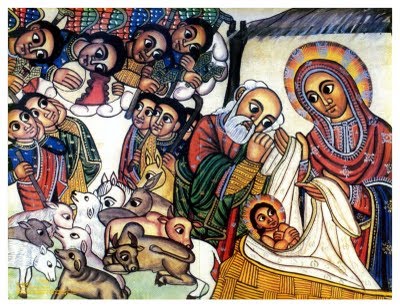
Nativity scenes are so sweet. You see them frequently at this time of year. Either lit up, like the one outside of our church, or carved in olive wood, similar to the figure I am holding up right now. They can be ceramic, plaster, or painted. Little, small enough to fit under a Christmas tree, or almost life-sized, like the one I saw outside of a big Catholic church in the suburbs.

I suspect we all could mention the cast of characters we might find in a nativity scene. Besides Mary, Joseph, and the baby Jesus, we find shepherds, animals, kings, and sometimes an angel. The nativity pictures look so gentle and perfect, just like a Christmas card.

Mary and Joseph did not have a picture-perfect time of it. As an adult male living under Roman occupation, Joseph was ordered to go to his ancestral town of Bethlehem and register, just as the Roman rulers said. Dr. Luke records it: “In those days Caesar Augustus issued a decree that a census should be taken of the entire Roman world. (This was the first census that took place while[a] Quirinius was governor of Syria.) And everyone went to their own town to register.”

There must have been a great deal of coming and going throughout Israel, as every adult went to their ancestral town. Complicating matters was Mary, Joseph’s betrothed, who was greatly pregnant. “So Joseph also went up from the town of Nazareth in Galilee to Judea, to Bethlehem the town of David, because he belonged to the house and line of David. He went there to register with Mary, who was pledged to be married to him and was expecting a child.”

I wonder how Joseph and Mary felt about being uprooted from their small town of Nazareth and forced to travel—that is, walk—dozens of miles through semi-arid, sometimes hilly country. I wonder what Mary and Joseph thought about coming to the very crowded town of Bethlehem, a near suburb of Jerusalem, chock full of extended relatives of King David. And, I have only an inkling of an idea of what Mary thought, being great with child, having to make the long, difficult journey. The forced timing of this whole trip must have been simply awful.

I want us to step back from Mary and Joseph for a moment. Let us leave them in Bethlehem. As one commentator mentioned, “We all see the Bible through an interpretive lens, and many Western Christians tend to read it through a European/American one. We often bypass the culture and customs that were prevalent during biblical times. We even interject our own bias and prejudice. This is a common error that causes misinterpretation to ensue.” [1]

But, isn’t that human nature? Each of us, all of us, relate to biblical narrative through the lenses of our own personal experiences, through our own separate upbringings. How else do we begin to understand some other person’s story, if not through familiar ideas, surroundings, characters, and narratives?

I was privileged to have the opportunity to get to know the Rev. Dr. Kenneth Bailey. I have attended the New Wilmington Mission Conference in western Pennsylvania the last week of July for almost twenty years, where Ken and his wife Mickey also attended. Except, they went to New Wilmington for some decades. The Baileys served as Presbyterian missionaries in the Middle East for decades, too, coming back to the United States each summer before returning to their work as teachers. Ken as a seminary professor, and his wife as a high school teacher.

Ken Bailey knew a vast amount about Middle Eastern culture and customs, both modern and ancient. He also knew a whole bunch of languages fluently, both modern and ancient. He was a man of great knowledge, stature, and influence, and yet also a humble and unassuming person. He wrote a number of biblical commentaries and scholarly discussions which included first-century Palestinian culture, and how it informs our reading of the Bible today.

I hesitate to break this to everyone, but according to current understandings of Palestinian customs and culture of the first century, Jesus was most probably not born in a stable. Where did this idea of a stable come from? It is difficult to tell. People elaborate, of course. You’ve all played “telephone” as young people, sitting in a big circle around a room, one person whispering in the ear of the next, each whispering what they heard in turn, and everyone laughing when the initial message ends up being all garbled at the end of the “telephone” chain.

We know the biblical text of the Gospel of Luke has remained constant, even through many translations over the centuries. However, as generations of people verbally relate the Nativity story, people tend to elaborate. It gets even more complicated when the message of the Gospel crosses the boundaries of different cultures, and crosses lines into different continents.

For example, considering the manger in a stable: “The mention of a ‘manger’ in Luke’s nativity story, suggesting animals, led mediaeval illustrators to depict the ox and the ass recognising the baby Jesus, so the natural setting was a stable—after all, isn’t that where animals are kept?” [2]  That stable is from a European point of view. But not necessarily, although Luke certainly mentions a manger.

Let’s go back to Mary and Joseph. We left this poor, exhausted couple on the outskirts of Bethlehem. The common modern understanding of an “inn” was another elaboration, since the Greek word kataluma is exactly the same word used to describe the upper room of the Passion Week. Its definition: “‘the spare or upper room in a private house or in a village […] where travelers received hospitality and where no payment was expected’ (ISBE 2004). A private lodging which is distinct from that in a public inn, i.e. caravanserai, or khan.” [3]

Mary and Joseph were probably bedded down in an upper room, dormitory-style, with a number of other extended relatives of the great King David. No private room, like they might have at an inn. As Luke said “she gave birth to her firstborn, a son. She wrapped him in cloths and placed him in a manger, because there was no guest room available for them.”

Not wonderful accommodations, but at least they were not freezing outside with no place to sleep. There was a communal area where the family’s animals were kept, at one end of the large open room, on the ground floor. I suspect there were animals, too—all watching the Holy Family, Mary, Joseph and the newborn baby Jesus. “Once Jesus was born, I envision the two of them tiredly improvising with a manger and some spare cloth, seeking the chance to rest before their newborn inevitably begins his new routine of squalling every 3 or 4 hours to be fed.” [4]

Where does that leave us, with our pretty nativity scenes under our Christmas trees, in front of our houses, and on our Christmas cards? What is the message we receive each Christmas? The holy God of all the universe became a human baby, born to an unmarried teenager, in uncomfortable, awkward circumstances. Not the best of beginnings from a human point of view, but certainly God-ordained beginnings.

What does all that mean for us? It means that we do not have to have neat, tidy lives, that our situations can be uncomfortable, awkward, sad, lonely, anxious, fearful, traumatic, with a whole host of other “negative” circumstances. None of that matters. What does matter is God is with us. Emmanuel, the God-become-human, God with us, is here in the middle of all those awkward, unfamiliar, even ugly situations. Have you lost a job? Jesus is with us. Have you lost a loved one? Jesus is with us. Have you lost a home, or changed neighborhoods, or are feeling lonely, depressed, or especially anxious? Jesus is still with us.

For to us a child is born, to us a son is given. Alleluia, amen.

[1] http://www.ashleyeaster.com/blog/yes-mary-knew

Guest post by: Pastor Gricel Medina, Leadership/Community Developer

[2] https://www.psephizo.com/biblical-studies/once-more-jesus-was-not-born-in-a-stable/

[3] Ibid.

[4] https://modernmetanoia.org/2016/12/09/756/

“Twas the Night Before Birthing”, Emily S. Kahm, Modern Metanoia, 2016.

@chaplaineliza

(Suggestion: visit me at my regular blog for 2018: matterofprayer: A Year of Everyday Prayers. #PursuePEACE – and my other blog,  A Year of Being Kind . Thanks!