

John 5:1-9 (5:6) – August 13, 2017
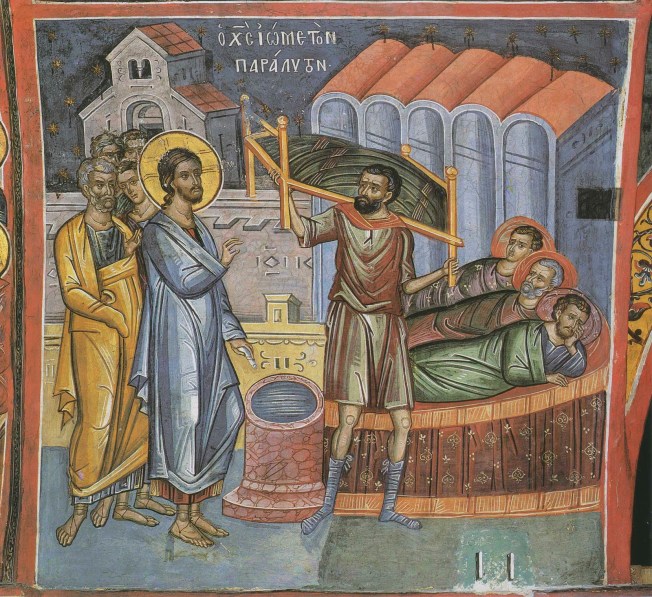
“Compassion for an Invalid”
Have you ever heard of a really whacky, old-time law that is still on the books? There are some doozies, still on the legal codes of certain municipalities, all across our country today.
To mention a few whacky laws from the past: “It is illegal to mispronounce the name of the city of Joliet, Illinois.” “In Utah, the law requires that daylight be seen between two dancing partners.” “Michigan law once required taking a census of bees every winter.” “In Muncie, Indiana, you cannot bring fishing tackle into a cemetery.” And, “A Minnesota law requires that men’s and women’s underwear not be hung on the same clothesline at the same time.” [1]
We can look at these laws today and laugh. However, the folks from years ago who put these laws into place felt strongly about them. They thought these laws were great ideas, and were genuinely concerned about their communities, families, and the well-being of their society.
Let’s take another look at our Scripture passage from John chapter 5, and see what it has to do with rules and rule-following. I’ll read from a modern translation for young people, from Illustrated Children’s Ministries.
“At a festival the Jewish people were observing, Jesus went up to Jerusalem. In that city, by the Sheep Gate, there is a pool—its Hebrew name is Beth-zatha—which has five entry spaces. People who are blind, or very sick, or cannot move gather in these spaces.”
Here, the Apostle John sets the stage for us. He gives us the time of year—during one of the great festivals, and the location—Jerusalem. What’s more, John then specifically mentions the place where this healing situation occurs, and gives some description.
To continue: “One man was there who had been ill for almost forty years. Jesus saw him lying there and knew that he had been there a long time. Jesus said to the man, “Do you want to be made well?”
Jesus’s question—“Do you want to be made well?” A really serious question, not to be taken lightly or taken for granted. I think Jesus knew the older man had given up hope, and Jesus had compassion on him: serious compassion. His heart went out to the poor guy. Let’s hear what the invalid’s answer is:
“The man explained, “Sir, I’m alone. There is no one who will put me into the pool when the healing water is stirred up. When I try to get there on my own, I’m too slow—someone else steps down ahead of me.”
This poor guy has been hanging out by the pool of Bethesda for almost forty years! He’s all alone. He’s too slow. He never can make it into the water. I suspect he continued to come to the pool where miracles happen simply because that was where he had gone for so long, that he was in the long-time habit of coming there. Plopping down in “his spot.” What is more, this invalid was at the end of his hope, in terms of hope for a cure ever coming to him.
When, wonder of wonders! What happened?
Jesus said to the invalid, “Stand up. Grab your mat. Walk.” The man did what Jesus said; he could! He was healed! This happened on a Sabbath day.”
Just think of how it feels to be healthy again after you’ve been sick for a couple days. I wonder how amazing it felt for this man Jesus healed who had been sick for 38 years! How would you have responded to Jesus’ healing?
I am absolutely certain that everyone who lived or worked near the pool of Bethesda knew this invalid. He was such a sad, sorry guy with a negative, down-in-the-mouth attitude. However, the Rabbi Jesus knew just where he was hurting, and just where he needed to be healed. Healed in body, yes! Healed also in mind and spirit? Yes, too!
I am not sure whether Jesus touched the muscles and brought them back to wholeness, or whether Jesus healed the joins and tendons and brought the middle-aged invalid back to a full range of motion. (Somehow, I cannot imagine Jesus doing anything less.) This is a miracle story. Jesus did, indeed work a mighty miracle! And, Jesus showed great compassion to this invalid who had been lying next to the pool for almost forty years.
It’s the short sentence at the very end of our Scripture reading today that I would like to highlight. “This happened on a Sabbath day.” Remember how we started this sermon? Talking about some wacky rules and laws? The Jewish religious leaders had some really picky, wacky rules and laws of their own. Just as an example, the Jewish Law said it was illegal for anyone to do any work on a Sabbath day, and for the former invalid to do a simple thing like carry his mat, that was considered work!
Some of the Jewish religious leaders saw the former invalid doing just that: carrying his mat, on his way home. (On his own two healthy feet, by the way.) The religious leaders said this man was breaking the law. They were totally serious about this law code, too!
Remember when I played “Simon Says” with the young people, before the sermon today? You all know the rules in “Simon Says,” how everyone does what the leader says as long as the leader says “Simon Says.” Sometimes, a lot of life can feel like a lot of rules to follow, too. And, sometimes certain rules and laws feel whacky, even ridiculous. Our Lord Jesus knew all of these religious rules, the various Laws of Moses. But Jesus did not always follow them. Like, in this case, where Jesus told the man who used to be an invalid to carry his mat—on the Sabbath day, too!
And, what about Jesus healing on the Sabbath day? The Jewish leaders considered that work, too! There is something the matter with religious people getting outraged about someone being healed—made whole—able to work and walk and be a full member of society again—just because the healing took place on the Sabbath day, the Jewish holy day. (We might examine the priorities of these “super-holy” Jewish religious leaders, for sure.)
Time and time again in the Gospels, Jesus confused and frustrated these same religious leaders. The defense of the Sabbath day laws and rules was “the defense of an entire system of ordering life and religious practice. It is the defense of a particular religious community—” [2]the Jewish community, Jewish society. Jesus questioned these Laws and religious rules in order to help others. [3]
Rosa Parks broke the law by sitting in the front of a bus in Birmingham. Martin Luther King, Jr. broke the law by marching for civil rights and to overcome racism and Jim Crow laws. Our own Pastor Gordon broke the law by traveling to the civil rights demonstrations in the 1960’s and marching with the likes of Mrs. Parks, the Rev. Dr. King, and so many others.
Considering our Gospel reading today, “Jesus brings God into human experience in ways that transcend and transform human definitions and categories.” [4]
What about you? Are you on the side of Jesus? Bringing God into human experience? Can we bring the clarion call of peace and justice into the world, into our neighborhoods and communities, and into the lives of those we love?
And remember, have compassion on everyone around you. Just like Jesus. Love one another, with our actions. Have compassion, just like Jesus.
[1] https://bible.org/seriespage/12-jesus-heals-man-pool-bethesda-john-51-18
“Jesus Heals the Man at the Pool of Bethesda (John 5:1-18),” by Robert Deffinbaugh at the Biblical Studies Foundation.
[2] O’Day, Gail, The Gospel of John, The new Interpreter’s Bible: general articles & introduction, commentary, & reflections for each book of the Bible, Vol. 9 (Nashville: Abingdon Press, 2000), 581.
[3] https://store.illustratedchildrensministry.com/products/an-illustrated-compassion-learning-to-love-like-god
[4] O’Day, Gail, The Gospel of John, The new Interpreter’s Bible: general articles & introduction, commentary, & reflections for each book of the Bible, Vol. 9 (Nashville: Abingdon Press, 2000), 581.
(A heartfelt thank you to An Illustrated Compassion: Learning to Love Like God. Many of these sermon ideas and thoughts came directly from this series. I appreciate this intergenerational curriculum, which is the basis for my summer sermon series on compassion. This curriculum comes from Illustrated Children’s Ministry. Thanks so much for such great ideas!)
(Suggestion: visit me at my regular blog for 2017: matterofprayer: A Year of Everyday Prayers. #PursuePEACE – and my other blog, A Year of Being Kind . Thanks!)

 Pastor, Preacher, Pray-er