Unknown's avatar

Ganging Up on a Neighbor

“Ganging Up on a Neighbor”
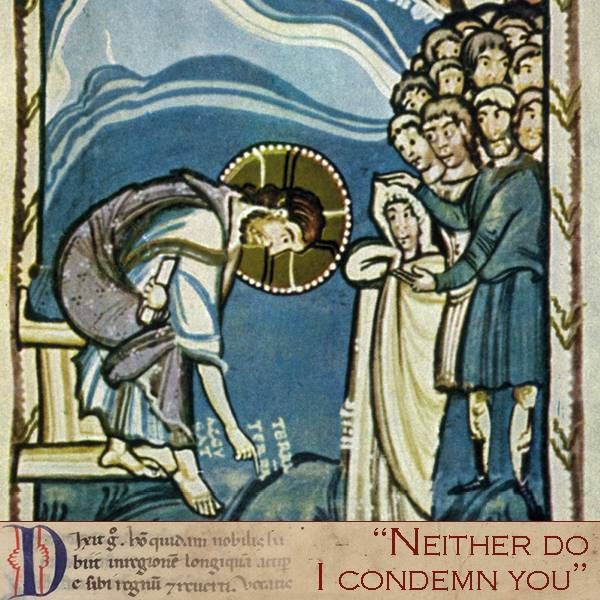
John 8:1-11 (8:7) – August 3, 2025

Have you ever watched a bunch of people gang up on one poor person? I’m thinking in elementary school, in the playground. Or, what about at the lunch table in high school? Even in the break room at work? A few mean words can turn nasty, fast! Sometimes if it goes too far, a group of people really start to pick on one poor person, or shun them, even ostracize them! And worst of all, the people doing the shunning can be such hypocrites!

Now we are entering the sketchy neighborhood of our Scripture reading for this morning. We have a group of Jewish leaders, big shots in their synagogues. You know what happened. These Jewish leaders have grabbed a woman in the very act of adultery. She may have been a married woman, and she was having sex with a man who was not her husband.  

The Rabbi Jesus has been talking with and discussing with groups of these leaders for some time. And, Jesus has been very successful at dialoging with these leaders, too! But, wait – they finally think they have got a situation that the Rabbi Jesus cannot squirm out of!

“Imagine the sense of urgency and the heightened emotions of the crowd swarming in on Jesus as he taught in the temple. They put this woman in front of the crowd. The Pharisees used her as an item, an object, a thing to entrap Jesus. I can imagine the contempt in the Pharisee’s voice as he asked, ‘Teacher, this woman was caught in the act of adultery. . . . Moses commanded us to stone such women. Now what do you say?’” [1]

Now, wait just a moment! The Jewish leaders have dragged this woman in front of Jesus, in front of the crowd in the Temple, and are accusing her, with baited breath! I can just see the crowd getting all agitated and upset! “Of course the Law of Moses tells us that adultery is bad! Of course this woman is guilty – our Jewish leaders say so! Of course she should be punished!” I can just hear the voices and noises of the crowd becoming more and more frantic and angry!

And, what does Jesus do? Nothing. He does not respond. He does not fly off the handle, as some people would. He does not react abruptly to the leaders or the crowd, either. Instead, Jesus stooped down and began writing on the ground with His finger. Finally, after the Jewish leaders kept badgering Him with questions, the Rabbi Jesus does respond.

Except, that makes me wonder. I know in our culture, in the United States, we do not stone people. Except, we still will ignore, and even jeer at people sometimes. We still practice shunning individuals in this country, sometimes.

These Jewish leaders and big shots at their synagogues seemed to have it all together. Except, these men were hypocrites, all the way! Saying one thing and doing another is the height of hypocrisy! I suspect these men – because the Jewish leaders were all men – these men felt fully justified in themselves. Fully self-righteous, and they couldn’t be bothered with pesky little things like their own repeated sin, or their conscience pricking them on the inside.

 I want each of us to understand how damaging it is to say one thing but do something totally different. “Do as I say, not as I do!” This is definitely the work of a hypocrite.

 “Hypocrisy creates barriers, harms relationships, and leads people away from God. In Matthew 23:27, Jesus calls out the Pharisees, saying, ‘Woe to you, scribes and Pharisees, hypocrites! You are like whitewashed tombs, which appear beautiful on the outside, but inside are full of dead men’s bones.’ The Pharisees focused on appearing holy, while ignoring God’s call to live with integrity and compassion.” [2]

The angry leaders who brought the woman to Jesus clearly were accusing and vicious towards the unnamed woman, and considered her simply a thing, an object of sin. I wonder whether they even considered the fact that this woman was a person of worth, or that she was created by God, just as much as each of them were? These were ways in which these leaders of the community could certainly live out God’s call to live each day with integrity and compassion – which the Rabbi Jesus did each day.

Jesus did not suddenly react or defend either Himself or the woman. Instead, He slowed down the frenetic emotion and action. Jesus reflected, and listened. Finally, Jesus made a comment. I imagine Him making that comment in a quiet but firm voice: “Let any one of you who is without sin be the first to throw a stone at her.” Then, “those who heard began to go away one at a time, the older ones first, until only Jesus was left, with the woman still standing there.”

Our summer sermon series features Fred Rogers, of Mister Rogers’ Neighborhood. We have considered several serious narratives from the Gospels during this series, and this week is no exception. Fred Rogers was no stranger to serious matters. A number of his television shows discussed very serious things – to children, yes, but also to adults. Divorce, death, war, and even the terrorist activity in 2001, on 9/11.

Fred Rogers excelled at listening to people. “Reflective listening, which does not imply agreement, pauses your agenda and aims to understand first. Fred listened intently and often agreed with the children since he was tuned into their fears and frustrations. [One of Fred’s signature messages,] ‘I like you just the way you are’ can’t get any more validating – pure emotional gold.” [3]

When Jesus practiced reflective listening in this extremely emotional situation in the Temple, we can see how tuned in Jesus was to the crowd’s fears and frustrations. And then, He turned the situation around, even turned it on its head by stating to the accusers in a quiet but firm voice: “Let any one of you who is without sin be the first to throw a stone at her.”

Jesus saw this woman as someone worthy of respect, a creation of God, unlike the men who accused her. Jesus’ words and actions offers this woman self-reflection and changed behavior at the realization of sin, just as He offered to the Jewish leaders and the crowds, multiple times throughout His ministry.  “Jesus’s actions were scandalous because they broadened acceptance, extended mercy and forgiveness to the undeserving, and brought justice to the overpowered and abused. Will the church ever do the same?[4]

Yes, today’s Scripture reading is extremely serious. And yes, Jesus makes His offer of grace and mercy, forgiveness and compassion to this woman, to the Jewish leaders who accused her, to the crowd, and to each one of us today. We can live honest, compassionate lives, with kindness and humility, today.

Here’s a challenge: “try to pay close attention to any moments when you might feel yourself slipping into judgment or hypocrisy. Maybe it’s a small thought about someone’s behavior, or a reaction to something they said. When you notice this, take a step back and remind yourself that we aren’t perfect either. Instead of letting judgment grow, try saying a silent prayer—for that person and for yourself. Ask God to help you see them through His eyes, with compassion and understanding.” [5]

I know I often ask in my sermons “what would Jesus do?” Who would Jesus forgive?

This week, I am going to change up my question, and ask “what would Fred Rogers do?” Who would Fred listen to? Who would Fred call his neighbor? I think, everyone. Each and every person, no matter who. Go. Go, and do that.

Alleluia, amen.

(A big thank you to the online resources for Mr. Rogers Day – the Sunday nearest March 20th, Fred Rogers’ birthday. These resources come from the Presbyterian Church (USA). https://www.pcusastore.com/Content/Site119/Basics/13792MrRogersIG_00000154465.pdf )

@chaplaineliza

(Suggestion: visit me at my other blogs: matterofprayer: A Year of Everyday Prayers. #PursuePEACE – and  A Year of Being Kind . Thanks!


[1] https://www.cbeinternational.org/resource/four-important-lessons-we-can-learn-from-jesus-and-the-woman-in-john-8/

[2] https://young-catholics.com/14808/exploring-hypocrisy-free-lesson-plan/

[3] https://www.psychologytoday.com/us/blog/the-full-picture/202302/mister-rogers-remembered-since-we-need-him-now

[4] https://www.cbeinternational.org/resource/four-important-lessons-we-can-learn-from-jesus-and-the-woman-in-john-8/

[5] https://young-catholics.com/14808/exploring-hypocrisy-free-lesson-plan/
Unknown's avatar

For the Least of These

“For the Least of These”

Matt 25-35 for whatever, words

Matthew 25:31-46 (25:40) – November 26, 2017

This Sunday—today—is the last Sunday in the liturgical year. This Sunday is also called Christ the King Sunday. We celebrate and lift up the might of the exalted Lord Jesus Christ today! Dominion, honor, power, authority, glory, majesty! Crown Him with many crowns! Praise to the Lord, the Almighty, the King of creation!

We have many marvelous hymns we can choose from for today. I love many of the words and tunes of the hymns that refer to our Lord Jesus having all power and authority in heaven and on earth, being King and ruler of the universe, and all creation.

I think all of us are familiar with the stories Jesus tells in His ministry, featuring real life situations. The Rabbi Jesus tries to get His listeners to understand some deeper truths through these stories, or parables. Jesus Himself talks about an all-powerful King at the end of the world, in this final parable from Matthew 25. The all-powerful King from this parable is the exalted Lord Jesus, ascended to heaven, as we declare every time we say the Apostle’s Creed.

As we did two weeks ago, let’s pull back from this particular parable, and look at the larger situation where the Rabbi Jesus tells it. This is midway through Holy Week in Jerusalem, where Jesus is being asked when the end times will come. That’s why He gives this long discourse called the Olivet Discourse, several chapters long in Matthew’s Gospel. Similar to now, people all through the centuries have been aware that the Bible has certain mysterious, even unclear prophecies concerning the end times, just before when the Messiah will come.

However, something does not fit. Something is very puzzling about this parable.

Here in Matthew 25, we have the exalted Lord Jesus, the almighty King eternal, sitting in judgment over all the peoples of the earth.

At first reading, even at second, third, tenth or twentieth reading, this final parable from Matthew can be really scary. Just like in the reading from the Hebrew Scriptures, from the prophet Ezekiel, all sheep and goats are separated, just as all the people from every nation in the world are separated. All people are divided into two groups: those who the King is pleased with, and those who the King is not pleased with.

The people listening to Jesus in Jerusalem that day were extremely puzzled. Scratching their heads, they might have said, “Rabbi, you just don’t make any sense.” Especially the people who had followed Jesus for months might have been particularly lost. Things just don’t add up!

On one hand, we have Jesus, the caring, nurturing Shepherd. This is what the prophet Ezekiel starts off with in our reading today. In many parables, in many situations throughout His ministry for three years, Jesus has shown Himself to be loving, caring, gentle, and welcoming to everyone—no matter who, no matter what.

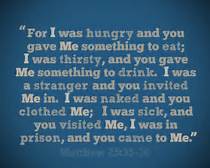
But, wait. Let’s go back to this final parable from Matthew, where the King at the end of all time is talking to the vast assembly of people from every nation, tribe and tongue. Let’s remind ourselves of the words of the Son of Man: “Then the King will say to the people on his right, “Come, you that are blessed by my Father! Come and possess the kingdom which has been prepared for you ever since the creation of the world.  I was hungry and you fed me, thirsty and you gave me a drink; I was a stranger and you received me in your homes, naked and you clothed me; I was sick and you took care of me, in prison and you visited me.”

I am certain that many people listening to Jesus and His parables were absolutely floored by these words. What on earth are You talking about, Jesus?

Dr. David Lose said, “When we think of God, we typically think in terms of power and might and glory and all the rest. And, indeed, the [final] parable begins by describing the coming of the Son of Man in glory to sit on his throne attended by angels, seemingly only reinforcing our preconceptions.” [1] This word picture is absolutely the picture we associate with Christ the King Sunday, with dominion, honor, power, authority, glory, and majesty!

Yet, we also see a loving, caring, nurturing Shepherd, as expressed by our Lord Jesus Himself any number of times during His ministry. And, there are glimpses of that Shepherd here in the parable, too. We have two different, disparate, even disconcerting pictures of Jesus here. What gives? Which is the real Jesus? What is going on here?

The people in the parable are puzzled, too. Let’s listen to their reaction: “When, Lord, did we ever see you hungry and feed you, or thirsty and give you a drink?  When did we ever see you a stranger and welcome you in our homes, or naked and clothe you?  When did we ever see you sick or in prison, and visit you?”

As if the two very different pictures of Jesus are not enough, the King in the parable adds a third. I tell you, whenever you did this for one of the least important of these members of my family, you did it for me!”

Here, Jesus tells us He is right with the chronically hungry and thirsty. He is among the strangers and refugees. He is among the indigent poor and sick, and is right there with the many hundreds of thousands all across the world who are in jail. Jesus, the Son of Man, would rather hang out with the bums on Skid Row rather than with the fancy people in their religious country clubs or with the fine Pharisees in their first-rate houses of worship.

Does anyone else feel challenged when they hear these serious words of Jesus?

As Dr. Lose tells us, “No one expects to see Jesus in the face of the disadvantaged, the poor, the imprisoned, and all those who are in manifest need.” [2]

Jesus gives us a judgment scene in this final parable. This is a cautionary scene described here, at the end of all time. Here, in this parable from Matthew, we have three separate pictures of Jesus. Yes, He is the King! All honor, power, majesty and glory be given to Him! Amen! Yes, Jesus is the Gentle Shepherd, the loving, caring, nurturing one who gathers the lost lambs into the fold. And, third, our Lord Jesus is seen in the faces of those who are difficult to love, and a challenge to care for.

Jesus shows up in those unexpected places, in the concrete and real needs of our neighbors next door, and around the world. But, you and I are not at the end times, yet. We can take action, and see the face of Jesus in others around us. The disadvantaged, the poor, the imprisoned, and in need.

Jesus calls us to serve others. By serving others, we will be serving—loving—caring for Jesus. How can we serve Jesus, today? How can we help others? How can we extend our hands and hearts to be loving, caring and giving, today? The best part? God will be right by our sides as we extend our hands to serve and care for others. And, God promises to change us from the inside out as we extend our hands—our hearts—ourselves—to others.

Here, in this final parable, Jesus the King tells us He is right with the vulnerable, the unlovely, the indigent, those difficult to love and those who are such a challenge to care for.

Next week, we will begin the liturgical year with the season of Advent, those weeks when we await the coming of the Baby in Bethlehem at Christmas. We await the mystery of the Incarnation, of the Eternal Almighty God the Son emptying Himself and becoming a baby. Becoming vulnerable, becoming human. Just like us.

Maranatha. Come, Lord Jesus.


[1] http://www.davidlose.net/2014/11/christ-the-king-a/ “The Unexpected God,” David Lose, …In The Meantime, 2014.

[2] Ibid.

(A heartfelt thank you to An Illustrated Compassion: Learning to Love Like God. Many of these sermon ideas and thoughts came directly from this series.  I appreciate this intergenerational curriculum, which is the basis for my summer sermon series on compassion. This curriculum comes from Illustrated Children’s Ministry. Thanks so much for such great ideas!)

@chaplaineliza

(Suggestion: visit me at my regular blog for 2017: matterofprayer: A Year of Everyday Prayers. #PursuePEACE – and my other blog,  A Year of Being Kind . Thanks!)

Unknown's avatar

Rejoice, Proclaim!

“Rejoice, Proclaim!”

Zeph 3-19 God will rejoice over you

Zephaniah 3:14 – December 13, 2015

Doom and gloom! “You brood of vipers!” and “Flee from the wrath to come!” Exactly what John the Baptist has been saying to the people of Israel for some time! And what about in this little, tiny book of the prophet Zephaniah? That is pretty much what he has been saying in the first two chapters, as well.

Why was Zephaniah so upset? In a commentary by Anne Stewart, she says “The oracles in the majority of the book announce cosmic destruction as divine judgment for the sins of [the nation of] Israel and, specifically, the priesthood. With vivid and at times disturbing language, the prophet envisions the arrival of the Day of the Lord, the time in which God will act to restore justice and to bring judgment on faithless, sinful nations.” [1]

But, what do we find in the third chapter of Zephaniah? A sudden turn-around. The people are told to rejoice! Not only rejoice, but rejoice with all of our hearts!

What gives here? What if God barged right into the middle of St. Luke’s Church, right here this Sunday morning? What if God came right into the middle of our daily lives with this message of rejoicing? What would happen then?

This is what Zephaniah says: “Be glad and rejoice with all your heart, Daughter Jerusalem! 15 The Lord has taken away your punishment, God has turned back your enemy. The Lord, the King of Israel, is with you; never again will you fear any harm.”

Before, life was bad. Awful! Doom and gloom! Horrible stuff! Yes, we were sinful. Yes, we were far away from God. Just as Zephaniah said—just as John the Baptist said—the people here on earth have fallen away from God and have been disobedient. God proclaimed judgment on everyone, for sure!

But, what now? Great question!

One of my commentaries tells us: “Imagine Zechariah and the people of God celebrating, with God there in their very midst. All are singing and dancing in the streets, and God is singing loudest of all. There is rejoicing because the people have been forgiven. They were imprisoned in sin, but all are forgiven and their sentence is commuted. God is their salvation and is coming into their midst to save them.”

This isn’t just a pause in the storm of judgment, but instead a get-out-of-jail-free card. We all—that is, you, me, everyone—are freed from sin, permanently. Did you hear? God is our salvation! That not only is Good News. That is absolutely Great News!

The prophet Zephaniah tells the people to rejoice. The third Sunday of Advent is traditionally “Rejoicing Sunday.” Our third Advent candle lets us know we can rejoice. Several of our Scripture lessons for today tell us to remember to give thanks for God’s great gifts to us.

Our commentary tells us that Zephaniah speaks in past, present, and future tenses. In terms of the present, the right now—Jesus Christ is in our midst. He is here with us, right now, of that we can be sure. What about the future? The prophet also lets us know about Christ’s coming again, in the second coming. There will be a time still to come when we will have our final homecoming with God, the greatest celebration of all.

What about the past? Zephaniah’s words are fulfilled in the coming of Christ as a baby in Bethlehem. That will be what we celebrate a week from Friday, on Christmas Day. We can see that Jesus “does not watch from a distance, but enters into the life of the world. This God enters even into human flesh, in the mystery and wonder of the Incarnation.” [2]

This third Sunday in Advent, we speak of joy. We look forward to joy coming into the world. We speak of the joy of a people redeemed and restored! And, God responds. As our reading from Zephaniah tells us, God sings. God shouts. God rejoices! Alleluia!

We will sing all four verses of “Joy to the World” in just a minute. That’s # 125 in our hymnals. But before we sing the carol, I would like everyone to follow along in the hymn books as I point out these opening lines as follows, verse by verse:

Why can we sing “Joy to the World” right now?

  1. No matter how bad things might be at the moment, “The Lord is come”, i.e. God is with us.
  2. The Savior, not any old king or mean dictator or nasty bully is in charge, is in charge of the world.   (Who is the savior?  Jesus is!)
  3. Given that, we don’t have to get upset or snowed under in our sorrows or caught up in all the bad stuff that happens.
  4. And, like all good last verses, this last verse is the summary.  We can rejoice and sing “Joy to the World!” because God rules the world with truth and grace. [3]


[1] http://www.workingpreacher.org/preaching.aspx?commentary_id=2700

[2] http://www.workingpreacher.org/preaching.aspx?commentary_id=468

[3] Worshiping with Children, Advent 3, 2015, Including children in the congregation’s worship, using the Revised Common Lectionary, Carolyn C. Brown

@chaplaineliza

Suggestion: visit me at my daily blog for 2015: matterofprayer: A Year of Everyday Prayers. and my other blog,  A Year of Being Kind .  Thanks!