Unknown's avatar

Encourage Like Paul!

“Encourage Like Paul!” – August 2, 2020

Phil 1-3 thank God words

Philippians 1:3-11 (1:3-6)

Do you remember a time when someone encouraged you? I mean, when you were feeling downhearted or down in the dumps, and a friend or relative gave you a real, sincere word of encouragement? I am afraid to say that my words of encouragement often do not measure up when compared to this encouraging letter Paul wrote to his Philippian friends. Paul really meant what he said in this letter to Philippi – every word!

We are starting a sermon series on the letter to the church in Philippi this week. This letter is one of the most heartwarming and personal letters written in the New Testament. Philippians is one of my favorite Bible books, too.

Just to remind us all, the apostle Paul traveled around for years. As an itinerant preacher and missionary, he was often on the move. Although, Paul did settle down from time to time, and stay in particular towns for a number of months. Like, right here, in Philippi.

`           I know today we might be encouraged by a family member over the telephone, or by a co-worker in a Zoom meeting, or by a friend through email or Instagram. But in the apostle Paul’s day, there were only two choices: either face to face, in a personal encounter, or in written form. Paul was far away from his friends and former parishioners, so he used a letter.  

Paul’s affection and care for his Philippian friends went much deeper than a nodding acquaintance, such as we might see in casual, continued encounters like in line at a grocery store, walking in the neighborhood, or in a polite exchange at the office.

Let’s look at exactly what Paul said here. This was a thank-you letter for a financial gift sent by the Philippian church. Since Paul was in prison, he was doubly thankful for the gift! I suspect it provided for his food, clothing and other needs while he was locked up. Let me remind people that if a prisoner’s friends or relatives did not supply these necessities, the prisoner was sadly out of luck. The prison did not supply anything. At least, not for free.

So, you and I might think this was a sad time and puzzling situation for Paul to have positive words to say about anything – much less to send such a positive, uplifting letter to his faraway friends in thanks for their financial gift.

Paul is fairly bubbling over with gratitude and thankfulness as he begins this letter. I wanted us to especially notice the 3rd verse. Paul thanks God every time he remembers his friends in Philippi. Do you have friends you can say that about? Do you or I have even one or two friends who are so special to us that we remember them to God with such warmth and excitement? What a marvelous thing to say about a friend. A good friend. Even, a best friend.

Verse 4 tells us that Paul always – always prays with joy when he prays for these special friends from Philippi. This is the first of many times Paul uses to word “joy” in this letter. He uses either the noun “joy” or the verb “rejoice” fourteen times! When I first took the course Bible Study Methods decades ago in bible college, we were told that if a passage or a book of the Bible repeated something, there was a really good reason for it. I believe, and commentators and Bible scholars agree, the apostle Paul means joy to be an overarching theme in this letter.

And, verse 5 tells what fills Paul with such joy: the Philippians not only were supporting Paul in prayer, but they also supported him in the partnership of the Gospel. They shared the Good News of Christ, too! That really filled the apostle Paul with joy.

How do you feel when you are especially encouraged and affirmed? What if that someone who encourages you is someone very special? Someone who means a whole lot to you? Doesn’t that make that encouragement and appreciation even more meaningful?

Let’s imagine. Close your eyes, if that helps you imagine. You and I are among this group of believers in Philippi, and we have just received this letter from our Pastor Paul in prison. Let’s listen again to these three verses: “I thank my God for you every time I think of you; and every time I pray for you all, I pray with joy because of the way in which you have helped me in the work of the gospel from the very first day until now.”

Paul is thankful for the money his friends sent. But, I hear these words saying how incredibly thankful and grateful Paul is for the caring and love of these people, friends from far away. Have you ever been encouraged and affirmed, with these amazing words?

I am reminded of when I taught piano lessons, some years ago, before I started seminary and several years into it. I taught for about ten years. I remember one student in particular. Her parents were going through a nasty divorce that lasted for many months. I taught this girl for a whole year. Her mother wanted her to continue with lessons until the end of the school year, as a stabilizing factor, because she saw how encouraging I was to her daughter in each lesson. And, I really tried to be a caring encourager for a troubled time in this girl’s life.

We all have had teachers, coaches or mentors in our past. Who has taught you about the Christian faith? Who has mentored you along the way, and encouraged you to become a more faithful believer? Do you have an apostle Paul in your life? Or, perhaps an encouraging and faithful Barnabas, one of Paul’s companions? Or, maybe an excited and eager John Mark, another companion of Paul? [1]

Whatever kind of teacher, coach or mentor in faith you have had, praise God for this beloved person. Thank the Lord for the impact this dear one has made on your life, and on mine. And, perhaps you can be that person who has a lasting impact on someone else. Please God, may it be today!

[1] http://www.word-sunday.com/Files/c/2Advent-c/SR-2Advent-c.html

“A Letter from a Mentor,” Larry Broding’s Word-Sunday.Com: A Catholic Resource for This Sunday’s Gospel. Adult Study, Children’s Story, Family Activity, Support Materials.

@chaplaineliza

(Suggestion: visit me at my regular blog for 2020: matterofprayer: A Year of Everyday Prayers. #PursuePEACE – and my other blog,  A Year of Being Kind . Thanks!
 

Unknown's avatar

Who Are We Looking For?

“Who Are We Looking For?”

Jesus and empty tomb

Matthew 28:1-10 (28:5-7) – April 12, 2020

Are you living in the midst of uncertainty? Not sure of what is happening from day to day? Sometimes, not even sure of which day it is? I talked with my sister yesterday, and she admitted she lost track of the days of the week a few days ago. I know for many, the “right-now-time” throws many people into a tailspin, and knocks them down. The “right-now-time” of quarantine is an uncertain, uncomfortable time. A time of not-knowing!

That is what it was like for the followers for the Rabbi Jesus, immediately after the crucifixion. They were in a tailspin, knocked down and uncertain what was coming next.

Their Rabbi, their leader and guide had just been killed in a particularly gruesome fashion on Friday afternoon. Joseph of Arimathea had gotten the body of Jesus released to him late Friday, and they quickly put Him in the tomb before night fell. It was the Sabbath night, too, so they had great reason for the big hurry. Friday night and Saturday day were—and are—the Jewish day of rest, especially made holy because of the Passover observance.

At such an uncertain, uncomfortable time, what do you think the disciples did on that Saturday, on that Sabbath day? Some may have cowered in fear, afraid that the Roman soldiers would come after Jesus’s close associates, too. Some may have been too grief-stricken even to move, to eat. Some may have gotten angry—angry at the Roman overlords, and angry at the Jewish authorities, but felt impotent to do anything about their anger.

What about us? What are we doing in the midst of this quarantine period, this “right-now-time” of the pandemic? Some today may also be afraid, fearful, anxious about ourselves and our loved ones. Some—whose lives have already been intimately touched by this virus—are grieving and mourning because of loved ones who are very sick or have already died. And then, there are those who are downright angry! Angry with an invisible virus, angry at the various responses to the pandemic, but feel personally impotent to do much about their anger.

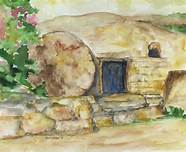
Our Gospel writer, Matthew, tells us of the two women disciples who come to the tomb early Sunday morning. They come where they laid Jesus’s body on that desperate Friday afternoon. They grieve and mourn, and have spices to anoint the body properly, since on Friday there hadn’t been enough time for a proper burial. Except—Jesus is not in the tomb!

Can you see the two women, thunderstruck, as they stand in front of the empty tomb? The stone has been rolled away, showing the hole in the rock. Plus, on top of the stone sits a miraculous sight in its own right. An angel, dressed in bright, shining white, waits to speak with the women. Can you imagine their surprise, shock, even fear at the angel’s appearance? The angel says, “Don’t be afraid!” I can just see the shining figure, hand outstretched, comforting words calming their fears and anxiety.

Here we are in 2020, in the midst of the “right-now-time” of the pandemic, and we need an angel to come and reassure us! Some today have even forgotten what the presence of God feels like. We badly need comforting words to calm our fears, anxiety, anger and confusion.

The angel did exactly that. The angel tells the women disciples not to be afraid, and repeats the words of Jesus—“He is not here, just as He said!” And then, “Quickly, go tell the other disciples Jesus is risen!”

Those women had their fear, grieving and uncertainty disappear in a moment! Alas, it won’t be quite that miraculous or quite that sudden for a recovery from this pandemic.

My journalist husband makes memes from time to time, and they sometimes have biting social commentary. He recently made a meme with a grandfatherly-type man reading to two young children, with a snarky comment about “the before-time.” But, what about the “right-now-time?” That tense time between the diagnosis and the treatment? Or that worried time when others have lost the job that provides income for their household? Or, that anxious time when we fear for loved ones who are essential workers? Or, that waiting time when some cannot even sit next to an ICU bed in the hospital because of COVID-19?

We are living through tumultuous times, indeed. I suspect, when people look back on the year 2020, there will be a clear line of demarcation between the “before-time,” the “right-now-time” in the midst of the pandemic, and whatever comes after. We hope, we pray that this next time may be known as the “recovery-time.”

As the angel told the women and men disciples, Jesus is no longer in the tomb! Jesus is risen! Yes, those were desperate, anxious times for the disciples, and yet Jesus said He would be with them. There have been fearful, anxious times throughout history, yet Jesus has conquered death. Disasters, famines, floods, and yes, pandemics have come upon great numbers of people at times—yet Jesus tells us, urges us “Don’t be afraid!”

Yes, the women were afraid, yet full of joy! We can take heart that Jesus gives us the assurance that He is alive!

“God is not finished yet. We might recall that, indeed, God’s favorite thing to do is to show up where we least expect God to be and to surprise those who have given up on God.” [1] Jesus has promised; He will be with us! And, His peace can never be taken away from us, no matter what. That is Good News, indeed. Amen, alleluia!


(I would like to thank Rev. Dr. David Lose. For this sermon, I have borrowed several ideas from his commentary on Holy Saturday, from his online article http://www.davidlose.net/2020/04/the-forgotten-day/ )

@chaplaineliza

(Suggestion: visit me at my regular blog for 2020: matterofprayer: A Year of Everyday Prayers. #PursuePEACE – and my other blog,  A Year of Being Kind . Thanks!

[1] http://www.davidlose.net/2020/04/the-forgotten-day/

Unknown's avatar

Star Light, Star Bright

“Star Light, Star Bright”

Matt 2-11 Epiphany star, Magi, angel, 12th century carving, Autun Cathedral

Matthew 2:1-12 (2:9) – January 5, 2020

When I was little, we always kept our Christmas tree up in our living room until Epiphany, January 6th. We did not always have this particular decoration, but sometimes, there would be a small star ornament my mother would place at the top of the tree. And, I can remember sitting in a darkened living room with my mom, filled with wonder. The only lights lit in the room would be the colored lights on the Christmas tree. What wondrous lights!

I wonder, were Christmas lights a big part of your Christmas celebration? They certainly were, where I grew up, on the northwest side of the Chicago. Christmas lights in the front yards of houses, and in the windows, as well as on the Christmas tree inside. And, I can remember hearing from a very young age that these bright, shiny Christmas lights all over were shining to remind everyone about the Christmas star, the Star of Bethlehem.

But, what about the original Star? Somehow, I suspect only a few people at the time of the birth of Jesus really understood the reason for the bright shining Star. That is, until it was shining over Bethlehem for a number of weeks.

Let’s look at what Matthew tells us, again: “After Jesus was born in Bethlehem in Judea, during the time of King Herod, Magi from the east came to Jerusalem and asked, “Where is the one who has been born king of the Jews? We saw his star when it rose and have come to worship him.” What do we know about these Magi, these scholars from the east?

Biblical commentators and historians tell us that these scholars were astronomers who spent their lives studying the stars and planetary movements, among other natural events. They were probably well-to-do, if not members of royal houses themselves. They most probably came from the general area of Persia—that is, in the area of modern-day Iraq, Syria and parts of Iran.  In their studies, consulting contemporary books and writings, these Magi had discovered that the appearance of a wondrous star meant that an important king—or ruler—had just been born. That Star—that Light—beckoned to these scholars. So, what did they decide to do? Go and visit that newborn king, of course!

While on their way, they needed directions. What to do? It only made sense for some well-born VIPs from another country to ask directions at the local palace.

We do know what happened when the Magi got to Jerusalem after following this Star for some weeks; Matthew tells us so. “When King Herod heard this he was disturbed, and all Jerusalem with him. When he had called together all the people’s chief priests and teachers of the law, he asked them where the Messiah was to be born. “In Bethlehem in Judea,” they replied.”

Do we see what a traumatic reaction these scholars had on many people in the area of Jerusalem? Lots of people were upset, especially King Herod! However, I do not know whether these scholars understood that Herod was a particularly nasty guy. At least, not at first.

Today, when you and I talk about Advent or Christmas services at our church, I wonder how people react to us when we talk about the Baby in Bethlehem? Have you recently invited people to our church for the holidays? Perhaps our acquaintances are just as cautious or bothered by our invitation as these people were, so long ago?

And, all this was happening because the Magi followed a Star. They had deciphered passages from books and manuscripts about something (or Someone) promised, whose birth was foretold in the skies. The Star was inviting them to follow, to journey into the unknown. These Magi must have been really excited at the prospect of seeing a prophecy come true.

After Herod directed the scholars to Bethlehem, down the road from Jerusalem, the Star moved again. As Matthew mentioned, “After they had heard the king, they went on their way, and the star they had seen when it rose went ahead of them until it stopped over the place where the child was. 10 When they saw the star, they were overjoyed. 11 On coming to the house, they saw the child with his mother Mary, and they bowed down and worshiped him.”

The Star—the Light from on high led them directly to the young King, where they bowed and worshiped. Can it lead us to draw near to our Lord Jesus? Is this Star, this Light a beacon of hope and joy for us, too?

All that was two thousand years ago, but Epiphany is still with us today. The word Epiphany means manifestation, or appearance. Epiphany is when Christ appears among us, offering hope and joy to all who might need it.

This brilliant Star encourages us to leave the darkness and despair behind and to come into the Light. God does, indeed put directional signals where we can see them. Sure, the sign of the Star of Bethlehem pointed the way to the Holy Child in Bethlehem two thousand years ago. But, doesn’t God use directional signals or signs to point to Jesus now, today? We can count on God’s love and presence with us, in Emmanuel, God-with-us.

Yes, Jesus appears when you or I need Him most. May He appear to each of us during this season of Epiphany, in spirit and in truth.

Alleluia, amen.


“During these weeks of Epiphany, dare to ask that Star some questions.

  • Where are we being led in this New Year?  Is the Star offering some course correction? Should we be like the magi and experiment with a “different road” that will lead us to new experiences?
  • What might we need to leave behind in order to start on this journey? What burdens or expectations can you and I set aside to lighten the load?
  • As the Light shines into our lives, what might we discover about ourselves? What do you and I value? What new parts of myself do I want to explore?
  • What does the Star—the Light reveal in our world? What needs or injustices are calling out for compassion and kindness?” [1]

(I would like to thank the Rev. Sue Foster for her Epiphany post “Into the Light!” For this sermon, I have borrowed several ideas and quotes from this devotional. Thanks so much!)

https://fosteringyourfaith.com/2019/12/30/into-the-light/ On December 30, 2019 By fosteringyourfaith In Epiphany

[1] https://fosteringyourfaith.com/2019/12/30/into-the-light/ On December 30, 2019 By fosteringyourfaith In Epiphany 

@chaplaineliza

(Suggestion: visit me at my regular blog for 2020: matterofprayer: A Year of Everyday Prayers. #PursuePEACE – and my other blog,  A Year of Being Kind . Thanks!

Unknown's avatar

We Know the Ending!

“We Know the Ending!”

Isa 65-17 new-heavens-new-earth

Isaiah 65:17-19 – November 17, 2019

Who likes to watch movies? I’m thinking in particular of scary movies. There’s the plucky heroine, the brave protagonist, the encouraging older character actor, the quirky supporting actor. I bet you recognize these typical parts of the horror movie formula. And, have you ever found yourself yelling at the screen, “Don’t go down in the creepy basement!” or “Don’t go up to the scary attic!” You and I could almost guess what was coming, couldn’t we? Many of them are so formulaic we already know the ending.

In the scripture reading from the end of Isaiah 65, we find out how things are going to end, at the end of all recorded time. It’s the end of the ultimate scary and suspenseful movie. Sure, there is a lot of scary stuff that happens in each of our lives, as well as really sad things and even some overwhelmingly traumatic happenings. But, there is no ultimate surprise ending to the overarching story. We already know the ending. God wins, and the whole world is re-created!

Let’s take a step back. What came before chapter 65 of Isaiah, in the original creation?

We all remember the blessed words of Genesis 1: “In the beginning, God created the heavens and the earth.” That was the time of the first creation. God created everything in this world, and God made it all very good. We have God’s word on it – it says so at the end of Genesis 1:31. “God saw all that He had made, and it was very good.”

The sad—even traumatic—events of Genesis 3 happened so soon afterwards, where the spotless creation was marred by sin, and the whole world was changed, turned topsy-turvy.

Just think—creation, blessed and sanctified by God in the beginning, was indelibly altered, leaving a huge upheaval in the whole order of all created beings and created places. We are still in that in-between time, dealing with the aftermath of Adam, Eve and the apple.

All this fall, I have done a part-time chaplain internship in a busy downtown hospital. There is nothing quite so intense as a critical care unit of a busy hospital to get across the sorrow, agony and mourning of the human experience.

Here at this church last week, we prayed for a senior who was scheduled for a delicate procedure the next day, last Monday. I have not checked up to see how that dear senior is doing now, but there are several serious continuing health issues in this dear one’s life and body. I do not know whether or not there are additional concerns in this situation. All I know is that I promised we would pray for this prayer request for four weeks. That is what I could do for this dear senior, to encourage and come alongside of this dear one.

But, we all are still in the time of the first creation. We all know about that time; still in the time of imperfection, of fallenness, of crying and suffering and sorrow.

I have mentioned Rev. Janet Hunt before. She is a Lutheran pastor in DeKalb. She is dealing with a real-life experience right now, where one of the families in her congregation is reeling from the unexpected news of cancer. This heart-breaking diagnosis affects not only the young person medically affected, but the whole extended family as well.

Rev. Hunt is correct when she says that this loving family has resources, both material and spiritual. They have adequate health insurance, and live near wonderful medical care and excellent hospitals. This youth’s particular medical diagnosis is the most common, and the most treatable form of that hated disease, cancer. And still—and still, Rev. Hunt’s heart breaks “to be living in a world where mothers weep, and dads stand stoic so as to emit a sense of much needed calm, and [young people] try to hold back tears of confusion and fear.” [1]

While here in this flawed world, we groan, and we struggle; we cry and we mourn. Why me, Lord? Why us? Why are there many children and young people in horrible circumstances, both in and out of the hospital? For that matter, why is anyone suffering? Why do bad, negative, even traumatic things happen to good, loving and compassionate people?

Why, Lord? Why, oh why? Please let me know. Please, please, dear Lord, act in all their troubled lives, relational difficulties, and medical situations

As we consider today’s Scripture reading from Isaiah 65, Rev. Hunt says, “I want the world the prophet promises now:

  • Where the sounds of weeping and distress are simply no more.
  • Where little ones (and children) never die and where life is still short when we live to be 100.
  • Where hard work is rewarded with adequate shelter and enough to eat for everyone.
  • Where sworn enemies —- the wolf and the lamb — eat together.

Oh, what a world that would be, will be where not one is hurt or destroyed on God’s holy mountain.” [2] This whole reading incorporates God’s wish for the entire world. When God describes Jerusalem, God means the whole world.

Remember how I started this sermon, talking about scary movies? We wanted to warn the characters of the dangers.  But, what if we have already seen that movie for the second, third, even fifth time when we knew the ending?  Once we knew the ending we sometimes might want to tell the hero not to worry during the scary parts and sometimes want to warn the heroine to be careful when everything is going well.

In our Gospel reading from Luke 21, the disciples ask, “Teacher, when will these [dire, horrible] things happen? And what will be the sign that they are about to take place?” The Hebrew Scripture readings for this week tell us God’s final ending.  The New Testament readings advise us on how to live until the ending comes. [3] Yes, we could concentrate on the disheartening Gospel reading, and look at all the bad, awful, and even worse things that are going to happen – and even happen right now. However, I wanted to look at God’s truly happily-ever-after ending. Let us all know and look forward to God’s ultimate, Good News ending.

Yes, creation is part of God’s continuing work today, and the continuing reality of the world today. Remember the prophet’s words in verse 65:19, that sorrow and crying will be taken away as God re-creates the world. Never fear – God will wipe away every tear from every eye. No more sorrow! In this reading, we see real celebration! Praise God, we will have joy in the morning on that day! In the words of that joyful gospel song, Soon and very soon!

Isn’t that God’s ultimate Good News? Alleluia, amen.

[1] http://dancingwiththeword.com/new-heavens-new-earth/

[2] http://dancingwiththeword.com/new-heavens-new-earth/

[3] http://worshipingwithchildren.blogspot.com/2016/10/year-c-proper-28-33rd-sunday-in.html

Worshiping with Children, Proper 28, Including children in the congregation’s worship, using the Revised Common Lectionary, Carolyn C. Brown, 2016.

@chaplaineliza

(Suggestion: visit me at my regular blog for 2019: matterofprayer: A Year of Everyday Prayers. #PursuePEACE – and my other blog,  A Year of Being Kind . Thanks!


Unknown's avatar

Baptism: A Gift of God

“Baptism: A Gift of God”

luke 3-21 african depiction baptism

Luke 3:21-22 – January 13, 2019

When I was a small child, I remember being so excited about gifts. Christmas gifts, birthday gifts, it did not matter. I remember how wonderful it was for me to receive gifts. I also remember when I was in middle school, when I first bought my mother a birthday present, a little vase from a gift store. I believe it was the first birthday present I had ever bought and given to anyone. I really hoped she would like it.

I also remember when I was a little older, being so excited to share my newly-opened gifts with one of my best friends. I would bring over to her house the sweater or special socks or wonderful book I had received, and be so happy when she rejoiced with me over my awesome gift. Can you think of any wonderful gifts that you wanted to share? Perhaps a brand new bicycle, or an engagement ring, or some extra-special news from far away. The wonderful joy of receiving the gift was made even more special by sharing the joy.  

One very special gift-giver is God. God gives wonderful gifts to God’s people. We can hear about that gift in our Gospel reading from Luke 3. “When all the people were being baptized, Jesus was baptized too.” When John the Baptist urged people to come forward and be baptized, Luke’s Gospel says all the people were baptized. That means all of them. All who heard John’s message and invitation came forward to receive God’s wonderful gift of grace through baptism.  

Who among us is perfect, here? Who never sins? Who never does anything wrong or never says mean or angry things, or never steps out of line? Not me. I know I fall short of where God wants me to be. I am hesitant to accept this free gift of God’s grace, at times. I know I sin, I know I miss the mark of God’s righteousness that is set for me in the Bible.

This is the case with you, and with everyone in the world, whether they admit it or not. Romans 3:23 tells us “For all have sinned and fallen short of the glory of God.” This is a heavy burden to lay on anyone. Yet, what does the Apostle Paul tell us in Romans 6:23? Yes, the wages of sin—our payment for sinning—is death. Yet, the free gift of God is eternal life through Jesus Christ our Lord.

As we watch in the baptism service, some may wonder. As we see, in Luke 3, some wondered there, too. Luke tells us they were questioning in their hearts whether John the Baptist might possibly be the Messiah. John redirected their questioning and their gaze by pointing to one who would come after him. John pointed to Jesus.

The Rev. Jeff Campbell relates, “A loving God is constantly reaching out, wanting to be at the center of our lives. And although we might still have questions, we are directed to Jesus, just as John directed those gathered who were seeking a Messiah.” [1]

Baptism is a sign of this marvelous, free gift of God. God’s rich and abundant grace is poured out. As we can see from our reading today in Luke, all the people present received this marvelous gift. Jesus was an extra-special case, since He already had an intimate relationship with His Heavenly Father. Looking at today’s reading, we can see what happened, from Luke’s account: “And as [Jesus] was praying, heaven was opened 22 and the Holy Spirit descended on him in bodily form like a dove. And a voice came from heaven: “You are my Son, whom I love; with you I am well pleased.”

Jesus showed, in part, that by being baptized He was dedicating His whole life to following His Heavenly Father. The Holy Spirit descending on Jesus was a visual sign of the gift of grace freely given that descends upon each one who is baptized. What a marvelous visual sign for all of us to treasure!

Then, as a sign of love and response, we strive to love and to serve God in Christian fellowship and service, all the days of our lives. Freely and without obligation.

I want to caution everyone here. Baptism is not something we do on our own, not some rung of the ladder we are building to get into God’s heaven. No, us building a ladder of good works will never work. God’s grace covers everything, and the free gift of God is given on our account. It’s not us at all. It is all God. God’s amazing love and indescribable gift.

When a baby is baptized, the parents tell God and the church, “Our child belongs to the Lord.” When an adult is baptized, he or she tells God, “I belong to you. I trust you with my whole life.” At Jesus’s baptism, God’s voice said aloud that Jesus is God’s beloved Son. Jesus is God’s well-loved Child. It pleases God that Jesus trusts and obeys God. That makes God glad beyond measure. [2]

Rev. Janet Hunt, ELCA pastor from DeKalb, relates the following: “Jesus’s life did not measure up to much by those standards you and I often hold dear. He never married or had a family. From all we can tell he owned no property, had no wealth to pass on once he died. The results of his work were awfully hard to measure: unless you kept track of the numbers healed and taught and fed. A whole lot of the time the crowd he hung around with was not the sort that could help him ‘get ahead.’ In fact, they were those most respectable folks then and now might mostly avoid. In the end, Jesus died a painful, shameful death, abandoned by his closest followers….being claimed and loved by God brings power and purpose — to Jesus, yes, but also to each and every one of us who have heard even a whisper of the promise Jesus hears today: “You are my Child, the beloved…” But that power and purpose are not only for this life alone. Oh, these must be promises which extend far beyond the physical and must carry us not only through this life but into life eternal, don’t you think? And isn’t it ours to begin and end each day wondering at the meaning of having been called by name… and belonging to God.” [3]

What wonderful gifts, to all of us. What an indescribable gift of grace, given freely in baptism, to us all!  

As the Holy Spirit descends like a dove from heaven, we all can hear the voice of God, whispering to each of us, “You are my son. You are my daughter. My beloved one. With you I am well pleased.”

Each of us can say, “I am God’s beloved.” Remember our baptismal vows, and rejoice!

[1] https://www.umcdiscipleship.org/worship/season-after-epiphany-2019-part-1-worship-planning-series/january-13-baptism-of-the-lord-sunday-year-c/baptism-of-the-lord-2019-year-c-preaching-notes

[2] https://www.umcdiscipleship.org/worship/season-after-epiphany-2019-part-1-worship-planning-series/january-13-baptism-of-the-lord-sunday-year-c/baptism-of-the-lord-2019-year-c-preaching-notes

[3] God’s Claim, God’s Protection…

http://dancingwiththeword.com/gods-claim-gods-protection/  January 6, 2019

Water Drop Words – Star Words

Marci Auld Glass is the pastor of Southminster Presbyterian Church in Boise, Idaho. She wrote a post several years ago in her blog Glass Overflowing where she said, “The premise is this: the magi followed the star to find baby Jesus, bringing their gifts. We are also seeking Jesus, trusting God can/does use many signs [or gifts] to guide us closer to the Divine presence.”

Marci says, “People are invited to take a star in worship. On each of the stars is a word. I invite people to trust the word that selects them, but we do not police the star choosing, so if people need to trade out a word, they are free to do so. When we first started doing this, people weren’t sure they wanted to trust the words they drew. Now it has become an important part of our congregation’s liturgical year.”

Here at St. Luke’s Church in Morton Grove, for the past few years we have been celebrating a Reaffirmation of Our Baptism on the second Sunday of January, the Sunday after Epiphany. Instead of star words, some churches have used water drops, and passed out water drop words to their congregations. That is what we are doing today.

The water drop gifts are passed around to the congregation using the same offering plates that we use later on in worship to gather up the tithes and offerings. As people help themselves to a water drop word (without looking—just reach in and grab!), the significance is not lost. In this moment, people are not asked to give; they are invited to receive. It reminds us that this is always the order of things in God’s kingdom—God always gives first, and then we are invited to respond with our gifts and ourselves.

As the Holy Spirit descends like a dove from heaven, we all can hear the voice of God, whispering to each of us, “You are my beloved one. With you I am well pleased.”

Each of us can say, “I am God’s beloved.” Remember our baptismal vows, and rejoice!


@chaplaineliza

(Suggestion: visit me at my regular blog for 2019: matterofprayer: A Year of Everyday Prayers. #PursuePEACE – and my other blog,  A Year of Being Kind . Thanks!