Unknown's avatar

Joy for Those Who Wander

“Joy for Those Who Wander”

Luke 2:1-7 (2:4-5) – December 14, 2025

            When some thing or some reading or some sermon is so familiar, so recognizable, are you tempted to tune it out? Turn it off?

I am preaching from an alternative lectionary, enlarging our Advent meditation on Dr. Luke’s so-familiar chapters. Today, I preach from the beginning of Luke chapter 2. Such a recognizable narrative! It has everything a story needs! Not only promise and heritage, not only memory and mystery. But, hearing an old story yet again brings its own kind of anticipation!

Although, the familiarity surrounding today’s reading is a particular problem for preachers. How do we make the reading fresh, bring it to life again, imbue it with that something extra special enough to cause people to tune in rather than tune out?

            Let us listen again to a portion of today’s reading: “And everyone went to their own town to register.So Joseph also went up from the town of Nazareth in Galilee to Judea, to Bethlehem the town of David, because he belonged to the house and line of David. He went there to register with Mary, who was pledged to be married to him and was expecting a child.”

            Joseph and Mary began to travel from Nazareth in the north of Galilee up to Bethlehem. A suburb of Jerusalem, really. A small town on the outskirts of the capital city, a good ways to the south of Galilee. We find Mary and Joseph (probably without a donkey – sorry to all of the lovers of traditional Christmas cards, everywhere) on the road, walking south to register for the census. And, they were not the only ones on the road.

            Can you see yourself – can I see myself – on the road? Are we all in transit, traveling along, not anywhere particularly fixed? Even those of us who have lived in the same place for a long time, is there something about your life, about our walk with God that makes you think that we all are on the road? Could it be that we all are wandering from one place to another, and not having a definite place to call home?

            The apostle Paul speaks of the temporary nature of this world, of this earthly tent we all inhabit. He says in 2 Corinthians 5, “For we know that if the earthly tent we live in is destroyed, we have a building from God, an eternal house in heaven, not built by human hands.” So, with that to look forward to, it gives us all a heavenly perspective to view our earthly tents, and the journey each of us is on, in this wide world today.

            Which brings us back to considering: the long trip for the census. And, since Bethlehem was the ancestral home of King David, that meant there were quite a lot of people who had to be counted who were descended from David. Including Joseph. Remember the genealogy written in the Gospel of Matthew?

            Speaking of descendants of David, I am sorry to prick the other balloons of belief in the traditional Christmas carols and traditions. “It would be unthinkable that Joseph, returning to his place of ancestral origins, would not have been received by family members, even if they were not close relatives.” Presbyterian missionary and pastor Dr. Kenneth Bailey, who is renowned for his studies of first-century Palestinian culture, comments:

“Even if he has never been there before he can appear suddenly at the home of a distant cousin, recite his genealogy, and he is among friends. Joseph had only to say, ‘I am Joseph, son of Jacob, son of Matthan, son of Eleazar, the son of Eliud,’ and the immediate response must have been, ‘You are welcome. What can we do for you?’” [1]

            I know this might be news to you – and it was to me. Jesus was not born in a cave or far on the outskirts of town, out adjacent to the field surrounding Bethlehem. However, this still does not let us off the hook for considering the larger question. Mary and Joseph were traveling, and were on the way, in between. According to Biblical record, they did not have very much money at all. (Although, because of the generous dictates of hospitality, they must have been put up in some cousin’s home while they were sojourning in Bethlehem.)

            I still would like to know! Our position as believers in the one true God makes us sojourners in this world; and this position is so similar to Mary and Joseph’s position as sojourners or travelers, too. Is there any solidarity for others today who are transient, who are traveling or sojourning, especially young families? Perhaps with mothers who are great with child at this time of the year, and are looking for even a temporary place to lay their heads?

             We can take this unexpected look at the Holy Family one step further. I remember a suburban church I attended a number of years ago. One of the smaller trees near the front door to the sanctuary was practically covered with blue ribbons. A sign was posted next to the tree, saying “While celebrating One homeless Family, these ribbons ask us to remember the homeless with us today.” I had never thought about the Holy Family in that way before. It’s God’s unexpected manner of opening our eyes, and displaying the new or different way we can look at Mary and Joseph and the baby Jesus.

            As we consider the birth of the baby Jesus in Bethlehem, as the Holy Family was traveling through, we can see this birth as so much more than simply a claim or confession of the church. As you and I are sojourners through this world, so we also are traveling through. Jesus, God’s eternal Son, the Second Person of the Trinity, emptied Himself. He willingly put Himself in this human flesh and became incarnate of the Virgin Mary. And, this is the most important part! This miraculous birth shows us the truth of our God. Our God loves us so much that the only way to really, truly show us how much was to become one of us. The Baby born in Bethlehem. [2]

            The baby Jesus, His parents Mary and Joseph – the Holy Family was on the way, traveling. Sojourning, and so are we. We are travelers, looking forward to that heavenly home, prepared for us in heaven. Are you on the road with us? On the way with Jesus?

            I close with two verses from a much beloved Christmas carol, collected in Appalachia by John Jacob Niles around 1900. Listen and hear the words of traveling, of being on the way.

 When Mary birthed Jesus, ’twas in a cow’s stall/with wise men and farmers and shepherd and all.
but high from God’s heaven a star’s light did fall, /and the promise of ages it did then recall.

I wonder as I wander, out under the sky, /how Jesus the Savior did come for to die
for poor ordinary people like you and like I; /I wonder as I wander, out under the sky.

            Alleluia, amen.

@chaplaineliza

(Suggestion: visit me at my other blogs: matterofprayer: A Year of Everyday Prayers. #PursuePEACE – and  A Year of Being Kind . Thanks!)


[1] https://www.psephizo.com/biblical-studies/once-more-jesus-was-not-born-in-a-stable/

[2] https://www.workingpreacher.org/dear-working-preacher/christmas-preaching
Unknown's avatar

Loving Neighbors in the Strangest Places

“Loving Neighbors in the Strangest Places”

Luke 19:1-10 (19:5) – July 13, 2025

I have rubbed elbows with all kinds of people! I grew up in Chicago in a half-and-half, working-class and middle-class neighborhood. I lived in (and worshiped in) two racially mixed areas of Chicago for some years. I’ve had a number of jobs before I went to seminary at 40 years old, in diverse industries, including the ramp, a huge warehouse, and an order fulfillment center. So, when I hear the Rabbi Jesus getting some guff from the crowd for hanging out with the riff-raff and “sinners,” that surely gets my attention!   

I think today’s Scripture reading is particularly fascinating since it shows someone who was definitely not well liked in his neighborhood. In fact, no one wanted to call him “friend” or neighbor. Zaccheus was a chief tax-collector for the Roman occupation. Yes, he was Jewish, and yes, he was working for the hated occupying foreign forces. And as if that were not enough to get him disliked by his Jewish neighbors, Zaccheus was officially delegated by the Roman government to collect their taxes for them.

The Roman government was not very particular about how they got their tax money – as long as they got it. So, the local tax collectors could be as demanding or dishonest as they wanted to be, all for the purpose of getting money for the Romans. And, if these tax collectors squeezed a little extra money out of their fellow Jews, the Romans did not care. As long as enough money came into the Roman treasury. That was all the occupying force cared about.

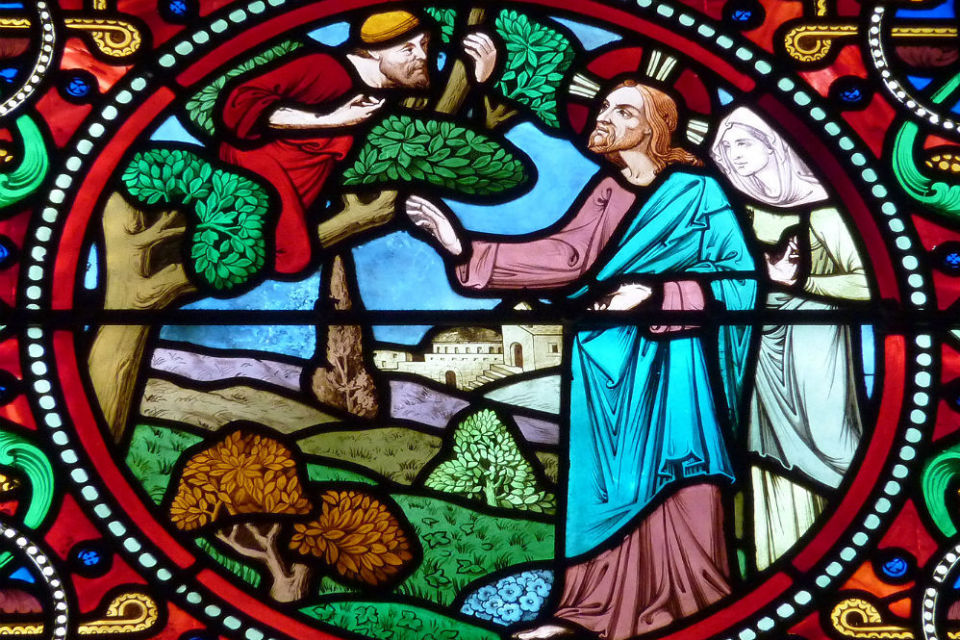
I would imagine that Zaccheus was a pretty lonely man. Until – the Rabbi Jesus came to town. This was several years after Jesus had started to preach, teach and do miracles, so I suspect by this time Jesus had quite a following, and quite the reputation! Let’s pick up right in the middle of the narrative: “3Zaccheus wanted to see who Jesus was, but because he was short he could not see over the crowd. So he ran ahead and climbed a sycamore-fig tree to see him, since Jesus was coming that way. When Jesus reached the spot, he looked up and said to him, “Zacchaeus, come down immediately. I must stay at your house today.” So he came down at once and welcomed him gladly.”

We read next that the crowd started to grumble, because the Rabbi Jesus saw and spoke with Zaccheus, truly engaged with him, and even said “I must stay at your house today.”  

Can you imagine, being the shortest guy in your high school! Plus, being one of the least popular persons in the town of Jericho! Both of those things must have been painful subjects for Zaccheus. I just imagine that he lived an isolated existence, wanting, hoping that someone would see him, notice him and validate him. This emotional response is only human!

We are currently observing a summer sermon series highlighting the person of Fred Rogers, of Mister Rogers’ Neighborhood. Have you ever thought of someone who is meek and gentle as being a strong individual? Someone who is so strong and confident themselves that they do not care what other people think? I think that is exactly the kind of person Fred Rogers was. Plus, Fred Rogers thought everyone was deserving of attention and respect, no matter what! And, that deep emotions were important things.

Of the many lessons Rogers gently gifted his audience, a chief one was that all emotions are valid, even the sad and angry ones. They need acceptance from friends and family and, often, expression – so long as it’s not violent. Sigmund Freud called this ‘sublimation,’ the channeling of destructive impulses into socially acceptable actions. It was a pillar of Rogers-ism, and [Rogers] often referred to dialogue about emotions and feelings as ‘important talk.’” [1]  

The Rabbi Jesus obviously thought that emotions were important – even the emotions of someone hated like Zaccheus. Sure, Zaccheus was seen as a hated tax collector by his Jewish neighbors! But, Zaccheus’s feelings were valid, too! Our Lord Jesus went out of His way to single Zaccheus out, see him, notice him, validate him. And, Jesus invited Himself over for dinner!

Salvation came to Zaccheus’s house that day. Jesus followed him home, and broke bread with him at a lonely table. Salvation comes to all of us when Jesus joins us, has fellowship with us. Even when people do not feel worthy, for whatever reason, to have Jesus join them – it doesn’t matter. Salvation is solidarity, hospitality, and yes, ministry.

Our commentator Karoline Lewis relates a modern (and true) narrative, taken from the column of David Brooks, long time New York Times columnist. Brooks tells the story of Kathy Fletcher and David Simpson. “They have a son named Santi, who went to Washington, D.C. public schools. Santi had a friend who sometimes went to school hungry. So, Santi invited him to occasionally eat and sleep at his house.”

“That friend had a friend and that friend had a friend, and now when you go to dinner at Kathy and David’s house on Thursday night there might be 15 to 20 teenagers crammed around the table, and later there will be groups of them crashing in the basement or in the few small bedrooms upstairs.”

The kids who show up at Kathy and David’s have endured the ordeals of modern poverty: homelessness, hunger, abuse, sexual assault. Almost all have seen death firsthand — to a sibling, friend or parent.”

“It’s anomalous for them to have a bed at home. One 21-year-old woman came to dinner last week and said this was the first time she’d been around a family table since she was 11… Poverty up close is so much more intricate and unpredictable than the picture of poverty you get from the grand national debates.”

“I started going to dinner there about two years ago,” writes Brooks, “hungry for something beyond food. Each meal we go around the table, and everybody has to say something nobody else knows about them. Each meal we demonstrate our commitment to care for one another. I took my daughter once and on the way out she said, ‘That’s the warmest place I can ever imagine.’”

The problems facing this country,” says Brooks, “are deeper than the labor participation rate and ISIS. It’s a crisis of solidarity, a crisis of segmentation, spiritual degradation, and [lack of] intimacy.”

“The kids call Kathy and David ‘Momma’ and ‘Dad,’ are unfailingly polite, clear the dishes, turn toward one another’s love like plants toward the sun and burst with big glowing personalities. The gift of Kathy and David is the gift of a complete intolerance of social distance,” insists Brooks. [2]

At church, we speak ‘salvation speech.’ This is speech that sees the other, that regards the overlooked. We speak speech that brings together, and unites across barriers and boundaries, classes and cultures. Speech that creates community and family for everyone. Speech that gives life and says that salvation is here and now, in this world as well as the next. [3]

Jesus said, “Today, salvation has come to this house.” It is salvation to a house, any house. It’s to a neighborhood, each and every neighborhood. This place where Zaccheus lives is where Fred Rogers would welcome, and be welcomed, too.

What would Jesus do? What would Fred Rogers do? Go. Do that.

(A big thank you to the online resources for Mr. Rogers Day – the Sunday nearest March 20th, Fred Rogers’ birthday. These resources come from the Presbyterian Church (USA). https://www.pcusastore.com/Content/Site119/Basics/13792MrRogersIG_00000154465.pdf )

@chaplaineliza

(Suggestion: visit me at my other blogs: matterofprayer: A Year of Everyday Prayers. #PursuePEACE – and  A Year of Being Kind . Thanks!


[1] https://www.cnn.com/2018/06/08/health/mister-rogers-go-ask-your-dad/index.html

[2] David Brooks, “The Power of a Dinner Table,” The New York Times, October, 18 2016, http://www.nytimes.com/2016/10/18/opinion/the-power-of-a-dinner-table.html

[3] https://www.workingpreacher.org/dear-working-preacher/salvation-today

Unknown's avatar

God Prepares a Table!

“God Prepares a Table!”

Psalm 23:5 – September 3, 2023

            I am fascinated by a painting I’ve encountered a number of times, of Jesus the Good Shepherd. This is the very first picture we have of Jesus, painted around 250 CE. It is found in the catacombs in Rome, those narrow, twisting underground tunnels. The walls are filled floor to ceiling with graves that have been dug – as tombs. Just imagine walking quietly through these twisting tunnels with a small oil lamp!

As you continue imagining, see yourself going to find fellow Christian friends who are gathering to worship by a designated grave. You need to be cautious as you listen for the clank of Roman soldiers’ armor, as you glide quietly along. Given this, it is easy to imagine why someone painted a picture of Jesus as a strong young shepherd on the ceiling of the catacomb! Jesus certainly can take care of us, as this Psalm says. [1]

Our Scripture reading today comes from the book of Psalms, and is one of the most familiar and beloved readings in the whole Bible, in either the Hebrew Scriptures or the New Testament. Countless people have turned to Psalm 23 for peace, for reassurance, in times of anxiety or struggle, and even in times of great joy. This psalm is a psalm for the ages, and has been read for centuries by believers, skeptics, and atheists alike.

            This very familiar psalm begins with the view of the Good Shepherd, taking loving care of His sheep. We hear about how the sheep depend upon the Shepherd to guide them and guard them as they roam in a flock. The sheep depend upon the Shepherd’s watchfulness and protection as they travel through dark and dangerous places. Yet, a change comes in verse five. We see the Shepherd change into a generous Host.  

            You and I know the familiar possessions many people own to show off their wealth and status. The huge, expensive, and showy house, sometimes with a large fence around it or now, in a gated community. Or, the luxury automobile, with all the bells and whistles, and a price tag I can’t even image. Except, those are signs of wealth and prestige here in the Western world, here in a culture we are familiar with.

            The traditional culture of the Middle East is very different, when it comes to displays of wealth and prosperity. “When you want the community to know that you have acquired wealth, you do not buy an expensive car or a large house. Rather, you host meals with three times as much food on the table as the numerous guests can eat.” [2]

            Such radical hospitality and generosity goes way overboard, in the eyes of many in our Western culture! But, this is the cultural way that traditional Middle Eastern people-groups show great wealth and prominence. The psalmist’s imagery goes even further. In Middle Eastern culture, men do not prepare food. Instead, women prepare the food for a banquet, and that does not mean setting a table with individual place settings and elaborate china.

Eating is carried out by tearing off a small piece of flat bread and using it to lift food from the common dish to the mouth. Each bite starts with a fresh piece of bread. There is nothing to do to ‘set the table’ except perhaps ‘spread the rugs’ (as referenced in Isa 21:5). As regards the food, servants and women prepare it. The master of the house provides the food, he does not prepare it.” [3] Several times in the Hebrew Scriptures, verses explicitly say that female involvement is instrumental for the spreading the table and serving of food.

Yet, here in verse 23:5 the psalm clearly says “You prepare a table before me in the presence of my enemies.” Here in one of our most beloved Bible passages, our God is portrayed as a nurturing, even mothering God! “Here too, what counts is that God is provides and protects. How surprising that the table spread in the presence of enemies! It is hard to relax and be fed in their presence. Yet God invites us to the table, come what may and come who may.” [4] You and I may be surprised at some of the visitors surrounding God’s welcoming table. And, for this Scripture to highlight God acting as a woman, doing traditional feminine tasks in preparing the table, is fully in keeping with numerous Scriptural references.

One of the many hymns written about Psalm 23 comes from the wonderful hymn writer Isaac Watts. “My Shepherd Will Supply My Need” is a touching reflection of the great care and nurture God takes on each of our accounts, in each of our lives.  You will note how Watts mirrors the shift in the Psalmist’s speech (from third person to second person in verse 4 and back to third person in verse 6) as he moves from the first to the second stanza.

“Much of Watts’ hymn text reflects the Psalmist speaking to the Lord. Changing the voice to second person highlights the prayerfulness of this Psalm, thereby emphasizing the more intimate relational aspect between God and God’s children.“ [5]

            As this comforting, relational psalm reminds us about the table prepared for us, the Apostle Paul references this table in 1 Corinthians 10 when mentioning Communion. Are you tired and worn, eager to come to the table of the Lord? What is more, God, our generous Host, invites us to come and partake of the abundant heavenly food and drink.

As we come together to celebrate the Lord’s Supper, we look forward to that marvelous banquet spread for all of us. For each of us. So, come. The Lord has prepared this table. Amen, alleluia.

@chaplaineliza

(Suggestion: visit me at my other blogs: matterofprayer: A Year of Everyday Prayers. #PursuePEACE – and  A Year of Being Kind . Thanks!

(I would like to express my great appreciation for Ken Bailey’s marvelous examination of all of the mentions of the Good Shepherd throughout the Bible in The Good Shepherd, the commentary published by IVP Academic in 2014. I got several excellent ideas and quotes for this sermon from this excellent book.)


[1] http://worshipingwithchildren.blogspot.com/2015/03/year-b-fourth-sunday-of-easter-april-26.html

[2] Bailey, Kenneth E., The Good Shepherd (InterVarsity Academic, Downers Grove, IL: 2014), 55-56.

[3] Ibid.

[4] https://www.workingpreacher.org/commentaries/revised-common-lectionary/ordinary-28/commentary-on-psalm-23-16

[5] https://www.workingpreacher.org/commentaries/revised-common-lectionary/fourth-sunday-of-easter-3/commentary-on-psalm-23-9

Unknown's avatar

Cup of Cold Water

“Cup of Cold Water”

Matt 10-42 water, words

Matthew 10:40-42 (10:42) – June 28, 2020

I have several friends who are wonderful hosts and hostesses. They love to have friends and relatives come to their homes, and provide such excellent hospitality. In fact, I had the great good fortune to be the recipient of such fine hospitality a few months ago, at the home of my niece Josie’s uncles (on her mom’s side), in Washington state. Jeff was a marvelous host!

What does hospitality have to do with this bible reading from Matthew 10? At first glance, this reading talks about prophets, or God’s messengers. Jesus tells us how it’s important to accept, or to welcome the messengers of God.

Hospitality was huge in the Middle East. It still is, today. If someone comes to your home, you go all out for them, making them comfortable, feeding them, and otherwise supplying their needs. That hospitality has been a hallmark and a highlight of visiting this region of the world, for centuries.

When the Rabbi Jesus made this statement about receiving the prophets, God’s messengers, what do you immediately think of? What is the first thing that comes to mind? The first thing I thought of was an old-fashioned Sunday dinner after church, where one of the prominent families at the church invites the minister over for a fine meal following the morning services. Well, that cannot happen now, because of COVID-19. Not the socializing at each other’s houses, and not the in-person worship services.

But – can this reading mean more than that?

Somehow, I don’t think the Rabbi Jesus was thinking about the chief rabbi from the most prosperous synagogue in town. I don’t think Jesus had the hot-shot leading elders of the largest congregation in mind, either.

I suspect you can immediately think of someone—maybe a couple of someones—who is absolutely marvelous at hospitality. Putting on parties and get-togethers, gathering friends, relatives, acquaintances. I know, I have been at a few of these gatherings. They are almost always wonderful times to connect. Wonderful times for eating and drinking, too.

What about you? Are you grateful to friends or relatives who have the spiritual gift of hospitality? This absolutely is a spiritual gift, listed among the other more acknowledged or appreciated biblical gifts. Some have that gift of hospitality in abundance.

Except, the words of Jesus do not excuse some of us who are not so hospitality-gifted. No, Jesus’s words are intended for all of us. That means every believer has the responsibility to extend hospitality, whether they have that spiritual gift or not.

I could expound upon the gifts of the Holy Spirit that are given to each believer when they come to believe in Jesus Christ. The apostle Paul has written several lists where he runs down a good number of these gifts: in chapters Romans 12, 1 Corinthians 12, and Ephesians 4, among others. Gifts like teaching, discernment, helps, and administration.

I can hear some people say, “Oh, I just don’t have a hospitable bone in my body. I can’t welcome people into my tiny apartment. I’m all thumbs when it comes to spreading a wonderful table, and I don’t know the first thing about throwing a big party.” Well, guess what? Jesus did not say, “This command is just for the people among you who really like Martha Stewart.” Or, “This command only applies to the people who can throw the best parties.”

Jesus wants ALL of us to be hospitable. He wants ALL of us to extend a welcome. But, to whom? Who is it Jesus wants us to welcome in such a way? It’s just our friends and relatives, right? It’s just the people from my church, or from my side of town. It’s just the people who look like me. Isn’t that who You mean, Jesus?

Let’s read verse 10:42 again. ”And if you give even a cup of cold water to one of the least of my followers, you will surely be rewarded.” Acts of mercy and deeds of compassion, no matter how small. My goodness. Is Jesus talking about being kind to – anyone? Everyone? No matter what? No matter who? No matter what they look like? Or, where they were born?

Yes, mercy and compassion are two of those spiritual gifts the apostle Paul talks about. Except, Jesus commands all of us to show compassion and mercy, right here. By doing these compassionate things for anyone and to everyone, we give witness to the unconditional love of our Lord Jesus. Jesus does not make this expression of compassion and mercy something exclusive to “only our kind.” No, He specifically says that we are commanded to show mercy and compassion to “the least of these.” Some translations use the words “these little ones.”

Okay, Jesus. I guess I get the idea. You want me to show mercy and compassion to just about everyone who needs help. But, I need some ideas.

Dr. David Lose, one of my favorite commentators, gives us some excellent suggestions. He says: “at other times, Jesus seems to say, it’s nothing more than giving a cup of cold water to one in need. Or offering a hug to someone who is grieving. Or a listening ear to someone in need of a friend. Or offering a ride to someone without a car. Or volunteering at the local foodbank. Or making a donation to an agency like Luther World Relief. Or…you get the idea.” [1]

Jesus does not simply make a suggestion. This cup of cold water, this mercy and compassion is something He is really serious about. Let us take our Lord’s words to heart, and put them into action. Now. Go, do, in Jesus’ name. Amen.

[1] https://www.workingpreacher.org/craft.aspx?post=3265

“No Small Gestures,” David Lose, Dear Working Preacher, 2014.

@chaplaineliza

(Suggestion: visit me at my regular blog for 2020: matterofprayer: A Year of Everyday Prayers. #PursuePEACE – and my other blog,  A Year of Being Kind . Thanks!

Unknown's avatar

Compassion through Hospitality

Genesis 18:4-5 – June 11, 2017

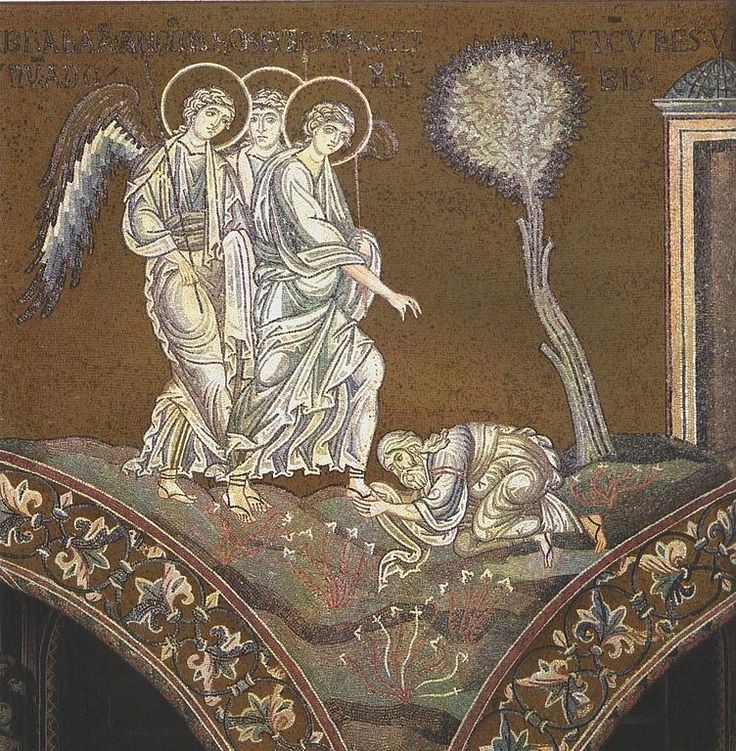
Exod 18 Abraham bends down before Holy Trinity - angelic visitors at Mamre - mosaic in Monreale Cathedral

“Compassion through Hospitality”

Almost everyone enjoys visiting with friends. This can involve meeting for a cup of coffee or tea, going out for a meal, or having friends over at your house. What do you do to make friends or relatives welcome at your table? How do you like to be welcomed, when you go over to someone’s house or apartment?

These are great things to think about. We begin our first sermon of the summer, our Compassion sermon series. Let’s take a look at Genesis and at Abraham, the friend of God. He and his wife Sarah were on a nomadic journey—a very long caravan camping trip that lasted for years and years. While they were traveling, they camped for a time in the land of Canaan near what is now the town of Hebron.

God appeared to him. Here’s how it happened: “The Lord appeared to Abraham near the great trees of Mamre while he was sitting at the entrance to his tent in the heat of the day.” Right off the bat, this bible reading lets us know an important fact. It’s sort of the summary statement at the beginning of this reading, and then the passage explains what it’s all about.

This first verse tells us a lot. Abraham had his tent set up by some big trees. There wasn’t any air conditioning in those days, so he looked for some big trees to provide natural cooling. Abraham sat at the entrance to his tent—a cool place, to catch any little breath of wind drifting by. We also know it was the middle of the day—a really hot time in that semi-desert terrain!

Now that we’ve explained more about it, in your mind’s eye, can’t you just see Abraham sitting there, catching the breeze in the cool shade, at the door of his tent?

What happens next? “Abraham looked up and saw three men standing nearby. When he saw them, he hurried from the entrance of his tent to meet them and bowed low to the ground.”

We are not sure how much Abraham knew about these three men, but he goes out of his way to greet these three strangers. In many places in the world, people give you a warm welcome when you come to their home. It’s certainly true of many people and places throughout the Middle East.

“As a nomad, Abraham and his family lived in tents, as they traveled with their grazing herds in the desert. The few who lived in the harsh deserts of Judea depended upon each other for survival. Visitors were treated very well, for they brought companionship and help for the host. The practice of hospitality was highly prized in Abraham’s time.[1]

“Abraham and Sarah offer hospitality to strangers that come to their camp, upon seeing the strangers coming in the heat of the day, it’s suddenly high gear hospitality.  Hospitality would be the duty of any desert dweller of the time.” [2] I mean, really greet you! They give any stranger an extravagant welcome.

Let’s turn to a modern-day example. When our children, or grandchildren, or nieces and nephews go over to a friend’s house, what are some things that might make these young people feel welcome? Yes, their friend might offer them a drink or a snack. That is great. But, let’s go further. What if their friend goes the extra step? What if their friend lets our children play with their toys? What if their friend lets them pick what show they would like to watch on cable or DVD? How about inviting them to stay for dinner, or even inviting them to sleep over? All these ways of helping them feel welcome in their home are ways of showing “hospitality.”

Just as Abraham and Sarah welcomed these unexpected strangers, can’t we do the same thing? Maybe make a special effort to welcome each person into our house—or church, regardless of whether we know them or not? We can help them feel noticed, cared for and safe in joining our group of friends. How did Abraham show these three people they were welcome?

“Abraham said, “If I have found favor in your eyes, my lord, do not pass your servant by. Let a little water be brought, and then you may all wash your feet and rest under this tree.”

Let’s play a little game with this bible reading, a topsy turvy game.

What if Abraham did not feel like showing hospitality to the three strangers? What would that have looked like? What might have happened, then? As the three persons came near the tent, Abraham might hide inside and shut the tent flaps tight. When they knocked at the tent door, Abraham could tell them to go away, in an angry voice. If the three persons insisted that they were thirsty or hungry, Abraham might yell that they should go some other place, and freeload off of someone else.

If all that had been true, bible history might have happened very differently!

But, no! Abraham and Sarah were fine hosts. Let’s read more of the bible passage: “Let me get you something to eat, so you can be refreshed and then go on your way—now that you have come to your servant.” “Very well,” they answered, “do as you say.”

As a fellow pastor commented, “There was no Holiday Inn, or highway rest area, there is only Abraham and Sarah’s camp and their herds and their well. So, when strangers appear in the heat of the day, needing a wash and a rest, you tend to their needs. Some kind of host switch has been flipped.  Abraham runs, he hastens, he quickly prepares.  His hospitality seems to go above and beyond – the best of the herd, the best flour and in abundance for the meal.” [3]

Modern times have not changed hospitality. How do good hosts show us their hospitality today? They offer food and drink and try to make us as comfortable as they can.

I remember my dear prayer partner Zhou Hui. She was born in mainland China, grew up in a poor neighborhood in a medium-sized town, did really well in school, and was able to get awarded a scholarship to university. She came here to the United States as a graduate student, and became a naturalized citizen. She lives near here, and her children attend New Trier High School. She is a devout Christian, and a real pray-er. I thank God I was able to be her prayer partner for years.

I bring up Zhou Hui because she always bends over backwards to be a wonderful hostess. She has the spiritual gift of hospitality, and she always offers wonderful food and drink to her guests. I can remember many, many enjoyable meals my young children and I had at her house. That is just what Abraham did here. He and Sarah hurried up and offered their unexpected visitors wonderful food and drink.

Abraham and Sarah not only showed these strangers genuine hospitality, they showed compassion—Godly compassion.

Hospitality is the way we help others feel welcomed and cared for, and that we can do this anywhere we are: for friends at our homes, new students in our classrooms or new neighbors on our block.

This narrative is a beautiful reminder that when we show compassion and kindness to other people, we are showing compassion and kindness to God.

When we read about Abraham, we might think, “How nice! What a good job, showing kindness and hospitality.” I have news for you: Jesus shows us hospitality! Jesus shows each of us kindness and compassion! Does this change the way we see other people in our lives, especially those we don’t know very well? Or, those we don’t even know at all?

How might we show hospitality to others? I know we pride ourselves on our kind, compassionate welcome to anyone who comes into our church. We can show our community that St. Luke’s Church witnesses to the love of Christ, not only with words, but doing what we do best: serving food and showing people a warm welcome.

Hospitality is a wonderful way to show everyone the love of God and show kindness and compassion—the same way God has already shown love, kindness, compassion and welcome to each of us. Let us go out, and do likewise.

Alleluia, amen.

[1] http://www.word-sunday.com/Files/c/16-c/FR-16-c.html “Abraham Welcomes the Lord,” Larry Broding’s Word-Sunday.Com: A Lectionary Resource for Catholics.

[2] https://seattlemennonite.org/2014/07/27/the-last-laugh/

[3] https://seattlemennonite.org/2014/07/27/the-last-laugh/

(A heartfelt thank you to An Illustrated Compassion: Learning to Love Like God. Many sermon ideas and thoughts came directly from this series.  I appreciate this intergenerational curriculum, which is the basis for my summer sermon series on compassion. This curriculum comes from Illustrated Children’s Ministry. Thanks so much for such great ideas!)

Unknown's avatar

God’s Abundance

“God’s Abundance”

John 2-8 Miracle Wedding at Cana Coptic icon

John 2:8 – January 17, 2016

Weddings are so often a joyful time! Busy, yes. Stressful, yes. But joy-filled, too!

Have you ever known a wedding where something unexpected happened? I mean, a mistake happened, or something just went plain wrong? These are just a few things that actually happened to a real-life pastor, the Rev. Dr. Alyce McKenzie.

  • The groom and best man got to the church on time, but they forgot to bring the suit for the 6-year-old ring bearer.
  • The matron of honor had surgery a little too recently to be standing for a long time and collapsed during the vows.
  • The pastor got the time wrong and showed up an hour late for the wedding.
  • People on the guest list didn’t bother to rsvp for the reception, but showed up anyway, assuming there would be enough food and drink for them. And there wasn’t. [1]

This last one happened at the commentator’s daughter’s wedding a few years ago. Can you imagine what kinds of consternation this might cause at a wedding? Surprise? Frustration? Embarrassment?

Imagine that wedding in the town of Cana, at the very beginning of the ministry of Jesus. It doesn’t so much matter when the wedding was celebrated, then or now. An awful problem, no matter where or when. Except, even more so in the Middle East, where hospitality is such an important, foundational part of life.

Today, we know how important it is to offer guests something to eat or drink when they come to our homes for a visit. Think of that, and then multiply it. Times ten, and even more. I suspect not only many of the local townspeople were there, but also friends and relatives from near-by towns. We read in the Gospel record that the Rabbi Jesus was also there, with His disciples. And, His mother was invited, too. Large crowd of people!

Reminding everyone, in the first century, Jewish custom held that most any wedding would be an event of celebration for several days. Our Scripture passage today shows a wealthy Jewish family—with a number of servants and a household steward.

Imagine the huge amount of time and the money that went into a celebration of that size. Plus, the logistics! We read that the family provided extravagant feasting for days. In the case of today’s Scripture, if there were any miscalculation or lack in provisions in food or drink, not only the bride and groom but also their families would most likely suffer great humiliation. And what if—God forbid—something should go very wrong? What then? The surprise, the frustration, the embarrassment that potentially could happen at that wedding celebration in Cana.

John begins his narrative in the middle of things. He opens the scene on the third day of the wedding feast. The party is in full swing! And it is a party. Huge celebration.

The miracles in John’s gospel are called signs; they show everyone Jesus the Son of God, and His Godly power, might and glory. As commentator Nancy Rockwell said, John’s signs deal with ordinary human things, set in the course of human events. Like, a wedding feast. [2] And the Son of God, the Divine Word made flesh, is human, too! He enjoys Himself at a big party, with His friends and family.

We aren’t sure, since the Gospel writer does not say. Perhaps Jesus’s mother Mary is related to the family, or is good friends with one or more family members. Regardless, she is concerned about the situation. “Weddings epitomize the fact that even the best planned and most auspicious of human scenarios are imperfect, flawed, and lacking. Something always goes wrong. Something is always askew. It is the role of the mother of Jesus to express that reality and to look expectantly (I imagine) in the direction of her Son.” [3]

His mother Mary comes to her Son—I suspect quietly. “When the wine was gone, Jesus’ mother said to him, ‘They have no more wine.’” What’s to be done? This is a huge problem, and a terrible embarrassment to both families! Talk about public humiliation! Mary knows very well what is going on. So, she goes to Jesus for assistance.

When we have problems, or embarrassment, or difficulty today, how do we handle it? Do we keep it to ourselves? How about sweeping awkward problems under the rug? Or do we do what Mary did? Do we go to Jesus?

Our commentator Nancy Rockwell says, “Consistent with the other signs in John’s gospel, and in keeping with John’s exact words, would be this: Mary cannot stand by and watch an injustice, will not watch the groom and his bride be disgraced;  she does not want their marriage celebration to have a lasting shame as its memory. And in response to her compassion for them Jesus does what Mary, in her famous song in Luke’s gospel proclaimed:  he fills the hungry with a good thing.  He replenishes the wine.” [4]

Yes, I could tell you about the expression Jesus uses to address His mother—“Woman,” which can be a term of respect. I could talk about the way Mary sidles up to the servants and tells them “Do whatever he tells you.” But, instead, I want to focus on the large stone jars that Jesus used. These were six large containers of water with anywhere from twenty to thirty gallons apiece. There was a large crowd gathered at the party—or, banquet. Jewish ceremonial tradition demanded that there be a large amount of water nearby for observant Jews to wash ceremonially before they ate.

Jesus knew all about this custom, and He told the servants to fill the jars. Let’s say there were twenty gallons in each one. That was one hundred twenty gallons of water, just waiting!

As Nancy Rockwell said so well, Jesus responded to His mother’s compassion for her friends. Jesus replenished the wine! Notice He did not shake His finger at the crowd for enjoying some wine. Neither did Jesus sneak out the back door, not wanting to have anything to do with such a “shameful happening.” Imagine, not having enough wine for a big, multi-day celebration like this!

Instead, Jesus replenished the wine. Over one hundred gallons of it! He allowed the party, the feasting, the celebration to continue. He stepped into potential humiliation and family embarrassment at a significant event in the town of Cana. Jesus transformed it into something abundant.

Jesus worked a miracle! Another way of looking at it is that God abundantly provided for this situation at the wedding party. God reached out and touched this event, transforming it into something miraculous. Jesus transformed the potential injustice and embarrassment of these families into something wonderful.

I remember another situation, another place, another time, where injustice, frustration and embarrassment were gradually transformed into something amazing. Dr. Martin Luther King Jr. and his words, and his actions? Transformed our country through the miracles of what was accomplished through the civil rights marches, through Dr. King’s earthshaking speeches and sermons. What a transformation, taking something hurtful and potentially embarrassing, and transcending the flawed and faulty world.

Thank God! God’s Son saw fit to provide for this family situation at the wedding. Jesus can provide for us when we get into embarrassing situations, or difficult situations. Let’s thank Jesus for His love and care for each one of us. For reaching out and giving abundantly from God’s overflowing resources.

Amen, alleluia!


[1] http://www.patheos.com/Progressive-Christian/Wedding-Mishaps-Alyce-McKenzie-01-14-2013

[2] http://www.patheos.com/blogs/biteintheapple/cana-an-unexpected-time/ Nancy Rockwell

[3] http://www.patheos.com/Progressive-Christian/Wedding-Mishaps-Alyce-McKenzie-01-14-2013

[4] http://www.patheos.com/blogs/biteintheapple/cana-an-unexpected-time/ Nancy Rockwell

@chaplaineliza

Suggestion: visit me at my sometimes-blog: matterofprayer: A Year of Everyday Prayers. and my other blog,  A Year of Being Kind .  Thanks!

Unknown's avatar

Open Our Hearts!

“Open Our Hearts!”

Acts 16 St. Lydia

Acts 16:6-15 – August 30, 2015

Men, men, men! Here in the United States, men still take center place in many areas today. Look at most sports broadcasts. What you see is—men! Look at many industries and places of work, still, today. Firefighters? Mostly men. Police officers? Mostly men. Truckers? Construction workers? Mostly men here, too.

The sermon I have for you this morning is not the typical sermon. I would like us to consider the passage from Acts 16 that was read just now. This passage is interesting because of its highlight on women. Let’s take a closer look at the subject at hand.

We are looking at Acts, chapter 16, as part of our summer sermon series, Postcards from the Early Church. The events recorded in this book take place later in the first century after the birth of Christ, a long, long time ago. The concepts of welcoming and celebrating multi-culturalism—as we do today—were not even thought of.

The apostle Paul and his friends had a bit of a culture shock themselves. They had been itinerant preachers and missionaries throughout Asia Minor for the past several years. They were on the front lines, spreading the good news of Jesus Christ on the frontier, to people who had never heard that good news before. And now, at the beginning of Acts 16, they take the huge step of crossing into Europe. They are now in Philippi, in what is now northern Greece, in the region of Macedonia. So they are truly missionaries, bridging continents, crossing cultures, coming into a new situation with their good news.

Now, there was one structure Paul and his friends had to deal with, wherever they went: the Roman Empire. The Roman Empire embraced many different cultures, from western Europe to northern Africa, to the edges of what is Iraq today. But within that polyglot of cultures, one basic aspect remained constant: the pre-eminence of men, and the subordination of women.

We can still see this fact of life in certain societies and cultures today; in certain cultures, women are still subordinate, not allowed to do things or to be involved in activities that are normal and matter of course for both women and men today, in our culture and society here in the United States.

Let’s return to the scripture passage we are examining today. Dr. Luke is different from the other biblical authors, since he was a Gentile, and a doctor. He was used to dealing with women and children as a doctor, as a matter of course, and I believe they were important to him, professionally as well as personally. Thus, he mentions them more often in his writings. Here in Acts 16, almost the first thing that Dr. Luke tells us about Paul and his friends in Philippi is their encounter with a gathering of women outside of the city.

Let me say how unusual this is, for the Bible. In either the Hebrew Scriptures or the New Testament, the mention of a gathering of women, only, is almost unheard of. The mention of a woman, on her own, at all, is unusual.

Just think about it: women in the Bible are usually mentioned in reference to a man: Abraham’s wife, Sarah; Judah’s daughter-in-law, Tamar; Samuel’s mother, Hannah; Mordecai’s cousin, Esther; Aquila’s wife, Priscilla; Jesus’ mother, Mary.

Some women in the Bible are not even mentioned by name: the woman at the well from John 4, the woman with the flow of blood from Luke 8, and the faith of the Syro-Phoenician woman from Mark 7—anonymous women, known only to God. But wherever they appear in the Bible, the women of the Hebrew Scriptures and New Testament are clearly examples for anyone who reads the Bible today or has read the Bible, throughout the centuries.

Let’s look at this situation in Acts 16 from a different perspective, for a moment. Quite an odd occurrence, to be sure! Here we have a small group of men, strangers from out of town, coming and sitting down among a larger group of women. What is going on here?

I could mention the fascinating information I researched about Jewish synagogues among majority Gentile towns in the first centuries of this common era, or about the possibility that there was no synagogue in Philippi, which led the God-fearing people who wished to worship outside of the town. However, that is not where I wish to focus today. I would like to look at the rabbi Paul and his companions coming to pray and worship with this group of women. Rabbi Paul was probably the guest preacher for the morning, supported by his colleagues in ministry.

This prayer meeting was an open-air meeting outside the town, probably at a marginal location near the river. It was a meeting of God-fearing women, probably mostly Gentile in makeup. The amazing thing about this mention in Acts 16 is that Dr. Luke mentions the women.

Women are not mentioned often in the Bible, period. But without the active participation and support of women, and some of them of high standing, too, Paul and his companions would not have been able to accomplish half of what they did. Women, especially of high standing, were involved in local politics throughout the region, and economically involved, as well. Women were important to the ongoing life of the new church and to the spreading of the good news for several years before this occasion in Philippi. I believe Paul was acknowledging this through his willingness to talk with and preach for the women.

It is unusual for women to be mentioned on their own, self-sufficient, having their own accountability and standing in the city where they live. Yet here we have just that. Dr. Luke particularly mentions Lydia, and he gives us lots of personal information about her. We can tell by her name that she is a Gentile woman, and we are told she was born in a city called Thyatira, and is a dealer in purple cloth, which for that time was a luxury item, for sure. What we can compare this to is a dealer in high-end designer clothing in our culture and context, today. We can readily see that she not only owns her own business, but she also has her own house, and household servants and maybe even assistants and others in her entourage.

What did the Lord do? Here in verse 14, the passage says that the Lord opened Lydia’s heart to listen eagerly to the things Paul preached. And because of her attention to the message, she came to faith in the Lord Jesus Christ. And as an expression of that sincere faith in the Lord, she went the next step, and was baptized, thereby making a public declaration of her realization of coming to faith. And not only Lydia, but also her whole household was baptized.

Then, after she was baptized, she offers her own house as a hotel, as a place for Paul and his companions to stay, a base of operations while they were in Philippi. She is hospitable, showing good character and a definite spiritual gift. She had been a God-fearer, a worshiper of God, and now she was a Christian, a believer in the good news.

That’s Lydia’s story. But, how about you? Lydia was a God-fearer. Lydia was a proselyte, probably coming faithfully to prayer and worship Sabbath after Sabbath. It could even have been for years, faithful in her attendance, faithful in her giving to others. But it took the Lord to open Lydia’s heart to listen eagerly to the message of the good news. It took the Lord to lead Lydia to faith in the good news of Jesus Christ.

What about you? Have you come to that point in your life where you accept what Jesus Christ has done for you? Have you come to believe in that good news that Paul preached? Paul’s answer from Acts 16 still stands today. It is still valid. “Believe on the Lord Jesus, and you will be saved, you and your household.”

And if you are a believer in the Lord already, praise God! You can join Lydia and Dr. Luke and Paul and Silas and the rest of the saints, throughout the centuries.

And even if we do know the Lord, there may be some who have been far away from Him, and not as attentive to God’s will and God’s ways. I know I have sinned, often, and I think there may be others in the same circumstance. The Lord does not turn His back, and ignore us when we come to say we’re sorry, and we have sinned. No.

The Lord is ready to welcome us, to extend God’s mercy and grace to us. Each one of us.

Have you come to the Lord? Have you asked forgiveness for your sins, and thanked God for welcoming you to Him? See, today is the day of salvation. Let this day be the day when you open your heart to the Lord.

@chaplaineliza

Suggestion: visit me at my daily blog for 2015: matterofprayer: A Year of Everyday Prayers. and my other blog,  A Year of Being Kind .  Thanks!


Unknown's avatar

Hospitality + Service = Discipleship!

“Hospitality + Service = Discipleship!“

Deacons Greek Jews Acts 6

Acts 6:1-7 – July 5, 2015

I attended an Interfaith Panel discussion last Tuesday evening at the Muslim Community Center here in Morton Grove. The panel had representatives from five major faith traditions here in the Chicago area: Baha’i, Christian, Jewish, Muslim and Sikh. Each gave their religion’s basic approach to serving those in need. Charity. Service to those less fortunate than ourselves. I appreciated listening to diverse views on charity and assisting the needy.

I want us to focus on the New Testament reading from Acts on—surprise! Charity and assisting the needy! My recent evening with the Interfaith panel has an unexpected tie-in to the bible passage from Acts this morning. I planned and set out these passages and these sermon topics almost two months ago, before I was ever contacted by the Interfaith Outreach Committee at the Community Center. Was I surprised to find out that the topic of last Tuesday’s evening fit right in with today’s reading from Acts—and today’s sermon.

What is the situation for the group of believers in the Risen Jesus? The early church?

Let’s turn back to the beginning of Acts 6, and take a look at this particular Postcard from the Early Church. The first sentence of the chapter tells us a lot: “In those days, the number of disciples was increasing.”

That’s the situation. Everything seems to be going well for this growing group of believers! Attendance in services is up. Plate income is increasing. The apostles—the pastors of this growing flock—are busier than ever. Everything is on the upswing. When—a complication comes up.

I need to give you all some backstory, so you can get the full picture. (I appreciate the Rev. Bryan Findlayson’s concise explanation.) At this point, just a couple of months after that first Pentecost, the birthday of the Church, all the believers were Jewish. Jerusalem was a large city in that area. It was the time of the Pax Romana, the Roman peace, and Jews from all over the known world returned to the city of Jerusalem and settled there.

As Rev. Findlayson mentions, “The Jewish world was divided between Aramaic-speaking Jews from Palestine [Hebrews—home grown], and Greek-speaking Jews from the dispersion [or Hellenists—who had grown up outside Palestine]. Racial tension, often focused on religious purity, existed in the wider Jewish community and found its way into the New Testament church. [The tension] revealed itself in a dispute over the care of widows. The [Greek-speaking Jews] claimed that their widows were not getting a fair share of the church’s welfare budget.”

Do you hear the problem? Two separate groups of people in the early Church, and one group—a minority group, no less—claimed they were being overlooked. Discriminated against. Or, rather, that their poverty-stricken widows, who were part of the group of believers, were being left out in the charity distribution. Welfare budget. Or almsgiving to the poor. Whatever you call it, a group of people was getting left out.

I don’t think that anyone was left out on purpose. What I do know—by Dr. Luke’s report—is that the Church in Jerusalem was growing by leaps and bounds! This is a good problem to have! In a large group of people going through such rapid growth, unfortunate things happen. And, it’s inevitable that someone ends up getting overlooked. Some people’s needs just aren’t met.

What happens next? This is the perfect situation for a church-splitting conflict. Hospitality was huge in the Middle East, as well as in other areas throughout the world. Of course people opened their homes to friends and acquaintances, even strangers, invited them in, offered things to them of what they had. Listen to Chapter 6: “So the Twelve apostles gathered all the believers together and said, “It would not be right for us to neglect the ministry of the word of God in order to wait on tables. Brothers and sisters, choose seven men from among you who are known to be full of the Spirit and wisdom. We will turn this responsibility over to them and will give our attention to prayer and the ministry of the word.’”

These verses in Acts show us the first rumblings of church conflict. The Apostles could have gotten anxious and started to fret. Or, possibly started micro-managing and overseeing each little thing in the distribution of food. Or, called a board meeting, and appointed a task force to study and look further into the treatment of the Greek-speaking widows. But did they? No. The Apostles faced the conflict directly, and responded in a proactive way.

What about today? People have definitely not stopped being hungry. What about communication problems? What about the local food preferences? How should those be handled? What if several different faith traditions in our area have conflicting methods in the distribution of food? Are there any hungry or needy people—unintentionally—getting left out?

Let me tell you more about the panel discussion and dinner at the Muslim Community Center last week. I heard diverse views on charity and assisting the needy. Yet—they were not so diverse, after all. I saw in all five faith traditions a deep concern for those with less, and a desire to come alongside and help where possible. I also appreciated breaking bread with such a diverse group of friends, after the evening service.

Yes, Baha’i, Christians, Jews, Muslims and Sikhs do come from different faith traditions. Yes, the Muslims are observing the holy month of Ramadan. Yes, Muslims commonly fast every day during the daylight hours during this month. The Community Center invited a large group of people to join together with them for this discussion and for the Iftar dinner after sunset, to break the fast at the end of the day.

Back to Acts. True, these Aramaic-speaking Jews and Greek-speaking Jews from the book of Acts were both of the same faith tradition. However, there were big cultural and language differences between them. So, what happened? How did they solve this problem? The Apostles had the whole group of believers choose seven upright, worthy individuals to be responsible for the distribution of food and goods to this minority group.

What I find the most interesting? The seven men all had Greek names. I suspect they all were Greek-speaking Jews, themselves! How awesome is that. The other believers showed great sensitivity in selecting seven servers, seven people who could oversee distributing of food. Seven men with Greek names. What’s more, one Greek man was even a proselyte, a convert to Judaism. Imagine that!

Paul Waddell, writing for the Center for Christian Ethics, tells us more about this calling, this service to the church: “Christian hospitality is a matter of welcoming, caring for, and befriending the stranger, the poor and needy, the homeless and destitute, the unloved and the unlikable, the weird and the strange, in gratitude to God and in imitation of Christ. For Christians, hospitality is not an occasional gesture but a whole way of being. It is not an interruption to our normal way of life but a habit, practice, or virtue that ought consistently to characterize our lives.”

Dr. Waddell asks: how do we become this kind of person/or these kinds of congregations in the Church and for the world today? Great question! We can start small, with a small act of kindness each day. A small act of hospitality, of welcome and greeting each day. Each one of us is called to be welcoming members of this church today. Each of us is an individual, true. However, Lone Ranger Christians are not a good idea. We need to support each other, be kind to each other, and support the wider community.

What about you? Are you going to be a welcoming person, both here at church, and at home, as well? No matter what the cultural differences, no matter where people come from, we are all called to be welcoming. Just as Jesus was kind and welcoming to all people, throughout the Gospels, we can all follow His excellent example. That’s what His disciples do, to the best of their ability, in the book of Acts. And, that’s what all of us can do, here in the church, and everywhere else, too!

Alleluia, amen!

@chaplaineliza

(Suggestion: visit me at my daily blog for 2015: matterofprayer: A Year of Everyday Prayers. and my other blog,  A Year of Being Kind .  Thanks!)