Unknown's avatar

Open Hearts to Joy!

“Open Hearts to Joy!”
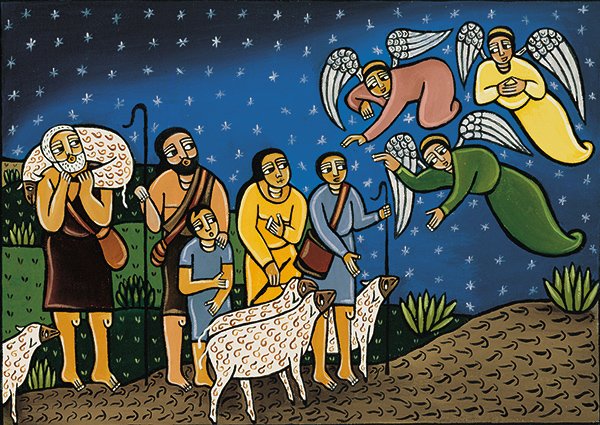
Luke 2:8-20 (2:15) – December 15, 2024

So many houses and apartments are decorated for the season at this time of year. Colorful lights and holiday decorations indoors and out, shining Christmas trees, special dishes and fancy tablecloths. Plus, some families have a Nativity scene in a special place, whether under the Christmas tree or placed in an extra special location, even outside, all lit up at night.

As we consider our Scripture reading for this morning, we think about the familiar words from Luke chapter 2. We think of the very pregnant Mary and her husband Joseph, coming into the town of Bethlehem late one day, but they could not find any place to stay. So familiar it is today, but I suspect you all can think of the Nativity scene figures: a kneeling Mary, Joseph hovering over his wife, and the baby Jesus lying in a manger.

Where did this tradition of decorating with a Nativity scene come from? Yes, the Nativity scene is a familiar way of retelling this story of the birth of Jesus. But—how did Nativity scenes begin? It was in 1223. “According to St. Bonaventure’s biography, St. Francis of Assisi got permission from Pope Honorious III to set up a manger with hay and two live animals—an ox and an ass—in a cave in the Italian village of Greccio. He then invited the villagers to come gaze upon the scene while he preached about ‘the babe of Bethlehem.’ (Francis was supposedly so overcome by emotion that he couldn’t say ‘Jesus.’)” [1]

            That first Nativity was located in Italy, during the 1200’s. The practice of Nativity scenes, pictures and photos has certainly spread from there, all over the world. Do you remember acting in Christmas Nativity scenes, or perhaps Christmas pageants with a Nativity scene in them? You, or your children? Or grandchildren?

            The Nativity scenes I remember always had at least one shepherd visiting the baby Jesus, along with a sheep or two. Perhaps you remember when you or your children or grandchildren were in a Christmas pageant. Were there shepherds abiding in the fields, keeping watch over their flocks by night? And, sheep! I remember several Nativity scenes in Christmas pageants years ago, where the small children were dressed up as sheep.

            Let’s hear again from Dr. Luke the words the angel said to the shepherds, that Christmas night: “the angel said to them, ‘Do not be afraid; for see—I am bringing you good news of great joy for all the people.” Not just the people in Italy, where St. Francis was. Not just the people in Europe, or North America. Good news of great joy for all the people, all over the world.

This week in Advent, here at this church we are concentrating on the shepherds. As we read this familiar Christmas story, was there much in the shepherds’ daily life and experience to fill them with joy? I do not think they were particularly joy-filled, with their ordinary, workaday life and their low, social status. I wonder whether the shepherds felt like that, right before the angel chorus broke into this hum-drum, workaday world and appeared to them?

Remember the difficult situation the shepherds were in. The shepherds’ position on the social ladder in Palestine was pretty much the bottom rung. The Jewish religious leaders even considered shepherds ritually unclean, since their duties and their work of looking after sheep made it impossible for them to observe the Sabbath. Working as a shepherd was something that vagrants might pick up, or a job for ne’er-do-wells, or others who were very much down on their luck. Their society stereotyped shepherds as liars, degenerates, and thieves.

 Just imagine the reaction of these lowly shepherds as they heard this news from the angels! Good news of great joy, especially, particularly for them! And centuries later, imagine the reaction of these same shepherds to think that they are now an integral part of a Nativity scene, a central part of the Christmas story played out time and time again, year after year.  

When my children were small, one of the first Christmas decorations I’d take out of the box would be our little Nativity scene. The little figures were all children, and it was intended specifically for the young. I would tell and re-tell the Christmas story again and again. When they were small, all four of my children would love to play with the figures, spending a good long time with those inexpensive yet meaningful little figures.  

Different churches do different things to communicate this narrative of the birth of Jesus. I read that the Rev. Janet Hunt has a yearly practice she does in her Lutheran church in De Kalb. But, I will let her tell you herself. “It has been my practice for many years to ‘build the creche’ with the children during the children’s sermon during Advent.  One week we add the animals. The next week the angels join them. Pretty soon Mary and Joseph arrive and not long after the baby Jesus and shepherds and the three sages from the East arrive last of all. The order is not perfect, of course, but it is one way of bringing the story home.” [2]

My personal Nativity scene, the one my children played with, has white children, every one. I had not thought about this when I bought the set of figures, more than thirty years ago. Even though my children were part of a multi-ethnic, multi-cultural school system, we still had an all-white Nativity set. Were the people in that first Nativity people of color? Yes, they were.

            Let us return to these shepherds of the first century, on the hills surrounding Bethlehem. They were downhearted outsiders, all right! People of color, non-white, on the bottom rung of their society, for sure. “But God does not give up on us. God sends angels to people who have given up on God. How would you respond to God sending angels to you when you’d given up on God? Like the shepherds, I’d be terrified.” [3]     

Remember the words of the angel of the Lord: “Do not be afraid; for see—I am bringing you good news of great joy for all the people.” We can praise God! God did not send good news of great joy to just a few people in the world, or even some of the world’s people. Or, only people of a certain position in society. No, our God sent good news of great joy to all the people of the world.

The angel has come to all cultures, all ethnicities, all people, wherever their position on the social ladder. All people, everywhere. Even us. You and I can truly come to the manger in Bethlehem side by side with the lowly shepherds.

            That is not only GOOD news, that is GREAT news. Good news of great joy, for all the people of the world! Alleluia, amen.

@chaplaineliza

(Suggestion: visit me at my other blogs: matterofprayer: A Year of Everyday Prayers. #PursuePEACE – and  A Year of Being Kind . Thanks!


[1] http://www.smithsonianmag.com/smart-news/the-first-nativity-scene-was-created-in-1223-161485505/ 

[2] https://dancingwiththeword.com/re-telling-the-story/

[3] http://www.workingpreacher.org/preaching.aspx?commentary_id=1522

Unknown's avatar

Some Children See Him

“Some Children See Him”

peru-nativity

Luke 2:8-15 – December 24, 2016

So many houses and apartments are decorated for the season at this time of year. Colorful lights and decorations indoors and out, shining Christmas trees, special dishes and fancy tablecloths. Plus, some families have a Nativity scene in a special place, whether under the Christmas tree or placed in an extra special location. Here at St. Luke’s Church, we have the Nativity scene with some other lovely Christmas decorations, in the narthex of our church.

The Christmas narrative from the Gospel of Luke is so familiar. Mary and Joseph enrolling for a census in Joseph’s ancestral town. Since it was the time of the census, the town was crowded to bursting. Mary was greatly pregnant, and while she was in Bethlehem, labor pains started. She and Joseph found shelter in a stable, and put her newborn baby in a feeding trough, a manger.

This evening, we are going to focus on the shepherds abiding in their fields, and the angel alerting them about the birth of this super-special Baby. Starting at verse 10 of Luke 2: “10 But the angel said to them, ‘Do not be afraid; for see—I am bringing you good news of great joy for all the people: 11 to you is born this day in the city of David a Savior, who is the Messiah,[a] the Lord.’” The shepherds quickly go into town and find the Baby, and worship and adore Him.

Yes, the Nativity scene is a familiar way of retelling this story. But—how did Nativity scenes begin? It was in 1223. “According to St. Bonaventure’s biography, St. Francis of Assisi got permission from Pope Honorious III to set up a manger with hay and two live animals—an ox and an ass—in a cave in the Italian village of Grecio. He then invited the villagers to come gaze upon the scene while he preached about ‘the babe of Bethlehem.’ (Francis was supposedly so overcome by emotion that he couldn’t say ‘Jesus.’)” [1]

However, that first Nativity was located in Italy, during the 1200’s. The practice of Nativity scenes, pictures and photos has certainly spread from there, all over the world. Do you remember acting in Christmas Nativity scenes? You, or your children? Or grandchildren?

When my children were small, one of the first Christmas decorations I’d take out of the box would be our little Nativity scene. The little statues were all children, and it was intended specifically for the young. I would tell and re-tell the Christmas story again and again. My younger two children would love to play with the figures, spending a good long time with those inexpensive yet meaningful little figures.

My personal Nativity scene, the one my children played with, has white children, every one. I had not thought about this when I bought the set of figures, more than twenty years ago. Even though my children were part of a multi-ethnic, multi-cultural school system, we still had an all-white Nativity set.

Let’s hear again the words of the angel to the shepherds, that Christmas night: “the angel said to them, ‘Do not be afraid; for see—I am bringing you good news of great joy for all the people.” Not just the people in Italy, where St. Francis was. Not just the people in Europe, or North America. Good news of great joy for all the people.

Think about Edith, our church’s pen pal from Kampala, Uganda. Almost everyone she sees on a regular day happens to be African, and dark-skinned. She has seen lighter-skinned people before, but most everyone she sees and interacts with is darker-skinned. What would a Nativity scene at Edith’s church in Kampala look like? (I don’t know. I can ask her!)

I love to go to a fair trade store in Evanston, a not-for-profit shop that sells goods from all over the world, called 10,000 Villages. This store has lots of different kinds of Christmas decorations, especially different kinds of Nativity scenes. Nativities from Mexico, South America, all over Africa, India, southeast Asia, and the Middle East.

I bought this Ethiopian Nativity puzzle several years ago from a fair trade shop. I love the way the figures almost come alive, with their bright colors. Is this vibrant Nativity a welcome sight for you, or is it a bit distracting? Perhaps we might be encouraged to meditate on something a little different? Perhaps we can use an alternative, ethnic kind of manger scene, or different- culture picture of the Mother and Child, this year? Certainly something to think about.

Remember the words of the angel of the Lord: “Do not be afraid; for see—I am bringing you good news of great joy for all the people.” We can praise God! God did not send good news of great joy to just a few people in the world, or even some of the world’s people. God sent good news of great joy to all the people of the world.

The angel has come to all cultures, all ethnicities, all people, everywhere.

That is not only GOOD news, that is GREAT news. Good news of great joy! We can truly praise God with the angel hosts, saying, “Glory to God in the highest heaven,
and on earth peace among those whom God favors!” Alleluia, amen!

[1] http://www.smithsonianmag.com/smart-news/the-first-nativity-scene-was-created-in-1223-161485505/

@chaplaineliza

(Suggestion: visit me at my regular blog for 2016: matterofprayer: A Year of Everyday Prayers. #PursuePEACE – and my other blog,  A Year of Being Kind . Thanks!)

Unknown's avatar

Proclaim the Gospel!

“Proclaim the Gospel!”

Luke 4-18 word cloud

Luke 4:14-21 – June 26, 2016

The primary season is over. You all know what that means. The presidential primaries have been going on for months, and they are finally over. Some people in the United States have followed the debates, listened to the various candidates, and discussed the various political positions, pro and con. What’s more, we are also going to elect congressional representatives, and state and local officials, too. Campaigning will begin in earnest this fall.

All of this campaigning has a purpose. The various candidates all try to have their position distilled down to a simple message. What they stand for. What they will strive to do.

I want us to look at the Gospel passage for today, from Luke. This is the very beginning of the public ministry of Rabbi Jesus. We can draw some parallels between this passage and the political campaign going on in our country, right now.

Sure, this was the very beginning. Jesus was just starting to make a name for Himself as an itinerant rabbi. And, He came to His hometown, the place where He grew up. Maybe where the butcher and baker down the street were good friends with His parents from way back. Maybe the real estate agent across the square sold His parents their house some years before, the house where His mother Mary still lives. In other words—I suspect everyone in that village was there in the synagogue that day to hear what the Rabbi Jesus—their hometown boy!—had to say.

Jesus already had generated some buzz in the greater Nazareth area. “Have you heard the latest about that Jesus? The one who says He is a Rabbi? The one who was baptized in the River Jordan by that Baptizer fellow? And, there was something about the heavens cracking open, a dove flying out of a clear blue sky—and a voice from heaven! I’m not saying all this was for real or not, but that is what people are saying about this Jesus. You know, the guy from our town.”

Jesus had hardly started to do His public ministry, and people were already talking about Him and what had happened in His life. Even in Nazareth, the town where He had grown up.

I am fascinated by this particular reading, where Jesus preaches His first sermon. It is quite a bit like political campaigns. The various candidates all try to have their position distilled down to a simple message. What they stand for. What they will strive to do. Just so, with Jesus.

Let’s read from our passage from the Gospel of Luke, again. “Jesus stood up to read, 17 and the scroll of the prophet Isaiah was handed to him. Unrolling it, He found the place where it is written: 18 ‘The Spirit of the Lord is on me, because he has anointed me to proclaim good news to the poor. He has sent me to proclaim freedom for the prisoners and recovery of sight for the blind, to set the oppressed free, 19 to proclaim the year of the Lord’s favor.’”

There we have it. Jesus distilled His message down. His position, what He stands for, and what He will strive to do. Jesus is here to proclaim good news. Or, in the word from middle English, God-spell. What we today know as Gospel. Proclaim the good news, indeed!

This is what we are told in the sentence for this week from the United Church of Christ’s Statement of Mission. Empowered by the Holy Spirit, we are called and commit ourselves: To proclaim the Gospel of Jesus Christ in our suffering world.”
If we say this passage from Luke is Jesus’s basic position statement for His overall ministry, how does that work for us? Jesus said He would proclaim: 1) good news to the poor, 2) freedom for the prisoners, 3) recovery of sight for the blind, and 4) to set the oppressed free.

My first thought is, I’m not poor! Or, a prisoner, or blind, or oppressed, either. I am not any of those things. What kind of stuff is Jesus saying here?

I live a fairly comfortable life in a small condo in Evanston. Seriously, what is Jesus bringing up? Does He have some kind of secret message? If these are the types of people Jesus says He is going to preach and minister to, I am not sure I would be comfortable with it. All that talk about the poor and blind, grief-stricken and oppressed, that is giving me some hesitation about following this new Rabbi Jesus.

But, let’s take a closer, deeper look. Here Jesus is addressing the poor. Could that be the poor in spirit, as well as poor, materially speaking? Next up, He addresses the prisoners. Perhaps, prisoners of sin? Then, speaking to the blind; blind to the love and gifts of God in their lives? And, Jesus came for the oppressed. Oppressed by anxiety, doubt, fear, anger, self-loathing, self-pity, self-righteousness. (I could go on, but I think you all have the idea.)

That is why Jesus has come to earth. That is His message, His purpose statement, distilled down to the pure essence. He has come to preach the Good News. The Gospel. The year of the Lord’s favor.

One of the commentators I consulted said it another way: “This Spirit inspired message is one of justice and mercy, of righteousness and freedom. This is a prophetic ministry, and when Jesus finishes reading the passage He sat down, and with every eye in the congregation focused on Him, He told them: ‘Today this scripture has been fulfilled in your hearing.’ In other words: I’m the one Isaiah spoke of. I’m going to do these very things.” [1]

Jesus is correct. He does do these things. That is why He came. That is the Good News, the distilled message of hope, love and promise from God. Moreover, He has come to bring that message to us—to each and every one of us, no matter what.

Jesus’s message is Good News! However, for us to really hear it, we need to become aware of our poverty, our captivity, our blindness, and what we are oppressed by. This is news “that we are not who we want to be, can be, and should be…and we never will be. Jesus comes bringing good news to those in need, and those who don’t see and admit their need want nothing to do with him.” [2]

What is more, Jesus tells us to do these things, too. We are to proclaim the Good News just as much as He proclaims it. We are sent in the same way that He is sent.

I would like everyone to turn to the back page of the bulletin. Look at the listing of the church staff. Who heads the list? We do. We all do! We are ALL ministers, every one of us sitting here today. Yes, and those in other places right now, too. Ministering, carrying the Good News of the Gospel wherever they are, too.

I loved the way the commentator David Lose put it: “This, in a sense, is what the Body of Christ and community of faith is – God’s hands delivering the promise of good news to all who come in need. Afraid? We may ask those around us. Come here to find courage. Lonely? Come join our community. Ill? Come here – or better, let us come to you – to care for you. Isolated? We will visit you. Discouraged? Let us gather together and encourage one another.”

Good News for all people, just as the angels said at Christ’s birth. Remember the Christmas narrative from Luke chapter 2? This is why Jesus was born to us. This is why He came into the world. How much better news could there possibly be?

What about you? Are you going to accept Jesus Christ’s offer of Good News today? Remember the words of the angel to the shepherds: “I bring you good news that will cause great joy for all the people.”  Ministering, carrying the Good News of the Gospel to each of us, to all the people, today.

[1] http://www.bobcornwall.com/2016/01/the-charismatic-messiah-lectionary.html

[2]  “Jesus’ Inaugural Address,” David Lose, Dear Working Preacher, 2013.  http://www.workingpreacher.org/craft.aspx?post=1771

@chaplaineliza

(Suggestion: visit me at my regular blog for 2016: matterofprayer: A Year of Everyday Prayers. and my other blog,  A Year of Being Kind . Thanks!)