Unknown's avatar

Check and Double-Check!

“Check and Double-Check!”
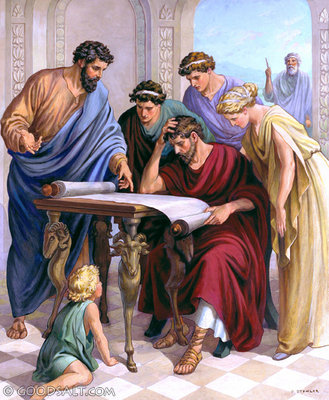
Acts 17 bereans

Acts 17:1-5a, 10-14 – September 13, 2015

When I attended seminary I had a handful of classes that were absolutely superb in every way. Interesting course material, fascinating professors, and assignments I could totally sink my teeth into. One of these courses was Reformed Tradition, taught at the Presbyterian seminary on the south side of Chicago. This course highlighted the Reformed Protestant church practices and theology since the 1500’s. And, I absolutely loved it.

One of the strong memories I have of this course is studying the practices of the Reformed missionaries of past centuries who were called to cross barriers (and in some cases, also cross continents and oceans). They took the message of the Gospel to those who had not yet heard the Good News of Jesus Christ.

That’s just what Paul and his friends are doing here in Acts 17. This week is the last of our Summer Sermon Series, Postcards from the Early Church. When last we met our intrepid heroes, (in Acts 16) they had crossed from Asia into Greece, into Europe. Here, in both towns of Thessalonica and Berea, they start preaching and speaking with the groups of Jews living in both areas, and they also preach to their Greek neighbors and friends.

To go back to the course I loved in seminary, Reformed Tradition, I discovered that many Protestant missionaries and mission agencies had a master plan. The missionaries would not just go and preach the Gospel. No! They almost always had an excellent method behind their outreach. They not only would start a small church or chapel, but would also often develop a health clinic, sometimes even a hospital. And—the missionaries almost always began a school. They wanted to teach people; not only how to read, but also teach math and other subjects; sometimes even beginning institutions of higher learning in far flung areas.

So, reading and literacy were of extremely high regard to the missionaries! This went along with the importance of each person being able to read the Scriptures for themselves. We can see that translating the Bible became a high priority, too.

What does this have to do with our Scripture passage for today, you might ask? After Paul and his friends were thrown out of the town of Thessalonica, they went down the road to the next town of Berea, fifty miles away. We don’t know very much about Berea, except—the Bereans eagerly searched the Hebrew Scriptures after they heard Paul’s message. Paul wasn’t just delivering a line, or trying to pull the wool over anyone’s eyes, no! The Bereans not only read, but diligently searched and sifted through the Scriptures to make sure that what Paul and his friends were telling them was true!

The literacy rate in Jewish communities has always been extremely high. For millennia it’s been this way. It’s marvelous to learn how to read, as well as do math and learn other subjects, too. Literacy has been a strong priority among large groups of Protestant missionaries, too. Reading the Scriptures is and has remained a primary goal, but just think about it. As we teach people how to read, we are also teaching them how to think, and how to reason. And, as more people in these far away mission areas learn more and more, the quality and standard of living rises in the whole community, as well! All very good things.

Dr. Luke doesn’t tell us too much about the Bereans. Except, the people in the town of Berea, in the foothills of the Olympian mountains, certainly seem like “people of more noble character” than the troublemakers in Thessalonica.

Using an excellent sermon illustration I discovered, “I want you to pretend for a moment that you are a first-century Berean Jew. Now suppose one Saturday a stranger comes into your synagogue and addresses the congregation. He says that his name is Paul, and he brings you the exciting news that the long-awaited Messiah has finally come! No, he didn’t actually restore the [physical] kingdom to Israel, as expected. In fact He was murdered a few years ago by the Romans. But, Paul says, that this is exactly what was supposed to happen to the Messiah, and he seems to prove it from Scripture. So now what do you do? If you are of noble character [as Dr. Luke says], you begin to search the Scriptures yourself to see if what Paul said is true.” [1]

Luke’s word used here in this passage is a legal term. Luke states that “Paul’s appeal to Israel’s Scriptures [was] a legal ‘witness’ to warrant his gospel’s claims about Jesus.”[2] Paul was not just making up imaginary tales, or fabricating fairy stories to put little children to sleep. No! Paul was using the Hebrew Scriptures as competent testimony to back up what he was telling them. And thus, many of the people who heard Paul out, believed what he said. Because they searched the Scriptures and made sure that what Paul was telling them matched with what they knew and already believed.

It’s like fact checking, today. How many people here have “heard something” about someone famous, or about some political candidate? How many people here are not sure where they first “heard it,” but “everyone is talking about it!” Like, for example, some Internet meme or email sob story passed around from person to person that is patently untrue.

My husband is an editor and journalist, working at a trade publication downtown. He takes special delight in exposing these sorts of gossip and misinformation that keep getting passed from one person to another via email, Facebook, and other kinds of social media. One of his favorite online tools is snopes dot com. “Snopes.com is the definitive Internet reference source for urban legends, folklore, myths, rumors, and misinformation.”[3]

I can just see some of these people in Berea, going to the library or to the synagogue where the scrolls and books were kept, checking out the sermons that Paul had just preached, as well as the discussion they had afterwards. Making sure—fact checking!—that Paul was the real deal. Dr. Luke tells us, “As a result, many of [the Berean Jews] believed, as did also a number of prominent Greek women and many Greek men.”
But, wait! This was not the end. Paul and his missionary friends did not have an easy time of it after starting the church in Berea. The people who stirred up things in the previous town heard about Paul and company and how they were having such an effect on the people in Berea. Some of those troublemakers from Thessalonica came over to Berea and made trouble in that town, too. Talk about nasty people! So, Paul’s new friends, the new believers in the Messiah, the Lord Jesus, shipped Paul out of town in a big hurry.

But the church Paul founded in Berea remained. Paul’s work here was done. We know they had a firm basis, since the Berean believers already had a solid foundation in the Hebrew Scriptures.

What about us? Do we have a similar solid foundation? Thank God, we have the Bible translated into English. It was translated for us centuries ago! We can look back to the great job that William Tyndale did in the 1500’s, paving the way for the King James Version, translated just after 1600. And now, today, we have many translations!

We can celebrate those translations, just as we celebrate our freedom to read the Bible, and our ability to study and learn about Scripture. There are still some places in the world today where it is a crime to read and study the Scriptures. I encourage all of you to pick up the Bible. Read a little every day. Become familiar with it. I know some of you do already. There are wonderful helps. Just ask me and I will hook you up with one!

God’s Word is truly a lamp to all of our feet, just as I told the Sunday school children before the sermon. The Bible sheds light on all of our paths. Just as it was with the Berean believers, just as it was with the Apostle Paul and his friends, so it is today. Praise God for God’s Word, freely available to all of us, today.

[1] “The Bereans,” Acts 17:10-14. Sermon delivered 10/25/2009 – Pastor David B. Curtis

[2] Wall, Robert W., Acts, from the New Interpreter’s Commentary series. (Nashville, Abingdon Press: 1994-2004) 239.

[3] http://snopes.com/

@chaplaineliza

Suggestion: visit me at my daily blog for 2015: matterofprayer: A Year of Everyday Prayers. and my other blog,  A Year of Being Kind .  Thanks!

Unknown's avatar

Generous with Our Faith

“Generous with Our Faith” – March 29, 2015

Jesus raising Lazarus John 11

John 11:25-27

Some people strive to be punctual. Even, early. My grandfather was like that. If he wasn’t fifteen minutes early for an appointment, he would consider himself late! Then, some people have a more fluid idea of time. They see a more relaxed framework of the spectrum of late- versus-early. These come down at different points on this spectrum. And then, we have Jesus.

Our Gospel reading is quite long today, from the 11th chapter of the Gospel of John. I wanted to read this whole passage in the context of this sermon. At the beginning of the reading, we have Jesus and His disciples, some distance from the town of Bethany, where His friends Mary, Martha and Lazarus lived. Let me set the scene. I will be using the awesome, modern version of the Gospel, translated by Eugene Peterson, called The Message.

1-3 A man was sick, Lazarus of Bethany, the town of Mary and her sister Martha. This was the same Mary who massaged the Lord’s feet with aromatic oils and then wiped them with her hair. It was her brother Lazarus who was sick. So the sisters sent word to Jesus, “Master, the one you love so very much is sick.”

When Jesus got the message, he said, “This sickness is not fatal. It will become an occasion to show God’s glory by glorifying God’s Son.”

5-7 Jesus loved Martha and her sister and Lazarus, but oddly, when he heard that Lazarus was sick, he stayed on where he was for two more days.


Here’s the situation in Bethany. We receive quite a lot of information here! Jesus was very close to all three siblings, to Lazarus, Mary and Martha. Lazarus became very sick! So sick, that his sisters sent an emergency message, a call for help, to Jesus. The request to Jesus has been made. A sincere request, made by the loved ones of Lazarus. I suspect we all can relate to this earnest request. We’ve made similar prayers from time to time. Any number of us have sent SOS messages to Jesus, too!

Jesus made mention of showing God’s glory through Lazarus’ sickness. Obviously, He made this comment to His disciples, and I suspect to whomever else was there, listening to Him, at the time. And, as was often the case with Jesus and some of the cryptic things He said, people just did not understand what He meant, at the time. Back to Jesus:

After the two days, Jesus said to his disciples, “Let’s go back to Judea.” They said, “Rabbi, you can’t do that. The Jews are out to kill you, and you’re going back?” 11 Jesus replied, “Our friend Lazarus has fallen asleep. I’m going to wake him up.”

12-13 The disciples said, “Master, if he’s gone to sleep, he’ll get a good rest and wake up feeling fine.” Jesus was talking about death, while his disciples thought he was talking about taking a nap.

14-15 Then Jesus became explicit: “Lazarus died. And I am glad for your sakes that I wasn’t there. You’re about to be given new grounds for believing. Now let’s go to him.”

Jesus knows. I mean, Jesus really knows the situation some miles away. His disciples are confused, and at first think Lazarus is just asleep. But, no! Is this a major complication, or what? Sure, there are miracles all over the Old and New Testaments, but miracles of healing, or of feeding large groups of people. Not of reversing death itself! And, especially, after several days!

On top of the disciples’ confusion at the words and behavior of Jesus, Jesus wants to go back to Bethany, which is a town just down the road from Jerusalem. “Jesus, You can’t go there! The Jewish leaders are going to arrest You. Probably try to kill You, too!” Jesus goes anyway.

17-20 When Jesus finally got there, he found Lazarus already four days dead. Bethany was near Jerusalem, only a couple of miles away, and many of the Jews were visiting Martha and Mary, sympathizing with them over their brother. Martha heard Jesus was coming and went out to meet him. Mary remained in the house.

We see Mary and Martha, in the house of mourning. Two very different women, mourning in two very different ways. Many of their friends and acquaintances are with them, too. Sympathizing and mourning with them, as was the custom of the time. Martha goes to meet Jesus while her sister stays put.

21-22 Martha said, “Master, if you’d been here, my brother wouldn’t have died. Even now, I know that whatever you ask God he will give you.”

23 Jesus said, “Your brother will be raised up.”

24 Martha replied, “I know that he will be raised up in the resurrection at the end of time.”

25-26 “You don’t have to wait for the End. I am, right now, Resurrection and Life. The one who believes in me, even though he or she dies, will live. And everyone who lives believing in me does not ultimately die at all. Do you believe this?”

27 “Yes, Master. All along I have believed that you are the Messiah, the Son of God who comes into the world.”

What a statement! What a testimony! Even though Martha is distraught at the death of her dear brother, she still has deep faith. As we’ve just heard, she states that her brother will be raised in the resurrection at the end of time. What does Jesus say? He does her one better.

I am the Resurrection and the Life.” Did you hear? Did everyone hear these words of faith? Words of hope? Words of new life? “The one who believes in me, even though he or she dies, will live.” And then Martha responds again, with great faith. “All along I have believed that you are the Messiah, the Son of God.”

I could preach a solid sermon on this statement of Martha’s, alone. This ringing declaration, these great words of a rock-solid faith were made at such a devastating time for Martha. On top of everything, in the middle of mourning her brother, we can see that this is not just an intellectual admission or assent for Martha, but heartfelt belief. But wait, there’s more! Much more!

28 After saying this, Martha went to her sister Mary and whispered in her ear, “The Teacher is here and is asking for you.”

29-32 The moment Mary heard that, she jumped up and ran out to him. Jesus had not yet entered the town but was still at the place where Martha had met him. When her sympathizing Jewish friends saw Mary run off, they followed her, thinking she was on her way to the tomb to weep there. Mary came to where Jesus was waiting and fell at his feet, saying, “Master, if only you had been here, my brother would not have died.”

33-34 When Jesus saw her sobbing and the Jews with her sobbing, a deep anger welled up within him. He said, “Where did you put him?”

34-35 “Master, come and see,” they said. Now Jesus wept. 36 The Jews said, “Look how deeply he loved him.”

37 Others among them said, “Well, if he loved him so much, why didn’t he do something to keep him from dying? After all, he opened the eyes of a blind man.”

We can tell, from these few scenes in the Gospel, that Martha, Mary and Lazarus had a close, intimate relationship. Mary even fell at Jesus’ feet, sobbing. Saying, “if only! If only You had been here!” The words of deep, gut-wrenching emotion are here, too. “Jesus wept.” We know that Jesus felt with Mary and Martha! We can see from this account that Jesus felt so badly and grieved with them, even though He knew what He was intending to do!

How often do we get into a situation where we have the opportunity to come alongside of someone who is devastated, a friend, a relative. Grieve alongside of them, and walk with them down that sorrowful road of mourning, loss, anger, anxiety. Grieve over the deep pain and loss in the reality of death. That’s why I think Jesus cried with Mary. And with Martha, and with the rest of the mourning people. Back to Jesus.

38-39 Then Jesus, the anger again welling up within him, arrived at the tomb. It was a simple cave in the hillside with a slab of stone laid against it. Jesus said, “Remove the stone.”

The sister of the dead man, Martha, said, “Master, by this time there’s a stench. He’s been dead four days!”

40 Jesus looked her in the eye. “Didn’t I tell you that if you believed, you would see the glory of God?” 41-42 Then, to the others, “Go ahead, take away the stone.”

Practical Martha. “Master, by this time there’s a stench. He’s been dead four days.” Wouldn’t that be something you might think of, too? I probably would have thought of it, too.

They removed the stone. Jesus raised his eyes to heaven and prayed, “Father, I’m grateful that you have listened to me. I know you always do listen, but on account of this crowd standing here I’ve spoken aloud so that they might believe that you sent me.”

43-44 Then he shouted, “Lazarus, come out!” And he came out, a cadaver, wrapped from head to toe, and with a kerchief over his face. Jesus told them, “Unwrap him and let him loose.”

45-48 That was a turnaround for many of the Jews who were with Mary. They saw what Jesus did, and believed in him.


Because of this display of resurrection power, because Lazarus was brought back to life, we see that many believed that Jesus was, indeed, the Messiah! The Son of God!

Let me ask: what do you believe? Do you think Jesus was just a great man? Did He preach great sermons, and live an exemplary life? Or, do you think Jesus was a prophet of God? A miracle-worker, like the prophets of the Old Testament, or like the Apostles? Or, the third option. Or—do you think Jesus was, indeed, the Messiah? The Son of God? As Jesus Himself said, the Resurrection and the Life?

Hear the words of Jesus! “The one who believes in Me, even though he or she dies, will live. And everyone who lives believing in Me does not ultimately die at all. Do you believe this?” Just as Jesus asked Martha so long ago, He is asking us, today, too. Can we respond with Martha, “Yes, Master. Yes, Lord. I believe.” With great faith. “All along I have believed that you are the Messiah, the Son of God.” Jesus is asking. Do we, really, believe?

Jesus was generous, giving life abundantly to Lazarus. Can we do any less in our lives? We are encouraged to be generous with our faith! To believe Jesus. To take Him at His word, and to trust in Him. Like Martha. Like Mary. We find out that we can believe Him, we can trust Jesus when times are hard, difficult, through storms and suffering. We are also happy to trust Jesus when times are happy, when everything is going our way. Whatever is happening in your life today, can you believe Jesus? Can you be generous? Believe the good news of the Gospel. Have faith! Believe Jesus!


Thanks to Eugene Peterson for his wonderful translation The Message. I read most of John chapter 11, around which I have interwoven this message. “Scripture taken from The Message. Copyright © 1993, 1994, 1995, 1996, 2000, 2001, 2002. Used by permission of NavPress Publishing Group.”

@chaplaineliza

Thanks to the kind friends at http://www.40acts.org.uk – I am using their sermon suggestions for Lent 2015. #40acts Do Lent generously!

(Suggestion: visit me at my daily blog for 2015: matterofprayer: A Year of Everyday Prayers. Thanks!)