Unknown's avatar

Love: God’s Better Way

“Love: God’s Better Way”

1 Corinthians 13:1-7 (13:4) – February 2, 2025

One of the most popular themes for songs is that of love. Songs that describe love of one person for another, or songs that tell about how awful it is to have unrequited love. Also, songs that tell about the emotions and feelings that come with being “in love.”

            One classic popular song written by Burt Bacharach and Hal David talks about love in a basic and simple way. Saying, “What the world needs now is love, sweet love.”

What is the state of the world, anyway? Judging from a quick view of the local news, the city of Chicago, the state of Illinois, the federal government, the uproar in Washington D.C., unemployment, not to mention abuse of different kinds—against women, children, and seniors. That is not even mentioning the various armed conflicts throughout the world—fights over territory, disputes over resources, differences between people of different religious beliefs.

            What can possibly bring harmony, hope and wholeness into the world today?

            This brings us to our scripture reading for the day, from 1 Corinthians 13. This chapter is called the Love Chapter. It is so often used as a scripture text for weddings! Perhaps you or a friend or relative had this chapter read at a wedding. But, did you know that the apostle Paul did not write this chapter to glorify romantic love?

One of my favorite commentators, Karoline Lewis, states “that this “Wedding Text” is not a passive, observable event that seeks our affirmation and support, but something that calls for our participation. This is not a text where we are asked to look on as guests, dressed for a party and seated dutifully in the church pews, but rather necessitates our involvement.” [1] Did you hear? Our participation! Our involvement!  

We are not supposed to sit quietly in a pew and let love happen to us. We are not supposed to sit in the bleachers while the professionals handle this love business. No! Let us take a closer look at exactly what Paul tells us to do, and how we are to get involved.

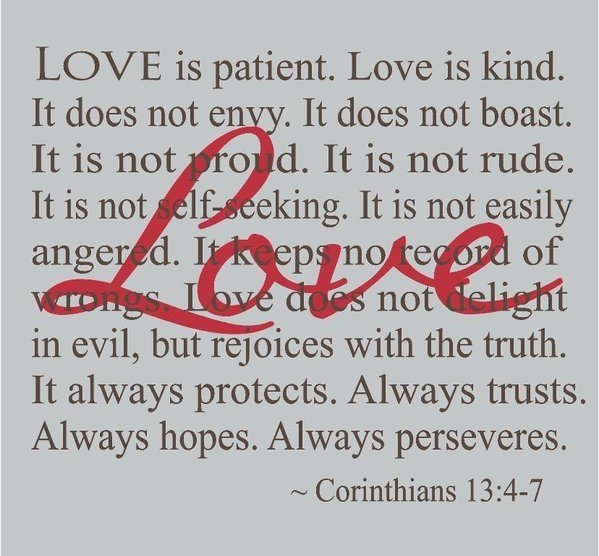
            Let us listen again to a portion of the words of 1 Corinthians 13, as brought up to date by Eugene Peterson in his modern translation “The Message.” “Love never gives up. Love cares more for others than for self. Love doesn’t want what it doesn’t have. Love doesn’t strut, Doesn’t have a swelled head, Doesn’t force itself on others, Isn’t always “me first,” Doesn’t fly off the handle, Doesn’t keep score of the sins of others, Doesn’t revel when others grovel.”

This is a penetrating way to teach people. Show them by example—examples of how not to love. Examples of jealousy or boasting, arrogance or rudeness. And especially, an example of a horrible injustice, where people are openly bigoted against females. (This can also be true of people who are bigoted about other differences, too, like about handicaps, or people of color, or of a different class of people, or of other nationalities or countries of origin.)

Those bad examples? Paul shows us clearly in this passage—don’t do those things! Don’t be that way! Sometimes, a bad example is the quickest way to our hearts and minds.

Paul was involved in a longer argument here in chapters 12 and 13 of his first letter to the Corinthian believers. Chapter 12 was all about the spiritual gifts that came from God, and meant for the strengthening of the body of Christ – the Church. Then in chapter 13, Paul zeros in on the most excellent of all of these God-given gifts. The gift of love. (or, charity, if we are speaking in a more flowery, King-James-version kind of a way).

            In this section I just read, Paul tells his friends and former church members what love is definitely not! Doesn’t strut, doesn’t have a swelled head, isn’t always “Me First!” Paul was making comparisons here! He had lived in the city of Corinth for many months, while he was pastor of this young church. He knew the rough and tumble, political attitude of the general population of the city of Corinth. Plus, he knew that this uncaring, callous attitude was rubbing off on the people inside of the church, too! That is why he wrote these words.

If we want to find out more about 1st century Corinth, “Charity [or, love] was not the activity of his opponents that spread their agenda. They promoted themselves, acted with arrogance, even engaged in shameful activities (backdoor politics?). As they sought personal gain, they provoked others, instilled animosities, and celebrated when others “lost face.” These were not the hallmarks of Christian community.” [2] In fact, all this crony-ism and inside politics sounds sadly familiar to me. But then, I grew up here in Chicago.

Instead, the apostle Paul gives us a marvelous example of what true love – and Godly caring, support, empathy – looks like. Listen again: “Love never gives up. Love cares more for others than for self. Takes pleasure in the flowering of truth, Puts up with anything, Trusts God always, Always looks for the best, Never looks back, But keeps going to the end.”

I don’t need to scramble and strive to love all by myself, trying really, really hard. It’s not all me, putting together my own faulty, human kind of caring. No! God freely gives gifts of love to all God’s children. That is what true love looks like. This is what true church looks like, too.

We can clearly see that Paul’s ministry of love, harmony and wholeness is for the whole world. Not just about taking care of those in our own families, although that’s important. It’s more than “taking care of our own,” although that is certainly laudable. It’s about showing love for everyone. For those affected by loneliness, or despair, disaster or disease wherever they are, without exclusion of those not like us or even of those we fear. Everyone.

Ending as I began, we look again at the Bacharach and David song, “What the World Needs Now.” The chorus of the song tells us the world needs love, sweet Godly love. Needs it badly. “No, not just for some, but for every, every, everyone.” Amen, Lord. Amen.

@chaplaineliza

(Suggestion: visit me at my other blogs: matterofprayer: A Year of Everyday Prayers. #PursuePEACE – and  A Year of Being Kind . Thanks!


[1] https://www.workingpreacher.org/commentaries/revised-common-lectionary/fourth-sunday-after-epiphany-3/commentary-on-1-corinthians-131-13-3

[2] http://www.word-sunday.com/Files/c/4-c/SR-4-c.html

Unknown's avatar

Trinity Benediction

“Trinity Benediction”

2 Corinthians 13:11-14 – June 4, 2023

            This is one of my favorite Sundays in the whole church year. Trinity Sunday! Today is a different kind of Sunday, one where we focus on a theological concept and place it in the center of our service today.

Yes, we can talk about the Trinity, and have Bible readings about the Trinity. But, the most important thing is to center our worship, praise and prayer around the indescribable reality of that most holy of holies, the God who created heaven and earth. No matter how many intellectual arguments or theological books we read, all else falls woefully short.

We have two short Bible readings today, one from the beginning of all things, from Genesis 1, and one from the end of one of Paul’s letters. We span from the beginning to a benediction. As we approach the reading from Genesis, it is the very opening of the Bible. The very beginning of the world. I will examine these verses more in depth next week, as I start our Summer Sermon Series, a Biblical view of God as Nurturer, God from a Feminine viewpoint.

 I wanted to highlight something important. When God created all things, God was there as Trinity just as much as God is here today as Trinity. But – you might ask, and I would not blame you if you did – what on earth is the Trinity? Great question! We see Trinity as One God in Three Persons, as from the marvelous hymn, “Holy, Holy, Holy.” Yet, even this soaring hymn cannot give us much information about the definition or composition of the Trinity.  

We know about our Lord Jesus, our Savior, the Good Shepherd who cares for His sheep. We have some idea about the Holy Spirit, the Holy Comforter, the one who energizes God’s people (as we heard last week at Pentecost). And, we fall down before God the Father, the Almighty, the Holy One who created heaven and earth. We can say with the host of heaven, “Holy, holy, holy! Merciful and mighty! God in three persons, blessed Trinity.” Just as I said a few minutes ago – as I do every week, after the Scripture Reading – “Glory be to the Father, and to the Son, and to the Holy Spirit. As it was in the beginning, is now and ever shall be. World without end, amen, amen.”  

            The Bible does not give a clear definition of the Trinity; it mentions it in general, several times in both the Hebrew Scriptures and the New Testament. A mystery: One God, three Persons. We can compare the Trinity to a green, growing clover with three leaves in one plant (as St. Patrick did, centuries ago). We can think of it as St. Athanasius described it, as the three stages of water, as liquid, solid (ice) and gas (steam). All water, and yet in different forms.

            Some people, younger people and small children, find it easier to grasp this challenging theological concept if we use the different names of a person. Talking about different names of a person can be more relatable. Although my children were small, they could certainly understand how my mother could be “Mom” to me, “Grandma” to them and “Sister” to my Aunt Bernice. Three different names, three different aspects, yet one person.

            Most of us, if not all of us, can relate to being called by different names. Daughter, Mom, Grandpa, Brother, Teacher, Nurse, Chaplain, Pastor. Sometimes these names are more functional, some less so. Yet, still, no matter which name is used, you are still you. It’s the same way with God. God can be called any one of dozens of names, describing different aspects and functions. [1] And, these are all various ways of understanding our huge God, just a little bit more!  

            As I have been going over several commentaries and articles about the Trinity and about our Bible reading from 2 Corinthians, this idea of God as Trinity being too immense for us limited humans to understand is one aspect that I am certainly aware of. Yes, we can get a bit closer to the idea of God in Three Persons, but never fully understand it. God is too huge.

As Rev. Janet Hunt said, “Over these last days, I have simply found myself with my eyes and heart open, hopeful to simply see the face of God, even the many faces of God, which is and are represented by the concept of the Trinity.” [2] Is it the marvelous gift of God’s very good creation we hear about in Genesis 1? Is it the holy connection which is ours through Father, Son and Holy Spirit, as described in 2 Corinthians 13?

            Perhaps, we are simply to be blessed by this theological truth, this mystery, and not worry about fully comprehending it? Just as the Father, Son and Holy Spirit are in conversation one with the other, blessed One in Three, just as the Trinity is caught up in the eternal I AM, the constant and eternal present tense. How can we understand it, much less explain it, to come anywhere close to God’s reality or satisfaction?

            The apostle Paul shared these words with his readers at the end of this letter. Perhaps he did not understand it either! Yet, he spoke of the Trinity in his benediction with warm, loving words. “12 Greet one another with a holy kiss. 13 All God’s people here send their greetings. 14 May the grace of the Lord Jesus Christ, and the love of God, and the fellowship of the Holy Spirit be with you all.”

            Perhaps this prayer by my friend Rev. Jo Anne Lesco Taylor can add another view to the different understandings I have put forth today, to close this meditation on the Trinity. I hope and I pray these words may bless us all.

Holy One in Three and Three in One, Let me dance with you.

I may not understand how you can be three distinct persons living in unity,
how you can sing in unison and harmony at the same time,
But I do not need to understand in order to trust your Presence.

I need not Know in order to Love as you love, as you open the circle to me
and invite me into your dance, into your grace,
into your wholeness and holiness, into your love.

Let it be so. Let me dance with you, God. Amen. [3]

@chaplaineliza

(Suggestion: visit me at my other blogs: matterofprayer: A Year of Everyday Prayers. #PursuePEACE – and  A Year of Being Kind . Thanks!


[1] http://worshipingwithchildren.blogspot.com/2014/05/year-trinity-sunday-first-sunday-after.html

[2] https://dancingwiththeword.com/the-face-of-god/

[3] https://pastorsings.com/2023/06/03/a-prayer-for-the-eve-of-trinity-sunday/?fbclid=IwAR2DW8vuOxwd8OzkZnSS1gD9-w9R4AxHMb66tpWUycbaf2_Ou3G9ZAL-1ZM